- Market Value (2025): USD 5.78 Bn
- Estimated Value (2026): USD 6.13 Bn
- Forecast Value (2036): USD 11.1 Bn
- CAGR (2026-2036): 6.1%
What is the Gelatin and Gelatin Derivatives Market forecast to be worth by 2036?
USD 6.1 billion in 2026 to USD 11.1 billion by 2036 at a 6.1% CAGR.
- The gelatin and gelatin derivatives market reached USD 5.78 billion in 2025.
- Global sales are expected to increase from USD 6.13 billion in 2026 to USD 11.1 billion in 2036.
- Revenue is projected to expand at a 6.1% CAGR during 2026 to 2036 as food formulators and pharmaceutical manufacturers continue using application-specific grades.
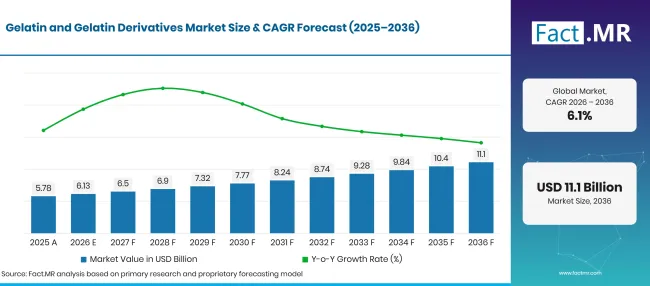
Gelatin And Gelatin Derivatives Market Forecast Global | Source: Fact.MR
| Year | Basis | Market Value (USD billion) |
|---|---|---|
| 2025 | Actual | 5.78 |
| 2026 | Estimate | 6.13 |
| 2036 | Forecast | 11.1 |
| CAGR 2026 to 2036 | Forecast period | 6.1% |
Source: Fact.MR analysis. Updated Nov 3, 2026
What are the defining numbers behind Gelatin and Gelatin Derivatives Market growth?
USD 5.0 billion in additional market value by 2036; bovine source, food and beverages, and gelling functions shape the 2026 mix.
- Demand Drivers in the Market
- Confectionery manufacturers use gelatin to form elastic gels that hold their shape during packing. A controlled setting temperature helps production teams manage molding speed and texture.
- Capsule manufacturers specify pharmaceutical gelatin for shell formation and controlled handling during filling. Grade consistency helps plants limit cracked shells and manufacturing losses. Eurostat recorded a 12.7% increase in the EU sold-production value of pharmaceutical products in 2024, reported in July 2025 [1].
- Biomedical material developers buy purified gelatin for research applications in which contamination and batch variability carry direct technical consequences. In August 2025, Rousselot reported that Cellbricks Therapeutics had used its purified gelatins in experimental bioprinted tissue constructs [3].
- Key Segments Analyzed
- By Source: Bovine is forecast to account for 47.9% of 2026 sales, reflecting its established use in multiple gel strengths and manufacturing processes.
- By Application: Food & Beverages is projected to represent 38.5% of 2026 value, particularly where a thermoreversible gel is required.
- By Function: Gelling Agent is estimated to contribute 44.2% of 2026 revenue, given its role in forming stable textures.
- Analyst Opinion at Fact.MR
- Shambhu Nath Jha, Principal Consultant at Fact.MR, states, “Gelatin suppliers compete on the consistency of their grades and the information provided with each shipment. Food manufacturers assess setting behavior and finished-product yield, while pharmaceutical customers place greater weight on traceability and processing records.”
- Strategic Implications
- Gelatin processors can document source origin and batch properties so manufacturers can compare equivalent grades before approving plant-scale trials.
- Food formulators benefit from testing gelatin in the final recipe because sugar content and processing temperature can alter finished texture.
- Capsule producers need to confirm viscosity and film properties against existing filling equipment before changing suppliers.
- Biomedical developers can align purity specifications with the intended research use and maintain separate controls for experimental grades.
The United Kingdom is projected to record 7.1% CAGR through 2036, followed by the United States at 6.8%. Japan is forecast at 6.0%, Germany at 5.7%, and Brazil at 4.3%.
How does the Gelatin and Gelatin Derivatives Market break down by segment?
Bovine is estimated at 47.9% by Source; Food & Beverages at 38.5% by Application; Gelling Agent at 44.2% by Function.
Which Source dominates?
Bovine is projected to represent 47.9% of 2026 source revenue.
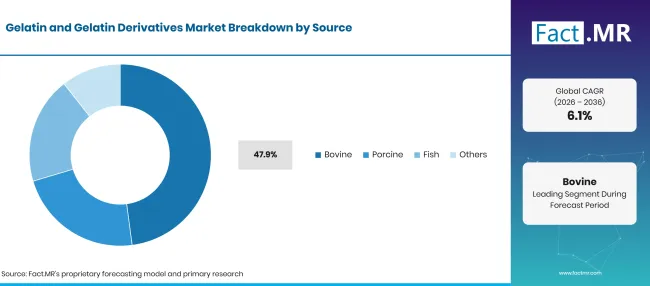
Gelatin And Gelatin Derivatives Market Breakdown Source | Source: Fact.MR
| Source | Share (2026) |
|---|---|
| Bovine (Leading segment) | 47.9% |
| Other sources combined | 52.1% |
| Total | 100.0% |
Source: Fact.MR analysis. Updated Nov 3, 2026
Bovine gelatin offers a broad commercial range of gel strengths for established food and pharmaceutical uses. Processors work with collagen-bearing raw materials and adjust treatment conditions to obtain the required viscosity. Porcine grades also serve confectionery and capsule applications, although religious and dietary restrictions shape their acceptance in some markets. Fish gelatin provides an alternative where product origin is central to labeling.
What leads the Application segment?
Food & Beverages is forecast to contribute 38.5% of 2026 application revenue.
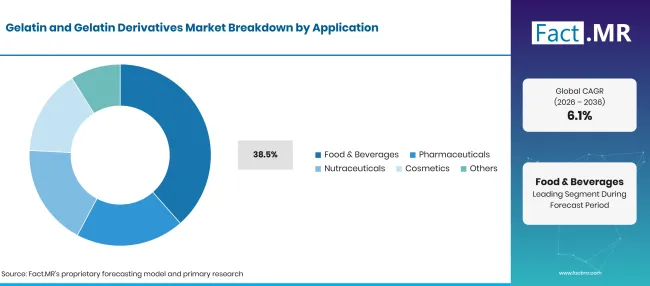
Gelatin And Gelatin Derivatives Market Breakdown Application | Source: Fact.MR
| Application | Share (2026) |
|---|---|
| Food & Beverages (Leading segment) | 38.5% |
| Other applications combined | 61.5% |
| Total | 100.0% |
Source: Fact.MR analysis. Updated Nov 3, 2026
Food and beverage formulators choose gelatin when they need chewiness, foam stability or a smooth gel texture. Confectionery is a familiar outlet, but dessert products and selected dairy applications also make use of its properties. Pharmaceuticals require tighter material specifications for hard and soft capsule shells. Nutraceutical producers examine gelatin in capsule and gummy formulations, while cosmetic formulators use selected grades for product feel.
How does Function shape demand?
Gelling Agent is estimated to hold 44.2% of 2026 function revenue.
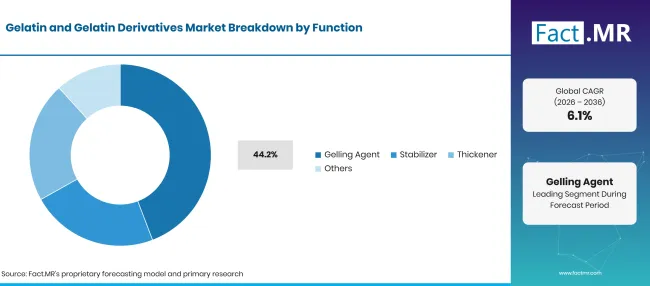
Gelatin And Gelatin Derivatives Market Breakdown Function | Source: Fact.MR
| Function | Share (2026) |
|---|---|
| Gelling Agent (Leading segment) | 44.2% |
| Other functions combined | 55.8% |
| Total | 100.0% |
Source: Fact.MR analysis. Updated Nov 3, 2026
Gelatin forms a gel as a warm solution cools and can soften again when reheated. That behavior gives confectionery makers control over texture and handling during manufacturing. Stabilizer use is different because the ingredient helps maintain a desired product structure during storage. As a thickener, gelatin changes flow and body without always producing a firm gel.
What is accelerating Gelatin and Gelatin Derivatives Market adoption, and what is holding it back?
Food-texture requirements and pharmaceutical-grade specifications support demand, while raw-material variability and qualification procedures complicate supplier changes.
Drivers Impact Analysis
| DRIVER | MODELLED IMPACT ON CAGR (pp) | GEOGRAPHIC RELEVANCE | IMPACT TIMELINE |
|---|---|---|---|
| Confectionery texture and setting consistency | +1.2 | North America, Europe, East Asia | Medium term |
| Capsule shell manufacturing specifications | +0.9 | North America, Europe, Asia | Long term |
| Purified gelatin for medical development | +0.7 | Europe, North America | Long term |
| Repeatable production-grade supply | +0.5 | Global | Short term |
| Application-specific source selection | +0.4 | Global | Medium term |
Source: Fact.MR analysis. Updated Nov 3, 2026
Opportunity Impact Analysis
| OPPORTUNITY | MODELLED IMPACT ON CAGR (pp) | GEOGRAPHIC RELEVANCE | IMPACT TIMELINE |
|---|---|---|---|
| Specialized pharmaceutical grades | +0.6 | Europe, North America, Japan | Long term |
| Medical biomaterial research grades | +0.4 | Europe, United States | Long term |
| Fish-origin formulations | +0.3 | East Asia, Europe | Medium term |
Source: Fact.MR analysis. Updated Nov 3, 2026
Restraints Impact Analysis
| RESTRAINT | MODELLED IMPACT ON CAGR (pp) | GEOGRAPHIC RELEVANCE | IMPACT TIMELINE |
|---|---|---|---|
| Variation in collagen-rich feedstock | -0.6 | Global | Short term |
| Grade qualification and change controls | -0.4 | North America, Europe, Japan | Medium term |
| Competition from other texture systems | -0.3 | Global | Long term |
Source: Fact.MR analysis. Updated Nov 3, 2026
Which countries are scaling the Gelatin and Gelatin Derivatives Market through 2036?
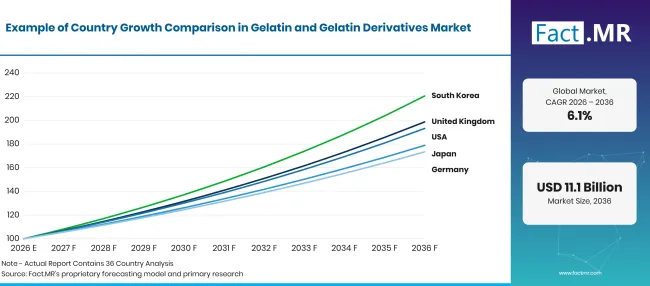
Gelatin And Gelatin Derivatives Market Growth Index | Source: Fact.MR
| Country | CAGR (2026 to 2036) |
|---|---|
| United Kingdom | 7.1% |
| United States | 6.8% |
| Japan | 6.0% |
| Germany | 5.7% |
| Brazil | 4.3% |
Source: Fact.MR analysis. Updated Nov 3, 2026
What supports United Kingdom adoption?
7.1% CAGR, linked to ingredient selection in established food and pharmaceutical manufacturing.
Food formulators operate in a broad manufacturing base. The Office for National Statistics reported food manufacturing accounted for 22.9% of UK manufacturers’ sales in 2025 [6]. British manufacturers also serve export customers. Defra recorded GBP 25.7 billion in food and drink exports during 2025 [7]. Pharmaceutical capsule makers evaluate gelatin for shell quality and process stability.
How is the United States market developing?
6.8% CAGR, associated with food formulation demand and established capsule manufacturing.
Food producers in the United States rely on gelatin for finished texture and batch consistency. Gelatin serves a small and specialized part of this wider economy, especially where texture is central to the product. The USDA Economic Research Service reported that food away from home represented 56.3% of U.S. food expenditure in 2025 [2]. Changing a gelatin source can require repeat texture tests and revised product labeling for food customers. USDA reported that annual U.S. food prices increased by less than 3.0% during 2025 [8].
What shapes gelatin demand in Japan?
6.0% CAGR, shaped by precise formulation needs and export-facing food production.
The Ministry of Agriculture, Forestry and Fisheries reported Japanese food and agricultural exports of JPY 1.7005 trillion in 2025 [9]. Gelatin producers serving export recipes need to meet destination-specific source requirements. In August 2026, the ministry recorded JPY 897.7 billion in food and agricultural exports for the first half of the year [10]. Japanese confectionery formulators place weight on precise chew and setting behavior. MAFF estimated Japan generated 4.61 million tonnes of food loss in fiscal 2024, announced in June 2026 [11]. Food producers face pressure to manage manufacturing losses, including waste caused by unstable textures.
What supports German market activity?
5.7% CAGR, connected to pharmaceutical manufacturing and specialized gelatin quality control.
Eurostat reported German extra-EU medicinal and pharmaceutical exports of EUR 67.9 billion in 2025 [5]. Eurostat recorded EUR 130 billion in German extra-EU chemical exports during 2025 [12]. Pharmaceutical purchasers can impose long product qualification cycles before an alternative ingredient is accepted. Eurostat reported that Germany imported EUR 24.2 billion of medicinal and pharmaceutical products from outside the EU in 2025. Strong cross-border sourcing increases the need to coordinate ingredient documentation.
How does Brazil compare?
4.3% CAGR, centered on food processing and medicine-market distribution.
Anvisa reported approximately BRL 182 billion in Brazilian pharmaceutical market revenue for 2025 [13]. The Brazilian medicines regulator reported 6.3 billion pharmaceutical packages sold in 2025. Sourcing collagen-rich inputs requires attention to feedstock conditions and extraction yield. Price pressure in mass food products can encourage trials of other gelling systems.
Which companies are the key providers?
Key companies include Rousselot (Darling Ingredients); GELITA AG; PB Leiner (Tessenderlo Group); Nitta Gelatin Inc.; Weishardt; Ewald-Gelatine GmbH; Sterling Gelatin (Sterling Biotech Limited); Juncà Gelatines S.L.; Trobas Gelatine B.V.
- Rousselot (Darling Ingredients)
- GELITA AG
- PB Leiner (Tessenderlo Group)
- Nitta Gelatin Inc.
- Weishardt
- Ewald-Gelatine GmbH
- Sterling Gelatin (Sterling Biotech Limited)
- Juncà Gelatines S.L.
- Trobas Gelatine B.V.
Bibliography
- [1] Eurostat. (2025, July 24). Decrease in industrial production in 2024
- [2] Zeballos, E., & Sinclair, W. (2026, June 11). Total U.S. food spending reached $2.51 trillion in 2025. U.S. Department of Agriculture, Economic Research Service
- [3] Rousselot. (2025, August 28). Advancing regenerative medicine: Cellbricks Therapeutics reaches key milestone using Rousselot biomaterials. Darling Ingredients
- [4] Rousselot. (2025, September 16). Rousselot to unveil gelatin prototypes for innovative medical device development at COMPAMED 2025. Darling Ingredients
- [5] Eurostat. (2026, April 13). Medicinal & pharma products: €221 billion trade surplus
- [6] Office for National Statistics. (2026, July 24). UK manufacturers’ sales by product: 2025.
- [7] Department for Environment, Food & Rural Affairs. (2026, July 29). Food statistics in your pocket.
- [8] U.S. Department of Agriculture, Economic Research Service. (2026, April 30). Food prices and spending.
- [9] Ministry of Agriculture, Forestry and Fisheries. (2026, February 3).[2025 agricultural, forestry and food export results].
- [10] Ministry of Agriculture, Forestry and Fisheries. (2026, August 4).[Agricultural, forestry and food export results for January–June 2026]
- [11] Ministry of Agriculture, Forestry and Fisheries. (2026, June 30).[Estimated business food loss for fiscal 2024].
- [12] Eurostat. (2026, October 15). EU chemicals trade surplus at €257 billion in 2025.
- [13] Agência Nacional de Vigilância Sanitária. (2026, September 28). CMED divulga 9° edição do Anuário Estatístico do Mercado Farmacêutico.
This Report Answers
- The report compares bovine, porcine and fish sources and identifies the leading source share.
- Application analysis examines food formulations and pharmaceutical-grade material requirements without treating the two as interchangeable.
- Function analysis separates gelling from stabilization and thickening on the basis of finished-product behavior.
- Country analysis compares gelatin market forecasts for the United Kingdom, United States, Japan, Germany and Brazil.
- Competitive analysis reviews commercial suppliers using grade suitability and documented products instead of company-share claims.
What does the Gelatin and Gelatin Derivatives Market cover?
The market covers gelatin and derivatives sold to food, pharmaceutical and other commercial manufacturers. Grades differ by source and specification. Fact.MR also covers nutraceutical formulations in related applications.
What is included in the scope?
The scope includes food, pharmaceutical, nutraceutical and cosmetic gelatin grades, including bovine, porcine and fish sources. Functions include gelling, stabilizing and thickening. Fact.MR also covers dietary supplements in related applications. A related application is nutraceutical formulations.
What is excluded from the scope?
Finished sweets, capsules and cosmetics are not counted as gelatin ingredient revenue. General meat and fish sales are also excluded. Standalone collagen peptides are outside the core scope when sold as separate products that do not meet the gelatin or gelatin-derivative market definition.
How Was the Analysis Built?
The analysis draws on 120+ sources, 35+ company portfolios, 25+ countries, and more than 20 industry interviews.
- Primary Research: Primary research includes discussions with manufacturers, service providers, technology developers, distributors, end users, and subject-matter experts. These conversations examine purchasing priorities, product adoption, operational challenges, approval requirements, competitive positioning, and the factors that influence wider market acceptance.
- Desk Research: Desk research covers government statistics, regulatory publications, company filings, trade data, technical studies, industry associations, standards, public policy, and other authoritative sources. Every source used in the analysis is documented in the bibliography.
- Market Sizing and Forecasting: Market estimates combine historical performance, demand indicators, pricing and volume trends, segment shares, company participation, country-level growth, adoption patterns, investment activity, and barriers to market expansion.
- Data Validation and Update Cycle: Findings are validated by comparing primary interviews with public data, company activity, regulatory changes, trade patterns, and industry developments. Regular updates review new product launches, capacity changes, partnerships, approvals, and shifts in commercial adoption.
Segmentation
What is the report’s scope and coverage?
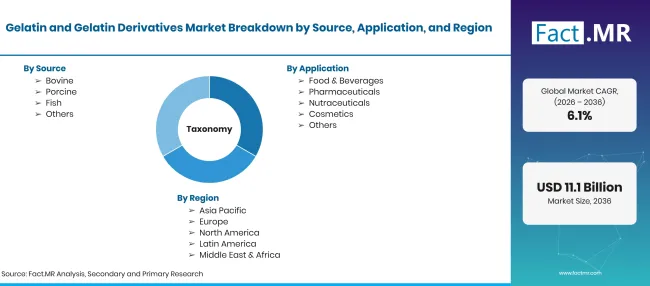
Factmr Gelatin And Gelatin Derivatives Market Taxonomy | Source: Fact.MR
| Attribute | Details |
|---|---|
| Quantitative Units | USD billion |
| Market Definition | Commercial gelatin and gelatin derivatives derived from collagen-bearing raw materials for food, pharmaceutical, nutraceutical, cosmetic and other uses. |
| Source | Bovine; Porcine; Fish; Others |
| Application | Food & Beverages; Pharmaceuticals; Nutraceuticals; Cosmetics; Others |
| Function | Gelling Agent; Stabilizer; Thickener; Others |
| Regions Covered | North America; Latin America; Western Europe; Eastern Europe; East Asia; South Asia & Pacific; Middle East & Africa |
| Countries Covered | United Kingdom; United States; Japan; Germany; Brazil |
| Companies Profiled | Rousselot (Darling Ingredients); GELITA AG; PB Leiner (Tessenderlo Group); Nitta Gelatin Inc.; Weishardt; Ewald-Gelatine GmbH; Sterling Gelatin (Sterling Biotech Limited); Juncà Gelatines S.L.; Trobas Gelatine B.V. |
| Forecast Period | 2026 to 2036 |
| Approach | Application volumes, supplier grade review, food and pharmaceutical activity, and forecast assumptions. |
Source: Fact.MR analysis. Updated Nov 3, 2026
How is the market segmented?
-
By Source
- Bovine
- Porcine
- Fish
- Others
-
By Application
- Food & Beverages
- Pharmaceuticals
- Nutraceuticals
- Cosmetics
- Others
-
By Function
- Gelling Agent
- Stabilizer
- Thickener
- Others
-
By Region
- North America
- Latin America
- Western Europe
- Eastern Europe
- East Asia
- South Asia & Pacific
- Middle East & Africa
Frequently Asked Questions
How big is the Gelatin and Gelatin Derivatives Market in 2026?
What is the CAGR of the Gelatin and Gelatin Derivatives Market from 2026 to 2036?
Which source leads the Gelatin and Gelatin Derivatives Market?
Which application leads the Gelatin and Gelatin Derivatives Market?
Who are the leading companies in the Gelatin and Gelatin Derivatives Market?
Who worked on this report


Preview the report firsthand - request a free sample
Free SampleGet the brochure for pricing and purchase details
Download PDF