- Market Value (2025): USD 55.2 Mn
- Estimated Value (2026): USD 58.9 Mn
- Forecast Value (2036): USD 112.9 Mn
- CAGR (2026-2036): 6.7%
What is the Peony Root Bark Extract Market forecast to be worth by 2036?
USD 58.9 million in 2026 to USD 112.9 million by 2036 at a 6.7% CAGR.
- The valuation of the peony root bark extract market was USD 55.2 million in 2025, with capsule and powder supplements taking most of the volume.
- By 2036, revenue will reach USD 112.9 million, up from USD 58.9 million in 2026 as standardized paeonol grades win space in skin care.
- A 6.7% CAGR will carry the market from 2026 to 2036, helped by wider use of traditional botanicals in regulated supplement formats.
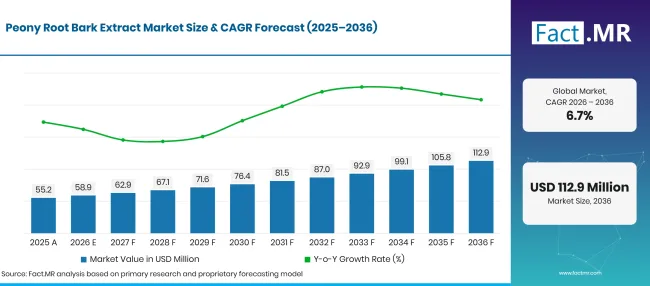
Peony Root Bark Extract Market Forecast Global | Source: Fact.MR
| Year | Basis | Market Value (USD million) |
|---|---|---|
| 2025 | Actual | 55.2 |
| 2026 | Estimate | 58.9 |
| 2036 | Forecast | 112.9 |
| CAGR 2026 to 2036 | Forecast period | 6.7% |
Source: Fact.MR analysis. Updated Oct 26, 2026
What are the defining numbers behind Peony Root Bark Extract Market growth?
The 2026 to 2036 period adds USD 54.0 million in new value, led by powdered extract for supplement makers.
- Demand Drivers in the Market
- Traditional medicine is moving into mainstream health systems. The WHO global report on traditional, complementary and integrative medicine, released in December 2025, draws on survey answers from 106 Member States [1]. Moutan Cortex is a standard ingredient in Chinese and Japanese herbal formulas, so this policy attention widens its buyer base.
- Pharmacopoeia standards give buyers a common test basis. China’s 2025 edition of the national pharmacopoeia took effect on October 1, 2025, under an announcement issued by the National Medical Products Administration [2]. Extract makers align paeonol assays and identity tests with these monographs.
- Supplement rules reward suppliers with strong identity files. The U.S. Food and Drug Administration finalized guidance in October 2026 on identity and safety data for new dietary ingredients, which must be notified at least 75 days before marketing [3]. Suppliers that hold botanical identity data for the root bark will meet these checks faster.
- Skin tone products give the extract a second outlet. Paeonol is used in brightening creams and serums, and cosmetic chemists value a plant-derived active with a long record of use.
- Packaged herbal products now reach shoppers through grocery aisles and web stores. Capsules and sachets carrying peony root bark are easier for consumers to find than loose herbal slices sold by specialist shops.
- Key Segments Analyzed
- By Product Type: Powder will hold 49.6% share in 2026, as it doses evenly into capsules, tablets and sachet blends.
- By Application: Dietary Supplements will account for 48.4% share in 2026, owing to capsule formats built on traditional herbal formulas.
- By Distribution Channel: Supermarkets/Hypermarkets will capture 35.8% share in 2026, since packaged herbal supplements now share shelf space with vitamins.
- By End-User: Individual Consumers will represent 72.3% share in 2026, reflecting self-directed purchases of supplements and skin care.
- Analyst Opinion at Fact.MR
- Shambhu Nath Jha, Principal Consultant at Fact.MR, states, “Buyers of peony root bark extract want proof of the species and the plant part before they talk about price. Suppliers that pair paeonol testing with clean sourcing records will win the larger supplement contracts. Skin care will add volume, but supplements will stay the base of this market through 2036.”
- Strategic Implications
- Extract manufacturers should state the species, plant part, extraction solvent and paeonol content on every specification sheet, so buyers can tell root bark extract from root extract.
- Supplement brands should confirm the regulatory status of the extract in each target country before launch, given that notification and labeling rules differ widely.
- Cosmetic formulators should run safety assessments on the exact extract and dose they plan to use, since data on other peony materials do not transfer.
- Distributors and online sellers should keep bulk ingredient sales separate from finished capsules in their catalogs and sales records.
Germany will lead the group at 7.6% CAGR, where pharmacies and drugstores carry a wide range of herbal supplements. The United States follows at 7.2% as most adults take at least one supplement. The United Kingdom will post 6.8%, with supplement use common across age groups. Japan will grow at 6.1%, where Kampo makers buy Moutan Cortex for long-standing formulas. Brazil completes the range at 5.4%, with growth tied to supplement rules set by Anvisa.
How does the Peony Root Bark Extract Market break down by segment?
Powder will lead Product Type at 49.6%; Dietary Supplements will top Application at 48.4%; Supermarkets/Hypermarkets will head Distribution Channel at 35.8%; Individual Consumers will hold first place in End-User at 72.3%.
Which Product Type dominates?
Powder represents 49.6% of 2026 sales.
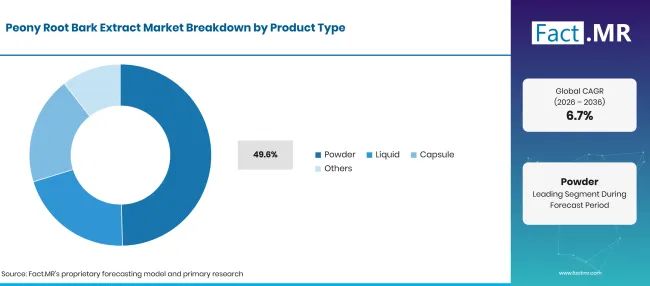
Peony Root Bark Extract Market Breakdown Product Type | Source: Fact.MR
| Product Type | Share (2026) |
|---|---|
| Powder (Leading segment) | 49.6% |
| Other segments combined | 50.4%* |
| Total | 100.0% |
Source: Fact.MR analysis. Updated Oct 26, 2026
Capsule fillers and tablet presses need an ingredient that flows well and blends evenly with excipients. Spray-dried peony root bark powder stores for long periods and ships at low cost, which suits makers of herbal supplement products who run large batches. Liquid extracts in water, glycerin or alcohol serve tonics, drops and cosmetic serums. Capsules sold as a product type are finished doses filled with powder, so their value follows the powder grade inside them.
What leads the Application segment?
Dietary Supplements take 48.4% of 2026 sales.
| Application | Share (2026) |
|---|---|
| Dietary Supplements (Leading segment) | 48.4% |
| Other segments combined | 51.6%* |
| Total | 100.0% |
Source: Fact.MR analysis. Updated Oct 26, 2026
Shoppers who follow traditional herbal practice buy Moutan Cortex in capsules more often than as loose bark for home decoction. Brands selling dietary supplements often pair it with other herbs from classic Chinese formulas. Label wording shapes how supplements present the extract. In December 2025, the FDA told industry it would not enforce the rule to repeat the DSHEA disclaimer on every label panel while it reviews the regulation [4]. Pharmaceutical use centers on Kampo and Chinese patent medicines, and cosmetics use paeonol for skin tone and soothing claims.
How does Distribution Channel shape demand?
Supermarkets/Hypermarkets carry 35.8% of 2026 sales.
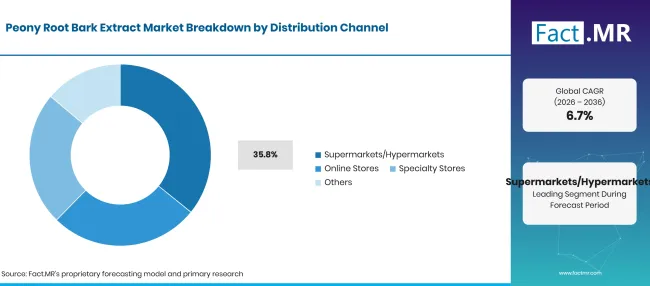
Peony Root Bark Extract Market Breakdown Distribution Channel | Source: Fact.MR
| Distribution Channel | Share (2026) |
|---|---|
| Supermarkets/Hypermarkets (Leading segment) | 35.8% |
| Other segments combined | 64.2%* |
| Total | 100.0% |
Source: Fact.MR analysis. Updated Oct 26, 2026
Large grocery chains stock herbal supplements next to vitamins, so a shopper can compare brands and prices in one visit. Private label ranges also give retailers a low-cost route to add botanical capsules. Online stores grow faster but face more questions on product origin. UK food regulators advise consumers to buy supplements online only from reputable businesses and to watch for counterfeits [5]. Specialty stores serve buyers who want a practitioner’s advice or specific traditional formulas.
What supports Individual Consumers within End-User?
Individual Consumers account for 72.3% of 2026 sales.
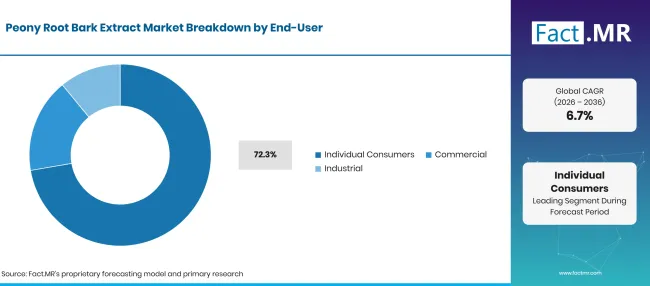
Peony Root Bark Extract Market Breakdown End User | Source: Fact.MR
| End-User | Share (2026) |
|---|---|
| Individual Consumers (Leading segment) | 72.3% |
| Other segments combined | 27.7%* |
| Total | 100.0% |
Source: Fact.MR analysis. Updated Oct 26, 2026
Most peony root bark extract reaches people who choose their own supplements and skin care. These buyers respond to clear labels, simple dosing and brands they already know. Commercial buyers include clinics, spas and practitioners who prescribe or apply herbal products. Industrial buyers purchase bulk extract for skin lightening products and Kampo granules, where each lot must meet a written specification.
What is accelerating Peony Root Bark Extract Market adoption, and what is holding it back?
Uptake will gain from mainstream interest in traditional herbs, pharmacopoeia testing standards and new skin care uses for paeonol. Thin safety data for some uses and uneven rules on botanical ingredients across countries will slow new launches.
Drivers Impact Analysis
| DRIVER | (~) % IMPACT ON CAGR | GEOGRAPHIC RELEVANCE | IMPACT TIMELINE |
|---|---|---|---|
| Wider use of traditional herbal formulas in capsule and tablet supplements | +2.0% | East Asia, North America | Medium term (2-4 years) |
| Pharmacopoeia identity and paeonol assay standards that ease buyer approval | +1.4% | East Asia, Western Europe | Short term (<= 2 years) |
| Paeonol-based actives in brightening and soothing skin care | +1.1% | East Asia, Western Europe | Medium term (2-4 years) |
| Retail and online access to packaged herbal supplements | +0.7% | Global | Short term (<= 2 years) |
Source: Fact.MR analysis. Updated Oct 26, 2026
Opportunity Impact Analysis
| OPPORTUNITY | (~) % IMPACT ON CAGR | GEOGRAPHIC RELEVANCE | IMPACT TIMELINE |
|---|---|---|---|
| Standardized extracts with stated species, plant part and paeonol content | +0.5% | Global | Medium term (2-4 years) |
| Cosmetic actives built on purified paeonol fractions | +0.4% | East Asia, Western Europe | Medium term (2-4 years) |
| Supply contracts with supplement brands for traceable bark | +0.3% | North America, Western Europe | Long term (>= 4 years) |
Source: Fact.MR analysis. Updated Oct 26, 2026
Restraints Impact Analysis
| RESTRAINT | (~) % IMPACT ON CAGR | GEOGRAPHIC RELEVANCE | IMPACT TIMELINE |
|---|---|---|---|
| Limited safety data for root bark extract in some applications | -0.7% | Global | Medium term (2-4 years) |
| Different notification and labeling rules across markets | -0.5% | North America, Western Europe, Latin America | Short term (<= 2 years) |
| Mixing of root bark with whole root or other peony parts | -0.4% | Global | Short term (<= 2 years) |
Source: Fact.MR analysis. Updated Oct 26, 2026
Which countries are scaling the Peony Root Bark Extract Market through 2036?
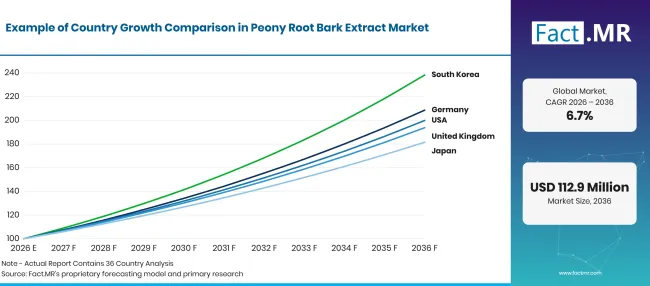
Peony Root Bark Extract Market Growth Index | Source: Fact.MR
| Country | CAGR (2026 to 2036) |
|---|---|
| Germany | 7.6% |
| United States | 7.2% |
| United Kingdom | 6.8% |
| Japan | 6.1% |
| Brazil | 5.4% |
Source: Fact.MR analysis. Updated Oct 26, 2026
What supports Germany’s adoption?
7.6% CAGR, as pharmacies and drugstores give herbal supplements wide reach.
German consumers spend heavily on health. The Federal Statistical Office reported health expenditure of EUR 538.2 billion in 2024, up 7.6% from 2023 [6]. Pharmacies and drugstore chains sell plant-based supplements and cosmetics side by side. Importers of peony root bark extract must show that each product meets EU food supplement and cosmetic rules.
How is the United States scaling demand?
7.2% CAGR, backed by everyday supplement use among adults.
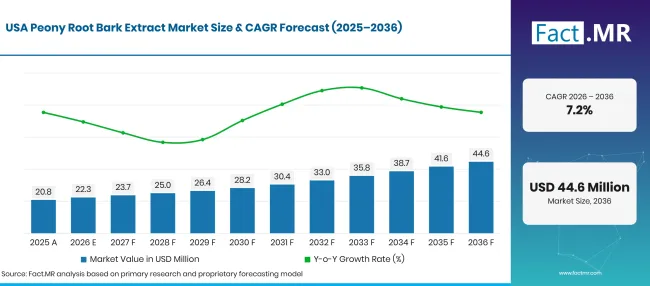
Peony Root Bark Extract Market Forecast Usa | Source: Fact.MR
Supplement use is routine for most American adults. The National Center for Health Statistics reported that 60.2% of adults used a dietary supplement in the past 30 days during August 2021 to August 2023, and 75.9% of those aged 60 and over did so [7]. Ingredients new to the U.S. supply need FDA notification before sale [3].
How is the United Kingdom developing demand?
6.8% CAGR, helped by common supplement use and clear retail rules.
In the Food Standards Agency’s Food and You 2 Wave 11 survey, 48% of respondents in Northern Ireland said they take vitamin or mineral supplements, including 57% of women [8]. The agency’s guidance bars supplements from claims to treat or prevent disease [5]. Brands therefore sell peony root bark capsules on general wellbeing messages.
How does Japan perform?
6.1% CAGR, reflecting steady output of Kampo formulas that use Moutan Cortex.
Japan’s Ministry of Health, Labour and Welfare reported production of Kampo preparations worth JPY 266,274 million in 2024, up 12.8% from 2023 [9]. Moutan Cortex appears in classic formulas such as keishibukuryogan and hachimijiogan. Makers test each lot of crude bark against the Japanese Pharmacopoeia before extraction.
What is supporting Brazil’s adoption?
5.4% CAGR, driven by supplement demand among adults managing chronic conditions.
Brazil’s Ministry of Health reported in its Vigitel 2025 results that diagnosed diabetes among adults rose from 5.5% in 2006 to 12.9% in 2024 [10]. Anvisa released the 9th edition of its food supplement questions and answers in January 2025, reflecting new rules on product registration and novel ingredients [11]. Peony root bark extract needs a clear route under these rules before wide launch.
Who leads the Peony Root Bark Extract Market?
The supplier base splits into two groups. Chinese extract makers such as Xi’an Biof Bio-Technology and Shaanxi Jintai Biological Engineering supply bulk plant extract powders and cosmetic raw materials. They compete on price, volume and paeonol testing. Western botanical specialists compete on documented quality and regulatory files. Indena builds standardized botanical fractions, and in June 2026 it set out a monacolin K-free range for metabolic health [12].
Sabinsa reported in June 2026 that its Curcumin C3 Reduct gained a positive novel food opinion in Great Britain, a sign of its regulatory reach [13]. Martin Bauer supplies plant extracts to nutraceutical makers. Givaudan serves skin care brands through its Active Beauty botanical actives. Tsumura buys crude drugs for Kampo extract formulations. Traceable bark and dossiers that satisfy regulators in several countries will separate suppliers through 2036.
Which companies are the key providers?
Key companies include Givaudan; Martin Bauer Group; Indena S.p.A.; Sabinsa Corporation; Xi’an Biof Bio-Technology Co., Ltd.; Shaanxi Jintai Biological Engineering Co., Ltd.; and Tsumura & Co.
- Givaudan
- Martin Bauer Group
- Indena S.p.A.
- Sabinsa Corporation
- Xi’an Biof Bio-Technology Co., Ltd.
- Shaanxi Jintai Biological Engineering Co., Ltd.
- Tsumura & Co.
Bibliography
- [1] World Health Organization. (2025, December 20). WHO global report on traditional, complementary and integrative medicine 2024.
- [2] National Medical Products Administration, China. (2025, March 25). 关于实施2025年版《中华人民共和国药典》有关事宜的公告 [Announcement on implementing the 2025 edition of the Pharmacopoeia of the People’s Republic of China].
- [3] U.S. Food and Drug Administration. (2026, October 19). Guidance for Industry: New Dietary Ingredient (NDI) Notifications and Related Issues; Identity and Safety Information About the NDI.
- [4] U.S. Food and Drug Administration. (2025, December 11). Letter to the Dietary Supplement Industry on the DSHEA Disclaimer.
- [5] Food Standards Agency. (2026, June 25). Food supplements guidance.
- [6] Statistisches Bundesamt (Destatis). (2026, July 21). Gesundheitsausgaben 2024 preisbereinigt um 3,9 % gestiegen [Health expenditure in 2024 up 3.9% in real terms].
- [7] National Center for Health Statistics. (2026, May 21). Dietary Supplement Use: United States, August 2021 to August 2023 (NCHS Data Brief No. 561).
- [8] Food Standards Agency. (2026, August 28). Northern Ireland Key Findings Report: Food and You 2: Wave 11.
- [9] Ministry of Health, Labour and Welfare, Japan. (2025, December 24). 令和6年 薬事工業生産動態統計年報 [Annual Report on Statistics of Production by Pharmaceutical Industry, 2024].
- [10] Ministério da Saúde, Brazil. (2026). Para o povo brasileiro viver mais e viver melhor: Resultados Vigitel 2025 [For Brazilians to live longer and better: Vigitel 2025 results].
- [11] Agência Nacional de Vigilância Sanitária. (2025, January 16). Anvisa atualiza perguntas e respostas sobre suplementos alimentares [Anvisa updates questions and answers on food supplements].
- [12] Indena. (2026, June 4). Shifting paradigms in metabolic health: preparing a monacolin k-free, multi-target era.
- [13] Sabinsa. (2026, June 8). Sabinsa’s Curcumin C3 Reduct® Receives Positive Opinion as Novel Food in Great Britain.
This Report Answers
- What the peony root bark extract market is worth in 2026 and how it will grow to 2036.
- Why powder, dietary supplements, supermarkets and individual consumers hold the top share in their segments.
- How pharmacopoeia tests and supplement rules affect which extracts buyers accept.
- Where Germany, the United States, the United Kingdom, Japan and Brazil stand on growth and regulation.
- Which suppliers make botanical extracts for this market and how they compete.
What does the Peony Root Bark Extract Market cover?
This market tracks extract made from the root bark of the tree peony, Paeonia suffruticosa. The bark is peeled from roots of plants grown for three to five years and dried before extraction. Its main marker is paeonol, with paeoniflorin and other glycosides also present.
Value is counted for powder, liquid and capsule forms across supplements, pharmaceuticals and cosmetics. Revenue includes extract sold in consumer-ready packs through retail and online channels, which explains the weight of individual consumers.
What is included in the scope?
Powder and liquid extracts of Moutan Cortex, standardized or not, are counted, as are capsules whose active content is this extract. Supply to makers of OTC herbal and traditional medicines such as Kampo granules is part of the pharmaceutical segment.
Extract sold to brands of natural skin care products is included at ingredient value. Purified paeonol made from the bark also falls within the boundary.
What is excluded from the scope?
Extracts from peony flowers, seeds, seed oil and the roots of herbaceous peonies such as Paeonia lactiflora are not counted. Synthetic paeonol made without the bark is also left out.
Finished cosmetics and multi-herb supplements count only for the value of the peony root bark extract inside them. Broader categories of natural and organic personal care are tracked in separate studies.
How Was the Analysis Built?
The analysis draws on 120+ sources, 35+ company portfolios, 25+ countries, and more than 20 industry interviews.
- Primary Research: Primary research includes discussions with manufacturers, service providers, technology developers, distributors, end users, and subject-matter experts. These conversations examine purchasing priorities, product adoption, operational challenges, approval requirements, competitive positioning, and the factors that influence wider market acceptance.
- Desk Research: Desk research covers government statistics, regulatory publications, company filings, trade data, technical studies, industry associations, standards, public policy, and other authoritative sources. Every source used in the analysis is documented in the bibliography.
- Market Sizing and Forecasting: Market estimates combine historical performance, demand indicators, pricing and volume trends, segment shares, company participation, country-level growth, adoption patterns, investment activity, and barriers to market expansion.
- Data Validation and Update Cycle: Findings are validated by comparing primary interviews with public data, company activity, regulatory changes, trade patterns, and industry developments. Regular updates review new product launches, capacity changes, partnerships, approvals, and shifts in commercial adoption.
Segmentation
What is the report’s scope and coverage?
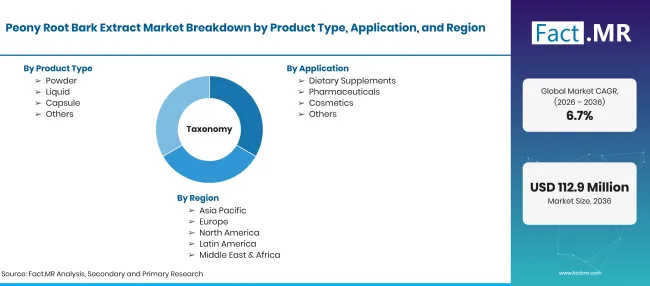
Peony Root Bark Extract Market Taxonomy | Source: Fact.MR
| Attribute | Details |
|---|---|
| Quantitative Units | USD million in 2026 to USD million by 2036 at CAGR |
| Market Definition | Extracts made from the root bark of Paeonia suffruticosa (Moutan Cortex), sold as powder, liquid or filled capsules. The scope covers sales for supplement, pharmaceutical and cosmetic use. |
| Product Type | Powder; Liquid; Capsule; Others |
| Application | Dietary Supplements; Pharmaceuticals; Cosmetics; Others |
| Distribution Channel | Supermarkets/Hypermarkets; Online Stores; Specialty Stores; Others |
| End-User | Individual Consumers; Commercial; Industrial |
| Regions Covered | North America; Latin America; Western Europe; Eastern Europe; East Asia; South Asia & Pacific; Middle East & Africa |
| Countries Covered | Germany; United States; United Kingdom; Japan; Brazil |
| Companies Profiled | Givaudan; Martin Bauer Group; Indena S.p.A.; Sabinsa Corporation; Xi’an Biof Bio-Technology Co., Ltd.; Shaanxi Jintai Biological Engineering Co., Ltd.; Tsumura & Co. |
| Forecast Period | 2026 to 2036 |
| Approach | Top-down and bottom-up model built from Moutan Cortex harvest and extraction yields; paeonol grade pricing; supplement, Kampo and cosmetic uptake by country; and review of supplier catalogs. |
Source: Fact.MR analysis. Updated Oct 26, 2026
How is the market segmented?
-
By Product Type
- Powder
- Liquid
- Capsule
- Others
-
By Application
- Dietary Supplements
- Pharmaceuticals
- Cosmetics
- Others
-
By Distribution Channel
- Supermarkets/Hypermarkets
- Online Stores
- Specialty Stores
- Others
-
By End-User
- Individual Consumers
- Commercial
- Industrial
-
By Region
- North America
- Latin America
- Western Europe
- Eastern Europe
- East Asia
- South Asia & Pacific
- Middle East & Africa
Frequently Asked Questions
How big is the peony root bark extract market in 2026?
What is the CAGR of the peony root bark extract market from 2026 to 2036?
Which product type leads the peony root bark extract market?
Which application leads the peony root bark extract market?
Which distribution channel leads the peony root bark extract market?
Which end-user leads the peony root bark extract market?
Which country will grow the most in the peony root bark extract market?
Who are the main companies in the peony root bark extract market?
Who worked on this report


Preview the report firsthand - request a free sample
Free SampleGet the brochure for pricing and purchase details
Download PDF