Geo-Specific Climate Risk Indexed Fertility Program Market
The Geo-Specific Climate Risk Indexed Fertility Program Market is analyzed across its key product, application and end-use segments, with regional trends and demand outlook, forecast 2026 to 2036.
By Fact.MR Chemical & Materials DeskFact-checked under the Fact.MR editorial processUpdated
9 min read
Geo-Specific Climate-Risk Indexed Fertility Program Market Forecast and Outlook 2026 to 2036
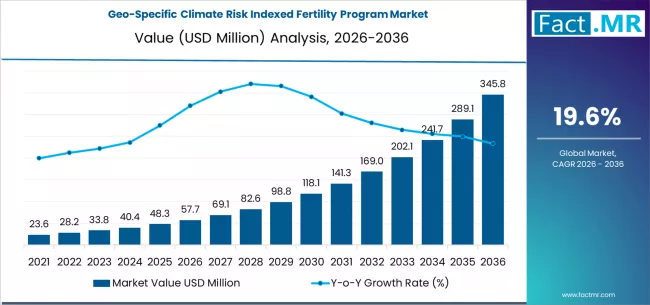
The global market for geo-specific climate-risk indexed fertility programs is projected for extraordinary growth, surging from USD 57.74 million in 2026 to USD 345.77 million by 2036, expanding at a remarkable CAGR of 19.6%.
Geo Specific Climate Risk Indexed Fertility Program Market Market Value Analysis | Source: Fact.MR
Summary of Geo-Specific Climate Risk Indexed Fertility Program Market
Market Snapshot
Global geo-specific climate risk indexed fertility program market revenue stood atUSD 57.74 million in 2026and is forecast to reachUSD 345.77 million by 2036.
At a19.6%CAGRfrom 2026 to 2036, this market is set to expand~6.0x in value, addingUSD 288.03 million in absolute opportunity.
Growth reflects a shift towardclimate-indexed nutrient management systems, where fertilizer programs are tailored to location-specific weather risks such as rainfall variability, drought probability, and heat stress.
These programs are evolving intorisk-calibrated agronomic frameworks, integrating soil data, climate models, and predictive analytics to stabilize yields under climate uncertainty.
Growing need toreduce yield volatility and protect farm economicsis reinforcing demand for risk-adjusted nutrient strategies.
Rising adoption ofprecision agriculture and predictivemodelingtoolsis enabling implementation of geo-specific fertility systems.
Integration withcrop insurance frameworks, sustainability reporting, and contract farming systemsis further accelerating adoption.
Increasing focus on:
Nutrient timing optimization
Climate-resilient crop performance
Reduction in nutrient losses due to extreme weather
Product and Segment View
Liquid form accounts for 40.1% of segment share in 2026,emergingas the leading segment due to compatibility with precision and variable-rate application systems.
Key application segments include:
Standard
Premium
Industrial
Others
These programs typically integrate:
Climate data analytics
Soil health baselines
Crop-specific nutrient planning
Adoption is driven by the ability tolink fertility decisions directly with probabilistic climate risk models, improving nutrient efficiency and yield stability.
Geography and Competitive Outlook
Growth is supported globally, with strong traction in regions exposed toclimate variability and intensive agriculture systems.
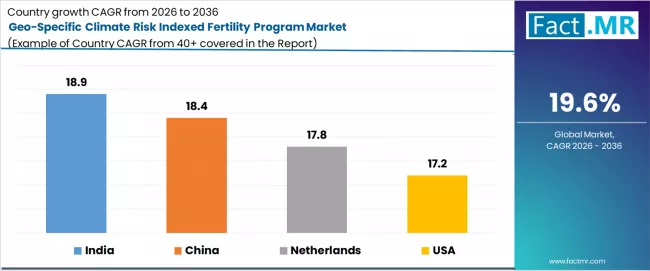
India, China, Netherlands, and the United Statesare key growth markets driven by adoption of precision agriculture and climate-resilient farming practices.
Market expansion is closely tied toclimate adaptation strategies, policy incentives, and digital agriculture infrastructure development.
Key companies active in this market include Bayer,Corteva,Nutrien, Syngenta,YaraInternational, and Trimble.
Geo-Specific Climate Risk Indexed Fertility Program Market — At a Glance
Attribute
Details
Market Value 2026
USD 57.74 million
Market Value 2036
USD 345.77 million
Absolute Dollar Opportunity 2026–2036
USD 288.03 million
Total Growth 2026–2036
498.9%
CAGR2026–2036
19.6%
Growth Multiple
~6.0x
Key Demand Theme
Climate-indexed nutrient programsoptimizingfertilizer use based on localized weather risk profiles
Leading Segment by Form (2026)
Liquid
Segment Share (2026)
40.1%
Key Growth Regions
Global (high adoption in climate-variable agricultural regions)
Key Countries
India, China, Netherlands, USA
Top Companies
Bayer,Corteva,Nutrien, Syngenta,Yara, Trimble
Segmentation by Application
Standard, Premium, Industrial, Others
Segmentation by Form
Liquid, Solid, Gas, Gel
Segmentation by Region
North America, Latin America, Western Europe, Eastern Europe, East Asia, South Asia & Pacific, MEA
This market represents the cutting-edge integration of climatology, data analytics, and agronomic science, delivering fertilizer management programs dynamically tailored to the specific historical and forecasted climate risks of a precise geographic location. Unlike regional best practices, these programs use hyper-local risk indices, for drought, flooding, heat stress, or early frost, to prescribe variable nutrient strategies that proactively build crop resilience and protect yield potential against the most probable local climate threats. Growth is driven by the acute need to adapt agricultural management to increased climate volatility and the corresponding financialization of climate risk through insurance and lending. These programs transform climate data from a generic warning into a prescriptive input for fertility planning. By indexing risk at the sub-field level, they enable farmers to allocate fertilizer investments more strategically, for example, prioritizing drought-mitigating potassium and silicon in moisture-stressed zones or adjusting nitrogen timing in areas prone to early-season leaching rains. This precision de-risks the growing season, turning adaptive management into a calculated, data-driven practice. The market’s evolution is centered on the convergence of high-resolution climate modeling, real-time sensor networks, and adaptive agronomic algorithms. Success depends on the accuracy of localized risk scoring and the program’s ability to translate that score into actionable, cost-effective fertility adjustments that demonstrably improve yield stability and input ROI in the face of climate uncertainty.
Category
Category
Segments
Application
Standard, Premium, Industrial, Other
Form
Liquid, Solid, Gas, Gel
Channel
Direct, Retail, Online, Distributor
Region
North America, Latin America, Western Europe, Eastern Europe, East Asia, South Asia & Pacific, MEA
Segmental Analysis
By Application, Which Program Type Provides Foundational Risk Adaptation?
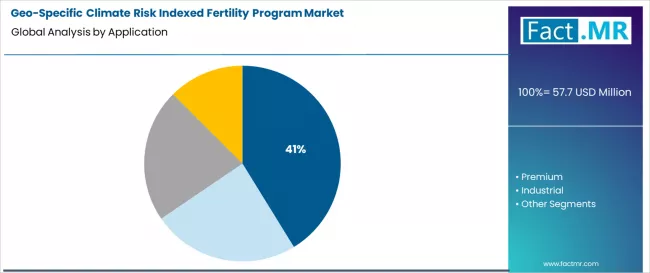
Geo Specific Climate Risk Indexed Fertility Program Market Analysis By Application | Source: Fact.MR
The standard application segment leads with a 41% share. These programs address the most common, high-probability climate risk in a region, such as terminal drought for wheat or excessive rainfall during planting for corn.
They provide a foundational, cost-adjusted fertility blueprint that moves farmers beyond a one-size-fits-all approach. Their broad appeal lies in offering a clear, initial step towards climate-adaptive management without the complexity of managing multiple, simultaneous risk indices, making them the entry point for widespread adoption.
By Form, Which Enables Responsive In-Season Adjustments?
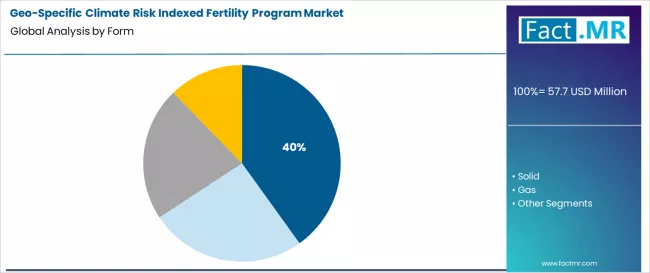
Geo Specific Climate Risk Indexed Fertility Program Market Analysis By Form | Source: Fact.MR
Liquid form holds a 40% share, critical for its agility in responding to updated climate-risk indices during the growing season. Liquid fertilizers can be quickly applied via fertigation or foliar sprays when a rising risk index, like a heatwave probability, triggers a programmed nutrient response.
This compatibility with precision application equipment allows for the variable-rate execution of geo-specific prescriptions, making liquid the essential delivery mechanism for dynamic, data-driven programs.
By Channel, How are These Complex Data-Driven Programs Managed?
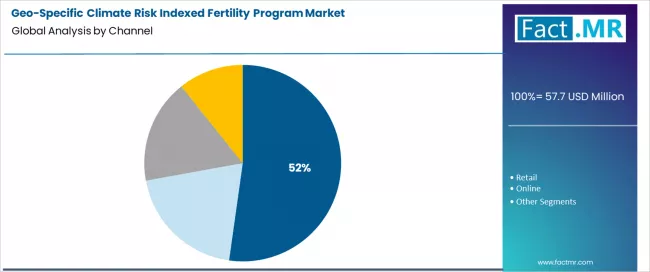
Geo Specific Climate Risk Indexed Fertility Program Market Analysis By Channel | Source: Fact.MR
Direct sales constitute the leading channel at 52%. The deployment of a climate-risk indexed program requires integrating multiple data streams, specialized software, and agronomic interpretation.
A direct relationship between the program provider and the farm operation, whether a large enterprise or a cooperative, is necessary for customizing the risk model, calibrating recommendations, and providing ongoing decision support as seasonal forecasts evolve.
What are the Drivers, Restraints, and Key Trends of the Geo-Specific Climate-Risk Indexed Fertility Program Market?
The primary driver is the escalating economic impact of climate volatility on farm profitability and the concurrent rise of parametric insurance and climate-smart financing, which often require evidence of adaptive practice. The increasing availability and affordability of granular climate data, soil sensors, and satellite imagery provide the necessary infrastructure. The growing mandate from food companies and lenders for climate-resilient supply chains creates a powerful market pull for verified adaptive strategies.
A significant restraint is the reliance on the predictive accuracy of climate models at a very local scale, which can still involve uncertainty. The digital literacy and technological infrastructure required can be a barrier for some farming communities. The subscription or service fee for advanced analytics represents an additional cost, and demonstrating the direct, seasonal financial return against a counterfactual scenario can be challenging, though multi-year stability benefits are clear.
Key trends include the bundling of programs with financial products, such as insurance premiums discounted for enrolled farmers or preferential loan rates. AI and machine learning are being leveraged to improve the predictive power of risk indices by analyzing decades of hyper-local yield and weather data. There is also a trend toward generating verified adaptive practice credits that can be sold in emerging ecosystem markets, creating a new revenue stream for participants.
Analysis of the Geo-Specific Climate-Risk Indexed Fertility Program Market by Key Countries
Geo Specific Climate Risk Indexed Fertility Program Market Cagr Analysis By Country | Source: Fact.MR
Country
CAGR (2026-2036)
India
18.9%
China
18.4%
Netherlands
17.8%
USA
17.2%
How is India's High Climate Vulnerability and Digital Leapfrogging Catalyzing Growth?
India’s leading CAGR of 18.9% is driven by its extreme vulnerability to monsoon variability, heatwaves, and untimely rains. Government initiatives like the Digital India campaign and the National Mission on Sustainable Agriculture are fostering an ecosystem for tech-driven solutions.
The scale of smallholder agriculture, combined with rising climate distress, creates a massive need for accessible, localized risk mitigation tools, making this a high-growth frontier for mobile-delivered, indexed fertility advisories.
What is the Impact of China's Top-Down Climate Adaptation and Agri-Digitization Policy?
China’s 18.4% growth is propelled by a national strategy that explicitly links climate adaptation with food security. The government is heavily investing in agricultural big data and digital infrastructure.
Geo-specific risk indexing aligns perfectly with this directive, allowing provincial and state farm operators to implement centrally supported but locally precise adaptation measures, driving rapid, policy-enabled adoption at scale.
Why are the Netherlands a Frontrunner in Data-Intensive Precision Agriculture?
The Netherlands' 17.8% CAGR is rooted in its culture of data-driven farming and its leadership in agri-tech export. Dutch farmers and technology providers are adept at integrating complex datasets.
The concept of indexing climate risk to financial and agronomic outcomes is a natural extension of this precision mindset, positioning the country as a living lab for developing and exporting sophisticated climate-adaptive program models.
How is the USA's Large-Scale Farming and Advanced Insurance Market Influencing Development?
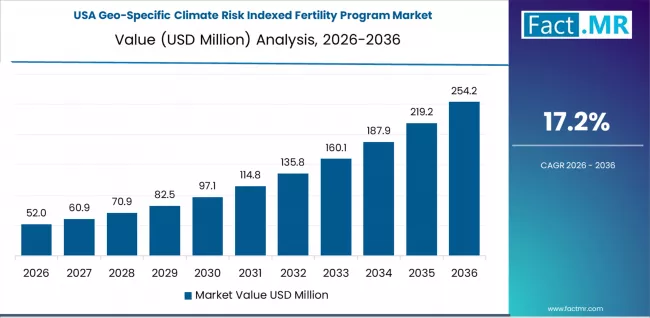
Geo Specific Climate Risk Indexed Fertility Program Market Country Value Analysis | Source: Fact.MR
The USA’s 17.2% growth is shaped by its extensive, technology-adopting farm operations and its sophisticated agricultural risk management sector. Major crop insurers and input suppliers are actively developing products that reward climate-adaptive practices.
Geo-specific indexed programs provide the verifiable, data-backed methodology needed to underwrite these new financial instruments, creating a strong commercial driver for adoption across the Corn Belt and other critical regions.
Competitive Landscape of the Geo-Specific Climate-Risk Indexed Fertility Program Market
Geo Specific Climate Risk Indexed Fertility Program Market Analysis By Company | Source: Fact.MR
The competitive landscape is defined by competition between major agriscience digital platforms, climate analytics startups, and precision agriculture giants. The battleground is the superiority of the proprietary climate risk algorithm, the seamless integration of the program with farm management and machinery systems, and the ability to form alliances with banks and insurance companies.
Success hinges on building a network effect where more user data continuously improves the risk models, and on demonstrating an unambiguous improvement in the climate resilience quotient of participating farms.
Key Players in the Geo-Specific Climate-Risk Indexed Fertility Program Market
Bayer AG
Corteva Inc.
Nutrien
Syngenta AG
Yara International ASA
Trimble Inc.
Scope of Report
Items
Values
Quantitative Units
USD Million
Application
Standard, Premium, Industrial, Other
Form
Liquid, Solid, Gas, Gel
Channel
Direct, Retail, Online, Distributor
Key Countries
USA, Netherlands, China, India
Key Companies
Bayer AG, Corteva Inc., Nutrien, Syngenta AG, Yara International ASA, Trimble Inc.
Additional Analysis
Analysis of climate risk scoring methodologies and their agronomic translation; validation studies of program efficacy on yield stability across stress years; economic modeling of risk reduction vs. program cost; integration with IoT sensor networks for real-time index updating; review of policy frameworks incentivizing climate-adaptive practices.
Market by Segments
Application :
Standard
Premium
Industrial
Other
Form :
Liquid
Solid
Gas
Gel
Channel :
Direct
Retail
Online
Distributor
Region :
North America
USA
Canada
Latin America
Brazil
Mexico
Argentina
Rest of Latin America
Western Europe
Germany
UK
France
Spain
Italy
Netherlands
BENELUX
Rest of Western Europe
Eastern Europe
Russia
Poland
Czech Republic
Rest of Eastern Europe
East Asia
China
Japan
South Korea
Rest of East Asia
South Asia & Pacific
India
ASEAN
Australia
Rest of South Asia & Pacific
MEA
Saudi Arabia
UAE
Turkiye
Rest of MEA
Frequently Asked Questions
How big is the geo-specific climate risk indexed fertility program market in 2026?
The global geo-specific climate risk indexed fertility program market is estimated to be valued at USD 57.7 million in 2026.
What will be the size of geo-specific climate risk indexed fertility program market in 2036?
The market size for the geo-specific climate risk indexed fertility program market is projected to reach USD 345.8 million by 2036.
How much will be the geo-specific climate risk indexed fertility program market growth between 2026 and 2036?
The geo-specific climate risk indexed fertility program market is expected to grow at a 19.6% CAGR between 2026 and 2036.
What are the key product types in the geo-specific climate risk indexed fertility program market?
The key product types in geo-specific climate risk indexed fertility program market are standard, premium, industrial and other.
Which form segment to contribute significant share in the geo-specific climate risk indexed fertility program market in 2026?
In terms of form, liquid segment to command 40.1% share in the geo-specific climate risk indexed fertility program market in 2026.