- Base Value(2025): 3.4 Bn
- Estimated Value(2026): 3.7 Bn
- Forecast Value (2036): 7.1 Bn
- CAGR (2026 - 2036): 6.7%
What is the salinity-mitigating fertilizer program for irrigated farms market forecast to be worth by 2036?
- In 2025, the salinity-mitigating fertilizer program for irrigated farms market was valued at USD 3.4 billion.
- Based on Fact.MR estimates, demand for salinity-mitigating fertilizer programs for irrigated farms is estimated to grow to USD 3.7 billion in 2026 and USD 7.1 billion by 2036.
- Fact.MR projects a CAGR of 6.7% during the forecast period.
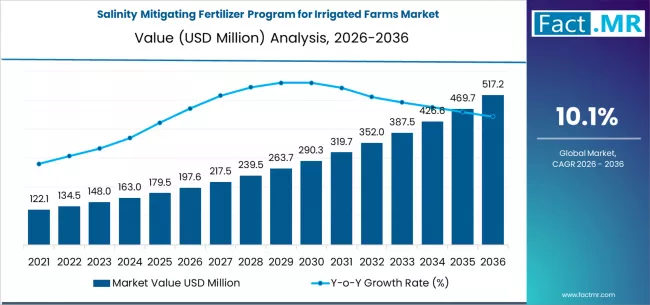
Salinity Mitigating Fertilizer Program For Irrigated Farms Market Market Value Analysis | Source: Fact.MR
Summary of Salinity-Mitigating Fertilizer Program for Irrigated Farms Market
- Market Definition
- The market includes fertilizer-linked programs designed to reduce salinity and sodicity risk in irrigated farms through nutrient planning, calcium amendment use, and leaching-compatible field management.
- Demand Drivers
- Irrigated salinity reduces crop water availability and can create toxicity pressure, which is increasing demand for nutrient programs built around root-zone salt control.
- Leaching remains central to salt management in irrigated systems, which strengthens the role of fertilizer programs that fit drainage and extra-water planning.
- Calcium-based amendment use remains commercially important because gypsum and related materials are widely used in sodic soil management where sodium displacement is needed.
- Key Segments Analyzed
- By Program Type: Calcium-based salinity-mitigation programs are estimated to lead with approximately 35% share in 2026, supported by strong gypsum and calcium-amendment relevance in sodic and saline-irrigated systems.
- By Application: Soil application programs are expected to hold approximately 39% share in 2026, driven by the physical need to amend the soil profile and support sodium displacement.
- By Crop Type: Fruits & vegetables are projected to account for approximately 31% share in 2026, supported by higher sensitivity to salinity and greater irrigation intensity.
- By Geography: India leads growth at 8.1% CAGR through 2036, supported by broad irrigated acreage and increasing demand for salt-mitigation input programs.
- Analyst Opinion at Fact.MR
- Shambhu Nath Jha, Senior Analyst at Fact.MR, opines, “CXOs should read this market as a water-soil-fertility management category rather than a conventional specialty fertilizer category. Buyers are paying for programs that help keep irrigated land productive under salt pressure, not only for added nutrient supply.”
- Strategic Implications
- Invest in calcium- and gysum-linked fertility programs that can be paired with drainage and leaching management in irrigated farms.
- Build technical sales capability around irrigation-water quality, salt balance, and amendment timing rather than only nutrient analysis.
- Position low-salt-index and root-zone-safe fertilizer programs in high-value irrigated crops where salinity effects show up quickly in stand, vigor, and yield.
- Methodology
- Market sizing uses irrigated acreage relevance, salinity exposure, crop sensitivity, and adoption potential across fertilizer-linked salinity-management programs.
- Analysis includes FAO and extension guidance on salt-affected soils, leaching requirements, and gypsum-supported reclamation logic.
- Forecasts account for rising irrigation pressure, salinity-management demand, and field adoption of calcium-amendment-based fertility programs.
The market is projected to generate USD 3.4 billion in absolute opportunity between 2026 and 2036. Growth is being supported by persistent salt pressure in irrigated areas, wider use of nutrient programs built around leaching and amendment logic, and stronger demand for field-specific soil and water management. FAO states that excess soil salinity causes poor and uneven stands, stunted growth, and poor yields, while Utah State University notes that excessive salts reduce water availability to plants through osmotic effects and may also create ion toxicity. That combination is pushing growers toward fertilizer programs that are designed to work under salinity pressure rather than conventional nutrient schedules.
India is projected to lead with a CAGR of 8.1% through 2036, driven by large irrigated acreage, recurring soil salinity concerns, and stronger adoption of managed nutrient programs in high-value crops. Mexico follows at 7.4%, supported by irrigated horticulture and rising pressure to protect yield under saline water conditions. China is expected to grow at 7.1%, underpinned by intensive irrigated agriculture and stronger demand for soil-recovery inputs. The United States records 6.8%, backed by precision irrigation and salinity-management planning in arid production systems. Brazil grows at 6.4%, supported by localized irrigation-led salinity issues and specialty crop programs. This divergence reflects differences in irrigation intensity, drainage quality, salinity exposure, and the maturity of farm-level nutrient management under salt stress.
How does the salinity-mitigating fertilizer program for irrigated farms market break down by segment?
Salinity-Mitigating Fertilizer Program for Irrigated Farms Market Analysis by Program Type
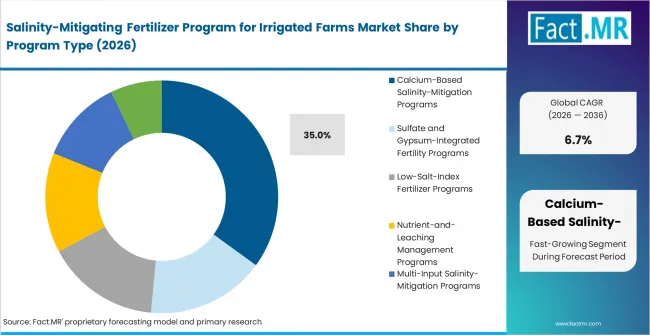
Salinity Mitigating Fertilizer Program For Irrigated Farms Market Analysis By Program Type | Source: Fact.MR
Salinity-mitigating fertilizer program for irrigated farms market analysis, calcium-based salinity-mitigation programs are estimated to hold 35% share in 2026. They lead because gypsum and other calcium amendment systems remain the most established agronomic tools for sodic soil management, especially where sodium must be displaced from exchange sites before salts can be leached below the root zone. Utah State University notes that calcium from gypsum can replace sodium on exchange sites when adequate drainage and leaching are present, while Arizona extension explains the role of calcium amendments in improving aggregation and soil condition. Low-salt-index nutrient programs continue to gain importance where growers want to reduce fertilizer-driven salt pressure in already stressed fields. Multi-input salinity-mitigation programs are also expanding because farms increasingly need fertility schedules that work with water quality, drainage, and soil remediation instead of treating each issue separately. [5]
- Gypsum Anchor: Calcium amendment programs retain commercial leadership because they align closely with sodic-soil correction logic.
- Low-Salt Index Logic: Nutrient programs are gaining value where farms need to reduce added salt load from fertilizer choices.
- Integrated Program Pull: Multi-input systems gain traction where growers need nutrient and salinity control in one management plan.
Salinity-Mitigating Fertilizer Program for Irrigated Farms Market Analysis by Application
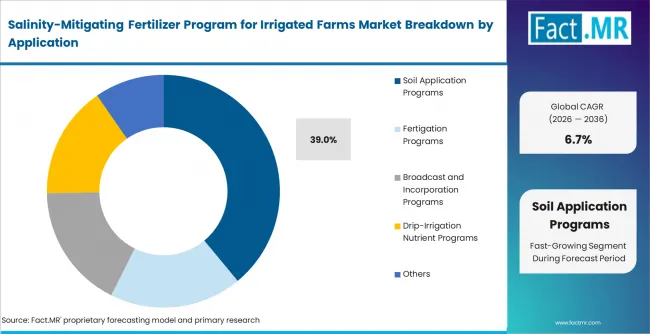
Salinity Mitigating Fertilizer Program For Irrigated Farms Market Analysis By Application | Source: Fact.MR
Based on Fact.MR’s analysis, soil application programs are expected to hold approximately 39% share in 2026. This segment leads because salinity and sodicity management often requires amendment movement into the soil profile rather than only solution-level correction. Soil-applied gypsum, calcium products, and reclamation-linked nutrient programs remain easier to integrate into field-level salinity treatment when the objective is to improve physical soil condition and support subsequent leaching. Fertigation programs remain commercially relevant in vegetables, orchards, and drip-irrigated systems, especially where growers need low-salt-index feeding and more careful nutrient placement under saline water conditions. Broadcast and incorporation programs also remain important because they fit broad-acre irrigated farming more easily than highly specialized delivery systems. Application leadership in this market therefore favors formats that can influence the soil-root environment at scale and fit routine irrigated-farm operations.
- Profile Treatment Need: Soil-based programs lead because sodic and saline soils often need amendment action below the surface.
- Drip-System Relevance: Fertigation gains importance where root-zone control and water efficiency drive nutrient decisions.
- Broad-Acre Fit: Broadcast and incorporated programs remain practical in large irrigated field systems.
Salinity-Mitigating Fertilizer Program for Irrigated Farms Market Analysis by Crop Type
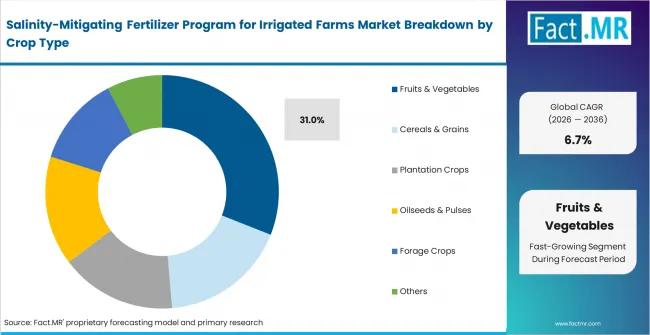
Salinity Mitigating Fertilizer Program For Irrigated Farms Market Analysis By Crop Type | Source: Fact.MR
Fruits & vegetables are projected to account for approximately 31% share in 2026. They lead because many irrigated horticultural crops are more visibly affected by salinity through uneven stands, quality loss, and yield suppression than lower-value extensive crops. FAO notes that salinity causes poor and spotty stands, uneven growth, and poor yields, which is especially damaging in market-sensitive horticulture. Cereals and grains remain important where irrigated acreage is large, though the strongest commercial pull comes from crop systems where salinity reduces both quality and marketability. Plantation crops and forage systems also create meaningful opportunity where irrigation water quality is variable and long-term soil productivity depends on salt management. Crop leadership in this market is driven by salinity sensitivity and irrigation dependence as much as by acreage.
- Horticulture Sensitivity: Fruits and vegetables support stronger demand because salinity damage appears quickly in quality-sensitive systems.
- Irrigation Dependence: Crop systems that rely continuously on irrigation create stronger recurring demand for salt-mitigation programs.
- Marketability Pressure: Higher-value crops justify more active salinity-management spending than lower-margin crops.
What is accelerating salinity-mitigating fertilizer program adoption, and what is holding it back?
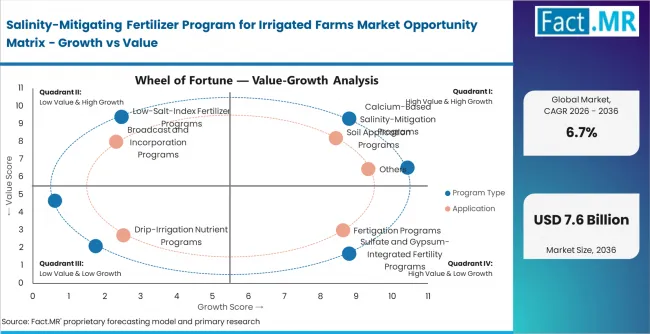
Salinity Mitigating Fertilizer Program For Irrigated Farms Market Opportunity Matrix Growth Vs Value | Source: Fact.MR
Fact.MR analysts observe that the salinity-mitigating fertilizer program for irrigated farms market is being shaped by the need to keep irrigated land productive under rising salt pressure. Structural demand is anchored in the fact that salinity reduces plant water uptake and can impair nutrient availability, while sodicity can damage soil structure and further weaken crop performance. FAO also emphasizes that controlling soluble salts in irrigation systems depends on maintaining enough leaching to move salts below the root zone. This makes nutrient programs more valuable when they are built to work within salinity-management systems rather than in isolation.
The main restraint is that fertilizer programs alone cannot solve salinity where drainage is poor or where leaching is inadequate. FAO and extension sources both make clear that salt control depends on water movement and drainage, not only on amendment use. This raises the proof burden for suppliers because results depend on field conditions outside the fertilizer program itself. Another restraint is regional variation in water quality and soil response, which makes standardized product claims harder to sustain across all irrigated systems.
- Gypsum-Integrated Programs: Calcium-amendment-linked fertility remains the clearest opportunity because sodic and saline soils still need sodium displacement and profile management.
- Drip-Irrigated Horticulture: High-value irrigated crops create attractive demand where salinity affects both yield and market quality quickly.
- Salt-Aware Nutrient Planning: Low-salt-index fertilizers and field-specific nutrient schedules create higher-value opportunity where growers need to control added salt load as well as nutrient supply.
Which countries are scaling salinity-mitigating fertilizer program demand fastest?
The salinity-mitigating fertilizer program for irrigated farms market is assessed across North America, Europe, Asia Pacific, Latin America, and Middle East and Africa, covering 40+ countries with demand profiles shaped by irrigation intensity, saline and sodic soil exposure, drainage quality, and adoption of field-specific salt-management practices.
.webp "Top Country Growth Comparison Salinity Mitigating Fertilizer Program For Irrigated Farms Market Cagr (2026 2036)")
Top Country Growth Comparison Salinity Mitigating Fertilizer Program For Irrigated Farms Market Cagr (2026 2036) | Source: Fact.MR
| Country | CAGR (2026 to 2036) |
|---|---|
| India | 8.1% |
| Mexico | 7.4% |
| China | 7.1% |
| United States | 6.8% |
| Brazil | 6.4% |
Source: Fact.MR analysis. Updated Jun 15, 2026
Source: Fact.MR analysis, based on proprietary forecasting model and primary research

Salinity Mitigating Fertilizer Program For Irrigated Farms Market Cagr Analysis By Country | Source: Fact.MR
North America Salinity-Mitigating Fertilizer Program for Irrigated Farms Market Analysis
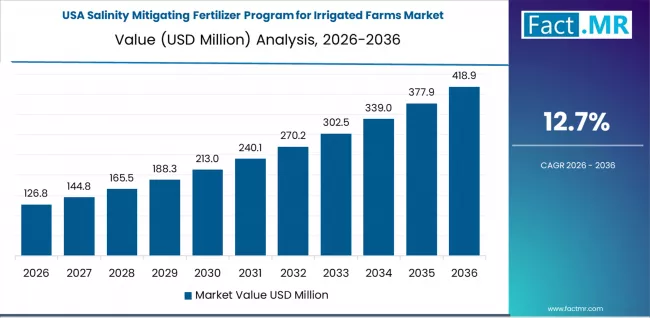
Salinity Mitigating Fertilizer Program For Irrigated Farms Market Country Value Analysis | Source: Fact.MR
North America remains an important commercial region because it combines irrigated specialty crops, arid and semi-arid production zones, and strong extension culture around saline and sodic soil management. Demand is strongest where growers already work with irrigation-water quality constraints and where soil amendment logic can be integrated into field nutrition programs. The region also benefits from established guidance on gypsum use, salinity monitoring, and irrigation-water planning, which makes it easier for fertilizer-linked mitigation programs to gain traction.
- United States: Arid irrigated regions, specialty crop systems, and stronger field testing continue to support demand across the United States. The market is projected to expand at a CAGR of 6.8% through 2036, driven by increasing need to manage soil salinity and maintain crop productivity in water-stressed zones. Adoption is particularly visible in high-value crops where consistent yield and quality depend on better nutrient balance and soil-condition control.
- Mexico: Irrigated horticulture and exposure to saline irrigation water create a strong commercial fit in Mexico. Sales of salinity-mitigating fertilizer programs are likely to rise at a CAGR of 7.4% during the forecast period, supported by intensive fruit and vegetable cultivation. Growers are increasingly using these programs to improve soil structure, reduce salt stress, and maintain crop performance under challenging irrigation conditions.
Fact.MR’s analysis of North America covers the United States, Canada, and Mexico. Includes irrigated horticulture, saline-soil management, and calcium-amendment-linked fertility demand.
Asia Pacific and Latin America Salinity-Mitigating Fertilizer Program for Irrigated Farms Market Analysis
Asia Pacific and Latin America offer the strongest long-term expansion potential because irrigated crop area, water-quality pressure, and field-level salinity management needs are rising across multiple crop systems. Demand is likely to strengthen where growers move from general fertilizer use toward nutrient programs that explicitly support salt mitigation and root-zone recovery. Adoption depends on irrigation discipline, drainage access, and the ability of suppliers to connect fertilizer planning with leaching and soil amendment logic.
- India: Broad irrigated acreage and the growing need for salt-aware nutrient programs continue to support demand across India. The market is projected to grow at an 8.1% CAGR through 2036, driven by increasing soil salinity concerns in canal- and groundwater-irrigated regions. Farmers are adopting targeted nutrient strategies to maintain soil balance, improve crop resilience, and sustain yields across cereals, pulses, and horticulture systems.
- Brazil: Localized irrigation-led salinity challenges and the expansion of specialty crop systems support growth in Brazil. Salinity-mitigating fertilizer program demand is expected to rise at a 6.4% CAGR through 2036, particularly in regions where irrigation intensity is increasing. Growers are using these programs to improve soil conditions, reduce salt stress, and maintain productivity in high-value crops.
- China: Intensive irrigated agriculture and rising demand for salinity management continue to support adoption across China. The market is projected to grow at a 7.1% CAGR through 2036, supported by high-output farming systems and increasing focus on soil health. Adoption is particularly visible in greenhouse and high-value crop segments where consistent performance depends on better salinity control and nutrient efficiency.
Fact.MR’s analysis covers India, China, Japan, ASEAN, Australia, Brazil, Argentina, and Rest of Latin America. Includes irrigated crop salinity, amendment-supported fertility demand, and adoption of leaching-compatible nutrient programs.
Who leads the salinity-mitigating fertilizer program for irrigated farms market landscape?
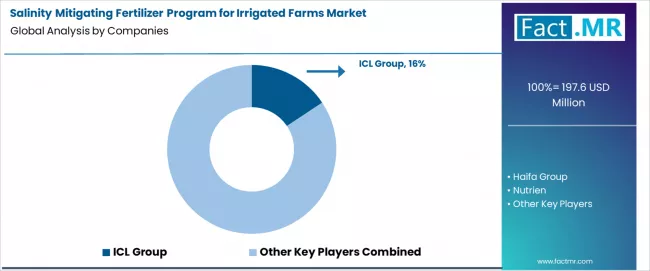
Salinity Mitigating Fertilizer Program For Irrigated Farms Market Analysis By Company | Source: Fact.MR
The salinity-mitigating fertilizer program for irrigated farms market is moderately concentrated at the program-design level, while distribution and technical support remain fragmented. Competitive strength comes from the ability to combine fertilizer planning with credible salinity-management logic. Suppliers need more than a specialty nutrient claim. They need a workable explanation of how their program supports calcium amendment use, leaching compatibility, root-zone salt control, and nutrient safety under saline conditions.
Competitive advantage is defined by amendment compatibility, agronomic clarity, and fit with irrigation management rather than by nutrient analysis alone. Calcium- and gypsum-linked programs benefit from stronger agronomic recognition. Low-salt-index nutrient schedules gain attention where growers need to reduce salt pressure from fertilizer decisions themselves. Buyers in this market usually choose on technical confidence and field recoverability rather than on lowest cost, because failure under saline irrigation conditions can reduce both yield and long-term soil productivity. Buyer dynamics vary by irrigation intensity and field condition. Large irrigated farms and precision operations are more likely to adopt first because they can coordinate water, amendment, and nutrient decisions. Broader adoption depends on whether suppliers can prove that the program works within real drainage and leaching limits rather than only under ideal field assumptions. Competitive intensity is therefore rising fastest in technically managed irrigated farming rather than in ordinary fertilizer distribution.
Which companies are the key players?
- Nutrien Ltd.
- Yara International ASA
- ICL Group Ltd.
- Haifa Group
- Coromandel International Ltd.
- SQM S.A.
Bibliography
- ICL Growing Solutions. (2025, January 20). Polysulphate®: A scientific approach to soil salinity. ICL Group.
- Coromandel International Limited. (2025, February). Gypsum. Coromandel International Limited.
- Yara International ASA. (2025). Yara integrated report 2024. Yara International ASA.
- Nutrien eKonomics. (2024, March 26). Episode 4: Is soil salinity impacting your crops? Nutrien Ltd
This Report Addresses
- Strategic intelligence on salinity-mitigating fertilizer program demand across irrigated farms, horticulture, and salinity-prone production systems.
- Growth opportunity mapping across calcium-based, gypsum-integrated, low-salt-index, and nutrient-and-leaching management programs.
- Segment analysis by program type, application, crop type, and end use.
- Regional outlook covering North America, Europe, Asia Pacific, Latin America, and Middle East and Africa.
- Competitive analysis of Nutrien, Yara, ICL, Mosaic, Haifa Group, EuroChem, and other participants.
- Root-zone salt control analysis covering leaching, calcium amendment use, nutrient safety, and irrigated-farm salinity management.
- Report delivered in PDF, Excel datasets, and presentation formats. Supported by primary interviews, extension guidance, and salinity-management literature.
What does the salinity-mitigating fertilizer program for irrigated farms market cover?
The market covers fertilizer systems designed to increase, protect, or support soil carbon while also supplying nutrients for crop production. It includes carbon-bearing and carbon-supportive fertility systems that combine nutrient delivery with materials or program structures intended to improve soil organic carbon, nutrient retention, soil aggregation, and long-term soil productivity.
Soil-Carbon Positive Fertilizer System Market Inclusions
Covers global and regional forecasts from 2026 to 2036. Includes biochar-enriched fertilizer systems, organic-mineral blends, humic and carbon-amendment nutrient systems, residue-linked fertility programs, and multi-input systems positioned to support soil organic carbon gains or maintenance. Covers products and agronomic program structures used where carbon-positive nutrient delivery, stronger nutrient retention, and soil-health-linked fertility are the core commercial objectives. [5]
Soil-Carbon Positive Fertilizer System Market Exclusions
Excludes standard bulk fertilizers sold only for nutrient supply without a soil-carbon-building or carbon-supportive role. Omits ordinary liming products, stand-alone compost or manure sales without a fertilizer-system format, and general soil-health consulting where an actual fertility system is not part of the commercial offer. It also excludes irrigation hardware and carbon-credit services not linked to a nutrient program.
Soil-Carbon Positive Fertilizer System Market Research Methodology
- Primary Research
- Interviews with soil fertility advisors, precision agronomy teams, carbon-amendment distributors, cooperative crop specialists, regenerative agriculture consultants, and large-farm nutrient managers across major agricultural regions.
- Desk Research
- Uses USDA and NRCS materials on soil organic carbon and soil health, FAO references on soil organic carbon and nutrient supply, IFA materials on 4R nutrient stewardship, and current literature on biochar and soil carbon-supportive nutrient systems.
- Market-Sizing and Forecasting
- Hybrid model using soil-carbon relevance, crop-value intensity, amendment fit, nutrient-retention need, and adoption potential across carbon-building fertilizer systems.
- Data Validation and Update Cycle
- Validated using extension and institutional soil-carbon guidance, soil-health references, current amendment literature, and recurring checks on carbon-supportive fertility use cases across field and intensive crop systems.
Segmentation
What is the report’s scope and coverage?
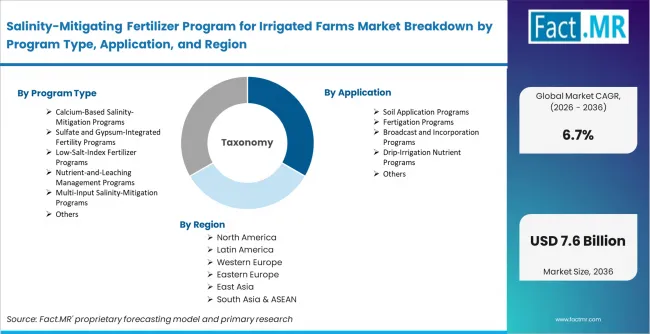
Salinity Mitigating Fertilizer Program For Irrigated Farms Market Breakdown By Program Type, Application, And Region | Source: Fact.MR
| Attribute | Details |
| Quantitative Units | USD billion (2026) to USD billion (2036), at a CAGR |
| Market Definition | Fertilizer-linked programs designed to reduce salinity and sodicity risk in irrigated farms through amendment use, low-salt nutrient planning, and leaching-compatible field management. |
| Program Type Segmentation | Calcium-Based Salinity-Mitigation Programs, Sulfate and Gypsum-Integrated Fertility Programs, Low-Salt-Index Fertilizer Programs, Nutrient-and-Leaching Management Programs, Multi-Input Salinity-Mitigation Programs, Others |
| Application Segmentation | Soil Application Programs, Fertigation Programs, Broadcast and Incorporation Programs, Drip-Irrigation Nutrient Programs, Others |
| Crop Type Segmentation | Cereals & Grains, Fruits & Vegetables, Plantation Crops, Oilseeds & Pulses, Forage Crops, Others |
| Regions Covered | North America, Europe, Asia Pacific, Latin America, Middle East and Africa |
| Countries Covered | United States, Canada, Mexico, Spain, Netherlands, Germany, France, India, China, Australia, Brazil, Argentina, and 40+ countries |
| Key Companies Profiled | Nutrien Ltd., Yara International ASA, ICL Group Ltd., Haifa Group,Coromandel International Ltd., SQM S.A. |
| Forecast Period | 2026 to 2036 |
| Approach | Hybrid top-down and bottom-up model using irrigated acreage risk, salinity exposure, amendment relevance, crop sensitivity, and primary interviews with growers, distributors, and agronomy teams. |
Source: Fact.MR analysis. Updated Jun 15, 2026
How is the market segmented?
-
By Program Type:
- Calcium-Based Salinity-Mitigation Programs
- Sulfate and Gypsum-Integrated Fertility Programs
- Low-Salt-Index Fertilizer Programs
- Nutrient-and-Leaching Management Programs
- Multi-Input Salinity-Mitigation Programs
- Others
-
By Application:
- Soil Application Programs
- Fertigation Programs
- Broadcast and Incorporation Programs
- Drip-Irrigation Nutrient Programs
- Others
-
By Crop Type:
- Cereals & Grains
- Fruits & Vegetables
- Plantation Crops
- Oilseeds & Pulses
- Forage Crops
- Others
-
By Region:
- North America
- United States
- Canada
- Mexico
- Latin America
- Brazil
- Argentina
- Chile
- Rest of Latin America
- Western Europe
- Germany
- France
- United Kingdom
- Italy
- Spain
- Nordic Countries
- BENELUX
- Rest of Western Europe
- Eastern Europe
- Russia
- Poland
- Hungary
- Balkan and Baltic
- Rest of Eastern Europe
- East Asia
- China
- Japan
- South Korea
- South Asia and Pacific
- India
- ASEAN
- Australia and New Zealand
- Rest of South Asia and Pacific
- Middle East and Africa
- Kingdom of Saudi Arabia
- Other GCC Countries
- Turkey
- South Africa
- Rest of Middle East and Africa
- North America
Frequently Asked Questions
Which program type is poised to lead the market?
Which application segment holds the largest share?
Which crop segment is expected to remain strongest?
Which end-use segment is likely to remain commercially important?
Which country shows the fastest growth?
What is driving demand for salinity-mitigating fertilizer programs?
What is the key challenge in this market?
Who worked on this report


Preview the report firsthand - request a free sample
Free SampleGet the brochure for pricing and purchase details
Download PDF