Microclimate-Specific Agrochemical Program Pack Market
Microclimate-Specific Agrochemical Program Pack Market Size and Share Forecast Outlook 2026 to 2036
Microclimate-specific agrochemical program pack market is projected to grow from USD 0.6 billion in 2026 to USD 2.9 billion by 2036, at a CAGR of 17.0%. Heat–Humidity Adaptive Packs will dominate with a 32.0% market share, while row crops (corn, soybean, cotton) will lead the crop system segment with a 41.0% share.
Microclimate-Specific Agrochemical Program Pack Market Forecast and Outlook 2026 to 2036
The global microclimate-specific agrochemical program pack market is projected to reach USD 2.86 billion by 2036. The market is valued at USD 0.59 billion in 2026 and is set to rise at a significant CAGR of 17.0% during the assessment period.
By program pack type, heat-humidity adaptive packs hold a leading 32% share. The row crops system segment represents a dominant 41% share, while temperature extremes serve as the primary microclimate trigger, accounting for 36% market share.
Key Takeaways from the Microclimate-Specific Agrochemical Program Pack Market
- Market Value for 2026: USD 0.59 Billion
- Market Value for 2036: USD 2.86 Billion
- Forecast CAGR (2026-2036): 17.0%
- Leading Program Pack Type Share (2026): Heat-Humidity Adaptive Packs (32%)
- Leading Crop System Share (2026): Row Crops (41%)
- Leading Microclimate Trigger Type Share (2026): Temperature Extremes (36%)
- Key Players in the Market: Climate FieldView (Program Bundles), Prospera Technologies, Taranis Ag Analytics, CropX Technologies, Arable Labs

A transformative trend is the move from calendar-based spray schedules to dynamic, hyper-localized input programs triggered by real-time field sensor data. These program packs bundle specific agrochemicals, adjuvants, and biostimulants optimized for predicted or occurring microclimate conditions. Innovation focuses on AI models that integrate soil moisture, canopy temperature, and hyperlocal weather forecasts to prescribe pre-emptive or responsive interventions. The seamless integration of these data-driven packs with automated irrigation and spraying equipment is creating adaptive crop management systems that operate with minimal human intervention.
Regulatory frameworks increasingly recognize the environmental benefits of precision application tied to actual risk, potentially streamlining approvals for context-dependent use patterns. Policies promoting climate-resilient agriculture and sustainable water use provide indirect support, as these packs are designed to optimize input efficiency under stress. Digital stewardship platforms that document the conditional logic behind each application help farmers demonstrate compliance with evolving traceability and environmental standards.
Microclimate-Specific Agrochemical Program Pack Market
| Metric | Value |
|---|---|
| Market Value (2026) | USD 0.59 Billion |
| Market Forecast Value (2036) | USD 2.86 Billion |
| Forecast CAGR (2026-2036) | 17.0% |
Category
| Category | Segments |
|---|---|
| Program Pack Type | Heat–Humidity Adaptive Packs, Drought–Stress Mitigation Packs, Excess Rainfall & Disease Pressure Packs, Cold Night–Warm Day Transition Packs, Others |
| Crop System | Row Crops (Corn, Soybean, Cotton), Fruits & Vegetables, Vineyards & Orchards, Plantation & Specialty Crops, Others |
| Microclimate Trigger Type | Temperature Extremes (Heat & Cold Stress), Humidity & Leaf Wetness Duration, Rainfall Intensity & Frequency, Wind Speed & Drift Risk Profiles, Others |
| Region | North America, Latin America, Western Europe, Eastern Europe, East Asia, South Asia & Pacific, MEA |
Segmental Analysis
By Program Pack Type, Which Addresses the Most Prevalent Climatic Challenge?
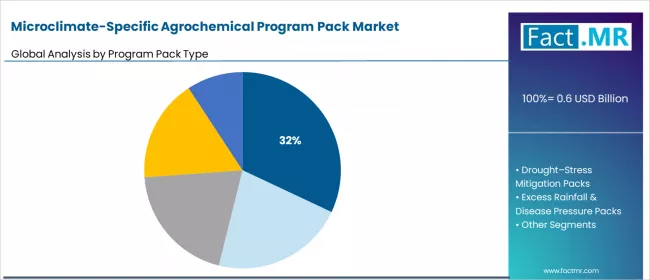
Heat-humidity adaptive packs lead the segment with a 32% share. This dominance reflects the widespread and compounding stress caused by high temperatures combined with elevated humidity, a condition that exacerbates pest pressure, disease proliferation, and plant physiological stress.
These packs typically combine stress-mitigating biostimulants, fungicides with curative kickback activity, and insecticides effective against pests thriving in warm, moist conditions. Their design ensures crop protection and physiological support are delivered synchronously when sensor networks detect this high-risk environmental threshold, preventing yield loss during critical growth stages.
By Crop System, Where is Microclimate Variability Most Pronounced and Impactful?

Row crops command the largest system share at 41%. The expansive, open-canopy architecture of corn, soybean, and cotton fields creates significant microclimate gradients across the field, with temperature and humidity varying considerably between the soil surface, canopy interior, and field edges.
These variations directly influence weed germination, disease cycles, and insect activity. Program packs for row crops utilize data from distributed sensor networks to prescribe variable-rate applications or tailored product mixes for different zones, transforming a uniform field into a mosaic of managed micro-environments for optimized protection and input use.
By Microclimate Trigger, What is the Most Universal and Damaging Stress Factor?
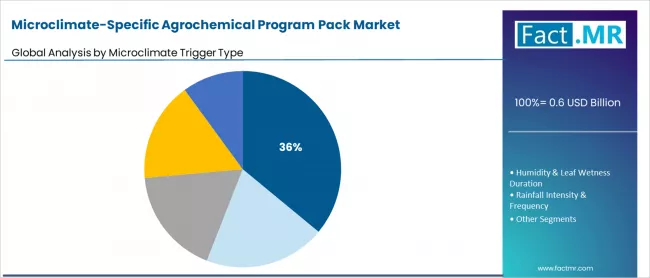
Temperature extremes represent the leading trigger type at 36%. Both heat waves and unseasonal frosts cause acute, often irreversible damage to plant cells and disrupt metabolic processes. Trigger-based packs for temperature stress go beyond simple protection; they include chemistries and biologics that prepare plant defenses ahead of forecasted events or facilitate recovery afterward.
This proactive approach, activated by precise weather predictions and real-time canopy temperature monitoring, shifts management from reaction to prevention, safeguarding photosynthetic capacity and reproductive development in high-value crops.
What are the Drivers, Restraints, and Key Trends of the Microclimate-Specific Agrochemical Program Pack Market?
Market expansion is propelled by the increasing accessibility and declining cost of in-field IoT sensors, which provide the granular environmental data necessary to trigger these packs. The escalating frequency and intensity of anomalous weather events due to climate change make static crop protection programs ineffective. Simultaneously, the rising cost of agrochemicals demands their use only under conditions guaranteeing maximum efficacy. The integration of these packs within broader digital farming platforms offers a seamless user experience, bundling data analytics with actionable input recommendations.
A significant restraint is the high initial investment required for a comprehensive sensor network and the digital subscription platform. The complexity of interpreting microclimate data and trusting algorithmic recommendations can be a barrier for less technologically adept farmers. Regulatory hurdles may exist for conditional use of pesticides based on sensor triggers rather than fixed schedules. Furthermore, the need for extreme reliability in both data transmission and pack efficacy is critical, as failure could lead to significant crop loss and erode user confidence.
Key trends feature the development of "predictive packs" activated by forecast models days before a stress event occurs. Cross-platform interoperability is becoming essential, allowing data from various sensor brands to inform a single decision engine. There is a growing emphasis on packs that include biological and nutrient components to build innate plant resilience alongside conventional protection. The market is also seeing the emergence of outcome-based insurance products linked to the use of these verified, adaptive program packs.
Analysis of the Microclimate-Specific Agrochemical Program Pack Market by Key Countries
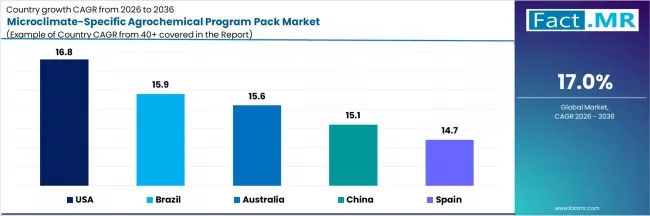
| Country | CAGR (2026-2036) |
|---|---|
| USA | 16.80% |
| Brazil | 15.90% |
| Australia | 15.60% |
| China | 15.10% |
| Spain | 14.70% |
How does the USA's Advanced Digital Agriculture Infrastructure Foster Adoption?

The USA exhibits a 16.80% CAGR, leveraging its mature ecosystem of precision agriculture technology, widespread high-speed connectivity in rural areas, and high adoption rates of yield monitoring and field mapping. American farmers face volatile seasonal conditions where a single hailstorm or heatwave can drastically alter disease risk within hours.
The ability of microclimate-specific packs to dynamically adjust recommendations provides a critical risk management tool. Major platform providers are embedding these packs into their existing digital suites, allowing farmers to activate them with a single click, driving integration at scale across millions of row crop acres.
Why is Brazil's Tropical Climate with Localized Rainfall Patterns a Key Driver?
Brazil's 15.90% growth is fueled by the highly variable microclimates within its vast fields, especially in the Cerrado region. Convective rainfall can drench one field section while leaving another dry, creating patchwork disease pressure. Brazilian growers, managing immense scale, utilize these program packs to respond to these hyperlocal conditions without blanket-spraying entire operations.
The integration of pack recommendations with irrigation and sprayer controllers allows for automated, sector-specific interventions, optimizing resource use and protecting yield potential in a climate where manual scouting is logistically impossible.
What Role Does Australia's Climate Extremes and Export Focus Play?
Australia's 15.60% CAGR is closely tied to its reputation for climate volatility and its dependence on high-quality, residue-compliant exports. Australian farmers use microclimate packs to navigate extreme diurnal temperature swings, sudden frosts, and erratic rainfall.
For horticulture and viticulture exporters, these packs are instrumental in managing residue profiles by applying chemistries only when specific humidity or temperature thresholds indicate maximum efficacy and minimum pre-harvest interval risk, ensuring strict compliance with international market standards.
How is China's Push for Smart Agriculture and Food Security Shaping the Market?
China's 15.10% growth aligns with national mandates to modernize agriculture through digital tools and protect food supply stability. Government-supported smart farm demonstrations and subsidies for sensor technology accelerate adoption.
In China's intensive protected horticulture and sprawling field crop operations, microclimate packs help manage the unique stresses of high-density planting and regional pollution-influenced weather patterns. Domestic tech companies are rapidly developing affordable, integrated sensor-and-pack solutions tailored for smallholder collectives, aiming to boost nationwide productivity and resilience.
What Factors Underpin Spain's Leadership in Precision Mediterranean Agriculture?
Spain's 14.70% growth is anchored in its high-value, irrigated Mediterranean production of fruits, vegetables, and wine grapes. These crops are exceptionally sensitive to microclimate shifts, such as cold night-warm day transitions that promote powdery mildew or extreme heat during flowering.
Spanish cultivators and agricultural cooperatives utilize sophisticated sensor networks to monitor canopy conditions in real time. Microclimate packs provide the targeted recommendations needed to protect premium quality and yield, making them an indispensable tool for maintaining competitiveness in the demanding European fresh produce market.
Competitive Landscape
The competitive landscape is defined by digital agriculture platforms competing to become the central decision-support hub for farmers. Established major platforms like Climate FieldView compete by leveraging their vast existing user bases and integrating program packs as a premium service layer on top of their foundational data storage and visualization tools. Their strength lies in brand recognition, extensive field data history, and partnerships with input manufacturers to co-develop validated pack recommendations.

Specialized AI and analytics firms like Prospera, Taranis, and Arable Labs compete through superior computer vision algorithms, unique sensor technology, or advanced forecasting models. They focus on delivering highly accurate, actionable insights for specific high-value crop segments. Competition intensifies around the predictive accuracy of the algorithms, the ease of integrating diverse data streams, the agronomic robustness of the recommended packs, and the ability to demonstrate a clear return on investment through input savings and yield preservation. Success increasingly depends on forming alliances with input suppliers, equipment manufacturers, and financial service providers to create bundled offerings.
Key Players in the Microclimate-Specific Agrochemical Program Pack Market
- Climate FieldView (Program Bundles)
- Prospera Technologies
- Taranis Ag Analytics
- CropX Technologies
- Arable Labs
Scope of Report
| Items | Values |
|---|---|
| Quantitative Units | USD Billion |
| Program Pack Type | Heat–Humidity Adaptive Packs, Drought–Stress Mitigation Packs, Excess Rainfall & Disease Pressure Packs, Cold Night–Warm Day Transition Packs, Others |
| Crop System | Row Crops (Corn, Soybean, Cotton), Fruits & Vegetables, Vineyards & Orchards, Plantation & Specialty Crops, Others |
| Microclimate Trigger Type | Temperature Extremes (Heat & Cold Stress), Humidity & Leaf Wetness Duration, Rainfall Intensity & Frequency, Wind Speed & Drift Risk Profiles, Others |
| Key Countries | USA, Brazil, Australia, China, Spain |
| Key Companies | Climate FieldView (Program Bundles), Prospera Technologies, Taranis Ag Analytics, CropX Technologies, Arable Labs |
| Additional Analysis | Analysis of sensor network density requirements, algorithmic validation protocols for trigger thresholds, data ownership and privacy frameworks, insurance and financial product linkages, and lifecycle assessment of input savings. |
Microclimate-Specific Agrochemical Program Pack Market by Segments
-
Program Pack Type :
- Heat–Humidity Adaptive Packs
- Drought–Stress Mitigation Packs
- Excess Rainfall & Disease Pressure Packs
- Cold Night–Warm Day Transition Packs
- Others
-
Crop System :
- Row Crops (Corn, Soybean, Cotton)
- Fruits & Vegetables
- Vineyards & Orchards
- Plantation & Specialty Crops
- Others
-
Microclimate Trigger Type :
- Temperature Extremes (Heat & Cold Stress)
- Humidity & Leaf Wetness Duration
- Rainfall Intensity & Frequency
- Wind Speed & Drift Risk Profiles
- Others
-
Region :
-
North America
- USA
- Canada
-
Latin America
- Brazil
- Mexico
- Argentina
- Rest of Latin America
-
Western Europe
- Germany
- UK
- France
- Spain
- Italy
- BENELUX
- Rest of Western Europe
-
Eastern Europe
- Czech Republic
- Poland
- Russia
- Rest of Eastern Europe
-
East Asia
- China
- Japan
- South Korea
- Rest of East Asia
-
South Asia & Pacific
- India
- Indonesia
- Australia
- Rest of South Asia & Pacific
-
MEA
- GCC Countries
- Turkiye
- Saudi Arabia
- Rest of MEA
-
Table of Content
- Executive Summary
- Global Market Outlook
- Demand to side Trends
- Supply to side Trends
- Technology Roadmap Analysis
- Analysis and Recommendations
- Market Overview
- Market Coverage / Taxonomy
- Market Definition / Scope / Limitations
- Market Background
- Market Dynamics
- Drivers
- Restraints
- Opportunity
- Trends
- Scenario Forecast
- Demand in Optimistic Scenario
- Demand in Likely Scenario
- Demand in Conservative Scenario
- Opportunity Map Analysis
- Product Life Cycle Analysis
- Supply Chain Analysis
- Investment Feasibility Matrix
- Value Chain Analysis
- PESTLE and Porter’s Analysis
- Regulatory Landscape
- Regional Parent Market Outlook
- Production and Consumption Statistics
- Import and Export Statistics
- Market Dynamics
- Global Market Analysis 2021 to 2025 and Forecast, 2026 to 2036
- Historical Market Size Value (USD Million) Analysis, 2021 to 2025
- Current and Future Market Size Value (USD Million) Projections, 2026 to 2036
- Y to o to Y Growth Trend Analysis
- Absolute $ Opportunity Analysis
- Global Market Pricing Analysis 2021 to 2025 and Forecast 2026 to 2036
- Global Market Analysis 2021 to 2025 and Forecast 2026 to 2036, By Program Pack Type
- Introduction / Key Findings
- Historical Market Size Value (USD Million) Analysis By Program Pack Type, 2021 to 2025
- Current and Future Market Size Value (USD Million) Analysis and Forecast By Program Pack Type, 2026 to 2036
- Heat–Humidity Adaptive Packs
- Drought–Stress Mitigation Packs
- Excess Rainfall & Disease Pressure Packs
- Cold Night–Warm Day Transition Packs
- Others
- Heat–Humidity Adaptive Packs
- Y to o to Y Growth Trend Analysis By Program Pack Type, 2021 to 2025
- Absolute $ Opportunity Analysis By Program Pack Type, 2026 to 2036
- Global Market Analysis 2021 to 2025 and Forecast 2026 to 2036, By Crop System
- Introduction / Key Findings
- Historical Market Size Value (USD Million) Analysis By Crop System, 2021 to 2025
- Current and Future Market Size Value (USD Million) Analysis and Forecast By Crop System, 2026 to 2036
- Row Crops (Corn, Soybean, Cotton)
- Fruits & Vegetables
- Vineyards & Orchards
- Plantation & Specialty Crops
- Others
- Row Crops (Corn, Soybean, Cotton)
- Y to o to Y Growth Trend Analysis By Crop System, 2021 to 2025
- Absolute $ Opportunity Analysis By Crop System, 2026 to 2036
- Global Market Analysis 2021 to 2025 and Forecast 2026 to 2036, By Microclimate Trigger Type
- Introduction / Key Findings
- Historical Market Size Value (USD Million) Analysis By Microclimate Trigger Type, 2021 to 2025
- Current and Future Market Size Value (USD Million) Analysis and Forecast By Microclimate Trigger Type, 2026 to 2036
- Temperature Extremes (Heat Cold Stress)
- Humidity & Leaf Wetness Duration
- Rainfall Intensity & Frequency
- Wind Speed & Drift Risk Profiles
- Others
- Temperature Extremes (Heat Cold Stress)
- Y to o to Y Growth Trend Analysis By Microclimate Trigger Type, 2021 to 2025
- Absolute $ Opportunity Analysis By Microclimate Trigger Type, 2026 to 2036
- Global Market Analysis 2021 to 2025 and Forecast 2026 to 2036, By Region
- Introduction
- Historical Market Size Value (USD Million) Analysis By Region, 2021 to 2025
- Current Market Size Value (USD Million) Analysis and Forecast By Region, 2026 to 2036
- North America
- Latin America
- Western Europe
- Eastern Europe
- East Asia
- South Asia and Pacific
- Middle East & Africa
- Market Attractiveness Analysis By Region
- North America Market Analysis 2021 to 2025 and Forecast 2026 to 2036, By Country
- Historical Market Size Value (USD Million) Trend Analysis By Market Taxonomy, 2021 to 2025
- Market Size Value (USD Million) Forecast By Market Taxonomy, 2026 to 2036
- By Country
- USA
- Canada
- Mexico
- By Program Pack Type
- By Crop System
- By Microclimate Trigger Type
- By Country
- Market Attractiveness Analysis
- By Country
- By Program Pack Type
- By Crop System
- By Microclimate Trigger Type
- Key Takeaways
- Latin America Market Analysis 2021 to 2025 and Forecast 2026 to 2036, By Country
- Historical Market Size Value (USD Million) Trend Analysis By Market Taxonomy, 2021 to 2025
- Market Size Value (USD Million) Forecast By Market Taxonomy, 2026 to 2036
- By Country
- Brazil
- Chile
- Rest of Latin America
- By Program Pack Type
- By Crop System
- By Microclimate Trigger Type
- By Country
- Market Attractiveness Analysis
- By Country
- By Program Pack Type
- By Crop System
- By Microclimate Trigger Type
- Key Takeaways
- Western Europe Market Analysis 2021 to 2025 and Forecast 2026 to 2036, By Country
- Historical Market Size Value (USD Million) Trend Analysis By Market Taxonomy, 2021 to 2025
- Market Size Value (USD Million) Forecast By Market Taxonomy, 2026 to 2036
- By Country
- Germany
- UK
- Italy
- Spain
- France
- Nordic
- BENELUX
- Rest of Western Europe
- By Program Pack Type
- By Crop System
- By Microclimate Trigger Type
- By Country
- Market Attractiveness Analysis
- By Country
- By Program Pack Type
- By Crop System
- By Microclimate Trigger Type
- Key Takeaways
- Eastern Europe Market Analysis 2021 to 2025 and Forecast 2026 to 2036, By Country
- Historical Market Size Value (USD Million) Trend Analysis By Market Taxonomy, 2021 to 2025
- Market Size Value (USD Million) Forecast By Market Taxonomy, 2026 to 2036
- By Country
- Russia
- Poland
- Hungary
- Balkan & Baltic
- Rest of Eastern Europe
- By Program Pack Type
- By Crop System
- By Microclimate Trigger Type
- By Country
- Market Attractiveness Analysis
- By Country
- By Program Pack Type
- By Crop System
- By Microclimate Trigger Type
- Key Takeaways
- East Asia Market Analysis 2021 to 2025 and Forecast 2026 to 2036, By Country
- Historical Market Size Value (USD Million) Trend Analysis By Market Taxonomy, 2021 to 2025
- Market Size Value (USD Million) Forecast By Market Taxonomy, 2026 to 2036
- By Country
- China
- Japan
- South Korea
- By Program Pack Type
- By Crop System
- By Microclimate Trigger Type
- By Country
- Market Attractiveness Analysis
- By Country
- By Program Pack Type
- By Crop System
- By Microclimate Trigger Type
- Key Takeaways
- South Asia and Pacific Market Analysis 2021 to 2025 and Forecast 2026 to 2036, By Country
- Historical Market Size Value (USD Million) Trend Analysis By Market Taxonomy, 2021 to 2025
- Market Size Value (USD Million) Forecast By Market Taxonomy, 2026 to 2036
- By Country
- India
- ASEAN
- Australia & New Zealand
- Rest of South Asia and Pacific
- By Program Pack Type
- By Crop System
- By Microclimate Trigger Type
- By Country
- Market Attractiveness Analysis
- By Country
- By Program Pack Type
- By Crop System
- By Microclimate Trigger Type
- Key Takeaways
- Middle East & Africa Market Analysis 2021 to 2025 and Forecast 2026 to 2036, By Country
- Historical Market Size Value (USD Million) Trend Analysis By Market Taxonomy, 2021 to 2025
- Market Size Value (USD Million) Forecast By Market Taxonomy, 2026 to 2036
- By Country
- Kingdom of Saudi Arabia
- Other GCC Countries
- Turkiye
- South Africa
- Other African Union
- Rest of Middle East & Africa
- By Program Pack Type
- By Crop System
- By Microclimate Trigger Type
- By Country
- Market Attractiveness Analysis
- By Country
- By Program Pack Type
- By Crop System
- By Microclimate Trigger Type
- Key Takeaways
- Key Countries Market Analysis
- USA
- Pricing Analysis
- Market Share Analysis, 2025
- By Program Pack Type
- By Crop System
- By Microclimate Trigger Type
- Canada
- Pricing Analysis
- Market Share Analysis, 2025
- By Program Pack Type
- By Crop System
- By Microclimate Trigger Type
- Mexico
- Pricing Analysis
- Market Share Analysis, 2025
- By Program Pack Type
- By Crop System
- By Microclimate Trigger Type
- Brazil
- Pricing Analysis
- Market Share Analysis, 2025
- By Program Pack Type
- By Crop System
- By Microclimate Trigger Type
- Chile
- Pricing Analysis
- Market Share Analysis, 2025
- By Program Pack Type
- By Crop System
- By Microclimate Trigger Type
- Germany
- Pricing Analysis
- Market Share Analysis, 2025
- By Program Pack Type
- By Crop System
- By Microclimate Trigger Type
- UK
- Pricing Analysis
- Market Share Analysis, 2025
- By Program Pack Type
- By Crop System
- By Microclimate Trigger Type
- Italy
- Pricing Analysis
- Market Share Analysis, 2025
- By Program Pack Type
- By Crop System
- By Microclimate Trigger Type
- Spain
- Pricing Analysis
- Market Share Analysis, 2025
- By Program Pack Type
- By Crop System
- By Microclimate Trigger Type
- France
- Pricing Analysis
- Market Share Analysis, 2025
- By Program Pack Type
- By Crop System
- By Microclimate Trigger Type
- India
- Pricing Analysis
- Market Share Analysis, 2025
- By Program Pack Type
- By Crop System
- By Microclimate Trigger Type
- ASEAN
- Pricing Analysis
- Market Share Analysis, 2025
- By Program Pack Type
- By Crop System
- By Microclimate Trigger Type
- Australia & New Zealand
- Pricing Analysis
- Market Share Analysis, 2025
- By Program Pack Type
- By Crop System
- By Microclimate Trigger Type
- China
- Pricing Analysis
- Market Share Analysis, 2025
- By Program Pack Type
- By Crop System
- By Microclimate Trigger Type
- Japan
- Pricing Analysis
- Market Share Analysis, 2025
- By Program Pack Type
- By Crop System
- By Microclimate Trigger Type
- South Korea
- Pricing Analysis
- Market Share Analysis, 2025
- By Program Pack Type
- By Crop System
- By Microclimate Trigger Type
- Russia
- Pricing Analysis
- Market Share Analysis, 2025
- By Program Pack Type
- By Crop System
- By Microclimate Trigger Type
- Poland
- Pricing Analysis
- Market Share Analysis, 2025
- By Program Pack Type
- By Crop System
- By Microclimate Trigger Type
- Hungary
- Pricing Analysis
- Market Share Analysis, 2025
- By Program Pack Type
- By Crop System
- By Microclimate Trigger Type
- Kingdom of Saudi Arabia
- Pricing Analysis
- Market Share Analysis, 2025
- By Program Pack Type
- By Crop System
- By Microclimate Trigger Type
- Turkiye
- Pricing Analysis
- Market Share Analysis, 2025
- By Program Pack Type
- By Crop System
- By Microclimate Trigger Type
- South Africa
- Pricing Analysis
- Market Share Analysis, 2025
- By Program Pack Type
- By Crop System
- By Microclimate Trigger Type
- USA
- Market Structure Analysis
- Competition Dashboard
- Competition Benchmarking
- Market Share Analysis of Top Players
- By Regional
- By Program Pack Type
- By Crop System
- By Microclimate Trigger Type
- Competition Analysis
- Competition Deep Dive
- Climate FieldView (Program Bundles)
- Overview
- Product Portfolio
- Profitability by Market Segments (Product/Age /Sales Channel/Region)
- Sales Footprint
- Strategy Overview
- Marketing Strategy
- Product Strategy
- Channel Strategy
- Prospera Technologies
- Taranis Ag Analytics
- CropX Technologies
- Arable Labs
- Others
- Climate FieldView (Program Bundles)
- Competition Deep Dive
- Assumptions & Acronyms Used
- Research Methodology
List Of Table
- Table 1: Global Market Value (USD Million) Forecast by Region, 2021 to 2036
- Table 2: Global Market Value (USD Million) Forecast by Program Pack Type, 2021 to 2036
- Table 3: Global Market Value (USD Million) Forecast by Crop System, 2021 to 2036
- Table 4: Global Market Value (USD Million) Forecast by Microclimate Trigger Type, 2021 to 2036
- Table 5: North America Market Value (USD Million) Forecast by Country, 2021 to 2036
- Table 6: North America Market Value (USD Million) Forecast by Program Pack Type, 2021 to 2036
- Table 7: North America Market Value (USD Million) Forecast by Crop System, 2021 to 2036
- Table 8: North America Market Value (USD Million) Forecast by Microclimate Trigger Type, 2021 to 2036
- Table 9: Latin America Market Value (USD Million) Forecast by Country, 2021 to 2036
- Table 10: Latin America Market Value (USD Million) Forecast by Program Pack Type, 2021 to 2036
- Table 11: Latin America Market Value (USD Million) Forecast by Crop System, 2021 to 2036
- Table 12: Latin America Market Value (USD Million) Forecast by Microclimate Trigger Type, 2021 to 2036
- Table 13: Western Europe Market Value (USD Million) Forecast by Country, 2021 to 2036
- Table 14: Western Europe Market Value (USD Million) Forecast by Program Pack Type, 2021 to 2036
- Table 15: Western Europe Market Value (USD Million) Forecast by Crop System, 2021 to 2036
- Table 16: Western Europe Market Value (USD Million) Forecast by Microclimate Trigger Type, 2021 to 2036
- Table 17: Eastern Europe Market Value (USD Million) Forecast by Country, 2021 to 2036
- Table 18: Eastern Europe Market Value (USD Million) Forecast by Program Pack Type, 2021 to 2036
- Table 19: Eastern Europe Market Value (USD Million) Forecast by Crop System, 2021 to 2036
- Table 20: Eastern Europe Market Value (USD Million) Forecast by Microclimate Trigger Type, 2021 to 2036
- Table 21: East Asia Market Value (USD Million) Forecast by Country, 2021 to 2036
- Table 22: East Asia Market Value (USD Million) Forecast by Program Pack Type, 2021 to 2036
- Table 23: East Asia Market Value (USD Million) Forecast by Crop System, 2021 to 2036
- Table 24: East Asia Market Value (USD Million) Forecast by Microclimate Trigger Type, 2021 to 2036
- Table 25: South Asia and Pacific Market Value (USD Million) Forecast by Country, 2021 to 2036
- Table 26: South Asia and Pacific Market Value (USD Million) Forecast by Program Pack Type, 2021 to 2036
- Table 27: South Asia and Pacific Market Value (USD Million) Forecast by Crop System, 2021 to 2036
- Table 28: South Asia and Pacific Market Value (USD Million) Forecast by Microclimate Trigger Type, 2021 to 2036
- Table 29: Middle East & Africa Market Value (USD Million) Forecast by Country, 2021 to 2036
- Table 30: Middle East & Africa Market Value (USD Million) Forecast by Program Pack Type, 2021 to 2036
- Table 31: Middle East & Africa Market Value (USD Million) Forecast by Crop System, 2021 to 2036
- Table 32: Middle East & Africa Market Value (USD Million) Forecast by Microclimate Trigger Type, 2021 to 2036
List Of Figures
- Figure 1: Global Market Pricing Analysis
- Figure 2: Global Market Value (USD Million) Forecast 2021 to 2036
- Figure 3: Global Market Value Share and BPS Analysis by Program Pack Type, 2026 and 2036
- Figure 4: Global Market Y to o to Y Growth Comparison by Program Pack Type, 2026 to 2036
- Figure 5: Global Market Attractiveness Analysis by Program Pack Type
- Figure 6: Global Market Value Share and BPS Analysis by Crop System, 2026 and 2036
- Figure 7: Global Market Y to o to Y Growth Comparison by Crop System, 2026 to 2036
- Figure 8: Global Market Attractiveness Analysis by Crop System
- Figure 9: Global Market Value Share and BPS Analysis by Microclimate Trigger Type, 2026 and 2036
- Figure 10: Global Market Y to o to Y Growth Comparison by Microclimate Trigger Type, 2026 to 2036
- Figure 11: Global Market Attractiveness Analysis by Microclimate Trigger Type
- Figure 12: Global Market Value (USD Million) Share and BPS Analysis by Region, 2026 and 2036
- Figure 13: Global Market Y to o to Y Growth Comparison by Region, 2026 to 2036
- Figure 14: Global Market Attractiveness Analysis by Region
- Figure 15: North America Market Incremental Dollar Opportunity, 2026 to 2036
- Figure 16: Latin America Market Incremental Dollar Opportunity, 2026 to 2036
- Figure 17: Western Europe Market Incremental Dollar Opportunity, 2026 to 2036
- Figure 18: Eastern Europe Market Incremental Dollar Opportunity, 2026 to 2036
- Figure 19: East Asia Market Incremental Dollar Opportunity, 2026 to 2036
- Figure 20: South Asia and Pacific Market Incremental Dollar Opportunity, 2026 to 2036
- Figure 21: Middle East & Africa Market Incremental Dollar Opportunity, 2026 to 2036
- Figure 22: North America Market Value Share and BPS Analysis by Country, 2026 and 2036
- Figure 23: North America Market Value Share and BPS Analysis by Program Pack Type, 2026 and 2036
- Figure 24: North America Market Y to o to Y Growth Comparison by Program Pack Type, 2026 to 2036
- Figure 25: North America Market Attractiveness Analysis by Program Pack Type
- Figure 26: North America Market Value Share and BPS Analysis by Crop System, 2026 and 2036
- Figure 27: North America Market Y to o to Y Growth Comparison by Crop System, 2026 to 2036
- Figure 28: North America Market Attractiveness Analysis by Crop System
- Figure 29: North America Market Value Share and BPS Analysis by Microclimate Trigger Type, 2026 and 2036
- Figure 30: North America Market Y to o to Y Growth Comparison by Microclimate Trigger Type, 2026 to 2036
- Figure 31: North America Market Attractiveness Analysis by Microclimate Trigger Type
- Figure 32: Latin America Market Value Share and BPS Analysis by Country, 2026 and 2036
- Figure 33: Latin America Market Value Share and BPS Analysis by Program Pack Type, 2026 and 2036
- Figure 34: Latin America Market Y to o to Y Growth Comparison by Program Pack Type, 2026 to 2036
- Figure 35: Latin America Market Attractiveness Analysis by Program Pack Type
- Figure 36: Latin America Market Value Share and BPS Analysis by Crop System, 2026 and 2036
- Figure 37: Latin America Market Y to o to Y Growth Comparison by Crop System, 2026 to 2036
- Figure 38: Latin America Market Attractiveness Analysis by Crop System
- Figure 39: Latin America Market Value Share and BPS Analysis by Microclimate Trigger Type, 2026 and 2036
- Figure 40: Latin America Market Y to o to Y Growth Comparison by Microclimate Trigger Type, 2026 to 2036
- Figure 41: Latin America Market Attractiveness Analysis by Microclimate Trigger Type
- Figure 42: Western Europe Market Value Share and BPS Analysis by Country, 2026 and 2036
- Figure 43: Western Europe Market Value Share and BPS Analysis by Program Pack Type, 2026 and 2036
- Figure 44: Western Europe Market Y to o to Y Growth Comparison by Program Pack Type, 2026 to 2036
- Figure 45: Western Europe Market Attractiveness Analysis by Program Pack Type
- Figure 46: Western Europe Market Value Share and BPS Analysis by Crop System, 2026 and 2036
- Figure 47: Western Europe Market Y to o to Y Growth Comparison by Crop System, 2026 to 2036
- Figure 48: Western Europe Market Attractiveness Analysis by Crop System
- Figure 49: Western Europe Market Value Share and BPS Analysis by Microclimate Trigger Type, 2026 and 2036
- Figure 50: Western Europe Market Y to o to Y Growth Comparison by Microclimate Trigger Type, 2026 to 2036
- Figure 51: Western Europe Market Attractiveness Analysis by Microclimate Trigger Type
- Figure 52: Eastern Europe Market Value Share and BPS Analysis by Country, 2026 and 2036
- Figure 53: Eastern Europe Market Value Share and BPS Analysis by Program Pack Type, 2026 and 2036
- Figure 54: Eastern Europe Market Y to o to Y Growth Comparison by Program Pack Type, 2026 to 2036
- Figure 55: Eastern Europe Market Attractiveness Analysis by Program Pack Type
- Figure 56: Eastern Europe Market Value Share and BPS Analysis by Crop System, 2026 and 2036
- Figure 57: Eastern Europe Market Y to o to Y Growth Comparison by Crop System, 2026 to 2036
- Figure 58: Eastern Europe Market Attractiveness Analysis by Crop System
- Figure 59: Eastern Europe Market Value Share and BPS Analysis by Microclimate Trigger Type, 2026 and 2036
- Figure 60: Eastern Europe Market Y to o to Y Growth Comparison by Microclimate Trigger Type, 2026 to 2036
- Figure 61: Eastern Europe Market Attractiveness Analysis by Microclimate Trigger Type
- Figure 62: East Asia Market Value Share and BPS Analysis by Country, 2026 and 2036
- Figure 63: East Asia Market Value Share and BPS Analysis by Program Pack Type, 2026 and 2036
- Figure 64: East Asia Market Y to o to Y Growth Comparison by Program Pack Type, 2026 to 2036
- Figure 65: East Asia Market Attractiveness Analysis by Program Pack Type
- Figure 66: East Asia Market Value Share and BPS Analysis by Crop System, 2026 and 2036
- Figure 67: East Asia Market Y to o to Y Growth Comparison by Crop System, 2026 to 2036
- Figure 68: East Asia Market Attractiveness Analysis by Crop System
- Figure 69: East Asia Market Value Share and BPS Analysis by Microclimate Trigger Type, 2026 and 2036
- Figure 70: East Asia Market Y to o to Y Growth Comparison by Microclimate Trigger Type, 2026 to 2036
- Figure 71: East Asia Market Attractiveness Analysis by Microclimate Trigger Type
- Figure 72: South Asia and Pacific Market Value Share and BPS Analysis by Country, 2026 and 2036
- Figure 73: South Asia and Pacific Market Value Share and BPS Analysis by Program Pack Type, 2026 and 2036
- Figure 74: South Asia and Pacific Market Y to o to Y Growth Comparison by Program Pack Type, 2026 to 2036
- Figure 75: South Asia and Pacific Market Attractiveness Analysis by Program Pack Type
- Figure 76: South Asia and Pacific Market Value Share and BPS Analysis by Crop System, 2026 and 2036
- Figure 77: South Asia and Pacific Market Y to o to Y Growth Comparison by Crop System, 2026 to 2036
- Figure 78: South Asia and Pacific Market Attractiveness Analysis by Crop System
- Figure 79: South Asia and Pacific Market Value Share and BPS Analysis by Microclimate Trigger Type, 2026 and 2036
- Figure 80: South Asia and Pacific Market Y to o to Y Growth Comparison by Microclimate Trigger Type, 2026 to 2036
- Figure 81: South Asia and Pacific Market Attractiveness Analysis by Microclimate Trigger Type
- Figure 82: Middle East & Africa Market Value Share and BPS Analysis by Country, 2026 and 2036
- Figure 83: Middle East & Africa Market Value Share and BPS Analysis by Program Pack Type, 2026 and 2036
- Figure 84: Middle East & Africa Market Y to o to Y Growth Comparison by Program Pack Type, 2026 to 2036
- Figure 85: Middle East & Africa Market Attractiveness Analysis by Program Pack Type
- Figure 86: Middle East & Africa Market Value Share and BPS Analysis by Crop System, 2026 and 2036
- Figure 87: Middle East & Africa Market Y to o to Y Growth Comparison by Crop System, 2026 to 2036
- Figure 88: Middle East & Africa Market Attractiveness Analysis by Crop System
- Figure 89: Middle East & Africa Market Value Share and BPS Analysis by Microclimate Trigger Type, 2026 and 2036
- Figure 90: Middle East & Africa Market Y to o to Y Growth Comparison by Microclimate Trigger Type, 2026 to 2036
- Figure 91: Middle East & Africa Market Attractiveness Analysis by Microclimate Trigger Type
- Figure 92: Global Market - Tier Structure Analysis
- Figure 93: Global Market - Company Share Analysis
- FAQs -
How big is the microclimate-specific agrochemical program pack market in 2026?
The global microclimate-specific agrochemical program pack market is estimated to be valued at USD 0.6 billion in 2026.
What will be the size of microclimate-specific agrochemical program pack market in 2036?
The market size for the microclimate-specific agrochemical program pack market is projected to reach USD 2.9 billion by 2036.
How much will be the microclimate-specific agrochemical program pack market growth between 2026 and 2036?
The microclimate-specific agrochemical program pack market is expected to grow at a 17.0% CAGR between 2026 and 2036.
What are the key product types in the microclimate-specific agrochemical program pack market?
The key product types in microclimate-specific agrochemical program pack market are heat–humidity adaptive packs, drought–stress mitigation packs, excess rainfall & disease pressure packs, cold night–warm day transition packs and others.
Which crop system segment to contribute significant share in the microclimate-specific agrochemical program pack market in 2026?
In terms of crop system, row crops (corn, soybean, cotton) segment to command 41.0% share in the microclimate-specific agrochemical program pack market in 2026.