- Market Value (2025): USD 2.88 Bn
- Estimated Value (2026): USD 2.97 Bn
- Forecast Value (2036): USD 4.52 Bn
- CAGR (2026-2036): 4.3%
What is the Glass Reinforced Furnaces Market forecast to be worth by 2036?
USD 2.97 billion in 2026 to USD 4.52 billion by 2036 at a 4.3% CAGR.
- Fact.MR estimates that the Glass Reinforced Furnaces Market was valued at USD 2.85 billion in 2025.
- Demand will grow from USD 2.97 billion in 2026 to USD 4.52 billion by 2036.
- The market is forecast to grow at a 4.3% CAGR from 2026 to 2036 as glass processors invest in controlled heating and strengthening equipment.
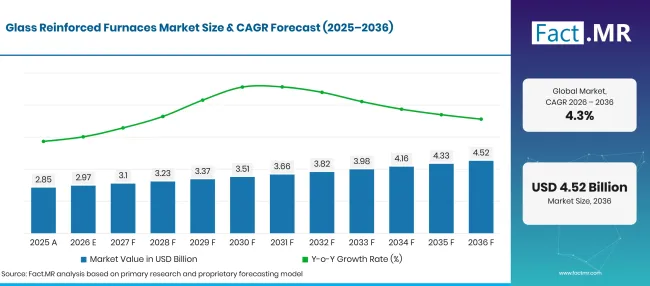
Factmr Glass Reinforced Furnaces Market Forecast Global | Source: Fact.MR
| Year | Basis | Market Value (USD billion) |
|---|---|---|
| 2025 | Actual | 2.85 |
| 2026 | Estimate | 2.97 |
| 2036 | Forecast | 4.52 |
| CAGR 2026 to 2036 | Forecast period | 4.3% |
Source: Fact.MR analysis. Updated Nov 3, 2026
What are the defining numbers behind Glass Reinforced Furnaces Market growth?
USD 1.5 billion absolute opportunity between 2026 and 2036.
- Demand Drivers in the Market
- Construction companies use strengthened glass in windows, facades, doors, and partitions. These applications require glass with suitable mechanical strength and thermal resistance.
- Automotive manufacturers require processed glass for vehicle windows and other glazing applications. Furnace suppliers can benefit from demand for equipment that handles different glass dimensions and supports repeatable production quality.
- Glass processors are considering furnace efficiency and operating costs when upgrading production lines. Electric and gas-heated systems offer different heating characteristics, making energy consumption and temperature control important purchasing considerations.
- Automation is becoming relevant to glass heat-treatment operations. Temperature monitoring and automated controls can help processors maintain consistent production conditions and reduce variations in finished glass quality.
- Key Segments Analyzed
- By Product Type, Electric Glass Reinforced Furnaces will account for 42.3% of the 2026 market, reflecting demand for controlled electric heating.
- By Application, Residential applications represent for 38.7% of the market in 2026, supported by the use of strengthened glass in building products.
- By End User, Construction will lead with 41.2% of the market in 2026 because of demand for architectural glazing and building installations.
- By Distribution Channel, Direct Sales hold 52.1% of the market in 2026 as buyers seek equipment configuration and technical support from manufacturers.
- Analyst Opinion at Fact.MR
- Shambhu Nath Jha, Principal Consultant at Fact.MR, states, “Glass processors are likely to focus on furnace systems that deliver consistent heating and dependable production quality. Equipment suppliers that improve energy efficiency and provide application-specific support can strengthen their position as construction and automotive glass requirements evolve.”
- Strategic Implications
- Furnace manufacturers should improve heating efficiency and temperature control to address operating cost concerns among glass processors.
- Equipment suppliers need to develop automated controls that support repeatable treatment across different glass dimensions and thicknesses.
- Distributors must provide installation guidance and maintenance support to help processors reduce equipment downtime.
- Glass processors can evaluate furnace capacity and energy consumption against their production requirements before selecting equipment.
Germany is forecast to record a 5.3% CAGR through 2036. Brazil is projected to register 4.8%, followed by the USA at 4.4%. The UK is estimated to advance at 3.9%, while Japan is forecast at 3.5%.
How does the Glass Reinforced Furnaces Market break down by segment?
According to Fact.MR, Electric Glass Reinforced Furnaces leads Product Type at 42.3%; Residential leads Application at 38.7%; Construction leads End User at 41.2%; and Direct Sales Leads Distribution Channel at 52.1%.
Which Product Type dominates?
Electric Glass Reinforced Furnaces is projected to hold 42.3% of the market in 2026.
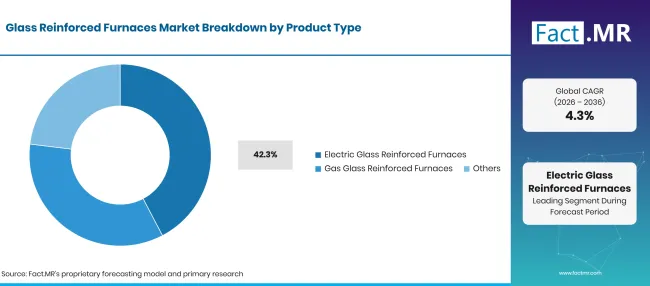
Factmr Glass Reinforced Furnaces Market Breakdown Product Type | Source: Fact.MR
| Product Type | Share (2026) |
|---|---|
| Electric Glass Reinforced Furnaces (Leading segment) | 42.3% |
| Other segments combined | 57.7%* |
| Total | 100.0% |
Source: Fact.MR analysis. Updated Nov 3, 2026
Electric furnace systems account for the leading share under this product classification. Their controlled heating characteristics make them relevant to glass processors that require consistent thermal treatment. Gas-heated systems remain important where production configuration and energy availability influence equipment selection. Other furnace types serve specialized processing requirements.
What leads the Application segment?
Residential is projected to represent 38.7% of the market in 2026.
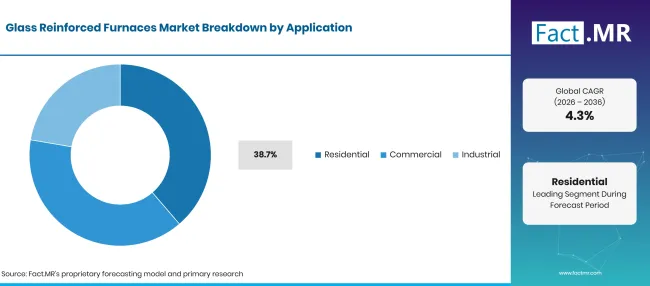
Factmr Glass Reinforced Furnaces Market Breakdown Application | Source: Fact.MR
| Application | Share (2026) |
|---|---|
| Residential (Leading segment) | 38.7% |
| Other segments combined | 61.3%* |
| Total | 100.0% |
Source: Fact.MR analysis. Updated Nov 3, 2026
Residential applications include strengthened glass used in windows, doors, partitions, and other building components. Commercial projects require glass for offices, retail buildings, and architectural installations. Industrial applications include specialized glass processing requirements where thermal performance and product consistency are important.
How does End User shape demand?
Construction is expected to account for 41.2% of the market in 2026.
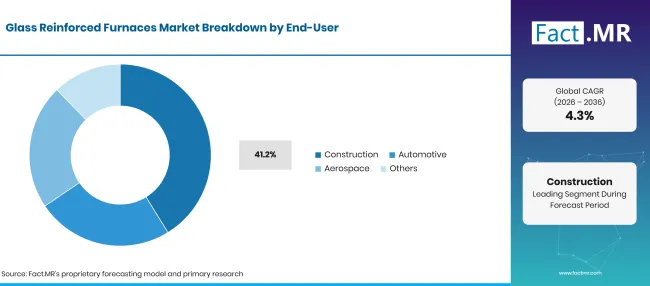
Factmr Glass Reinforced Furnaces Market Breakdown End User | Source: Fact.MR
| End User | Share (2026) |
|---|---|
| Construction (Leading segment) | 41.2% |
| Other segments combined | 58.8%* |
| Total | 100.0% |
Source: Fact.MR analysis. Updated Nov 3, 2026
Construction accounts for the largest end-user share because strengthened glass is used across building envelopes and interior installations. Automotive manufacturers require processed glass for vehicle glazing, while aerospace applications involve specialized glass requirements. Other end users purchase strengthened glass for different industrial and commercial purposes.
What drives the Distribution Channel segment?
Direct Sales leads with 52.1% of the market in 2026.
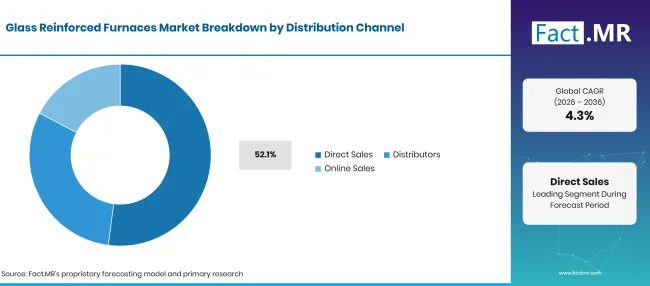
Factmr Glass Reinforced Furnaces Market Breakdown Distribution Channel | Source: Fact.MR
| Distribution Channel | Share (2026) |
|---|---|
| Direct Sales (Leading segment) | 52.1% |
| Other segments combined | 47.9%* |
| Total | 100.0% |
Source: Fact.MR analysis. Updated Nov 3, 2026
Direct sales allow furnace manufacturers to engage with glass processors during equipment selection and installation. Buyers may require technical guidance on heating capacity, furnace dimensions, automation, and maintenance. Distributors support regional access to equipment and services, while online channels can assist with product discovery and initial supplier evaluation.
What is accelerating Glass Reinforced Furnaces Market adoption, and what is holding it back?
Demand for strengthened glass and furnace automation supports adoption, but high equipment costs and energy requirements can slow investment.
Drivers Impact Analysis
| DRIVER | (~) % IMPACT ON CAGR | GEOGRAPHIC RELEVANCE | IMPACT TIMELINE |
|---|---|---|---|
| Demand for architectural strengthened glass | +1.0% | Europe, Asia, Americas | Medium term (2–4 years) |
| Automotive glass processing requirements | +0.9% | Global | Medium term (2–4 years) |
| Furnace automation and process control | +0.7% | Global | Short term (≤ 2 years) |
| Energy-efficient heating technologies | +0.5% | Europe, Asia | Long term (≥ 4 years) |
| Industrial glass processing investments | +0.4% | Global | Medium term (2–4 years) |
Source: Fact.MR analysis. Updated Nov 3, 2026
Opportunity Impact Analysis
| OPPORTUNITY | (~) % IMPACT ON CAGR | GEOGRAPHIC RELEVANCE | IMPACT TIMELINE |
|---|---|---|---|
| Development of energy-efficient electric furnaces | +0.8% | Global | Long term (≥ 4 years) |
| Automated temperature monitoring | +0.7% | Global | Medium term (2–4 years) |
| Application-specific furnace configurations | +0.6% | Europe, Asia | Medium term (2–4 years) |
| After-sales service and maintenance contracts | +0.5% | Global | Short term (≤ 2 years) |
| Expansion of architectural glass processing | +0.4% | Americas, Asia | Long term (≥ 4 years) |
Source: Fact.MR analysis. Updated Nov 3, 2026
Restraints Impact Analysis
| RESTRAINT | (~) % IMPACT ON CAGR | GEOGRAPHIC RELEVANCE | IMPACT TIMELINE |
|---|---|---|---|
| High initial furnace investment | -0.8% | Global | Short term (≤ 2 years) |
| Energy consumption during operation | -0.6% | Global | Medium term (2–4 years) |
| Maintenance and replacement costs | -0.5% | Global | Medium term (2–4 years) |
| Technical skills required for operation | -0.4% | Emerging markets | Long term (≥ 4 years) |
| Production downtime during installation | -0.3% | Global | Short term (≤ 2 years) |
Source: Fact.MR analysis. Updated Nov 3, 2026
Which countries are scaling the Glass Reinforced Furnaces Market through 2036?
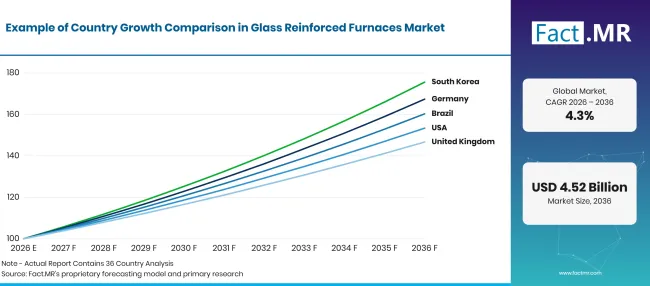
Glass Reinforced Furnaces Market Growth Index | Source: Fact.MR
| Country | CAGR (2026–2036) |
|---|---|
| Germany | 5.3% |
| Brazil | 4.8% |
| USA | 4.4% |
| UK | 3.9% |
| Japan | 3.5% |
Source: Fact.MR analysis. Updated Nov 3, 2026
What supports Germany adoption?
5.3% CAGR, supported by industrial manufacturing and demand for high-performance glass processing.
Germany's established industrial base creates demand for advanced glass-processing equipment. Destatis reported that automotive industry production increased by 3.6% month on month in June 2026, after seasonal and calendar adjustment. Construction production increased by 0.1% over the same period. These official indicators provide industrial context for glass-tempering furnace suppliers; they do not directly measure furnace purchases [6].[6]
How is Brazil developing glass reinforced furnace adoption?
4.8% CAGR, driven by construction requirements and automotive glass processing.
Brazil's construction and automotive industries provide potential customers for glass processors supplying building and vehicle applications. IBGE reported that the National Index of Civil Construction, a construction-cost indicator, increased by 1.19% in June 2026 and by 4.48% in the first half of the year. These figures describe construction costs rather than building output or furnace purchases [7].[7]
What supports United States adoption?
4.4% CAGR, supported by construction glazing and automotive glass requirements.
The United States market is influenced by architectural and automotive glazing requirements. The U.S. Census Bureau estimated August 2026 construction spending at a seasonally adjusted annual rate of USD 2,203.1 billion, up 0.9% from the revised July estimate. This is a broad construction-spending indicator rather than a direct measure of glass furnace demand [8].[8]
How is the United Kingdom building adoption?
3.9% CAGR, shaped by architectural glazing and industrial glass processing.
The UK market is influenced by architectural glazing and industrial glass processing. The Office for National Statistics reported that manufacturing output grew 1.2% in August 2026 compared with July. Over the separate three months ending August, construction output declined by 1.0% compared with the preceding three months. These measures provide wider industrial context for equipment investment [9].[9]
What supports Japan adoption?
3.5% CAGR, supported by automotive manufacturing and precision glass processing.
Japan's automotive and electronics industries require glass products with controlled dimensions and performance characteristics. The country's official Statistics Dashboard recorded an industrial production index of 104.1 for September 2026, with 2020 set as the base year. However, the Ministry of Land, Infrastructure, Transport and Tourism reported a 2.7% year-on-year decline in new housing starts during September. Investment in glass-processing furnaces is therefore likely to depend more heavily on automotive and specialized industrial applications than on broad housing expansion [10] [11].
Who leads the Glass Reinforced Furnaces Market?
According to Fact.MR, MAPPI International, Glaston Corporation, LandGlass, Nabertherm, and CTM are relevant suppliers of glass-tempering and glass-treatment furnace equipment. HORN Glass Industries participates in the broader glass-melting furnace equipment category.
MAPPI International supplies electric glass-tempering furnaces [1]. Glaston provides tempering machinery for architectural and automotive glass processing [2]. LandGlass offers flat and bent glass-tempering furnace systems, including electric and gas-heated configurations [3]. Nabertherm supplies industrial furnace solutions for glass and fibre-optics processing, while CTM offers industrial glass chemical-tempering equipment [4].
HORN Glass Industries is relevant to glass-melting furnace systems. Its inclusion depends on whether the market definition extends beyond glass strengthening and thermal treatment to include raw-glass melting equipment [5].
Which companies are the key providers?
Key companies include MAPPI International; Glaston Corporation; LandGlass; Nabertherm GmbH; CTM S.r.l.
- MAPPI International
- Glaston Corporation
- LandGlass
- Nabertherm GmbH
- CTM S.r.l.
Bibliography
- [1] MAPPI International. (n.d.). Products: Glass tempering furnaces
- [2] Glaston Corporation. (n.d.). Tempering
- [3] LandGlass. (n.d.). Glass tempering furnace
- [4] Nabertherm GmbH. (n.d.). Fiber Optics/Glass
- [5] HORN Glass Industries AG. (n.d.). Melting furnaces & equipment
- [6] Statistisches Bundesamt (Destatis). (2026, August 7). Production in June 2026: +0.2% on the previous month
- [7] Instituto Brasileiro de Geografia e Estatística. (2026, July 10). National Index of Civil Construction accelerates to 1.19% in June
- [8] U.S. Census Bureau. (2026, October 1). Monthly construction spending, August 2026
- [9] Office for National Statistics. (2026, October 15). GDP monthly estimate, UK: August 2026
- [10] Statistics Bureau of Japan. (n.d.). Statistics Dashboard
- [11] Ministry of Land, Infrastructure, Transport and Tourism. (2026, October 30).[Building starts statistics report: September 2026]
This Report Answers
- The report describes how glass reinforced furnaces are used in glass strengthening and thermal treatment.
- Segment analysis compares electric and gas furnace systems alongside the application categories.
- Country analysis discusses Germany, Brazil, USA, UK, and Japan based on the growth estimates.
- The competitive overview profiles specialist furnace and glass-processing equipment suppliers.
- Distribution analysis compares direct sales with distributor-led and online channels.
- The report evaluates demand drivers and restraints affecting furnace investment decisions.
What does the Glass Reinforced Furnaces Market cover?
The market covers industrial furnace systems used to strengthen glass through controlled heating and thermal treatment. It tracks electric and gas-heated furnace configurations used by glass processors serving construction, automotive, aerospace, and other applications. Equipment selection depends on heating performance, production capacity, energy consumption, automation, and the required characteristics of finished glass.
What is included in the scope?
Included products comprise industrial furnace systems used for glass strengthening and related thermal treatment. The value boundary covers electric and gas-heated systems and other relevant furnace configurations. Application coverage includes residential, commercial, and industrial uses, while end-user coverage includes construction, automotive, aerospace, and other industries.
What is excluded from the scope?
The analysis excludes finished glass products and glass materials sold independently of furnace equipment. Glass manufacturers are not classified as furnace-equipment suppliers solely because they operate furnaces in their production facilities. General industrial furnaces without a relevant glass-processing application are also excluded. Furnace installation and maintenance services are not counted as equipment revenue unless specifically included in the market valuation.
How Was the Analysis Built?
The analysis draws on 120+ sources, 35+ company portfolios, 25+ countries, and more than 20 industry interviews.
- Primary Research: Primary research includes discussions with furnace manufacturers, glass processors, equipment distributors, end users, and subject-matter experts. These conversations examine equipment selection, heating requirements, purchasing priorities, operational challenges, maintenance needs, and the factors influencing adoption.
- Desk Research: Desk research covers company product portfolios, technical documentation, industry publications, government resources, trade data, manufacturing statistics, and other relevant sources. Every source used in the analysis is documented in the bibliography.
- Market Sizing and Forecasting: Market estimates combine historical performance, equipment demand indicators, pricing and volume trends, segment shares, company participation, country-level growth, investment activity, and barriers to market expansion.
- Data Validation and Update Cycle: Findings are validated by comparing primary interviews with company product information, public data, industry developments, equipment launches, capacity changes, and shifts in commercial adoption.
Segmentation
What is the report’s scope and coverage?
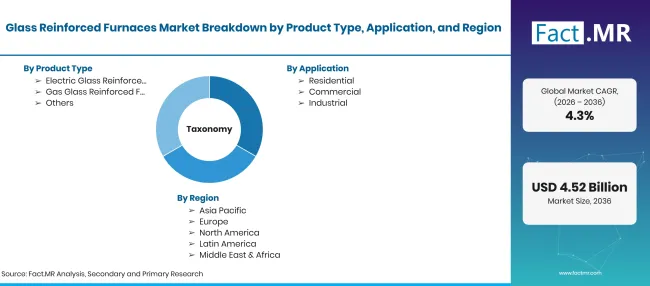
Factmr Glass Reinforced Furnaces Market Taxonomy | Source: Fact.MR
| Attribute | Details |
|---|---|
| Quantitative Units | USD billion |
| Market Definition | The glass tempering furnaces market as industrial heating systems designed to strengthen glass through controlled thermal processing. These furnaces heat glass before rapid cooling to improve its strength and resistance to impact and thermal stress across architectural and automotive applications. |
| Product Type | Electric Glass Reinforced Furnaces; Gas Glass Reinforced Furnaces; Others |
| Application | Residential; Commercial; Industrial |
| End User | Construction; Automotive; Aerospace; Others |
| Distribution Channel | Direct Sales; Distributors; Online Sales |
| Regions Covered | North America; Latin America; Europe; East Asia; South Asia & Pacific; Middle East & Africa |
| Countries Covered | Germany; Brazil; USA; UK; Japan |
| Companies Profiled | MAPPI International; Glaston Corporation; LandGlass; Nabertherm GmbH; CTM S.r.l. |
| Forecast Period | 2026 to 2036 |
| Approach | Market segmentation and scenario-based analysis supported by company product portfolios and industry demand indicators |
Source: Fact.MR analysis. Updated Nov 3, 2026
How is the market segmented?
-
By Product Type
- Electric Glass Reinforced Furnaces
- Gas Glass Reinforced Furnaces
- Others
-
By Application
- Residential
- Commercial
- Industrial
-
By End User
- Construction
- Automotive
- Aerospace
- Others
-
By Distribution Channel
- Direct Sales
- Distributors
- Online Sales
-
By Region
- North America
- Latin America
- Western Europe
- Eastern Europe
- East Asia
- South Asia & Pacific
- Middle East & Africa
Who worked on this report


Preview the report firsthand - request a free sample
Free SampleGet the brochure for pricing and purchase details
Download PDF