- Market Value (2025): USD 4.91 Bn
- Estimated Value (2026): USD 5.25 Bn
- Forecast Value (2036): USD 10.4 Bn
- CAGR (2026-2036): 7.0%
What is the Curved Glass Market forecast to be worth by 2036?
USD 5.3 billion in 2026 to USD 10.4 billion by 2036 at a 7.0% CAGR.
- As per Fact.MR analysis, the curved glass market was valued at USD 4.91 billion in 2025.
- Demand will grow from USD 5.25 billion in 2026 to USD 10.4 billion by 2036.
- The market is forecast to grow at a 7.0% CAGR from 2026 to 2036 as automotive styling and architectural glazing applications support demand for shaped glass.
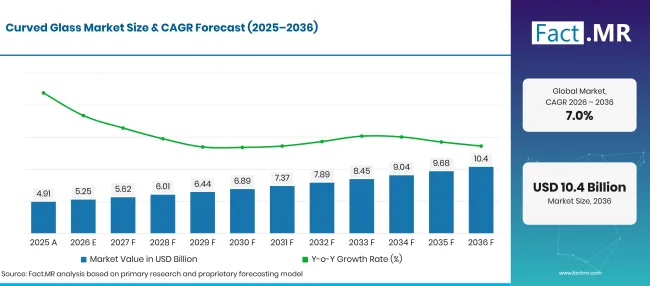
Curved Glass Market Forecast Global | Source: Fact.MR
| Year | Basis | Market Value (USD billion) |
|---|---|---|
| 2025 | Actual | 4.91 |
| 2026 | Estimate | 5.25 |
| 2036 | Forecast | 10.4 |
| CAGR 2026 to 2036 | Forecast period | 7.0% |
Source: Fact.MR analysis. Updated Nov 3, 2026
What are the defining numbers behind Curved Glass Market growth?
USD 5.1 billion absolute opportunity between 2026 and 2036.
- Demand Drivers in the Market
- Automotive manufacturers use curved glazing to support vehicle styling, visibility and cabin design. Global motor-vehicle production is a relevant background indicator for glazing suppliers, but the report's 2025 worldwide production figure requires direct reconciliation with OICA's original country-level production table before publication [1].
- Architectural designers increasingly specify curved glazing for facades and interior structures. Guardian Glass identifies curved facades as an architectural application and describes glass solutions designed to retain visual and thermal performance after bending [2].
- Vehicle interiors increasingly feature larger integrated curved displays. Corning’s AutoGrade Gorilla Glass for 3D uses ColdForm technology to shape glass for curved automotive applications while maintaining optical performance [3].
- Building projects require curved glass that meets safety and performance standards. Saint-Gobain’s Contour portfolio supports architectural applications through curved glass that can be laminated or assembled into glazed units [4].
- Key Segments Analyzed
- By Product Type, Tempered Glass will represent 42.3% of the market in 2026 because heat treatment supports the strength and safety requirements of curved glazing.
- By Application, Automotive will account for 48.6% share in 2026, reflecting the use of shaped windscreens, side windows, panoramic roofs, and interior display covers.
- By End User, Commercial leads with 52.3% share in 2026, supported by demand from commercial building projects and vehicle-related applications.
- Analyst Opinion at Fact.MR
- Shambhu Nath Jha, Principal Consultant at Fact.MR, states, “Curved glass is gaining relevance where manufacturers and architects want greater design flexibility without compromising safety or optical quality. Suppliers that can deliver consistent curvature and reliable processing across automotive and building applications are likely to find wider opportunities.”
- Strategic Implications
- Glass manufacturers should strengthen bending and tempering capabilities to meet complex curvature and dimensional requirements.
- Automotive suppliers need to develop lightweight curved glazing that supports panoramic roofs and integrated display designs.
- Architectural glass providers can demonstrate how curved products retain safety and thermal performance after processing.
- Electronics suppliers must focus on optical consistency and surface quality for curved display cover glass.
- Buyers need to be assessed for the glass specification and installation requirements before comparing products only on price.
Germany is forecast to record 7.8% CAGR through 2036. Brazil is projected to register 7.1%, followed by the USA at 6.5%. The UK is estimated to advance at 5.8%, while Japan is forecast at 5.1%.
How does the Curved Glass Market break down by segment?
According to Fact.MR, Tempered Glass leads Product Type at 42.3%; Automotive leads Application at 48.6%; and Commercial Leads End User at 52.3%.
Which Product Type dominates?
Tempered Glass is projected to hold 42.3% of the market in 2026.
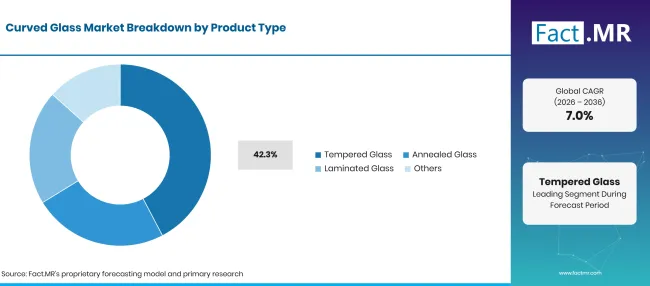
Curved Glass Market Breakdown Product Type | Source: Fact.MR
| Product Type | Share (2026) |
|---|---|
| Tempered Glass (Leading segment) | 42.3% |
| Other segments combined | 57.7%* |
| Total | 100.0% |
Source: Fact.MR analysis. Updated Nov 3, 2026
Tempered glass is used in curved glazing where greater resistance to mechanical and thermal stresses is required. Heat treatment is particularly relevant to automotive side windows and architectural installations that require safety performance. Annealed glass can be used in applications where further processing or specific design requirements determine the final product specification. Laminated glass combines glass layers with an interlayer to help retain fragments after breakage.
What leads the Application segment?
Automotive is projected to represent 48.6% of the market in 2026.
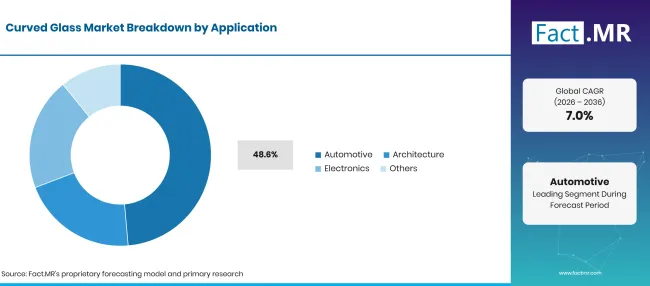
Curved Glass Market Breakdown Application | Source: Fact.MR
| Application | Share (2026) |
|---|---|
| Automotive (Leading segment) | 48.6% |
| Other segments combined | 51.4%* |
| Total | 100.0% |
Source: Fact.MR analysis. Updated Nov 3, 2026
Automotive applications include windscreens and side windows as well as panoramic roofs and other curved glazing components. Vehicle manufacturers use shaped glass to support aerodynamics and exterior styling while maintaining visibility and occupant protection. Architecture remains an important application through curved facades and interior glazing. Electronics uses curved cover glass for vehicle displays and other device interfaces.
How does End User shape demand?
Commercial is expected to account for 52.3% of the market in 2026.
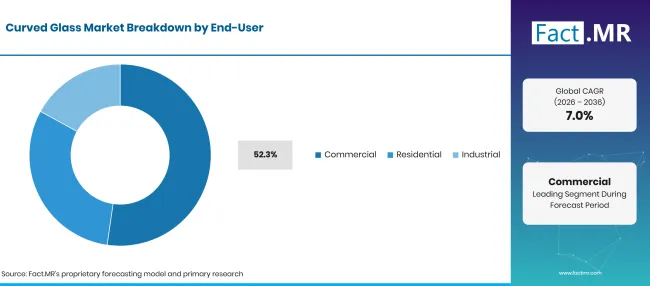
Curved Glass Market Breakdown End User | Source: Fact.MR
| End User | Share (2026) |
|---|---|
| Commercial (Leading segment) | 52.3% |
| Other segments combined | 47.7%* |
| Total | 100.0% |
Source: Fact.MR analysis. Updated Nov 3, 2026
Commercial applications in the supplied segmentation include curved architectural glazing for offices, retail buildings and other commercial properties. Automotive glazing for commercial vehicles should be classified consistently within vehicle-related applications to avoid overlap. Residential applications include curved windows and decorative installations, while industrial applications cover specialist protective glazing.
What is accelerating Curved Glass Market adoption, and what is holding it back?
Automotive design and architectural glazing support demand, while specialized processing costs and installation requirements can limit wider adoption.
Drivers Impact Analysis
| DRIVER | (~) % IMPACT ON CAGR | GEOGRAPHIC RELEVANCE | IMPACT TIMELINE |
|---|---|---|---|
| Curved automotive glazing requirements | +1.0% | Germany, USA, Japan | Medium term (2–4 years) |
| Architectural facade modernization | +0.9% | Europe, Asia, Middle East | Medium term (2–4 years) |
| Panoramic roof and vehicle design adoption | +0.7% | Global | Medium term (2–4 years) |
| Curved automotive display integration | +0.5% | Germany, Japan, USA | Long term (≥4 years) |
| Demand for customized building interiors | +0.4% | Global | Long term (≥4 years) |
Source: Fact.MR analysis. Updated Nov 3, 2026
Opportunity Impact Analysis
| OPPORTUNITY | (~) % IMPACT ON CAGR | GEOGRAPHIC RELEVANCE | IMPACT TIMELINE |
|---|---|---|---|
| Complex curved architectural facades | +0.8% | Europe, Middle East, Asia | Medium term (2–4 years) |
| Lightweight curved automotive glazing | +0.7% | Germany, Japan, USA | Medium term (2–4 years) |
| Curved display cover glass | +0.6% | Asia, USA, Europe | Long term (≥4 years) |
| Customized tempered curved glass | +0.5% | Global | Short term (≤2 years) |
| Laminated curved safety glazing | +0.4% | Global | Medium term (2–4 years) |
Source: Fact.MR analysis. Updated Nov 3, 2026
Restraints Impact Analysis
| RESTRAINT | (~) % IMPACT ON CAGR | GEOGRAPHIC RELEVANCE | IMPACT TIMELINE |
|---|---|---|---|
| High processing and tooling costs | -0.8% | Global | Short term (≤2 years) |
| Glass breakage during bending and tempering | -0.6% | Global | Short term (≤2 years) |
| Complex installation and replacement | -0.5% | Europe, North America | Medium term (2–4 years) |
| Dimensional and optical quality requirements | -0.4% | Global | Medium term (2–4 years) |
| Limited availability of specialized processors | -0.3% | Emerging markets | Long term (≥4 years) |
Source: Fact.MR analysis. Updated Nov 3, 2026
Which countries are scaling the Curved Glass Market through 2036?
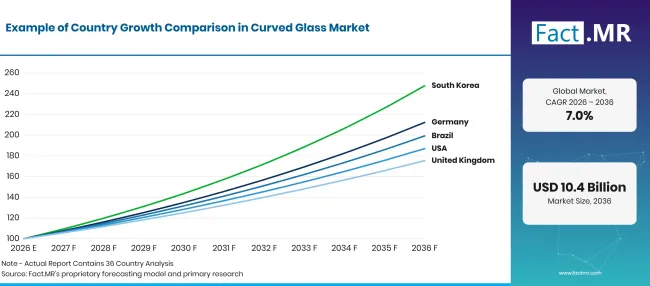
Curved Glass Market Growth Index | Source: Fact.MR
| Country | CAGR (2026–2036) |
|---|---|
| Germany | 7.8% |
| Brazil | 7.1% |
| USA | 6.5% |
| UK | 5.8% |
| Japan | 5.1% |
Source: Fact.MR analysis. Updated Nov 3, 2026
What supports Germany adoption?
7.8% CAGR, supported by automotive manufacturing and demand for advanced vehicle glazing.
Germany's automotive industry provides a strong base for curved glass demand. The VDA reported that domestic passenger car production reached approximately 4.15 million units in 2025, an increase of 2% over the previous year [5]. Automotive suppliers can address demand for shaped windscreens and panoramic glazing while architectural projects provide another route for curved glass adoption.
How is Brazil developing curved glass adoption?
7.1% CAGR, shaped by vehicle manufacturing and architectural construction requirements.
According to ANFAVEA's January 2026 industry presentation, Brazil produced approximately 2.644 million motor vehicles in 2025. This automotive production base provides context for vehicle-glazing manufacturers, although it does not directly measure curved-glass sales [6].
What supports United States adoption?
6.5% CAGR, driven by automotive production and demand for specialized architectural glazing.
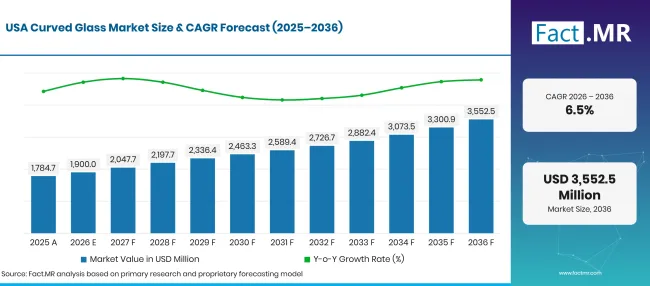
Curved Glass Market Forecast Usa | Source: Fact.MR
The United States recorded 16.2 million new light-vehicle sales in 2025, representing a 2.4% increase over 2024 [13]. This expanding vehicle market supports demand for advanced glazing solutions, including curved windscreens and panoramic roofs. Architectural opportunities are also supported by commercial construction activity, with office and industrial building expenditures contributing to broader demand for specialized glazing [14].
How is the United Kingdom building adoption?
5.8% CAGR, led by automotive production and architectural glazing projects.
The Society of Motor Manufacturers and Traders reported that UK factories produced 717,371 passenger cars in 2025. Automotive manufacturing is an important end-use industry for curved glazing, including products designed for model-specific glazing and safety requirements. Architectural uses include building facades and interior features [7].
What supports Japan adoption?
5.1% CAGR, backed by automotive manufacturing and advanced glass processing capabilities.
Japan produced approximately 8.41 million four-wheeled vehicles in 2025, an increase of 2.1% over the previous year, according to the Japan Automobile Manufacturers Association [8]. This production base supports demand for automotive glazing and panoramic roof components. Japanese glass manufacturers also participate in specialty glass development for vehicle displays and other electronic applications.
Who leads the Curved Glass Market?
According to Fact.MR, Saint-Gobain, Guardian Glass, AGC Inc., Nippon Sheet Glass, Xinyi Glass, Corning Incorporated, and SCHOTT AG are relevant suppliers across curved architectural glazing, automotive glass, and specialty glass processing.
Saint-Gobain offers Contour curved glass products for architectural applications. Guardian Glass provides architectural glazing solutions designed for curved facades. AGC's automotive portfolio includes flat and curved glass for transport applications [10]. Nippon Sheet Glass supplies architectural and automotive glazing and develops glass shaping capabilities for complex vehicle designs [11]. Xinyi Glass offers customized curved tempered glass for architectural projects [9]. Corning develops curved glass for automotive display interiors through its ColdForm technology. SCHOTT AG provides bending and reshaping capabilities for glass and glass-ceramic sheets [12].
Commercial competition depends on the ability to deliver consistent curvature and optical quality while meeting safety and installation requirements. Automotive customers require repeatable production and close coordination with vehicle design teams. Architectural buyers place greater emphasis on customized dimensions and facade performance. Specialty electronics applications require optical consistency and surface quality.
Which companies are the key providers?
Key companies include Saint-Gobain; Guardian Glass; AGC Inc.; Nippon Sheet Glass Co., Ltd.; Xinyi Glass Holdings Limited; Corning Incorporated; and SCHOTT AG.
- Saint-Gobain
- Guardian Glass
- AGC Inc.
- Nippon Sheet Glass Co., Ltd.
- Xinyi Glass Holdings Limited
- Corning Incorporated
- SCHOTT AG
Bibliography
- [1] International Organization of Motor Vehicle Manufacturers. (2026). World motor vehicle production by country/region and type: 2025.
- [3] Corning Incorporated. (n.d.). AutoGrade™ Corning Gorilla Glass for 3D interiors.
- [4] Saint-Gobain Glass. (n.d.). CONTOUR: Curved glass.
- [5] Verband der Automobilindustrie. (2026, January 5). Passenger car production in 2025 slightly above previous year's level.
- [6] Associação Nacional dos Fabricantes de Veículos Automotores. (2026, January 15). Produção e venda de autoveículos crescem em 2025 e Anfavea projeta nova alta em 2026.
- [7] Society of Motor Manufacturers and Traders. (2026, January 29). Tough year for auto but new models and Industrial Strategy can deliver growth.
- [8] Japan Automobile Manufacturers Association. (n.d.). 四輪車 [Four-wheeled vehicles].
- [9] Xinyi Glass Holdings Limited. (n.d.). Architectural glass.
- [10] AGC Automotive. (n.d.). Glass for transport vehicles.
- [11] Nippon Sheet Glass Co., Ltd. (n.d.). Products.
- [12] SCHOTT AG. (n.d.). Converting and reshaping.
- [13] Manzi, P. (2025, December 31). December 2025 Market Beat: New light-vehicle sales totaled 16.2 million units in 2025. National Automobile Dealers Association.
- [14] Lewandowski, B., Illig, A., Street, E., & Wobbekind, R. (2026). Economic impacts of commercial real estate in the U.S.: Office, industrial, retail and multifamily (2026 U.S. ed.). NAIOP Research Foundation.
This Report Answers
- The report describes how curved glass is used across automotive, architectural, and electronics applications.
- Segment analysis compares tempered, annealed, and laminated glass alongside the specified application categories.
- Country analysis discusses Germany, Brazil, USA, UK, and Japan alongside automotive production indicators.
- The competitive overview profiles companies with identifiable curved-glass products or glass-bending capabilities.
- Product analysis distinguishes tempered glass from annealed and laminated curved glass.
- Application analysis examines demand from automotive glazing and architectural projects as well as curved electronic display components.
What does the Curved Glass Market cover?
The market covers glass products shaped through bending or forming processes to create curved profiles. It includes curved glass used in vehicle windscreens and windows as well as architectural facades and interior structures. The scope also includes specialty curved glass used for electronic displays and other applications where a shaped glass surface is required.
What is included in the scope?
Included products cover tempered curved glass and curved glass made from annealed or laminated glass.
Automotive coverage includes windscreens and side windows as well as panoramic roof components. Architectural coverage includes curved facades and interior glazing. Electronics coverage includes curved display cover glass and related specialty components.
What is excluded from the scope?
The analysis excludes standard flat glass that has not undergone a bending or forming process.
Flat glass used as a raw material is not counted as a finished curved-glass product. General glass processing equipment and installation services are also excluded unless directly included in the sale of a curved-glass product. Non-glass plastic panels and polymer glazing are outside the defined market.
How Was the Analysis Built?
The analysis draws on 120+ sources, 35+ company portfolios, 25+ countries, and more than 20 industry interviews.
- Primary Research: Primary research includes discussions with glass manufacturers, processors, automotive suppliers, architectural glazing contractors, distributors, end users, and subject-matter experts. These conversations examine purchasing priorities, processing requirements, product adoption, quality standards, and manufacturing challenges.
- Desk Research: Desk research covers official automotive production statistics, company product portfolios, technical documents, construction and building publications, industry associations, and other authoritative sources. Every source used in the analysis is documented in the bibliography.
- Market Sizing and Forecasting: Market estimates combine historical performance, demand indicators, pricing and volume trends, segment shares, company participation, country-level growth, application trends, and barriers to market expansion.
- Data Validation and Update Cycle: Findings are validated by comparing company product information with public industry data and technical publications. Regular updates review new product launches, manufacturing capacity changes, partnerships, automotive platform developments, and architectural project activity.
Segmentation
What is the report’s scope and coverage?
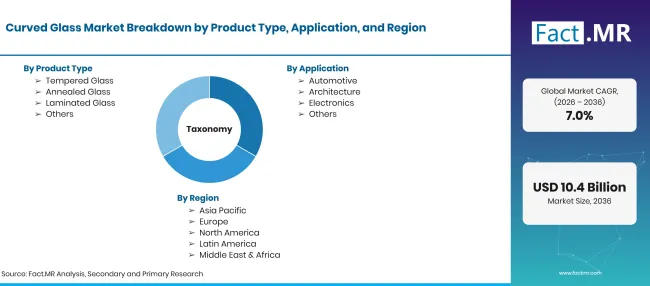
Curved Glass Market Taxonomy | Source: Fact.MR
| Attribute | Details |
|---|---|
| Quantitative Units | USD billion |
| Market Definition | The curved glass market comprises glass products that undergo controlled bending or forming processes to achieve specific curved shapes and dimensions. These products are used in automotive glazing and architectural structures alongside electronic displays and specialized equipment. |
| Product Type | Tempered Glass; Annealed Glass; Laminated Glass; Others |
| Application | Automotive; Architecture; Electronics; Others |
| End User | Commercial; Residential; Industrial |
| Regions Covered | North America; Latin America; Western Europe; Eastern Europe; East Asia; South Asia & Pacific; Middle East & Africa |
| Countries Covered | Germany; Brazil; USA; UK; Japan |
| Companies Profiled | Saint-Gobain; Guardian Glass; AGC Inc.; Nippon Sheet Glass Co., Ltd.; Xinyi Glass Holdings Limited; Corning Incorporated; SCHOTT AG |
| Forecast Period | 2026 to 2036 |
| Approach | Market segmentation and scenario-based analysis supported by company product portfolios and official automotive industry statistics |
Source: Fact.MR analysis. Updated Nov 3, 2026
How is the market segmented?
-
By Product Type
- Tempered Glass
- Annealed Glass
- Laminated Glass
- Others
-
By Application
- Automotive
- Architecture
- Electronics
- Others
-
By End User
- Commercial
- Residential
- Industrial
-
By Region
- North America
- Latin America
- Western Europe
- Eastern Europe
- East Asia
- South Asia & Pacific
- Middle East & Africa
Frequently Asked Questions
How big is the curved glass market in 2026?
What is the CAGR from 2026 to 2036?
Which product type has the largest share?
Which application leads the market?
Which end user has the largest share?
Which countries are covered?
Which companies are covered?
Who worked on this report


Preview the report firsthand - request a free sample
Free SampleGet the brochure for pricing and purchase details
Download PDF