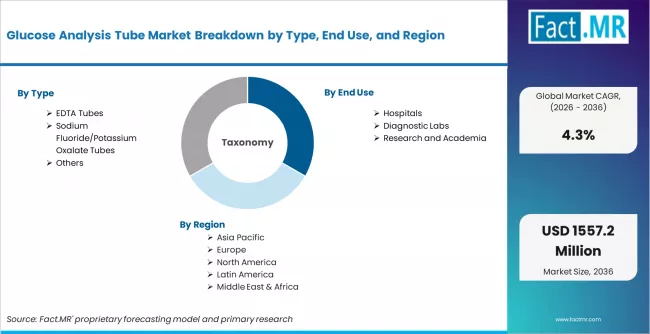
Glucose Analysis Tube Market Size, Share, Growth and Forecast (2026 - 2036)
Glucose Analysis Tube Market is segmented by Type (EDTA Tubes, Sodium Fluoride/Potassium Oxalate Tubes, Others), End Use (Hospitals, Diagnostic Labs, Research and Academia), Application (Blood Glucose Testing, Clinical Chemistry, Point Of Care Testing, Research Applications), and Region, with forecasts covering the period from 2026 to 2036.
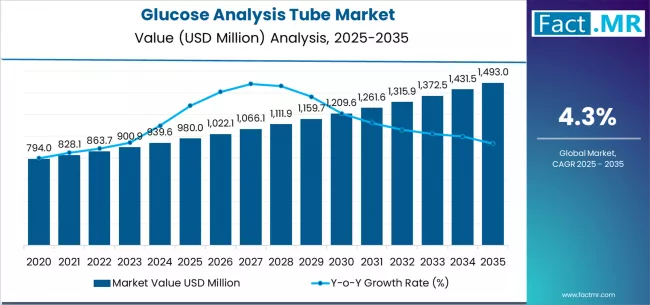
According to Fact.MR estimates, the global glucose analysis tube market market was valued at USD 980.0 million in 2025. The market is projected to reach USD 1,022.1 million in 2026 and is expected to grow to USD 1,557.2 million by 2036, expanding at a CAGR of 4.3%. EDTA Tubes is anticipated to account for 60.0% of the product segment in 2026, while Hospitals is expected to remain the leading application with around 55.0% share.
Glucose Analysis Tube Market Analysis and Forecast by Fact.MR
The glucose analysis tube market, valued at USD 980.0 million in 2025, is expanding at a 4.3% CAGR to reach USD 1,557.233 million by 2036. Glucose analysis tubes are pre-filled blood collection tubes containing anticoagulants and glycolysis inhibitors used to preserve blood glucose levels during transport and processing in clinical laboratory testing. Growth reflects the global diabetes pandemic driving diagnostic testing volumes, expanding clinical laboratory and point-of-care testing infrastructure, and standardization of pre-analytical sample handling protocols. The USD 535.093 million incremental opportunity between 2026 and 2036 is concentrated in EDTA-based tube demand across Asia, North America, and Europe.
Summary of Glucose Analysis Tube Market
- Market Snapshot
- Market value in 2025: USD 980.0 million
- Projected value in 2026: USD 1,022.14 million; forecast to reach USD 1,557.233 million by 2036
- CAGR from 2026 to 2036: 4.3%
- Incremental opportunity (2026 to 2036): USD 535.093 million
- EDTA tubes lead type demand with 60.0% share in 2025
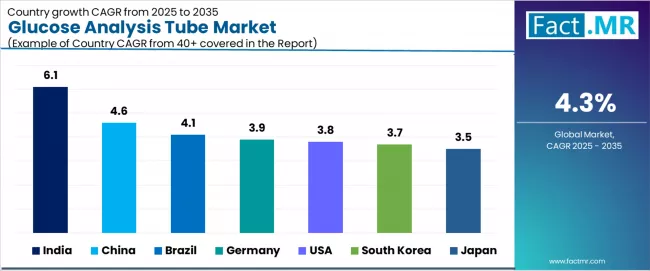
- India and China lead country-level growth, followed by Brazil and Germany
- Demand and Growth Drivers
- The global diabetes prevalence continues to rise, with the IDF projecting over 700 million adults affected by 2045, generating sustained and growing demand for blood glucose diagnostic testing and the consumable tubes required for each test.
- Clinical laboratory standardization initiatives are mandating specific tube types with validated glycolysis inhibitors for accurate glucose determination, creating structured procurement demand.
- Hospital and diagnostic laboratory construction in emerging markets is expanding the physical infrastructure for glucose testing, each facility requiring ongoing tube consumable supply.
- Point-of-care glucose testing is complementing rather than replacing laboratory-based testing, as confirmatory laboratory glucose analysis is still required for diabetes diagnosis and monitoring in many clinical protocols.
- Product and Segment View
- EDTA tubes hold 60.0% of type demand, driven by broad laboratory adoption for hematology and chemistry panels that include glucose analysis.
- Hospitals account for 55.0% of end-use demand, anchored by inpatient glucose monitoring, emergency department testing, and outpatient laboratory services.
- Blood glucose testing holds 36.5% of application share, the primary clinical application driving glucose analysis tube consumption.
- Key segmentation includes:
- Type: EDTA Tubes, Sodium Fluoride/Potassium Oxalate Tubes, Others
- End Use: Hospitals, Diagnostic Labs, Research and Academia
- Application: Blood Glucose Testing, Clinical Chemistry, Point of Care Testing, Research Applications
- Distribution Channel: Direct Sales, Distributors, Online Sales
- Geography and Competitive Outlook
- North America is a significant revenue region, with the USA contributing USD 365.415 million in 2025.
- South Asia is the fastest-growing region, with India recording the highest country CAGR driven by diabetes testing volume growth.
- Europe maintains steady growth, with Germany leading through laboratory standardization and quality protocols.
- Becton Dickinson and Company (BD) leads the competitive field with a 35.0% market share, followed by Greiner Bio-One, Terumo Corporation, and Sarstedt.
- Analyst Opinion
- The glucose analysis tube market is a laboratory consumable category where demand is structurally tied to the diabetes testing burden. With diabetes prevalence rising across all global regions, the per-test consumable requirement of blood collection tubes creates a proportional growth trajectory. Fact.MR expects the fastest volume growth to concentrate in India, China, and other high-diabetes-burden emerging markets where diagnostic laboratory infrastructure is expanding. In mature markets, growth is driven by testing frequency increases and tube technology upgrades that improve pre-analytical accuracy. BD maintains dominant market share through manufacturing scale, global distribution, and hospital procurement contract penetration.
Key Growth Drivers, Constraints, and Opportunities
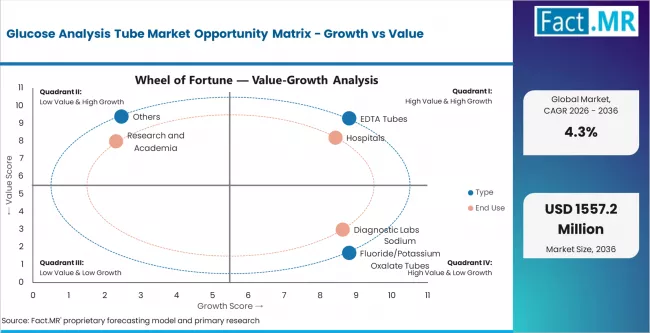
Key Factors Driving Growth
- Diabetes testing volume growth: Rising global diabetes prevalence generates proportional demand for glucose determination tests, each requiring one or more blood collection tubes as consumable inputs.
- Laboratory infrastructure expansion: Hospital and diagnostic laboratory construction in India, China, and other emerging markets creates new tube consumption at each facility commissioning.
- Pre-analytical standardization: Clinical laboratory accreditation requirements mandate validated tube types for glucose determination, reducing use of non-standardized collection methods.
Key Market Constraints
- Commodity pricing pressure: Blood collection tubes are commodity consumables with intense price competition, particularly for standard EDTA and NaF/KOx tube formats.
- POC glucose testing growth: Rapid POC glucose testing using handheld meters reduces laboratory glucose test volumes in some clinical settings, partially offsetting laboratory tube demand growth.
- Waste and sustainability concerns: Single-use plastic tube consumption generates laboratory waste streams, creating environmental scrutiny and potential regulatory pressure.
Key Opportunity Areas
- Citrate-buffered glucose tubes: Next-generation tubes using citrate buffer with NaF provide faster glycolysis inhibition than conventional NaF/KOx tubes, capturing procurement preference as clinical evidence accumulates.
- Emerging market laboratory expansion: Each new clinical laboratory in India, China, and Africa generates recurring tube demand proportional to testing volumes from the first day of operation.
- Integrated tube-automation compatibility: Tubes designed for compatibility with automated pre-analytical sorting and processing systems capture preference in laboratories upgrading to automated workflows.
Segment-wise Analysis of the Glucose Analysis Tube Market
- EDTA tubes lead type demand at 60.0%, driven by broad laboratory adoption for multi-analyte panels.
- Hospitals account for 55.0% of end-use demand, through inpatient and outpatient glucose testing services.
- Blood glucose testing holds 36.5% of application share.
Which type dominates the Glucose Analysis Tube Market?
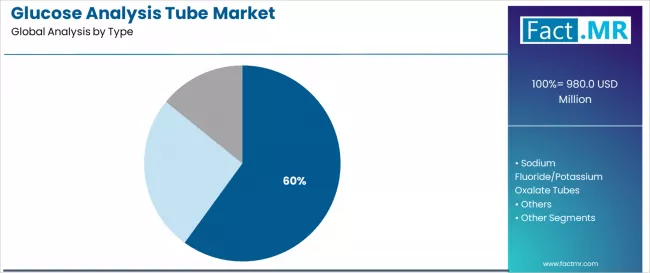
EDTA tubes hold a 60.0% share of type demand in 2025. The share reflects the broad laboratory use of EDTA anticoagulant tubes across hematology and chemistry panels that include glucose analysis as one of multiple analytes per draw. EDTA tubes serve dual purpose in many laboratory protocols, enabling both complete blood count and basic metabolic panel testing from the same specimen type, reducing the number of tubes required per patient.
Sodium fluoride/potassium oxalate tubes account for the second-largest share, specifically designed for glucose preservation through glycolysis inhibition. NaF/KOx tubes are the traditional gold standard for dedicated glucose determination, preventing in vitro glucose consumption during transport.
Which end use dominates the Glucose Analysis Tube Market?
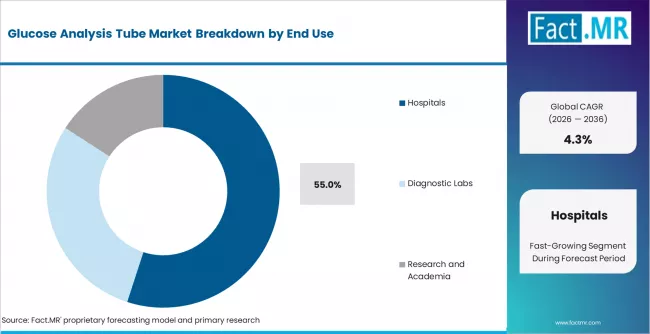
Hospitals account for 55.0% of end-use demand. Hospital laboratories process glucose analysis for inpatient monitoring, emergency department assessment, and outpatient clinic testing. The high testing volumes generated by hospital-based diabetes care programs, surgical patients requiring perioperative glucose management, and emergency presentations create sustained tube consumption.
Diagnostic laboratories represent the second-largest end-use segment, serving as reference laboratories for community-based glucose testing. Research and academic institutions contribute a smaller share for investigational glucose-related studies.
Which application dominates the Glucose Analysis Tube Market?
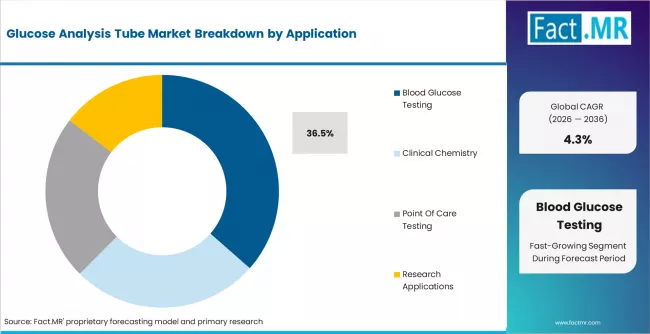
Blood glucose testing holds 36.5% of application share. The share reflects the primary clinical purpose of glucose analysis tubes: providing accurately preserved blood specimens for laboratory glucose determination used in diabetes diagnosis, monitoring, and management. Blood glucose testing is among the most frequently ordered laboratory tests globally.
Clinical chemistry is the second-largest application, as glucose analysis is routinely included in basic and comprehensive metabolic panels ordered across multiple clinical indications beyond diabetes management.
Which Product Trend is Shaping the Next Phase of Growth in the Glucose Analysis Tube Market?
Citrate-buffered glucose preservation tubes are shaping the next product generation. Conventional NaF/KOx tubes require 1 to 4 hours to fully inhibit glycolysis, during which specimen glucose levels can decline by 5% to 7%, creating pre-analytical error. Citrate-buffered tubes containing NaF achieve near-immediate glycolysis inhibition, preserving glucose levels within minutes of blood draw. Clinical evidence from IFCC working group studies supports the superior pre-analytical accuracy of citrate-buffered tubes, and laboratory guideline bodies are increasingly recommending their adoption for glucose determination.
The commercial transition from conventional NaF/KOx to citrate-buffered tubes creates a tube technology upgrade cycle that benefits manufacturers offering the newer format. BD, Greiner Bio-One, and Sarstedt have launched citrate-buffered glucose tubes, and Fact.MR projects that the transition will accelerate as accreditation bodies incorporate citrate-buffered tube recommendations into laboratory quality requirements. The upgrade carries a modest unit price premium that improves per-tube revenue in a commodity-pricing environment.
Regional Outlook Across Key Markets
.webp)
- North America is a significant revenue region, with the USA contributing USD 365.415 million in 2025.
- South Asia is the fastest-growing region, with India recording the highest country CAGR.
- East Asia records strong growth, with China expanding diagnostic laboratory capacity.
- Europe maintains steady growth, shaped by laboratory accreditation standards.
CAGR Table
| Country | CAGR (%) |
|---|---|
| India | 6.1% |
| China | 4.6% |
| Brazil | 4.1% |
| Germany | 3.9% |
| USA | 3.8% |
| South Korea | 3.7% |
| Japan | 3.5% |
Source: Fact.MR analysis, based on proprietary forecasting model and primary research.
India: diabetes burden and laboratory infrastructure expansion
India records the highest country-level CAGR driven by the world second-largest diabetes population (estimated over 100 million adults), rapid diagnostic laboratory construction, and government health programs expanding diabetes screening access. The proliferation of private diagnostic laboratory chains (Thyrocare, Dr Lal PathLabs, SRL Diagnostics) creates structured tube procurement demand at scale.
- Growth anchor: High diabetes burden and diagnostic laboratory chain expansion create proportional tube consumption growth.
USA: testing volume density and tube technology adoption
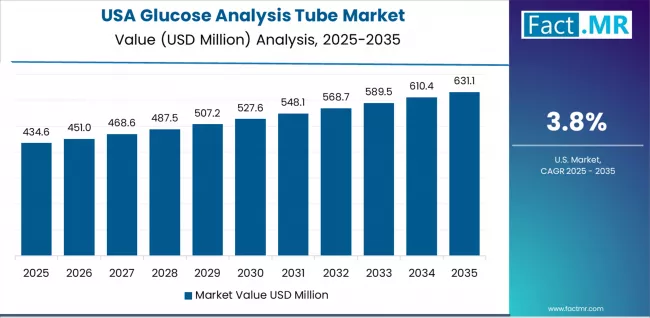
The USA contributes USD 365.415 million in 2025. Growth reflects high per-capita diabetes testing frequency, laboratory automation adoption driving tube-automation compatibility requirements, and the transition toward citrate-buffered glucose tubes in accredited laboratories. BD maintains dominant market share through hospital GPO contract penetration and established supply chain relationships.
- Growth anchor: High testing frequency and tube technology transition drive steady demand in a mature laboratory infrastructure.
China: diagnostic laboratory modernization
China records strong growth driven by public hospital clinical laboratory modernization, expanding diabetes screening programs, and growing adoption of international laboratory quality standards. The standardization of blood collection tube specifications through national laboratory accreditation requirements is creating structured procurement demand.
- Growth anchor: Laboratory modernization and diabetes screening expansion create dual demand for standardized glucose analysis tubes.
Germany: laboratory quality leadership
Germany leads European growth supported by rigorous clinical laboratory accreditation standards, high diabetes testing frequency in statutory health insurance-covered populations, and early adoption of citrate-buffered glucose tube technology based on IFCC recommendations.
- Growth anchor: Quality accreditation standards and guideline-driven tube technology adoption support premium product demand.
Competitive Benchmarking and Company Positioning
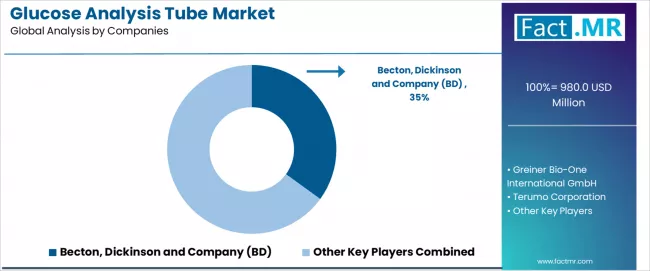
Glucose Analysis Tube Market Analysis By Company
- BD leads with 35.0% market share, maintaining dominance through manufacturing scale, global distribution infrastructure, and hospital GPO contract penetration across the Vacutainer product platform.
- Greiner Bio-One and Sarstedt compete in the mid-tier, each offering full blood collection tube portfolios with glucose-specific products and strong European and emerging market distribution.
- Terumo Corporation maintains a position through its blood collection systems and Asia-Pacific distribution strength.
The competitive field is concentrated, with BD commanding 35.0% market share through its Vacutainer platform dominance. BD benefits from hospital procurement contract lock-in, laboratory equipment integration, and the switching costs associated with changing tube suppliers across validated laboratory workflows.
Greiner Bio-One (Vacuette) and Sarstedt (Monovette) are the primary competitors, each offering comprehensive tube portfolios with specific glucose preservation tube options. Competition between these players is primarily on pricing, distribution reach, and tube-automation system compatibility.
Regional manufacturers in India (Hindustan Syringes, Poly Medicure) and China (Improve Medical, Kangjian Medical) are gaining share in their domestic markets by offering price-competitive tubes that meet national laboratory standards.
Key Companies in the Glucose Analysis Tube Market
Becton Dickinson and Company (BD), Greiner Bio-One International GmbH, Terumo Corporation, Sarstedt AG and Co. KG, FL Medical Srl, Cardinal Health Inc., Narang Medical Limited, Improve Medical Co. Ltd, Kangjian Medical Inc., and Hindustan Syringes and Medical Devices Ltd are the principal companies operating in the global glucose analysis tube market.
Recent Industry Developments
- BD: citrate-buffered glucose tube portfolio expansion (2025)
- BD expanded its Vacutainer citrate-buffered glucose tube product line in 2025, adding new tube volume sizes and configurations designed for compatibility with automated pre-analytical laboratory sorting systems.
- Greiner Bio-One: glucose tube automation integration (2025)
- Greiner Bio-One launched an updated Vacuette glucose tube in 2025 with enhanced barcode labeling and cap design optimized for automated laboratory processing lines.
- Sarstedt: emerging market distribution expansion (2025)
- Sarstedt expanded its glucose analysis tube distribution network in India and Southeast Asia in 2025, partnering with local distributors to serve the growing diagnostic laboratory market.
- Improve Medical: citrate-buffered tube launch for Chinese market (2026)
- Improve Medical Co. launched a citrate-buffered glucose preservation tube for the Chinese clinical laboratory market in early 2026, targeting hospital laboratories upgrading to IFCC-recommended glucose preservation standards.
Leading Companies Shaping the Glucose Analysis Tube Market
-
Global Players
- Becton, Dickinson and Company (BD)
- Greiner Bio-One International GmbH
- Terumo Corporation
- Sarstedt AG and Co. KG
- Cardinal Health, Inc.
- FL Medical Srl
-
Regional Players
- Narang Medical Limited
- Improve Medical Co., Ltd.
- Kangjian Medical Inc.
- Hindustan Syringes and Medical Devices Ltd.
-
Emerging / Start-up Players
- Poly Medicure Limited
- Haematonics Inc.
- VWR International, LLC
Sources and Research References
- BD Annual Report 2024 and Blood Collection Division Updates
- IDF Diabetes Atlas, Global Diabetes Prevalence Data
- IFCC Working Group on Pre-analytical Phase, Glucose Tube Recommendations
- Greiner Bio-One Product Catalogue and Technical Documentation
- WHO Essential Diagnostics List
- National clinical laboratory accreditation body standards
All numerical data in this report is derived from Fact.MR proprietary research. Source references are provided for contextual and directional validation only.
Key Questions This Report Addresses
- What is the projected size of the glucose analysis tube market by 2036?
- Which tube type holds the largest share?
- What CAGR is expected from 2026 to 2036?
- Which country is growing fastest?
- Who is the leading company?
- What is the incremental opportunity between 2026 and 2036?
- How are citrate-buffered tubes affecting the market?
- What role does diabetes prevalence play in tube demand?
Glucose Analysis Tube Market Definition
The glucose analysis tube market covers pre-filled vacuum blood collection tubes designed for glucose determination in clinical laboratory settings. Products contain specific anticoagulants and glycolysis inhibitors that preserve blood glucose concentration during specimen transport and processing.
Glucose Analysis Tube Market Inclusions
- EDTA anticoagulant tubes used for glucose analysis within multi-analyte panels
- Sodium fluoride/potassium oxalate tubes specifically designed for glucose preservation
- Specialty glucose preservation tubes with citrate buffers and other glycolysis inhibitors
- Tubes distributed through direct, distributor, and online channels to hospitals, labs, and research institutions
Glucose Analysis Tube Market Exclusions
- Point-of-care glucose testing strips and cartridges
- Continuous glucose monitoring sensors and devices
- Urine glucose testing supplies
- Blood collection needles, holders, and transfer devices
Glucose Analysis Tube Market Research Methodology
- Bottom-up revenue modeling using blood collection tube consumption volumes, unit pricing, and diagnostic test volumes across 15+ countries
- Primary interviews with clinical laboratory directors, hospital procurement managers, and blood collection supply distributors
- Cross-referencing diabetes prevalence data from IDF Diabetes Atlas and national health statistics
- Validation through tube manufacturer production volumes, distributor sales data, and hospital supply chain records
- Forecasting calibrated against diabetes testing volume projections, laboratory construction data, and tube technology transition rates
- Company-level revenue triangulation using annual reports and blood collection product line disclosures
Scope of Analysis

| Parameter | Details |
|---|---|
| Market size (2025) | USD 980.0 million |
| Forecast period | 2026 to 2036 |
| CAGR | 4.3% |
| Base year | 2025 |
| Units | USD Million |
| Segments covered | Type (EDTA, NaF/KOx, Others); End Use (Hospitals, Diagnostic Labs, Research); Application (Blood Glucose Testing, Clinical Chemistry, POC Testing, Research); Distribution Channel (Direct, Distributors, Online) |
| Regions covered | North America, Latin America, Europe, East Asia, South Asia and Pacific, Middle East and Africa |
| Countries profiled | USA, India, China, Germany, Brazil, South Korea, Japan |
| Companies profiled | BD, Greiner Bio-One, Terumo, Sarstedt, Cardinal Health, FL Medical |
| Forecasting approach | Bottom-up revenue modeling validated through primary research, diabetes testing volume analysis, and company-level financial triangulation |
Market Segmentation Analysis
-
Glucose Analysis Tube Market Market Segmented by Type:
- EDTA Tubes
- Micro Collection Tubes
- Vacuum Blood Collection Tubes
- Pediatric Tubes
- Sodium Fluoride/Potassium Oxalate Tubes
- Vacuum Blood Collection Tubes
- Non Vacuum Tubes
- Gel Barrier Tubes
- Others
- Sodium Fluoride EDTA Tubes
- Lithium Heparin Tubes
- Custom Additive Tubes
- EDTA Tubes
-
Glucose Analysis Tube Market Market Segmented by End Use:
- Hospitals
- Public Hospitals
- Private Hospitals
- Specialty Clinics
- Diagnostic Labs
- Independent Labs
- Hospital Affiliated Labs
- Chain Laboratories
- Research and Academia
- Research Institutes
- Universities
- Clinical Research Organizations
- Hospitals
-
Glucose Analysis Tube Market Market Segmented by Application:
- Blood Glucose Testing
- Diagnostic Testing
- Fasting Glucose Testing
- Postprandial Testing
- Clinical Chemistry
- Laboratory Analysis
- Routine Testing
- Specialized Testing
- Point Of Care Testing
- Rapid Testing
- Bedside Testing
- Home Testing
- Research Applications
- Clinical Research
- Metabolic Studies
- Drug Development
- Blood Glucose Testing
-
Glucose Analysis Tube Market Market Segmented by Distribution Channel:
- Direct Sales
- Hospital Procurement
- Bulk Contracts
- Group Purchasing
- Distributors
- Medical Device Distributors
- Regional Distributors
- Specialty Distributors
- Online Sales
- E Commerce Platforms
- Small Clinics
- Home Care Buyers
- Direct Sales
-
Glucose Analysis Tube Market Market by Region:
- North America
- USA
- Canada
- Mexico
- Latin America
- Brazil
- Chile
- Rest of Latin America
- Western Europe
- Germany
- UK
- Italy
- Spain
- France
- Nordic
- BENELUX
- Rest of Western Europe
- Eastern Europe
- Russia
- Poland
- Hungary
- Balkan & Baltic
- Rest of Eastern Europe
- East Asia
- China
- Japan
- South Korea
- South Asia and Pacific
- India
- ASEAN
- Australia & New Zealand
- Rest of South Asia and Pacific
- Middle East & Africa
- Kingdom of Saudi Arabia
- Other GCC Countries
- Turkiye
- South Africa
- Other African Union
- Rest of Middle East & Africa
- North America
- Frequently Asked Questions -
What is the current size of the glucose analysis tube market?
The global market is valued at USD 980.0 million in 2025.
What growth rate is expected?
The market is projected to grow at a CAGR of 4.3% from 2026 to 2036.
What will the market be worth by 2036?
The market is forecast to reach USD 1,557.233 million by 2036.
Which type leads?
EDTA tubes lead with 60.0% of type demand in 2025.
Which country is growing fastest?
India records the highest country-level CAGR.
Who is the market leader?
BD leads with a 35.0% market share in 2025.
What is the USA market value?
The USA contributes USD 365.415 million in 2025.
Table of Content
- Executive Summary
- Global Market Outlook
- Demand to side Trends
- Supply to side Trends
- Technology Roadmap Analysis
- Analysis and Recommendations
- Market Overview
- Market Coverage / Taxonomy
- Market Definition / Scope / Limitations
- Research Methodology
- Chapter Orientation
- Analytical Lens and Working Hypotheses
- Market Structure, Signals, and Trend Drivers
- Benchmarking and Cross-market Comparability
- Market Sizing, Forecasting, and Opportunity Mapping
- Research Design and Evidence Framework
- Desk Research Programme (Secondary Evidence)
- Company Annual and Sustainability Reports
- Peer-reviewed Journals and Academic Literature
- Corporate Websites, Product Literature, and Technical Notes
- Earnings Decks and Investor Briefings
- Statutory Filings and Regulatory Disclosures
- Technical White Papers and Standards Notes
- Trade Journals, Industry Magazines, and Analyst Briefs
- Conference Proceedings, Webinars, and Seminar Materials
- Government Statistics Portals and Public Data Releases
- Press Releases and Reputable Media Coverage
- Specialist Newsletters and Curated Briefings
- Sector Databases and Reference Repositories
- Fact.MR Internal Proprietary Databases and Historical Market Datasets
- Subscription Datasets and Paid Sources
- Social Channels, Communities, and Digital Listening Inputs
- Additional Desk Sources
- Expert Input and Fieldwork (Primary Evidence)
- Primary Modes
- Qualitative Interviews and Expert Elicitation
- Quantitative Surveys and Structured Data Capture
- Blended Approach
- Why Primary Evidence is Used
- Field Techniques
- Interviews
- Surveys
- Focus Groups
- Observational and In-context Research
- Social and Community Interactions
- Stakeholder Universe Engaged
- C-suite Leaders
- Board Members
- Presidents and Vice Presidents
- R&D and Innovation Heads
- Technical Specialists
- Domain Subject-matter Experts
- Scientists
- Physicians and Other Healthcare Professionals
- Governance, Ethics, and Data Stewardship
- Research Ethics
- Data Integrity and Handling
- Primary Modes
- Tooling, Models, and Reference Databases
- Desk Research Programme (Secondary Evidence)
- Data Engineering and Model Build
- Data Acquisition and Ingestion
- Cleaning, Normalisation, and Verification
- Synthesis, Triangulation, and Analysis
- Quality Assurance and Audit Trail
- Market Background
- Market Dynamics
- Drivers
- Restraints
- Global Market Analysis 2021 to 2025 and Forecast, 2026 to 2036
- Historical Market Size Value (USD Million) Analysis, 2021 to 2025
- Current and Future Market Size Value (USD Million) Projections, 2026 to 2036
- Y to o to Y Growth Trend Analysis
- Absolute $ Opportunity Analysis
- Global Market Pricing Analysis 2021 to 2025 and Forecast 2026 to 2036
- Global Market Analysis 2021 to 2025 and Forecast 2026 to 2036, By Type
- Introduction / Key Findings
- Historical Market Size Value (USD Million) Analysis By Type , 2021 to 2025
- Current and Future Market Size Value (USD Million) Analysis and Forecast By Type , 2026 to 2036
- EDTA Tubes
- Micro Collection Tubes
- Vacuum Blood Collection Tubes
- Pediatric Tubes
- Sodium Fluoride/Potassium Oxalate Tubes
- Vacuum Blood Collection Tubes
- Non Vacuum Tubes
- Gel Barrier Tubes
- Others
- Sodium Fluoride EDTA Tubes
- Lithium Heparin Tubes
- Custom Additive Tubes
- EDTA Tubes
- Y to o to Y Growth Trend Analysis By Type , 2021 to 2025
- Absolute $ Opportunity Analysis By Type , 2026 to 2036
- Global Market Analysis 2021 to 2025 and Forecast 2026 to 2036, By End Use
- Introduction / Key Findings
- Historical Market Size Value (USD Million) Analysis By End Use, 2021 to 2025
- Current and Future Market Size Value (USD Million) Analysis and Forecast By End Use, 2026 to 2036
- Hospitals
- Public Hospitals
- Private Hospitals
- Specialty Clinics
- Diagnostic Labs
- Independent Labs
- Hospital Affiliated Labs
- Chain Laboratories
- Research and Academia
- Research Institutes
- Universities
- Clinical Research Organizations
- Hospitals
- Y to o to Y Growth Trend Analysis By End Use, 2021 to 2025
- Absolute $ Opportunity Analysis By End Use, 2026 to 2036
- Global Market Analysis 2021 to 2025 and Forecast 2026 to 2036, By Application
- Introduction / Key Findings
- Historical Market Size Value (USD Million) Analysis By Application, 2021 to 2025
- Current and Future Market Size Value (USD Million) Analysis and Forecast By Application, 2026 to 2036
- Blood Glucose Testing
- Diagnostic Testing
- Fasting Glucose Testing
- Postprandial Testing
- Clinical Chemistry
- Laboratory Analysis
- Routine Testing
- Specialized Testing
- Point Of Care Testing
- Rapid Testing
- Bedside Testing
- Home Testing
- Research Applications
- Clinical Research
- Metabolic Studies
- Drug Development
- Blood Glucose Testing
- Y to o to Y Growth Trend Analysis By Application, 2021 to 2025
- Absolute $ Opportunity Analysis By Application, 2026 to 2036
- Global Market Analysis 2021 to 2025 and Forecast 2026 to 2036, By Distribution Channel
- Introduction / Key Findings
- Historical Market Size Value (USD Million) Analysis By Distribution Channel, 2021 to 2025
- Current and Future Market Size Value (USD Million) Analysis and Forecast By Distribution Channel, 2026 to 2036
- Direct Sales
- Hospital Procurement
- Bulk Contracts
- Group Purchasing
- Distributors
- Medical Device Distributors
- Regional Distributors
- Specialty Distributors
- Online Sales
- E Commerce Platforms
- Small Clinics
- Home Care Buyers
- Direct Sales
- Y to o to Y Growth Trend Analysis By Distribution Channel, 2021 to 2025
- Absolute $ Opportunity Analysis By Distribution Channel, 2026 to 2036
- Global Market Analysis 2021 to 2025 and Forecast 2026 to 2036, By Region
- Introduction
- Historical Market Size Value (USD Million) Analysis By Region, 2021 to 2025
- Current Market Size Value (USD Million) Analysis and Forecast By Region, 2026 to 2036
- North America
- Latin America
- Western Europe
- Eastern Europe
- East Asia
- South Asia and Pacific
- Middle East & Africa
- Market Attractiveness Analysis By Region
- North America Market Analysis 2021 to 2025 and Forecast 2026 to 2036, By Country
- Historical Market Size Value (USD Million) Trend Analysis By Market Taxonomy, 2021 to 2025
- Market Size Value (USD Million) Forecast By Market Taxonomy, 2026 to 2036
- By Country
- USA
- Canada
- Mexico
- By Type
- By End Use
- By Application
- By Distribution Channel
- By Country
- Market Attractiveness Analysis
- By Country
- By Type
- By End Use
- By Application
- By Distribution Channel
- Key Takeaways
- Latin America Market Analysis 2021 to 2025 and Forecast 2026 to 2036, By Country
- Historical Market Size Value (USD Million) Trend Analysis By Market Taxonomy, 2021 to 2025
- Market Size Value (USD Million) Forecast By Market Taxonomy, 2026 to 2036
- By Country
- Brazil
- Chile
- Rest of Latin America
- By Type
- By End Use
- By Application
- By Distribution Channel
- By Country
- Market Attractiveness Analysis
- By Country
- By Type
- By End Use
- By Application
- By Distribution Channel
- Key Takeaways
- Western Europe Market Analysis 2021 to 2025 and Forecast 2026 to 2036, By Country
- Historical Market Size Value (USD Million) Trend Analysis By Market Taxonomy, 2021 to 2025
- Market Size Value (USD Million) Forecast By Market Taxonomy, 2026 to 2036
- By Country
- Germany
- UK
- Italy
- Spain
- France
- Nordic
- BENELUX
- Rest of Western Europe
- By Type
- By End Use
- By Application
- By Distribution Channel
- By Country
- Market Attractiveness Analysis
- By Country
- By Type
- By End Use
- By Application
- By Distribution Channel
- Key Takeaways
- Eastern Europe Market Analysis 2021 to 2025 and Forecast 2026 to 2036, By Country
- Historical Market Size Value (USD Million) Trend Analysis By Market Taxonomy, 2021 to 2025
- Market Size Value (USD Million) Forecast By Market Taxonomy, 2026 to 2036
- By Country
- Russia
- Poland
- Hungary
- Balkan & Baltic
- Rest of Eastern Europe
- By Type
- By End Use
- By Application
- By Distribution Channel
- By Country
- Market Attractiveness Analysis
- By Country
- By Type
- By End Use
- By Application
- By Distribution Channel
- Key Takeaways
- East Asia Market Analysis 2021 to 2025 and Forecast 2026 to 2036, By Country
- Historical Market Size Value (USD Million) Trend Analysis By Market Taxonomy, 2021 to 2025
- Market Size Value (USD Million) Forecast By Market Taxonomy, 2026 to 2036
- By Country
- China
- Japan
- South Korea
- By Type
- By End Use
- By Application
- By Distribution Channel
- By Country
- Market Attractiveness Analysis
- By Country
- By Type
- By End Use
- By Application
- By Distribution Channel
- Key Takeaways
- South Asia and Pacific Market Analysis 2021 to 2025 and Forecast 2026 to 2036, By Country
- Historical Market Size Value (USD Million) Trend Analysis By Market Taxonomy, 2021 to 2025
- Market Size Value (USD Million) Forecast By Market Taxonomy, 2026 to 2036
- By Country
- India
- ASEAN
- Australia & New Zealand
- Rest of South Asia and Pacific
- By Type
- By End Use
- By Application
- By Distribution Channel
- By Country
- Market Attractiveness Analysis
- By Country
- By Type
- By End Use
- By Application
- By Distribution Channel
- Key Takeaways
- Middle East & Africa Market Analysis 2021 to 2025 and Forecast 2026 to 2036, By Country
- Historical Market Size Value (USD Million) Trend Analysis By Market Taxonomy, 2021 to 2025
- Market Size Value (USD Million) Forecast By Market Taxonomy, 2026 to 2036
- By Country
- Kingdom of Saudi Arabia
- Other GCC Countries
- Turkiye
- South Africa
- Other African Union
- Rest of Middle East & Africa
- By Type
- By End Use
- By Application
- By Distribution Channel
- By Country
- Market Attractiveness Analysis
- By Country
- By Type
- By End Use
- By Application
- By Distribution Channel
- Key Takeaways
- Key Countries Market Analysis
- USA
- Pricing Analysis
- Market Share Analysis, 2025
- By Type
- By End Use
- By Application
- By Distribution Channel
- Canada
- Pricing Analysis
- Market Share Analysis, 2025
- By Type
- By End Use
- By Application
- By Distribution Channel
- Mexico
- Pricing Analysis
- Market Share Analysis, 2025
- By Type
- By End Use
- By Application
- By Distribution Channel
- Brazil
- Pricing Analysis
- Market Share Analysis, 2025
- By Type
- By End Use
- By Application
- By Distribution Channel
- Chile
- Pricing Analysis
- Market Share Analysis, 2025
- By Type
- By End Use
- By Application
- By Distribution Channel
- Germany
- Pricing Analysis
- Market Share Analysis, 2025
- By Type
- By End Use
- By Application
- By Distribution Channel
- UK
- Pricing Analysis
- Market Share Analysis, 2025
- By Type
- By End Use
- By Application
- By Distribution Channel
- Italy
- Pricing Analysis
- Market Share Analysis, 2025
- By Type
- By End Use
- By Application
- By Distribution Channel
- Spain
- Pricing Analysis
- Market Share Analysis, 2025
- By Type
- By End Use
- By Application
- By Distribution Channel
- France
- Pricing Analysis
- Market Share Analysis, 2025
- By Type
- By End Use
- By Application
- By Distribution Channel
- India
- Pricing Analysis
- Market Share Analysis, 2025
- By Type
- By End Use
- By Application
- By Distribution Channel
- ASEAN
- Pricing Analysis
- Market Share Analysis, 2025
- By Type
- By End Use
- By Application
- By Distribution Channel
- Australia & New Zealand
- Pricing Analysis
- Market Share Analysis, 2025
- By Type
- By End Use
- By Application
- By Distribution Channel
- China
- Pricing Analysis
- Market Share Analysis, 2025
- By Type
- By End Use
- By Application
- By Distribution Channel
- Japan
- Pricing Analysis
- Market Share Analysis, 2025
- By Type
- By End Use
- By Application
- By Distribution Channel
- South Korea
- Pricing Analysis
- Market Share Analysis, 2025
- By Type
- By End Use
- By Application
- By Distribution Channel
- Russia
- Pricing Analysis
- Market Share Analysis, 2025
- By Type
- By End Use
- By Application
- By Distribution Channel
- Poland
- Pricing Analysis
- Market Share Analysis, 2025
- By Type
- By End Use
- By Application
- By Distribution Channel
- Hungary
- Pricing Analysis
- Market Share Analysis, 2025
- By Type
- By End Use
- By Application
- By Distribution Channel
- Kingdom of Saudi Arabia
- Pricing Analysis
- Market Share Analysis, 2025
- By Type
- By End Use
- By Application
- By Distribution Channel
- Turkiye
- Pricing Analysis
- Market Share Analysis, 2025
- By Type
- By End Use
- By Application
- By Distribution Channel
- South Africa
- Pricing Analysis
- Market Share Analysis, 2025
- By Type
- By End Use
- By Application
- By Distribution Channel
- USA
- Market Structure Analysis
- Competition Dashboard
- Competition Benchmarking
- Market Share Analysis of Top Players
- By Regional
- By Type
- By End Use
- By Application
- By Distribution Channel
- Competition Analysis
- Competition Deep Dive
- Becton, Dickinson and Company (BD)
- Overview
- Product Portfolio
- Profitability by Market Segments (Product/Age /Sales Channel/Region)
- Sales Footprint
- Strategy Overview
- Marketing Strategy
- Product Strategy
- Channel Strategy
- Greiner Bio-One International GmbH
- Terumo Corporation
- Sarstedt AG & Co. KG
- FL Medical Srl
- Medtronic plc
- Cardinal Health, Inc.
- Narang Medical Limited
- Improve Medical Co., Ltd.
- VACUETTE Medical Products GmbH
- Kangjian Medical Inc.
- Hindustan Syringes & Medical Devices Ltd.
- Haematonics Inc.
- VWR International, LLC
- Poly Medicure Limited
- Becton, Dickinson and Company (BD)
- Competition Deep Dive
- Market Dynamics
- Assumptions & Acronyms Used
List Of Table
- Table 1: Global Market Value (USD Million) Forecast by Region, 2021 to 2036
- Table 2: Global Market Value (USD Million) Forecast by Type , 2021 to 2036
- Table 3: Global Market Value (USD Million) Forecast by End Use, 2021 to 2036
- Table 4: Global Market Value (USD Million) Forecast by Application, 2021 to 2036
- Table 5: Global Market Value (USD Million) Forecast by Distribution Channel, 2021 to 2036
- Table 6: North America Market Value (USD Million) Forecast by Country, 2021 to 2036
- Table 7: North America Market Value (USD Million) Forecast by Type , 2021 to 2036
- Table 8: North America Market Value (USD Million) Forecast by End Use, 2021 to 2036
- Table 9: North America Market Value (USD Million) Forecast by Application, 2021 to 2036
- Table 10: North America Market Value (USD Million) Forecast by Distribution Channel, 2021 to 2036
- Table 11: Latin America Market Value (USD Million) Forecast by Country, 2021 to 2036
- Table 12: Latin America Market Value (USD Million) Forecast by Type , 2021 to 2036
- Table 13: Latin America Market Value (USD Million) Forecast by End Use, 2021 to 2036
- Table 14: Latin America Market Value (USD Million) Forecast by Application, 2021 to 2036
- Table 15: Latin America Market Value (USD Million) Forecast by Distribution Channel, 2021 to 2036
- Table 16: Western Europe Market Value (USD Million) Forecast by Country, 2021 to 2036
- Table 17: Western Europe Market Value (USD Million) Forecast by Type , 2021 to 2036
- Table 18: Western Europe Market Value (USD Million) Forecast by End Use, 2021 to 2036
- Table 19: Western Europe Market Value (USD Million) Forecast by Application, 2021 to 2036
- Table 20: Western Europe Market Value (USD Million) Forecast by Distribution Channel, 2021 to 2036
- Table 21: Eastern Europe Market Value (USD Million) Forecast by Country, 2021 to 2036
- Table 22: Eastern Europe Market Value (USD Million) Forecast by Type , 2021 to 2036
- Table 23: Eastern Europe Market Value (USD Million) Forecast by End Use, 2021 to 2036
- Table 24: Eastern Europe Market Value (USD Million) Forecast by Application, 2021 to 2036
- Table 25: Eastern Europe Market Value (USD Million) Forecast by Distribution Channel, 2021 to 2036
- Table 26: East Asia Market Value (USD Million) Forecast by Country, 2021 to 2036
- Table 27: East Asia Market Value (USD Million) Forecast by Type , 2021 to 2036
- Table 28: East Asia Market Value (USD Million) Forecast by End Use, 2021 to 2036
- Table 29: East Asia Market Value (USD Million) Forecast by Application, 2021 to 2036
- Table 30: East Asia Market Value (USD Million) Forecast by Distribution Channel, 2021 to 2036
- Table 31: South Asia and Pacific Market Value (USD Million) Forecast by Country, 2021 to 2036
- Table 32: South Asia and Pacific Market Value (USD Million) Forecast by Type , 2021 to 2036
- Table 33: South Asia and Pacific Market Value (USD Million) Forecast by End Use, 2021 to 2036
- Table 34: South Asia and Pacific Market Value (USD Million) Forecast by Application, 2021 to 2036
- Table 35: South Asia and Pacific Market Value (USD Million) Forecast by Distribution Channel, 2021 to 2036
- Table 36: Middle East & Africa Market Value (USD Million) Forecast by Country, 2021 to 2036
- Table 37: Middle East & Africa Market Value (USD Million) Forecast by Type , 2021 to 2036
- Table 38: Middle East & Africa Market Value (USD Million) Forecast by End Use, 2021 to 2036
- Table 39: Middle East & Africa Market Value (USD Million) Forecast by Application, 2021 to 2036
- Table 40: Middle East & Africa Market Value (USD Million) Forecast by Distribution Channel, 2021 to 2036
List Of Figures
- Figure 1: Global Market Pricing Analysis
- Figure 2: Global Market Value (USD Million) Forecast 2021-2036
- Figure 3: Global Market Value Share and BPS Analysis by Type, 2026 and 2036
- Figure 4: Global Market Y-o-Y Growth Comparison by Type,2026 to 2036
- Figure 5: Global Market Attractiveness Analysis by Type
- Figure 6: Global Market Value Share and BPS Analysis by End Use, 2026 and 2036
- Figure 7: Global Market Y-o-Y Growth Comparison by End Use,2026 to 2036
- Figure 8: Global Market Attractiveness Analysis by End Use
- Figure 9: Global Market Value Share and BPS Analysis by Application, 2026 and 2036
- Figure 10: Global Market Y-o-Y Growth Comparison by Application,2026 to 2036
- Figure 11: Global Market Attractiveness Analysis by Application
- Figure 12: Global Market Value Share and BPS Analysis by Distribution Channel, 2026 and 2036
- Figure 13: Global Market Y-o-Y Growth Comparison by Distribution Channel,2026 to 2036
- Figure 14: Global Market Attractiveness Analysis by Distribution Channel
- Figure 15: Global Market Value (USD Million) Share and BPS Analysis by Region, 2026 and 2036
- Figure 16: Global Market Y-o-Y Growth Comparison by Region,2026 to 2036
- Figure 17: Global Market Attractiveness Analysis by Region
- Figure 18: North America Market Incremental Dollar Opportunity,2026 to 2036
- Figure 19: Latin America Market Incremental Dollar Opportunity,2026 to 2036
- Figure 20: Western Europe Market Incremental Dollar Opportunity,2026 to 2036
- Figure 21: Eastern Europe Market Incremental Dollar Opportunity,2026 to 2036
- Figure 22: East Asia Market Incremental Dollar Opportunity,2026 to 2036
- Figure 23: South Asia and Pacific Market Incremental Dollar Opportunity,2026 to 2036
- Figure 24: Middle East & Africa Market Incremental Dollar Opportunity,2026 to 2036
- Figure 25: North America Market Value Share and BPS Analysis by Country, 2026 and 2036
- Figure 26: North America Market Value Share and BPS Analysis by Type, 2026 and 2036
- Figure 27: North America Market Y-o-Y Growth Comparison by Type,2026 to 2036
- Figure 28: North America Market Attractiveness Analysis by Type
- Figure 29: North America Market Value Share and BPS Analysis by End Use, 2026 and 2036
- Figure 30: North America Market Y-o-Y Growth Comparison by End Use,2026 to 2036
- Figure 31: North America Market Attractiveness Analysis by End Use
- Figure 32: North America Market Value Share and BPS Analysis by Application, 2026 and 2036
- Figure 33: North America Market Y-o-Y Growth Comparison by Application,2026 to 2036
- Figure 34: North America Market Attractiveness Analysis by Application
- Figure 35: North America Market Value Share and BPS Analysis by Distribution Channel, 2026 and 2036
- Figure 36: North America Market Y-o-Y Growth Comparison by Distribution Channel,2026 to 2036
- Figure 37: North America Market Attractiveness Analysis by Distribution Channel
- Figure 38: Latin America Market Value Share and BPS Analysis by Country, 2026 and 2036
- Figure 39: Latin America Market Value Share and BPS Analysis by Type, 2026 and 2036
- Figure 40: Latin America Market Y-o-Y Growth Comparison by Type,2026 to 2036
- Figure 41: Latin America Market Attractiveness Analysis by Type
- Figure 42: Latin America Market Value Share and BPS Analysis by End Use, 2026 and 2036
- Figure 43: Latin America Market Y-o-Y Growth Comparison by End Use,2026 to 2036
- Figure 44: Latin America Market Attractiveness Analysis by End Use
- Figure 45: Latin America Market Value Share and BPS Analysis by Application, 2026 and 2036
- Figure 46: Latin America Market Y-o-Y Growth Comparison by Application,2026 to 2036
- Figure 47: Latin America Market Attractiveness Analysis by Application
- Figure 48: Latin America Market Value Share and BPS Analysis by Distribution Channel, 2026 and 2036
- Figure 49: Latin America Market Y-o-Y Growth Comparison by Distribution Channel,2026 to 2036
- Figure 50: Latin America Market Attractiveness Analysis by Distribution Channel
- Figure 51: Western Europe Market Value Share and BPS Analysis by Country, 2026 and 2036
- Figure 52: Western Europe Market Value Share and BPS Analysis by Type, 2026 and 2036
- Figure 53: Western Europe Market Y-o-Y Growth Comparison by Type,2026 to 2036
- Figure 54: Western Europe Market Attractiveness Analysis by Type
- Figure 55: Western Europe Market Value Share and BPS Analysis by End Use, 2026 and 2036
- Figure 56: Western Europe Market Y-o-Y Growth Comparison by End Use,2026 to 2036
- Figure 57: Western Europe Market Attractiveness Analysis by End Use
- Figure 58: Western Europe Market Value Share and BPS Analysis by Application, 2026 and 2036
- Figure 59: Western Europe Market Y-o-Y Growth Comparison by Application,2026 to 2036
- Figure 60: Western Europe Market Attractiveness Analysis by Application
- Figure 61: Western Europe Market Value Share and BPS Analysis by Distribution Channel, 2026 and 2036
- Figure 62: Western Europe Market Y-o-Y Growth Comparison by Distribution Channel,2026 to 2036
- Figure 63: Western Europe Market Attractiveness Analysis by Distribution Channel
- Figure 64: Eastern Europe Market Value Share and BPS Analysis by Country, 2026 and 2036
- Figure 65: Eastern Europe Market Value Share and BPS Analysis by Type, 2026 and 2036
- Figure 66: Eastern Europe Market Y-o-Y Growth Comparison by Type,2026 to 2036
- Figure 67: Eastern Europe Market Attractiveness Analysis by Type
- Figure 68: Eastern Europe Market Value Share and BPS Analysis by End Use, 2026 and 2036
- Figure 69: Eastern Europe Market Y-o-Y Growth Comparison by End Use,2026 to 2036
- Figure 70: Eastern Europe Market Attractiveness Analysis by End Use
- Figure 71: Eastern Europe Market Value Share and BPS Analysis by Application, 2026 and 2036
- Figure 72: Eastern Europe Market Y-o-Y Growth Comparison by Application,2026 to 2036
- Figure 73: Eastern Europe Market Attractiveness Analysis by Application
- Figure 74: Eastern Europe Market Value Share and BPS Analysis by Distribution Channel, 2026 and 2036
- Figure 75: Eastern Europe Market Y-o-Y Growth Comparison by Distribution Channel,2026 to 2036
- Figure 76: Eastern Europe Market Attractiveness Analysis by Distribution Channel
- Figure 77: East Asia Market Value Share and BPS Analysis by Country, 2026 and 2036
- Figure 78: East Asia Market Value Share and BPS Analysis by Type, 2026 and 2036
- Figure 79: East Asia Market Y-o-Y Growth Comparison by Type,2026 to 2036
- Figure 80: East Asia Market Attractiveness Analysis by Type
- Figure 81: East Asia Market Value Share and BPS Analysis by End Use, 2026 and 2036
- Figure 82: East Asia Market Y-o-Y Growth Comparison by End Use,2026 to 2036
- Figure 83: East Asia Market Attractiveness Analysis by End Use
- Figure 84: East Asia Market Value Share and BPS Analysis by Application, 2026 and 2036
- Figure 85: East Asia Market Y-o-Y Growth Comparison by Application,2026 to 2036
- Figure 86: East Asia Market Attractiveness Analysis by Application
- Figure 87: East Asia Market Value Share and BPS Analysis by Distribution Channel, 2026 and 2036
- Figure 88: East Asia Market Y-o-Y Growth Comparison by Distribution Channel,2026 to 2036
- Figure 89: East Asia Market Attractiveness Analysis by Distribution Channel
- Figure 90: South Asia and Pacific Market Value Share and BPS Analysis by Country, 2026 and 2036
- Figure 91: South Asia and Pacific Market Value Share and BPS Analysis by Type, 2026 and 2036
- Figure 92: South Asia and Pacific Market Y-o-Y Growth Comparison by Type,2026 to 2036
- Figure 93: South Asia and Pacific Market Attractiveness Analysis by Type
- Figure 94: South Asia and Pacific Market Value Share and BPS Analysis by End Use, 2026 and 2036
- Figure 95: South Asia and Pacific Market Y-o-Y Growth Comparison by End Use,2026 to 2036
- Figure 96: South Asia and Pacific Market Attractiveness Analysis by End Use
- Figure 97: South Asia and Pacific Market Value Share and BPS Analysis by Application, 2026 and 2036
- Figure 98: South Asia and Pacific Market Y-o-Y Growth Comparison by Application,2026 to 2036
- Figure 99: South Asia and Pacific Market Attractiveness Analysis by Application
- Figure 100: South Asia and Pacific Market Value Share and BPS Analysis by Distribution Channel, 2026 and 2036
- Figure 101: South Asia and Pacific Market Y-o-Y Growth Comparison by Distribution Channel,2026 to 2036
- Figure 102: South Asia and Pacific Market Attractiveness Analysis by Distribution Channel
- Figure 103: Middle East & Africa Market Value Share and BPS Analysis by Country, 2026 and 2036
- Figure 104: Middle East & Africa Market Value Share and BPS Analysis by Type, 2026 and 2036
- Figure 105: Middle East & Africa Market Y-o-Y Growth Comparison by Type,2026 to 2036
- Figure 106: Middle East & Africa Market Attractiveness Analysis by Type
- Figure 107: Middle East & Africa Market Value Share and BPS Analysis by End Use, 2026 and 2036
- Figure 108: Middle East & Africa Market Y-o-Y Growth Comparison by End Use,2026 to 2036
- Figure 109: Middle East & Africa Market Attractiveness Analysis by End Use
- Figure 110: Middle East & Africa Market Value Share and BPS Analysis by Application, 2026 and 2036
- Figure 111: Middle East & Africa Market Y-o-Y Growth Comparison by Application,2026 to 2036
- Figure 112: Middle East & Africa Market Attractiveness Analysis by Application
- Figure 113: Middle East & Africa Market Value Share and BPS Analysis by Distribution Channel, 2026 and 2036
- Figure 114: Middle East & Africa Market Y-o-Y Growth Comparison by Distribution Channel,2026 to 2036
- Figure 115: Middle East & Africa Market Attractiveness Analysis by Distribution Channel
- Figure 116: Global Market - Tier Structure Analysis
- Figure 117: Global Market - Company Share Analysis