- Market Value (2025): USD 423.0 Mn
- Estimated Value (2026): USD 511.0 Mn
- Forecast Value (2036): USD 3381.4 Mn
- CAGR (2026-2036): 20.8%
What is the Graphene-Coated Cathode Materials Market forecast to be worth by 2036?
USD 511.0 million in 2026 to USD 3381.4 million by 2036 at a 20.8% CAGR.
- The Graphene-Coated Cathode Materials Market reached USD 423.0 million in 2025.
- Demand is projected to increase from USD 511.0 million in 2026 to USD 3381.4 million by 2036.
- The market is forecast to record 20.8% CAGR from 2026 to 2036 as EV cells and fast-charge programs increase qualification of graphene-enabled cathode interfaces.
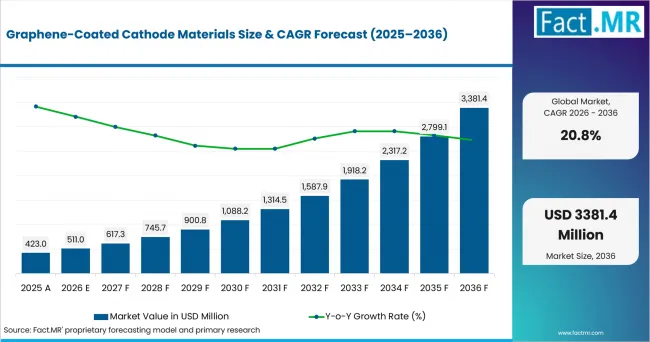
Graphene Coated Cathode Materials Value Analysis | Source: Fact.MR
What are the defining numbers behind Graphene-Coated Cathode Materials Market growth?
An absolute opportunity of USD 2,870.3 million is expected between 2026 and 2036.
- Demand Drivers in the Market
- Cell engineering teams need lower interfacial resistance because fast-charge programs place more stress on electron transport. The IEA reported in May 2026 that EV battery deployment reached 1.2 TWh in 2025.
- Cathode-material developers need conformal surface protection supported by graphene shells or overcoats. The architecture is expected to preserve conductive contact around active particles while limiting surface exposure.
- High-nickel development teams need interface designs that are expected to support conductivity under elevated voltage and temperature. Consistent graphene coverage is anticipated to carry more weight as nickel content rises.
- Battery manufacturers need coating or additive formats that fit established slurry and cell-production steps. Qualification time is expected to remain a commercial constraint when new coating steps change mixing or drying conditions.
- Key Segments Analyzed
- By Coating Architecture: Graphene shell on cathode particles is expected to hold 39.0% share in 2026, reflecting direct coverage of the active-material interface.
- By Cathode Chemistry: NMC is projected to account for 32.0% share in 2026 because high-energy cell programs place tight controls on conductivity and surface stability.
- By Performance Target: Fast charge is anticipated to capture 36.0% share in 2026 as low-resistance conductive networks support higher charging rates with controlled carbon loading.
- By Application: EV cells are estimated to represent 47.0% share in 2026, supported by automotive programs that combine scale with strict cycle-life qualification.
- Analyst Opinion at Fact.MR
- Shambhu Nath Jha, Principal Consultant at Fact.MR, states, “Commercialization is expected to depend on whether graphene improves a cathode while preserving established process conditions. Qualification is anticipated to favor uniform coverage and repeatable cell performance. Suppliers therefore need material control alongside electrochemical evidence.”
- Strategic Implications
- Cathode-material suppliers should align scale-up evidence with domestic battery programs. The U.S. Department of Energy announced up to USD 725 million in January 2025 for battery critical materials and advanced batteries. Supplier evidence should connect battery chemicals performance with repeatable coating quality.
- Graphene producers should tailor surface chemistry separately for NMC and LFP programs. The same approach should account for emerging manganese-rich formulations and lithium-ion battery binders used in cathode processing.
- Cell developers should compare coated active material with conventional carbon-additive loading under the same electrode density and charging protocol. A common protocol keeps cell-level evidence comparable across formulations.
- Scale-up teams should build quality controls around particle coverage and slurry behavior. Small inconsistencies are expected to become more visible when production moves from grams to tonnes.
France is forecast to record 23.4% CAGR through 2036 supported by battery-manufacturing investment. South Korea is anticipated to reach 22.5% as its cell-manufacturing base expands next-generation battery work. The USA is projected at 21.6% reflecting domestic materials investment. Japan is estimated at 20.1% owing to battery-capacity policy. Germany is forecast at 18.0% supported by charging infrastructure and industrial battery development.
How does the Graphene-Coated Cathode Materials Market break down by segment?
Graphene shell on cathode particles leads Coating Architecture at 39.0% share in 2026; EV cells lead Application at 47.0%.
Which Coating Architecture dominates?
Graphene shell on cathode particles is expected to account for 39.0% share in 2026, reflecting direct coverage of the active-material interface.
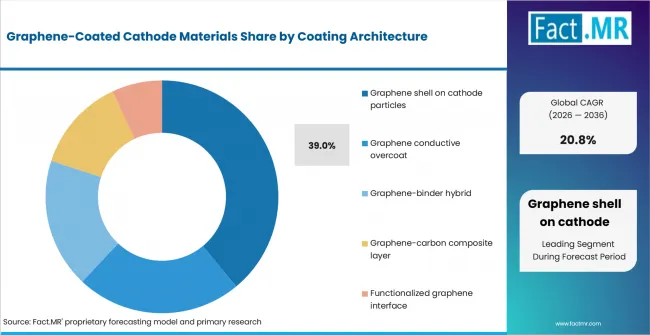
Graphene Coated Cathode Materials Analysis By Coating Architecture | Source: Fact.MR
Particle-level graphene shells place a conductive layer around cathode active material. The architecture is expected to improve contact continuity while preserving the underlying cathode chemistry.
What leads the Cathode Chemistry segment?
NMC is projected to account for 32.0% share in 2026.
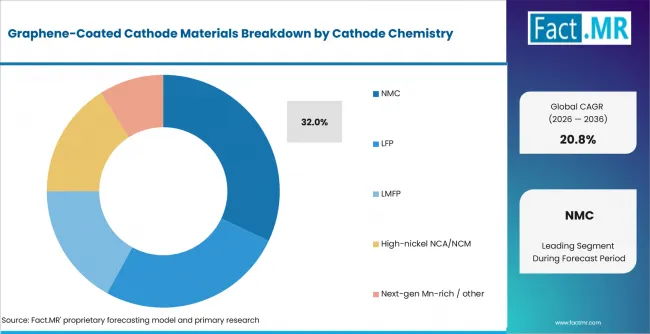
Graphene Coated Cathode Materials Analysis By Cathode Chemistry | Source: Fact.MR
NMC is expected to remain attractive for graphene interface work where conductivity and surface stability shape high-energy cells. NanoXplore’s September 2025 annual information form lists graphene-enhanced conductive additives for cathode slurries.
How does Performance Target shape demand?
Fast charge is anticipated to lead with 36.0% share in 2026.
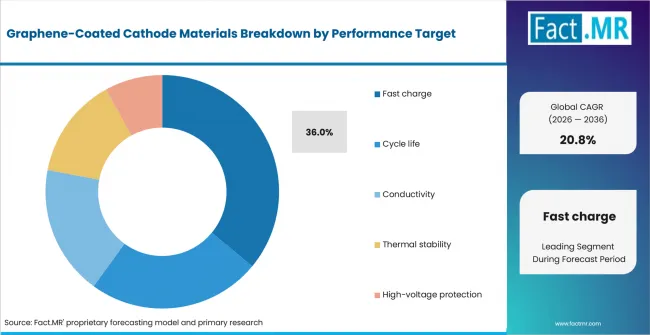
Graphene Coated Cathode Materials Analysis By Performance Target | Source: Fact.MR
Fast charging is expected to increase the value of low-resistance conductive pathways. Cycle-life and high-voltage programs are anticipated to place more weight on interface durability.
What supports EV cells within Application?
EV cells are estimated to represent 47.0% share in 2026.
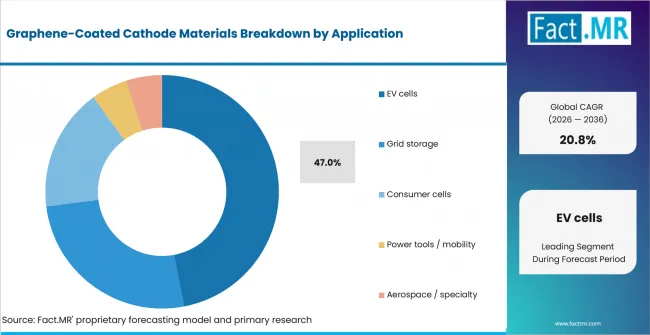
Graphene Coated Cathode Materials Analysis By Application | Source: Fact.MR
EV cells combine fast-charge targets with long qualification cycles. The IEA reported in May 2026 that electric car sales exceeded 20 million in 2025 and represented one-quarter of new cars worldwide. The scale is expected to widen the application base for qualified cathode materials. Residential energy storage systems provide a second route where cycle life and cost shape material selection.
What is accelerating Graphene-Coated Cathode Materials Market adoption, and what is holding it back?
Fast-charge and interface-stability requirements support adoption; qualification time and coating consistency restrain it.
Drivers Impact Analysis
| DRIVER | (~) % IMPACT ON CAGR | GEOGRAPHIC RELEVANCE | IMPACT TIMELINE |
|---|---|---|---|
| Fast-charge cathode performance | Qualitative | Global | Short term (<= 2 years) |
| Surface protection for high-energy cathodes | Qualitative | North America, Europe, East Asia | Medium term (2-4 years) |
| Lower conductive-carbon loading | Qualitative | Global | Medium term (2-4 years) |
| Drop-in compatibility with existing electrode processing | Qualitative | Global | Long term (>= 4 years) |
Opportunity Impact Analysis
| OPPORTUNITY | (~) % IMPACT ON CAGR | GEOGRAPHIC RELEVANCE | IMPACT TIMELINE |
|---|---|---|---|
| Pre-coated cathode active material | Qualitative | North America, Europe, East Asia | Short term (<= 2 years) |
| LFP and LMFP conductive interfaces | Qualitative | East Asia, Europe | Medium term (2-4 years) |
| Grid and specialty cell qualification | Qualitative | Global | Long term (>= 4 years) |
Restraints Impact Analysis
| RESTRAINT | (~) % IMPACT ON CAGR | GEOGRAPHIC RELEVANCE | IMPACT TIMELINE |
|---|---|---|---|
| Long battery-material qualification cycles | Qualitative | Global | Short term (<= 2 years) |
| Coating uniformity at production scale | Qualitative | Global | Medium term (2-4 years) |
| Graphene dispersion and feedstock consistency | Qualitative | North America, Europe, East Asia | Long term (>= 4 years) |
Which countries are scaling the Graphene-Coated Cathode Materials Market through 2036?
- France remains 0.9 percentage point above South Korea as domestic EV programs and battery manufacturing expand the local qualification base.
- South Korea remains 0.9 percentage point above the USA supported by concentrated cell manufacturing and next-generation battery development.
- The USA remains 1.5 percentage points above Japan reflecting domestic battery investment and electrified-vehicle demand.
- Japan remains 2.1 percentage points above Germany owing to national battery-capacity policy and cell-development programs.
- Germany closes the displayed range supported by fast-charging infrastructure and industrial battery engineering.
Comparable growth rates create different entry conditions across the five countries. Qualification pathways are shaped by cell production and battery policy. Coverage spans North America and Latin America alongside Western Europe. Eastern Europe and East Asia are included with South Asia & Pacific and Middle East & Africa.
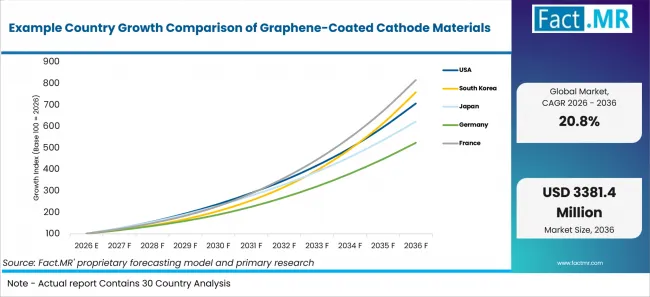
Example Country Growth Comparison Of Graphene Coated Cathode Materials | Source: Fact.MR
| Country | CAGR (2026-2036) |
|---|---|
| France | 23.4% |
| South Korea | 22.5% |
| United States | 21.6% |
| Japan | 20.1% |
| Germany | 18.0% |
What supports France adoption?
23.4% CAGR, supported by electric-vehicle activity and battery-manufacturing investment.
France’s electric-vehicle mix is expected to expand the local qualification base for coated cathodes. SDES reported in February 2026 that France registered 331,200 new electric passenger cars in 2025. The vehicle base is expected to support cell trials focused on conductivity and cycle life. Graphene shells and conductive overcoats fit programs that retain established cathode chemistries.
How is South Korea scaling demand?
22.5% CAGR, driven by cell manufacturing and next-generation battery development.
South Korea’s role as a major battery manufacturing hub is expected to support concentrated graphene-interface qualification. In January 2026, South Korea’s Ministry of Land, Infrastructure and Transport reported that electric vehicles accounted for 13% of all new vehicle registrations in 2025. That concentration is expected to support structured testing for fast charge and cycle life. Repeatable coating coverage remains central to customer approval.
What supports USA adoption?
21.6% CAGR, supported by electrified-vehicle demand and domestic battery-material development.
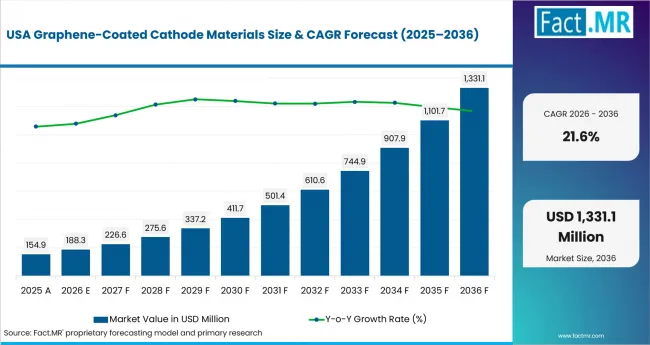
Graphene Coated Cathode Materials Country Value Analysis | Source: Fact.MR
U.S. vehicle programs are expected to widen the qualification base for coated cathodes. EIA reported in July 2026 that hybrid electric, battery electric and plug-in hybrid electric vehicles together represented 24% of new U.S. light-duty vehicle sales in Q2 2026. The vehicle mix is expected to increase attention to fast-charge cell performance. Domestic programs provide qualification routes for graphene shells and conductive overcoats.
How does Japan perform?
20.1% CAGR, led by domestic battery-capacity policy and cell-development programs.
Japanese cell developers are expected to place greater weight on cycle life and high-voltage stability as domestic capacity expands. METI stated in June 2026 that Japan targets 150 GWh per year of battery manufacturing capacity from 2030 into the mid-2030s. The target is expected to support qualification across NMC and other lithium-ion chemistries. Graphene interfaces fit programs focused on stable conductive pathways.
What is supporting Germany adoption?
18.0% CAGR, supported by fast-charging infrastructure and industrial battery engineering.
Germany’s charging network is expected to increase attention to cell performance at elevated charging rates. Bundesnetzagentur reported that 55,665 public fast-charging points were in operation in Germany as of August 1, 2026. The infrastructure base is expected to support demand for fast-charge battery engineering. Coated cathodes fit programs where conductivity and interface stability remain qualification priorities.
Who leads the Graphene-Coated Cathode Materials Market?
Volexion focuses on conformal graphene encapsulation of lithium-ion cathode active materials. Argonne’s Chain Reaction Innovations reported in December 2025 that Volexion was shipping its first graphene-coated cathode active materials to tier-one manufacturers. NanoXplore lists graphene-enhanced conductive additives for anodes and cathode slurries.
HydroGraph’s public filings document its collaboration with NEI Corporation on NANOMYTE® FGA-1AD and FGA-1ND graphene dispersions for battery-electrode conductivity. NEI’s technical documentation states that these dispersions can be integrated into existing electrode slurries and used as anode and cathode conductive additives in lithium-ion batteries. Public company materials show differentiation across cathode encapsulation, slurry integration, manufacturing compatibility and battery-level validation.
Which companies are the key providers?
Key companies include Volexion; NanoXplore; GraphEnergy; Graphene Manufacturing Group (GMG); CARBON T&C; and HydroGraph.
- Volexion
- NanoXplore
- GraphEnergy
- Graphene Manufacturing Group (GMG)
- CARBON T&C
- HydroGraph
Bibliography
- International Energy Agency. (2026, May 20). Global EV Outlook 2026.
- U.S. Department of Energy. (2025, January 10). DOE issues notice of intent for funding in strengthening domestic critical materials processing and manufacturing to enhance national security.
- Service des données et études statistiques. (2026, February 11). Immatriculations de voitures en 2025 : le marché du neuf baisse, celui de l’occasion résiste.
- U.S. Energy Information Administration. (2026, July 27). Hybrid sales rise while battery electric sales remain lower after tax credit expiration.
- Ministry of Economy, Trade and Industry. (2026, June 2). “Battery Industry Strategy” revised as the “Battery and Power Industry Strategy”.
- Bundesnetzagentur. (2026, July 29). Elektromobilität: Öffentliche Ladeinfrastruktur.
- Chain Reaction Innovations. (2025, December 12). 2025 startup milestones. Argonne National Laboratory.
- HydroGraph Clean Power Inc. (2026, January 27). Management discussion and analysis for the year ended September 30, 2025.
- NanoXplore Inc. (2025, September 16). Annual information form: For the year ended June 30, 2025.
- NEI Corporation. (2025, March 5). Collaboration yields new high-performance graphene dispersions.
This Report Answers
- The report covers graphene-coated cathode materials across coating architecture and cathode chemistry. Performance target and application complete the segmentation framework.
- Segment analysis identifies graphene shell on cathode particles and NMC as the specified 2026 leaders. Fast charge and EV cells complete the share comparison.
- Country analysis compares France and South Korea with the United States. Japan and Germany complete the comparison through battery activity and material-qualification conditions.
- Competitive analysis separates direct coated-cathode activity from conductive-additive roles. Upstream graphene-material capability is assessed separately across the six profiled companies.
- Application analysis reviews EV cells and grid storage. Consumer cells and power-tool mobility are included alongside aerospace or specialty uses.
What does the Graphene-Coated Cathode Materials Market cover?
The market covers graphene-enabled cathode interfaces used to modify conductivity and particle-surface behavior in lithium-ion cells. Related solid-state battery materials remain adjacent because the assessment centers on lithium-ion cathode interfaces.
Coverage spans NMC and LFP alongside LMFP. High-nickel and manganese-rich chemistries are included where graphene modifies the cathode interface. Dry electrode binders form a separate process category within electrode manufacturing.
What is included in the scope?
The scope includes pre-coated active material and graphene cathode formulations used in cell manufacturing. Coating architectures cover particle shells and conductive overcoats. Graphene-binder hybrids and composite layers are included with functionalized interfaces. Applications include EV cells and grid storage alongside consumer cells. Power tools and aerospace uses complete the application coverage.
What is excluded from the scope?
The assessment is limited to graphene-enabled cathode materials and cathode formulations. Anode-only graphene systems and current-collector coatings fall into adjacent categories. Conventional carbon additives form a separate material class when graphene is absent from the cathode formulation.
How Was the Analysis Built?
The analysis draws on 120+ sources, 35+ company portfolios, 25+ countries, and more than 20 industry interviews.
- Primary Research: Primary research includes discussions with manufacturers, service providers, technology developers, distributors, end users, and subject-matter experts. These conversations examine purchasing priorities, product adoption, operational challenges, approval requirements, competitive positioning, and the factors that influence wider market acceptance.
- Desk Research: Desk research covers government statistics, regulatory publications, company filings, trade data, technical studies, industry associations, standards, public policy, and other authoritative sources. Every source used in the analysis is documented in the bibliography.
- Market Sizing and Forecasting: Market estimates combine historical performance, demand indicators, pricing and volume trends, segment shares, company participation, country-level growth, adoption patterns, investment activity, and barriers to market expansion.
- Data Validation and Update Cycle: Findings are validated by comparing primary interviews with public data, company activity, regulatory changes, trade patterns, and industry developments. Regular updates review new product launches, capacity changes, partnerships, approvals, and shifts in commercial adoption.
What is the report’s scope and coverage?
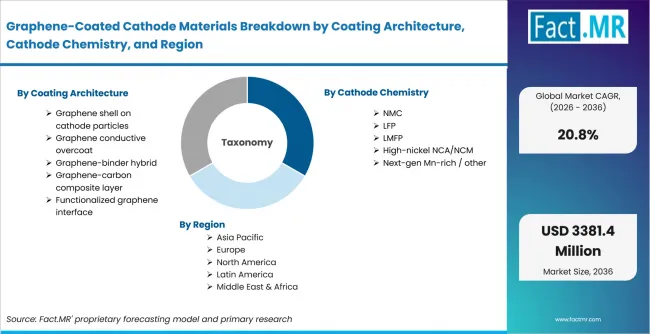
Graphene Coated Cathode Materials Breakdown By Coating Architecture, Cathode Chemistry, And Region | Source: Fact.MR
| Attribute | Details |
|---|---|
| Quantitative Units | USD million in 2026 to USD million by 2036 at CAGR |
| Market Definition | Cathode active materials or cathode-electrode formulations where graphene is applied as a particle shell, conductive overcoat, binder hybrid, composite layer or functionalized interface to improve cathode conductivity, surface protection or related cell performance. |
| Coating Architecture | Graphene shell on cathode particles; Graphene conductive overcoat; Graphene-binder hybrid; Graphene-carbon composite layer; Functionalized graphene interface |
| Cathode Chemistry | NMC; LFP; LMFP; High-nickel NCA/NCM; Next-gen Mn-rich / other |
| Performance Target | Fast charge; Cycle life; Conductivity; Thermal stability; High-voltage protection |
| Application | EV cells; Grid storage; Consumer cells; Power tools / mobility; Aerospace / specialty |
| Regions Covered | North America; Latin America; Western Europe; Eastern Europe; East Asia; South Asia & Pacific; Middle East & Africa |
| Countries Covered | United States; South Korea; Japan; Germany; France |
| Key Companies Profiled | Volexion; NanoXplore; GraphEnergy; Graphene Manufacturing Group (GMG); CARBON T&C; HydroGraph |
| Forecast Period | 2026 to 2036 |
| Approach | Hybrid top-down and bottom-up assessment using cathode chemistry mix, EV and storage applications, graphene material participation, country evidence and provider portfolio review. |
How is the market segmented?
-
By Coating Architecture
- Graphene shell on cathode particles
- Graphene conductive overcoat
- Graphene-binder hybrid
- Graphene-carbon composite layer
- Functionalized graphene interface
-
By Cathode Chemistry
- NMC
- LFP
- LMFP
- High-nickel NCA/NCM
- Next-gen Mn-rich / other
-
By Performance Target
- Fast charge
- Cycle life
- Conductivity
- Thermal stability
- High-voltage protection
-
By Application
- EV cells
- Grid storage
- Consumer cells
- Power tools / mobility
- Aerospace / specialty
-
By Region
- North America
- Latin America
- Western Europe
- Eastern Europe
- East Asia
- South Asia & Pacific
- Middle East & Africa