- Market Value (2025): USD 4.1 Bn
- Estimated Value (2026): USD 4.5 Bn
- Forecast Value (2036): USD 12.3 Bn
- CAGR (2026-2036): 10.6%
What is the Grease-Resistant Fiber Trays Market forecast to be worth by 2036?
USD 4.5 billion in 2026 to USD 12.3 billion by 2036 at a 10.6% CAGR.
- The Grease-Resistant Fiber Trays Market reached USD 4.1 billion in 2025.
- Demand is projected to increase from USD 4.5 billion in 2026 to USD 12.3 billion by 2036.
- The market is forecast to record a 10.6% CAGR from 2026 to 2036 as foodservice operators and prepared-meal packers seek fiber trays that control grease while meeting changing food-contact and packaging rules.
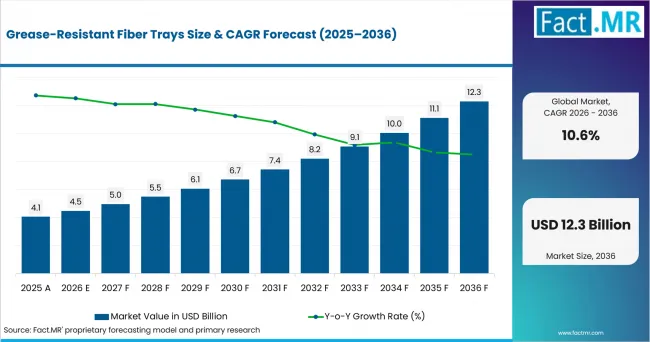
Grease Resistant Fiber Trays Value Analysis | Source: Fact.MR
What are the defining numbers behind Grease-Resistant Fiber Trays Market growth?
An absolute opportunity of USD 7.8 billion is expected between 2026 and 2036.
- Demand Drivers in the Market
- Foodservice operators need trays that retain rigidity under hot and oily foods because leaks or softening disrupt takeaway service and meal presentation. Grease holdout therefore has to remain consistent from filling through handoff.
- Prepared-food packers need grease and moisture barriers that meet current food-contact requirements and maintain reliable oil holdout during storage and serving. Barrier selection is expected to vary by meal temperature and expected holding time.
- Institutional kitchens need stackable molded-fiber formats that tolerate reheating and portioning while fitting cafeteria and catering workflows. Standardized footprints can simplify storage and reduce handling changes across meal programs.
- Packaging teams need fiber structures that support material recovery and lightweighting goals while preserving sealing surfaces and transport resistance. Material choice is therefore expected to balance fiber furnish with coating behavior and forming quality.
- Key Segments Analyzed
- By Fiber Feedstock: Bagasse is expected to hold 37.0% share in 2026 due to its molded-fiber suitability and use in foodservice formats.
- By Performance Treatment: Grease resistant is projected to account for 33.0% share in 2026 as hot meals require reliable oil holdout during service.
- By Format: Trays are anticipated to capture 34.0% share in 2026 owing to their fit across cafeteria service, prepared meals and counter-to-table handling.
- By Application: Hot meals are estimated to represent 31.0% share in 2026 because heat and grease place the highest combined demands on tray structure and barrier performance.
- Analyst Opinion at Fact.MR
- Shambhu Nath Jha, Principal Consultant at Fact.MR, states, “A fiber tray must keep its shape and control grease under real foodservice conditions. Suppliers are expected to compete on barrier chemistry, forming consistency and clear end-of-life claims.”
- Strategic Implications
- Fiber converters should document oil holdout and heat performance by food type so qualification reflects actual contact conditions. Test methods should match the tray’s intended meal temperature and dwell time.
- Foodservice brands should test trays across realistic delivery dwell times so barrier selection reflects hot sauces, fats and steam exposure. Trials should examine lid fit and stacking performance under the same service conditions.
- Material developers should prioritize PFAS-free grease resistance. In January 2025, the U.S. Food and Drug Administration determined that 35 PFAS-related food contact notifications for grease-proofing paper and paperboard were no longer effective.
- Institutional distributors should simplify assortments around formats that cover hot meals and chilled prepared foods while maintaining consistent lid or film compatibility. A smaller format set can improve inventory control across school and cafeteria programs.
China is forecast to record 10.9% CAGR through 2036. The USA and Japan are each projected at 10.4%, Germany at 10.2%, and France at 9.7%. Foodservice scale and packaging requirements shape the differences between these markets.
How does the Grease-Resistant Fiber Trays Market break down by segment?
Bagasse leads Fiber Feedstock at 37.0%; Trays lead Format at 34.0%.
Which Fiber Feedstock leads?
Bagasse is expected to hold 37.0% share in 2026.
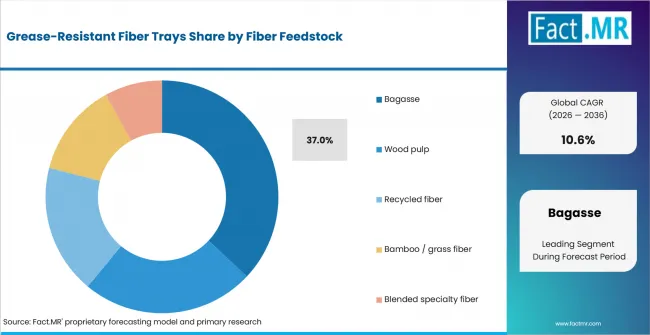
Grease Resistant Fiber Trays Analysis By Fiber Feedstock | Source: Fact.MR
Bagasse fits wet-forming and molded-fiber production while giving foodservice brands a plant-derived feedstock option. Huhtamaki lists molded-fiber food trays designed to absorb excess oil, with selected Savaday products BPI-certified as compostable in commercial facilities.
What leads the Performance Treatment segment?
Grease resistant is projected to account for 33.0% share in 2026.
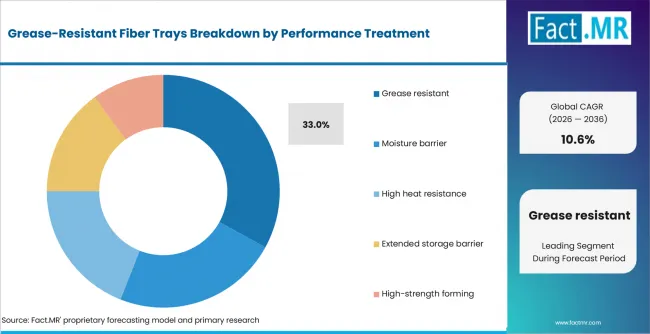
Grease Resistant Fiber Trays Analysis By Performance Treatment | Source: Fact.MR
Grease resistance is central to the category because oil migration can stain the tray and weaken fiber structure during foodservice use. Barrier systems therefore need clear food-contact documentation and stable performance across the intended temperature and holding period.
How does Format shape demand?
Trays are anticipated to lead with 34.0% share in 2026.
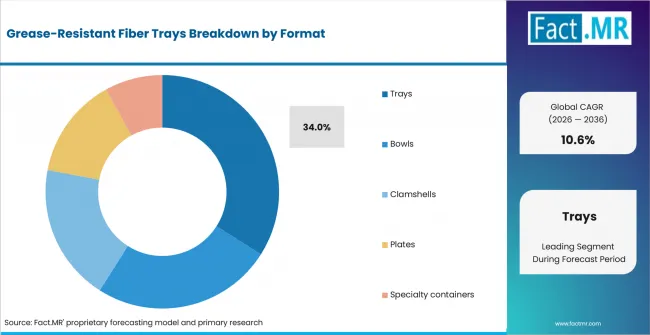
Grease Resistant Fiber Trays Analysis By Format | Source: Fact.MR
Open trays suit serving lines and prepared foods because they keep portions visible while supporting stackable back-of-house handling. Format selection is expected to depend on rim strength, nesting efficiency and compatibility with lids or lidding film.
What supports Hot meals within Application?
Hot meals are estimated to represent 31.0% share in 2026.
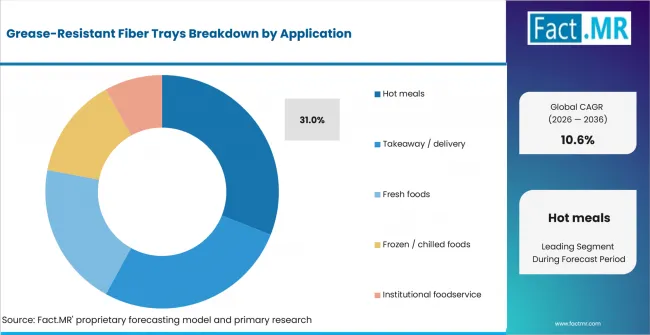
Grease Resistant Fiber Trays Analysis By Application | Source: Fact.MR
Hot meals combine temperature and grease exposure with moisture generated during holding and transport. In November 2025, Sabert reported that its Pulp Ultra molded-fiber formulation won the U.S. Plastics Pact Packaging Innovation Award for Compostability and withstands direct hot-oil and grease contact up to 185°F.
What is accelerating Grease-Resistant Fiber Trays Market adoption, and what is holding it back?
Foodservice volume and non-PFAS grease resistance support adoption; performance-cost tradeoffs and recovery limits restrain it.
Drivers Impact Analysis
| DRIVER | (~) % IMPACT ON CAGR | GEOGRAPHIC RELEVANCE | IMPACT TIMELINE |
|---|---|---|---|
| Food-away-from-home and takeaway meal volume | +1.5% | North America, East Asia, Europe | Short term (<= 2 years) |
| Shift away from legacy PFAS grease-proofing chemistry | +1.2% | North America, Europe | Short term (<= 2 years) |
| Fiber recovery and packaging-material reduction goals | +0.9% | Europe, North America | Medium term (2-4 years) |
| Prepared-food and institutional meal formats | +0.7% | Global | Medium term (2-4 years) |
Opportunity Impact Analysis
| DRIVER | (~) % IMPACT ON CAGR | GEOGRAPHIC RELEVANCE | IMPACT TIMELINE |
|---|---|---|---|
| High-barrier non-PFAS treatments for oily meals | +1.0% | North America, Europe | Short term (<= 2 years) |
| Compartment and lidded fiber systems | +0.7% | North America, East Asia | Medium term (2-4 years) |
| Lightweight hybrid fiber structures | +0.5% | Europe, Global | Long term (>= 4 years) |
Restraints Impact Analysis
| RESTRAINT | (~) % IMPACT ON CAGR | GEOGRAPHIC RELEVANCE | IMPACT TIMELINE |
|---|---|---|---|
| Barrier cost and converting complexity | -0.7% | Global | Short term (<= 2 years) |
| Heat, oil and long-hold performance limits | -0.5% | Global | Medium term (2-4 years) |
| Uneven composting and recovery infrastructure | -0.4% | North America, Europe | Long term (>= 4 years) |
Which countries are scaling the Grease-Resistant Fiber Trays Market through 2036?
- China remains 0.5 percentage point above the USA and Japan as catering scale supports fiber-tray demand.
- The USA and Japan each record 10.4% CAGR, although foodservice structure and packaging requirements create different entry conditions.
- Germany remains 0.2 percentage point below the USA and Japan as recovery requirements influence fiber and barrier selection.
- France remains 0.5 percentage point below Germany as restaurant demand develops alongside tighter packaging rules.
- The displayed range spans 1.2 percentage points from China at 10.9% to France at 9.7%.
Comparable CAGRs can create different entry conditions because foodservice scale, recovery systems and packaging policy vary by country. Full coverage includes North America, Latin America, Western Europe, Eastern Europe, East Asia, South Asia & Pacific, and Middle East & Africa.
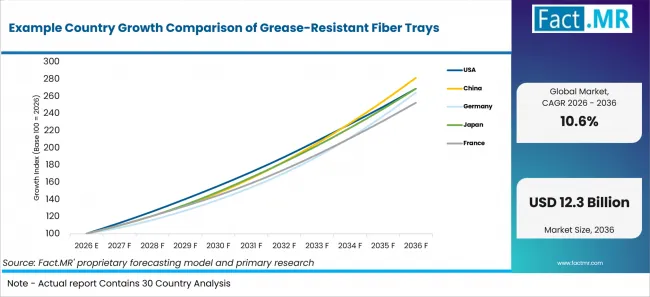
Example Country Growth Comparison Of Grease Resistant Fiber Trays | Source: Fact.MR
| Country | CAGR (2026-2036) |
|---|---|
| China | 10.9% |
| USA | 10.4% |
| Japan | 10.4% |
| Germany | 10.2% |
| France | 9.7% |
What supports USA adoption?
10.4% CAGR through 2036, supported by foodservice spending and fiber-packaging qualification.
U.S. foodservice channels provide a broad base for serving and takeaway trays. In June 2026, USDA Economic Research Service reported that U.S. food-away-from-home spending reached USD 1.41 trillion in 2025 and represented 56.3% of total food expenditures. Grease-resistant fiber formats are expected to gain consideration where operators need stackable trays with consistent hot-food performance.
How is China shaping demand?
10.9% CAGR through 2036, supported by catering scale and food purchasing activity.
China combines a large catering base with established molded-fiber manufacturing capability. In February 2026, the National Bureau of Statistics reported 2025 catering income of 5,798.2 billion yuan. The figure was 3.2% above 2024. Bagasse and blended plant fibers are expected to support takeaway and institutional meal programs requiring oil holdout and forming consistency.
How is Japan developing demand?
10.4% CAGR through 2036, supported by visitor activity and prepared-food channels.
Japan combines established prepared-food and foodservice channels with substantial visitor activity. In January 2026, the Japan National Tourism Organization reported 42,683,600 visitor arrivals in 2025, 15.8% above 2024. The tourism figure provides broader foodservice-demand context, while tray qualification depends separately on grease resistance, stackability and hot-food performance.
What is supporting Germany’s adoption?
10.2% CAGR through 2036, supported by packaging recovery systems and foodservice use.
Germany has established packaging collection and recovery systems that shape material decisions for foodservice converters. In January 2026, the German Environment Agency and Central Agency Packaging Register reported that around 5.5 million tonnes of packaging waste collected by dual systems were recovered in 2024. Tray programs are expected to favor barriers that preserve performance and align with paper-based recovery routes.
How does France perform?
9.7% CAGR through 2036, supported by restaurant activity and fiber-packaging conversion.
France combines restaurant demand with packaging requirements that increase attention to material choice. In June 2026, INSEE reported that accommodation and foodservice value added increased 2.8% in volume in 2025. Grease-resistant fiber trays are projected to address hot-meal and takeaway uses where converters can maintain rigidity and clearly defined end-of-life handling.
Who leads the Grease-Resistant Fiber Trays Market?
Huhtamaki, Novolex including the former Pactiv Evergreen business, Sabert, Genpak, CKF and Stora Enso are profiled across molded-fiber and fiber-based food-tray solutions.
Huhtamaki, Sabert, Genpak and CKF participate across molded-fiber and fiber-based foodservice packaging formats. Their portfolios emphasize attributes including grease and moisture resistance, heat tolerance, structural strength, stackability and suitability for takeaway and foodservice applications.
Stora Enso adds fiber-based tray-material capability through its Trayforma portfolio, which is designed around stiffness, formability, converting reliability and application-specific barrier performance. Novolex represents the combined business that incorporated Pactiv Evergreen following completion of their transaction in April 2025.
Supplier differentiation includes barrier performance, structural strength, heat resistance, forming and converting performance, and compatibility with foodservice applications. End-of-life characteristics such as compostability and recyclability also form part of product positioning across these portfolios.
Which companies are the key providers?
Key providers include Huhtamaki and Novolex, including the former Pactiv Evergreen business, are profiled with Sabert, Genpak, CKF and Stora Enso.
- Huhtamaki
- Novolex (including former Pactiv Evergreen business)
- Sabert
- Genpak
- CKF
- Stora Enso
Bibliography
- Zeballos, E., & Sinclair, W. (2026, June 11). Total U.S. food spending reached $2.51 trillion in 2025. U.S. Department of Agriculture, Economic Research Service.
- U.S. Food and Drug Administration. (2025, January 3). FDA determines authorization for 35 food contact notifications related to PFAS are no longer effective.
- National Bureau of Statistics of China. (2026, February 28). Statistical communiqué of the People’s Republic of China on the 2025 national economic and social development.
- German Environment Agency, & Central Agency Packaging Register. (2026, January 27). Facts against myths: Packaging waste recycling in Germany is working.
- Cazin, E., Delamare, K., Hananel, J., Royer, F., & Varrambier, P. (2026, June 23). Le compte des services marchands en 2025 : Malgré un ralentissement de l’activité, les services marchands demeurent le premier soutien de la croissance du PIB. Insee Première, (2112).
- Sabert Corporation. (2025, November 19). Sabert Corporation’s Pulp Ultra® wins 2025 U.S. Plastics Pact Packaging Innovation Award for compostability.
- Novolex. (2025, April 1). Novolex and Pactiv Evergreen Inc. complete combination, creating a leading manufacturer in food, beverage and specialty packaging.
This Report Addresses
- The report explains how feedstock and treatment affect grease resistance in food trays.
- Country analysis covers China, USA, Japan, Germany and France through 2036.
- Competitive analysis reviews Huhtamaki, Novolex, Sabert, Genpak, CKF and Stora Enso.
- Application analysis covers hot meals, takeaway, fresh foods, chilled foods and institutional foodservice.
- Performance analysis covers grease holdout, moisture resistance, heat tolerance and forming strength.
- Official statistics and first-party company sources support the operating and regulatory context.
What does the Grease-Resistant Fiber Trays Market cover?
The market covers fiber trays designed to resist grease from hot meals and prepared foods. Adjacent demand can be compared with high-performance molded fiber and paper trays coverage.
It includes the stated fiber feedstocks and performance treatments across tray-led applications. Downstream use is linked to foodservice packaging and compostable food service coatings where barrier performance shapes fiber-format selection.
What is included in the scope?
The scope includes trays, bowls, clamshells, plates and specialty fiber containers where grease resistance is part of foodservice performance.
What is excluded from the scope?
Plastic-only trays, metal trays, reusable serviceware and standalone paperboard cartons fall outside the defined fiber-tray scope.
General coating materials and tray-forming equipment are treated only as operating context for finished fiber-tray programs.
How Was the Analysis Built?
The analysis draws on 120+ sources, 35+ company portfolios, 25+ countries, and more than 20 industry interviews.
- Primary Research: Primary research includes discussions with manufacturers, service providers, technology developers, distributors, end users, and subject-matter experts. These conversations examine purchasing priorities, product adoption, operational challenges, approval requirements, competitive positioning, and the factors that influence wider market acceptance.
- Desk Research: Desk research covers government statistics, regulatory publications, company filings, trade data, technical studies, industry associations, standards, public policy, and other authoritative sources. Every source used in the analysis is documented in the bibliography.
- Market Sizing and Forecasting: Market estimates combine historical performance, demand indicators, pricing and volume trends, segment shares, company participation, country-level growth, adoption patterns, investment activity, and barriers to market expansion.
- Data Validation and Update Cycle: Findings are validated by comparing primary interviews with public data, company activity, regulatory changes, trade patterns, and industry developments. Regular updates review new product launches, capacity changes, partnerships, approvals, and shifts in commercial adoption.
What is the report’s scope and coverage?
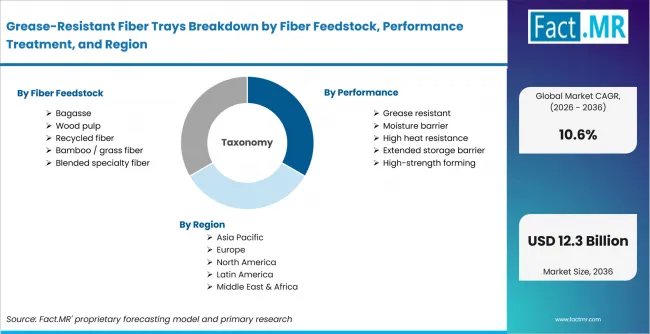
Grease Resistant Fiber Trays Breakdown By Fiber Feedstock, Performance Treatment, And Region | Source: Fact.MR
| Attribute | Details |
| Quantitative Units | USD Billion |
| Market Definition | Molded-fiber and fiber-based trays engineered to resist grease during foodservice, prepared-food and institutional meal use. |
| Fiber Feedstock | Bagasse; Wood pulp; Recycled fiber; Bamboo / grass fiber; Blended specialty fiber |
| Performance Treatment | Grease resistant; Moisture barrier; High heat resistance; Extended storage barrier; High-strength forming |
| Format | Trays; Bowls; Clamshells; Plates; Specialty containers |
| Application | Hot meals; Takeaway / delivery; Fresh foods; Frozen / chilled foods; Institutional foodservice |
| Regions Covered | North America; Latin America; Western Europe; Eastern Europe; East Asia; South Asia & Pacific; Middle East & Africa |
| Countries Covered | USA; China; Germany; Japan; France |
| Key Companies Profiled | Huhtamaki; Novolex including former Pactiv Evergreen business; Sabert; Genpak; CKF; Stora Enso |
| Forecast Period | 2026 to 2036 |
| Approach | Hybrid top-down and bottom-up review using foodservice activity, packaging regulation, fiber-tray product portfolios, segment shares, country growth and first-hand source validation. |
How is the market segmented?
-
By Fiber Feedstock
- Bagasse
- Wood pulp
- Recycled fiber
- Bamboo / grass fiber
- Blended specialty fiber
-
By Performance Treatment
- Grease resistant
- Moisture barrier
- High heat resistance
- Extended storage barrier
- High-strength forming
-
By Format
- Trays
- Bowls
- Clamshells
- Plates
- Specialty containers
-
By Application
- Hot meals
- Takeaway / delivery
- Fresh foods
- Frozen / chilled foods
- Institutional foodservice
-
By Region
- North America
- Latin America
- Western Europe
- Eastern Europe
- East Asia
- South Asia & Pacific
- Middle East & Africa