- Market Value (2025): USD 0.8 Bn
- Estimated Value (2026): USD 0.9 Bn
- Forecast Value (2036): USD 1.6 Bn
- CAGR (2026-2036): 6.2%
What is the Fiber-Based Food Liners Market forecast to be worth by 2036?
USD 0.9 billion in 2026 to USD 1.6 billion by 2036 at 6.2% CAGR.
- The market crossed USD 0.8 billion in 2025 as qualification expanded across paper and molded-fiber liners.
- Fiber-based food liners demand is anticipated to rise from USD 0.9 billion in 2026 to USD 1.6 billion by 2036.
- The market is forecast to record 6.2% CAGR through 2036 supported by barrier performance and documentation.
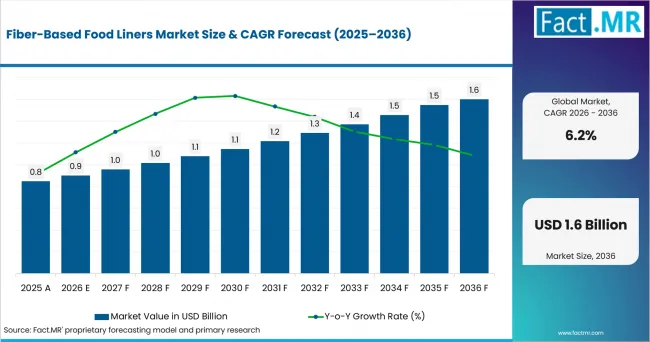
Fiber Based Food Liners Market Value Analysis | Source: Fact.MR
What are the defining numbers behind Fiber-Based Food Liners Market growth?
USD 0.7 billion absolute opportunity by 2036, led by carton liners and greaseproof paper across foodservice applications.
- Demand Drivers in the Market
- Restaurant chains require liners that control grease transfer while preserving carton strength during service.
- Food processors require sheets that cut and fold reliably without reducing commercial packing speed.
- Packaging teams require fluorine-free barrier evidence that reflects actual food temperature and commercial holding time.
- National accounts require stable converting because inconsistent dimensions disrupt approved routines across regional sites.
- Key Segments Analyzed
- By product type: Box - carton liners are forecast to represent 34.0% in 2026 driven by familiar routines.
- By material: Geaseproof paper is projected to account for 34.0% in 2026 due to foldability.
- By barrier – treatment: Grease-resistant structures are projected to hold 44.0% share in 2026 owing to visible oil-control requirements.
- By application: In 2026, quick-service restaurants are expected to hold 38.0% share because standardized menus create repeat consumption.
- By end use: Foodservice is forecast to lead with 58.0% share in 2026 due to recurring service.
- By sales channel: Direct - OEM is estimated to hold 44.0% in 2026 owing to controlled trials.
- Analyst Opinion at Fact.MR
- Shambhu Nath Jha Principal Consultant states that approval requires proven grease control, consistent specifications, and clear recovery guidance.
- Strategic Implications
- Converters should test liner movement and grease control inside customer cartons before proposing wider material changes.
- Foodservice operators need to compare delivered cost after testing dispensing speed and product appearance under normal kitchen conditions.
- Paper producers should align porosity with coating weight because excessive treatment raises cost and complicates recovery.
- Regional distributors must stock standard sizes while direct teams manage custom formats for national programs.
Adoption of fiber-based food liners is strengthening as foodservice operators seek packaging formats that align with waste-reduction policies and recovery requirements. Material qualification now emphasizes grease performance and end-of-life documentation. Supporting this trend, the EU generated 79.7 million tonnes of packaging waste in 2023, reinforcing demand for lower-impact packaging solutions.
Country-level demand remains strong with India expected to record a 10.7% CAGR through 2036. China is projected to post a 9.7% CAGR, propelled by large-scale converting capacity and paper-tableware standards. The UK is anticipated to advance at an 8.7% CAGR, aided by collection reforms, while Brazil is estimated to register an 8.6% CAGR, supported by packaging policy developments. Germany is forecast to grow at a 7.8% CAGR, reinforced by rigorous technical review and recovery-claim requirements.
How does the Fiber-Based Food Liners Market break down by segment?
Box - carton liners are projected to account for 34.0%, while greaseproof paper is forecast to hold 34.0%.
Which product type dominates?
Box-carton liners are expected to hold 34.0% share in 2026.
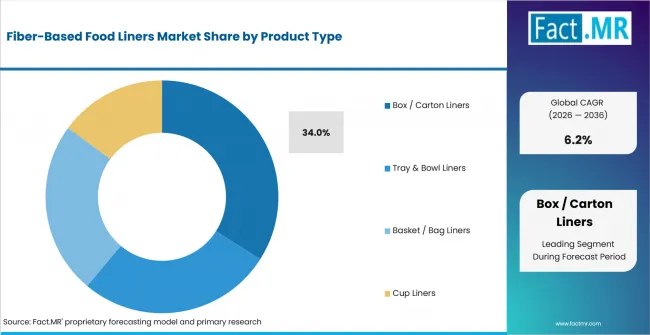
Fiber Based Food Liners Market Analysis By Product Type | Source: Fact.MR
Box-carton liners is projected to hold 34.0% share in 2026, supported by familiar routines that preserve approved carton retention within foodservice operations. Tray liners fit established packing routines while remaining independently replaceable. Commercial accounts retain food-specific grease and handling tests during qualification.
What leads the material segment?
Greaseproof paper is projected to account for 34.0% share in 2026.
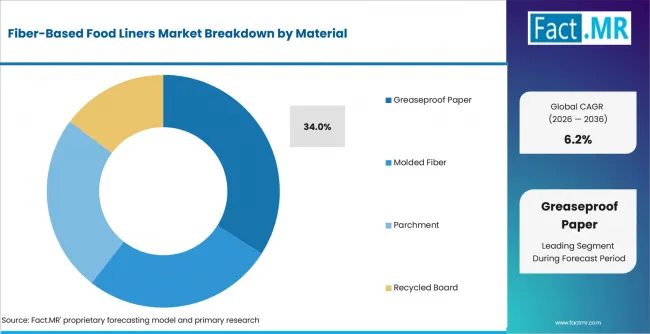
Fiber Based Food Liners Market Analysis By Material | Source: Fact.MR
Greaseproof paper is estimated to lead with 34.0% share in 2026, driven by its low weight and broad converting compatibility. Restaurant teams test grades against menu temperature and holding time. Successful trials permit wider use without changing the surrounding carton.
How does barrier-treatment shape demand?
Grease-resistant structures are anticipated to capture 44.0% share in 2026.
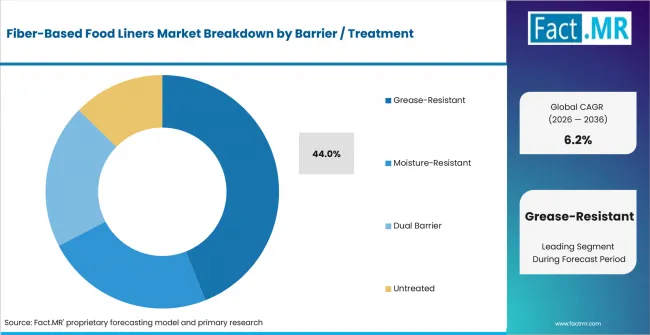
Fiber Based Food Liners Market Analysis By Barrier Treatment | Source: Fact.MR
Grease-resistant structures are poised to hold 44.0% share in 2026, reinforced by their ability to control oil migration and maintain appearance throughout service cycles. Adoption also depends on chemistry disclosure and local recovery guidance. Unclear disposal instructions can reduce commercial value across service regions.
What supports quick-service restaurants within application?
Quick-service restaurants are estimated to represent 38.0% share in 2026.
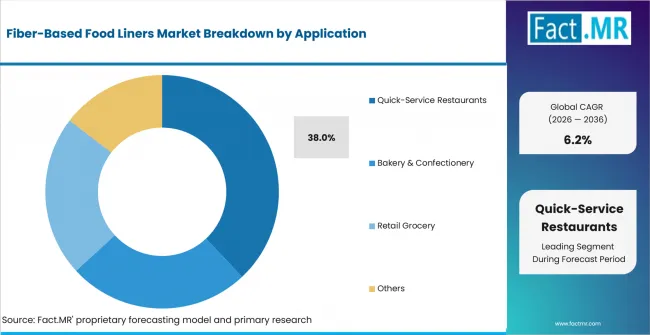
Fiber Based Food Liners Market Analysis By Application | Source: Fact.MR
In 2026, quick-service restaurants are expected to lead the application segment with a 38.0% share, benefiting from high-volume foodservice operations that require consistent packaging performance. Quick-service restaurants expose liners to repeated heat and grease. Restaurant groups evaluate barrier performance alongside disposal guidance, with approval dependent on reliable handling and a recovery route suited to each service region.
Why does foodservice hold the end-use position?
Foodservice is forecast to garner 58.0% share in 2026
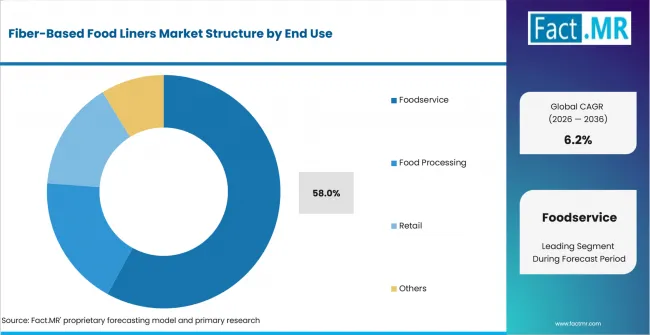
Fiber Based Food Liners Market Analysis By End Use | Source: Fact.MR
The end-use category is forecast to be led by foodservice at 58.0% share in 2026, reflecting recurring liner consumption across daily meal service operations. Converters retain accounts through reliable dispensing and stable dimensions. Disposal uncertainty or supply interruptions can disqualify otherwise capable liners.
What leads the sales channel segment?
Direct-OEM is expected to record 44.0% share in 2026
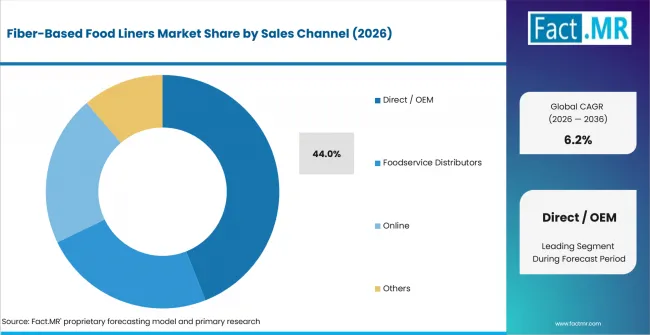
Fiber Based Food Liners Market Analysis By Sales Channel | Source: Fact.MR
Direct-OEM is projected to hold 44.0% share in 2026, underpinned by controlled trials that require documented application specifications at scale. Distributors remain necessary for standard sizes. Custom programs advance more gradually without direct control over chemistry and converting continuity.
What is accelerating Fiber-Based Food Liners Market adoption, and what is holding it back?
Food-contact specification replacement is anticipated to support growth, while qualification cost and recovery uncertainty restrain conversion speed.
Drivers Impact Analysis
| DRIVER | (~) % IMPACT ON CAGR | GEOGRAPHIC RELEVANCE | IMPACT TIMELINE |
|---|---|---|---|
| Fluorine-free grease-barrier qualification for food-contact paper | +0.8% | North America and Western Europe | Short term (<= 2 years) |
| Packaging waste rules requiring recovery evidence during design approval | +0.7% | Western Europe and United Kingdom | Medium term (2-4 years) |
| Takeaway and prepared-food workflows requiring repeat liner consumption | +0.5% | East Asia and North America | Medium term (2-4 years) |
| Chain-wide specifications rewarding consistent multi-plant converting | +0.4% | Global foodservice accounts | Medium term (2-4 years) |
| Direct account consolidation expanding bundled packaging programs | +0.3% | North America and Europe | Long term (>= 4 years) |
Source: Fact.MR analysis. Updated Aug 1, 2026
- Food-contact chemistry: Early disclosure lets technical teams compare barriers under intended temperature and holding conditions before wider trials.
- Recovery-focused design: Regulation (EU) 2025-40 brings composition and recyclability into decisions while discouraging unnecessary material combinations.
- Repeat consumption: Every meal creates another liner requirement after approval while reliable replenishment supports recurring revenue.
- Multi-plant consistency: National accounts require identical dimensions and treatments across sites to avoid renewed line checks.
- Bundled programs: Larger groups combine liners with related formats while specialists compete through faster sampling and narrow expertise.
Opportunity Impact Analysis
| OPPORTUNITY | (~) % IMPACT ON CAGR | GEOGRAPHIC RELEVANCE | IMPACT TIMELINE |
|---|---|---|---|
| Low-coat-weight grease barriers for existing paper grades | +0.5% | North America and Western Europe | Medium term (2-4 years) |
| Application-specific liners for delivery and extended holding | +0.4% | East Asia and major urban markets | Short term (<= 2 years) |
| Lightweight carton-liner combinations using separate functional layers | +0.4% | Global foodservice accounts | Medium term (2-4 years) |
| Regional direct supply with standardized chain specifications | +0.3% | India, Brazil and Southeast Asia | Long term (>= 4 years) |
Source: Fact.MR analysis. Updated Aug 1, 2026
- Low-coat barriers: Narrow treatments control grease while reducing material use for menus needing limited protection.
- Delivery liners: Longer holding increases grease and moisture exposure so developers use stronger delivery specifications.
- Separate layers: Liners change food-contact performance without replacing structural packs which preserves carton economics and simplifies qualification.
- Regional supply: Local converting supports faster trials and shorter routes while national accounts retain one central specification.
Restraints Impact Analysis
| RESTRAINT | (~) % IMPACT ON CAGR | GEOGRAPHIC RELEVANCE | IMPACT TIMELINE |
|---|---|---|---|
| Multi-stage testing across food, liner and surrounding package | -0.5% | Global | Medium term (2-4 years) |
| Coating composition creating uncertain recovery instructions | -0.4% | Western Europe and North America | Short term (<= 2 years) |
| Price pressure on lightweight foodservice consumables | -0.3% | India, China and Brazil | Medium term (2-4 years) |
| Distributor fragmentation limiting custom specification control | -0.2% | Emerging regional markets | Long term (>= 4 years) |
Source: Fact.MR analysis. Updated Aug 1, 2026
- Qualification burden: Teams test grease transfer and fit before recovery review because failure extends network approval.
- Recovery uncertainty: Paper appearance does not establish recyclability so restaurant groups require clear coating and disposal guidance.
- Price pressure: Small unit-cost changes accumulate across restaurant volumes while premium structures require measurable operating gains.
- Channel fragmentation: Smaller restaurants buy standard liners locally while custom programs need direct technical support.
Which countries are scaling Fiber-Based Food Liners Market fastest?
Brazil 6.7%, Germany 5.9%, United States 5.7%.
Coverage includes the Americas and Europe alongside East Asia, South Asia and Pacific, and Middle East and Africa.
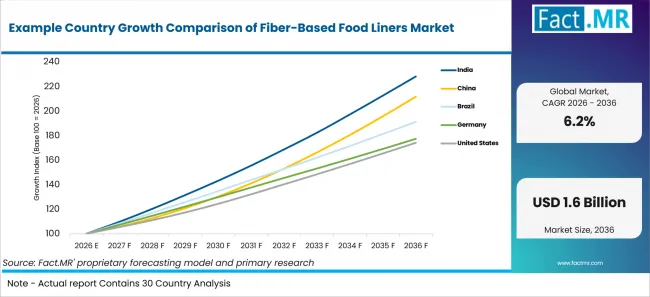
Example Country Growth Comparison Of Fiber Based Food Liners Market | Source: Fact.MR
| COUNTRY | CAGR |
|---|---|
| Brazil | 6.7% |
| Germany | 5.9% |
| United States | 5.7% |
Source: Fact.MR analysis. Updated Aug 1, 2026
How is India scaling Fiber-Based Food Liners demand?
8.6% CAGR, supported by food-grade packaging enforcement and expanding restaurant service networks.
Indian vendors need approved sheets that replace newspaper. FSSAI ended newspaper use in June 2026. Demand is projected to expand at an 8.6% CAGR through 2036, reinforced by the transition toward compliant paper packaging materials, although price pressure continues to constrain adoption.
What underpins growth in China?
7.8% CAGR, influenced by national coated-paper standards and high-output converting capacity.
Chinese converters follow a national coated-paper standard. GB/T 36392-2025 took effect in January 2026 and supports barrier paper structures. Industry is anticipated to record a 7.8% CAGR through 2036, aided by standardized coated-paper requirements despite ongoing price pressure across smaller accounts.
How is Brazil developing Fiber-Based Food Liners demand?
6.7% CAGR, supported by urban foodservice activity and closer comparison with plastic recovery routes.
Brazil is estimated to post a 6.7% CAGR through 2036, driven by expanding urban foodservice activity. Regional reverse-logistics differences continue to complicate converter guidance and qualification decisions across states.
What is driving Germany's growth through 2036?
5.9% CAGR, shaped by detailed material documentation and persistent cost pressure across restaurant accounts.
German restaurant accounts require detailed material documentation. The market is forecast to register a 5.9% CAGR through 2036, underpinned by oxygen-barrier paper wraps that support food-specific designs, while weak economics limit adoption of premium treatments.
What supports the United States outlook?
5.7% CAGR, driven by fluorine-free grease-barrier qualification and multi-plant account consistency.
United States restaurant groups require consistent grease-barrier performance. The FDA closed 35 legacy PFAS notifications in January 2025. Demand is expected to grow at a 5.7% CAGR through 2036, bolstered by increasing adoption of fluorine-free barrier coatings.
Who leads the Fiber-Based Food Liners Market?
Huhtamaki is estimated to hold 13.0% share, while several converted-format and specialty-paper groups compete across narrower applications.
Competition remains distributed among converter and specialty-paper suppliers whose commercial access depends on demonstrated performance. Huhtamaki and Novolex compete through foodservice scale, while Sabert focuses on catering and Mondi Group and Stora Enso emphasize barrier-paper solutions.
Which companies are the key providers?
Key providers include Huhtamaki, Novolex, Sabert and Mondi Group. Stora Enso, Georgia-Pacific and Nordic Paper.
- Huhtamaki
- Novolex
- Sabert and Mondi Group. Stora Enso
- Georgia-Pacific
- Nordic Paper.
Bibliography
- Sabert Corporation. (2025, June 2). Sabert Invests in the Future of Food Packaging with Innovative, Domestically Produced Solutions Featured at the 2025 IDDBA Show. Sabert Corporation.
- Ahlstrom Oyj. (2025, April 7). Ahlstrom receives home compostable certification in Australia and New Zealand for Sulpack® Flexible packaging. Ahlstrom.
- Pactiv Evergreen Inc. (2025, April 1). Current Report on Form 8-K. U.S. Securities and Exchange Commission.
- European Parliament and Council of the European Union. (2025, January 22). Regulation (EU) 2025-40 of the European Parliament and of the Council of 19 December 2024 on packaging and packaging waste, amending Regulation (EU) 2019-1020 and Directive (EU) 2019-904, and repealing Directive 94-62-EC. Official Journal of the European Union.
- Ministry of Health and Family Welfare. (2026, June 5). FSSAI directs stakeholders to discontinue the use of newspaper for packaging or serving food products. Press Information Bureau.
- State Administration for Market Regulation and Standardization Administration of China. (2025, June 30). GB-T 36392-2025: Coated paper and board for food packaging. National Public Service Platform for Standards Information.
- Presidency of the Federative Republic of Brazil. (2025, October 21). Decreto nº 12.688, de 21 de outubro de 2025. Presidency of the Federative Republic of Brazil.
- U.S. Food and Drug Administration. (2025, January 3). FDA Determines Authorization for 35 Food Contact Notifications Related to PFAS Are No Longer Effective. U.S. Food and Drug Administration.
This Report Addresses
- The report covers liner formats and materials used within commercial food-contact programs.
- Segment analysis examines carton liners and greaseproof paper alongside performance treatments.
- Application analysis covers foodservice while channel analysis compares direct and distributor purchasing routes.
- Country analysis compares India, China and Brazil with Germany and the United States.
- Competitive analysis profiles converted-format groups and specialty-paper producers by capability and account reach.
- Scope analysis separates liner revenue from standalone packages and downstream food sales.
What does the Fiber-Based Food Liners Market cover?
Fiber-based sheets and formed components that function as a separate food-contact liner inside another package or service item.
Covered revenue includes separable liners sold inside cartons and trays. Basket and cup inserts also remain included. Restaurant chains and processors define the boundary through purchases of separately priced liner components.
What is included in the scope?
Food-contact liner formats sold through direct and distributor channels across the stated regional coverage and six segmentation dimensions.
Included products cover flat sheets and formed liners. Applied barriers remain included when they contribute to liner value.
What is excluded from the scope?
Standalone packages and plastic-only structures are excluded alongside food revenue and coating sales that remain separate from a finished liner.
Standalone boxes and trays remain excluded unless they function as liners. Food sales and unrelated packaging revenue remain excluded.
How Was the Analysis Built?
The analysis draws on 120+ sources, 35+ company portfolios, 25+ countries, and more than 20 industry interviews.
- Primary Research: Primary research includes discussions with manufacturers, service providers, technology developers, distributors, end users, procurement teams, and subject-matter experts. These conversations examine purchasing priorities, product adoption, operational challenges, approval requirements, competitive positioning, and the factors that influence wider market acceptance.
- Desk Research: Desk research covers government statistics, regulatory publications, company filings, trade data, technical studies, industry associations, standards, public policy, and other authoritative sources. Every source used in the analysis is documented in the bibliography.
- Market Sizing and Forecasting: Market estimates combine historical performance, demand indicators, pricing and volume trends, segment shares, company participation, country-level growth, adoption patterns, investment activity, and barriers to market expansion.
- Data Validation and Update Cycle: Findings are validated by comparing primary interviews with public data, company activity, regulatory changes, trade patterns, and industry developments. Regular updates review new product launches, capacity changes, partnerships, approvals, procurement trends, and shifts in commercial adoption.
Segmentation
What is the report's scope and coverage?
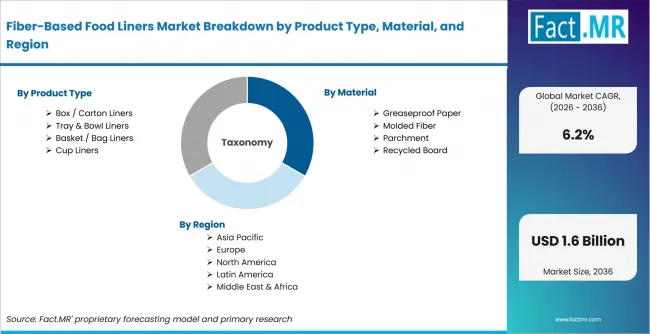
Fiber Based Food Liners Market Breakdown By Product Type, Material, And Region | Source: Fact.MR
| Coverage field | Report scope |
|---|---|
| Quantitative Units | USD Billion |
| Market Definition | Revenue from separable fiber-based food-contact liners, sheets, inserts and formed components. Standalone packages and food revenue are excluded. |
| Product Type | Box - Carton Liners, Tray & Bowl Liners, Basket - Bag Liners, Cup Liners |
| Material | Greaseproof Paper, Molded Fiber, Parchment, Recycled Board |
| Barrier - Treatment | Grease-Resistant, Moisture-Resistant, Dual Barrier, Untreated |
| Application | Quick-Service Restaurants, Bakery & Confectionery, Retail Grocery, Others |
| End Use | Foodservice, Food Processing, Retail, Others |
| Sales Channel | Direct - OEM, Foodservice Distributors, Online, Others |
| Regions Covered | North America, Latin America, Western Europe, Eastern Europe, East Asia, South Asia and Pacific, Middle East and Africa |
| Countries Covered | United States, Canada, Brazil, Mexico, Argentina, Chile, Germany, France, United Kingdom, 20+ in full report |
| Key Companies Profiled | Huhtamaki, Novolex, Sabert, Mondi Group, Stora Enso, Georgia-Pacific, Nordic Paper |
| Forecast Period | 2026 to 2036 |
| Approach | Hybrid analysis using liner demand, substrate use, application volumes, channel economics and replacement cycles. |
Source: Fact.MR analysis. Updated Aug 1, 2026
How is the market segmented?
-
By Product Type:
- Box - Carton Liners
- Tray & Bowl Liners
- Basket - Bag Liners
- Cup Liners
-
By Material:
- Greaseproof Paper
- Molded Fiber
- Parchment
- Recycled Board
-
By Barrier - Treatment:
- Grease-Resistant
- Moisture-Resistant
- Dual Barrier
- Untreated
-
By Application:
- Quick-Service Restaurants
- Bakery & Confectionery
- Retail Grocery
- Others
-
By End Use:
- Foodservice
- Food Processing
- Retail
- Others
-
By Sales Channel:
- Direct - OEM
- Foodservice Distributors
- Online
- Others
-
By Region:
- North America
- United States
- Canada
- Latin America
- Brazil
- Mexico
- Argentina
- Chile
- Western Europe
- Germany
- France
- United Kingdom
- Italy
- Spain
- Benelux
- Nordics
- Eastern Europe
- Poland
- Czech Republic
- Romania
- Hungary
- East Asia
- Japan
- South Korea
- South Asia and Pacific
- ASEAN
- Australia and New Zealand
- Middle East and Africa
- GCC Countries
- South Africa
- Türkiye
- Israel
- North America
Frequently Asked Questions
Which product type holds the principal share in the Fiber-Based Food Liners Market?
Which material accounts for the principal share in the Fiber-Based Food Liners Market?
Which barrier treatment holds the principal share in the Fiber-Based Food Liners Market?
Which country records the principal profiled CAGR in the Fiber-Based Food Liners Market?
What is the main growth driver in the Fiber-Based Food Liners Market?
What is the principal restraint in the Fiber-Based Food Liners Market?
Which companies are profiled in the Fiber-Based Food Liners Market report?
Who worked on this report


Preview the report firsthand - request a free sample
Free SampleGet the brochure for pricing and purchase details
Download PDF