Green Hydrogen Market Size, Share, Growth and Forecast (2026 - 2036)
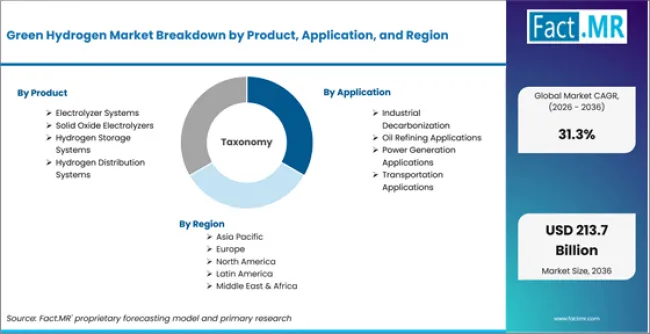
Green Hydrogen Market is segmented by Product (Electrolyzer Systems, Solid Oxide Electrolyzers, Hydrogen Storage Systems, Hydrogen Distribution Systems), Application (Industrial Decarbonization, Oil Refining Applications, Power Generation Applications, Transportation Applications), End Use (Energy & Power Companies, Industrial Manufacturers, Oil & Gas Companies, Transportation Sector), and Region, with forecasts covering the period from 2026 to 2036.
Green Hydrogen Market Analysis and Forecast by Fact.MR
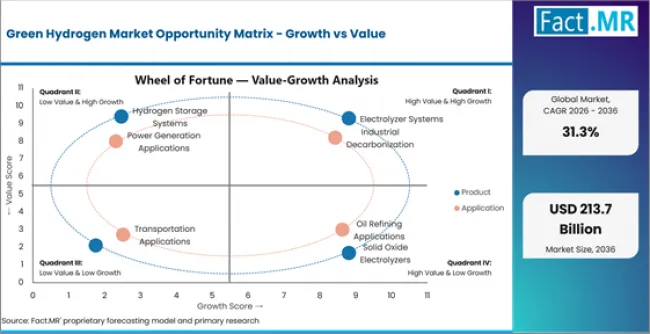
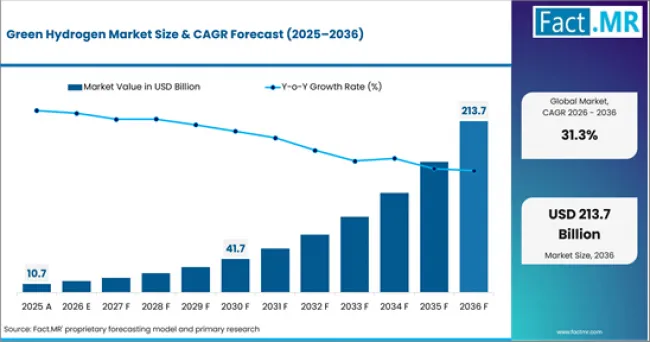
- The Green Hydrogen Market is projected to grow at a CAGR of 31.3% to reach USD 14.0 billion in 2026 and USD 213.7 billion by 2036.
- Driven by government mandates and subsidies for hydrogen strategies and production in major economies, scaling electrolyzer manufacturing capacity that is driving down the capital costs per MW, and increasing off-take agreements from industrial decarbonization and heavy transport applications.
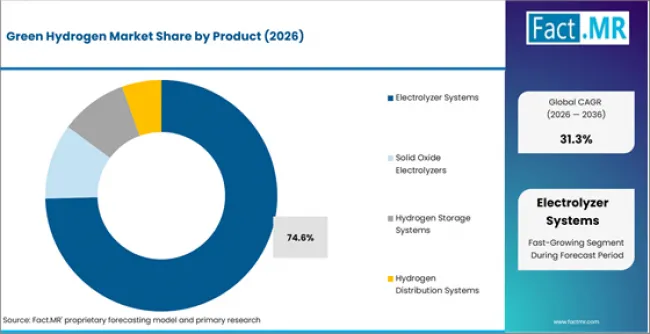
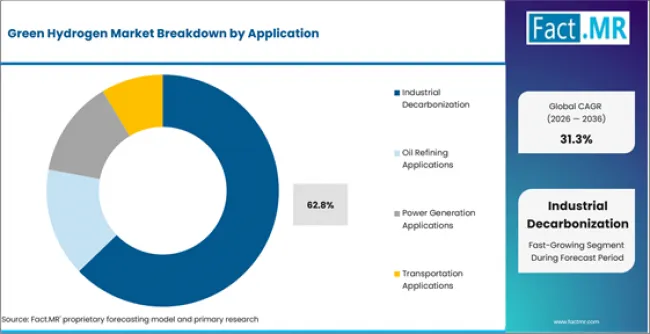
- Electrolyzer systems will contribute 74.6% share and industrial decarbonization will hold 62.8% share as energy companies, steelmakers and chemical producers seek to reduce emissions, comply with regulations and hedge against future energy costs.
Summary of the Green Hydrogen Market
- Market Snapshot
- In 2025, the global Green Hydrogen Market was valued at approximately USD 10.7 billion.
- The market is estimated to reach USD 14.0 billion in 2026 and is projected to attain USD 213.7 billion by 2036.
- The market is likely to expand at a CAGR of 31.3% during the forecast period.
- The market is anticipated to create an absolute dollar opportunity of USD 199.7 billion between 2026 and 2036.
- Electrolyzer systems account for 74.6% of product segment share in 2026.
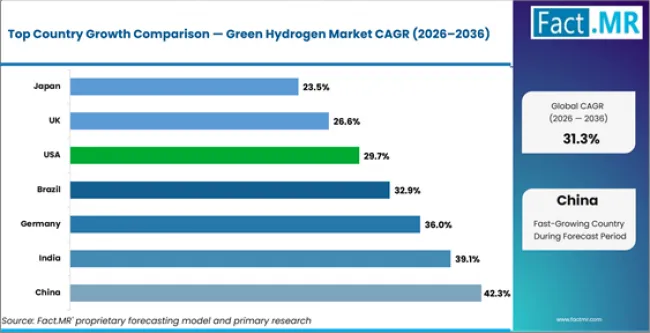
- China (42.3%) and India (39.1%) are the key growth markets during the forecast period.
- Demand and Growth Drivers
- The EU, USA, China, India and Australia have government hydrogen strategies mandating production targets and subsidy mechanisms that create bankable investment conditions for green hydrogen projects.
- Capital costs are going down from USD 1,200 to USD 1,500 per kW to sub-USD 500 per kW at scale, driven by Nel, ITM Power, Plug Power and Chinese manufacturers expanding electrolyzer manufacturing capacity.
- The largest single industrial demand category for decarbonization of the steel industry is via direct reduced iron (DRI) substituting coal-based blast furnace operations using green hydrogen.
- Ammonia synthesis using green hydrogen creates a pathway for decarbonized fertilizer production and green ammonia-based shipping fuel that addresses hard-to-abate emission sectors.
- IRA Section 45V production tax credits of up to USD 3 per kg make U.S. green hydrogen cost-competitive with grey hydrogen at current natural gas prices, creating the strongest single-market investment incentive globally.
- Geography and Competitive Outlook
- China at 42.3% reflects strong market fundamentals and expanding demand.
- India at 39.1% reflects strong market fundamentals and expanding demand.
- Germany at 36.0% reflects strong market fundamentals and expanding demand.
- Key players include Linde plc, Air Products Inc., Air Liquide, Cummins Inc., Engie, Nel ASA.
- Analyst Opinion
- Shambhu Nath Jha, Principal Consultant at Fact.MR, says 'The green hydrogen market is the fastest-growing energy market globally, driven by the convergence of government mandates, electrolyzer cost reduction, and industrial decarbonization commitment. The growth rates are exceptionally high because the market is scaling from a small base as projects announced in 2022 to 2024 reach final investment decisions and begin production in 2025 to 2028. China and India lead because they combine massive industrial hydrogen consumption with government support for domestic electrolyzer manufacturing. The critical success factor is electrolyzer cost reduction, because green hydrogen must reach USD 2 per kg to compete with grey hydrogen without subsidies, and manufacturing scale is the primary pathway to that cost target.'
Key Growth Drivers, Constraints, and Opportunities

Key Factors Driving Growth
- Structural patterns in end-use consumption are generating primary demand growth, which supports procurement needs.
- Technology and process development expanding the product capability and application scope.
- Regulatory frameworks leading to demand driven by compliance and quality specifications in key markets.
Key Market Constraints
- Procurement risk arises for downstream consumers from supply concentration or volatile raw material costs.
- Operating cost for manufacturers serving global markets is driven up by regulatory compliance complexity across jurisdictions.
- Competitive pressure from alternative materials or processes constrains pricing power in the commodity segment.
Key Opportunity Areas
- Margins above commodity products are created through pricing premiums for high purity and specialty grades.
- As manufacturing infrastructure is developed, the expansion of industrial capacity in emerging markets represents a large untapped pool of demand.
- Sustainability certification and responsible sourcing create differentiated product positioning that supports premium pricing.
Segment-wise Analysis of the Green Hydrogen Market
- Electrolyzer systems hold 74.6% of the product segment in 2026.
The green hydrogen market is segmented by product type, application, end use, technology, formulation, distribution channel, and region.
Which Product Segment Dominates the Green Hydrogen Market?

Product segment is 74.6% in 2026 for electrolyzer systems. Their leadership is characterized by broad applicability, established procurement patterns and alignment with primary end-use consumption requirements.
Complementary product categories serve specific needs. The leading segment is projected to retain its dominance through 2036.
Which Application Segment Dominates the Green Hydrogen Market?

The leading application anchors demand through structural consumption in the key industrial end-use categories. Production volume trends and regulatory quality requirements support the demand.
Secondary applications add growing demand from expanding use cases. The leading application continues to be the core demand driver.
Which Trend is Shaping the Next Phase of Growth in the Green Hydrogen Market?
Gigawatt-scale electrolyzer manufacturing is the defining technology trend, where production scale drives cost reduction toward the USD 2 per kg green hydrogen target needed for unsubsidized competitiveness with grey hydrogen. Manufacturing capacity announced by Nel, ITM Power, Plug Power, ThyssenKrupp nucera, and Chinese manufacturers including LONGi and Sungrow targets combined annual capacity exceeding 50 GW by 2028. This production scale applies automotive-style manufacturing principles including automated assembly, standardized cell stacks, and supply chain optimization to electrolyzer production.
The commercial significance is that electrolyzer cost reduction is the single most important variable determining the pace and scale of green hydrogen market growth. Every 10% reduction in electrolyzer capital cost reduces the levelized cost of green hydrogen by approximately 5 to 7%, bringing more projects across the viability threshold. Manufacturers that achieve production scale first will establish cost advantages that compound over successive production generations, creating winner-take-most dynamics in what is currently a fragmented supplier landscape.
Regional Outlook Across Key Markets
- China at 42.3% reflects expanding demand driven by regional industrial and regulatory fundamentals.
- India at 39.1% reflects expanding demand driven by regional industrial and regulatory fundamentals.
- Germany at 36.0% reflects expanding demand driven by regional industrial and regulatory fundamentals.
- Brazil at 32.9% reflects expanding demand driven by regional industrial and regulatory fundamentals.
.webp)
| Country | CAGR (%) |
|---|---|
| China | 42.3% |
| India | 39.1% |
| Germany | 36.0% |
| Brazil | 32.9% |
| USA | 29.7% |
Source: Fact MR (FMR) analysis, based on proprietary forecasting model and primary research.
Green Hydrogen Market Growth Assessment in China
China at a 42.3% CAGR through 2036 on government mandates of hydrogen strategy and support for domestically manufactured electrolyzers. Gigawatt-scale green hydrogen projects are being developed by state-owned energy companies Sinopec and SPIC. Domestic PEM and alkaline electrolyzer manufacturers are hitting cost points 30 to 40% lower than Western competitors, speeding up project economics.
- Hydrogen projects by state-owned energy companies create gigawatt-scale deployment pipelines underpinned by government policy and capital.
- Domestic electrolyzer manufacturing cost advantages accelerate the achievement of competitive hydrogen production costs more quickly than imported equipment.
Green Hydrogen Market Demand Trends in India
The National Green Hydrogen Mission aiming to produce 5 million tonnes of green hydrogen annually by 2030 is placing India at a CAGR of 39.1% through 2036. Reliance Industries, Adani Green Energy and Indian Oil Corporation have announced plans to invest billions of dollars in green hydrogen. The availability of abundant renewable energy resources, particularly solar in Rajasthan and Gujarat, offers low cost electricity input for electrolysis operations.
- Production targets under the National Green Hydrogen Mission create government-mandated deployment targets with specific funding and subsidy mechanisms.
- Western states have abundant low-cost solar energy resources that provide competitive electricity input costs to enhance green hydrogen production economics.
Green Hydrogen Market Analysis in Germany
EU Hydrogen Strategy and German National Hydrogen Strategy to set up regulatory frameworks and develop import infrastructure at a CAGR of 36.0% by 2036. ThyssenKrupp nucera has enough home electrolyzer production for European projects. Energiewende industrial decarbonization targets will boost demand for green hydrogen in the steel, chemical and refinery industries.
- EU Hydrogen Strategy regulatory frameworks establish binding production and import targets that provide green hydrogen project developers with investment certainty.
- ThyssenKrupp nucera’s production of electrolyzers for the home market provides European green hydrogen projects with regionally produced equipment that meets the requirements for EU content.
Green Hydrogen Market Opportunity in Brazil
Brazil is well-positioned to become a green hydrogen export hub due to its plentiful renewable energy resources such as hydroelectric, wind, and solar, with an expected CAGR of 32.9% through 2036. Port of Pecem in Ceara is building green hydrogen export terminal infrastructure aimed at European offtakers. Petroleo Brasileiro (Petrobras) is looking at combining green hydrogen with current refining operations.
- Low cost renewable energy sources, such as hydro, wind and solar power, provide competitive electricity input for the large scale electrolysis operations.
- Port of Pecem green hydrogen export terminal development positions Brazil as a supply source for European industrial off-takers seeking imported green hydrogen.
Green Hydrogen Market Outlook in USA

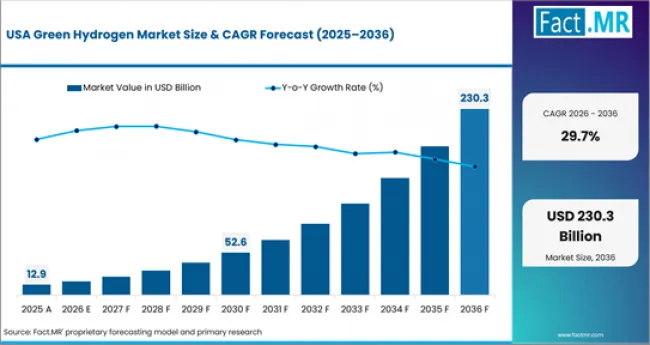
IRA Section 45V production tax credits of up to USD 3 per kg create the strongest single-market green hydrogen investment incentive globally at a 29.7% CAGR through 2036. DOE Regional Clean Hydrogen Hubs program has selected seven hub projects for development across diverse geographic and application contexts. Air Products, Plug Power, and NextEra are developing projects targeting both industrial off-take and transportation fuel applications.
- Green hydrogen becomes cost-competitive with grey hydrogen thanks to up to USD 3 per kg of IRA Section 45V tax incentives, the strongest global investment incentive.
- Seven hub projects in industrial, transportation and power generation settings receive federal co-investment through the DOE Regional Clean Hydrogen Hubs program.
Competitive Benchmarking and Company Positioning

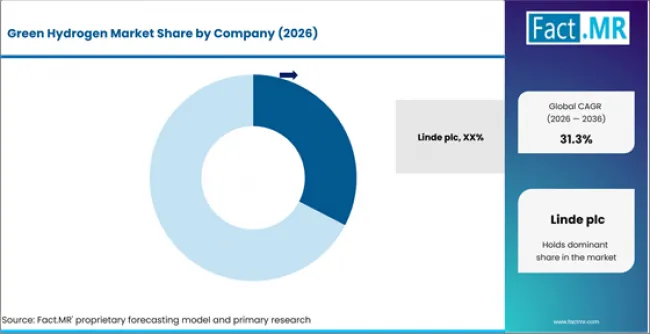
Green Hydrogen Market Analysis By Company
- Linde plc, Air Products Inc., Air Liquide hold leading positions through established presence and broad capabilities.
- Cummins Inc., Engie, Nel ASA compete across specific categories and regional markets.
- Technology capability, supply reliability, and customer relationship depth create primary competitive differentiators.
The competitive landscape features Linde plc and Air Products Inc. leading through scale and expertise, while regional competitors serve specialized requirements.
Competition is intensifying as market growth attracts investment and technology evolution creates new product requirements.
Key Companies in the Green Hydrogen Market
- Linde plc, Air Products Inc., Air Liquide, Cummins Inc., Engie are among the leading players.
- Nel ASA, ITM Power, Plug Power, Siemens Energy, ThyssenKrupp nucera compete across specific segments and markets.
Recent Industry Developments
- Recent Industry Developments in the Green Hydrogen Market (2025)
- Nel ASA – Capacity Expansion & Electrolyzer Manufacturing Scale-Up (2025) Nel ASA advanced its electrolyzer manufacturing expansion, targeting significant capacity growth. This includes scaling its U.S. PEM production facility in Wallingford, Connecticut, toward 500 MW annual capacity, and progressing with a 1 GW production line for its next-generation pressurized alkaline platform at Herøya, Norway (with commercial launch planned for 2026). These steps support broader gigawatt-scale ambitions in the global green hydrogen sector.
- Siemens Energy – Large-Scale PEM Electrolyzer Project Delivery (2025) Siemens Energy continued delivering large-scale PEM electrolyzer systems for green hydrogen projects, including major installations in Europe (e.g., deliveries to Air Liquide’s Normand’Hy project and involvement in projects like Kassø, Denmark). The company is strengthening its position in multi-MW to gigawatt-class deployments.
- Air Products – Green Hydrogen & Ammonia Off-Take Agreements (2025) Air Products secured and advanced long-term offtake and partnership agreements for green/low-carbon hydrogen and ammonia. Key developments include progress on the NEOM Green Hydrogen Project in Saudi Arabia (nearing completion) and advanced negotiations with Yara for low-emission ammonia projects linking U.S. and Saudi initiatives, providing strong revenue visibility and supporting project financing.
Leading Companies Shaping the Green Hydrogen Market
- Linde plc
- Air Products Inc.
- Air Liquide
- Cummins Inc.
- Engie
- Nel ASA
- ITM Power
- Plug Power
- Siemens Energy
- ThyssenKrupp nucera
Sources and Research References
- Grand View Research. (2025). Green hydrogen market size & share industry report, 2033. Grand View Research.
- Mordor Intelligence. (n.d.). Green hydrogen companies – Top company list. Mordor Intelligence.
- Persistence Market Research. (2025). Green hydrogen market size & top players analysis, 2032. Persistence Market Research.
- Research Intelo. (n.d.). Green hydrogen market research report 2033. Research Intelo.
- Linde plc. Product development and market activity updates.
- Air Products Inc.. Product development and market activity updates.
- Air Liquide. Product development and market activity updates.
This bibliography is provided for reader reference and is not exhaustive. The full report contains the complete reference list and detailed citations.
Green Hydrogen Market Definition
The green hydrogen market covers the core products, chemicals, and services within the defined scope across global and regional markets.
Green Hydrogen Market Inclusions
- The scope covers global and regional market size and forecasts for 2026 to 2036 across product type, application, end use, technology, formulation, distribution channel, and region.
- It includes regional demand analysis based on primary demand drivers, regulatory frameworks, and end-use spending patterns.
- The report covers pricing analysis across major product grades and delivery configurations.
Green Hydrogen Market Exclusions
- The scope excludes adjacent categories and general-purpose products not specifically designed for the defined market application.
- It excludes consulting and financial services not directly linked to market-specific procurement.
Green Hydrogen Market Research Methodology
- The methodology combines secondary research, primary interviews, and forecast modelling.
- It draws on 100+ secondary sources and benchmarks 40+ company portfolios.
- Market sizing covers 25+ countries through a demand-side model with top-down validation.
- The main validation includes 20+ interviews across manufacturers, providers, end users and partners.
- Procurement-cycle analysed, sensitivity tested, and final estimates will be cross-validated.
Scope of Analysis

| Parameter | Details |
|---|---|
| Quantitative Units | USD 14.0 billion to USD 213.7 billion, at a CAGR of 31.3% |
| Market Definition | The Green Hydrogen Market covers the primary products and services within the defined scope. |
| Regions Covered | North America, Latin America, Europe, East Asia, South Asia and Pacific, Middle East and Africa |
| Countries Covered | China, India, Germany, Brazil, USA, 25 plus countries |
| Key Companies | Linde plc, Air Products Inc., Air Liquide, Cummins Inc., Engie, Nel ASA, ITM Power, Plug Power, Siemens Energy, ThyssenKrupp nucera |
| Forecast Period | 2026 to 2036 |
| Approach | Hybrid demand-side and top-down methodology with primary interviews and cross-validation |
Green Hydrogen Market Segmentation
-
Green Hydrogen Market Segmented by Product:
- Electrolyzer Systems
- Alkaline Electrolyzers
- Conventional Alkaline Stack Systems
- Advanced Pressure Alkaline Systems
- PEM Electrolyzers
- Polymer Electrolyte Membrane Systems
- High Efficiency PEM Stack Units
- Alkaline Electrolyzers
- Solid Oxide Electrolyzers
- High Temperature Electrolyzers
- Ceramic Based SOEC Systems
- Industrial Heat Integrated Units
- Anion Exchange Membrane Systems
- Low Cost AEM Stack Systems
- Next Gen AEM Electrolyzers
- High Temperature Electrolyzers
- Hydrogen Storage Systems
- Compressed Hydrogen Storage
- High Pressure Cylinder Storage
- Tube Trailer Storage Systems
- Liquid Hydrogen Storage
- Cryogenic Storage Tanks
- LNG Integrated Hydrogen Storage
- Compressed Hydrogen Storage
- Hydrogen Distribution Systems
- Pipeline Distribution Systems
- Dedicated Hydrogen Pipelines
- Blended Gas Pipeline Systems
- Mobile Distribution Systems
- Trailer Based Hydrogen Transport
- Modular Distribution Containers
- Pipeline Distribution Systems
- Electrolyzer Systems
-
Green Hydrogen Market Segmented by Application:
- Industrial Decarbonization
- Steel Manufacturing Applications
- Green Steel Production Processes
- Hydrogen Based Reduction Systems
- Chemical Industry Applications
- Ammonia Production Systems
- Methanol Synthesis Processes
- Steel Manufacturing Applications
- Oil Refining Applications
- Hydrogenation Processes
- Desulfurization Systems
- Hydrocracking Applications
- Refinery Fuel Replacement
- Low Carbon Refining Units
- Process Emission Reduction Systems
- Hydrogenation Processes
- Power Generation Applications
- Hydrogen Power Plants
- Gas Turbine Hydrogen Blending
- Fuel Cell Power Systems
- Grid Balancing Applications
- Energy Storage Integration
- Peak Load Management Systems
- Hydrogen Power Plants
- Transportation Applications
- Fuel Cell Vehicles
- Hydrogen Passenger Vehicles
- Commercial Fuel Cell Trucks
- Aviation & Marine Applications
- Hydrogen Aviation Fuel Systems
- Marine Hydrogen Propulsion Systems
- Fuel Cell Vehicles
- Industrial Decarbonization
-
Green Hydrogen Market Segmented by End Use:
- Energy & Power Companies
- Renewable Energy Developers
- Green Hydrogen Producers
- Wind Solar Hybrid Operators
- Utility Companies
- Electricity Grid Operators
- Hydrogen Utility Networks
- Renewable Energy Developers
- Industrial Manufacturers
- Heavy Industry Operators
- Steel Production Companies
- Cement Manufacturing Plants
- Chemical Manufacturers
- Fertilizer Producers
- Industrial Gas Companies
- Heavy Industry Operators
- Oil & Gas Companies
- Refining Companies
- Petroleum Refiners
- Downstream Processing Firms
- Energy Transition Divisions
- Low Carbon Fuel Units
- Decarbonization Project Teams
- Refining Companies
- Transportation Sector
- Automotive Manufacturers
- Fuel Cell Vehicle OEMs
- Commercial Vehicle Makers
- Logistics Operators
- Fleet Operators
- Public Transport Agencies
- Automotive Manufacturers
- Energy & Power Companies
-
Green Hydrogen Market Segmented by Technology:
- Water Electrolysis Technology
- Alkaline Electrolysis Systems
- Traditional Electrolysis Units
- High Efficiency Alkaline Systems
- PEM Electrolysis Technology
- Membrane Based Electrolyzers
- Fast Response Electrolysis Systems
- Alkaline Electrolysis Systems
- Solid Oxide Technology
- High Temperature Electrolysis
- Thermal Energy Integrated Systems
- Ceramic Stack Electrolyzers
- Hybrid Electrolysis Systems
- Multi Mode Hydrogen Production Systems
- Renewable Integrated Electrolysis Units
- High Temperature Electrolysis
- Hydrogen Compression Technology
- Mechanical Compression Systems
- High Pressure Gas Compressors
- Multi Stage Compression Units
- Electrochemical Compression
- Low Energy Compression Systems
- Advanced Ion Transfer Compressors
- Mechanical Compression Systems
- Storage Technology
- Cryogenic Storage Systems
- Liquid Hydrogen Cooling Systems
- Ultra Low Temperature Tanks
- Solid State Storage
- Metal Hydride Storage Systems
- Advanced Material Storage Units
- Cryogenic Storage Systems
- Water Electrolysis Technology
-
Green Hydrogen Market Segmented by Formulation:
- Integrated Hydrogen Production Systems
- Electrolysis Integrated Modules
- Plug and Play Electrolyzer Units
- Modular Hydrogen Production Skids
- Energy Integrated Systems
- Renewable Power Coupled Systems
- Grid Connected Hydrogen Units
- Electrolysis Integrated Modules
- Hybrid Production Systems
- Multi Source Hydrogen Systems
- Wind + Electrolysis Systems
- Solar + Hydrogen Hybrid Systems
- Industrial Waste Energy Systems
- Waste Heat Recovery Electrolysis
- Industrial Off Gas Utilization Systems
- Multi Source Hydrogen Systems
- Storage Integrated Systems
- Production Storage Coupled Systems
- On Site Hydrogen Buffer Systems
- Distributed Storage Networks
- Transport Integrated Systems
- Mobile Hydrogen Generation Units
- Container Based Production Systems
- Production Storage Coupled Systems
- Integrated Hydrogen Production Systems
-
Green Hydrogen Market Segmented by Distribution Channel:
- Direct Project Sales
- Government Hydrogen Projects
- National Hydrogen Mission Contracts
- Public Energy Transition Programs
- Industrial EPC Contracts
- Engineering Procurement Construction Firms
- Turnkey Hydrogen Plant Developers
- Government Hydrogen Projects
- Strategic Partnerships
- Energy Company Alliances
- Utility Hydrogen Joint Ventures
- Industrial Consortium Projects
- Technology Partnerships
- Electrolyzer Manufacturer Alliances
- Renewable Energy Partnerships
- Energy Company Alliances
- Industrial Distributors
- Energy Equipment Distributors
- Hydrogen System Integrators
- Industrial Gas Equipment Suppliers
- Regional Distributors
- Local Energy Infrastructure Suppliers
- Regional Hydrogen Equipment Dealers
- Energy Equipment Distributors
- Online Industrial Platforms
- B2B Energy Marketplaces
- Digital Hydrogen Procurement Platforms
- Industrial Energy Portals
- B2C Energy Marketplaces
- Digital Hydrogen Procurement Platforms
- Industrial Energy Portals
- B2B Energy Marketplaces
- Direct Project Sales
-
Green Hydrogen Market by Region:
- North America
- USA
- Canada
- Mexico
- Latin America
- Brazil
- Chile
- Rest of Latin America
- Western Europe
- Germany
- UK
- Italy
- Spain
- France
- Nordic
- BENELUX
- Rest of Western Europe
- Eastern Europe
- Russia
- Poland
- Hungary
- Balkan & Baltic
- Rest of Eastern Europe
- East Asia
- China
- Japan
- South Korea
- South Asia and Pacific
- India
- ASEAN
- Australia & New Zealand
- Rest of South Asia and Pacific
- Middle East & Africa
- Kingdom of Saudi Arabia
- Other GCC Countries
- Turkiye
- South Africa
- Other African Union
- Rest of Middle East & Africa
- North America
- Frequently Asked Questions -
How big is the green hydrogen market in 2026?
The global green hydrogen market is estimated to be valued at USD 14.0 billion in 2026.
What will be the size of green hydrogen market in 2036?
The market size for the green hydrogen market is projected to reach USD 213.7 billion by 2036.
How much will be the green hydrogen market growth between 2026 and 2036?
The green hydrogen market is expected to grow at a 31.3% CAGR between 2026 and 2036.
What are the key product in the green hydrogen market?
The key product in green hydrogen market are Electrolyzer Systems, Solid Oxide Electrolyzers, Hydrogen Storage Systems and Hydrogen Distribution Systems.
Which application segment is expected to contribute significant share in the green hydrogen market in 2026?
In terms of application, industrial decarbonization segment is expected to command 62.8% share in the green hydrogen market in 2026.
Table of Content
- Key Takeaways
- Market Size and CAGR
- Top Growth Driver
- Fastest Growing Segment
- Leading Region
- Key Companies
- Emerging Opportunities
- Executive Summary
- Global Market Outlook
- Demand-side Trends
- Supply-side Trends
- Technology Roadmap Analysis
- Analysis and Recommendations
- Analyst Perspective (What is happening? Why now? What should investors know?)
- Key Questions Answered
- How large is the market?
- What is the CAGR?
- What are key trends?
- Which region dominates?
- Who are the leaders?
- Market Overview
- Market Coverage / Taxonomy
- Market Definition / Scope / Limitations
- Research Methodology
- Chapter Orientation
- Analytical Lens and Working Hypotheses
- Market Structure, Signals, and Trend Drivers
- Benchmarking and Cross-market Comparability
- Market Sizing, Forecasting, and Opportunity Mapping
- Research Design and Evidence Framework
- Desk Research Programme (Secondary Evidence)
- Expert Input and Fieldwork (Primary Evidence)
- Tooling, Models, and Reference Databases
- Data Engineering and Model Build
- Quality Assurance and Audit Trail
- Market Background
- Market Dynamics (Drivers, Restraints, Opportunity, Trends)
- Scenario Forecast (Optimistic, Likely, Conservative)
- Impact Analysis
- AI Impact
- Sustainability Impact
- Regulatory Impact
- Technology Impact
- Consumer / Buyer Analysis
- Purchase Drivers
- Adoption Barriers
- Buyer Journey
- Opportunity Map Analysis
- Product Life Cycle Analysis
- Supply Chain Analysis
- Investment Feasibility Matrix
- Value Chain Analysis
- PESTLE and Porter's Analysis
- Regulatory Landscape
- Regional Parent Market Outlook
- Production and Consumption Statistics
- Import and Export Statistics
- Global Market Analysis and Forecast, 2021 to 2036
- Historical Market Size Value (USD Million) Analysis, 2021 to 2025
- Current and Future Market Size Value (USD Million) Projections, 2026 to 2036
- Y-o-Y Growth Trend Analysis
- Absolute $ Opportunity Analysis
- Global Market Pricing Analysis, 2021 to 2036
- Global Market Analysis and Forecast, By Product, 2021 to 2036
- Introduction / Key Findings
- Historical Market Size Value (USD Million) Analysis By Product, 2021 to 2025
- Current and Future Market Size Value (USD Million) Analysis and Forecast By Product, 2026 to 2036
- Electrolyzer Systems
- Alkaline Electrolyzers
- PEM Electrolyzers
- Solid Oxide Electrolyzers
- High Temperature Electrolyzers
- Anion Exchange Membrane Systems
- Hydrogen Storage Systems
- Compressed Hydrogen Storage
- Liquid Hydrogen Storage
- Hydrogen Distribution Systems
- Pipeline Distribution Systems
- Mobile Distribution Systems
- Electrolyzer Systems
- Y-o-Y Growth Trend Analysis By Product, 2021 to 2025
- Absolute $ Opportunity Analysis By Product, 2026 to 2036
- Global Market Analysis and Forecast, By Application, 2021 to 2036
- Introduction / Key Findings
- Historical Market Size Value (USD Million) Analysis By Application, 2021 to 2025
- Current and Future Market Size Value (USD Million) Analysis and Forecast By Application, 2026 to 2036
- Industrial Decarbonization
- Steel Manufacturing Applications
- Chemical Industry Applications
- Oil Refining Applications
- Hydrogenation Processes
- Refinery Fuel Replacement
- Power Generation Applications
- Hydrogen Power Plants
- Grid Balancing Applications
- Transportation Applications
- Fuel Cell Vehicles
- Aviation & Marine Applications
- Industrial Decarbonization
- Y-o-Y Growth Trend Analysis By Application, 2021 to 2025
- Absolute $ Opportunity Analysis By Application, 2026 to 2036
- Global Market Analysis and Forecast, By End Use, 2021 to 2036
- Introduction / Key Findings
- Historical Market Size Value (USD Million) Analysis By End Use, 2021 to 2025
- Current and Future Market Size Value (USD Million) Analysis and Forecast By End Use, 2026 to 2036
- Energy & Power Companies
- Renewable Energy Developers
- Utility Companies
- Industrial Manufacturers
- Heavy Industry Operators
- Chemical Manufacturers
- Oil & Gas Companies
- Refining Companies
- Energy Transition Divisions
- Transportation Sector
- Automotive Manufacturers
- Logistics Operators
- Energy & Power Companies
- Y-o-Y Growth Trend Analysis By End Use, 2021 to 2025
- Absolute $ Opportunity Analysis By End Use, 2026 to 2036
- Global Market Analysis and Forecast, By Technology, 2021 to 2036
- Introduction / Key Findings
- Historical Market Size Value (USD Million) Analysis By Technology, 2021 to 2025
- Current and Future Market Size Value (USD Million) Analysis and Forecast By Technology, 2026 to 2036
- Water Electrolysis Technology
- Alkaline Electrolysis Systems
- PEM Electrolysis Technology
- Solid Oxide Technology
- High Temperature Electrolysis
- Hybrid Electrolysis Systems
- Hydrogen Compression Technology
- Mechanical Compression Systems
- Electrochemical Compression
- Storage Technology
- Cryogenic Storage Systems
- Solid State Storage
- Water Electrolysis Technology
- Y-o-Y Growth Trend Analysis By Technology, 2021 to 2025
- Absolute $ Opportunity Analysis By Technology, 2026 to 2036
- Global Market Analysis and Forecast, By Formulation, 2021 to 2036
- Introduction / Key Findings
- Historical Market Size Value (USD Million) Analysis By Formulation, 2021 to 2025
- Current and Future Market Size Value (USD Million) Analysis and Forecast By Formulation, 2026 to 2036
- Integrated Hydrogen Production Systems
- Electrolysis Integrated Modules
- Energy Integrated Systems
- Hybrid Production Systems
- Multi Source Hydrogen Systems
- Industrial Waste Energy Systems
- Storage Integrated Systems
- Production Storage Coupled Systems
- Transport Integrated Systems
- Integrated Hydrogen Production Systems
- Y-o-Y Growth Trend Analysis By Formulation, 2021 to 2025
- Absolute $ Opportunity Analysis By Formulation, 2026 to 2036
- Global Market Analysis and Forecast, By Distribution Channel
- Introduction / Key Findings
- Historical Market Size Value (USD Million) Analysis By Distribution Channel, 2021 to 2025
- Current and Future Market Size Value (USD Million) Analysis and Forecast By Distribution Channel, 2026 to 2036
- Direct Project Sales
- Government Hydrogen Projects
- Industrial EPC Contracts
- Strategic Partnerships
- Energy Company Alliances
- Technology Partnerships
- Industrial Distributors
- Energy Equipment Distributors
- Regional Distributors
- Online Industrial Platforms
- B2B Energy Marketplaces
- B2C Energy Marketplaces
- Direct Project Sales
- Y-o-Y Growth Trend Analysis By Distribution Channel, 2021 to 2025
- Absolute $ Opportunity Analysis By Distribution Channel, 2026 to 2036
- Global Market Analysis and Forecast, By Region, 2021 to 2036
- Introduction
- Historical Market Size Value (USD Million) Analysis By Region, 2021 to 2025
- Current Market Size Value (USD Million) Analysis and Forecast By Region, 2026 to 2036
- North America
- Latin America
- Western Europe
- Eastern Europe
- East Asia
- South Asia and Pacific
- Middle East & Africa
- Market Attractiveness Analysis By Region
- North America Market Analysis and Forecast, By Country, 2021 to 2036
- Historical Market Size Value (USD Million) Trend Analysis By Market Taxonomy, 2021 to 2025
- Market Size Value (USD Million) Forecast By Market Taxonomy, 2026 to 2036
- By Country
- USA
- Canada
- Mexico
- By Product
- By Application
- By End Use
- By Technology
- By Formulation
- By Distribution Channel
- By Country
- Market Attractiveness Analysis
- By Country
- By Product
- By Application
- By End Use
- By Technology
- By Formulation
- By Distribution Channel
- Key Takeaways
- Latin America Market Analysis and Forecast, By Country
- Historical Market Size Value (USD Million) Trend Analysis By Market Taxonomy, 2021 to 2025
- Market Size Value (USD Million) Forecast By Market Taxonomy, 2026 to 2036
- By Country
- Brazil
- Chile
- Rest of Latin America
- By Product
- By Application
- By End Use
- By Technology
- By Formulation
- By Distribution Channel
- By Country
- Market Attractiveness Analysis
- By Country
- By Product
- By Application
- By End Use
- By Technology
- By Formulation
- By Distribution Channel
- Key Takeaways
- Western Europe Market Analysis and Forecast, By Country
- Historical Market Size Value (USD Million) Trend Analysis By Market Taxonomy, 2021 to 2025
- Market Size Value (USD Million) Forecast By Market Taxonomy, 2026 to 2036
- By Country
- Germany
- UK
- Italy
- Spain
- France
- Nordic
- BENELUX
- Rest of Western Europe
- By Product
- By Application
- By End Use
- By Technology
- By Formulation
- By Distribution Channel
- By Country
- Market Attractiveness Analysis
- By Country
- By Product
- By Application
- By End Use
- By Technology
- By Formulation
- By Distribution Channel
- Key Takeaways
- Eastern Europe Market Analysis and Forecast, By Country
- Historical Market Size Value (USD Million) Trend Analysis By Market Taxonomy, 2021 to 2025
- Market Size Value (USD Million) Forecast By Market Taxonomy, 2026 to 2036
- By Country
- Russia
- Poland
- Hungary
- Balkan & Baltic
- Rest of Eastern Europe
- By Product
- By Application
- By End Use
- By Technology
- By Formulation
- By Distribution Channel
- By Country
- Market Attractiveness Analysis
- By Country
- By Product
- By Application
- By End Use
- By Technology
- By Formulation
- By Distribution Channel
- Key Takeaways
- East Asia Market Analysis and Forecast, By Country
- Historical Market Size Value (USD Million) Trend Analysis By Market Taxonomy, 2021 to 2025
- Market Size Value (USD Million) Forecast By Market Taxonomy, 2026 to 2036
- By Country
- China
- Japan
- South Korea
- By Product
- By Application
- By End Use
- By Technology
- By Formulation
- By Distribution Channel
- By Country
- Market Attractiveness Analysis
- By Country
- By Product
- By Application
- By End Use
- By Technology
- By Formulation
- By Distribution Channel
- Key Takeaways
- South Asia and Pacific Market Analysis and Forecast, By Country
- Historical Market Size Value (USD Million) Trend Analysis By Market Taxonomy, 2021 to 2025
- Market Size Value (USD Million) Forecast By Market Taxonomy, 2026 to 2036
- By Country
- India
- ASEAN
- Australia & New Zealand
- Rest of South Asia and Pacific
- By Product
- By Application
- By End Use
- By Technology
- By Formulation
- By Distribution Channel
- By Country
- Market Attractiveness Analysis
- By Country
- By Product
- By Application
- By End Use
- By Technology
- By Formulation
- By Distribution Channel
- Key Takeaways
- Middle East & Africa Market Analysis and Forecast, By Country
- Historical Market Size Value (USD Million) Trend Analysis By Market Taxonomy, 2021 to 2025
- Market Size Value (USD Million) Forecast By Market Taxonomy, 2026 to 2036
- By Country
- Kingdom of Saudi Arabia
- Other GCC Countries
- Turkiye
- South Africa
- Other African Union
- Rest of Middle East & Africa
- By Product
- By Application
- By End Use
- By Technology
- By Formulation
- By Distribution Channel
- By Country
- Market Attractiveness Analysis
- By Country
- By Product
- By Application
- By End Use
- By Technology
- By Formulation
- By Distribution Channel
- Key Takeaways
- Key Countries Market Analysis
- USA
- Pricing Analysis
- Market Share Analysis, 2025
- By Product
- By Application
- By End Use
- By Technology
- By Formulation
- By Distribution Channel
- Canada
- Pricing Analysis
- Market Share Analysis, 2025
- By Product
- By Application
- By End Use
- By Technology
- By Formulation
- By Distribution Channel
- Mexico
- Pricing Analysis
- Market Share Analysis, 2025
- By Product
- By Application
- By End Use
- By Technology
- By Formulation
- By Distribution Channel
- Brazil
- Pricing Analysis
- Market Share Analysis, 2025
- By Product
- By Application
- By End Use
- By Technology
- By Formulation
- By Distribution Channel
- Chile
- Pricing Analysis
- Market Share Analysis, 2025
- By Product
- By Application
- By End Use
- By Technology
- By Formulation
- By Distribution Channel
- Germany
- Pricing Analysis
- Market Share Analysis, 2025
- By Product
- By Application
- By End Use
- By Technology
- By Formulation
- By Distribution Channel
- UK
- Pricing Analysis
- Market Share Analysis, 2025
- By Product
- By Application
- By End Use
- By Technology
- By Formulation
- By Distribution Channel
- Italy
- Pricing Analysis
- Market Share Analysis, 2025
- By Product
- By Application
- By End Use
- By Technology
- By Formulation
- By Distribution Channel
- Spain
- Pricing Analysis
- Market Share Analysis, 2025
- By Product
- By Application
- By End Use
- By Technology
- By Formulation
- By Distribution Channel
- France
- Pricing Analysis
- Market Share Analysis, 2025
- By Product
- By Application
- By End Use
- By Technology
- By Formulation
- By Distribution Channel
- India
- Pricing Analysis
- Market Share Analysis, 2025
- By Product
- By Application
- By End Use
- By Technology
- By Formulation
- By Distribution Channel
- ASEAN
- Pricing Analysis
- Market Share Analysis, 2025
- By Product
- By Application
- By End Use
- By Technology
- By Formulation
- By Distribution Channel
- Australia & New Zealand
- Pricing Analysis
- Market Share Analysis, 2025
- By Product
- By Application
- By End Use
- By Technology
- By Formulation
- By Distribution Channel
- China
- Pricing Analysis
- Market Share Analysis, 2025
- By Product
- By Application
- By End Use
- By Technology
- By Formulation
- By Distribution Channel
- Japan
- Pricing Analysis
- Market Share Analysis, 2025
- By Product
- By Application
- By End Use
- By Technology
- By Formulation
- By Distribution Channel
- South Korea
- Pricing Analysis
- Market Share Analysis, 2025
- By Product
- By Application
- By End Use
- By Technology
- By Formulation
- By Distribution Channel
- Russia
- Pricing Analysis
- Market Share Analysis, 2025
- By Product
- By Application
- By End Use
- By Technology
- By Formulation
- By Distribution Channel
- Poland
- Pricing Analysis
- Market Share Analysis, 2025
- By Product
- By Application
- By End Use
- By Technology
- By Formulation
- By Distribution Channel
- Hungary
- Pricing Analysis
- Market Share Analysis, 2025
- By Product
- By Application
- By End Use
- By Technology
- By Formulation
- By Distribution Channel
- Kingdom of Saudi Arabia
- Pricing Analysis
- Market Share Analysis, 2025
- By Product
- By Application
- By End Use
- By Technology
- By Formulation
- By Distribution Channel
- Turkiye
- Pricing Analysis
- Market Share Analysis, 2025
- By Product
- By Application
- By End Use
- By Technology
- By Formulation
- By Distribution Channel
- South Africa
- Pricing Analysis
- Market Share Analysis, 2025
- By Product
- By Application
- By End Use
- By Technology
- By Formulation
- By Distribution Channel
- USA
- Market Structure Analysis
- Competition Dashboard
- Competition Benchmarking
- Market Share Analysis of Top Players
- By Regional
- By Product
- By Application
- By End Use
- By Technology
- By Formulation
- By Distribution Channel
- Emerging Startups
- Innovation Benchmarking
- Competition Analysis
- Competition Deep Dive
- Linde plc
- Overview
- Product Portfolio
- Profitability by Market Segments (Product/Age /Sales Channel/Region)
- Sales Footprint
- Strategy Overview
- Marketing Strategy
- Product Strategy
- Channel Strategy
- Air Product Inc.
- Air Liquide
- Cummins Inc.
- Engie
- Nel ASA
- Siemens Energy
- Toshiba Energy Systems and Solutions Corporation
- Uniper SE
- Bloom Energy
- Linde plc
- Competition Deep Dive
- Case Studies
- Success Stories
- Recent Developments
- Assumptions & Acronyms Used
List Of Table
- Table 1: Global Market Value (USD Million) Forecast by Region, 2021 to 2036
- Table 2: Global Market Value (USD Million) Forecast by Product, 2021 to 2036
- Table 3: Global Market Value (USD Million) Forecast by Application, 2021 to 2036
- Table 4: Global Market Value (USD Million) Forecast by End Use, 2021 to 2036
- Table 5: Global Market Value (USD Million) Forecast by Technology, 2021 to 2036
- Table 6: Global Market Value (USD Million) Forecast by Formulation, 2021 to 2036
- Table 7: Global Market Value (USD Million) Forecast by Distribution Channel, 2021 to 2036
- Table 8: Global Market rma_anu Forecast by rma_anu, 2021 to 2036
- Table 9: North America Market Value (USD Million) Forecast by Country, 2021 to 2036
- Table 10: North America Market Value (USD Million) Forecast by Product, 2021 to 2036
- Table 11: North America Market Value (USD Million) Forecast by Application, 2021 to 2036
- Table 12: North America Market Value (USD Million) Forecast by End Use, 2021 to 2036
- Table 13: North America Market Value (USD Million) Forecast by Technology, 2021 to 2036
- Table 14: North America Market Value (USD Million) Forecast by Formulation, 2021 to 2036
- Table 15: North America Market Value (USD Million) Forecast by Distribution Channel, 2021 to 2036
- Table 16: Latin America Market Value (USD Million) Forecast by Country, 2021 to 2036
- Table 17: Latin America Market Value (USD Million) Forecast by Product, 2021 to 2036
- Table 18: Latin America Market Value (USD Million) Forecast by Application, 2021 to 2036
- Table 19: Latin America Market Value (USD Million) Forecast by End Use, 2021 to 2036
- Table 20: Latin America Market Value (USD Million) Forecast by Technology, 2021 to 2036
- Table 21: Latin America Market Value (USD Million) Forecast by Formulation, 2021 to 2036
- Table 22: Latin America Market Value (USD Million) Forecast by Distribution Channel, 2021 to 2036
- Table 23: Western Europe Market Value (USD Million) Forecast by Country, 2021 to 2036
- Table 24: Western Europe Market Value (USD Million) Forecast by Product, 2021 to 2036
- Table 25: Western Europe Market Value (USD Million) Forecast by Application, 2021 to 2036
- Table 26: Western Europe Market Value (USD Million) Forecast by End Use, 2021 to 2036
- Table 27: Western Europe Market Value (USD Million) Forecast by Technology, 2021 to 2036
- Table 28: Western Europe Market Value (USD Million) Forecast by Formulation, 2021 to 2036
- Table 29: Western Europe Market Value (USD Million) Forecast by Distribution Channel, 2021 to 2036
- Table 30: Eastern Europe Market Value (USD Million) Forecast by Country, 2021 to 2036
- Table 31: Eastern Europe Market Value (USD Million) Forecast by Product, 2021 to 2036
- Table 32: Eastern Europe Market Value (USD Million) Forecast by Application, 2021 to 2036
- Table 33: Eastern Europe Market Value (USD Million) Forecast by End Use, 2021 to 2036
- Table 34: Eastern Europe Market Value (USD Million) Forecast by Technology, 2021 to 2036
- Table 35: Eastern Europe Market Value (USD Million) Forecast by Formulation, 2021 to 2036
- Table 36: Eastern Europe Market Value (USD Million) Forecast by Distribution Channel, 2021 to 2036
- Table 37: East Asia Market Value (USD Million) Forecast by Country, 2021 to 2036
- Table 38: East Asia Market Value (USD Million) Forecast by Product, 2021 to 2036
- Table 39: East Asia Market Value (USD Million) Forecast by Application, 2021 to 2036
- Table 40: East Asia Market Value (USD Million) Forecast by End Use, 2021 to 2036
- Table 41: East Asia Market Value (USD Million) Forecast by Technology, 2021 to 2036
- Table 42: East Asia Market Value (USD Million) Forecast by Formulation, 2021 to 2036
- Table 43: East Asia Market Value (USD Million) Forecast by Distribution Channel, 2021 to 2036
- Table 44: South Asia and Pacific Market Value (USD Million) Forecast by Country, 2021 to 2036
- Table 45: South Asia and Pacific Market Value (USD Million) Forecast by Product, 2021 to 2036
- Table 46: South Asia and Pacific Market Value (USD Million) Forecast by Application, 2021 to 2036
- Table 47: South Asia and Pacific Market Value (USD Million) Forecast by End Use, 2021 to 2036
- Table 48: South Asia and Pacific Market Value (USD Million) Forecast by Technology, 2021 to 2036
- Table 49: South Asia and Pacific Market Value (USD Million) Forecast by Formulation, 2021 to 2036
- Table 50: South Asia and Pacific Market Value (USD Million) Forecast by Distribution Channel, 2021 to 2036
- Table 51: Middle East & Africa Market Value (USD Million) Forecast by Country, 2021 to 2036
- Table 52: Middle East & Africa Market Value (USD Million) Forecast by Product, 2021 to 2036
- Table 53: Middle East & Africa Market Value (USD Million) Forecast by Application, 2021 to 2036
- Table 54: Middle East & Africa Market Value (USD Million) Forecast by End Use, 2021 to 2036
- Table 55: Middle East & Africa Market Value (USD Million) Forecast by Technology, 2021 to 2036
- Table 56: Middle East & Africa Market Value (USD Million) Forecast by Formulation, 2021 to 2036
- Table 57: Middle East & Africa Market Value (USD Million) Forecast by Distribution Channel, 2021 to 2036
List Of Figures
- Figure 1: Global Market Pricing Analysis
- Figure 2: Global Market Value (USD Million) Forecast 2021 to 2036
- Figure 3: Global Market Value Share and BPS Analysis by Product, 2026 and 2036
- Figure 4: Global Market Y-o-Y Growth Comparison by Product, 2026 to 2036
- Figure 5: Global Market Attractiveness Analysis by Product
- Figure 6: Global Market Value Share and BPS Analysis by Application, 2026 and 2036
- Figure 7: Global Market Y-o-Y Growth Comparison by Application, 2026 to 2036
- Figure 8: Global Market Attractiveness Analysis by Application
- Figure 9: Global Market Value Share and BPS Analysis by End Use, 2026 and 2036
- Figure 10: Global Market Y-o-Y Growth Comparison by End Use, 2026 to 2036
- Figure 11: Global Market Attractiveness Analysis by End Use
- Figure 12: Global Market Value Share and BPS Analysis by Technology, 2026 and 2036
- Figure 13: Global Market Y-o-Y Growth Comparison by Technology, 2026 to 2036
- Figure 14: Global Market Attractiveness Analysis by Technology
- Figure 15: Global Market Value Share and BPS Analysis by Formulation, 2026 and 2036
- Figure 16: Global Market Y-o-Y Growth Comparison by Formulation, 2026 to 2036
- Figure 17: Global Market Attractiveness Analysis by Formulation
- Figure 18: Global Market Value Share and BPS Analysis by Distribution Channel, 2026 and 2036
- Figure 19: Global Market Y-o-Y Growth Comparison by Distribution Channel, 2026 to 2036
- Figure 20: Global Market Attractiveness Analysis by Distribution Channel
- Figure 21: Global Market Value (USD Million) Share and BPS Analysis by Region, 2026 and 2036
- Figure 22: Global Market Y-o-Y Growth Comparison by Region, 2026 to 2036
- Figure 23: Global Market Attractiveness Analysis by Region
- Figure 24: North America Market Incremental Dollar Opportunity, 2026 to 2036
- Figure 25: Latin America Market Incremental Dollar Opportunity, 2026 to 2036
- Figure 26: Western Europe Market Incremental Dollar Opportunity, 2026 to 2036
- Figure 27: Eastern Europe Market Incremental Dollar Opportunity, 2026 to 2036
- Figure 28: East Asia Market Incremental Dollar Opportunity, 2026 to 2036
- Figure 29: South Asia and Pacific Market Incremental Dollar Opportunity, 2026 to 2036
- Figure 30: Middle East & Africa Market Incremental Dollar Opportunity, 2026 to 2036
- Figure 31: North America Market Value Share and BPS Analysis by Country, 2026 and 2036
- Figure 32: North America Market Value Share and BPS Analysis by Product, 2026 and 2036
- Figure 33: North America Market Y-o-Y Growth Comparison by Product, 2026 to 2036
- Figure 34: North America Market Attractiveness Analysis by Product
- Figure 35: North America Market Value Share and BPS Analysis by Application, 2026 and 2036
- Figure 36: North America Market Y-o-Y Growth Comparison by Application, 2026 to 2036
- Figure 37: North America Market Attractiveness Analysis by Application
- Figure 38: North America Market Value Share and BPS Analysis by End Use, 2026 and 2036
- Figure 39: North America Market Y-o-Y Growth Comparison by End Use, 2026 to 2036
- Figure 40: North America Market Attractiveness Analysis by End Use
- Figure 41: North America Market Value Share and BPS Analysis by Technology, 2026 and 2036
- Figure 42: North America Market Y-o-Y Growth Comparison by Technology, 2026 to 2036
- Figure 43: North America Market Attractiveness Analysis by Technology
- Figure 44: North America Market Value Share and BPS Analysis by Formulation, 2026 and 2036
- Figure 45: North America Market Y-o-Y Growth Comparison by Formulation, 2026 to 2036
- Figure 46: North America Market Attractiveness Analysis by Formulation
- Figure 47: North America Market Value Share and BPS Analysis by Distribution Channel, 2026 and 2036
- Figure 48: North America Market Y-o-Y Growth Comparison by Distribution Channel, 2026 to 2036
- Figure 49: North America Market Attractiveness Analysis by Distribution Channel
- Figure 50: Latin America Market Value Share and BPS Analysis by Country, 2026 and 2036
- Figure 51: Latin America Market Value Share and BPS Analysis by Product, 2026 and 2036
- Figure 52: Latin America Market Y-o-Y Growth Comparison by Product, 2026 to 2036
- Figure 53: Latin America Market Attractiveness Analysis by Product
- Figure 54: Latin America Market Value Share and BPS Analysis by Application, 2026 and 2036
- Figure 55: Latin America Market Y-o-Y Growth Comparison by Application, 2026 to 2036
- Figure 56: Latin America Market Attractiveness Analysis by Application
- Figure 57: Latin America Market Value Share and BPS Analysis by End Use, 2026 and 2036
- Figure 58: Latin America Market Y-o-Y Growth Comparison by End Use, 2026 to 2036
- Figure 59: Latin America Market Attractiveness Analysis by End Use
- Figure 60: Latin America Market Value Share and BPS Analysis by Technology, 2026 and 2036
- Figure 61: Latin America Market Y-o-Y Growth Comparison by Technology, 2026 to 2036
- Figure 62: Latin America Market Attractiveness Analysis by Technology
- Figure 63: Latin America Market Value Share and BPS Analysis by Formulation, 2026 and 2036
- Figure 64: Latin America Market Y-o-Y Growth Comparison by Formulation, 2026 to 2036
- Figure 65: Latin America Market Attractiveness Analysis by Formulation
- Figure 66: Latin America Market Value Share and BPS Analysis by Distribution Channel, 2026 and 2036
- Figure 67: Latin America Market Y-o-Y Growth Comparison by Distribution Channel, 2026 to 2036
- Figure 68: Latin America Market Attractiveness Analysis by Distribution Channel
- Figure 69: Western Europe Market Value Share and BPS Analysis by Country, 2026 and 2036
- Figure 70: Western Europe Market Value Share and BPS Analysis by Product, 2026 and 2036
- Figure 71: Western Europe Market Y-o-Y Growth Comparison by Product, 2026 to 2036
- Figure 72: Western Europe Market Attractiveness Analysis by Product
- Figure 73: Western Europe Market Value Share and BPS Analysis by Application, 2026 and 2036
- Figure 74: Western Europe Market Y-o-Y Growth Comparison by Application, 2026 to 2036
- Figure 75: Western Europe Market Attractiveness Analysis by Application
- Figure 76: Western Europe Market Value Share and BPS Analysis by End Use, 2026 and 2036
- Figure 77: Western Europe Market Y-o-Y Growth Comparison by End Use, 2026 to 2036
- Figure 78: Western Europe Market Attractiveness Analysis by End Use
- Figure 79: Western Europe Market Value Share and BPS Analysis by Technology, 2026 and 2036
- Figure 80: Western Europe Market Y-o-Y Growth Comparison by Technology, 2026 to 2036
- Figure 81: Western Europe Market Attractiveness Analysis by Technology
- Figure 82: Western Europe Market Value Share and BPS Analysis by Formulation, 2026 and 2036
- Figure 83: Western Europe Market Y-o-Y Growth Comparison by Formulation, 2026 to 2036
- Figure 84: Western Europe Market Attractiveness Analysis by Formulation
- Figure 85: Western Europe Market Value Share and BPS Analysis by Distribution Channel, 2026 and 2036
- Figure 86: Western Europe Market Y-o-Y Growth Comparison by Distribution Channel, 2026 to 2036
- Figure 87: Western Europe Market Attractiveness Analysis by Distribution Channel
- Figure 88: Eastern Europe Market Value Share and BPS Analysis by Country, 2026 and 2036
- Figure 89: Eastern Europe Market Value Share and BPS Analysis by Product, 2026 and 2036
- Figure 90: Eastern Europe Market Y-o-Y Growth Comparison by Product, 2026 to 2036
- Figure 91: Eastern Europe Market Attractiveness Analysis by Product
- Figure 92: Eastern Europe Market Value Share and BPS Analysis by Application, 2026 and 2036
- Figure 93: Eastern Europe Market Y-o-Y Growth Comparison by Application, 2026 to 2036
- Figure 94: Eastern Europe Market Attractiveness Analysis by Application
- Figure 95: Eastern Europe Market Value Share and BPS Analysis by End Use, 2026 and 2036
- Figure 96: Eastern Europe Market Y-o-Y Growth Comparison by End Use, 2026 to 2036
- Figure 97: Eastern Europe Market Attractiveness Analysis by End Use
- Figure 98: Eastern Europe Market Value Share and BPS Analysis by Technology, 2026 and 2036
- Figure 99: Eastern Europe Market Y-o-Y Growth Comparison by Technology, 2026 to 2036
- Figure 100: Eastern Europe Market Attractiveness Analysis by Technology
- Figure 101: Eastern Europe Market Value Share and BPS Analysis by Formulation, 2026 and 2036
- Figure 102: Eastern Europe Market Y-o-Y Growth Comparison by Formulation, 2026 to 2036
- Figure 103: Eastern Europe Market Attractiveness Analysis by Formulation
- Figure 104: Eastern Europe Market Value Share and BPS Analysis by Distribution Channel, 2026 and 2036
- Figure 105: Eastern Europe Market Y-o-Y Growth Comparison by Distribution Channel, 2026 to 2036
- Figure 106: Eastern Europe Market Attractiveness Analysis by Distribution Channel
- Figure 107: East Asia Market Value Share and BPS Analysis by Country, 2026 and 2036
- Figure 108: East Asia Market Value Share and BPS Analysis by Product, 2026 and 2036
- Figure 109: East Asia Market Y-o-Y Growth Comparison by Product, 2026 to 2036
- Figure 110: East Asia Market Attractiveness Analysis by Product
- Figure 111: East Asia Market Value Share and BPS Analysis by Application, 2026 and 2036
- Figure 112: East Asia Market Y-o-Y Growth Comparison by Application, 2026 to 2036
- Figure 113: East Asia Market Attractiveness Analysis by Application
- Figure 114: East Asia Market Value Share and BPS Analysis by End Use, 2026 and 2036
- Figure 115: East Asia Market Y-o-Y Growth Comparison by End Use, 2026 to 2036
- Figure 116: East Asia Market Attractiveness Analysis by End Use
- Figure 117: East Asia Market Value Share and BPS Analysis by Technology, 2026 and 2036
- Figure 118: East Asia Market Y-o-Y Growth Comparison by Technology, 2026 to 2036
- Figure 119: East Asia Market Attractiveness Analysis by Technology
- Figure 120: East Asia Market Value Share and BPS Analysis by Formulation, 2026 and 2036
- Figure 121: East Asia Market Y-o-Y Growth Comparison by Formulation, 2026 to 2036
- Figure 122: East Asia Market Attractiveness Analysis by Formulation
- Figure 123: East Asia Market Value Share and BPS Analysis by Distribution Channel, 2026 and 2036
- Figure 124: East Asia Market Y-o-Y Growth Comparison by Distribution Channel, 2026 to 2036
- Figure 125: East Asia Market Attractiveness Analysis by Distribution Channel
- Figure 126: South Asia and Pacific Market Value Share and BPS Analysis by Country, 2026 and 2036
- Figure 127: South Asia and Pacific Market Value Share and BPS Analysis by Product, 2026 and 2036
- Figure 128: South Asia and Pacific Market Y-o-Y Growth Comparison by Product, 2026 to 2036
- Figure 129: South Asia and Pacific Market Attractiveness Analysis by Product
- Figure 130: South Asia and Pacific Market Value Share and BPS Analysis by Application, 2026 and 2036
- Figure 131: South Asia and Pacific Market Y-o-Y Growth Comparison by Application, 2026 to 2036
- Figure 132: South Asia and Pacific Market Attractiveness Analysis by Application
- Figure 133: South Asia and Pacific Market Value Share and BPS Analysis by End Use, 2026 and 2036
- Figure 134: South Asia and Pacific Market Y-o-Y Growth Comparison by End Use, 2026 to 2036
- Figure 135: South Asia and Pacific Market Attractiveness Analysis by End Use
- Figure 136: South Asia and Pacific Market Value Share and BPS Analysis by Technology, 2026 and 2036
- Figure 137: South Asia and Pacific Market Y-o-Y Growth Comparison by Technology, 2026 to 2036
- Figure 138: South Asia and Pacific Market Attractiveness Analysis by Technology
- Figure 139: South Asia and Pacific Market Value Share and BPS Analysis by Formulation, 2026 and 2036
- Figure 140: South Asia and Pacific Market Y-o-Y Growth Comparison by Formulation, 2026 to 2036
- Figure 141: South Asia and Pacific Market Attractiveness Analysis by Formulation
- Figure 142: South Asia and Pacific Market Value Share and BPS Analysis by Distribution Channel, 2026 and 2036
- Figure 143: South Asia and Pacific Market Y-o-Y Growth Comparison by Distribution Channel, 2026 to 2036
- Figure 144: South Asia and Pacific Market Attractiveness Analysis by Distribution Channel
- Figure 145: Middle East & Africa Market Value Share and BPS Analysis by Country, 2026 and 2036
- Figure 146: Middle East & Africa Market Value Share and BPS Analysis by Product, 2026 and 2036
- Figure 147: Middle East & Africa Market Y-o-Y Growth Comparison by Product, 2026 to 2036
- Figure 148: Middle East & Africa Market Attractiveness Analysis by Product
- Figure 149: Middle East & Africa Market Value Share and BPS Analysis by Application, 2026 and 2036
- Figure 150: Middle East & Africa Market Y-o-Y Growth Comparison by Application, 2026 to 2036
- Figure 151: Middle East & Africa Market Attractiveness Analysis by Application
- Figure 152: Middle East & Africa Market Value Share and BPS Analysis by End Use, 2026 and 2036
- Figure 153: Middle East & Africa Market Y-o-Y Growth Comparison by End Use, 2026 to 2036
- Figure 154: Middle East & Africa Market Attractiveness Analysis by End Use
- Figure 155: Middle East & Africa Market Value Share and BPS Analysis by Technology, 2026 and 2036
- Figure 156: Middle East & Africa Market Y-o-Y Growth Comparison by Technology, 2026 to 2036
- Figure 157: Middle East & Africa Market Attractiveness Analysis by Technology
- Figure 158: Middle East & Africa Market Value Share and BPS Analysis by Formulation, 2026 and 2036
- Figure 159: Middle East & Africa Market Y-o-Y Growth Comparison by Formulation, 2026 to 2036
- Figure 160: Middle East & Africa Market Attractiveness Analysis by Formulation
- Figure 161: Middle East & Africa Market Value Share and BPS Analysis by Distribution Channel, 2026 and 2036
- Figure 162: Middle East & Africa Market Y-o-Y Growth Comparison by Distribution Channel, 2026 to 2036
- Figure 163: Middle East & Africa Market Attractiveness Analysis by Distribution Channel
- Figure 164: Global Market - Tier Structure Analysis
- Figure 165: Global Market - Company Share Analysis