- Market Value (2025): USD 2.7 Bn
- Estimated Value (2026): USD 3.0 Bn
- Forecast Value (2036): USD 10.1 Bn
- CAGR (2026-2036): 12.9%
What is the Heat-Seal Bio Coatings Market forecast to be worth by 2036?
USD 3.0 billion in 2026 to USD 10.1 billion by 2036, at a 12.9% CAGR.
- The Heat-Seal Bio Coatings Market crossed a valuation of USD 2.7 billion in 2025.
- Demand is projected to increase from USD 3.0 billion in 2026 to USD 10.1 billion by 2036.
- The market is forecast to record a 12.9% CAGR from 2026 to 2036 as paper converters and food-packaging producers qualify heat-sealable bio-based coating systems.
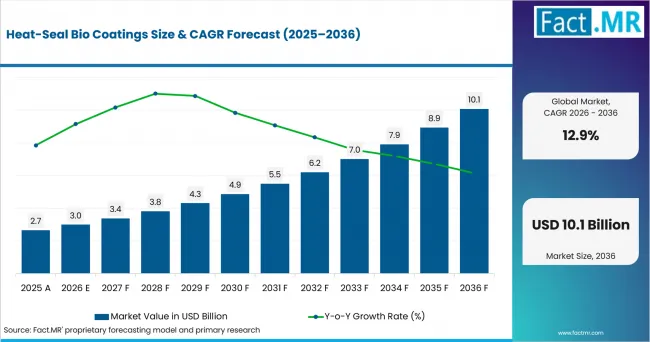
Heat Seal Bio Coatings Value Analysis | Source: Fact.MR
What are the defining numbers behind Heat-Seal Bio Coatings Market growth?
USD 7.1 billion absolute opportunity by 2036, led by aqueous biopolymer dispersion, heat seal performance and paper substrates.
- Demand Drivers in the Market
- Paper converters need heat-sealable coatings that run on established coating and forming equipment while preserving fiber recovery after use.
- Foodservice packaging producers need oil and moisture resistance in coated paper formats. On January 3, 2025, the U.S. FDA determined that 35 PFAS-related food contact notifications for grease-proofing substances used on paper and paperboard food packaging were no longer effective because manufacturers or suppliers had ceased production, supply, or use of the substances.
- Brand packaging teams need seal windows that protect pack integrity during filling and distribution while supporting bio-based or compostable material claims.
- Molded-fiber and carton manufacturers need functional coatings that add sealing performance while keeping the fiber substrate central to the package structure.
- Key Segments Analyzed
- By Coating Chemistry: Aqueous biopolymer dispersion is expected to hold 33.0% share in 2026 because water-based systems fit established paper-coating processes.
- By Performance: Heat seal is projected to account for 34.0% share in 2026 owing to its direct role in closing cups, wraps, pouches and coated fiber packs.
- By Substrate: Paper is anticipated to capture 37.0% share in 2026 due to broad use across foodservice wraps, cups and flexible paper formats.
- By Application: Foodservice is estimated to represent 29.0% share in 2026 supported by high packaging turnover and pressure to reduce conventional plastic layers.
- Analyst Opinion at Fact.MR
- Shambhu Nath Jha, Principal Consultant at Fact.MR states, “Commercial qualification centers on repeatable sealing across existing converting lines. Converters also examine grease control and food-contact compliance before approving a coating. Suppliers that combine process stability with documented end-of-life performance are expected to gain broader qualification across fiber packaging.”
- Strategic Implications
- Coating formulators should document seal initiation temperature, seal strength and barrier performance on the paper grades used by target converters.
- Paper mills should evaluate coating compatibility with repulping and fiber-recovery processes before positioning coated grades for recyclable food packaging.
- Foodservice converters should qualify coatings under real filling temperatures and grease loads instead of relying on laboratory seal data alone.
- Brand owners should align package claims with the EU Packaging and Packaging Waste Regulation. The European Commission reported that Regulation (EU) 2025/40 on packaging and packaging waste entered into force on February 11, 2025, introducing updated EU-wide requirements for packaging and packaging waste.
China is projected to record 14.1% CAGR through 2036 as foodservice activity and packaging regulation increase demand for functional fiber formats. The USA is anticipated to post 13.6% supported by food-away-from-home spending and PFAS phase-out requirements. Germany is estimated at 13.4% owing to ready-meal production and packaging-recycling rules. France is forecast at 12.9% as food retail expands while plastic-packaging policy tightens. Japan is expected to record 11.7% as food spending and resource-circulation programs support coated fiber alternatives.
How does the Heat-Seal Bio Coatings Market break down by segment?
Paper leads Substrate at 37.0%; heat seal leads Performance at 34.0%.
Which Coating Chemistry dominates?
Aqueous biopolymer dispersion holds 33.0% share in 2026.
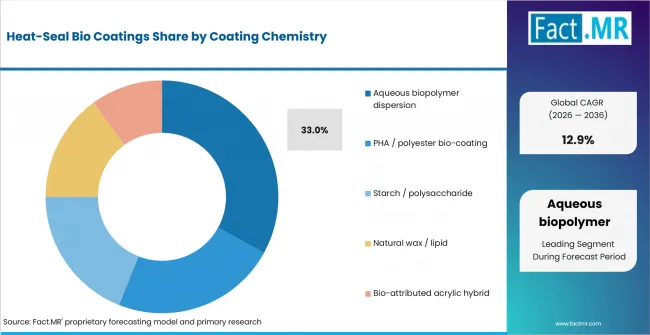
Heat Seal Bio Coatings Analysis By Coating Chemistry | Source: Fact.MR
Aqueous biopolymer dispersion is expected to lead because paper and board converters apply water-based coatings on familiar equipment. PHA and polyester bio-coatings follow where compostability or renewable-content positioning is paired with heat-seal performance. Starch and polysaccharide systems serve fiber-focused applications where coating compatibility shapes converter trials. Natural wax or lipid coatings address moisture and grease control. Bio-attributed acrylic hybrids provide another heat-sealable barrier route.
What leads the Performance segment?
Heat seal accounts for 34.0% share in 2026.
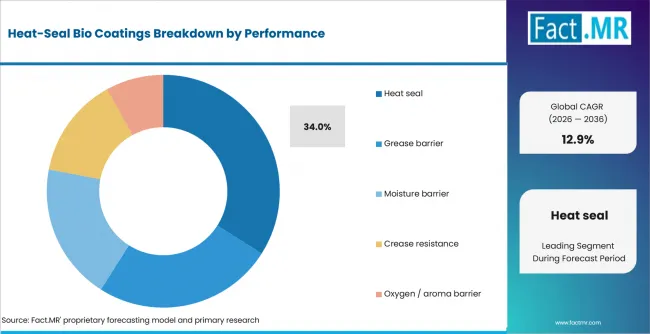
Heat Seal Bio Coatings Analysis By Performance | Source: Fact.MR
Heat seal is projected to account for 34.0% share because the coating forms part of the package-closing function. Grease barrier follows in food wraps and service formats exposed to oils. Moisture barrier supports cups and chilled-food formats that face condensation and liquid contact. Crease resistance serves folding cartons that need coating continuity after converting. Michelman introduced Nuvita Life 4002 on April 30, 2026 as a bio-based dry-film coating with heat-seal and oil-and-grease barrier performance.
How does Substrate shape demand?
Paper leads with 37.0% share in 2026.
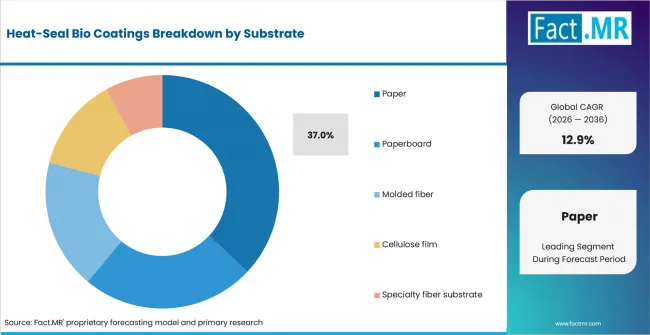
Heat Seal Bio Coatings Analysis By Substrate | Source: Fact.MR
Paper is anticipated to hold 37.0% because it is widely converted into wraps and foodservice formats that benefit from a thin functional coating. Paperboard follows across cups and cartons where stiffness remains central after coating. Molded fiber needs moisture and grease control on shaped surfaces. Cellulose film adds transparent fiber-based formats while specialty fiber substrates serve narrower application needs.
What supports Foodservice within Application?
Foodservice represents 29.0% share in 2026.
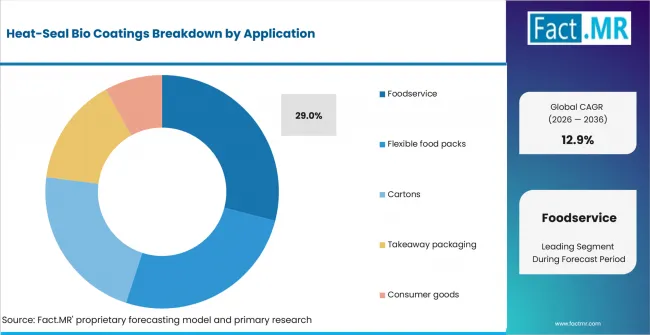
Heat Seal Bio Coatings Analysis By Application | Source: Fact.MR
Foodservice is estimated to represent 29.0% because cups and takeaway packs combine short use cycles with demanding seal conditions. Flexible food packs follow where coated paper competes with film structures. Cartons require coating continuity after folding so seal performance remains stable during final pack conversion. Takeaway packaging places greater emphasis on leak control. Consumer goods use coated fiber where barrier and sealing functions extend beyond food.
What is accelerating Heat-Seal Bio Coatings Market adoption, and what is holding it back?
Fiber-packaging conversion and PFAS substitution drive it; coating qualification and cost restrain it.
Drivers Impact Analysis
| DRIVER | (~) % IMPACT ON CAGR | GEOGRAPHIC RELEVANCE | IMPACT TIMELINE |
|---|---|---|---|
| Fiber conversion in foodservice packaging | +2.1% | North America, Europe, East Asia | Short term (<= 2 years) |
| PFAS and plastic-layer substitution | +1.7% | North America, Europe | Short term (<= 2 years) |
| Heat-seal performance on existing lines | +1.3% | Global | Medium term (2-4 years) |
| Fiber recovery and recyclability requirements | +1.0% | Europe, East Asia | Medium term (2-4 years) |
| Bio-based material positioning | +0.8% | Global | Long term (>= 4 years) |
Opportunity Impact Analysis
| OPPORTUNITY | (~) % IMPACT ON CAGR | GEOGRAPHIC RELEVANCE | IMPACT TIMELINE |
|---|---|---|---|
| Bio-based heat-seal coatings | +1.4% | Global | Medium term (2-4 years) |
| Molded-fiber foodservice coatings | +1.0% | North America, Europe | Medium term (2-4 years) |
| Compostable coated food packs | +0.8% | Europe, East Asia | Long term (>= 4 years) |
| Water-based coating line conversions | +0.6% | Global | Short term (<= 2 years) |
Restraints Impact Analysis
| RESTRAINT | (~) % IMPACT ON CAGR | GEOGRAPHIC RELEVANCE | IMPACT TIMELINE |
|---|---|---|---|
| Seal-window and barrier trade-offs | -0.8% | Global | Short term (<= 2 years) |
| Cost versus conventional polymer layers | -0.6% | Global | Medium term (2-4 years) |
| Food-contact and compostability qualification | -0.5% | North America, Europe, East Asia | Medium term (2-4 years) |
| End-of-life inconsistency across markets | -0.4% | Global | Long term (>= 4 years) |
Which countries are scaling the Heat-Seal Bio Coatings Market through 2036?
- The country comparison spans 2.4 percentage points across the forecast period.
- China remains 0.5 percentage point above the USA as catering activity expands the addressable base for coated fiber food packaging.
- The USA remains 0.2 percentage point above Germany as foodservice channels and fluorine-free paper packaging requirements support coating qualification.
- Germany remains 0.5 percentage point above France as ready-meal production and fiber-packaging recovery systems support functional coated paper formats.
- France remains 1.2 percentage points above Japan as food retail activity and packaging rules influence fiber-based pack design.
- Japan closes the displayed range as household consumption and resource-circulation programs support functional paper packaging.
Comparable CAGRs create different entry conditions across foodservice scale, converting infrastructure and packaging rules. Full report coverage includes North America, Latin America, Western Europe, Eastern Europe, East Asia, South Asia & Pacific, and Middle East & Africa.
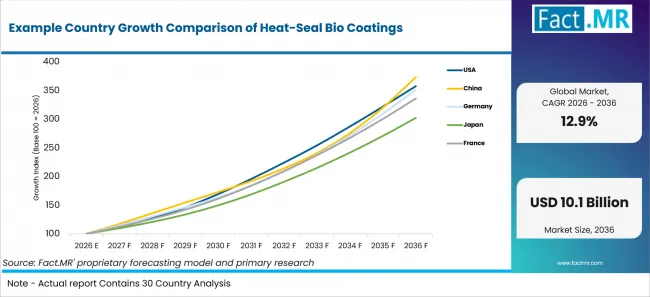
Example Country Growth Comparison Of Heat Seal Bio Coatings | Source: Fact.MR
| Country | CAGR (2026-2036) |
|---|---|
| China | 14.1% |
| USA | 13.6% |
| Germany | 13.4% |
| France | 12.9% |
| Japan | 11.7% |
How is China scaling Heat-Seal Bio Coatings Market demand?
14.1% CAGR through 2036, supported by catering scale and fiber food-packaging demand.
China combines a large catering channel with extensive paper-converting capacity for service packaging. The National Bureau of Statistics reported in February 2026 that 2025 catering income reached 5,798.2 billion yuan. China is projected to record 14.1% CAGR through 2036 as converters qualify heat-seal coatings for cups, wraps and takeaway formats.
What supports the USA outlook?
13.6% CAGR through 2036, led by foodservice activity and fiber-packaging conversion.
U.S. foodservice and retail channels create a broad testing base for coated paper formats. The U.S. Census Bureau reported on September 16, 2026 that retail and food services sales reached USD 773.9 billion in August 2026. The USA is anticipated to record 13.6% CAGR through 2036 as converters expand heat-seal coating use across food-facing fiber packaging.
What underpins Germany's growth?
13.4% CAGR through 2036, backed by ready-meal production and fiber-packaging recovery systems.
Germany has an established base of prepared-food production that uses sealed paper and board formats. Destatis reported on January 14, 2026 that ready-meal output reached 1.7 million tonnes in 2024. Germany is estimated to record 13.4% CAGR through 2036 as coating suppliers align seal performance with paper-recovery requirements.
How is France developing demand?
12.9% CAGR through 2036, shaped by food retail activity and fiber-packaging design changes.
France combines a large food retail base with packaging programs that favor material efficiency. Insee reported on June 18, 2026 that in-store food retail sales increased 1.8% in volume during 2025. France is forecast to record 12.9% CAGR through 2036 as converters evaluate heat-seal bio coatings for cartons, wraps and takeaway packaging.
How does Japan perform?
11.7% CAGR through 2036, driven by household consumption and fiber-packaging use.
Japan has a mature packaged-food channel with exacting converting and seal-performance requirements. USDA Foreign Agricultural Service reported in April 2026 that Japan's food processing sector was valued at USD 174 billion in 2025. Japan is expected to record 11.7% CAGR through 2036 as aqueous and bio-based coatings gain qualification across paper food formats.
Who leads the Heat-Seal Bio Coatings Market?
Solenis and BASF provide direct heat-seal and barrier-coating coverage. Michelman and Archroma broaden the fiber-packaging technology set alongside Dow and Paramelt.
The profiled provider set spans water-based barrier systems and bio-based coating technologies for fiber packaging. Solenis and BASF provide paper-focused barrier-coating portfolios, while Michelman, Archroma and Dow broaden the range of water, grease, moisture and heat-sealable coating technologies for fiber-based packaging. Competitive differentiation includes sealing performance, compatibility with industrial coating equipment and food-contact documentation.
Paramelt provides a directly aligned bio-based heat-seal route through its Aquavate™ Bio portfolio. In 2026, Paramelt described Aquavate™ Bio SB 2383 as a water-based, bio-based PHA heat-seal coating for paper packaging. The coating provides grease resistance and reliable heat-sealability and is engineered for standard industrial coating methods, including gravure-based processes.
Which companies are the key providers?
Solenis and BASF are key providers. Michelman and Archroma are also profiled. Dow and Paramelt complete the company set.
- Solenis
- BASF
- Michelman
- Archroma
- Dow
- Paramelt
Bibliography
- U.S. Food and Drug Administration. (2025, January 3). FDA determines authorization for 35 food contact notifications related to PFAS are no longer effective.
- European Commission, Directorate-General for Environment. (2025, February 11). New rules enter into force for a more sustainable and competitive packaging economy.
- BASF. (2025, May 6). Metpack and BASF cooperate to demonstrate certified home-compostable, coated paper for food packaging.
- Michelman. (2026, April 30). Michelman introduces Nuvita® Life 4002 & Nuvita® Life 4605: Bio-based barrier coatings for paper packaging applications.
- National Bureau of Statistics of China. (2026, February 28). Statistical communiqué of the People’s Republic of China on the 2025 national economic and social development.
- U.S. Census Bureau. (2026, September 16). Advance monthly sales for retail and food services (CB26-153).
- Statistisches Bundesamt (Destatis). (2026, January 14). Produktion von Fertiggerichten binnen fünf Jahren mengenmäßig um 25,6 % gestiegen [Production of ready meals increased by 25.6% in volume within five years].
- Bonfils, J., Ceci-Renaud, N., Finot, J., Gallot, P., Gamrasni, A., & Lépine, N. (2026, June 18). Le compte du commerce en 2025: L’activité accélère dans le commerce de détail et se contracte de nouveau dans le commerce de gros et dans le commerce et la réparation d’automobiles. Insee Première, (2111).
- Aoki, S. (2026, April 1). Food processing ingredients annual (Report No. JA2026-0012). U.S. Department of Agriculture, Foreign Agricultural Service.
This Report Answers
- The report explains how coating chemistry and performance influence selection across fiber packaging.
- Segment analysis identifies aqueous biopolymer dispersion and heat seal as the largest displayed shares in their respective dimensions.
- Competitive analysis reviews Solenis and BASF alongside Michelman. Archroma and Dow are assessed with Paramelt across functional coating technologies.
- Technology assessment covers PHA or polyester coatings and starch systems alongside natural wax and bio-attributed acrylic routes.
- Application analysis covers foodservice and flexible food packs together with cartons, takeaway packaging and consumer goods.
- The evidence review uses official statistics and first-party company announcements to support the market analysis.
What does the Heat-Seal Bio Coatings Market cover?
Aqueous biopolymer and PHA/polyester coatings provide heat-seal functions on fiber packaging. Starch and natural wax routes complement bio-attributed coating systems.
The Heat-Seal Bio Coatings Market covers functional coatings applied to paper and paperboard. It also includes molded fiber alongside cellulose film and specialty fiber substrates. Included coating systems provide heat-seal performance. They are also expected to contribute grease and moisture control alongside crease or oxygen-barrier functions.
The market boundary centers on coatings where heat sealing is a core commercial function. Petroleum-only extrusion laminates remain outside the defined category. Adjacent adhesives enter the scope only when the adhesive itself serves as the functional heat-seal coating layer.
What is included in the scope?
Heat-seal bio coating systems used on paper and paperboard packaging. Molded fiber and cellulose film applications are included alongside specialty fiber formats.
The scope includes aqueous biopolymer dispersions and PHA or polyester bio-coatings. It also covers starch systems and natural wax coatings alongside bio-attributed acrylic hybrids. Related coverage of bio-based barrier coatings provides wider chemistry context for functional fiber packaging.
The paper barrier coatings analysis supports comparison across grease and moisture functions on paper and board. PHA-specific pathways are covered through biobased PHA coatings. Adjacent seal-focused applications are covered through compostable heat-seal coatings. Applications in this report include foodservice and flexible food packs. Cartons and takeaway packaging are covered alongside consumer goods.
What is excluded from the scope?
Petroleum-only laminates, standalone packaging adhesives and non-sealing barrier coatings are outside the scope.
The scope boundary leaves out uncoated paper and board along with conventional polyethylene or polypropylene laminates. Barrier coatings centered solely on non-sealing functions remain outside the category. Standalone hot-melt adhesives enter the scope only when functioning as the functional heat-seal coating layer.
Rigid bioplastic packaging falls outside the scope when the bioplastic forms the package body. Printing inks and primers remain outside the category when their primary role is decoration or print protection.
How Was the Analysis Built?
The analysis draws on 120+ sources, 35+ company portfolios, 25+ countries, and more than 20 industry interviews.
- Primary Research: Primary research includes discussions with manufacturers, service providers, technology developers, distributors, end users, and subject-matter experts. These conversations examine purchasing priorities, product adoption, operational challenges, approval requirements, competitive positioning, and the factors that influence wider market acceptance.
- Desk Research: Desk research covers government statistics, regulatory publications, company filings, trade data, technical studies, industry associations, standards, public policy, and other authoritative sources. Every source used in the analysis is documented in the bibliography.
- Market Sizing and Forecasting: Market estimates combine historical performance, demand indicators, pricing and volume trends, segment shares, company participation, country-level growth, adoption patterns, investment activity, and barriers to market expansion.
- Data Validation and Update Cycle: Findings are validated by comparing primary interviews with public data, company activity, regulatory changes, trade patterns, and industry developments. Regular updates review new product launches, capacity changes, partnerships, approvals, and shifts in commercial adoption.
What is the report’s scope and coverage?
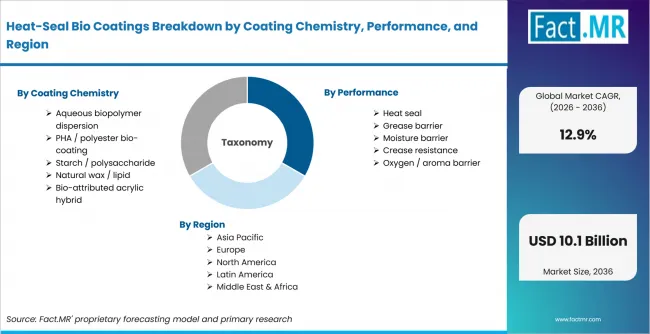
Heat Seal Bio Coatings Breakdown By Coating Chemistry, Performance, And Region | Source: Fact.MR
| Attribute | Details |
|---|---|
| Quantitative Units | USD billion |
| Market Definition | Bio-based or bio-attributed functional coatings applied to fiber packaging to provide heat-seal performance together with selected barrier functions. |
| Coating Chemistry | Aqueous biopolymer dispersion; PHA / polyester bio-coating; Starch / polysaccharide; Natural wax / lipid; Bio-attributed acrylic hybrid |
| Performance | Heat seal; Grease barrier; Moisture barrier; Crease resistance; Oxygen / aroma barrier |
| Substrate | Paper; Paperboard; Molded fiber; Cellulose film; Specialty fiber substrate |
| Application | Foodservice; Flexible food packs; Cartons; Takeaway packaging; Consumer goods |
| Regions Covered | North America; Latin America; Western Europe; Eastern Europe; East Asia; South Asia & Pacific; Middle East & Africa |
| Countries Covered | China; USA; Germany; France; Japan |
| Key Companies Profiled | Solenis; BASF; Michelman; Archroma; Dow; Paramelt |
| Forecast Period | 2026 to 2036 |
| Approach | Hybrid top-down and bottom-up assessment using coating chemistry mix, packaging applications, country demand indicators and provider portfolio review. |
How is the market segmented?
-
By Coating Chemistry
- Aqueous biopolymer dispersion
- PHA / polyester bio-coating
- Starch / polysaccharide
- Natural wax / lipid
- Bio-attributed acrylic hybrid
-
By Performance
- Heat seal
- Grease barrier
- Moisture barrier
- Crease resistance
- Oxygen / aroma barrier
-
By Substrate
- Paper
- Paperboard
- Molded fiber
- Cellulose film
- Specialty fiber substrate
-
By Application
- Foodservice
- Flexible food packs
- Cartons
- Takeaway packaging
- Consumer goods
-
By Region
- North America
- Latin America
- Western Europe
- Eastern Europe
- East Asia
- South Asia & Pacific
- Middle East & Africa