- Market Value (2025): USD 1.3 Bn
- Estimated Value (2026): USD 1.4 Bn
- Forecast Value (2036): USD 3.0 Bn
- CAGR (2026-2036): 8.1%
What is the Bio-Based Structural Bonding Adhesives Market forecast to be worth by 2036?
USD 1.4 billion in 2026 and USD 3.0 billion by 2036, implying an 8.1% CAGR over 2026-2036.
- The Bio-Based Structural Bonding Adhesives Market was valued at USD 1.3 billion in 2025.
- Demand to increase from USD 1.4 billion in 2026 to USD 3.0 billion by 2036.
- The market is forecast to record 8.1% CAGR from 2026 to 2036.
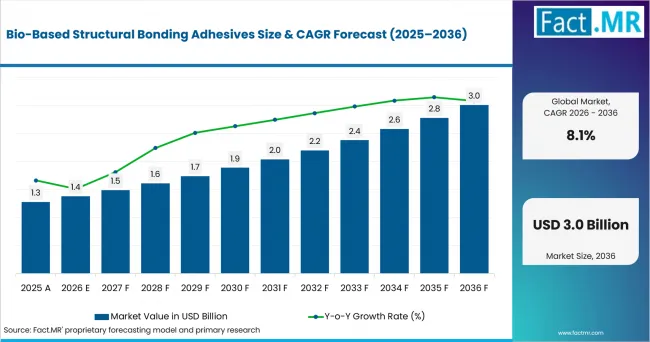
Bio Based Structural Bonding Adhesives Value Analysis | Source: Fact.MR
What are the defining numbers behind Bio-Based Structural Bonding Adhesives Market growth?
An absolute opportunity of USD 1.6 billion is expected between 2026 and 2036.
- Demand Drivers in the Market
- Engineered-wood producers need load-bearing adhesives that retain certified bond performance while increasing renewable input. The U.S. Census Bureau reported on February 27, 2026 that the value of construction put in place totaled USD 2,164.4 billion in 2025.
- Automotive assembly teams need structural adhesives that bond mixed substrates while supporting lower product carbon footprints in interiors, body structures and battery-related assemblies.
- Electronics manufacturers need compact bonding systems with controlled cure behavior because structural joints must tolerate thermal cycling while fitting automated production lines.
- Industrial panel manufacturers need consistent moisture, heat or reactive cure profiles so bio-based formulations can enter existing lines without creating long production interruptions.
- Key Segments Analyzed
- By Chemistry: Bio-PUR to hold 34.0% share in 2026 due to its combination of structural strength, formulation flexibility and compatibility with renewable feedstocks or certified mass-balance attribution.
- By Structural Bonding Use: Structural assembly to account for 30.0% share in 2026 as load-bearing joints across industrial and building applications require durable adhesion.
- By Cure: Moisture cure to represent 33.0% share in 2026, reflecting the modelled importance of simple one-component handling in structural adhesive applications.
- By Renewable Content: The less-than-20% band to capture 29.0% share in 2026 because partial renewable substitution can reduce formulation change relative to higher-substitution approaches.
- Analyst View at Fact.MR
- Shambhu Nath Jha, Principal Consultant at Fact.MR, states, “Performance equivalence carries more weight than renewable content alone in structural qualification. Structural users are expected to favor formulations that raise renewable input while preserving cure speed and joint durability. Suppliers should pair feedstock transparency with application testing that fits existing assembly equipment.”
- Strategic Implications
- Adhesive formulators should document renewable-content methodology and bond-performance results in the same technical package. In June 2025, Sika highlighted research on its patented bio-based amine hardener for epoxy systems, reporting that the resulting bio-based system matched or exceeded the mechanical strength and durability of conventional fossil-based systems.
- Automotive material teams should qualify bio-based grades against mixed-substrate joints and production-line cure windows before platform release.
- Building-product manufacturers should prioritize structural systems that fit current panel or timber pressing processes without added certification complexity.
- Distributors should separate genuinely structural products from lower-load bio-based adhesives so application claims remain clear during technical selection.
France leads at 9.9% CAGR through construction activity and demand for building-panel and engineered-wood bonding. The USA follows at 8.8% as large-scale construction supports structural adhesive demand. Japan reaches 7.9% through industrial manufacturing activity. Germany records 7.3% through construction and building-panel applications, while Finland reaches 6.1% through construction growth and its established wood-products industry.
How does the Bio-Based Structural Bonding Adhesives Market break down by segment?
Based on the supplied 2026 segment estimates, Bio-PUR leads Chemistry at 34.0% and moisture cure leads Cure at 33.0%.
Which Chemistry segment leads?
Bio-PUR to hold 34.0% share in 2026.
Bio-PUR is suited to structural joints requiring toughness and substrate flexibility. Henkel documents bio-based polyurethane systems for load-bearing timber construction. Bostik documents bio-based copolyester and bio-polyamide hot-melt options for applications including automotive interiors and electronics.
What leads Structural Bonding Use?
Structural assembly to account for 30.0% share in 2026.
Structural assembly covers bonds that transfer load between joined parts. Building panels, engineered wood and industrial assemblies use adhesives to distribute stress across the bond area. This use case favors formulations that retain joint durability while allowing renewable feedstock substitution within established application processes.
How does Cure shape demand?
Moisture cure to represent 33.0% share in 2026.
Moisture-cure systems simplify handling because one-component products crosslink after exposure to ambient moisture. Henkel announced on November 12, 2025 that Technomelt PUR 6260 ECO is a bio-based polyurethane hot-melt adhesive for automotive interiors made from at least 60% renewable and recycled raw materials. The product delivers full performance at a lamination temperature 15°C lower than Henkel’s standard product for the application and is designed to support fast processing.
What supports less than 20% within Renewable Content?
The less-than-20% renewable-content band to hold 29.0% share in 2026.
Lower renewable-content bands reduce the formulation change required for established structural products. Higher bands address manufacturers with broader renewable-material goals. Formulations with more than 80% measured bio-based content require composition documentation, while certified mass-balance claims require separate chain-of-custody documentation and should not be treated as a physical bio-based-content percentage.
What is accelerating Bio-Based Structural Bonding Adhesives Market adoption, and what is holding it back?
Renewable-feedstock substitution drives adoption; qualification burden restrains it.
Drivers Impact Analysis
| DRIVER | (~) % IMPACT ON CAGR | GEOGRAPHIC RELEVANCE | IMPACT TIMELINE |
|---|---|---|---|
| Renewable feedstock targets in industrial formulations | Qualitative assessment | North America, Europe, East Asia | Medium term (2-4 years) |
| Mass-timber and building-panel bonding | Qualitative assessment | North America, Europe, Japan | Medium term (2-4 years) |
| Automotive lightweight mixed-material assembly | Qualitative assessment | USA, Germany, France, Japan | Long term (>= 4 years) |
| Lower-temperature and simplified cure processes | Qualitative assessment | Global | Short term (<= 2 years) |
| Supplier certification of renewable content | Qualitative assessment | Europe, North America | Medium term (2-4 years) |
Opportunity Impact Analysis
| OPPORTUNITY | (~) % IMPACT ON CAGR | GEOGRAPHIC RELEVANCE | IMPACT TIMELINE |
|---|---|---|---|
| Bio-PUR for engineered timber | Qualitative assessment | Europe, North America | Medium term (2-4 years) |
| Renewable hot melts for electronics and interiors | Qualitative assessment | East Asia, Europe, North America | Short term (<= 2 years) |
| Certified mass-balance-attributed grades for existing production lines | Qualitative assessment | Europe, North America | Medium term (2-4 years) |
| Debondable structural systems for circular design | Qualitative assessment | Europe, Japan, USA | Long term (>= 4 years) |
Restraints Impact Analysis
| RESTRAINT | (~) % IMPACT ON CAGR | GEOGRAPHIC RELEVANCE | IMPACT TIMELINE |
|---|---|---|---|
| Long structural qualification cycles | Qualitative assessment | Global | Short term (<= 2 years) |
| Renewable feedstock cost and availability variation | Qualitative assessment | Europe, North America, East Asia | Medium term (2-4 years) |
| Performance trade-offs at high substitution levels | Qualitative assessment | Global | Medium term (2-4 years) |
| Certification complexity across applications | Qualitative assessment | Europe, North America | Long term (>= 4 years) |
Which countries are scaling Bio-Based Structural Bonding Adhesives Market fastest?
- The country comparison spans 3.8 percentage points and forms three practical growth bands across the forecast period.
- France remains 1.1 percentage points above the USA as construction activity supports demand for building-panel and engineered-wood structural bonding.
- The USA remains 0.9 percentage point above Japan through large-scale construction activity and downstream demand for structural adhesive systems.
- Japan remains 0.6 percentage point above Germany as industrial manufacturing activity supports structural bonding demand across automotive, electronics and other industrial applications.
- Germany remains 1.2 percentage points above Finland through construction activity and building-panel bonding applications.
- Finland closes the displayed range through construction growth and an established wood-products industry that supports timber, plywood and panel-bonding applications.
Comparable CAGRs can create different entry conditions due to construction activity, industrial manufacturing depth, timber and panel production, renewable-feedstock adoption and structural qualification requirements. Full report coverage includes North America, Latin America, Western Europe, Eastern Europe, East Asia, South Asia & Pacific, Middle East & Africa.
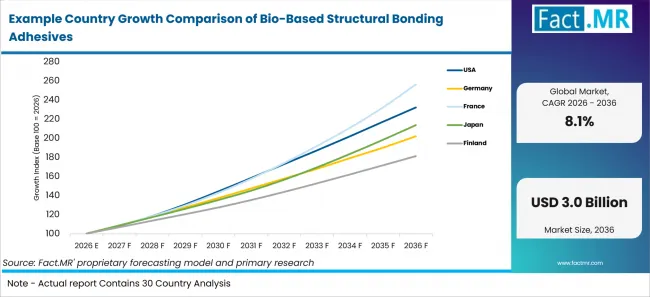
Example Country Growth Comparison Of Bio Based Structural Bonding Adhesives | Source: Fact.MR
| Country | CAGR (2026-2036) |
|---|---|
| France | 9.9% |
| USA | 8.8% |
| Japan | 7.9% |
| Germany | 7.3% |
| Finland | 6.1% |
What supports France growth?
9.9% CAGR, supported by construction activity and engineered-wood bonding demand.
France’s Service des données et études statistiques reported in July 2026 that 376,241 dwellings were authorized for construction from July 2025 through June 2026. This construction pipeline supports bio-based structural adhesives across building panels and engineered-wood assemblies, where manufacturers require durable load-bearing bonds while increasing renewable-material content within established production and qualification processes.
How is the USA scaling demand?
8.8% CAGR, driven by large-scale construction and structural bonding applications.
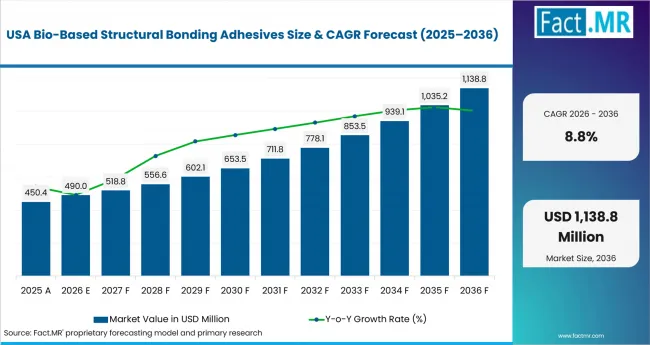
Bio Based Structural Bonding Adhesives Country Value Analysis | Source: Fact.MR
The U.S. Census Bureau reported that construction put in place reached USD 2,164.4 billion in 2025. This substantial downstream base supports bio-based structural adhesives across engineered wood, building panels and industrial assemblies, where suppliers must combine renewable feedstocks with dependable bond strength, cure performance and application compatibility.
What supports Japan growth?
7.9% CAGR, supported by industrial production and advanced bonding requirements.
Japan’s Ministry of Economy, Trade and Industry reported a revised seasonally adjusted industrial production index of 104.5 for January 2026. This manufacturing activity supports bio-based structural adhesive demand across automotive, electronics and industrial applications, where bonding systems must combine renewable chemistry with controlled cure behavior and durable joint performance.
How is Germany developing demand?
7.3% CAGR, backed by construction activity and building-panel applications.
Destatis reported that production in the construction of buildings increased 8.4% month over month in December 2025 after seasonal and calendar adjustment. This activity supports demand for bio-based structural adhesives in panels, engineered wood and other building assemblies, where producers need renewable formulations that maintain bond durability and fit existing pressing and curing processes.
What supports Finland adoption?
6.1% CAGR, supported by wood-products manufacturing and timber bonding demand.
Natural Resources Institute Finland reported that the wood-products industry consumed 30.0 million cubic metres of roundwood in 2025. This substantial processing base supports bio-based structural adhesives in plywood, engineered timber and panel applications, where renewable feedstocks align naturally with wood-based construction while durable bond performance remains essential.
Who leads the Bio-Based Structural Bonding Adhesives Market?
The profiled supplier set includes Henkel, H.B. Fuller, Arkema/Bostik, and Sika, with different structural-bonding and renewable-chemistry capabilities.
Henkel is directly relevant through bio-based PUR adhesive systems for load-bearing timber construction and bio-based PUR hot-melt adhesives for automotive interiors. H.B. Fuller reported on June 23, 2025 that about 60% of its new product development focused on improving the sustainability of customers’ end products, including energy-efficient building materials and electric vehicles. Bostik, Arkema’s adhesives business, offers bio-based specialty hot-melt adhesives based on copolyester and copolyamide chemistries; separately, its Pliogrip™ structural-adhesive portfolio includes two-part polyurethane, epoxy and methacrylate technologies.
Sika combines structural-bonding technologies with research on bio-based epoxy hardeners and the implementation of bio-based raw materials in selected adhesive solutions. Across these portfolios, differentiation includes renewable or bio-based content, bond durability, cure and processing behavior, and technical application support.
Which companies are profiled?
The profiled company set comprises Henkel, H.B. Fuller, Arkema/Bostik, and Sika.
- Henkel
- H.B. Fuller
- Arkema / Bostik
- Sika
Bibliography
- U.S. Census Bureau. (2026, February 27). Monthly construction spending, December 2025.
- Service des données et études statistiques. (2026, July 28). Construction de logements : résultats à fin juin 2026 (France entière).
- Ministry of Economy, Trade and Industry. (2026, March 19). Indices of industrial production: Revised report for January 2026.
- Federal Statistical Office (Destatis). (2026, February 6). Production in December 2025: -1.9% on the previous month.
- Statistics Finland. (2026, February 10). Turnover in construction grew by 5.0 per cent in December 2025 from one year ago.
- Henkel. (2025, May 7). Sustainability across the entire value chain.
- Henkel. (2025, November 12). Technomelt PUR 6260 ECO drives sustainability gains for automotive interiors.
- H.B. Fuller Company. (2025, June 23). H.B. Fuller announces 2024 sustainability report.
- Natural Resources Institute Finland. (2026, April 28). Forest industries’ wood consumption 2025.
- ISCC System GmbH. (2026, February 13). Mass balance and attribution: Understanding the difference.
This Report Answers
- The report defines structural bonding demand across Chemistry and Structural Bonding Use while retaining Cure and Renewable Content as separate selection dimensions.
- Country analysis covers France, USA, Japan, Germany and Finland with market-specific drivers, restraints and 2026-2036 CAGR comparisons.
- Competitive analysis profiles Henkel, H.B. Fuller, Arkema/Bostik, and Sika without assigning company market shares.
- Chemistry coverage includes Bio-PUR, Bio-polyester, Bio-polyamide, Silane-modified bio polymer and Hybrid renewable adhesive.
- Use-case coverage includes Structural assembly, Electronics, Automotive, Building panels and Consumer or industrial applications.
What does the Bio-Based Structural Bonding Adhesives Market cover?
Bio-PUR, bio-polyester, bio-polyamide, silane-modified and hybrid renewable adhesives used in structural bonding.
The market covers adhesives that contain renewable or bio-attributed feedstocks and are formulated for structural or high-load bonding. Included chemistries span polyurethane, polyester, polyamide, silane-modified polymers and hybrid systems used across industrial assembly and building applications.
Renewable content defines the scope. General-purpose bio-based glues are excluded unless engineered for structural load transfer.
What is included in the scope?
Bio-based structural adhesive systems used in industrial, automotive, electronics and building assemblies.
Coverage includes Bio-PUR, bio-polyester, bio-polyamide, silane-modified bio polymer and hybrid renewable adhesive chemistry. Structural bonding use covers assembly, electronics, automotive, building panels and consumer or industrial applications. Cure routes include moisture, hot melt, two-component reactive, heat and UV or dual cure.
What is excluded from the scope?
Non-structural bio-based glues and fossil-only structural adhesives are outside the scope.
The scope excludes conventional structural adhesives with no renewable or bio-attributed content. Pressure-sensitive labels, disposable hygiene adhesives and packaging sealants fall outside the market when their intended function is separate from structural load transfer. Mechanical fasteners, welding systems and weatherproofing-only sealants remain outside the market boundary unless sold as part of a structural bonding function.
How Was the Analysis Built?
The analysis draws on 120+ sources, 35+ company portfolios, 25+ countries, and more than 20 industry interviews.
- Primary Research: Primary research includes discussions with manufacturers, service providers, technology developers, distributors, end users, and subject-matter experts. These conversations examine purchasing priorities, product adoption, operational challenges, approval requirements, competitive positioning, and the factors that influence wider market acceptance.
- Desk Research: Desk research covers government statistics, regulatory publications, company filings, trade data, technical studies, industry associations, standards, public policy, and other authoritative sources. Every source used in the analysis is documented in the bibliography.
- Market Sizing and Forecasting: Market estimates combine historical performance, demand indicators, pricing and volume trends, segment shares, company participation, country-level growth, adoption patterns, investment activity, and barriers to market expansion.
- Data Validation and Update Cycle: Findings are validated by comparing primary interviews with public data, company activity, regulatory changes, trade patterns, and industry developments. Regular updates review new product launches, capacity changes, partnerships, approvals, and shifts in commercial adoption.
Segmentation
What is the report’s scope and coverage?
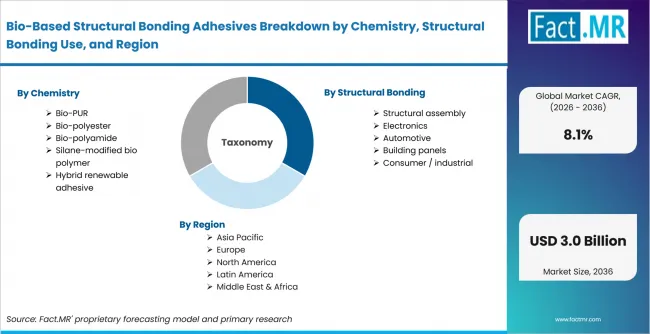
Bio Based Structural Bonding Adhesives Breakdown By Chemistry, Structural Bonding Use, And Region | Source: Fact.MR
| Attribute | Details |
|---|---|
| Quantitative Units | USD billion |
| Market Definition | Renewable or bio-attributed structural adhesives formulated for durable load-bearing bonding. |
| Chemistry | Bio-PUR; Bio-polyester; Bio-polyamide; Silane-modified bio polymer; Hybrid renewable adhesive |
| Structural Bonding Use | Structural assembly; Electronics; Automotive; Building panels; Consumer / industrial |
| Cure | Moisture cure; Hot melt; 2K reactive; Heat cure; UV / dual cure |
| Renewable Content | <20%; 20-40%; 41-60%; 61-80%; >80% bio-based / certified mass-balance attribution |
| Regions Covered | North America; Latin America; Western Europe; Eastern Europe; East Asia; South Asia & Pacific; Middle East & Africa |
| Countries Covered | USA; Germany; France; Japan; Finland |
| Key Companies Profiled | Henkel; H.B. Fuller; Arkema / Bostik; Sika; |
| Forecast Period | 2026 to 2036 |
| Approach | Official statistics; first-party company evidence; supplier portfolio review; country and segment analysis |
How is the market segmented?
-
By Chemistry
- Bio-PUR
- Bio-polyester
- Bio-polyamide
- Silane-modified bio polymer
- Hybrid renewable adhesive
-
By Structural Bonding Use
- Structural assembly
- Electronics
- Automotive
- Building panels
- Consumer / industrial
-
By Cure
- Moisture cure
- Hot melt
- 2K reactive
- Heat cure
- UV / dual cure
-
By Renewable Content
- <20%
- 20-40%
- 41-60%
- 61-80%
- >80% bio-based / certified mass-balance attribution
-
By Region
- North America
- Latin America
- Western Europe
- Eastern Europe
- East Asia
- South Asia & Pacific
- Middle East & Africa
Frequently Asked Questions
How big is the Bio-Based Structural Bonding Adhesives Market in 2026?
What is the CAGR of the Bio-Based Structural Bonding Adhesives Market from 2026 to 2036?
Which chemistry leads the Bio-Based Structural Bonding Adhesives Market?
Which structural bonding use leads the Bio-Based Structural Bonding Adhesives Market?
Who are the leading companies in the Bio-Based Structural Bonding Adhesives Market?
Who worked on this report


Preview the report firsthand - request a free sample
Free SampleGet the brochure for pricing and purchase details
Download PDF