- Market Value (2025): USD 253.6 Mn
- Estimated Value (2026): USD 270.0 Mn
- Forecast Value (2036): USD 505.9 Mn
- CAGR (2026-2036): 6.5%
What is the Bio-Based PUR Hot Melts Market forecast to be worth by 2036?
USD 270.0 million in 2026 to USD 505.9 million by 2036 at a 6.5% CAGR.
- The Bio-Based PUR Hot Melts Market reached USD 253.6 million in 2025.
- Demand is projected to increase from USD 270.0 million to USD 505.9 million by 2036.
- The market is forecast to record 6.5% CAGR from 2026 to 2036 as converters and assembly plants qualify lower-carbon PUR systems for production lines.
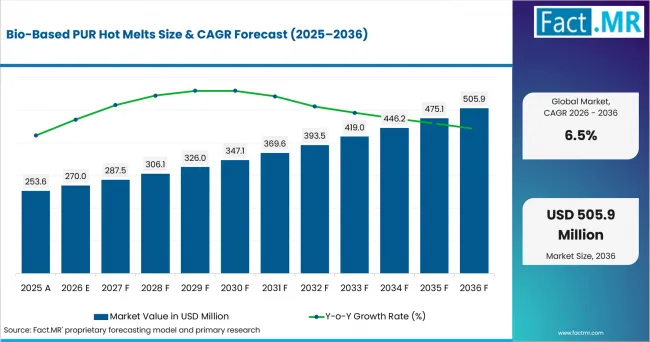
Bio Based Pur Hot Melts Value Analysis | Source: Fact.MR
What are the defining numbers behind Bio-Based PUR Hot Melts Market growth?
An absolute opportunity of USD 235.9 million is expected between 2026 and 2036.
- Demand Drivers in the Market
- Packaging converters need bio-based PUR hot melts that bond coated paper-board at high line speeds and support lower-carbon material requests.
- Furniture manufacturers need reactive PUR systems that hold edge-banding and profile-wrapping bonds during heat and cleaning exposure.
- Automotive trim suppliers need low-monomer bio-based hot melts that maintain cabin durability and support material carbon reduction.
- Electronics assemblers need specialty PUR adhesives that control moisture cure and bond-line stability in compact assemblies.
- Key Segments Analyzed
- By PUR Platform: Reactive PUR is expected to hold 64.0% share in 2026 because moisture-cure chemistry fits durable packaging, wood, automotive and electronics bonding.
- By Application: Packaging / paper-board is projected to account for 35.0% share in 2026 as box, carton and board converters use hot melts in fast sealing operations.
- By Cure / Process: Moisture cure is anticipated to capture 57.0% share in 2026 due to its balance of initial strength and final cross-linked performance.
- By Bio-Based Content: <10% is estimated to represent 29.0% share in 2026 as formulators begin partial substitution before moving to higher renewable-carbon grades.
- Analyst Opinion at Fact.MR
- Shambhu Nath Jha, Principal Consultant at Fact.MR, states, “Bio-based PUR hot melts are drawing attention because qualification is difficult once a bond line is approved. Customers want lower-carbon content, but they still judge the adhesive by open time, green strength, cure reliability and substrate fit. Suppliers are expected to gain where they combine renewable feedstock claims with application data that line engineers can trust.”
- Strategic Implications
- Adhesive producers should document renewable-carbon content and bond performance on the same data sheet.
- Packaging converters should test paper-board and coated substrates under real sealing speeds before switching grades.
- Automotive trim suppliers should prioritize low-monomer PUR platforms that meet cabin exposure requirements.
- Furniture plants should qualify bio-polyol reactive PUR grades first in edge-banding and flat lamination lines.
Brazil is projected to record 7.2% CAGR through 2036 as packaging conversion, footwear production and automotive trim demand support new adhesive trials. Denmark is expected to post 6.8% CAGR because bio-based materials policy and high-value furniture production create demand for documented inputs. The USA is anticipated to advance at 6.1% CAGR as adhesive users balance paper-board packaging scale with automotive interior qualification. Japan is forecast to reach 5.3% CAGR through electronics assembly and precision manufacturing needs. Germany is estimated to record 5.0% CAGR as mature furniture, packaging and automotive plants require deeper testing before switching materials.
How does the Bio-Based PUR Hot Melts Market break down by segment?
Reactive PUR is projected to lead PUR Platform at 64.0% share in 2026; while Moisture cure leads Cure / Process at 57.0% share.
Which PUR Platform dominates?
Reactive PUR is expected to hold 64.0% share in 2026.
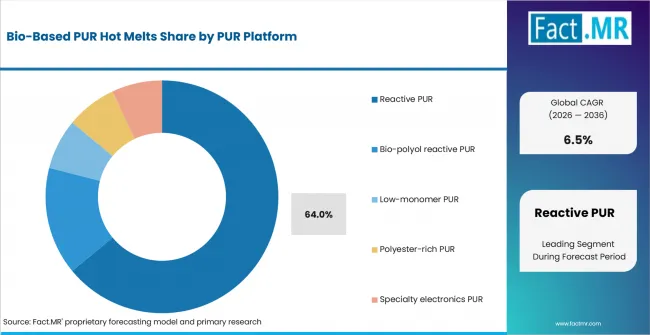
Bio Based Pur Hot Melts Analysis By Pur Platform | Source: Fact.MR
Reactive PUR leads because it gives processors a two-step performance path: quick set first, stronger final properties after moisture cure. This fit suits paper-board packaging, furniture profiles and automotive trim that move before final cure.
What leads the Application segment?
Packaging / paper-board is projected to account for 35.0% share in 2026.
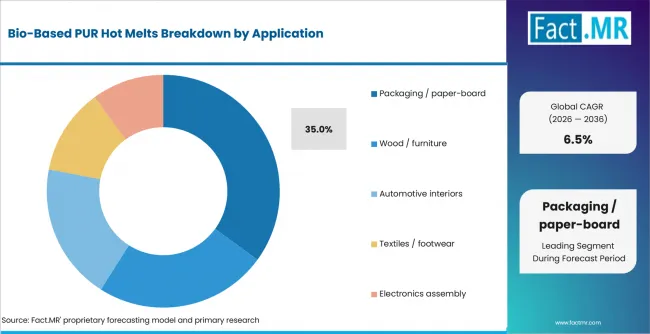
Bio Based Pur Hot Melts Analysis By Application | Source: Fact.MR
Packaging / paper-board leads because corrugated boxes, cartons and coated boards need fast application with stable bonding. The U.S. Census Bureau reported USD 90,674 million in U.S. paperboard container shipments in 2025, indicating the substantial scale of the domestic paperboard-container manufacturing sector.
How does Cure / Process shape demand?
Moisture cure is anticipated to hold 57.0% share in 2026.
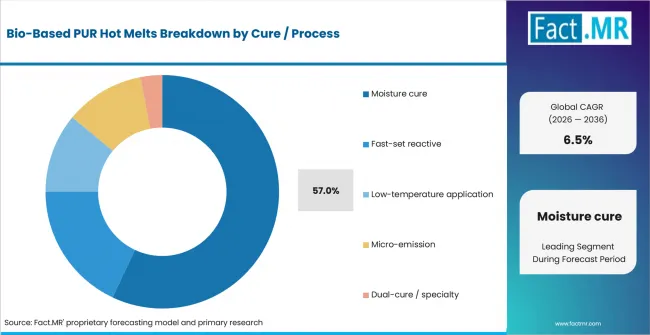
Bio Based Pur Hot Melts Analysis By Cure Process | Source: Fact.MR
Moisture cure leads because PUR hot melts provide strong initial tack during assembly and then develop higher bond strength after exposure to atmospheric moisture. This curing route supports durable adhesion, process flexibility and dependable performance across packaging, automotive, textile, woodworking and industrial bonding applications.
What supports demand within Bio-Based Content?
<10% is estimated to hold 29.0% share in 2026.
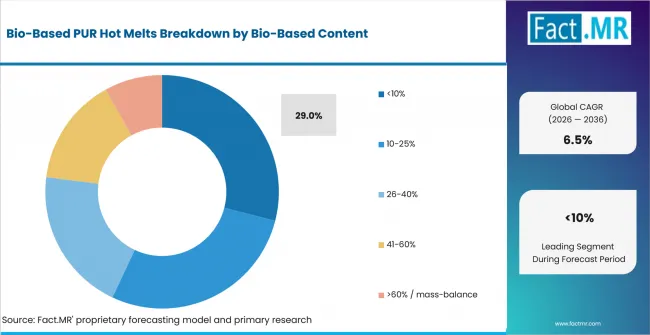
Bio Based Pur Hot Melts Analysis By Bio Based Content | Source: Fact.MR
The <10% content band leads because many users start with partial bio-based substitution before changing a full adhesive specification. A lower starting level can reduce qualification risk when production teams still need familiar viscosity, set time and final adhesion.
European Bioplastics reported global biobased plastics production capacity of 2.31 million tonnes in 2025, with actual production of 1.67 million tonnes, equivalent to an average utilization rate of 72%. Utilization varied substantially by polymer, ranging from 28% to 100%, reflecting differences in technology maturity and market development.
What is accelerating Bio-Based PUR Hot Melts Market adoption, and what is holding it back?
Demand is expected to rise through packaging carbon targets, reactive bonding performance and low-monomer PUR development. Growth is limited by qualification cost and feedstock availability.
Drivers Impact Analysis
| DRIVER | (~) % IMPACT ON CAGR | GEOGRAPHIC RELEVANCE | IMPACT TIMELINE |
|---|---|---|---|
| Packaging and paper-board conversion toward lower fossil-carbon inputs | +1.2% | North America, Europe | Short term (<= 2 years) |
| Automotive interior bonding requirements for low-carbon reactive PUR grades | +0.9% | USA, Germany, Japan | Medium term (2-4 years) |
| Furniture and wood lamination demand for durable bio-based adhesive options | +0.7% | Germany, Denmark, Brazil | Medium term (2-4 years) |
| Electronics assembly use of specialty PUR hot melts in compact devices | +0.5% | Japan, USA | Long term (>= 4 years) |
Opportunity Impact Analysis
| OPPORTUNITY | (~) % IMPACT ON CAGR | GEOGRAPHIC RELEVANCE | IMPACT TIMELINE |
|---|---|---|---|
| Higher bio-based content ranges for premium packaging and furniture grades | +0.8% | Europe, USA | Medium term (2-4 years) |
| Low-temperature application for heat-sensitive substrates | +0.6% | Global | Short term (<= 2 years) |
| Mass-balance and renewable-carbon documentation for large accounts | +0.5% | Europe, Japan | Long term (>= 4 years) |
Restraints Impact Analysis
| RESTRAINT | (~) % IMPACT ON CAGR | GEOGRAPHIC RELEVANCE | IMPACT TIMELINE |
|---|---|---|---|
| Customer qualification and production-line revalidation costs | -0.6% | Global | Short term (<= 2 years) |
| Variation in renewable feedstock availability and quality | -0.4% | Europe, North America, Asia | Medium term (2-4 years) |
| Moisture-cure sensitivity on difficult substrates | -0.3% | Global | Long term (>= 4 years) |
Which countries are scaling the Bio-Based PUR Hot Melts Market through 2036?
- The country comparison spans 2.2 percentage points and forms three growth bands across the forecast period.
- Brazil remains 0.4 percentage point above Denmark as footwear, furniture and packaging converters test lower-carbon bonding systems.
- Denmark remains 0.7 percentage point above the USA through EU packaging policy and Nordic documentation requirements.
- The USA remains 0.8 percentage point above Japan through paper-board packaging scale and domestic adhesive manufacturing depth.
- Japan remains 0.3 percentage point above Germany as electronics assembly and automotive trim programs support specialty PUR use.
- Germany closes the displayed range through mature furniture, packaging and automotive qualification standards.
Comparable CAGRs create different entry conditions due to substrate testing, moisture-cure control, bio-based content evidence and application-line approval. Full report coverage includes North America, Latin America, Western Europe, Eastern Europe, East Asia, South Asia & Pacific, Middle East & Africa.
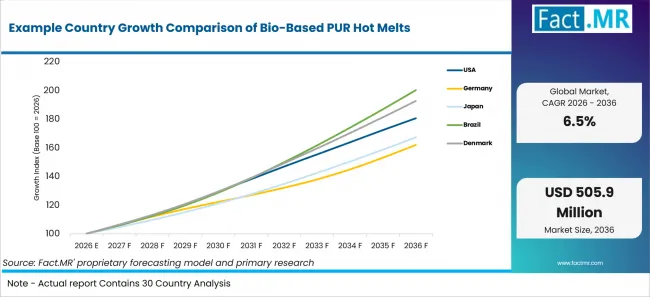
Example Country Growth Comparison Of Bio Based Pur Hot Melts | Source: Fact.MR
| Country | CAGR (2026-2036) |
|---|---|
| Brazil | 7.2% |
| Denmark | 6.8% |
| USA | 6.1% |
| Japan | 5.3% |
| Germany | 5.0% |
What supports Brazil adoption?
7.2% CAGR, supported by footwear, furniture and paper-board conversion demand.
Brazil’s adhesive demand is tied to industrial users that need fast setting and heat-resistant bonds for daily production. IBGE reported on June 3, 2025 that Brazilian industrial production increased 1.4% cumulatively from January through April 2025 compared with the same period of 2024, while furniture production increased 5.0%. That production base gives bio-based PUR hot melts a route into wood bonding, footwear assembly and packaging conversion where suppliers can provide local testing support.
How is Denmark scaling demand?
6.8% CAGR, driven by EU packaging rules and Nordic low-emission specifications.
Denmark’s demand is shaped by small but specification-heavy users in packaging, furniture and specialty assembly. The European Commission stated in February 2025 that Regulation (EU) 2025/40 entered into force for packaging and packaging waste. That regulatory setting is expected to keep Danish converters focused on adhesives that pair renewable content claims with clean bonding performance.
What supports USA growth?
6.1% CAGR, backed by paper-board packaging scale and adhesive manufacturing depth.
The USA offers a large converter base where bio-based PUR hot melts can be tested across cartons, board packaging and automotive interiors. The U.S. Census Bureau reported in February 2026 that 2025 paperboard container shipments reached USD 90,674 million. That scale supports formulation work for lower-carbon hot melts used in high-speed packaging lines.
How does Japan perform?
5.3% CAGR, led by electronics assembly and automotive interior bonding.
Japan’s demand profile is more specialized because electronics and automotive users often require careful control of cure, heat exposure and bond-line behavior. METI announced the 2025 Current Survey of Production yearbooks on June 30, 2026. The survey scope includes manufactured chemical products, plastic products and transport machinery. That official reporting base supports supplier attention to industrial niches where specialty PUR grades can qualify slowly but retain value.
What is supporting Germany’s adoption?
5.0% CAGR, supported by automotive, furniture and packaging qualification standards.
Germany’s market is expected to grow through technically demanding users that test hot melt systems before switching approved production grades. KLEIBERIT states that its Micro-Emission PUR hotmelt variants contain less than 0.1% monomeric diisocyanate. That product position fits German furniture and interior applications where lower-emission handling and durable bonding are evaluated together.
Who leads the Bio-Based PUR Hot Melts Market?
Henkel is active in polyurethane hot-melt adhesives through its TECHNOMELT and LOCTITE portfolios. LOCTITE HHD 3544F provides a bio-based PUR hot-melt reference for consumer-electronics assembly, while Henkel's November 2025 launch of TECHNOMELT PUR 6260 ECO provides a bio-based PUR reference for automotive interiors. The latter contains at least 60% renewable and recycled raw materials and is designed for cockpit, door and center-console applications.
H.B. Fuller participates directly through reactive polyurethane hot-melt adhesives for textile lamination. The company states that it developed a more sustainable reactive PUR hot-melt range using polyester polyols made with recycled PET content and bio-based polyols, together with biomass-balanced isocyanate replacing fossil MDI. H.B. Fuller reports tested sustainability rates ranging from 50% to 90%.
Jowat is relevant through reactive adhesives, including PUR systems, serving woodworking and furniture, paper and packaging, textile and automotive applications. Its Jowat do Brasil operation provides a local presence in Brazil, supporting regional service and close customer contact.
KLEIBERIT is active in PUR hot-melt adhesives for surface lamination, profile wrapping, edge bonding and assembly applications in the wood and furniture sector. Its LIGNA 2025 communication highlights PUR hot-melt products containing non-petroleum-based raw materials and an expanding range of Micro-Emission formulations. KLEIBERIT also markets a bio-based, Micro-Emission reactive PUR edge hot melt, KLEIBERIT 707.9.85.
Which companies are the key providers?
Key companies include Henkel; H.B. Fuller; Jowat; and KLEIBERIT.
- Henkel
- H.B. Fuller
- Jowat
- KLEIBERIT
Bibliography
- European Bioplastics. (2025, December 2). EUBP presents the results of the 2025 market data report.
- Directorate-General for Environment. (2025, February 11). New rules enter into force for a more sustainable and competitive packaging economy. European Commission.
- Henkel. (2025, November 12). Technomelt PUR 6260 ECO drives sustainability gains for automotive interiors.
- Instituto Brasileiro de Geografia e Estatística. (2025, June 3). Industrial production changes by 0.1% in April.
- Instituto Brasileiro de Geografia e Estatística. (2026, February 3). Industrial output retreats 1.2% in December.
- KLEIBERIT SE & Co. KG. (2025). Designed for professionals. Engineered for the future.
- Ministry of Economy, Trade and Industry. (2026, June 30). Preliminary report on Current Survey of Production: May 2026.
- Sika India Pvt. Ltd. (2025, April). SikaMelt®-625 [Product data sheet].
- U.S. Census Bureau. (2026, February 23). Monthly full report on manufacturers’ shipments, inventories and orders: December 2025 (Release No. CB 26-24 M3-2 (25)-12).
This Report Answers
- The report explains bio-based PUR hot melt use across platform, application, cure process and bio-based content.
- Segment analysis explains why reactive PUR, packaging / paper-board and moisture cure hold visible positions.
- Country analysis examines Brazil, Denmark, the USA, Japan and Germany through demand evidence and restraints.
- Competitive analysis reviews current providers across PUR hot melts and bio-based adhesive portfolios.
- Application analysis assesses how line speed, bond durability and substrate testing influence purchase decisions.
What does the Bio-Based PUR Hot Melts Market cover?The Bio-Based PUR Hot Melts Market covers reactive polyurethane hot melt adhesives with bio-based, renewable, recycled or mass-balance content. It includes grades used by packaging converters, furniture plants, automotive trim suppliers, textile and footwear producers and electronics assemblers. polyester hot melt adhesivesmoisture curing adhesivesThe assessment covers reactive PUR, bio-polyol reactive PUR, low-monomer PUR, polyester-rich PUR and specialty electronics PUR platforms. Adjacent chemistry is covered through polyester hot melt adhesives and moisture curing adhesives. What is included in the scope? The scope includes PUR hot melt adhesives where renewable or bio-based content is part of the formulation or documented material claim. It includes moisture-cure, fast-set, low-temperature, micro-emission, dual-cure and specialty grades. Adjacent applications include non-woven adhesives and adhesive tapes. What is excluded from the scope? The scope excludes commodity polyurethane resins without hot melt adhesive functionality. It also excludes mechanical fasteners, welding consumables, solvent-only adhesive systems, finished pressure-sensitive tapes and medical adhesives outside industrial bonding. Wider resin chemistry is covered under bio-synthetic phenolic resins. How Was the Analysis Built? The analysis draws on 120+ sources, 35+ company portfolios, 25+ countries, and more than 20 industry interviews. • Primary Research: Primary research includes discussions with manufacturers, service providers, technology developers, distributors, end users, and subject-matter experts. These conversations examine purchasing priorities, product adoption, operational challenges, approval requirements, competitive positioning, and the factors that influence wider market acceptance. • Desk Research: Desk research covers government statistics, regulatory publications, company filings, trade data, technical studies, industry associations, standards, public policy, and other authoritative sources. Every source used in the analysis is documented in the bibliography. • Market Sizing and Forecasting: Market estimates combine historical performance, demand indicators, pricing and volume trends, segment shares, company participation, country-level growth, adoption patterns, investment activity, and barriers to market expansion. • Data Validation and Update Cycle: Findings are validated by comparing primary interviews with public data, company activity, regulatory changes, trade patterns, and industry developments. Regular updates review new product launches, capacity changes, partnerships, approvals, and shifts in commercial adoption.
The Bio-Based PUR Hot Melts Market covers reactive polyurethane hot melt adhesives with bio-based, renewable, recycled or mass-balance content. It includes grades used by packaging converters, furniture plants, automotive trim suppliers, textile and footwear producers and electronics assemblers.
polyester hot melt adhesivesmoisture curing adhesivesThe assessment covers reactive PUR, bio-polyol reactive PUR, low-monomer PUR, polyester-rich PUR and specialty electronics PUR platforms. Adjacent chemistry is covered through polyester hot melt adhesives and moisture curing adhesives.
What is included in the scope?
The scope includes PUR hot melt adhesives where renewable or bio-based content is part of the formulation or documented material claim.
It includes moisture-cure, fast-set, low-temperature, micro-emission, dual-cure and specialty grades. Adjacent applications include non-woven adhesives and adhesive tapes.
What is excluded from the scope?
The scope excludes commodity polyurethane resins without hot melt adhesive functionality.
It also excludes mechanical fasteners, welding consumables, solvent-only adhesive systems, finished pressure-sensitive tapes and medical adhesives outside industrial bonding. Wider resin chemistry is covered under bio-synthetic phenolic resins.
How Was the Analysis Built?
The analysis draws on 120+ sources, 35+ company portfolios, 25+ countries, and more than 20 industry interviews.
- Primary Research: Primary research includes discussions with manufacturers, service providers, technology developers, distributors, end users, and subject-matter experts. These conversations examine purchasing priorities, product adoption, operational challenges, approval requirements, competitive positioning, and the factors that influence wider market acceptance.
- Desk Research: Desk research covers government statistics, regulatory publications, company filings, trade data, technical studies, industry associations, standards, public policy, and other authoritative sources. Every source used in the analysis is documented in the bibliography.
- Market Sizing and Forecasting: Market estimates combine historical performance, demand indicators, pricing and volume trends, segment shares, company participation, country-level growth, adoption patterns, investment activity, and barriers to market expansion.
- Data Validation and Update Cycle: Findings are validated by comparing primary interviews with public data, company activity, regulatory changes, trade patterns, and industry developments. Regular updates review new product launches, capacity changes, partnerships, approvals, and shifts in commercial adoption.
What is the report’s scope and coverage?
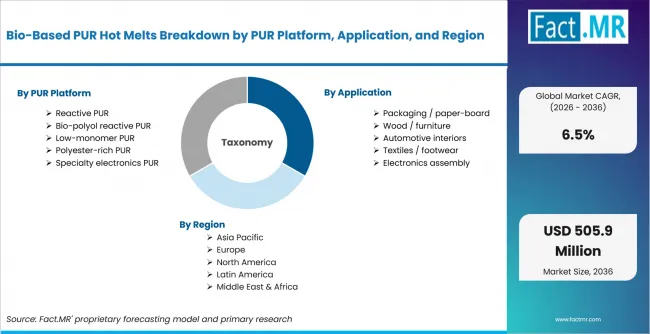
Bio Based Pur Hot Melts Breakdown By Pur Platform, Application, And Region | Source: Fact.MR
| Attribute | Details |
|---|---|
| Quantitative Units | USD million |
| Market Definition | Bio-based PUR hot melts are polyurethane reactive hot melt adhesives that include renewable, bio-based, recycled or mass-balance content and are used for industrial bonding applications. |
| PUR Platform | Reactive PUR; Bio-polyol reactive PUR; Low-monomer PUR; Polyester-rich PUR; Specialty electronics PUR |
| Application | Packaging / paper-board; Wood / furniture; Automotive interiors; Textiles / footwear; Electronics assembly |
| Cure / Process | Moisture cure; Fast-set reactive; Low-temperature application; Micro-emission; Dual-cure / specialty |
| Bio-Based Content | <10%; 10-25%; 26-40%; 41-60%; >60% / mass-balance |
| Regions Covered | North America; Latin America; Western Europe; Eastern Europe; East Asia; South Asia & Pacific; Middle East & Africa |
| Countries Covered | United States; South Korea; Japan; Brazil; Denmark; Germany |
| Selected Country Values | USA USD 97.44 million; South Korea USD 7.75 million; Japan USD 10.06 million in 2026 |
| Key Companies Profiled | Henkel; H.B. Fuller; Jowat; KLEIBERIT |
| Forecast Period | 2026 to 2036 |
| Approach | Hybrid top-down and bottom-up approach using adhesive application volume, PUR platform mix, bio-based content bands, country demand signals and provider portfolio review. |
How is the market segmented?
-
By PUR Platform
- Reactive PUR
- Bio-polyol reactive PUR
- Low-monomer PUR
- Polyester-rich PUR
- Specialty electronics PUR
-
By Application
- Packaging / paper-board
- Wood / furniture
- Automotive interiors
- Textiles / footwear
- Electronics assembly
-
By Cure / Process
- Moisture cure
- Fast-set reactive
- Low-temperature application
- Micro-emission
- Dual-cure / specialty
-
By Bio-Based Content
- <10%
- 10-25%
- 26-40%
- 41-60%
- >60% / mass-balance
-
By Region
- North America
- Latin America
- Western Europe
- Eastern Europe
- East Asia
- South Asia & Pacific
- Middle East & Africa