- Market Value (2025): USD 155.3 Mn
- Estimated Value (2026): USD 164.0 Mn
- Forecast Value (2036): USD 282.0 Mn
- CAGR (2026-2036): 5.6%
What is the Heat-Stable Oil Dyes Market forecast to be worth by 2036?
USD 164.0 million in 2026 to USD 282.0 million by 2036, at 5.6% CAGR from 2026 to 2036.
- The heat-stable oil dyes market crossed a valuation of USD 155.3 million in 2025.
- Demand is projected to increase from USD 164.0 million in 2026 to USD 282.0 million by 2036 as oil-based systems operate across wider temperature windows.
- The market is forecast to record a 5.6% CAGR from 2026 to 2036 because product identity and oil-medium compatibility are receiving closer attention under higher thermal exposure.
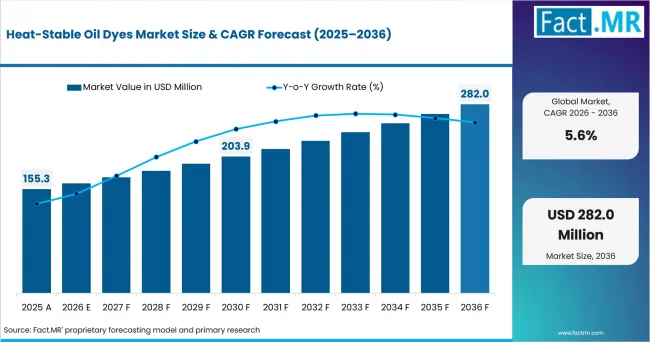
Heat Stable Oil Dyes Market Value Analysis | Source: Fact.MR
What are the defining numbers behind Heat-Stable Oil Dyes Market growth?
USD 118.0 million absolute opportunity by 2036.
- Demand Drivers in the Market
- Lubricant and heat-transfer fluid makers use dyes that stay mixed in hot oil and remain easy to see after long periods of heat exposure.
- PAO and ester oils do not mix with dyes in the same way as process oils or bio-based oils. Each dye therefore needs separate testing in the oil where it will be used.
- Plant quality staff use steady color to identify products during production. A sudden color change can also help them spot contamination or mixing errors.
- Dyes that work at low amounts and produce fewer fumes can help reduce smoke and deposits in equipment running at high temperatures.
- Key Segments Analyzed
- By Temperature Rating: Up to 120°C is expected to hold 22.0% share in 2026 because it covers general lubrication and thermal-management applications operating under moderate temperature conditions.
- By Oil Medium: Mineral oils are projected to account for 32.0% share in 2026 due to their broad use and lower cost across oil-based industrial systems.
- By Dye Chemistry: Azo oil dyes are anticipated to capture 36.0% share in 2026 due to broad shade availability and practical oil solubility.
- By Application: Lubricants are estimated to represent 38.0% share in 2026 because engine and gear-oil formulations often need visible product identity.
- By Performance Attribute: Color retention is forecast to account for 33.0% share in 2026 because shade endurance is the clearest reason to select a heat-stable grade.
- Analyst Opinion at Fact.MR
- Shambhu Nath Jha, Senior Analyst at Fact.MR, states, "A dye cannot be called heat-stable after only one test. Its color may change depending on the oil, the amount of air it meets, and how long it stays hot. Full aging results give customers a clearer picture of whether the color will remain steady throughout the product’s working life."
- Strategic Implications
- Dye producers need to report shade retention in several oil media and exposure intervals instead of relying on one headline temperature.
- Formulators need to screen volatility and clarity together because a dye sometimes retains hue while still creating deposits or haze.
- Industrial fluid companies are expected to reduce future reformulation work by qualifying alternate heat-stable chemistries before a regulatory or supply disruption occurs.
- Distributors need to match samples to the customer's actual oil and thermal cycle instead of recommending grades only by color family.
The United States is projected to expand at a 5.7% CAGR from 2026 to 2036 across a diverse specialty-lubricant and industrial-fluid formulation base. Germany is forecast to grow at 5.5% CAGR by 2036 on engineering-led fluid design and rigorous chemical documentation. France is expected to record 5.3% CAGR through 2036 across lubricant and heat-transfer-fluid blending. Italy is anticipated to post 5.2% CAGR from 2026 to 2036, supported by hydraulic and process-oil producers. Japan is estimated to advance at 5.4% CAGR by 2036 as precision manufacturing rewards stable specialty-fluid performance.
How does the Heat-Stable Oil Dyes Market break down by segment?
Up to 120°C is projected to lead Temperature Rating with 22.0% share, while Mineral oils are expected to lead Oil Medium with 32.0% share in 2026.
Which Temperature Range holds a notable share?
Up to 120°C accounts for 22.0% share in 2026.
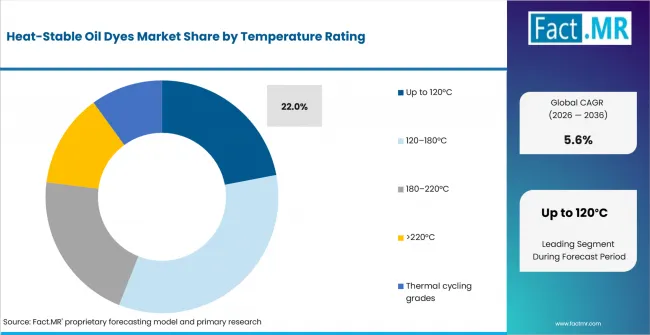
Heat Stable Oil Dyes Market Analysis By Temperature Rating | Source: Fact.MR
This temperature range supports general lubrication and thermal-management applications that operate under moderate heat. Colorants used in these systems need to remain stable during routine processing without requiring the higher performance linked to more demanding temperature bands. The segment therefore serves a broad base of standard industrial oils and fluids.
Which Oil Base leads?
Mineral Oils account for 32.0% share in 2026.
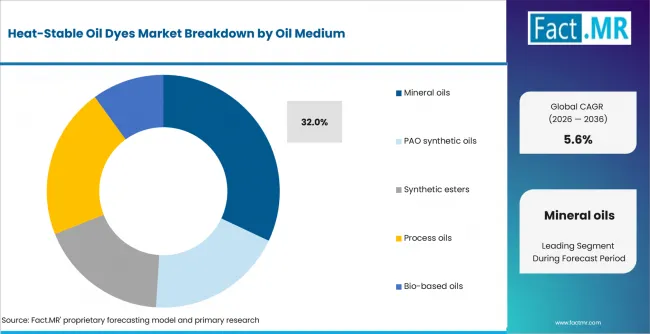
Heat Stable Oil Dyes Market Analysis By Oil Medium | Source: Fact.MR
A large share of standard lubricants still uses Mineral Oils, giving dye manufacturers a broad base for product qualification. Their familiar solvency and established use across machinery and maintenance products make shade matching easier. This wide application range places Mineral Oils ahead of more specialized synthetic oil systems.
Why do Azo Oil Dyes hold the top position?
Azo Oil Dyes capture 36.0% share in 2026.
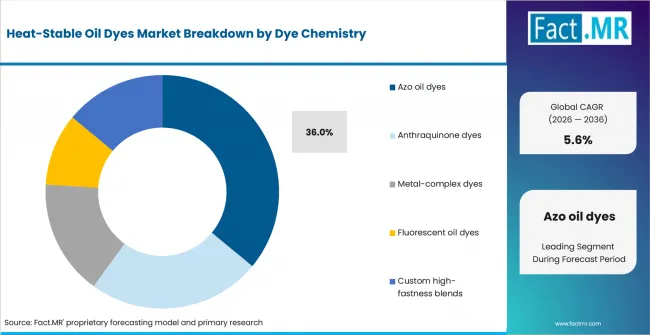
Heat Stable Oil Dyes Market Analysis By Dye Chemistry | Source: Fact.MR
Shade choice plays a major role in the strength of Azo Oil Dyes. Manufacturers can use them across several oil-based products without moving to highly specialized chemistry. Their balance of oil solubility, color range, and commercial cost keeps them suitable for routine applications that need dependable heat resistance.
What supports Lubricants within Application?
Lubricants represent 38.0% share in 2026.
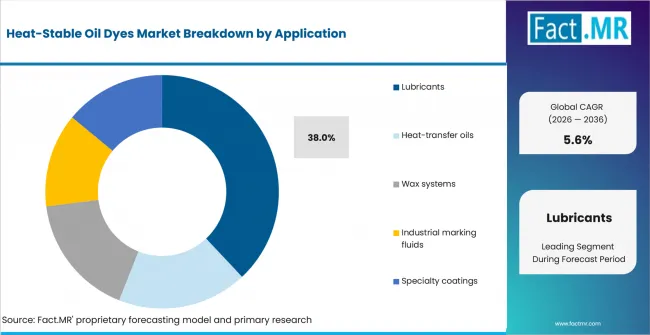
Heat Stable Oil Dyes Market Analysis By Application | Source: Fact.MR
Color helps distinguish engine oils, gear oils, and industrial lubricants during filling, storage, and maintenance. These products also operate across different heat conditions, so the selected dye must remain clear and stable during use. The variety and scale of lubricant applications give this segment the largest commercial base.
Why does Color Retention lead Performance demand?
Color Retention holds 33.0% share in 2026.
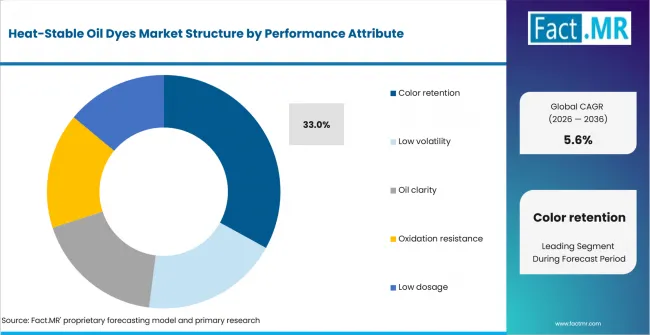
Heat Stable Oil Dyes Market Analysis By Performance Attribute | Source: Fact.MR
A heat-stable dye loses its purpose when the shade fades or changes during processing and service. Manufacturers therefore place Color Retention at the center of product selection. Stable color supports product identity, quality checks, and consistent appearance after prolonged exposure to elevated temperatures in oil-based systems.
What is accelerating Heat-Stable Oil Dyes Market adoption, and what is holding it back?
The main accelerator is the spread of oil-based systems that need deliberate visual identity under sustained heat. The main restraint is performance variability: the same dye sometimes behaves differently by temperature and oxygen exposure as well as oil medium and additive package.
Drivers Impact Analysis
| DRIVER | (~) % IMPACT ON CAGR | GEOGRAPHIC RELEVANCE | IMPACT TIMELINE |
|---|---|---|---|
| Higher operating temperatures | +0.8% | Global industrial markets | Medium term (2-4 years) |
| Synthetic oil adoption | +0.7% | USA, Germany, and Japan | Long term (>= 4 years) |
| Process visibility | +0.6% | Manufacturing economies | Short term (<= 2 years) |
| Low-dosage formulation | +0.5% | Global | Short term (<= 2 years) |
| Environmental screening | +0.4% | European Union | Long term (>= 4 years) |
Source: Fact.MR analysis. Updated Jul 17, 2026
- Higher operating temperatures: Equipment and process fluids are expected to remain stable under demanding duty cycles. Colorants need to keep pace so visual identification does not fail before the host fluid reaches its service limit.
- Synthetic oil adoption: PAO and ester formulations broaden the solvency and polarity conditions seen by the dye. This is expected to support chemistry-specific products and more detailed compatibility work.
- Process visibility: Colored oils help plant staff identify fluids during charging and sampling. Heat-stable grades are projected to preserve that visual function where fluids circulate at elevated temperature.
Opportunity Impact Analysis
| OPPORTUNITY | (~) % IMPACT ON CAGR | GEOGRAPHIC RELEVANCE | IMPACT TIMELINE |
|---|---|---|---|
| Thermal aging data packages | +0.4% | USA, Germany, and Japan | Medium term (2-4 years) |
| Synthetic-media colorants | +0.4% | Europe and East Asia | Long term (>= 4 years) |
| Thermal cycling grades | +0.3% | Global | Medium term (2-4 years) |
| Bio-based oil compatibility | +0.3% | Europe and Japan | Long term (>= 4 years) |
Source: Fact.MR analysis. Updated Jul 17, 2026
- Thermal aging data packages: Dye producers are expected to differentiate by showing shade retention and volatility after controlled heat exposure in representative oils. They also need clarity and sediment data because customers use those results to shorten screening.
- Synthetic-media colorants: PAO and ester fluids together represent a significant source segment. Dyes designed around their distinct solvency profiles are expected to capture projects that standard mineral-oil products cannot serve consistently.
- Thermal cycling grades: Thermal cycling grades are estimated to hold 10.0% of Temperature Rating demand because repeated heating and cooling creates shade-drift risk. Products that control that drift through multiple cycles are expected to support specialized industrial-fluid programs.\
Restraints Impact Analysis
| RESTRAINT | (~) % IMPACT ON CAGR | GEOGRAPHIC RELEVANCE | IMPACT TIMELINE |
|---|---|---|---|
| Heat-driven shade drift | -0.4% | Global | Short term (<= 2 years) |
| Oil-medium dependence | -0.3% | Global | Medium term (2-4 years) |
| Volatility and deposits | -0.3% | High-temperature industrial applications | Long term (>= 4 years) |
| Measurement ambiguity | -0.2% | Global quality laboratories | Short term (<= 2 years) |
Source: Fact.MR analysis. Updated Jul 17, 2026
- Heat-driven shade drift: A dye sometimes darkens or fades during hot storage and use. Hue shift sometimes triggers rejection even when the fluid's mechanical properties remain acceptable.
- Oil-medium dependence: Performance in mineral oil does not prove performance in PAO or ester systems. Process and bio-based oils need separate checks, so the qualification matrix consumes lab time and slows launch decisions.
- Volatility and deposits: Colorant loss or decomposition creates fumes or residue in severe cases. Conservative customers omit color when the identification benefit does not justify that risk.
Which country markets show the clearest heat-stable oil dye demand?
United States 5.7%, Germany 5.5%, France 5.3%, Italy 5.2%, Japan 5.4%.
Regional analysis covers North America; Europe; and Asia Pacific. Country sections focus on the United States and Germany alongside France and Italy as well as Japan. The complete report extends the same analysis to more than 30 countries.
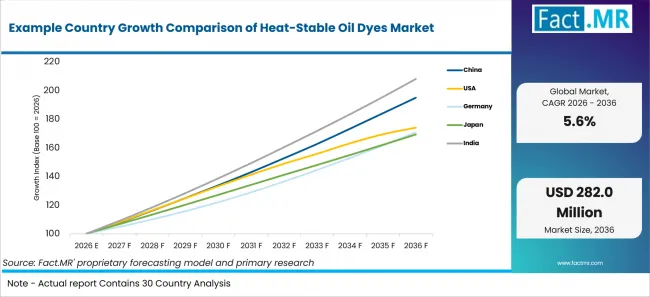
Example Country Growth Comparison Of Heat Stable Oil Dyes Market | Source: Fact.MR
| COUNTRY | CAGR |
|---|---|
| United States | 5.7% |
| Germany | 5.5% |
| France | 5.3% |
| Italy | 5.2% |
| Japan | 5.4% |
Source: Fact.MR analysis. Updated Jul 17, 2026
What sustains demand in the United States?
5.7% CAGR, supported by varied lubricant uses across transport, factories, and thermal systems.
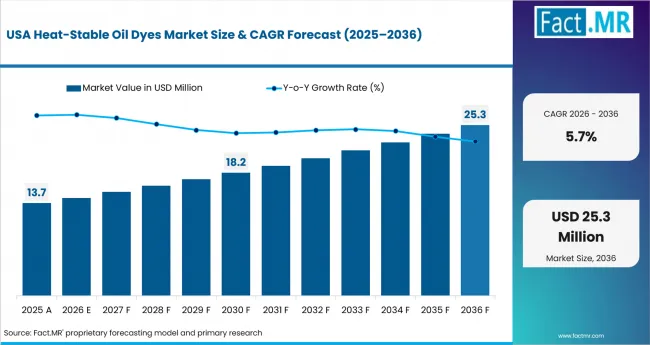
Heat Stable Oil Dyes Market Country Value Analysis | Source: Fact.MR
The United States has a wide customer base for engine oils, machinery lubricants, heat-transfer fluids, and specialty industrial products. Each application places different demands on shade stability and operating temperature. The market is projected to grow at a 5.7% CAGR from 2026 to 2036 as formulators seek dyes supported by clear composition and thermal-aging records.
How does Germany shape technical purchasing criteria?
5.5% CAGR, driven by machinery production and detailed material approval.
German manufacturers place close attention on how a dye behaves inside the finished oil instead of judging color strength alone. Machinery and automotive production create demand for shades that remain stable under heat and extended use. Demand is forecast to rise at a 5.5% CAGR through 2036 as technical records, repeatable batches, and fit with synthetic oils carry greater weight.
Where does France use Heat-Stable Oil Dyes?
5.3% CAGR, backed by automotive production and industrial fluid blending.
France has an established automotive value chain and a broad industrial base that use lubricants and process fluids under different heat conditions. The shift toward electric vehicle production also changes fluid and material requirements across plants. The market is expected to record a 5.3% CAGR from 2026 to 2036 as blenders test dyes across mineral and ester-based formulations.
What is Italy’s role in the Heat-Stable Oil Dyes Market?
5.2% CAGR, linked to machinery, metalworking, and small-batch industrial fluid production.
Italy’s demand is shaped by factories producing machinery, metal goods, and other capital equipment. Many lubricant companies serve these users with hydraulic, gear, and process oils made in varied batch sizes. Italian demand is anticipated to post a 5.2% CAGR by 2036 as quickly dispersing concentrates help blenders maintain a uniform shade without adding unnecessary production steps.
What defines the opportunity in Japan?
5.4% CAGR, supported by precision manufacturing and tightly controlled material changes.
Japanese machinery and tooling companies depend on stable parts, careful production control, and long operating life. These conditions favor dyes with low batch variation and predictable behavior in both mineral and synthetic oils. The market is projected to expand at a 5.4% CAGR from 2026 to 2036 as dependable supply, consistent technical records, and advance notice of formulation changes influence approval.
Who leads the Heat-Stable Oil Dyes Market?
Solar Organics; Neelikon; FastColours; and Abbey Color compete across heat-stable oil dye programs with different combinations of color chemistry and formulation support.
Solar Organics and Neelikon are included because both supply oil-soluble dyes for non-polar materials. Solar Organics offers Solasol dyes for lubricants, waxes, and related oil-based products. In March 2025, Neelikon also described oil-soluble dyes developed for oils and fats. FastColours and Abbey Color add smaller but relevant portfolios for oil, lubricant, and wax applications. Their inclusion reflects product compatibility with hydrocarbon-based media, although thermal stability still needs to be confirmed for each grade.
Which companies are the key providers?
The company set includes Solar Organics; Neelikon; FastColours; and Abbey Color.
- Solar Organics
- Neelikon
- FastColours
- Abbey Color
Bibliography
- ASTM International. (2024). Standard test method for ASTM color of petroleum products (ASTM color scale) (ASTM Standard No. D1500-24).
- Neelikon Colours Global. (2025, March 31). Understanding the difference between water-soluble dyes and oil-soluble dyes.
- European Commission. (2024, July). EU Ecolabel lubricants user manual: Commission Decision (EU) 2018/1702 establishing the EU Ecolabel criteria for lubricants (Version 1.5).
- Department of Chemicals and Petrochemicals. (2026, February 6). Annual report 2025–26. Ministry of Chemicals and Fertilizers, Government of India.
This Report Addresses
- The report establishes the 2025 revenue base and tracks the market through 2036.
- It compares demand growth in the United States and Germany alongside France and Italy as well as Japan inside coverage of more than 30 countries.
- It reviews Solar Organics; Neelikon; FastColours; Abbey Color within the defined competitive structure.
- It distinguishes standard azo and anthraquinone dyes from metal-complex dyes as well as fluorescent and custom high-fastness chemistries.
- It maps opportunities in lubricants and heat-transfer oils alongside waxes and marking fluids as well as specialty coatings.
- It grounds the forecast in temperature range and oil-medium compatibility. The same review covers color retention and volatility alongside clarity and oxidation as well as dosage.
What does the Heat-Stable Oil Dyes Market cover?
The study covers heat-stable colorant demand wherever an oil-based system must preserve an intentional shade under thermal stress.
Analysis spans temperature rating and oil medium alongside dye chemistry and application. The same framework covers performance attribute and country as well as competitor. The commercial assessment includes qualification practice and thermal-aging evidence. It also covers regulatory documentation and custom blends as well as technical service.
What is included in the scope?
Included dyes must be soluble in the relevant oil medium and marketed or qualified for elevated-temperature use.
The market counts powder and liquid forms of standard and custom heat-stable oil dyes used across the five defined applications. Products serving mineral and PAO oils are included with ester and process oils when the colorant value is isolated. Bio-based oils are included under the same rule.
What is excluded from the scope?
The study does not count the value of the oil system or unrelated color technologies.
Excluded categories include base fluids and lubricant additives. Wax matrices and coating matrices are excluded alongside finished products and water dyes as well as insoluble pigments. Colorants used only at ambient temperature or outside oil-based media are also beyond scope.
How Was the Analysis Built?
The analysis draws on 120+ sources, 35+ company portfolios, 25+ countries, and more than 20 industry interviews.
- Primary Research: Primary research includes discussions with manufacturers, service providers, technology developers, distributors, end users, procurement teams, and subject-matter experts. These conversations examine purchasing priorities, product adoption, operational challenges, approval requirements, competitive positioning, and the factors that influence wider market acceptance.
- Desk Research: Desk research covers government statistics, regulatory publications, company filings, trade data, technical studies, industry associations, standards, public policy, and other authoritative sources. Every source used in the analysis is documented in the bibliography.
- Market Sizing and Forecasting: Market estimates combine historical performance, demand indicators, pricing and volume trends, segment shares, company participation, country-level growth, adoption patterns, investment activity, and barriers to market expansion.
- Data Validation and Update Cycle: Findings are validated by comparing primary interviews with public data, company activity, regulatory changes, trade patterns, and industry developments. Regular updates review new product launches, capacity changes, partnerships, approvals, procurement trends, and shifts in commercial adoption.
Segmentation
What is the report's scope and coverage?
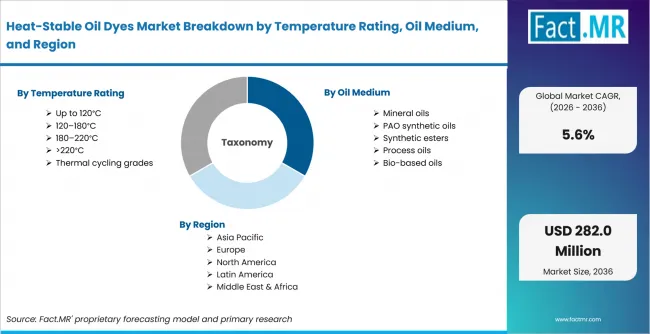
Heat Stable Oil Dyes Market Breakdown By Temperature Rating, Oil Medium, And Region | Source: Fact.MR
| ATTRIBUTE | DETAILS |
|---|---|
| Quantitative Units | USD million in 2026 to USD million by 2036 at CAGR |
| Market Definition | Heat-stable oil dyes are oil-soluble colorants and formulated concentrates sold to retain a controlled shade during elevated-temperature processing, storage, or service. |
| Temperature Rating | Up to 120 degrees C; 120-180 degrees C; 180-220 degrees C; >220 degrees C; Thermal cycling grades |
| Oil Medium | Mineral oils; PAO synthetic oils; Synthetic esters; Process oils; Bio-based oils |
| Dye Chemistry | Azo oil dyes; Anthraquinone dyes; Metal-complex dyes; Fluorescent oil dyes; Custom high-fastness blends |
| Application | Lubricants; Heat-transfer oils; Wax systems; Industrial marking fluids; Specialty coatings |
| Performance Attribute | Color retention; Low volatility; Oil clarity; Oxidation resistance; Low dosage |
| Regions Covered | North America; Europe; Asia Pacific; Latin America; Middle East and Africa |
| Countries Covered | United States; Germany; France; Italy; Japan (analysis on 30+ countries in the full report) |
| Key Companies Profiled | Solar Organics; Neelikon; FastColours; Abbey Color |
| Forecast Period | 2026 to 2036 |
| Approach | Sizing combines colored output by application and oil medium with dye dosage, concentrate strength, temperature grade, and realized price, then reconciles results to company sales. |
Source: Fact.MR analysis. Updated Jul 17, 2026
How is the market segmented?
-
By Temperature Rating
- Up to 120 degrees C
- 120-180 degrees C
- 180-220 degrees C
- >220 degrees C
- Thermal cycling grades
-
By Oil Medium
- Mineral oils
- PAO synthetic oils
- Synthetic esters
- Process oils
- Bio-based oils
-
By Dye Chemistry
- Azo oil dyes
- Anthraquinone dyes
- Metal-complex dyes
- Fluorescent oil dyes
- Custom high-fastness blends
-
By Application
- Lubricants
- Heat-transfer oils
- Wax systems
- Industrial marking fluids
- Specialty coatings
-
By Performance Attribute
- Color retention
- Low volatility
- Oil clarity
- Oxidation resistance
- Low dosage
-
By Region
- North America
- United States
- Europe
- Germany
- France
- Italy
- Asia Pacific
- Japan
Frequently Asked Questions
Which Oil Medium leads the Heat-Stable Oil Dyes Market?
Which Dye Chemistry leads the Heat-Stable Oil Dyes Market?
Which Application leads the Heat-Stable Oil Dyes Market?
Which Performance Attribute leads the Heat-Stable Oil Dyes Market?
Which country records the highest CAGR in the Heat-Stable Oil Dyes Market?
How does Germany perform in the Heat-Stable Oil Dyes Market?
How does Japan perform in the Heat-Stable Oil Dyes Market?
How does France perform in the Heat-Stable Oil Dyes Market?
How does Italy perform in the Heat-Stable Oil Dyes Market?
What is the primary driver in the Heat-Stable Oil Dyes Market?
What is the main restraint in the Heat-Stable Oil Dyes Market?
Why are Azo Oil Dyes important?
Why do Lubricants dominate demand?
Who worked on this report


Preview the report firsthand - request a free sample
Free SampleGet the brochure for pricing and purchase details
Download PDF