Soilless Substrate-Specific Fertility Solution Market
Soilless Substrate-Specific Fertility Solution Market Size and Share Forecast Outlook 2026 to 2036
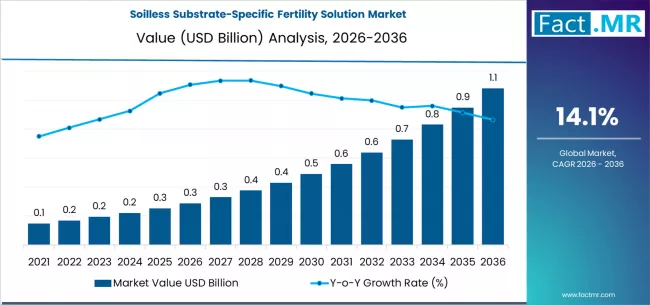
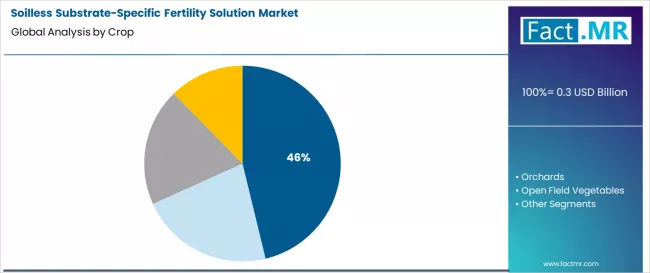
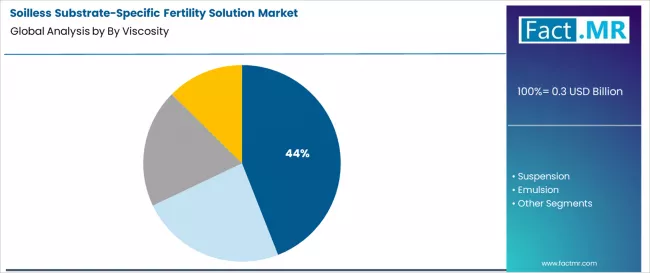
Soilless substrate-specific fertility solution market is projected to grow from USD 0.3 billion in 2026 to USD 1.1 billion by 2036, at a CAGR of 14.1%. Greenhouse Vegetables will dominate with a 46.2% market share, while clear liquid will lead the by viscosity segment with a 44.0% share.
Soilless Substrate-Specific Fertility Solution Market Forecast and Outlook 2026 to 2036
The global market for soilless substrate-specific fertility solutions is projected to grow from USD 0.29 billion in 2026 to USD 1.08 billion by 2036, advancing at a CAGR of 14.1%. This market addresses the sophisticated nutritional demands of high-value controlled CEA and specialty outdoor production that utilizes inert or organic growing media instead of soil.
Key Takeaways from the Soilless Substrate-Specific Fertility Solution Market
- Market Value for 2026: USD 0.29 Billion
- Market Value for 2036: USD 1.08 Billion
- Forecast CAGR (2026-2036): 14.1%
- Leading Crop Segment (2026): Greenhouse Vegetables (46%)
- Leading Viscosity Segment (2026): Clear Liquid (44%)
- Leading Sales Channel Segment (2026): Ag-Retailers (60%)
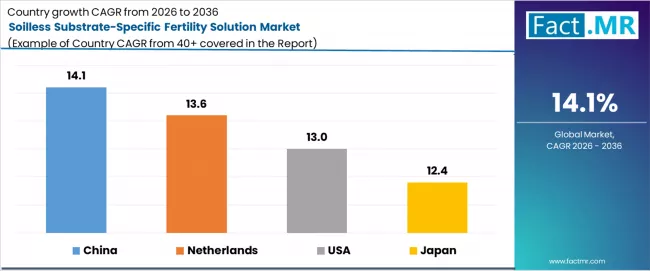
- Key Growth Countries: China (14.1% CAGR), Netherlands (13.6% CAGR), USA (13% CAGR), Japan (12.4% CAGR)
- Key Players in the Market: ICL Group Ltd., Haifa Group, Yara International ASA, Nutrien, EuroChem Group A.G., Compass Minerals

Unlike one-size-fits-all hydroponic formulas, these solutions are precision-engineered to account for the unique chemical interactions, CEC, and moisture dynamics of specific substrates such as rockwool, coco coir, peat blends, and organic composts.
Growth is driven by the specialization and intensification of soilless production systems, where maximizing yield and quality requires harmonizing the nutrient solution with the substrate's physical and chemical properties.
A formulation designed for inert rockwool, which holds no nutrients, differs fundamentally from one for buffered coco coir, which can interact with certain ions. This specialization prevents nutrient lockout, optimizes pH stability, and enhances plant-available nutrition, directly translating to improved crop uniformity, faster growth cycles, and superior product quality in systems where margin for error is minimal.
The market’s expansion reflects a maturation in soilless production, moving from experimental growing to optimized commercial operation. Success depends on deep agronomic research into substrate-nutrient dynamics and the ability to provide growers with tailored programs that include not just the fertilizer solution, but also complementary amendments and precise irrigation protocols for their chosen medium.
Metric
| Metric | Value |
|---|---|
| Market Value (2026) | USD 0.29 Billion |
| Market Forecast Value (2036) | USD 1.08 Billion |
| Forecast CAGR (2026-2036) | 14.1% |
Category
| Category | Segments |
|---|---|
| Crop | Greenhouse Vegetables, Orchards, Open Field Vegetables, Cannabis/Hemp |
| By Viscosity | Clear Liquid, Suspension, Emulsion, Soluble Gel |
| Sales Channel | Ag-Retailers, Direct-to-Farmer, Online Marketplaces, Cooperatives |
| Region | North America, Latin America, Western Europe, Eastern Europe, East Asia, South Asia & Pacific, MEA |
Segmental Analysis
By Crop, Which Systems Rely Heavily on Tailored Substrate Nutrition?

Greenhouse vegetables lead with a 46% share, encompassing tomatoes, cucumbers, peppers, and leafy greens grown in bags or slabs of rockwool, coco, or peat. These high-intensity systems require absolute nutritional precision to manage fruit quality, prevent blossom-end rot, and control vegetative vs. generative balance. Substrate-specific solutions are critical for managing the salinity and pH within the root zone of these valuable crops, directly impacting profitability.
By Viscosity, Which is Paramount for Substrate Irrigation Systems?

Clear liquid formulations dominate with a 44% share, essential for maintaining the integrity of drip irrigation and fertigation systems used in substrate culture. Clog-free application is non-negotiable for ensuring even moisture and nutrient distribution throughout the substrate slab or container. Clear, stable solutions also allow growers to easily monitor nutrient tank health and prevent the buildup of precipitates that can alter the substrate's chemical environment.
By Sales Channel, Where is Specialized Knowledge Concentrated?

Ag-retailers focusing on professional horticulture are the primary channel at 60%. Selecting and correctly using a substrate-specific program requires expert advice. These retailers provide the essential link, helping growers choose the right solution for their substrate type such as a coco-specific program with adjusted calcium and magnesium, and offering troubleshooting support for issues like salt accumulation or pH drift unique to each medium.
What are the Drivers, Restraints, and Key Trends of the Soilless Substrate-Specific Fertility Solution Market?
The key driver is the global shift toward high-efficiency, protected cultivation to ensure yield security and quality consistency. The expansion of cannabis/hemp production in soilless media presents a major, high-margin segment. Increasing grower understanding that substrate choice dictates nutritional management is pushing demand beyond generic formulas. The need to optimize water and nutrient use efficiency for both economic and sustainability certifications further supports adoption.
A main restraint is the higher cost and complexity compared to standard soluble fertilizers. Growers must commit to a specific substrate and its partnered nutritional program, reducing flexibility. The risk of incompatibility or poor performance if a solution is used with the wrong substrate can lead to significant crop losses, increasing the perceived risk for some growers. Market fragmentation with numerous small substrate types can also challenge solution providers.
Key trends include the development of substrate starter packs that include pre-buffering amendments and the initial fertility solution to correctly charge a new medium. Integration with sensor technology that monitors substrate moisture, EC, and temperature to dynamically adjust feeding recipes is advancing. There is also a strong trend toward sustainable substrate solutions, such as those tailored for wood fiber or composted green waste, driving parallel innovation in compatible fertility formulas.
Analysis of the Soilless Substrate-Specific Fertility Solution Market by Key Countries

| Country | CAGR (2026-2036) |
|---|---|
| China | 14.1% |
| Netherlands | 13.6% |
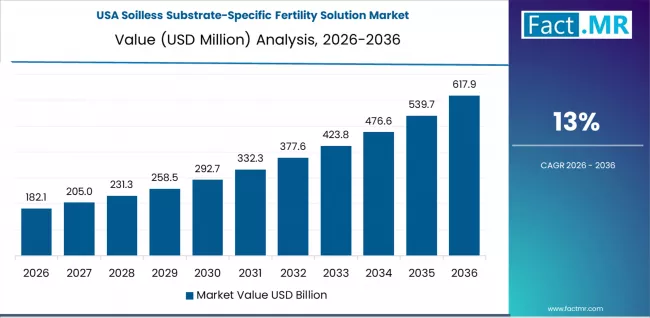
| USA | 13% |
| Japan | 12.4% |
How is China's Massive Protected Agriculture Build-Out Influencing Demand?
China’s leading growth rate of 14.1% is tied to its world-leading expansion of modern greenhouse area, much of which utilizes soilless substrates like rockwool for tomato and cucumber production.
National food security policies favor this high-yield approach. The scale of adoption creates immense demand for bulk, reliable fertility solutions tailored to the substrates promoted by these large-scale, tech-driven operations.
Why are the Netherlands a Center for Substrate Science and Export?
The Netherlands' 13.6% growth is built on its unparalleled expertise in substrate-based greenhouse production. Dutch research institutes are global authorities on substrate physics and chemistry.
This deep knowledge fuels the development and export of sophisticated fertility programs paired with specific substrate brands (e.g., recipes for Grodan rockwool or Jiffy peat), making the country a hub for premium, science-backed solutions.
What is the Impact of the USA's Diverse and Evolving CEA and Cannabis Sectors?

The USA’s 13% growth is segmented. Large greenhouse vegetable operations drive demand for proven substrate programs, while the legal cannabis industry, heavily reliant on coco coir and peat blends, acts as a high-value innovation and adoption engine for tailored nutrients. This dual demand fosters a dynamic market with products ranging from large-scale commodity solutions to premium, boutique cannabis formulas.
How is Japan's Focus on Precision and Quality Shaping the Market?
Japan’s 12.4% CAGR reflects its focus on ultra-high-quality fruit and vegetable production in controlled environments. Japanese growers are meticulous in managing root zone conditions. The demand is for extremely pure, consistent, and substrate-specific solutions that minimize variability and maximize the flavor, color, and shelf-life of premium produce for domestic retailers.
Competitive Landscape of the Soilless Substrate-Specific Fertility Solution Market

The competitive landscape features specialized horticultural nutrition companies competing against broader agri-input firms. Competition is intense around proprietary formulation science that addresses specific substrate challenges such as calcium availability in coco coir, and pH stability in peat.
Strategic partnerships with major substrate manufacturers are a key advantage, allowing for co-branded or recommended nutrient programs. Providing comprehensive technical support, including substrate-specific irrigation and fertigation schedules, is a critical differentiator for winning and retaining commercial grower customers.
Key Players in the Soilless Substrate-Specific Fertility Solution Market
- ICL Group Ltd.
- Haifa Group
- Yara International ASA
- Nutrien
- EuroChem Group A.G.
- Compass Minerals
Scope of Report
| Items | Values |
|---|---|
| Quantitative Units | USD Billion |
| Crop | Greenhouse Vegetables, Orchards, Open Field Vegetables, Cannabis/Hemp |
| By Viscosity | Clear Liquid, Suspension, Emulsion, Soluble Gel |
| Sales Channel | Ag-Retailers, Direct-to-Farmer, Online Marketplaces, Cooperatives |
| Key Countries | Netherlands, China, USA, Japan |
| Key Companies | ICL Group Ltd., Haifa Group, Yara International ASA, Nutrien, EuroChem Group A.G., Compass Minerals |
| Additional Analysis | Chemical analysis of nutrient-substrate interactions (CEC, buffering); comparative yield and quality trials across substrate-nutrient combinations; economic analysis of leaching fraction management with tailored solutions; review of sustainable substrate trends and their nutritional implications; integration with automated fertigation and dosing systems. |
Market by Segments
-
Crop :
- Greenhouse Vegetables
- Orchards
- Open Field Vegetables
- Cannabis/Hemp
-
By Viscosity :
- Clear Liquid
- Suspension
- Emulsion
- Soluble Gel
-
Sales Channel :
- Ag-Retailers
- Direct-to-Farmer
- Online Marketplaces
- Cooperatives
-
Region :
- North America
- USA
- Canada
- Latin America
- Brazil
- Mexico
- Argentina
- Rest of Latin America
- Western Europe
- Germany
- UK
- France
- Spain
- Italy
- Netherlands
- BENELUX
- Rest of Western Europe
- Eastern Europe
- Russia
- Poland
- Czech Republic
- Rest of Eastern Europe
- East Asia
- China
- Japan
- South Korea
- Rest of East Asia
- South Asia & Pacific
- India
- ASEAN
- Australia
- Rest of South Asia & Pacific
- MEA
- Saudi Arabia
- UAE
- Turkiye
- Rest of MEA
- North America
Table of Content
- Executive Summary
- Global Market Outlook
- Demand to side Trends
- Supply to side Trends
- Technology Roadmap Analysis
- Analysis and Recommendations
- Market Overview
- Market Coverage / Taxonomy
- Market Definition / Scope / Limitations
- Market Background
- Market Dynamics
- Drivers
- Restraints
- Opportunity
- Trends
- Scenario Forecast
- Demand in Optimistic Scenario
- Demand in Likely Scenario
- Demand in Conservative Scenario
- Opportunity Map Analysis
- Product Life Cycle Analysis
- Supply Chain Analysis
- Investment Feasibility Matrix
- Value Chain Analysis
- PESTLE and Porter’s Analysis
- Regulatory Landscape
- Regional Parent Market Outlook
- Production and Consumption Statistics
- Import and Export Statistics
- Market Dynamics
- Global Market Analysis 2021 to 2025 and Forecast, 2026 to 2036
- Historical Market Size Value (USD Million) Analysis, 2021 to 2025
- Current and Future Market Size Value (USD Million) Projections, 2026 to 2036
- Y to o to Y Growth Trend Analysis
- Absolute $ Opportunity Analysis
- Global Market Pricing Analysis 2021 to 2025 and Forecast 2026 to 2036
- Global Market Analysis 2021 to 2025 and Forecast 2026 to 2036, By Crop
- Introduction / Key Findings
- Historical Market Size Value (USD Million) Analysis By Crop, 2021 to 2025
- Current and Future Market Size Value (USD Million) Analysis and Forecast By Crop, 2026 to 2036
- Greenhouse Vegetables
- Orchards
- Open Field Vegetables
- Cannabis/Hemp
- Greenhouse Vegetables
- Y to o to Y Growth Trend Analysis By Crop, 2021 to 2025
- Absolute $ Opportunity Analysis By Crop, 2026 to 2036
- Global Market Analysis 2021 to 2025 and Forecast 2026 to 2036, By By Viscosity
- Introduction / Key Findings
- Historical Market Size Value (USD Million) Analysis By By Viscosity, 2021 to 2025
- Current and Future Market Size Value (USD Million) Analysis and Forecast By By Viscosity, 2026 to 2036
- Clear Liquid
- Suspension
- Emulsion
- Soluble Gel
- Clear Liquid
- Y to o to Y Growth Trend Analysis By By Viscosity, 2021 to 2025
- Absolute $ Opportunity Analysis By By Viscosity, 2026 to 2036
- Global Market Analysis 2021 to 2025 and Forecast 2026 to 2036, By Sales Channel
- Introduction / Key Findings
- Historical Market Size Value (USD Million) Analysis By Sales Channel, 2021 to 2025
- Current and Future Market Size Value (USD Million) Analysis and Forecast By Sales Channel, 2026 to 2036
- Ag-Retailers
- Direct-to-Farmer
- Online Marketplaces
- Cooperatives
- Ag-Retailers
- Y to o to Y Growth Trend Analysis By Sales Channel, 2021 to 2025
- Absolute $ Opportunity Analysis By Sales Channel, 2026 to 2036
- Global Market Analysis 2021 to 2025 and Forecast 2026 to 2036, By Region
- Introduction
- Historical Market Size Value (USD Million) Analysis By Region, 2021 to 2025
- Current Market Size Value (USD Million) Analysis and Forecast By Region, 2026 to 2036
- North America
- Latin America
- Western Europe
- Eastern Europe
- East Asia
- South Asia and Pacific
- Middle East & Africa
- Market Attractiveness Analysis By Region
- North America Market Analysis 2021 to 2025 and Forecast 2026 to 2036, By Country
- Historical Market Size Value (USD Million) Trend Analysis By Market Taxonomy, 2021 to 2025
- Market Size Value (USD Million) Forecast By Market Taxonomy, 2026 to 2036
- By Country
- USA
- Canada
- Mexico
- By Crop
- By By Viscosity
- By Sales Channel
- By Country
- Market Attractiveness Analysis
- By Country
- By Crop
- By By Viscosity
- By Sales Channel
- Key Takeaways
- Latin America Market Analysis 2021 to 2025 and Forecast 2026 to 2036, By Country
- Historical Market Size Value (USD Million) Trend Analysis By Market Taxonomy, 2021 to 2025
- Market Size Value (USD Million) Forecast By Market Taxonomy, 2026 to 2036
- By Country
- Brazil
- Chile
- Rest of Latin America
- By Crop
- By By Viscosity
- By Sales Channel
- By Country
- Market Attractiveness Analysis
- By Country
- By Crop
- By By Viscosity
- By Sales Channel
- Key Takeaways
- Western Europe Market Analysis 2021 to 2025 and Forecast 2026 to 2036, By Country
- Historical Market Size Value (USD Million) Trend Analysis By Market Taxonomy, 2021 to 2025
- Market Size Value (USD Million) Forecast By Market Taxonomy, 2026 to 2036
- By Country
- Germany
- UK
- Italy
- Spain
- France
- Nordic
- BENELUX
- Rest of Western Europe
- By Crop
- By By Viscosity
- By Sales Channel
- By Country
- Market Attractiveness Analysis
- By Country
- By Crop
- By By Viscosity
- By Sales Channel
- Key Takeaways
- Eastern Europe Market Analysis 2021 to 2025 and Forecast 2026 to 2036, By Country
- Historical Market Size Value (USD Million) Trend Analysis By Market Taxonomy, 2021 to 2025
- Market Size Value (USD Million) Forecast By Market Taxonomy, 2026 to 2036
- By Country
- Russia
- Poland
- Hungary
- Balkan & Baltic
- Rest of Eastern Europe
- By Crop
- By By Viscosity
- By Sales Channel
- By Country
- Market Attractiveness Analysis
- By Country
- By Crop
- By By Viscosity
- By Sales Channel
- Key Takeaways
- East Asia Market Analysis 2021 to 2025 and Forecast 2026 to 2036, By Country
- Historical Market Size Value (USD Million) Trend Analysis By Market Taxonomy, 2021 to 2025
- Market Size Value (USD Million) Forecast By Market Taxonomy, 2026 to 2036
- By Country
- China
- Japan
- South Korea
- By Crop
- By By Viscosity
- By Sales Channel
- By Country
- Market Attractiveness Analysis
- By Country
- By Crop
- By By Viscosity
- By Sales Channel
- Key Takeaways
- South Asia and Pacific Market Analysis 2021 to 2025 and Forecast 2026 to 2036, By Country
- Historical Market Size Value (USD Million) Trend Analysis By Market Taxonomy, 2021 to 2025
- Market Size Value (USD Million) Forecast By Market Taxonomy, 2026 to 2036
- By Country
- India
- ASEAN
- Australia & New Zealand
- Rest of South Asia and Pacific
- By Crop
- By By Viscosity
- By Sales Channel
- By Country
- Market Attractiveness Analysis
- By Country
- By Crop
- By By Viscosity
- By Sales Channel
- Key Takeaways
- Middle East & Africa Market Analysis 2021 to 2025 and Forecast 2026 to 2036, By Country
- Historical Market Size Value (USD Million) Trend Analysis By Market Taxonomy, 2021 to 2025
- Market Size Value (USD Million) Forecast By Market Taxonomy, 2026 to 2036
- By Country
- Kingdom of Saudi Arabia
- Other GCC Countries
- Turkiye
- South Africa
- Other African Union
- Rest of Middle East & Africa
- By Crop
- By By Viscosity
- By Sales Channel
- By Country
- Market Attractiveness Analysis
- By Country
- By Crop
- By By Viscosity
- By Sales Channel
- Key Takeaways
- Key Countries Market Analysis
- USA
- Pricing Analysis
- Market Share Analysis, 2025
- By Crop
- By By Viscosity
- By Sales Channel
- Canada
- Pricing Analysis
- Market Share Analysis, 2025
- By Crop
- By By Viscosity
- By Sales Channel
- Mexico
- Pricing Analysis
- Market Share Analysis, 2025
- By Crop
- By By Viscosity
- By Sales Channel
- Brazil
- Pricing Analysis
- Market Share Analysis, 2025
- By Crop
- By By Viscosity
- By Sales Channel
- Chile
- Pricing Analysis
- Market Share Analysis, 2025
- By Crop
- By By Viscosity
- By Sales Channel
- Germany
- Pricing Analysis
- Market Share Analysis, 2025
- By Crop
- By By Viscosity
- By Sales Channel
- UK
- Pricing Analysis
- Market Share Analysis, 2025
- By Crop
- By By Viscosity
- By Sales Channel
- Italy
- Pricing Analysis
- Market Share Analysis, 2025
- By Crop
- By By Viscosity
- By Sales Channel
- Spain
- Pricing Analysis
- Market Share Analysis, 2025
- By Crop
- By By Viscosity
- By Sales Channel
- France
- Pricing Analysis
- Market Share Analysis, 2025
- By Crop
- By By Viscosity
- By Sales Channel
- India
- Pricing Analysis
- Market Share Analysis, 2025
- By Crop
- By By Viscosity
- By Sales Channel
- ASEAN
- Pricing Analysis
- Market Share Analysis, 2025
- By Crop
- By By Viscosity
- By Sales Channel
- Australia & New Zealand
- Pricing Analysis
- Market Share Analysis, 2025
- By Crop
- By By Viscosity
- By Sales Channel
- China
- Pricing Analysis
- Market Share Analysis, 2025
- By Crop
- By By Viscosity
- By Sales Channel
- Japan
- Pricing Analysis
- Market Share Analysis, 2025
- By Crop
- By By Viscosity
- By Sales Channel
- South Korea
- Pricing Analysis
- Market Share Analysis, 2025
- By Crop
- By By Viscosity
- By Sales Channel
- Russia
- Pricing Analysis
- Market Share Analysis, 2025
- By Crop
- By By Viscosity
- By Sales Channel
- Poland
- Pricing Analysis
- Market Share Analysis, 2025
- By Crop
- By By Viscosity
- By Sales Channel
- Hungary
- Pricing Analysis
- Market Share Analysis, 2025
- By Crop
- By By Viscosity
- By Sales Channel
- Kingdom of Saudi Arabia
- Pricing Analysis
- Market Share Analysis, 2025
- By Crop
- By By Viscosity
- By Sales Channel
- Turkiye
- Pricing Analysis
- Market Share Analysis, 2025
- By Crop
- By By Viscosity
- By Sales Channel
- South Africa
- Pricing Analysis
- Market Share Analysis, 2025
- By Crop
- By By Viscosity
- By Sales Channel
- USA
- Market Structure Analysis
- Competition Dashboard
- Competition Benchmarking
- Market Share Analysis of Top Players
- By Regional
- By Crop
- By By Viscosity
- By Sales Channel
- Competition Analysis
- Competition Deep Dive
- ICL Group Ltd.
- Overview
- Product Portfolio
- Profitability by Market Segments (Product/Age /Sales Channel/Region)
- Sales Footprint
- Strategy Overview
- Marketing Strategy
- Product Strategy
- Channel Strategy
- Haifa Group
- Yara International ASA
- Nutrien
- EuroChem Group A.G.
- Compass Minerals
- ICL Group Ltd.
- Competition Deep Dive
- Assumptions & Acronyms Used
- Research Methodology
List Of Table
- Table 1: Global Market Value (USD Million) Forecast by Region, 2021 to 2036
- Table 2: Global Market Value (USD Million) Forecast by Crop, 2021 to 2036
- Table 3: Global Market Value (USD Million) Forecast by By Viscosity, 2021 to 2036
- Table 4: Global Market Value (USD Million) Forecast by Sales Channel, 2021 to 2036
- Table 5: North America Market Value (USD Million) Forecast by Country, 2021 to 2036
- Table 6: North America Market Value (USD Million) Forecast by Crop, 2021 to 2036
- Table 7: North America Market Value (USD Million) Forecast by By Viscosity, 2021 to 2036
- Table 8: North America Market Value (USD Million) Forecast by Sales Channel, 2021 to 2036
- Table 9: Latin America Market Value (USD Million) Forecast by Country, 2021 to 2036
- Table 10: Latin America Market Value (USD Million) Forecast by Crop, 2021 to 2036
- Table 11: Latin America Market Value (USD Million) Forecast by By Viscosity, 2021 to 2036
- Table 12: Latin America Market Value (USD Million) Forecast by Sales Channel, 2021 to 2036
- Table 13: Western Europe Market Value (USD Million) Forecast by Country, 2021 to 2036
- Table 14: Western Europe Market Value (USD Million) Forecast by Crop, 2021 to 2036
- Table 15: Western Europe Market Value (USD Million) Forecast by By Viscosity, 2021 to 2036
- Table 16: Western Europe Market Value (USD Million) Forecast by Sales Channel, 2021 to 2036
- Table 17: Eastern Europe Market Value (USD Million) Forecast by Country, 2021 to 2036
- Table 18: Eastern Europe Market Value (USD Million) Forecast by Crop, 2021 to 2036
- Table 19: Eastern Europe Market Value (USD Million) Forecast by By Viscosity, 2021 to 2036
- Table 20: Eastern Europe Market Value (USD Million) Forecast by Sales Channel, 2021 to 2036
- Table 21: East Asia Market Value (USD Million) Forecast by Country, 2021 to 2036
- Table 22: East Asia Market Value (USD Million) Forecast by Crop, 2021 to 2036
- Table 23: East Asia Market Value (USD Million) Forecast by By Viscosity, 2021 to 2036
- Table 24: East Asia Market Value (USD Million) Forecast by Sales Channel, 2021 to 2036
- Table 25: South Asia and Pacific Market Value (USD Million) Forecast by Country, 2021 to 2036
- Table 26: South Asia and Pacific Market Value (USD Million) Forecast by Crop, 2021 to 2036
- Table 27: South Asia and Pacific Market Value (USD Million) Forecast by By Viscosity, 2021 to 2036
- Table 28: South Asia and Pacific Market Value (USD Million) Forecast by Sales Channel, 2021 to 2036
- Table 29: Middle East & Africa Market Value (USD Million) Forecast by Country, 2021 to 2036
- Table 30: Middle East & Africa Market Value (USD Million) Forecast by Crop, 2021 to 2036
- Table 31: Middle East & Africa Market Value (USD Million) Forecast by By Viscosity, 2021 to 2036
- Table 32: Middle East & Africa Market Value (USD Million) Forecast by Sales Channel, 2021 to 2036
List Of Figures
- Figure 1: Global Market Pricing Analysis
- Figure 2: Global Market Value (USD Million) Forecast 2021 to 2036
- Figure 3: Global Market Value Share and BPS Analysis by Crop, 2026 and 2036
- Figure 4: Global Market Y to o to Y Growth Comparison by Crop, 2026 to 2036
- Figure 5: Global Market Attractiveness Analysis by Crop
- Figure 6: Global Market Value Share and BPS Analysis by By Viscosity, 2026 and 2036
- Figure 7: Global Market Y to o to Y Growth Comparison by By Viscosity, 2026 to 2036
- Figure 8: Global Market Attractiveness Analysis by By Viscosity
- Figure 9: Global Market Value Share and BPS Analysis by Sales Channel, 2026 and 2036
- Figure 10: Global Market Y to o to Y Growth Comparison by Sales Channel, 2026 to 2036
- Figure 11: Global Market Attractiveness Analysis by Sales Channel
- Figure 12: Global Market Value (USD Million) Share and BPS Analysis by Region, 2026 and 2036
- Figure 13: Global Market Y to o to Y Growth Comparison by Region, 2026 to 2036
- Figure 14: Global Market Attractiveness Analysis by Region
- Figure 15: North America Market Incremental Dollar Opportunity, 2026 to 2036
- Figure 16: Latin America Market Incremental Dollar Opportunity, 2026 to 2036
- Figure 17: Western Europe Market Incremental Dollar Opportunity, 2026 to 2036
- Figure 18: Eastern Europe Market Incremental Dollar Opportunity, 2026 to 2036
- Figure 19: East Asia Market Incremental Dollar Opportunity, 2026 to 2036
- Figure 20: South Asia and Pacific Market Incremental Dollar Opportunity, 2026 to 2036
- Figure 21: Middle East & Africa Market Incremental Dollar Opportunity, 2026 to 2036
- Figure 22: North America Market Value Share and BPS Analysis by Country, 2026 and 2036
- Figure 23: North America Market Value Share and BPS Analysis by Crop, 2026 and 2036
- Figure 24: North America Market Y to o to Y Growth Comparison by Crop, 2026 to 2036
- Figure 25: North America Market Attractiveness Analysis by Crop
- Figure 26: North America Market Value Share and BPS Analysis by By Viscosity, 2026 and 2036
- Figure 27: North America Market Y to o to Y Growth Comparison by By Viscosity, 2026 to 2036
- Figure 28: North America Market Attractiveness Analysis by By Viscosity
- Figure 29: North America Market Value Share and BPS Analysis by Sales Channel, 2026 and 2036
- Figure 30: North America Market Y to o to Y Growth Comparison by Sales Channel, 2026 to 2036
- Figure 31: North America Market Attractiveness Analysis by Sales Channel
- Figure 32: Latin America Market Value Share and BPS Analysis by Country, 2026 and 2036
- Figure 33: Latin America Market Value Share and BPS Analysis by Crop, 2026 and 2036
- Figure 34: Latin America Market Y to o to Y Growth Comparison by Crop, 2026 to 2036
- Figure 35: Latin America Market Attractiveness Analysis by Crop
- Figure 36: Latin America Market Value Share and BPS Analysis by By Viscosity, 2026 and 2036
- Figure 37: Latin America Market Y to o to Y Growth Comparison by By Viscosity, 2026 to 2036
- Figure 38: Latin America Market Attractiveness Analysis by By Viscosity
- Figure 39: Latin America Market Value Share and BPS Analysis by Sales Channel, 2026 and 2036
- Figure 40: Latin America Market Y to o to Y Growth Comparison by Sales Channel, 2026 to 2036
- Figure 41: Latin America Market Attractiveness Analysis by Sales Channel
- Figure 42: Western Europe Market Value Share and BPS Analysis by Country, 2026 and 2036
- Figure 43: Western Europe Market Value Share and BPS Analysis by Crop, 2026 and 2036
- Figure 44: Western Europe Market Y to o to Y Growth Comparison by Crop, 2026 to 2036
- Figure 45: Western Europe Market Attractiveness Analysis by Crop
- Figure 46: Western Europe Market Value Share and BPS Analysis by By Viscosity, 2026 and 2036
- Figure 47: Western Europe Market Y to o to Y Growth Comparison by By Viscosity, 2026 to 2036
- Figure 48: Western Europe Market Attractiveness Analysis by By Viscosity
- Figure 49: Western Europe Market Value Share and BPS Analysis by Sales Channel, 2026 and 2036
- Figure 50: Western Europe Market Y to o to Y Growth Comparison by Sales Channel, 2026 to 2036
- Figure 51: Western Europe Market Attractiveness Analysis by Sales Channel
- Figure 52: Eastern Europe Market Value Share and BPS Analysis by Country, 2026 and 2036
- Figure 53: Eastern Europe Market Value Share and BPS Analysis by Crop, 2026 and 2036
- Figure 54: Eastern Europe Market Y to o to Y Growth Comparison by Crop, 2026 to 2036
- Figure 55: Eastern Europe Market Attractiveness Analysis by Crop
- Figure 56: Eastern Europe Market Value Share and BPS Analysis by By Viscosity, 2026 and 2036
- Figure 57: Eastern Europe Market Y to o to Y Growth Comparison by By Viscosity, 2026 to 2036
- Figure 58: Eastern Europe Market Attractiveness Analysis by By Viscosity
- Figure 59: Eastern Europe Market Value Share and BPS Analysis by Sales Channel, 2026 and 2036
- Figure 60: Eastern Europe Market Y to o to Y Growth Comparison by Sales Channel, 2026 to 2036
- Figure 61: Eastern Europe Market Attractiveness Analysis by Sales Channel
- Figure 62: East Asia Market Value Share and BPS Analysis by Country, 2026 and 2036
- Figure 63: East Asia Market Value Share and BPS Analysis by Crop, 2026 and 2036
- Figure 64: East Asia Market Y to o to Y Growth Comparison by Crop, 2026 to 2036
- Figure 65: East Asia Market Attractiveness Analysis by Crop
- Figure 66: East Asia Market Value Share and BPS Analysis by By Viscosity, 2026 and 2036
- Figure 67: East Asia Market Y to o to Y Growth Comparison by By Viscosity, 2026 to 2036
- Figure 68: East Asia Market Attractiveness Analysis by By Viscosity
- Figure 69: East Asia Market Value Share and BPS Analysis by Sales Channel, 2026 and 2036
- Figure 70: East Asia Market Y to o to Y Growth Comparison by Sales Channel, 2026 to 2036
- Figure 71: East Asia Market Attractiveness Analysis by Sales Channel
- Figure 72: South Asia and Pacific Market Value Share and BPS Analysis by Country, 2026 and 2036
- Figure 73: South Asia and Pacific Market Value Share and BPS Analysis by Crop, 2026 and 2036
- Figure 74: South Asia and Pacific Market Y to o to Y Growth Comparison by Crop, 2026 to 2036
- Figure 75: South Asia and Pacific Market Attractiveness Analysis by Crop
- Figure 76: South Asia and Pacific Market Value Share and BPS Analysis by By Viscosity, 2026 and 2036
- Figure 77: South Asia and Pacific Market Y to o to Y Growth Comparison by By Viscosity, 2026 to 2036
- Figure 78: South Asia and Pacific Market Attractiveness Analysis by By Viscosity
- Figure 79: South Asia and Pacific Market Value Share and BPS Analysis by Sales Channel, 2026 and 2036
- Figure 80: South Asia and Pacific Market Y to o to Y Growth Comparison by Sales Channel, 2026 to 2036
- Figure 81: South Asia and Pacific Market Attractiveness Analysis by Sales Channel
- Figure 82: Middle East & Africa Market Value Share and BPS Analysis by Country, 2026 and 2036
- Figure 83: Middle East & Africa Market Value Share and BPS Analysis by Crop, 2026 and 2036
- Figure 84: Middle East & Africa Market Y to o to Y Growth Comparison by Crop, 2026 to 2036
- Figure 85: Middle East & Africa Market Attractiveness Analysis by Crop
- Figure 86: Middle East & Africa Market Value Share and BPS Analysis by By Viscosity, 2026 and 2036
- Figure 87: Middle East & Africa Market Y to o to Y Growth Comparison by By Viscosity, 2026 to 2036
- Figure 88: Middle East & Africa Market Attractiveness Analysis by By Viscosity
- Figure 89: Middle East & Africa Market Value Share and BPS Analysis by Sales Channel, 2026 and 2036
- Figure 90: Middle East & Africa Market Y to o to Y Growth Comparison by Sales Channel, 2026 to 2036
- Figure 91: Middle East & Africa Market Attractiveness Analysis by Sales Channel
- Figure 92: Global Market - Tier Structure Analysis
- Figure 93: Global Market - Company Share Analysis
- FAQs -
How big is the soilless substrate-specific fertility solution market in 2026?
The global soilless substrate-specific fertility solution market is estimated to be valued at USD 0.3 billion in 2026.
What will be the size of soilless substrate-specific fertility solution market in 2036?
The market size for the soilless substrate-specific fertility solution market is projected to reach USD 1.1 billion by 2036.
How much will be the soilless substrate-specific fertility solution market growth between 2026 and 2036?
The soilless substrate-specific fertility solution market is expected to grow at a 14.1% CAGR between 2026 and 2036.
What are the key product types in the soilless substrate-specific fertility solution market?
The key product types in soilless substrate-specific fertility solution market are greenhouse vegetables, orchards, open field vegetables and cannabis/hemp.
Which by viscosity segment to contribute significant share in the soilless substrate-specific fertility solution market in 2026?
In terms of by viscosity, clear liquid segment to command 44.0% share in the soilless substrate-specific fertility solution market in 2026.