The High-Cation-Exchange-Capacity Enhancing Fertility Blend Market is analyzed by blend type, including zeolite-enriched and humic-based blends, along with application method and region, forecast 2026 to 2036.
By Fact.MR Chemical & Materials DeskLead analyst:
S.N. JhaPublished :
Updated :
16 min read
Fact-checked under the Fact.MR editorial process
High-Cation-Exchange-Capacity Enhancing Fertility Blend Market Forecast and Outlook (2026 to 2036)
The high-cation-exchange-capacity enhancing fertility blend market was valued at USD 3.1 billion in 2025.
According to Fact.MR, demand is projected to reach USD 3.3 billion in 2026 and expand to USD 6.4 billion by 2036, reflecting a CAGR of 6.8% during the forecast period.
High Cation Exchange Capacity Enhancing Fertility Blend Market Market Value Analysis | Source: Fact.MR
Metric
Value
Estimated Value in 2026
USD 3.3 billion
Forecast Value in 2036
USD 6.4 billion
Forecast CAGR (2026 to 2036)
6.8%
Source: Fact.MR analysis. Updated May 12, 2026
Summary of High-Cation-Exchange-Capacity Enhancing Fertility Blend Market
Market Definition
The market includes fertility blends formulated to improve nutrient-holding capacity and support stronger retention of positively charged nutrients in soil through CEC-enhancing materials.
Demand Drivers
Low-CEC soils are more vulnerable to nutrient movement, which increases the value of blends that improve retention of ammonium, potassium, calcium, and magnesium.
Organic matter and amendment-led soil management are supporting demand because organic matter is closely linked with improved CEC and better nutrient-holding performance.
Biochar- and zeolite-linked nutrient-retention strategies are increasing commercial interest in multi-component fertility blends that combine soil improvement with fertilizer efficiency.
Key Segments Analyzed
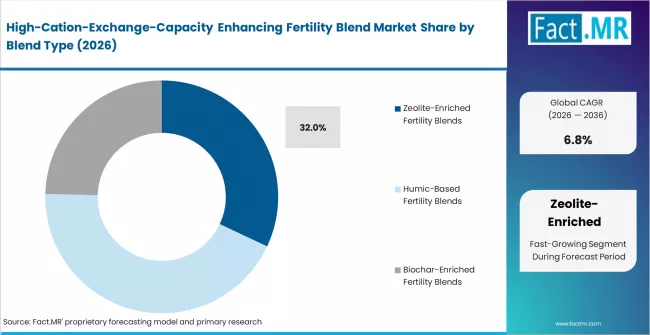
By Blend Type: Zeolite-enriched fertility blends are estimated to lead with approximately 32% share in 2026, supported by strong ion-exchange positioning and nutrient-holding behavior.
By Application: Granular soil incorporation is expected to hold approximately 38% share in 2026, driven by practical fit in bulk field programs and broader acreage deployment.
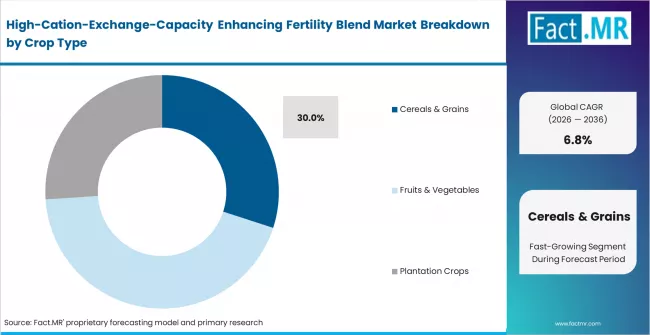
By Crop Type: Cereals & grains are projected to account for approximately 30% share in 2026, supported by large acreage and nutrient-efficiency pressure in coarse- and medium-textured soils.
By Geography: India leads growth at 8.2% CAGR through 2036, supported by increasing use of soil-improvement inputs in intensive crop systems.
Analyst Opinion at FACT.MR
Shambhu Nath Jha, Senior Analyst at Fact.MR, states, “CXOs should read this market as a nutrient-retention category rather than a conventional fertilizer-premium category. Buyers are not simply paying for added nutrition. They are paying for a soil environment that can hold nutrient value longer and reduce avoidable loss.”
Strategic Implications
Invest in blend formats that combine nutrient supply with ion-exchange-supportive materials for low-CEC and nutrient-leaching-prone soils.
Build technical sales capability around soil testing, organic matter trends, and nutrient-holding performance rather than only nutrient analysis.
Position multi-component blends where growers need better retention of potassium and ammonium under precision fertility and irrigated crop systems.
Methodology
Market sizing uses soil-type relevance, nutrient-loss exposure, crop-value intensity, and adoption potential across CEC-enhancing fertility blends.
Analysis includes extension guidance on CEC and nutrient retention plus USDA and related references on biochar and ion-exchange-supportive amendments. [4]
Forecasts account for soil-health adoption, precision nutrient management, and the rising commercial importance of nutrient-holding efficiency in crop programs.
The market is expected to generate an absolute opportunity of USD 3.1 billion between 2026 and 2036, supported by growing focus on nutrient efficiency and soil performance. Growth is driven by increasing attention to nutrient-retention efficiency, particularly in soils where potassium and ammonium are prone to leaching or weak retention. Academic extension materials highlight that cation exchange capacity (CEC) is strongly linked to soil texture and organic matter and typically changes slowly over time. This creates demand for fertility blends that combine nutrient delivery with retention-supportive materials, helping improve nutrient availability, reduce losses, and support more stable crop performance across varying soil conditions. [1]
India is projected to lead with a CAGR of 8.2% by 2036, driven by intensifying crop nutrition programs and broader use of soil-improvement inputs in high-value and irrigated systems. Brazil follows at 7.6%, supported by large-acre cropping and stronger nutrient-efficiency pressure. The United States is expected to grow at 7.1%, underpinned by precision nutrient management and soil-health adoption. Canada records 6.6%, supported by agronomic focus on nutrient efficiency and organic matter management. Mexico grows at 6.0%, backed by irrigated horticulture and nutrient-retention needs in lighter soils. This variation reflects differences in soil texture, organic matter management, irrigation intensity, and willingness to adopt fertility blends that improve nutrient-holding performance. [2]
Segmental Analysis
High-Cation-Exchange-Capacity Enhancing Fertility Blend Market Analysis by Blend Type
High Cation Exchange Capacity Enhancing Fertility Blend Market Analysis By Blend Type | Source: Fact.MR
High-cation-exchange-capacity enhancing fertility blend market analysis, zeolite-enriched fertility blends are estimated to hold 32% share in 2026. They lead because zeolites continue to be described as having high cation-exchange potential and strong nutrient and water holding and releasing characteristics, which makes them commercially attractive in blends designed to retain ammonium and other cations more effectively in the soil. Humic-based blends remain important because current literature links humic substances with improved CEC and soil productivity functions. Biochar-enriched blends are also expanding, supported by USDA materials that describe biochar as capable of increasing soil cation exchange capacity and nutrient retention in suitable systems. Leadership in this segment depends on whether the blend can improve nutrient-holding performance without disrupting standard field fertility programs.
Zeolite Positioning: Zeolite-based materials keep a commercial advantage because their cation-exchange behavior is easier to communicate in nutrient-retention programs. [5]
Biochar Opportunity: Biochar-enriched blends gain traction where growers want nutrient-retention support and soil-conditioning value in one program.
High-Cation-Exchange-Capacity Enhancing Fertility Blend Market Analysis by Application
High Cation Exchange Capacity Enhancing Fertility Blend Market Analysis By Application | Source: Fact.MR
Based on Fact.MR’s analysis, granular soil incorporation is expected to hold approximately 38% share in 2026. This segment leads because CEC-enhancing blend materials are often easiest to deploy through pre-plant or in-season soil incorporation, where they can interact directly with the soil exchange complex and influence nutrient-holding behavior across the root zone. Bulk field blending remains commercially important because growers want CEC-supportive materials integrated into standard fertilizer routines without major operational change. Band application also remains relevant where growers want concentrated nutrient-retention support near the crop row. Fertigation-compatible programs are gaining traction in specialty crops, though the broadest acreage fit still lies with granular and dry-blend deployment. Application leadership in this market favors systems that fit conventional farm equipment and allow CEC-supportive materials to be integrated with minimal disruption.
Field Fit: Dry and granular incorporation remain easier to scale across large-acre programs than highly specialized delivery systems.
Low-CEC Protection: Coarse-textured soils with low CEC create stronger demand for field-ready nutrient-retention support.
Operational Advantage: Farmers favor formats that fit normal blending and spreading workflows while still improving nutrient-holding performance.
High-Cation-Exchange-Capacity Enhancing Fertility Blend Market Analysis by Crop Type
High Cation Exchange Capacity Enhancing Fertility Blend Market Analysis By Crop Type | Source: Fact.MR
Cereals & grains are projected to account for approximately 30% share in 2026, as large-acre nutrient programs in these crops create clear economic pressure to reduce fertilizer losses and improve nutrient retention in soils that may not naturally hold potassium or ammonium well. Extension guidance notes that sandy soils are low in clay and low in CEC, which makes potassium retention and fertilizer build strategies more difficult in these systems. Fruits and vegetables remain highly attractive in irrigated and intensive systems where nutrient management is more precise, though cereals and grains hold the larger commercial base because of acreage and repeat fertility demand. Crop leadership in this market is shaped by nutrient-retention economics as much as by crop value.
Broad-Acre Logic: Grain systems create a strong market base because even moderate retention gains matter across large nutrient volumes.
Potassium Retention Concern: Low-CEC soils can lose potassium more easily, which strengthens the value proposition for CEC-enhancing blends.
Intensive Crop Pull: Fruits and vegetables still create high-value demand where irrigation and precision feeding make retention visible at the crop level.
Drivers, Restraints, and Opportunities
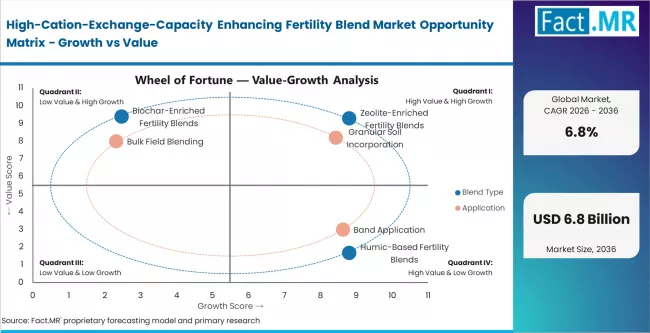
High Cation Exchange Capacity Enhancing Fertility Blend Market Opportunity Matrix Growth Vs Value | Source: Fact.MR
Fact.MR analysts observe that the high-cation-exchange-capacity enhancing fertility blend market is being shaped by the growing need to improve fertilizer-use efficiency through nutrient retention rather than only nutrient dosage. Structural demand is anchored in the fact that soils with low CEC hold cations less effectively, which can weaken the return on applied fertilizer. USDA and related sources also support the relevance of amendments such as biochar in improving nutrient retention and, in some systems, CEC. This creates a favorable commercial environment for fertility blends designed to hold nutrients longer in the root zone.
The main restraint is performance variability. Materials associated with improved CEC or nutrient retention do not behave identically across all soils, climates, and crop systems. Extension guidance emphasizes that CEC is strongly tied to soil texture and organic matter and changes slowly over time. That means buyers need technical confidence before shifting from standard fertility programs into retention-enhancing blend strategies. Cost discipline also slows adoption where growers want clear nutrient-savings or crop-response proof before paying for a more complex blend.
Low-CEC Soil Opportunity: Coarse and sandy soils remain the clearest commercial opportunity because nutrient-holding limitations are more visible there.
Organic Matter Integration: Blends that pair nutrient supply with organic-matter-supportive materials can benefit from the close relationship between organic matter and CEC.
Zeolite and Biochar Expansion: Materials linked with ion exchange or nutrient-retention behavior create higher-value opportunities where growers want retention gains without rebuilding the whole fertility program.
Regional Analysis
The high-cation-exchange-capacity enhancing fertility blend market is assessed across North America, Europe, Asia Pacific, Latin America, and Middle East and Africa, covering 40+ countries with demand profiles shaped by soil texture, organic matter management, irrigated crop intensity, and adoption of soil-improvement fertility programs. The full report provides market attractiveness analysis by region and country.
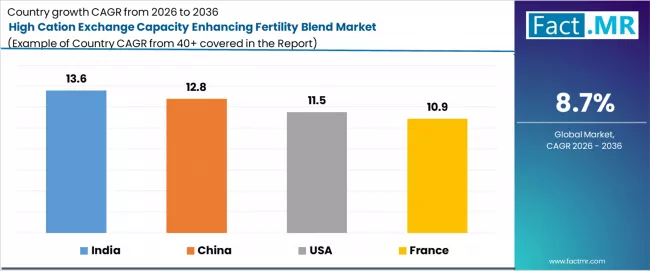
Top Country Growth Comparison High Cation Exchange Capacity Enhancing Fertility Blend Market Cagr (2026 2036) | Source: Fact.MR
Country
CAGR (2026 to 2036)
India
8.2%
Brazil
7.6%
United States
7.1%
Canada
6.6%
Mexico
6.0%
Source: Fact.MR analysis. Updated May 12, 2026
Source: Fact.MR analysis, based on proprietary forecasting model and primary research
High Cation Exchange Capacity Enhancing Fertility Blend Market Cagr Analysis By Country | Source: Fact.MR
North America High-Cation-Exchange-Capacity Enhancing Fertility Blend Market Analysis
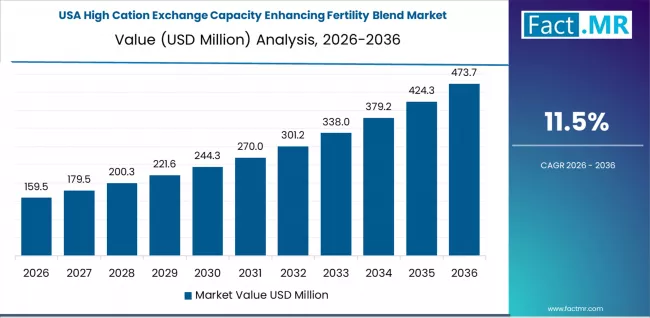
High Cation Exchange Capacity Enhancing Fertility Blend Market Country Value Analysis | Source: Fact.MR
North America remains an important commercial region because it combines soil-testing discipline, precision nutrient management, and growing interest in soil-health-linked fertility programs. The region has clear relevance for CEC-enhancing blends where coarse-textured soils, lower organic matter, or irrigated production increase nutrient-retention pressure. Demand is strongest where growers are already monitoring soil properties and can link low nutrient-holding performance with crop nutrition losses or weaker fertilizer return.
United States: Precision agriculture adoption and a stronger focus on nutrient efficiency continue to support demand across the United States. The market is projected to expand at a CAGR of 7.1% through 2036, supported by widespread soil testing and increasing interest in improving nutrient retention. Growers are prioritizing input optimization and minimizing nutrient loss, particularly in large-scale row crop systems where efficiency gains directly impact profitability and sustainability outcomes.
Canada: Agronomic interest in nutrient retention and soil organic matter management supports adoption across Canada. High-cation-exchange-capacity enhancing fertility blend demand is expected to grow at a CAGR of 6.6% through 2036, as producers focus on improving soil structure and nutrient-holding capacity under shorter growing seasons. Use is particularly relevant in cereal and oilseed systems where consistent nutrient availability supports stable crop performance.
Mexico: Irrigated horticulture and nutrient-retention needs in lighter soils create a practical commercial fit in Mexico. Sales of high-cation-exchange-capacity enhancing fertility blends are likely to rise at a CAGR of 6.0% during the forecast period. Growers are increasingly adopting these blends to improve soil fertility management, reduce leaching losses, and support consistent crop quality in high-value fruit and vegetable production systems.
Fact.MR’s analysis of North America covers the United States, Canada, and Mexico. Includes nutrient-retention demand, low-CEC soil relevance, and soil-health-linked fertility program adoption.
Asia Pacific and Latin America High-Cation-Exchange-Capacity Enhancing Fertility Blend Market Analysis
Asia Pacific and Latin America offer the strongest long-term expansion potential because nutrient-efficiency pressure, irrigated crop intensity, and soil-improvement input demand are rising across multiple crop systems. Demand is likely to strengthen where growers move beyond nutrient application alone and begin to prioritize how well soil can retain what is applied. Adoption depends on channel education, soil-testing access, and the ability of suppliers to demonstrate retention value in commercial terms rather than only in laboratory terms.
India: Expanding interest in soil-improvement inputs and more intensive crop nutrition practices continue to support demand across India. The market is projected to grow at an 8.2% CAGR through 2036, driven by rising awareness around soil health, nutrient efficiency, and yield stability. Adoption is increasing in cereals, pulses, and horticulture, particularly in regions where soil degradation and nutrient loss are becoming more visible challenges.
Brazil: Large-acre cropping systems and a stronger push toward nutrient-efficiency improvement support expansion in Brazil. High-cation-exchange-capacity enhancing fertility blend demand is expected to rise at a 7.6% CAGR through 2036, supported by large-scale cultivation of soybeans, corn, and sugarcane. Growers are focusing on improving soil nutrient retention and reducing input losses to maintain productivity across diverse climatic and soil conditions.
Fact.MR’s analysis covers India, China, Japan, ASEAN, Australia, Brazil, Argentina, and Rest of Latin America. Includes soil-retention demand, organic matter-linked fertility improvement, and adoption of nutrient-efficiency enhancing blends across major agricultural systems.
Competitive Aligners for Market Players
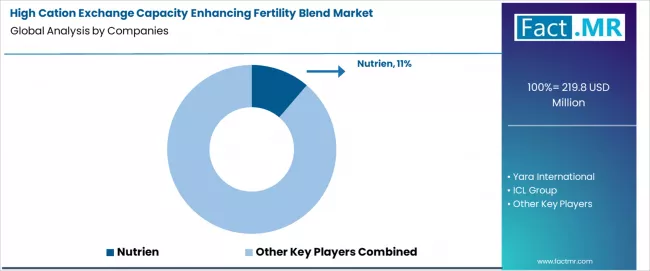
High Cation Exchange Capacity Enhancing Fertility Blend Market Analysis By Company | Source: Fact.MR
The high-cation-exchange-capacity enhancing fertility blend market is moderately concentrated at the formulation level, while distribution and technical support remain fragmented. Competitive strength comes from the ability to combine nutrient supply with clearly understood retention-supportive materials such as zeolite, humic inputs, biochar, or similar exchange-supportive components. Suppliers need more than a soil-health claim. They need a credible nutrient-retention explanation tied to soil type, crop system, and fertilizer performance. [6]
Competitive advantage is defined by formulation consistency, agronomic clarity, and the ability to integrate into standard fertility programs without excessive complexity. Zeolite-linked products benefit from clearer ion-exchange positioning. Organic-matter and humic-linked blends benefit from broader soil-improvement narratives. Biochar-enriched blends gain attention where suppliers can show retention and soil-conditioning value together, though variability across soils keeps proof burden high. Buyers in this market typically choose on technical confidence and expected nutrient efficiency rather than on input cost alone.
Buyer dynamics vary by soil limitation and agronomy sophistication. Large farms and precision operations are more likely to adopt first because they can identify low-CEC zones and justify specialized blends with better data. Broader adoption will depend on whether suppliers can show that the blend improves fertilizer economics in a consistent, field-relevant way. Competitive intensity is therefore rising fastest in technically managed nutrient programs rather than in undifferentiated bulk fertility.
Key Players
ICL Group Ltd.
Yara International ASA
Nutrien Ltd.
The Mosaic Company
Haifa Group
EuroChem Group AG
UPL Ltd.
Coromandel International Ltd.
SQM S.A.
Nufarm Limited
Bibliography
[1] University of Minnesota Extension. Soil testing on fruit and vegetable farms.
[2] University of Minnesota Extension. Fall K fertilizer decisions: How should corn growers approach low-testing, low-CEC soils?
[3] ScienceDirect. The role of natural and synthetic zeolites as soil amendments in agriculture.
[4] USDA Climate Hubs. Soil Restoration with Biochar.
[5] ScienceDirect. Natural and synthetic zeolites for water management in agriculture.
[6] Agronomy. Humic Substances: Bridging Ecology and Agriculture for a Sustainable Future.
This Report Addresses
Strategic intelligence on CEC-enhancing fertility blend demand across field crops, horticulture, and soil-improvement fertility systems.
Market forecast from USD 3.3 billion in 2026 to USD 6.4 billion by 2036 at a CAGR of 6.8%.
Growth opportunity mapping across zeolite-enriched, humic-based, biochar-enriched, and multi-component CEC enhancement blends.
Segment analysis by blend type, application, crop type, and end use.
Regional outlook covering North America, Europe, Asia Pacific, Latin America, and Middle East and Africa.
Competitive analysis of ICL Group, Yara International, Nutrien, Mosaic, Haifa Group, EuroChem, and other participants.
Report delivered in PDF, Excel datasets, and presentation formats. Supported by primary interviews, extension guidance, and soil-retention research.
Market Definition
The market covers fertilizer-compatible blends designed to improve soil cation exchange capacity or nutrient-holding behavior through the inclusion of materials such as zeolites, humic substances, biochar, or other ion-exchange-supportive mineral and organic components. These blends are used to improve retention of positively charged nutrients, reduce nutrient loss risk, and improve fertilizer-use efficiency across field crops, horticulture, and managed soil systems.
Covers global and regional forecasts from 2026 to 2036. Includes zeolite-enriched blends, humic-based blends, biochar-enriched blends, clay-mineral blends, and multi-component formulations designed to raise nutrient-holding performance or support higher effective CEC behavior in soil. Covers products used in field incorporation, crop nutrition programs, and soil-fertility systems where nutrient retention, slower loss, and stronger fertilizer efficiency are the core commercial objectives. [3]
Excludes standard bulk fertilizers sold only for nutrient supply without a CEC-enhancing or nutrient-retention position. Omits ordinary liming products, simple organic manures without a fertility-blend format, and stand-alone biostimulants that are not sold as nutrient-holding or CEC-improving fertility blends. It also excludes irrigation hardware and general soil-health services not linked to actual blend deployment.
High-Cation-Exchange-Capacity Enhancing Fertility Blend Market Research Methodology
Primary Research:Interviews with soil fertility advisors, precision agronomy teams, bulk blend distributors, grower cooperatives, regenerative agriculture consultants, and large-farm nutrient managers across key agricultural regions.
Desk Research:Uses extension and university materials on cation exchange capacity, USDA references on biochar and nutrient retention, and technical literature describing zeolite, organic matter, and nutrient-holding soil amendments.
Market-Sizing and Forecasting:Hybrid model using low-CEC soil relevance, crop-value intensity, nutrient-retention need, adoption potential across amendment-enhanced fertilizer blends, and technical suitability across major farming systems.
Data Validation and Update Cycle:Validated using extension nutrient-management guidance, supplier positioning around nutrient retention, soil-health practice references, and recurring checks on commercial need in coarse-textured and intensive crop systems.
Market Breakdown
Segmentation
Scope of Report
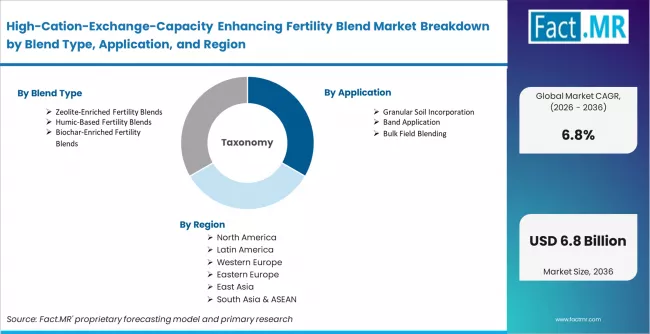
High Cation Exchange Capacity Enhancing Fertility Blend Market Breakdown By Blend Type, Application, And Region | Source: Fact.MR
Attribute
Details
Quantitative Units
USD 3.3 billion (2026) to USD 6.4 billion (2036), at a CAGR of 6.8%
Market Definition
Fertility blends designed to improve nutrient-holding behavior and effective cation exchange support in soil through mineral, organic, or multi-component materials that enhance retention of positively charged nutrients.
North America, Europe, Asia Pacific, Latin America, Middle East and Africa
Countries Covered
United States, Canada, Mexico, Spain, Netherlands, Germany, France, India, China, Australia, Brazil, Argentina, and 40+ countries
Key Companies Profiled
ICL Group Ltd., Yara International ASA, Nutrien Ltd., The Mosaic Company, Haifa Group, EuroChem Group AG, UPL Ltd., Coromandel International Ltd., SQM S.A., Nufarm Limited
Forecast Period
2026 to 2036
Approach
Hybrid top-down and bottom-up model using soil-type relevance, nutrient-retention need, crop intensity, low-CEC soil exposure, and primary interviews with growers, distributors, and agronomy teams.
Source: Fact.MR analysis. Updated May 12, 2026
High-Cation-Exchange-Capacity Enhancing Fertility Blend Market by Segments
By Blend Type:
Zeolite-Enriched Fertility Blends
Humic-Based Fertility Blends
Biochar-Enriched Fertility Blends
Clay-Mineral Fertility Blends
Multi-Component CEC Enhancement Blends
Others
By Application:
Granular Soil Incorporation
Band Application
Fertigation-Compatible Programs
Bulk Field Blending
Others
By Crop Type:
Cereals & Grains
Fruits & Vegetables
Oilseeds & Pulses
Plantation Crops
Turf & Ornamentals
Others
By Region:
North America
United States
Canada
Mexico
Latin America
Brazil
Argentina
Chile
Rest of Latin America
Western Europe
Germany
France
United Kingdom
Italy
Spain
Nordic Countries
BENELUX
Rest of Western Europe
Eastern Europe
Russia
Poland
Hungary
Balkan and Baltic
Rest of Eastern Europe
East Asia
China
Japan
South Korea
South Asia and Pacific
India
ASEAN
Australia and New Zealand
Rest of South Asia and Pacific
Middle East and Africa
Kingdom of Saudi Arabia
Other GCC Countries
Turkey
South Africa
Rest of Middle East and Africa
Questions Answered
Frequently Asked Questions
How big is the high cation exchange capacity enhancing fertility blend market in 2026?
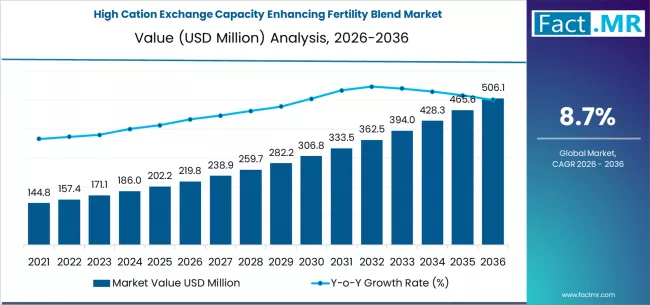
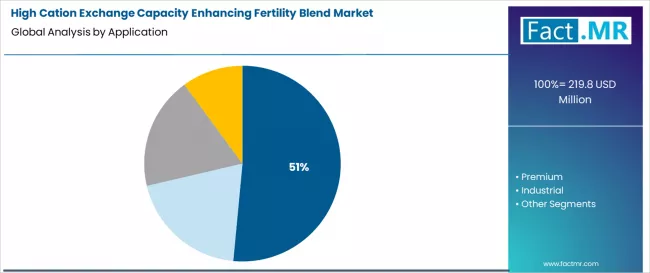
The global high cation exchange capacity enhancing fertility blend market is estimated to be valued at USD 219.8 million in 2026.
What will be the size of high cation exchange capacity enhancing fertility blend market in 2036?
The market size for the high cation exchange capacity enhancing fertility blend market is projected to reach USD 506.1 million by 2036.
How much will be the high cation exchange capacity enhancing fertility blend market growth between 2026 and 2036?
The high cation exchange capacity enhancing fertility blend market is expected to grow at a 8.7% CAGR between 2026 and 2036.
What are the key product types in the high cation exchange capacity enhancing fertility blend market?
The key product types in high cation exchange capacity enhancing fertility blend market are standard, premium, industrial and other.
Which form segment to contribute significant share in the high cation exchange capacity enhancing fertility blend market in 2026?
In terms of form, liquid segment to command 45.4% share in the high cation exchange capacity enhancing fertility blend market in 2026.
.webp "Top Country Growth Comparison High Cation Exchange Capacity Enhancing Fertility Blend Market Cagr (2026 2036)")