- Base Value(2025): 51.3 Bn
- Forecast Value (2035): 93.6 Bn
- CAGR (2035): 6.2%
High Performance Films Market Size, Share and Forecast Outlook 2025 to 2035
The global high performance films market is forecast to reach USD 93.6 billion by 2035, up from USD 51.3 billion in 2025. During the forecast period, the industry is projected to register at a CAGR of 6.2%. The development of films with superior properties, such as enhanced durability, improved optical clarity, and outstanding resistance to environmental factors, has been facilitated by innovation in film manufacturing techniques and materials science.
These developments facilitate the development of films that satisfy the changing requirements of numerous sectors, such as aerospace, automotive, and electronics, thereby increasing the demand for high-performance films.
Quick Stats of High Performance Films Market
- High Performance Films Market Size (2025): USD 51.3 billion
- Projected High Performance Films Market Size (2035): USD 93.6 billion
- Forecast CAGR of High Performance Films Market (2025 to 2035): 6.2%
- Leading Material Segment of High Performance Films Market: Polyester
- Key Growth Regions of High Performance films Market: United States, China, Japan
- Key Players of the High Performance Films Market: Dow Chemical Company, The 3M Company, Solvay S.A., Covestro, Evonik, Honeywell International Inc., others.
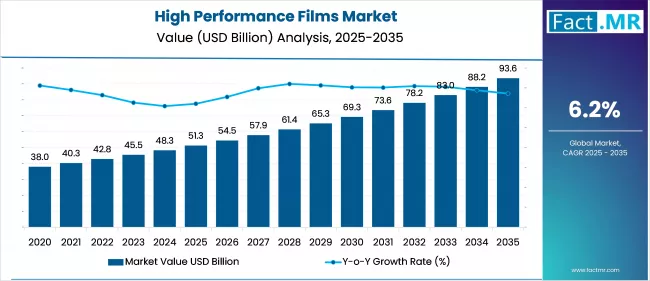
High Performance Films Market Analysis Value 2025 To 2035 | Source: Fact.MR
| Metric | Value |
|---|---|
| Industry Size (2025E) | USD 51.3 billion |
| Industry Size (2035F) | USD 93.6 billion |
| CAGR (2025-2035) | 6.2% |
Source: Fact.MR analysis. Updated Aug 19, 2025
The market is projected to increase from USD 51.3 billion in 2025 to approximately USD 69.3 billion by 2030, indicating a consistent growth trajectory that facilitates capacity planning and long-term agreements.Packaging and labeling films are expected to comply with the EU’s Packaging and Packaging Waste Regulation, which took effect on February 11, 2025, and will be applicable from August 12, 2026.
The regulations establish recyclability standards and Design for Recycling criteria, encouraging converters to adopt mono-material or recyclable film structures and increase recycled content. This will benefit suppliers possessing advanced technologies in PE, PP, PET, and coatings, as well as those demonstrating traceable EPR performance.
New U.S. tariffs on plastics imports from China, effective in 2025, along with ongoing tariff discussions, are leading to a re-evaluation of supply chains. Plastics processors in the United States may experience increased reshoring demand in the automotive and consumer goods sectors, potentially leading to a constriction in the supply of specific resins and specialty films within North America. Buyers must anticipate pricing variability across regions and evaluate the option of dual sourcing.
The market is projected to grow from approximately USD 69.3 billion in 2030 to USD 93.6 billion by 2035. Growth will be concentrated in high-specification films for energy, mobility, and electronics. In solar photovoltaic technology, manufacturers are increasingly adopting coated polyethylene terephthalate backsheets and polyvinylidene fluoride-layer solutions.
This shift in demand favors durable barrier and UV-resistant coatings over certain multilayer legacy stacks, thereby creating opportunities for coating chemistries and PET substrate suppliers.
Electronics continues to serve as a catalyst. Recent developments in flexible and stretchable displays have positioned colorless polyimide and other high-heat, optically clear films favorably, thereby sustaining premium pricing in thin, low-haze grades for applications in foldables, wearables, and in-vehicle displays.
The demand for high-barrier films, such as PCTFE, in pharmaceutical packaging is increasing, leading to niche capacity expansions and innovations in laminates. Solar PV backsheets demonstrate significant growth, underscoring the energy sector's demand for specialty films.
In conjunction with the EU circularity regulations and shifts in U.S. trade policy, these elements indicate a combination of compliance-driven reformulation, targeted regional capacity expansion, and enhancements in product mix, rather than expansion driven by price increases.
Top High Performance Films Market Dynamics
The high-performance films market is experiencing consistent development as a result of their growing presence in a variety of applications, including electronics, automotive, aerospace, medical, and packaging. In industries that necessitate precision, efficiency, and durability, their exceptional mechanical, thermal, and barrier properties render them indispensable.
Technological advancements and sustainability trends are generating new opportunities; however, environmental concerns, capital-intensive manufacturing, and high production costs continue to be significant obstacles that affect market dynamics.
Increasing Demand from the Electronics Industry
The increasing adoption of electronic devices and appliances is fueling the need for films that provide electrical insulation, thermal management, and protection against electromagnetic interference.
In applications like protective covers, touchscreens, and flexible displays, high-performance specialty films are highly regarded for their distinctive properties that improve both the durability and functionality of products. As the landscape of consumer electronics advances, the demand for these sophisticated films is anticipated to increase significantly.
Transition to Sustainable and Eco-Conscious Materials
The growing focus on environmental responsibility, along with strict regulatory standards, is driving sectors to embrace sustainable, biodegradable, and recyclable film options.
Organizations are diligently developing specialty films that ensure superior performance while minimizing environmental impact. This transition to sustainable options is expected to greatly increase the need for high-performance green films in the near future.
Innovations in Film Production Processes
Continuous advancements in material science and manufacturing technologies are facilitating the creation of films that offer improved strength, flexibility, and durability under extreme conditions.
Innovations like nanocoatings, multi-layer structures, and enhanced polymer blends are broadening the scope of applications for high-performance films in sectors such as automotive, aerospace, and medical devices. These technological advancements are enhancing the versatility, cost-effectiveness, and commercial viability of high-performance films.
High Manufacturing Costs and Non-Biodegradability to Restrict Adoption
The production of high-performance films involves advanced polymers and chemicals, making manufacturing costly. Fluctuating prices of petroleum-based raw materials like naphtha also add instability to production costs, impacting profitability and access especially for small and medium enterprises (SMEs).
Many high-performance films are non-biodegradable and pose environmental disposal problems. Stricter environmental regulations globally, such as the EU’s Circular Economy Action Plan and bans on single-use plastics, require manufacturers to invest in sustainable and recyclable alternatives. Compliance with these regulations adds to operational complexity and cost.
Capital Intensive Nature of High-Performance Films Manufacturing Discourages New Players’ Entry
Manufacturing high-performance films demands technical expertise and capital-intensive processes. This restricts growth and entry of new players, especially smaller companies with limited R&D budgets. Extended product development lead times due to complexity also slow market responsiveness.
The market is highly competitive with ongoing demands for product innovation to meet diverse industrial standards, requiring continuous investment in research and development. Crude oil price fluctuations directly affect feedstock costs for films, adding uncertainty and potential cost increases.
Top Regions in the High Performance Films Market
North America accounts for a significant portion of the high-performance films market, influenced by robust manufacturing and technological industries. Industries including aerospace, automotive, and electronics continuously pursue innovative films that provide durability, flexibility, and resistance to environmental factors, while adhering to regulatory standards. The increasing demand for advanced materials is driving market growth in the region.
Europe has developed into a lucrative market, driven by the increasing prevalence of online shopping and the demand for efficient, aesthetically pleasing packaging. High-performance films are essential in protective packaging due to their lightweight characteristics and excellent barrier properties against moisture, oxygen, and various contaminants.
The UK is experiencing significant growth attributed to its expanding electronics sector, where these films are utilized in displays, insulation layers, protective coatings, and flexible printed circuits.
Asia Pacific is an important investment hub, attributed to swift urbanization and infrastructure advancement. The demand for advanced building materials, such as energy-efficient glazing and protective coatings, is increasing in residential and commercial projects.
There is a significant demand for specialty films that provide thermal insulation, UV protection, and increased durability, especially in large-scale construction and modernization projects.
Country-Wise Outlook
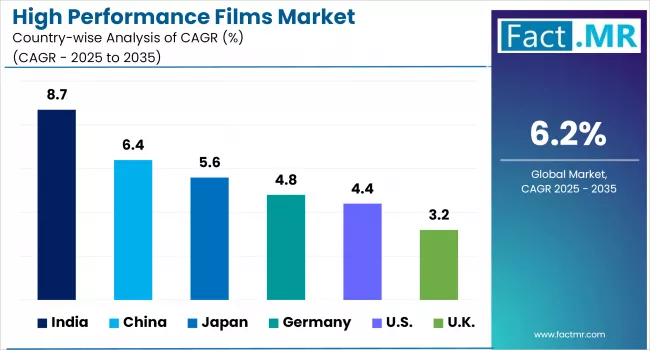
High Performance Films Market Analysis By Country | Source: Fact.MR
| Country | CAGR (2025 to 2035) |
|---|---|
| United States | 4.4% |
| China | 6.4% |
| Japan | 5.6% |
Source: Fact.MR analysis. Updated Aug 19, 2025
Strong Packaging Demand and Cross-Sector Adoption Fuel Market Expansion in the United States
The U.S. high performance films market is expanding rapidly, driven by rising demand in the food and beverage packaging sector. These films deliver enhanced hygiene, extended shelf life, and tamper-proof features, making them integral to packaged and frozen food applications. Innovations in durability, barrier performance, and aesthetics further strengthen adoption.
In automotive, lightweight and durable films are increasingly deployed in interiors, windows, and electrical insulation to improve fuel efficiency and reduce emissions, supported by stringent fuel economy regulations.
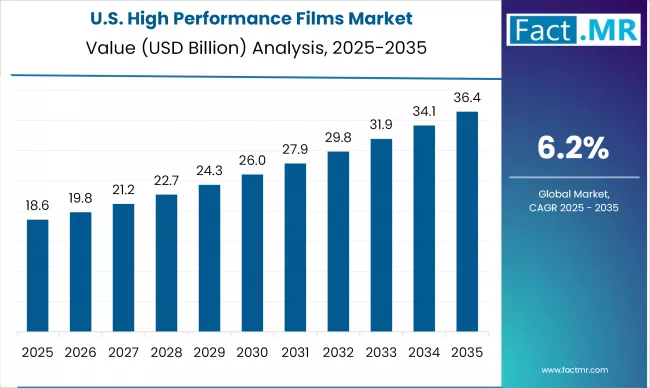
US High Performance Films Market Analysis Value 2025 To 2035 | Source: Fact.MR
In electronics, superior heat resistance and mechanical strength position these films as essential in flexible displays, touchscreens, printed circuit boards, and photovoltaic cells, benefiting from the rapid growth of solar PV and flexible electronics.
Healthcare adoption is rising due to their biocompatibility, barrier protection, and sterilization properties, ensuring product integrity and patient safety. Increased healthcare spending and ongoing medical device innovation sustain this trajectory.
- Packaging sector demand underpinned by hygiene, shelf life, and safety requirements.
- Automotive and electronics leveraging lightweight, durable, heat-resistant properties.
- Healthcare demand supported by biocompatibility and sterilization capabilities.
Automotive Sector Growth and Technological Advancements Drive Market Performance in China
China’s high performance films market is advancing on the back of robust automotive production, rising vehicle sales, and heightened preventive maintenance demand.
Expanding vehicle ownership has accelerated the need for modern, high-precision service equipment in repair and maintenance facilities. Adoption of advanced technologies such as automation, virtual reality, and optical imaging are improving service accuracy and efficiency.
The automotive aftermarket is undergoing transformation as stricter regulations, advanced vehicle designs, and evolving consumer expectations drive investments in next-generation equipment. Rising used vehicle sales and the need for pre-resale repairs are boosting demand for wheel and tire servicing solutions.
Strategic R&D investments and initiatives such as Smithers’ expansion of its Suzhou testing facilities position China as a global hub for automotive testing, innovation, and partnerships.
- Market growth fueled by automotive expansion and preventive maintenance demand.
- Technology adoption enhancing precision and efficiency in automotive servicing.
- R&D and facility investments reinforcing China’s position in global automotive testing.
Premium Tire Demand and Service Automation Support Steady Market Growth in Japan
Japan’s high performance films market benefits from sustained automotive output, strong demand for fuel-efficient and eco-friendly tires, and continuous advances in tire technology.
Growing vehicle ownership and preference for premium tires with enhanced safety and low rolling resistance drive robust replacement demand, especially for aging vehicles under strict safety compliance. Urban investments in advanced tire service infrastructure such as touchless and run-flat changers are elevating efficiency and service quality.
While high-profile partnerships have been limited in 2025, ongoing domestic innovation and long-standing international collaborations, such as Yokohama’s partnership with SCI Pneus in Brazil, continue to integrate Japan into global technical and supply chain ecosystems.
- Premium tire demand and safety compliance boosting replacement market growth.
- Urban facility upgrades driving adoption of automated tire service solutions.
- International partnerships reinforcing global integration and technical exchange.
Analyzing High Performance Films Market by Leading Segments
The high-performance films market is characterized by materials and types that integrate advanced functionality with sustainability, addressing the changing requirements of sectors including electronics, packaging, automotive, and healthcare. Ongoing advancements in material science and manufacturing techniques are leading to improvements in product durability, thermal stability, and barrier efficiency.
Polyester films represent the largest material share among the leading segments, attributed to their versatility and performance in electronic devices. In contrast, barrier films dominate by type, owing to their essential function in maintaining product integrity. Both segments are experiencing significant investment in recyclability, multi-functionality, and innovations tailored to specific applications to meet regulatory and consumer demands.
Polyester Films Dominant Material Choice Driven by Electronics and Wearable Tech
In 2025, polyester accounted for the largest share of the high performance films market. Its exceptional thermal stability and electrical insulation make it ideal for substrates in touchscreens, displays, and flexible circuits. Demand is accelerating with the rapid evolution of electronics, particularly the trend toward compact, high-functionality devices.
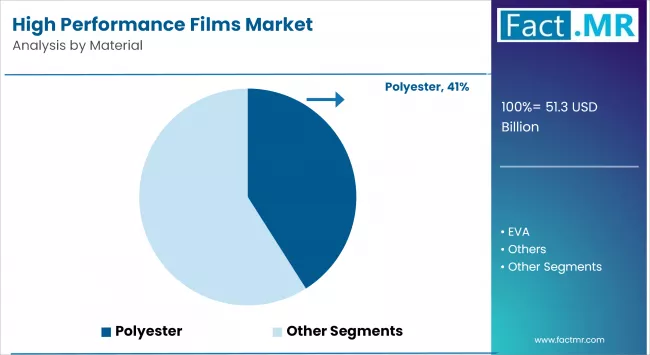
High Performance Films Market Analysis By Material | Source: Fact.MR
Wearable technology and consumer electronics are expanding the application scope of polyester films, ensuring sustained growth. Industry players are also diversifying offerings to address sustainability, recyclability, and enhanced properties like chemical resistance, biocompatibility, and thermal stability.
Recent developments include Cosmo Films’ launch of seven new specialty films in the U.S. in 2024, spanning PVC-free signage films, PETG shrink label films, CPP lamination films, heat-resistant laminates, and advanced labeling films, and Essen Speciality Films’ 2025 expansion into high-performance stocks for packaging, automotive, electronics, and medical markets.
- Polyester retains largest material share due to superior thermal and insulation properties.
- Growth driven by consumer electronics, wearable tech, and evolving display technologies.
- Product innovation focuses on sustainability, recyclability, and multifunctional properties.
Barrier Films Demand Underpinned by Packaging Shelf-Life Demands
Barrier films held the largest market share in 2025, valued for their ability to protect products from moisture, oxygen, and UV light—key to extending shelf life in food and beverage applications.
Innovations include metallic polyester ultra-high barrier films designed to replace aluminum foil in flexible packaging, offering superior oxygen/moisture protection (0.1 cc/m²-day & 0.1 g/m²-day), recyclability, reduced pinholes, and enhanced puncture resistance. These films streamline laminate structures, lowering complexity and cost while improving sustainability.
Advancements such as thermoformable barrier films with up to 18 layers and rigid high-barrier films for pharmaceuticals highlight their growing relevance in healthcare packaging, aligning with strict safety and product integrity standards.
- Barrier films are preferred due to superior protection and extended shelf life capabilities
- Next-gen designs replacing aluminum foil improve recyclability and reduce packaging complexity
- Increasing adoption in healthcare and pharmaceutical packaging for product safety
Competitive Analysis
BASF SE provides a wide selection of high-performance and specialty films that are specifically engineered to address the diverse requirements of a variety of industries, such as automotive, electronics, construction, and packaging.
These films are designed to exhibit exceptional qualities, including resistance to environmental factors, flexibility, and durability. The company's portfolio comprises polyamide (PA) films, polyethylene (PE) films, and other advanced polymer-based solutions that are tailored to specific applications that necessitate high barrier performance against gases and moisture.
Advanced technologies that enable features such as anti-fogging, UV protection, and anti-static properties are incorporated into specialty films offered by Clariant AG. These advancements render them appropriate for a diverse range of applications, including electronic devices that necessitate durable protective coatings and food packaging that extends its shelf life.
Key players in the market are Dow Chemical Company, The 3M Company, Solvay S.A., Covestro, Evonik, Honeywell International Inc., Amcor, Berry Global Group, American Durafilm Co., Eastman Chemical Company, DuPont and other players.
Recent Developments
- In May 2024, Clariant AG unveiled a range of innovative solutions at NPE 2024 to significantly reduce the environmental impact of plastics, particularly in specialty and high-performance films. These new offerings are designed to enhance the sustainability profile of plastic products while maintaining their performance characteristics.
- In January 2024, LANXESS launched a sustainability film highlighting its commitment to sustainable practices within the specialty and high-performance films sector. This film showcases how the company integrates sustainability into its production processes, emphasizing the development of innovative materials that meet high-performance standards and adhere to environmental regulations and sustainability goals.
Segmentation
Segmentation of High Performance Films Market
-
By Material :
- Polyester
- EVA
- Polyolefin
- Polyamide
- Fluoropolymer
- Other Materials
-
By Type :
- Barrier Films
- Safety & Security Films
- Decorative Films
- Microporous Films
- Other Types
-
By Application :
- Automotive
- Aerospace
- Electrical & Electronics
- Packaging
- Construction
- Other Applications
-
By Region :
- North America
- Latin America
- Western Europe
- Eastern Europe
- East Asia
- South Asia & Pacific
- Middle East & Africa
Frequently Asked Questions
What is the global high performance films market size in 2025?
Who are the major players operating in the high performance films market?
What is the estimated valuation of the high performance films market by 2035?
At what CAGR is the high performance films market slated to grow during the study period?
Who worked on this report


Preview the report firsthand - request a free sample
Free SampleGet the brochure for pricing and purchase details
Download PDF