- Base Value(2025): 10.8 Bn
- Estimated Value(2025): 10.8 Bn
- Forecast Value (2035): 21.6 Bn
- CAGR (2025 - 2035): 7.2%
Higher Alpha Olefins Market Forecast and Outlook 2025 to 2035
The global higher alpha olefins market is projected to reach USD 21.6 billion by 2035, recording an absolute increase of USD 10.8 billion over the forecast period. The market is valued at USD 10.8 billion in 2025 and is set to rise at a CAGR of 7.2% during the assessment period. The market is expected to grow by approximately 2.0 times during the same period, supported by increasing demand for polyethylene comonomers in packaging applications worldwide, driving consumption of specialized linear alpha olefins and increasing investments in advanced oligomerization technologies with enhanced product selectivity across polymer, lubricant, and surfactant applications globally.
Manufacturers face mounting pressure to meet stringent performance requirements and optimize production efficiency while addressing sustainability concerns and raw material cost volatility, with modern higher alpha olefin products providing documented performance benefits including improved polymer properties, enhanced lubricant viscosity indices, and superior surfactant biodegradability compared to conventional alternatives alone.
Quick Stats for Higher Alpha Olefins Market
- Higher Alpha Olefins Market Value (2025): USD 10.8 billion
- Higher Alpha Olefins Market Forecast Value (2035): USD 21.6 billion
- Higher Alpha Olefins Market Forecast CAGR: 7.2%
- Leading Product Type in Higher Alpha Olefins Market: C6-C8 (48.7%)
- Key Growth Regions in Higher Alpha Olefins Market: Asia Pacific, North America, and Europe
- Top Players in Higher Alpha Olefins Market: Shell Chemicals, INEOS Oligomers, Chevron Phillips Chemical, ExxonMobil Chemical, Sasol, SABIC, QatarEnergy, Idemitsu Kosan, Godrej Industries, Linde
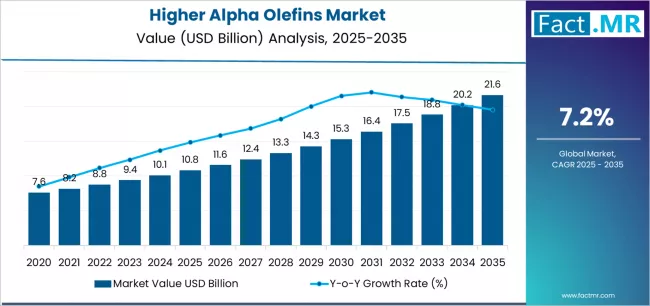
Higher Alpha Olefins Market Market Value Analysis | Source: Fact.MR
Rising awareness about specialty chemical applications and expanding petrochemical capacity in emerging markets enabling localized production create substantial opportunities for producers and downstream partners. However, feedstock price fluctuations and environmental regulations across markets may pose obstacles to margin stability and capacity expansion.
The C6-C8 segment dominates market activity, driven by extensive utilization as polyethylene comonomers and growing demand for short-chain alpha olefins in polymer modification applications worldwide. Industry participants increasingly recognize the commercial advantages of C6-C8 products, with typical offerings providing effective polymer property enhancement and processing optimization at competitive price points through established petrochemical distribution networks.
The C10-C14 segment demonstrates robust presence, supported by critical applications in synthetic lubricants and detergent alcohol production requiring mid-range carbon chain functionalities. Polyethylene comonomers emerge as the dominant application segment, reflecting the substantial role of linear low-density polyethylene and high-density polyethylene production in global plastics manufacturing. Integrated petrochemical complexes represent the leading production model, driven by feedstock integration advantages and economies of scale in ethylene-based oligomerization processes.
Regional dynamics show North America maintaining market leadership, supported by extensive petrochemical infrastructure and established specialty chemical manufacturing capabilities across Gulf Coast production facilities.
Asia Pacific demonstrates the fastest growth trajectory driven by rapidly expanding polyolefin capacity and increasing downstream chemical manufacturing, while Europe emphasizes advanced specialty applications and sustainability-focused production technologies.
USA leads country-level growth through integrated specialty lubricant production and advanced polyethylene manufacturing, followed by China supported by massive ethylene capacity additions and domestic polymer demand expansion. The competitive landscape features moderate concentration with Shell Chemicals maintaining market leadership position at a 20.4% market share, while specialized players including INEOS Oligomers, Chevron Phillips Chemical, and ExxonMobil Chemical compete through targeted technology innovations and comprehensive feedstock integration strategies across diverse application portfolios.
Higher Alpha Olefins Market Key Takeaways
| Metric | Value |
|---|---|
| Market Value (2025) | USD 10.8 billion |
| Market Forecast Value (2035) | USD 21.6 billion |
| Forecast CAGR (2025-2035) | 7.2% |
Source: Fact.MR analysis. Updated Dec 3, 2025
Why is the Higher Alpha Olefins Market Growing?
The higher alpha olefins market grows by enabling manufacturers to produce advanced polymers, high-performance lubricants, and specialty surfactants while addressing performance requirements and sustainability objectives without exclusive reliance on conventional chemical intermediates.
Downstream industries face mounting pressure to enhance product properties and meet environmental standards while managing production costs and supply chain reliability, with modern higher alpha olefin grades typically providing targeted performance benefits including superior polymer flexibility, enhanced lubricant thermal stability, and improved surfactant biodegradability compared to traditional chemical building blocks alone, making these specialty olefins essential for comprehensive industrial chemical applications.
The market is driven by three concrete demand factors tied to industrial outcomes. First, rising polyethylene production capacity and increasing demand for linear low-density polyethylene in flexible packaging create expanding consumption opportunities for comonomer-grade alpha olefins, with C6-C8 products representing critical enablers of enhanced film properties in high-volume polymer applications.
Second, growing synthetic lubricant adoption in automotive and industrial applications drives demand for polyalphaolefin precursors, with studies demonstrating significant performance advantages in viscosity stability and oxidation resistance. Third, increasing emphasis on biodegradable surfactants and sustainable detergent formulations enables market expansion for detergent-range alpha olefins that support environmental compliance while maintaining cleaning efficacy across consumer and industrial applications.
Segmental Analysis
The market is segmented by type and application. By type, the market is divided into C6-C8, C10-C14, and C16. Based on application, the market is categorized into polyethylene comonomers, lubricants & synthetic oils, detergents & surfactants, and other applications.
What Makes C6-C8 the Leading Product Type Category?
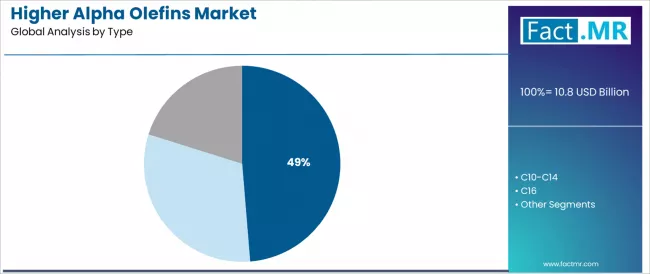
Higher Alpha Olefins Market Analysis By Type | Source: Fact.MR
The C6-C8 segment represents the dominant force in the higher alpha olefins market, capturing 48.7% of total market share in 2025. This established product category encompasses short-chain linear alpha olefins featuring critical polyethylene comonomer functionality and polymer modification capabilities, including 1-hexene and 1-octene grades that enable superior film properties, enhanced mechanical strength, and optimized processing characteristics across linear low-density polyethylene and high-density polyethylene production worldwide.
The C6-C8 segment's market leadership stems from its essential role in modern polyolefin manufacturing, with products capable of providing precise control over polymer crystallinity, density adjustment, and mechanical property optimization while maintaining excellent processability and cost-effectiveness standards across diverse packaging and industrial applications.
The C10-C14 segment maintains a substantial market share at approximately 33.4%, serving synthetic lubricant manufacturers and detergent alcohol producers who require mid-range carbon chain alpha olefins for polyalphaolefin synthesis, plasticizer production, and linear alcohol manufacturing where specific molecular weight distributions provide optimal performance characteristics.
These products offer critical functionality for high-performance lubricant applications while providing sufficient chain length to support specialty chemical synthesis. The C10-C14 segment demonstrates steady demand, driven by automotive lubricant quality requirements and expanding industrial synthetic oil adoption.
The C16 segment accounts for a 17.9% market share, serving specialty applications including drilling fluids, oilfield chemicals, and niche surfactant formulations where longer carbon chains provide unique solubility and performance characteristics not achievable with shorter chain alternatives.
Key commercial advantages driving the C6-C8 segment include essential polyethylene comonomer functionality with demonstrated polymer property enhancement across major global polyolefin production facilities. Other factors include established integration with ethylene production infrastructure allowing cost-effective manufacturing and reliable supply chain positioning, superior processing characteristics enabling optimized polymer extrusion and film production while maintaining product consistency and quality standards, and broad application versatility providing market stability across multiple end-use sectors beyond single-application dependency constraints.
How do Polyethylene Comonomers Lead Application Segments?
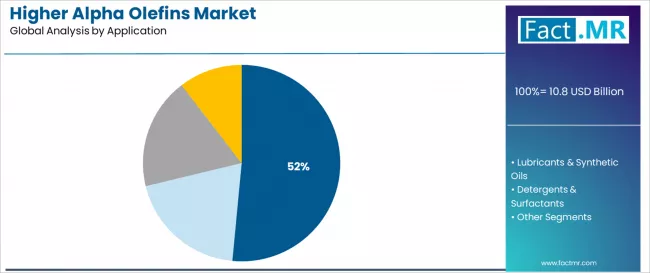
Higher Alpha Olefins Market Analysis By Application | Source: Fact.MR
Polyethylene comonomers represent the dominant application segment in the higher alpha olefins market with a 51.5% market share in 2025, reflecting the fundamental role of linear alpha olefins in modern polyolefin production and polymer property modification. The polyethylene comonomer segment demonstrates consistent demand driven by global packaging industry growth, expanding flexible film applications, and increasing adoption of advanced polyethylene grades requiring precise molecular architecture control through comonomer incorporation.
The lubricants & synthetic oils segment emerges as an important application category with a 27.3% market share, demonstrating robust growth potential driven by automotive industry transition toward higher-performance lubricants and expanding industrial synthetic oil adoption requiring polyalphaolefin base stocks with superior thermal stability and viscosity characteristics. Manufacturers utilizing C10-C14 alpha olefins as feedstock for polyalphaolefin synthesis require specialized oligomerization technologies capable of producing tailored molecular weight distributions for specific lubricant performance requirements.
The detergents & surfactants segment accounts for approximately 13.8% market share, serving consumer goods manufacturers and industrial cleaning applications requiring biodegradable surfactant raw materials including linear alcohol ethoxylates and alkylbenzene sulfonates derived from detergent-range alpha olefins. Other applications represent 7.4% market share, encompassing specialty chemicals including drilling fluids, oilfield chemicals, plasticizers, and polymer modifiers across diverse industrial sectors.
What are the Drivers, Restraints, and Key Trends of the Higher Alpha Olefins Market?
The market is driven by three concrete demand factors tied to industrial outcomes. First, rising polyethylene production capacity globally and increasing demand for high-performance packaging films create expanding consumption opportunities for comonomer-grade alpha olefins, with C6-C8 products representing critical enablers of linear low-density polyethylene manufacturing in comprehensive polymer production protocols, requiring reliable feedstock availability. Second, growing automotive and industrial lubricant quality requirements drive demand for synthetic base oils, with polyalphaolefin production from C10-C14 alpha olefins demonstrating significant performance advantages in thermal stability, viscosity index, and oxidation resistance compared to conventional mineral oils by 2030. Third, increasing regulatory pressure for biodegradable surfactants and sustainable detergent formulations enable market expansion for detergent-range alpha olefins that support environmental compliance while maintaining commercial cleaning efficacy across consumer and industrial applications.
Market restraints include feedstock cost volatility and crude oil price fluctuations that can challenge production economics and margin stability, particularly in regions where ethylene pricing dynamics create unpredictable raw material cost structures and competitive pressure from alternative chemical routes. Capital intensity of oligomerization technology and specialized reactor requirements pose another significant obstacle, as higher alpha olefin production depends on advanced catalytic systems and process optimization, potentially limiting new capacity additions and market entry opportunities. Environmental regulations regarding emissions and energy consumption create additional barriers for production expansion, demanding continuous process improvement and sustainability investment initiatives.
Key trends indicate accelerated capacity expansion in Middle East markets, particularly Saudi Arabia and Qatar, where integrated ethylene complexes demonstrate willingness to invest in downstream alpha olefin production leveraging feedstock cost advantages and strategic positioning. Technology advancement trends toward selective oligomerization catalysts enabling improved carbon number distribution control optimize product value and application-specific performance characteristics. However, the market thesis could face disruption if significant breakthrough technologies in alternative polymer modification methods or major shifts in lubricant base oil preferences reduce reliance on traditional alpha olefin-based chemical intermediates.
Analysis of the Higher Alpha Olefins Market by Key Countries
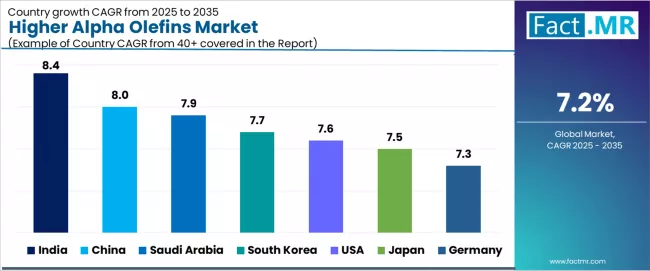
Higher Alpha Olefins Market Cagr Analysis By Country | Source: Fact.MR
| Country | CAGR (2025 to 2035) |
|---|---|
| India | 8.4% |
| China | 8.0% |
| Saudi Arabia | 7.9% |
| South Korea | 7.7% |
| USA | 7.6% |
| Japan | 7.5% |
| Germany | 7.3% |
Source: Fact.MR analysis. Updated Dec 3, 2025
The global higher alpha olefins market is expanding steadily, with India leading at an 8.4% CAGR through 2035, driven by rising polymer and packaging output, expanding petrochemical infrastructure, and increasing downstream chemical manufacturing capabilities. China follows at 8.0%, supported by expansion of domestic olefin capacity, massive polyethylene production growth, and integrated chemical complex development. Saudi Arabia records 7.9%, reflecting ethylene-based feedstock cost advantages and strategic downstream integration initiatives.
South Korea advances at 7.7%, leveraging strong polyalphaolefin and surfactant demand across specialty chemical sectors. USA posts 7.6%, focusing on integration into specialty lubricants and advanced polymer applications, while Japan grows steadily at 7.5%, emphasizing adoption in electronics and medical-grade polymer production. Germany demonstrates 7.3% growth, anchored by advanced specialty chemicals refinement and high-performance application development.
What Makes India the Fastest Growing Market Globally?
India demonstrates the strongest growth potential in the higher alpha olefins market with a CAGR of 8.4% through 2035. The country's leadership position stems from rapidly expanding polymer production capacity, growing packaging industry demand, and increasing petrochemical infrastructure development driving consumption of polyethylene comonomers and specialty chemical intermediates.
Growth is concentrated in major petrochemical hubs and industrial corridors, including Gujarat, Maharashtra, and Tamil Nadu, where integrated chemical complexes are increasingly implementing modern oligomerization technologies for localized alpha olefin production supporting downstream polymer and chemical manufacturing. Distribution channels through petrochemical trading networks, specialty chemical distributors, and direct supply agreements expand product accessibility across polyolefin producers and lubricant manufacturers.
The country's growing emphasis on import substitution and domestic chemical value chain development provides strong momentum for indigenous alpha olefin production, including comprehensive adoption across expanding plastics processing and packaging sectors seeking reliable local sourcing.
Key market factors include expanding polyethylene capacity concentrated in western India petrochemical complexes with rising comonomer requirements, petrochemical infrastructure development through major projects including Reliance Industries and HPCL-Mittal Energy supporting alpha olefin production capabilities, comprehensive downstream chemical expansion ecosystem, including synthetic lubricant manufacturing with proven specialty chemical capabilities, and domestic production initiatives featuring Indian petrochemical companies developing oligomerization technologies while establishing competitive supply alternatives to imports.
How is China Emerging as a High-Growth Market?
In major petrochemical clusters including eastern coastal regions, Pearl River Delta, and northern industrial zones, the adoption of higher alpha olefin solutions is accelerating across integrated chemical complexes, driven by massive polyethylene capacity additions and growing emphasis on downstream value chain integration.
The market demonstrates strong growth momentum with a CAGR of 8.0% through 2035, linked to comprehensive ethylene cracker expansion and increasing focus on specialty chemical manufacturing self-sufficiency. Chinese petrochemical producers are implementing modern oligomerization technologies to supply growing domestic polyolefin demand while meeting expanding requirements for synthetic lubricants and specialty surfactants.
The country's coordinated petrochemical development strategy creates ongoing demand for alpha olefin capacity additions, while increasing technology localization drives adoption of domestically developed oligomerization processes.
What Drives USA Market Leadership?
Higher Alpha Olefins Market Market Value Analysis | Source: Fact.MR
USA market expansion is driven by diverse application portfolios, including specialty lubricant production in Gulf Coast facilities and advanced polyethylene manufacturing across integrated petrochemical complexes. The country demonstrates steady growth potential with a CAGR of 7.6% through 2035, supported by continuous technology innovation from established chemical manufacturers and strategic focus on high-value specialty applications.
American producers face competitive advantages related to shale gas-derived ethylene feedstock economics and established specialty chemical market access, enabling premium product positioning. Strong downstream integration with polyalphaolefin manufacturing and advanced polymer production creates stable baseline demand for higher alpha olefins, particularly in automotive lubricant and high-performance packaging applications where specification-driven product selection drives primary purchasing decisions.
Market characteristics include integrated petrochemical producers showing robust alpha olefin production with substantial capacity across Gulf Coast region, application preferences emphasizing specialty lubricant base stocks and premium polyethylene grades in advanced manufacturing sectors, future projections indicate continued focus on high-purity products and application-specific alpha olefin grades supporting premium market positioning, and growing emphasis on sustainable production technologies supporting environmental compliance and corporate sustainability objectives.
How does Germany Demonstrate Specialty Application Leadership?
The market in Germany leads in advanced specialty chemicals refinement based on integration with high-performance application development and technical customer support for enhanced product utilization. The country shows strong potential with a CAGR of 7.3% through 2035, driven by sophisticated chemical industry infrastructure and producer focus on premium application segments in automotive, industrial, and specialty markets.
German chemical companies are adopting higher alpha olefins through comprehensive technical service models and application development partnerships for optimal performance in demanding end-use environments, particularly in automotive lubricant formulations and specialty polymer applications demanding rigorous quality standards. Distribution channels through established chemical supply networks and technical partnerships expand coverage across manufacturing sectors and specialty chemical customers.
Leading market segments include automotive lubricant applications in premium synthetic oil formulations implementing comprehensive performance requirements, specialty polymer manufacturers partnering with alpha olefin suppliers achieving high technical integration levels, strategic collaborations between chemical producers and end-users expanding application knowledge and product optimization capabilities, and focus on sustainable production methods and circular economy approaches addressing environmental stewardship requirements.
What positions Japan for High-Performance Application Leadership?

Higher Alpha Olefins Market Japan Market Share Analysis By Type | Source: Fact.MR
Japan's higher alpha olefins market demonstrates sophisticated application preferences focused on electronics-grade polymers and medical-grade materials, with documented integration of high-purity alpha olefins achieving substantial improvement in product quality and performance consistency across advanced manufacturing applications.
The country maintains steady growth momentum with a CAGR of 7.5% through 2035, driven by mature market dynamics emphasizing product purity and quality assurance methodologies that align with Japanese manufacturing standards applied to chemical intermediates and specialty materials.
Major industrial regions, including Tokyo-Yokohama, Osaka-Kobe, and Nagoya areas, showcase advanced utilization of specialty-grade alpha olefins where stringent quality specifications integrate seamlessly with electronics manufacturing and medical device production requiring validated chemical supply chains.
Key market characteristics include quality-focused manufacturers driving demand for high-purity alpha olefin grades with emphasis on lot-to-lot consistency and comprehensive testing documentation, quality assurance partnerships enabling reliable supply with comprehensive regulatory compliance programs, technology collaboration between Japanese chemical companies and international alpha olefin producers expanding specialty product availability capabilities, and emphasis on application-specific product development addressing unique requirements in electronics, medical, and advanced material sectors.
What Characterizes Saudi Arabia's Market Development?
In major petrochemical complexes including Jubail, Yanbu, and Ras Tanura, the development of higher alpha olefin production capacity is accelerating across integrated facilities, driven by ethylene-based feedstock cost advantages and strategic downstream diversification initiatives. The market demonstrates solid growth potential with a CAGR of 7.9% through 2035, linked to comprehensive petrochemical expansion programs and increasing focus on value chain integration beyond basic commodity chemicals.
Saudi Arabian producers are implementing world-scale oligomerization units to capture downstream margins while meeting regional polyolefin comonomer demand and establishing export supply positions. The country's strategic petrochemical development creates ongoing opportunities for alpha olefin capacity additions, while feedstock integration advantages support competitive positioning in global specialty chemical markets.
Key development areas include national oil companies and joint ventures leading alpha olefin capacity development with emphasis on integrated production economics, export-oriented strategies serving Asia Pacific and European polyolefin producers requiring reliable comonomer supply, technology partnerships with international licensors providing proven oligomerization process designs and operational expertise, and strategic positioning leveraging feedstock advantages and logistics infrastructure supporting global market access and competitive pricing capabilities.
How Does South Korea Show Specialty Chemical Excellence?
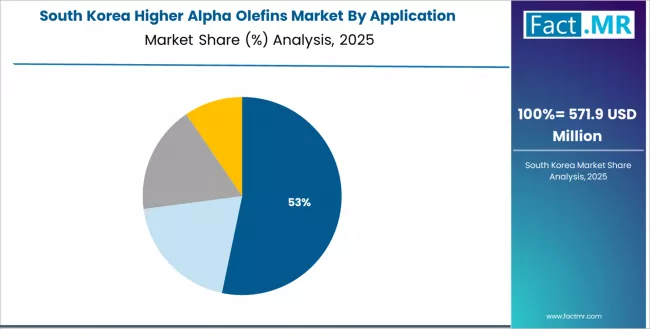
Higher Alpha Olefins Market South Korea Market Share Analysis By Application | Source: Fact.MR
South Korea's higher alpha olefins market demonstrates strong integration with downstream specialty chemical manufacturing focused on polyalphaolefin production and surfactant applications, with documented adoption across synthetic lubricant complexes and detergent chemical facilities implementing comprehensive quality systems.
The country maintains steady growth momentum with a CAGR of 7.7% through 2035, driven by sophisticated petrochemical infrastructure and industry emphasis on high-value specialty chemical production that aligns with Korean manufacturing competitiveness strategies. Major petrochemical complexes in Ulsan, Yeosu, and Daesan showcase advanced alpha olefin utilization where integrated production enables seamless supply to polyalphaolefin synthesis units and detergent alcohol manufacturing facilities.
Key market characteristics include integrated petrochemical producers driving demand for captive alpha olefin supply supporting downstream synthetic lubricant manufacturing, specialty chemical partnerships enabling consistent product quality with comprehensive technical support programs, export competitiveness in polyalphaolefin and specialty surfactant markets benefiting from integrated alpha olefin production capabilities, and emphasis on process efficiency and product quality optimization addressing competitive positioning in global specialty chemical trade.
Europe Market Split by Country
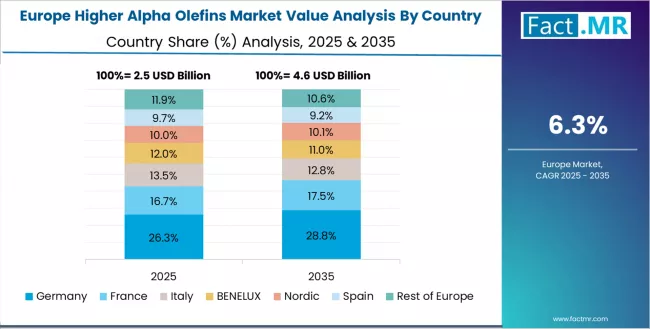
Higher Alpha Olefins Market Europe Country Market Share Analysis, 2025 & 2035 | Source: Fact.MR
The higher alpha olefins market in Europe is projected to grow from USD 2.16 billion in 2025 to USD 4.32 billion by 2035, registering a CAGR of 7.2% over the forecast period. Germany is expected to maintain its leadership position with a 31.5% market share in 2025, adjusting to 31.2% by 2035, supported by its extensive specialty chemicals expertise, automotive lubricant industry integration, and comprehensive application development capabilities serving major European markets.
UK follows with a 18.7% share in 2025, projected to reach 19.0% by 2035, driven by specialty lubricant production and established chemical manufacturing infrastructure in major industrial regions implementing advanced application technologies. France holds a 16.8% share in 2025, expected to maintain 17.0% by 2035 through ongoing development of integrated petrochemical operations and specialty chemical manufacturing.
Italy commands a 14.2% share, while Spain accounts for 11.3% in 2025. The rest of Europe region is anticipated to gain momentum, expanding its collective share from 7.5% to 7.6% by 2035, attributed to increasing alpha olefin adoption in Nordic specialty chemical sectors and emerging Central European polyolefin production facilities implementing modern comonomer technologies.
Competitive Landscape of the Higher Alpha Olefins Market
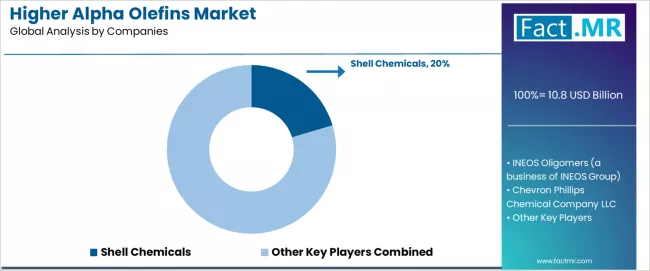
Higher Alpha Olefins Market Analysis By Company | Source: Fact.MR
The higher alpha olefins market features approximately 10-15 meaningful players with moderate concentration, where Shell Chemicals maintains 20.4% of global market share through established oligomerization technology leadership, extensive global production footprint, and comprehensive integration with downstream applications. Competition centers on production technology efficiency, feedstock integration advantages, and application development capabilities rather than price competition alone.
Market leaders include Shell Chemicals, INEOS Oligomers, and Chevron Phillips Chemical, which maintain competitive advantages through proprietary oligomerization technologies, integrated ethylene supply chains, and deep expertise in alpha olefin production optimization, creating high customer confidence among polyolefin producers and specialty chemical manufacturers seeking reliable supply partnerships.
These companies leverage decades of operational experience and ongoing process improvement initiatives to defend market positions while expanding capacity in strategic growth regions including Middle East and Asia Pacific.
Specialized petrochemical producers encompass ExxonMobil Chemical, Sasol, and SABIC, which compete through integrated production complexes, feedstock flexibility, and regional market positioning strategies serving local polyolefin industries and export markets.
Middle Eastern national oil companies including QatarEnergy leverage feedstock advantages and strategic petrochemical development programs, while established Asian producers including Idemitsu Kosan and Godrej Industries focus on regional market supply and application-specific product development.
Technology and industrial gas companies including Linde provide enabling technologies and process solutions supporting alpha olefin production optimization across multiple producers. Market dynamics favor companies that combine operational excellence with strategic feedstock positioning and downstream market access addressing complete value chain from ethylene oligomerization through end-use application support.
Strategic emphasis on technology licensing, capacity expansion in advantaged locations, and sustainability improvement enables differentiation in increasingly competitive petrochemical intermediate markets across developed and emerging regions.
Key Players in the Higher Alpha Olefins Market
- Shell Chemicals
- INEOS Oligomers (a business of INEOS Group)
- Chevron Phillips Chemical Company LLC
- ExxonMobil Chemical Company
- Sasol Limited
- SABIC (Saudi Basic Industries Corporation)
- QatarEnergy
- Idemitsu Kosan Co., Ltd.
- Godrej Industries Limited
- Linde plc
Segmentation
Scope of the Report
| Items | Values |
|---|---|
| Quantitative Units | USD 10.8 Billion |
| Type | C6-C8, C10-C14, C16 |
| Application | Polyethylene Comonomers, Lubricants & Synthetic Oils, Detergents & Surfactants, Other Applications |
| Regions Covered | Asia Pacific, Europe, North America, Latin America, Middle East & Africa |
| Country Covered | India, China, USA, Saudi Arabia, South Korea, Japan, Germany, and 40+ countries |
| Key Companies Profiled | Shell Chemicals, INEOS Oligomers, Chevron Phillips Chemical, ExxonMobil Chemical, Sasol, SABIC, QatarEnergy, Idemitsu Kosan, Godrej Industries, Linde |
| Additional Attributes | Dollar sales by type and application categories, regional adoption trends across Asia Pacific, North America, and Middle East, competitive landscape with petrochemical producers and specialty chemical manufacturers, product specifications and technology requirements, integration with polyolefin production and synthetic lubricant manufacturing, innovations in selective oligomerization and process efficiency, and development of specialized applications with sustainability focus and performance optimization capabilities. |
Source: Fact.MR analysis. Updated Dec 3, 2025
Higher Alpha Olefins Market by Segments
-
Type :
- C6-C8
- C10-C14
- C16
-
Application :
- Polyethylene Comonomers
- Lubricants & Synthetic Oils
- Detergents & Surfactants
- Other Applications
-
Region :
- Asia Pacific
- China
- Japan
- South Korea
- India
- Australia
- Rest of Asia Pacific
- Europe
- Germany
- UK
- France
- Italy
- Spain
- Rest of Europe
- North America
- USA
- Canada
- Mexico
- Latin America
- Brazil
- Argentina
- Rest of Latin America
- Middle East & Africa
- Saudi Arabia
- UAE
- Qatar
- Rest of Middle East & Africa
- Asia Pacific
Frequently Asked Questions
How big is the higher alpha olefins market in 2025?
What will be the size of higher alpha olefins market in 2035?
How much will be the higher alpha olefins market growth between 2025 and 2035?
What are the key product types in the higher alpha olefins market?
Which application segment to contribute significant share in the higher alpha olefins market in 2025?
Who worked on this report


Preview the report firsthand - request a free sample
Free SampleGet the brochure for pricing and purchase details
Download PDF