High-Precision Row-Zone Herbicide Banding Chemistry Market

High-Precision Row-Zone Herbicide Banding Chemistry Market Size and Share Forecast Outlook 2026 to 2036

High-precision row-zone herbicide banding chemistry market is projected to grow from USD 0.4 billion in 2026 to USD 2.0 billion by 2036, at a CAGR of 17.0%. High-Adhesion Low-Spread Banding Formulations will dominate with a 36.0% market share, while camera-guided row-zone sprayers will lead the application system compatibility segment with a 39.0% share.

High-Precision Row-Zone Herbicide Banding Chemistry Market Forecast and Outlook 2026 to 2036

The global high-precision row-zone herbicide banding chemistry market is projected to reach USD 1.98 billion by 2036. The market is valued at USD 0.41 billion in 2026 and is set to rise at a notable CAGR of 17.0% during the assessment period.

By chemistry design type, high-adhesion low-spread banding formulations hold a leading 36% share. Compatibility with camera-guided row-zone sprayers represents a dominant 39% segment, while application in row crops accounts for a 52% market share, underscoring the technology's primary addressable market.

Key Takeaways from the High-Precision Row-Zone Herbicide Banding Chemistry Market

  • Market Value for 2026: USD 0.41 Billion
  • Market Value for 2036: USD 1.98 Billion
  • Forecast CAGR (2026-2036): 17.0%
  • Leading Chemistry Design Type Share (2026): High-Adhesion Low-Spread Banding Formulations (36%)
  • Leading Application System Compatibility Share (2026): Camera-Guided Row-Zone Sprayers (39%)
  • Leading Crop System Share (2026): Row Crops (52%)
  • Key Players in the Market: Blue River Technology (Row-Zone Systems), Ecorobotix SA, Carbon Bee (Precision Spraying), Greeneye Technology, Bilberry SAS
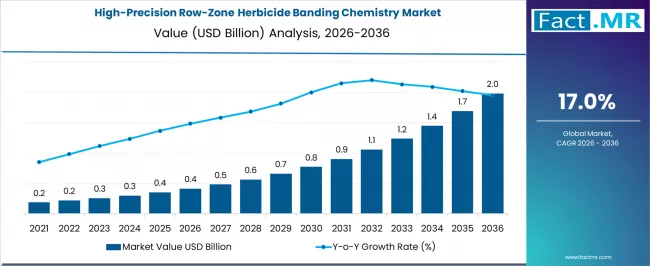
High Precision Row Zone Herbicide Banding Chemistry Market Market Value Analysis

A dominant trend is the definitive shift from broadcast herbicide applications to chemically sophisticated bands placed with millimeter accuracy only over the crop row. This transition demands herbicides engineered not to spread beyond the intended few centimeters, maintaining lethal concentrations exactly where weed seeds germinate while leaving the inter-row area completely chemical-free.

Innovation accelerates around chemistry that bonds to soil or crop residue within the band, preventing washoff and providing extended residual control. This precision is increasingly managed by integrated systems where the chemical formulation's properties are digitally mapped to the machine's guidance and detection capabilities, creating a closed-loop system of application and efficacy.

Regulatory and economic frameworks are perhaps the most powerful catalysts for this market. Policies that incentivize cover cropping and integrated vegetation management in the inter-row area for soil health directly necessitate banded herbicide use. Herbicide taxation proposals based on total volume applied per hectare make banding, which can reduce chemical use by 50-80%, financially compelling.

Regulatory approvals for new herbicides are increasingly contingent on demonstration of reduced environmental loading, a criterion perfectly met by banded application protocols, thereby fast-tracking the development and labeling of chemistry designed for this specific use.

High-Precision Row-Zone Herbicide Banding Chemistry Market

Metric Value
Market Value (2026) USD 0.41 Billion
Market Forecast Value (2036) USD 1.98 Billion
Forecast CAGR (2026-2036) 17.0%

Category

Category Segments
Chemistry Design Type High-Adhesion Low-Spread Banding Formulations, Soil-Active Residual Band Chemistries, Volatility-Reduced Target-Zone Herbicides, Micro-Encapsulated Precision Band Actives, Others
Application System Compatibility Camera-Guided Row-Zone Sprayers, Planter-Mounted Band Applicators, Robotic & Autonomous Weeders, Strip-Till Integrated Banding, Others
Crop System Row Crops (Corn, Soybean, Cotton), Cereals & Grains, Oilseeds & Pulses, Vegetables & Specialty Crops, Others
Region North America, Latin America, Western Europe, Eastern Europe, East Asia, South Asia & Pacific, MEA

Segmental Analysis

By Chemistry Design, Which Formulation Property is Paramount for Band Integrity?
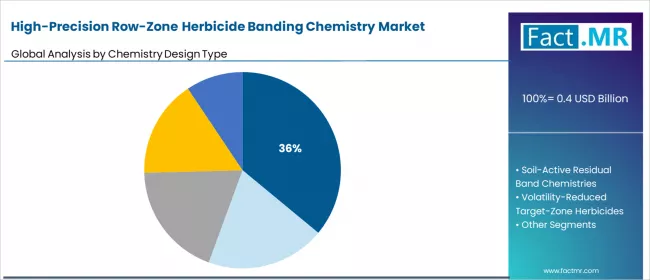
High Precision Row Zone Herbicide Banding Chemistry Market Analysis By Chemistry Design Type

High-adhesion low-spread banding formulations lead the segment with a 36% share. This primacy is non-negotiable; the entire agronomic and environmental premise of banding collapses if the herbicide migrates from the target zone.

These chemistries incorporate specialized polymers and adjuvants that cause droplets to rapidly immobilize upon contact with soil or residue, forming a concentrated, narrow band. This physical property prevents lateral movement into the inter-row, protecting cover crops and soil biology, while ensuring the band itself retains a high, effective concentration of active ingredient to control weeds throughout the critical early growth stage.

By Application System Compatibility, Which Technology Enables the Most Dynamic and Accurate Band Placement?
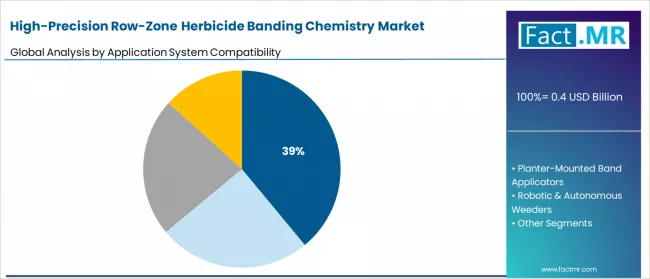
High Precision Row Zone Herbicide Banding Chemistry Market Analysis By Application System Compatibility

Camera-guided row-zone sprayers represent the largest compatibility share at 39%. This reflects the transition from passive, mechanical banding to intelligent, vision-based systems. These sprayers use real-time machine vision to identify the crop row and adjust boom section or nozzle control instantaneously to apply herbicide only to that shifting target zone, even as the tractor drifts.

The chemistry used must be compatible with the rapid on/off pulsing of these systems and effective at the very low volumes they apply, creating a synergistic demand for both advanced hardware and tailored chemistry.

By Crop System, Where is the Economic and Agronomic Logic of Banding Most Compelling?
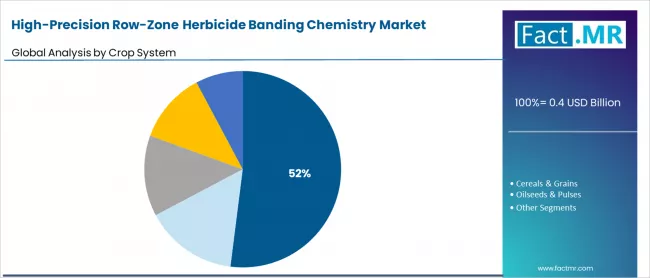
High Precision Row Zone Herbicide Banding Chemistry Market Analysis By Crop System

Row crops command a decisive 52% share. The clear spatial separation between crop rows and inter-rows in corn, soybean, and cotton systems makes banding a logical and highly efficient practice. The cost savings from reducing herbicide use by more than half across millions of hectares is enormous.

Preserving clean inter-rows allows for mechanical cultivation or the establishment of cover crops for soil health and carbon sequestration, integrating weed control into a broader regenerative system. This powerful combination of direct input savings and enhanced system sustainability drives massive adoption in this sector.

What are the Drivers, Restraints, and Key Trends of the High-Precision Row-Zone Herbicide Banding Chemistry Market?

Market expansion is fueled by an urgent convergence of economic, environmental, and regulatory forces. Soaring herbicide costs and proliferating resistance make reducing volume while maintaining efficacy a financial imperative. Simultaneously, soil health movements and carbon farming programs valorize the chemical-free inter-row for cover cropping. Regulatory pressure to shrink agriculture's environmental footprint targets non-target pesticide application, making banding a compliant solution. The maturation of reliable machine vision and robotics finally provides the physical means to execute banding with accuracy at commercial scale, unlocking the latent potential of the chemistry.

A primary restraint is the significant capital investment required for the precision application equipment, which can deter adoption despite long-term chemical savings. The agronomic knowledge required to manage a field with both a cash crop band and an inter-row cover crop is more complex than uniform broadcast systems. Not all herbicide chemistries are suitable for banding, potentially limiting the toolset for managing certain resistant weeds. Demonstrating consistent weed control within the band, especially under heavy residue, requires impeccable chemical placement and soil activity.

Trends include the co-development of herbicide and cover crop seed systems as a bundled offering. Formulation science is focusing on ultra-concentrated products that minimize the volume carried on the sprayer, extending operational range. The integration of banding maps with harvest yield data is allowing for variable-width banding based on historical weed pressure. There is also a growing research focus on band-compatible pre-emergent herbicides that work effectively through crop residue, a common challenge in conservation tillage systems.

Analysis of the High-Precision Row-Zone Herbicide Banding Chemistry Market by Key Countries
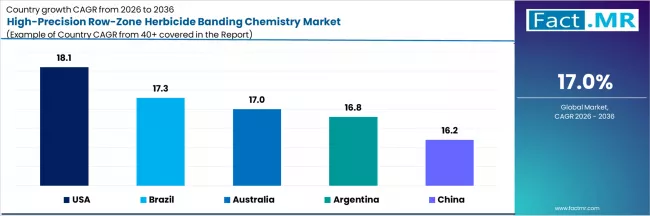
High Precision Row Zone Herbicide Banding Chemistry Market Cagr Analysis By Country

Country CAGR (2026-2036)
USA 18.10%
Brazil 17.30%
Australia 17.00%
Argentina 16.80%
China 16.20%

How does the USA's Convergence of Technology, Regulation, and Farm Economics Drive Leadership?
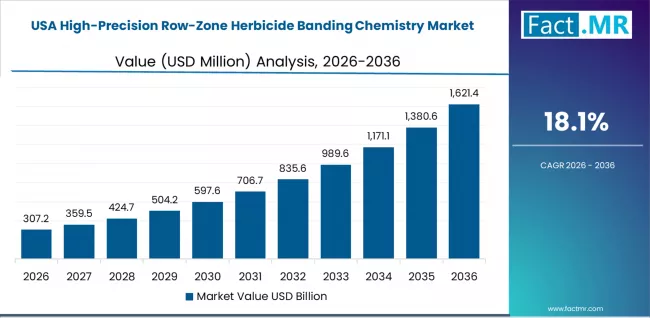
High Precision Row Zone Herbicide Banding Chemistry Market Country Value Analysis

The USA exhibits the highest CAGR at 18.10%, a position earned through a perfect alignment of enabling factors. American agriculture faces stringent regulatory scrutiny on water quality and non-target impacts, making banding a strategic compliance tool. The strong economic incentive to reduce input costs in large-scale row crop operations is immediate.

The USA is a global hub for the development of both the precision spraying technology and the advanced chemical formulations, with robust R&D ecosystems and venture capital flowing into agri-tech. The adoption is further accelerated by carbon market programs that pay farmers for maintaining cover crops, a practice made vastly more reliable by switching from broadcast to banded herbicide applications.

Why is Brazil's Battle for Profitability and Sustainability a Key Growth Engine?

Brazil's 17.30% growth is driven by an intense focus on operational efficiency and sustainable intensification within its massive soybean and cotton production. Herbicide costs represent a major expense, and banding offers direct and substantial savings. Brazilian farmers are also early adopters of intercropping and cover cropping techniques to improve soil health in the tropical environment.

Banded herbicides are the enabling technology that makes these complex, multi-species systems manageable. The scale of Brazilian agriculture means that even modest per-hectare savings translate into enormous national economic benefits, driving rapid, large-scale adoption of both the equipment and the specialized chemistry.

What Factors Underpin Australia's Leadership in Dryland Precision Farming?

Australia's 17.00% CAGR is rooted in its dryland farming systems where input efficiency is synonymous with risk management and profitability. Australian growers have long used strategic chemical placement to conserve moisture and manage weeds. Banding technology represents the next logical step in this evolution, allowing for extreme precision in herbicide placement.

The practice helps preserve ground cover in the inter-row, which is critical for preventing erosion and conserving soil moisture in Australia's variable climate. The high level of technological adoption and innovation in Australian broadacre farming creates a receptive and sophisticated market for advanced banding chemistries.

How does Argentina's No-Till Legacy and Export Pressure Shape Adoption?

Argentina's 16.80% growth builds upon its deep expertise and widespread adoption of no-till farming. The challenge in long-term no-till systems is managing weeds without disturbing the protective soil residue. Banded herbicides offer an elegant solution, controlling weeds in the row while leaving the inter-row residue intact. Additionally, as a major exporter of soybeans and cereals,

Argentine producers are under pressure to meet evolving sustainability standards in international markets. Adopting precision banding, which drastically reduces per-hectare chemical load, becomes a key strategy for maintaining market access and social license to operate, driving investment in the necessary chemistry and equipment.

What drives China's Push for Precision in a Labor-Constrained Landscape?

China's 16.20% growth is propelled by national strategies to increase agricultural productivity while reducing environmental impact. The government actively promotes precision agriculture technologies to cope with rising labor costs and limited arable land. Banded herbicide application aligns with goals to cut pesticide use per unit area.

This is especially relevant in China's expanding large-scale farm cooperatives, which have the capital and scale to invest in precision sprayers. Domestic development of camera-guidance systems and tailored formulations for crops like corn and vegetables supports widespread implementation, aiming to boost yields and meet stringent domestic food safety standards.

Competitive Landscape of the High-Precision Row-Zone Herbicide Banding Chemistry Market
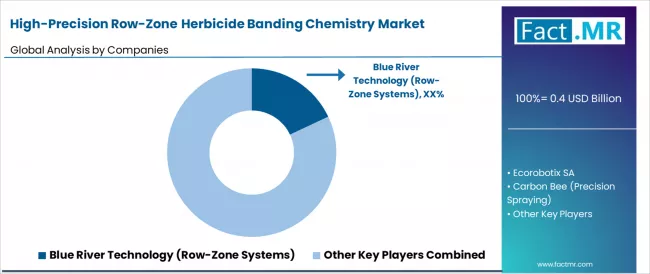
High Precision Row Zone Herbicide Banding Chemistry Market Analysis By Company

The competitive landscape is uniquely structured around deep collaboration and competition between precision equipment pioneers and agile formulation specialists. Technology-first companies like Blue River Technology, Ecorobotix, and Greeneye Technology lead the market. These firms often compete by developing integrated, proprietary systems where the hardware, computer vision software, and in some cases, a recommended chemistry portfolio are offered as a holistic solution. Their competitive edge lies in superior detection algorithms, rugged field hardware, and the seamless integration of spray commands with chemical performance parameters.

Specialized formulation companies and the internal divisions of larger agrochemical firms compete by developing the advanced chemistries that make these precision systems agronomically effective. They focus on creating products with the precise physical and chemical properties such as controlled spread, soil binding, and volatility reduction that unlock the full potential of banding. Success in this segment hinges on close technical partnerships with equipment manufacturers to ensure compatibility, conducting rigorous field trials that demonstrate weed control efficacy within the narrow band, and providing clear stewardship guidelines to farmers. Companies like Carbon Bee and Bilberry SAS operate in this space, often focusing on specific regional crops or weed challenges.

Key Players in the High-Precision Row-Zone Herbicide Banding Chemistry Market

  • Blue River Technology (Row-Zone Systems)
  • Ecorobotix SA
  • Carbon Bee (Precision Spraying)
  • Greeneye Technology
  • Bilberry SAS

Scope of Report

Items Values
Quantitative Units USD Billion
Chemistry Design Type High-Adhesion Low-Spread Banding Formulations, Soil-Active Residual Band Chemistries, Volatility-Reduced Target-Zone Herbicides, Micro-Encapsulated Precision Band Actives, Others
Application System Compatibility Camera-Guided Row-Zone Sprayers, Planter-Mounted Band Applicators, Robotic & Autonomous Weeders, Strip-Till Integrated Banding, Others
Crop System Row Crops (Corn, Soybean, Cotton), Cereals & Grains, Oilseeds & Pulses, Vegetables & Specialty Crops, Others
Key Countries USA, Brazil, Australia, Argentina, China
Key Companies Blue River Technology (Row-Zone Systems), Ecorobotix SA, Carbon Bee (Precision Spraying), Greeneye Technology, Bilberry SAS
Additional Analysis In-depth analysis of droplet physics for band formation, soil-residue interactions of banded actives, economic models comparing banding vs. broadcast programs across farm scales, regulatory pathways for label claims specific to banded application, and compatibility testing protocols with cover crop species.

High-Precision Row-Zone Herbicide Banding Chemistry Market by Segments

  • Chemistry Design Type :

    • High-Adhesion Low-Spread Banding Formulations
    • Soil-Active Residual Band Chemistries
    • Volatility-Reduced Target-Zone Herbicides
    • Micro-Encapsulated Precision Band Actives
    • Others
  • Application System Compatibility :

    • Camera-Guided Row-Zone Sprayers
    • Planter-Mounted Band Applicators
    • Robotic & Autonomous Weeders
    • Strip-Till Integrated Banding
    • Others
  • Crop System :

    • Row Crops (Corn, Soybean, Cotton)
    • Cereals & Grains
    • Oilseeds & Pulses
    • Vegetables & Specialty Crops
    • Others
  • Region :

    • North America

      • USA
      • Canada
    • Latin America

      • Brazil
      • Mexico
      • Argentina
      • Rest of Latin America
    • Western Europe

      • Germany
      • UK
      • France
      • Spain
      • Italy
      • BENELUX
      • Rest of Western Europe
    • Eastern Europe

      • Czech Republic
      • Poland
      • Russia
      • Rest of Eastern Europe
    • East Asia

      • China
      • Japan
      • South Korea
      • Rest of East Asia
    • South Asia & Pacific

      • India
      • Indonesia
      • Australia
      • Rest of South Asia & Pacific
    • MEA

      • GCC Countries
      • Turkiye
      • Saudi Arabia
      • Rest of MEA

Table of Content

  1. Executive Summary
    • Global Market Outlook
    • Demand to side Trends
    • Supply to side Trends
    • Technology Roadmap Analysis
    • Analysis and Recommendations
  2. Market Overview
    • Market Coverage / Taxonomy
    • Market Definition / Scope / Limitations
  3. Market Background
    • Market Dynamics
      • Drivers
      • Restraints
      • Opportunity
      • Trends
    • Scenario Forecast
      • Demand in Optimistic Scenario
      • Demand in Likely Scenario
      • Demand in Conservative Scenario
    • Opportunity Map Analysis
    • Product Life Cycle Analysis
    • Supply Chain Analysis
    • Investment Feasibility Matrix
    • Value Chain Analysis
    • PESTLE and Porter’s Analysis
    • Regulatory Landscape
    • Regional Parent Market Outlook
    • Production and Consumption Statistics
    • Import and Export Statistics
  4. Global Market Analysis 2021 to 2025 and Forecast, 2026 to 2036
    • Historical Market Size Value (USD Million) Analysis, 2021 to 2025
    • Current and Future Market Size Value (USD Million) Projections, 2026 to 2036
      • Y to o to Y Growth Trend Analysis
      • Absolute $ Opportunity Analysis
  5. Global Market Pricing Analysis 2021 to 2025 and Forecast 2026 to 2036
  6. Global Market Analysis 2021 to 2025 and Forecast 2026 to 2036, By Chemistry Design Type
    • Introduction / Key Findings
    • Historical Market Size Value (USD Million) Analysis By Chemistry Design Type, 2021 to 2025
    • Current and Future Market Size Value (USD Million) Analysis and Forecast By Chemistry Design Type, 2026 to 2036
      • High-Adhesion Low-Spread Banding Formulations
      • Soil-Active Residual Band Chemistries
      • Volatility-Reduced Target-Zone Herbicides
      • Micro-Encapsulated Precision Band Actives
      • Others
    • Y to o to Y Growth Trend Analysis By Chemistry Design Type, 2021 to 2025
    • Absolute $ Opportunity Analysis By Chemistry Design Type, 2026 to 2036
  7. Global Market Analysis 2021 to 2025 and Forecast 2026 to 2036, By Application System Compatibility
    • Introduction / Key Findings
    • Historical Market Size Value (USD Million) Analysis By Application System Compatibility, 2021 to 2025
    • Current and Future Market Size Value (USD Million) Analysis and Forecast By Application System Compatibility, 2026 to 2036
      • Camera-Guided Row-Zone Sprayers
      • Planter-Mounted Band Applicators
      • Robotic & Autonomous Weeders
      • Strip-Till Integrated Banding
    • Y to o to Y Growth Trend Analysis By Application System Compatibility, 2021 to 2025
    • Absolute $ Opportunity Analysis By Application System Compatibility, 2026 to 2036
  8. Global Market Analysis 2021 to 2025 and Forecast 2026 to 2036, By Crop System
    • Introduction / Key Findings
    • Historical Market Size Value (USD Million) Analysis By Crop System, 2021 to 2025
    • Current and Future Market Size Value (USD Million) Analysis and Forecast By Crop System, 2026 to 2036
      • Row Crops (Corn, Soybean, Cotton)
      • Cereals & Grains
      • Oilseeds & Pulses
      • Vegetables & Specialty Crops
      • Others
    • Y to o to Y Growth Trend Analysis By Crop System, 2021 to 2025
    • Absolute $ Opportunity Analysis By Crop System, 2026 to 2036
  9. Global Market Analysis 2021 to 2025 and Forecast 2026 to 2036, By Region
    • Introduction
    • Historical Market Size Value (USD Million) Analysis By Region, 2021 to 2025
    • Current Market Size Value (USD Million) Analysis and Forecast By Region, 2026 to 2036
      • North America
      • Latin America
      • Western Europe
      • Eastern Europe
      • East Asia
      • South Asia and Pacific
      • Middle East & Africa
    • Market Attractiveness Analysis By Region
  10. North America Market Analysis 2021 to 2025 and Forecast 2026 to 2036, By Country
    • Historical Market Size Value (USD Million) Trend Analysis By Market Taxonomy, 2021 to 2025
    • Market Size Value (USD Million) Forecast By Market Taxonomy, 2026 to 2036
      • By Country
        • USA
        • Canada
        • Mexico
      • By Chemistry Design Type
      • By Application System Compatibility
      • By Crop System
    • Market Attractiveness Analysis
      • By Country
      • By Chemistry Design Type
      • By Application System Compatibility
      • By Crop System
    • Key Takeaways
  11. Latin America Market Analysis 2021 to 2025 and Forecast 2026 to 2036, By Country
    • Historical Market Size Value (USD Million) Trend Analysis By Market Taxonomy, 2021 to 2025
    • Market Size Value (USD Million) Forecast By Market Taxonomy, 2026 to 2036
      • By Country
        • Brazil
        • Chile
        • Rest of Latin America
      • By Chemistry Design Type
      • By Application System Compatibility
      • By Crop System
    • Market Attractiveness Analysis
      • By Country
      • By Chemistry Design Type
      • By Application System Compatibility
      • By Crop System
    • Key Takeaways
  12. Western Europe Market Analysis 2021 to 2025 and Forecast 2026 to 2036, By Country
    • Historical Market Size Value (USD Million) Trend Analysis By Market Taxonomy, 2021 to 2025
    • Market Size Value (USD Million) Forecast By Market Taxonomy, 2026 to 2036
      • By Country
        • Germany
        • UK
        • Italy
        • Spain
        • France
        • Nordic
        • BENELUX
        • Rest of Western Europe
      • By Chemistry Design Type
      • By Application System Compatibility
      • By Crop System
    • Market Attractiveness Analysis
      • By Country
      • By Chemistry Design Type
      • By Application System Compatibility
      • By Crop System
    • Key Takeaways
  13. Eastern Europe Market Analysis 2021 to 2025 and Forecast 2026 to 2036, By Country
    • Historical Market Size Value (USD Million) Trend Analysis By Market Taxonomy, 2021 to 2025
    • Market Size Value (USD Million) Forecast By Market Taxonomy, 2026 to 2036
      • By Country
        • Russia
        • Poland
        • Hungary
        • Balkan & Baltic
        • Rest of Eastern Europe
      • By Chemistry Design Type
      • By Application System Compatibility
      • By Crop System
    • Market Attractiveness Analysis
      • By Country
      • By Chemistry Design Type
      • By Application System Compatibility
      • By Crop System
    • Key Takeaways
  14. East Asia Market Analysis 2021 to 2025 and Forecast 2026 to 2036, By Country
    • Historical Market Size Value (USD Million) Trend Analysis By Market Taxonomy, 2021 to 2025
    • Market Size Value (USD Million) Forecast By Market Taxonomy, 2026 to 2036
      • By Country
        • China
        • Japan
        • South Korea
      • By Chemistry Design Type
      • By Application System Compatibility
      • By Crop System
    • Market Attractiveness Analysis
      • By Country
      • By Chemistry Design Type
      • By Application System Compatibility
      • By Crop System
    • Key Takeaways
  15. South Asia and Pacific Market Analysis 2021 to 2025 and Forecast 2026 to 2036, By Country
    • Historical Market Size Value (USD Million) Trend Analysis By Market Taxonomy, 2021 to 2025
    • Market Size Value (USD Million) Forecast By Market Taxonomy, 2026 to 2036
      • By Country
        • India
        • ASEAN
        • Australia & New Zealand
        • Rest of South Asia and Pacific
      • By Chemistry Design Type
      • By Application System Compatibility
      • By Crop System
    • Market Attractiveness Analysis
      • By Country
      • By Chemistry Design Type
      • By Application System Compatibility
      • By Crop System
    • Key Takeaways
  16. Middle East & Africa Market Analysis 2021 to 2025 and Forecast 2026 to 2036, By Country
    • Historical Market Size Value (USD Million) Trend Analysis By Market Taxonomy, 2021 to 2025
    • Market Size Value (USD Million) Forecast By Market Taxonomy, 2026 to 2036
      • By Country
        • Kingdom of Saudi Arabia
        • Other GCC Countries
        • Turkiye
        • South Africa
        • Other African Union
        • Rest of Middle East & Africa
      • By Chemistry Design Type
      • By Application System Compatibility
      • By Crop System
    • Market Attractiveness Analysis
      • By Country
      • By Chemistry Design Type
      • By Application System Compatibility
      • By Crop System
    • Key Takeaways
  17. Key Countries Market Analysis
    • USA
      • Pricing Analysis
      • Market Share Analysis, 2025
        • By Chemistry Design Type
        • By Application System Compatibility
        • By Crop System
    • Canada
      • Pricing Analysis
      • Market Share Analysis, 2025
        • By Chemistry Design Type
        • By Application System Compatibility
        • By Crop System
    • Mexico
      • Pricing Analysis
      • Market Share Analysis, 2025
        • By Chemistry Design Type
        • By Application System Compatibility
        • By Crop System
    • Brazil
      • Pricing Analysis
      • Market Share Analysis, 2025
        • By Chemistry Design Type
        • By Application System Compatibility
        • By Crop System
    • Chile
      • Pricing Analysis
      • Market Share Analysis, 2025
        • By Chemistry Design Type
        • By Application System Compatibility
        • By Crop System
    • Germany
      • Pricing Analysis
      • Market Share Analysis, 2025
        • By Chemistry Design Type
        • By Application System Compatibility
        • By Crop System
    • UK
      • Pricing Analysis
      • Market Share Analysis, 2025
        • By Chemistry Design Type
        • By Application System Compatibility
        • By Crop System
    • Italy
      • Pricing Analysis
      • Market Share Analysis, 2025
        • By Chemistry Design Type
        • By Application System Compatibility
        • By Crop System
    • Spain
      • Pricing Analysis
      • Market Share Analysis, 2025
        • By Chemistry Design Type
        • By Application System Compatibility
        • By Crop System
    • France
      • Pricing Analysis
      • Market Share Analysis, 2025
        • By Chemistry Design Type
        • By Application System Compatibility
        • By Crop System
    • India
      • Pricing Analysis
      • Market Share Analysis, 2025
        • By Chemistry Design Type
        • By Application System Compatibility
        • By Crop System
    • ASEAN
      • Pricing Analysis
      • Market Share Analysis, 2025
        • By Chemistry Design Type
        • By Application System Compatibility
        • By Crop System
    • Australia & New Zealand
      • Pricing Analysis
      • Market Share Analysis, 2025
        • By Chemistry Design Type
        • By Application System Compatibility
        • By Crop System
    • China
      • Pricing Analysis
      • Market Share Analysis, 2025
        • By Chemistry Design Type
        • By Application System Compatibility
        • By Crop System
    • Japan
      • Pricing Analysis
      • Market Share Analysis, 2025
        • By Chemistry Design Type
        • By Application System Compatibility
        • By Crop System
    • South Korea
      • Pricing Analysis
      • Market Share Analysis, 2025
        • By Chemistry Design Type
        • By Application System Compatibility
        • By Crop System
    • Russia
      • Pricing Analysis
      • Market Share Analysis, 2025
        • By Chemistry Design Type
        • By Application System Compatibility
        • By Crop System
    • Poland
      • Pricing Analysis
      • Market Share Analysis, 2025
        • By Chemistry Design Type
        • By Application System Compatibility
        • By Crop System
    • Hungary
      • Pricing Analysis
      • Market Share Analysis, 2025
        • By Chemistry Design Type
        • By Application System Compatibility
        • By Crop System
    • Kingdom of Saudi Arabia
      • Pricing Analysis
      • Market Share Analysis, 2025
        • By Chemistry Design Type
        • By Application System Compatibility
        • By Crop System
    • Turkiye
      • Pricing Analysis
      • Market Share Analysis, 2025
        • By Chemistry Design Type
        • By Application System Compatibility
        • By Crop System
    • South Africa
      • Pricing Analysis
      • Market Share Analysis, 2025
        • By Chemistry Design Type
        • By Application System Compatibility
        • By Crop System
  18. Market Structure Analysis
    • Competition Dashboard
    • Competition Benchmarking
    • Market Share Analysis of Top Players
      • By Regional
      • By Chemistry Design Type
      • By Application System Compatibility
      • By Crop System
  19. Competition Analysis
    • Competition Deep Dive
      • Blue River Technology (Row-Zone Systems)
        • Overview
        • Product Portfolio
        • Profitability by Market Segments (Product/Age /Sales Channel/Region)
        • Sales Footprint
        • Strategy Overview
          • Marketing Strategy
          • Product Strategy
          • Channel Strategy
      • Ecorobotix SA
      • Carbon Bee (Precision Spraying)
      • Greeneye Technology
      • Bilberry SAS
      • Others
  20. Assumptions & Acronyms Used
  21. Research Methodology

List Of Table

  • Table 1: Global Market Value (USD Million) Forecast by Region, 2021 to 2036
  • Table 2: Global Market Value (USD Million) Forecast by Chemistry Design Type, 2021 to 2036
  • Table 3: Global Market Value (USD Million) Forecast by Application System Compatibility, 2021 to 2036
  • Table 4: Global Market Value (USD Million) Forecast by Crop System, 2021 to 2036
  • Table 5: North America Market Value (USD Million) Forecast by Country, 2021 to 2036
  • Table 6: North America Market Value (USD Million) Forecast by Chemistry Design Type, 2021 to 2036
  • Table 7: North America Market Value (USD Million) Forecast by Application System Compatibility, 2021 to 2036
  • Table 8: North America Market Value (USD Million) Forecast by Crop System, 2021 to 2036
  • Table 9: Latin America Market Value (USD Million) Forecast by Country, 2021 to 2036
  • Table 10: Latin America Market Value (USD Million) Forecast by Chemistry Design Type, 2021 to 2036
  • Table 11: Latin America Market Value (USD Million) Forecast by Application System Compatibility, 2021 to 2036
  • Table 12: Latin America Market Value (USD Million) Forecast by Crop System, 2021 to 2036
  • Table 13: Western Europe Market Value (USD Million) Forecast by Country, 2021 to 2036
  • Table 14: Western Europe Market Value (USD Million) Forecast by Chemistry Design Type, 2021 to 2036
  • Table 15: Western Europe Market Value (USD Million) Forecast by Application System Compatibility, 2021 to 2036
  • Table 16: Western Europe Market Value (USD Million) Forecast by Crop System, 2021 to 2036
  • Table 17: Eastern Europe Market Value (USD Million) Forecast by Country, 2021 to 2036
  • Table 18: Eastern Europe Market Value (USD Million) Forecast by Chemistry Design Type, 2021 to 2036
  • Table 19: Eastern Europe Market Value (USD Million) Forecast by Application System Compatibility, 2021 to 2036
  • Table 20: Eastern Europe Market Value (USD Million) Forecast by Crop System, 2021 to 2036
  • Table 21: East Asia Market Value (USD Million) Forecast by Country, 2021 to 2036
  • Table 22: East Asia Market Value (USD Million) Forecast by Chemistry Design Type, 2021 to 2036
  • Table 23: East Asia Market Value (USD Million) Forecast by Application System Compatibility, 2021 to 2036
  • Table 24: East Asia Market Value (USD Million) Forecast by Crop System, 2021 to 2036
  • Table 25: South Asia and Pacific Market Value (USD Million) Forecast by Country, 2021 to 2036
  • Table 26: South Asia and Pacific Market Value (USD Million) Forecast by Chemistry Design Type, 2021 to 2036
  • Table 27: South Asia and Pacific Market Value (USD Million) Forecast by Application System Compatibility, 2021 to 2036
  • Table 28: South Asia and Pacific Market Value (USD Million) Forecast by Crop System, 2021 to 2036
  • Table 29: Middle East & Africa Market Value (USD Million) Forecast by Country, 2021 to 2036
  • Table 30: Middle East & Africa Market Value (USD Million) Forecast by Chemistry Design Type, 2021 to 2036
  • Table 31: Middle East & Africa Market Value (USD Million) Forecast by Application System Compatibility, 2021 to 2036
  • Table 32: Middle East & Africa Market Value (USD Million) Forecast by Crop System, 2021 to 2036

List Of Figures

  • Figure 1: Global Market Pricing Analysis
  • Figure 2: Global Market Value (USD Million) Forecast 2021 to 2036
  • Figure 3: Global Market Value Share and BPS Analysis by Chemistry Design Type, 2026 and 2036
  • Figure 4: Global Market Y to o to Y Growth Comparison by Chemistry Design Type, 2026 to 2036
  • Figure 5: Global Market Attractiveness Analysis by Chemistry Design Type
  • Figure 6: Global Market Value Share and BPS Analysis by Application System Compatibility, 2026 and 2036
  • Figure 7: Global Market Y to o to Y Growth Comparison by Application System Compatibility, 2026 to 2036
  • Figure 8: Global Market Attractiveness Analysis by Application System Compatibility
  • Figure 9: Global Market Value Share and BPS Analysis by Crop System, 2026 and 2036
  • Figure 10: Global Market Y to o to Y Growth Comparison by Crop System, 2026 to 2036
  • Figure 11: Global Market Attractiveness Analysis by Crop System
  • Figure 12: Global Market Value (USD Million) Share and BPS Analysis by Region, 2026 and 2036
  • Figure 13: Global Market Y to o to Y Growth Comparison by Region, 2026 to 2036
  • Figure 14: Global Market Attractiveness Analysis by Region
  • Figure 15: North America Market Incremental Dollar Opportunity, 2026 to 2036
  • Figure 16: Latin America Market Incremental Dollar Opportunity, 2026 to 2036
  • Figure 17: Western Europe Market Incremental Dollar Opportunity, 2026 to 2036
  • Figure 18: Eastern Europe Market Incremental Dollar Opportunity, 2026 to 2036
  • Figure 19: East Asia Market Incremental Dollar Opportunity, 2026 to 2036
  • Figure 20: South Asia and Pacific Market Incremental Dollar Opportunity, 2026 to 2036
  • Figure 21: Middle East & Africa Market Incremental Dollar Opportunity, 2026 to 2036
  • Figure 22: North America Market Value Share and BPS Analysis by Country, 2026 and 2036
  • Figure 23: North America Market Value Share and BPS Analysis by Chemistry Design Type, 2026 and 2036
  • Figure 24: North America Market Y to o to Y Growth Comparison by Chemistry Design Type, 2026 to 2036
  • Figure 25: North America Market Attractiveness Analysis by Chemistry Design Type
  • Figure 26: North America Market Value Share and BPS Analysis by Application System Compatibility, 2026 and 2036
  • Figure 27: North America Market Y to o to Y Growth Comparison by Application System Compatibility, 2026 to 2036
  • Figure 28: North America Market Attractiveness Analysis by Application System Compatibility
  • Figure 29: North America Market Value Share and BPS Analysis by Crop System, 2026 and 2036
  • Figure 30: North America Market Y to o to Y Growth Comparison by Crop System, 2026 to 2036
  • Figure 31: North America Market Attractiveness Analysis by Crop System
  • Figure 32: Latin America Market Value Share and BPS Analysis by Country, 2026 and 2036
  • Figure 33: Latin America Market Value Share and BPS Analysis by Chemistry Design Type, 2026 and 2036
  • Figure 34: Latin America Market Y to o to Y Growth Comparison by Chemistry Design Type, 2026 to 2036
  • Figure 35: Latin America Market Attractiveness Analysis by Chemistry Design Type
  • Figure 36: Latin America Market Value Share and BPS Analysis by Application System Compatibility, 2026 and 2036
  • Figure 37: Latin America Market Y to o to Y Growth Comparison by Application System Compatibility, 2026 to 2036
  • Figure 38: Latin America Market Attractiveness Analysis by Application System Compatibility
  • Figure 39: Latin America Market Value Share and BPS Analysis by Crop System, 2026 and 2036
  • Figure 40: Latin America Market Y to o to Y Growth Comparison by Crop System, 2026 to 2036
  • Figure 41: Latin America Market Attractiveness Analysis by Crop System
  • Figure 42: Western Europe Market Value Share and BPS Analysis by Country, 2026 and 2036
  • Figure 43: Western Europe Market Value Share and BPS Analysis by Chemistry Design Type, 2026 and 2036
  • Figure 44: Western Europe Market Y to o to Y Growth Comparison by Chemistry Design Type, 2026 to 2036
  • Figure 45: Western Europe Market Attractiveness Analysis by Chemistry Design Type
  • Figure 46: Western Europe Market Value Share and BPS Analysis by Application System Compatibility, 2026 and 2036
  • Figure 47: Western Europe Market Y to o to Y Growth Comparison by Application System Compatibility, 2026 to 2036
  • Figure 48: Western Europe Market Attractiveness Analysis by Application System Compatibility
  • Figure 49: Western Europe Market Value Share and BPS Analysis by Crop System, 2026 and 2036
  • Figure 50: Western Europe Market Y to o to Y Growth Comparison by Crop System, 2026 to 2036
  • Figure 51: Western Europe Market Attractiveness Analysis by Crop System
  • Figure 52: Eastern Europe Market Value Share and BPS Analysis by Country, 2026 and 2036
  • Figure 53: Eastern Europe Market Value Share and BPS Analysis by Chemistry Design Type, 2026 and 2036
  • Figure 54: Eastern Europe Market Y to o to Y Growth Comparison by Chemistry Design Type, 2026 to 2036
  • Figure 55: Eastern Europe Market Attractiveness Analysis by Chemistry Design Type
  • Figure 56: Eastern Europe Market Value Share and BPS Analysis by Application System Compatibility, 2026 and 2036
  • Figure 57: Eastern Europe Market Y to o to Y Growth Comparison by Application System Compatibility, 2026 to 2036
  • Figure 58: Eastern Europe Market Attractiveness Analysis by Application System Compatibility
  • Figure 59: Eastern Europe Market Value Share and BPS Analysis by Crop System, 2026 and 2036
  • Figure 60: Eastern Europe Market Y to o to Y Growth Comparison by Crop System, 2026 to 2036
  • Figure 61: Eastern Europe Market Attractiveness Analysis by Crop System
  • Figure 62: East Asia Market Value Share and BPS Analysis by Country, 2026 and 2036
  • Figure 63: East Asia Market Value Share and BPS Analysis by Chemistry Design Type, 2026 and 2036
  • Figure 64: East Asia Market Y to o to Y Growth Comparison by Chemistry Design Type, 2026 to 2036
  • Figure 65: East Asia Market Attractiveness Analysis by Chemistry Design Type
  • Figure 66: East Asia Market Value Share and BPS Analysis by Application System Compatibility, 2026 and 2036
  • Figure 67: East Asia Market Y to o to Y Growth Comparison by Application System Compatibility, 2026 to 2036
  • Figure 68: East Asia Market Attractiveness Analysis by Application System Compatibility
  • Figure 69: East Asia Market Value Share and BPS Analysis by Crop System, 2026 and 2036
  • Figure 70: East Asia Market Y to o to Y Growth Comparison by Crop System, 2026 to 2036
  • Figure 71: East Asia Market Attractiveness Analysis by Crop System
  • Figure 72: South Asia and Pacific Market Value Share and BPS Analysis by Country, 2026 and 2036
  • Figure 73: South Asia and Pacific Market Value Share and BPS Analysis by Chemistry Design Type, 2026 and 2036
  • Figure 74: South Asia and Pacific Market Y to o to Y Growth Comparison by Chemistry Design Type, 2026 to 2036
  • Figure 75: South Asia and Pacific Market Attractiveness Analysis by Chemistry Design Type
  • Figure 76: South Asia and Pacific Market Value Share and BPS Analysis by Application System Compatibility, 2026 and 2036
  • Figure 77: South Asia and Pacific Market Y to o to Y Growth Comparison by Application System Compatibility, 2026 to 2036
  • Figure 78: South Asia and Pacific Market Attractiveness Analysis by Application System Compatibility
  • Figure 79: South Asia and Pacific Market Value Share and BPS Analysis by Crop System, 2026 and 2036
  • Figure 80: South Asia and Pacific Market Y to o to Y Growth Comparison by Crop System, 2026 to 2036
  • Figure 81: South Asia and Pacific Market Attractiveness Analysis by Crop System
  • Figure 82: Middle East & Africa Market Value Share and BPS Analysis by Country, 2026 and 2036
  • Figure 83: Middle East & Africa Market Value Share and BPS Analysis by Chemistry Design Type, 2026 and 2036
  • Figure 84: Middle East & Africa Market Y to o to Y Growth Comparison by Chemistry Design Type, 2026 to 2036
  • Figure 85: Middle East & Africa Market Attractiveness Analysis by Chemistry Design Type
  • Figure 86: Middle East & Africa Market Value Share and BPS Analysis by Application System Compatibility, 2026 and 2036
  • Figure 87: Middle East & Africa Market Y to o to Y Growth Comparison by Application System Compatibility, 2026 to 2036
  • Figure 88: Middle East & Africa Market Attractiveness Analysis by Application System Compatibility
  • Figure 89: Middle East & Africa Market Value Share and BPS Analysis by Crop System, 2026 and 2036
  • Figure 90: Middle East & Africa Market Y to o to Y Growth Comparison by Crop System, 2026 to 2036
  • Figure 91: Middle East & Africa Market Attractiveness Analysis by Crop System
  • Figure 92: Global Market - Tier Structure Analysis
  • Figure 93: Global Market - Company Share Analysis

- FAQs -

How big is the high-precision row-zone herbicide banding chemistry market in 2026?

The global high-precision row-zone herbicide banding chemistry market is estimated to be valued at USD 0.4 billion in 2026.

What will be the size of high-precision row-zone herbicide banding chemistry market in 2036?

The market size for the high-precision row-zone herbicide banding chemistry market is projected to reach USD 2.0 billion by 2036.

How much will be the high-precision row-zone herbicide banding chemistry market growth between 2026 and 2036?

The high-precision row-zone herbicide banding chemistry market is expected to grow at a 17.0% CAGR between 2026 and 2036.

What are the key product types in the high-precision row-zone herbicide banding chemistry market?

The key product types in high-precision row-zone herbicide banding chemistry market are high-adhesion low-spread banding formulations, soil-active residual band chemistries, volatility-reduced target-zone herbicides, micro-encapsulated precision band actives and others.

Which application system compatibility segment to contribute significant share in the high-precision row-zone herbicide banding chemistry market in 2026?

In terms of application system compatibility, camera-guided row-zone sprayers segment to command 39.0% share in the high-precision row-zone herbicide banding chemistry market in 2026.

High-Precision Row-Zone Herbicide Banding Chemistry Market