- Base Value(2025): 1.4 Bn
- Estimated Value(2026): 1.6 Bn
- Forecast Value (2036): 4.5 Bn
- CAGR (2026 - 2036): 11.3%
High Purity Pig Iron Market Analysis and Forecast by Fact.MR
- The global high purity pig iron market is estimated at USD 1.56 billion in 2026 and is forecast to expand at a CAGR of 11.3% to reach USD 4.55 billion by 2036.
- High purity pig iron (HPPI) encompasses foundry grade, ductile grade, and steelmaking grade pig iron with controlled low levels of phosphorus, sulfur, and residual elements, produced through blast furnace, electric arc furnace, and direct reduction processes.
- The market is driven by expanding ductile iron demand for automotive and wind energy castings, growing EV component requirements for high-purity metallurgical feedstock, green steel production adoption requiring ultra-clean inputs, and tightening quality specifications in precision casting applications where residual element control directly determines component fatigue life and mechanical reliability.
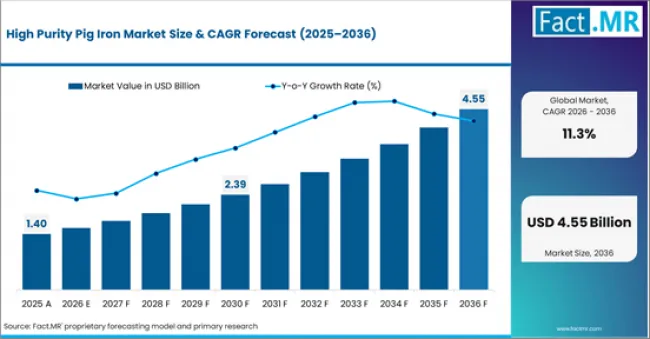
High Purity Pig Iron Market Value Analysis | Source: Fact.MR
Summary of High Purity Pig Iron Market
- Market Snapshot
- In 2025, the global High Purity Pig Iron Market was valued at approximately USD 1.40 billion.
- The market is estimated to reach USD 1.56 billion in 2026 and is projected to attain USD 4.55 billion by 2036.
- The high purity pig iron market is likely to expand at a CAGR of 11.3% during the forecast period.
- The market is anticipated to create an absolute dollar opportunity of USD 2.99 billion between 2026 and 2036.
- High purity accounts for 45% of purity level share in 2026.
- China (12.4%) and India (11.7%) are the key growth markets during the forecast period.
- Demand and Growth Drivers
- Ductile iron casting expansion for automotive, wind energy, and infrastructure applications drives demand for low-phosphorus, low-sulfur pig iron feedstock with controlled residual elements.
- Electric vehicle manufacturing growth creates demand for high-purity metallurgical inputs for precision cast components, battery housings, and structural parts requiring superior fatigue performance.
- Green steel production adoption using electric arc furnace routes requires ultra-clean pig iron as a virgin iron supplement to dilute residual elements from scrap-based steelmaking.
- Wind turbine component casting, including hub assemblies, bearing housings, and structural frames, requires high-purity ductile iron with documented metallurgical consistency.
- Tightening quality specifications in automotive Tier 1 casting operations drive specification of premium HPPI from verified sources with traceable chemical composition.
- Product and Segment View
- Foundry grade pig iron accounts for 40% of the product type segment in 2026, driven by gray iron and ductile iron casting demand across automotive, machinery, and infrastructure applications.
- Blast furnace process accounts for 60% of the production process segment in 2026, with traditional and mini blast furnace operations producing the majority of global HPPI output.
- High purity grade (controlled composition with low impurities) holds 45% of the purity level segment, serving the broadest range of foundry and steelmaking quality requirements.
- Key segmentation includes:
- Product Type: Foundry grade (basic, low phosphorus), Ductile grade (nodular, low sulfur), Steelmaking grade
- Production Process: Blast furnace, Electric arc furnace, Direct reduction
- Purity Level: High purity (controlled composition), Ultra high purity (below 0.02% P, 0.01% S), Standard purity
- Application: Casting (gray iron, ductile iron), Steel production, Automotive components
- End Use Industry: Foundry, Steel, Automotive, Infrastructure
- Form Type: Pig form (standard, custom), Granular, Molten
- These systems enable:
- Ductile iron production with controlled nodularity, tensile strength, and elongation for safety-critical automotive and infrastructure castings
- Residual element dilution in electric arc furnace steelmaking, improving steel purity when scrap inputs contain excessive copper, tin, or nickel
- Metallurgical consistency enabling foundries to produce castings with documented, repeatable mechanical properties for automotive qualification
- Geography and Competitive Outlook
- Asia Pacific leads growth through China and India, driven by expanding foundry capacity, automotive manufacturing, and infrastructure casting demand.
- North America sustains demand through the USA, supported by ductile iron pipe, automotive casting, and green steel feedstock requirements.
- Europe maintains growth through Germany, driven by automotive casting specification, wind energy component demand, and steel purity requirements.
- China (12.4%) and India (11.7%) lead growth, while the USA (10.9%), Germany (10.1%), Japan (9.6%), South Korea (8.8%), and Brazil (7.9%) sustain demand.
- QIT-Fer et Titane (Rio Tinto) dominates with approximately 32% market share through its Sorelmetal brand, the global benchmark for HPPI quality.
- Analyst Opinion
- Shambhu Nath Jha, Principal Consultant at Fact.MR, says 'The high purity pig iron market is entering a structural growth acceleration driven by the convergence of ductile iron demand, EV casting requirements, and green steel feedstock needs. QIT-Fer et Titane's 32% market share through its Sorelmetal brand reflects the value of vertically integrated production, ultra-tight impurity control, and established foundry customer relationships spanning decades. Rio Tinto's investment of 143 million dollars in a BioIron facility in Western Australia to develop low-carbon iron production using microwave energy and biomass signals the industry's direction toward decarbonized HPPI production. The competitive landscape is highly concentrated, with the top three companies controlling approximately 60 to 70% of global production capacity, creating pricing power and supply security advantages for established producers.'
Key Growth Drivers, Constraints, and Opportunities
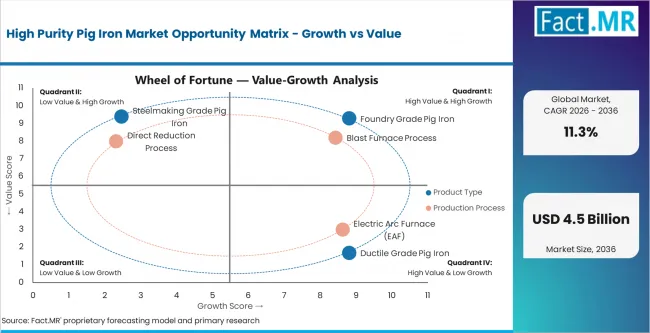
High Purity Pig Iron Market Opportunity Matrix Growth Vs Value | Source: Fact.MR
Key Factors Driving Growth
- Ductile iron demand expansion for automotive, wind energy, and infrastructure drives HPPI consumption as foundries require low-residual metallurgical feedstock.
- Green steel production using EAF routes creates growing demand for virgin pig iron as a residual element diluent complementing scrap-based steelmaking.
- EV component manufacturing growth creates demand for high-purity castings with superior mechanical properties for battery housings and structural parts.
Key Market Constraints
- Highly concentrated supply with the top three producers controlling 60 to 70% of global capacity creates supply risk and limits buyer negotiating power.
- Long blast furnace investment cycles of 5 to 7 years limit supply response to demand surges, creating periods of tight supply and price spikes.
- Logistics costs for shipping pig iron, a dense, heavy commodity, limit the economic radius of supply and create regional price differentials.
Key Opportunity Areas
- Low-carbon HPPI production using hydrogen direct reduction, biomass, and renewable energy positions producers for green steel premium pricing.
- Granulated pig iron offering easier handling, faster melting, and more accurate charge control is gaining specification preference over traditional pig form.
- Expanding ductile iron applications in water infrastructure, renewable energy, and EV manufacturing create structural demand growth beyond traditional automotive.
Segment-wise Analysis of the High Purity Pig Iron Market
- Foundry grade pig iron holds 40% of the product type segment in 2026, sustained by gray iron and ductile iron casting for automotive, machinery, and infrastructure.
- Casting accounts for 40% of the application segment in 2026, reflecting the fundamental role of HPPI as metallurgical feedstock for ductile and gray iron production.
- Pig form holds 60% of the form type segment, with standard and custom pig shapes serving traditional foundry melting operations.
The market is segmented by product type, production process, purity level, application, end use industry, form type, and region. Foundry grade leads by product type. Blast furnace leads by process. High purity leads by purity level, and casting leads by application.
Which Product Type Segment Dominates the High Purity Pig Iron Market?
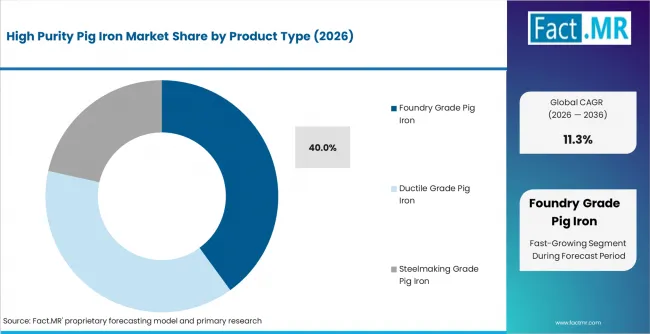
High Purity Pig Iron Market Analysis By Product Type | Source: Fact.MR
Foundry grade pig iron accounts for 40% of the product type segment in 2026. Basic foundry pig iron serves general gray iron casting, while low-phosphorus foundry pig iron serves high-quality automotive and machinery castings where phosphorus control below 0.05% is essential for mechanical properties.
Ductile grade pig iron, including nodular and low-sulfur grades, serves ductile iron production requiring sulfur control below 0.01% for consistent nodularity. Steelmaking grade pig iron serves electric arc furnace operations as a virgin iron supplement for residual dilution.
Which Application Segment Dominates the High Purity Pig Iron Market?
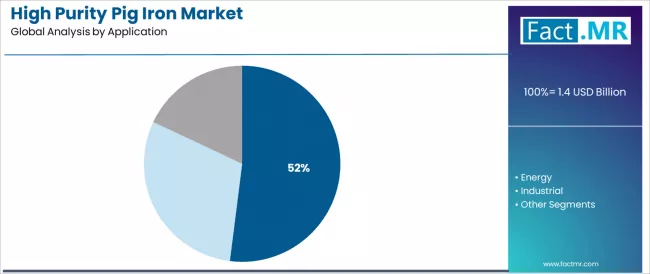
High Purity Pig Iron Market Analysis By Application | Source: Fact.MR
Casting accounts for 40% of the application segment in 2026. Gray iron casting for automotive engine blocks, machinery components, and industrial equipment consumes the largest foundry-grade HPPI volume. Ductile iron casting for pipes, heavy equipment, wind turbine components, and automotive structural parts represents the fastest-growing casting application segment.
Steel production is the second-largest application, with HPPI serving as a clean metallurgical supplement in EAF steelmaking. Automotive directly consumes HPPI through captive foundry operations producing engine components, brake parts, and transmission housings.
Which Purity Level Segment Dominates the High Purity Pig Iron Market?
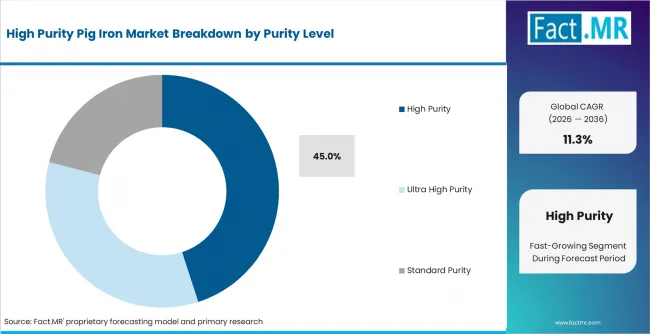
High Purity Pig Iron Market Analysis By Purity Level | Source: Fact.MR
High purity grade accounts for 45% of the purity level segment in 2026. Controlled-composition HPPI with documented low levels of phosphorus, sulfur, and residual elements serves the broadest range of foundry and steelmaking quality requirements, providing reliable metallurgical consistency for repeatable casting production.
Ultra high purity grade (below 0.02% phosphorus, below 0.01% sulfur) serves the most demanding applications including automotive safety-critical castings, precision ductile iron, and specialty steel. Standard purity serves general-purpose foundry and steelmaking where composition control is less critical.
Which Product Trend is Shaping the Next Phase of Growth in the High Purity Pig Iron Market?
Low-carbon high purity pig iron production using hydrogen direct reduction and biomass-based processes is the defining trend. Rio Tinto invested 143 million dollars in a BioIron facility in Western Australia to develop a low-carbon iron production process using microwave energy and biomass, signaling the industry's transition toward decarbonized metallurgical feedstock. As automakers and steelmakers pursue Scope 3 emission reduction, the carbon footprint of pig iron feedstock becomes a specification parameter alongside chemical composition.
Granulated HPPI is gaining market share over traditional pig form through operational advantages including faster melting in induction furnaces, more accurate charge weight control, easier storage and handling, and reduced breakage losses. These handling efficiency gains translate to foundry operating cost savings that justify the modest premium over standard pig form, making granulated product the preferred format for modern automated foundry operations.
Regional Outlook Across Key Markets
.webp "Top Country Growth Comparison High Purity Pig Iron Market Cagr (2026 2036)")
Top Country Growth Comparison High Purity Pig Iron Market Cagr (2026 2036) | Source: Fact.MR
- China leads growth at 12.4%, driven by expanding foundry capacity, automotive casting, infrastructure demand, and growing EAF steelmaking adoption.
- India follows at 11.7%, supported by ductile iron pipe manufacturing, automotive foundry expansion, and steel production growth.
- The USA grows at 10.9%, driven by ductile iron demand, green steel feedstock needs, automotive casting, and wind turbine component requirements.
- Europe sustains growth through Germany (10.1%), supported by automotive casting specification and wind energy ductile iron demand.
| Country | CAGR (%) |
|---|---|
| China | 12.4% |
| India | 11.7% |
| USA | 10.9% |
| Germany | 10.1% |
| Japan | 9.6% |
| South Korea | 8.8% |
| Brazil | 7.9% |
Source: Fact.MR analysis. Updated May 25, 2026
Source: Fact MR (FMR) analysis, based on proprietary forecasting model and primary research.
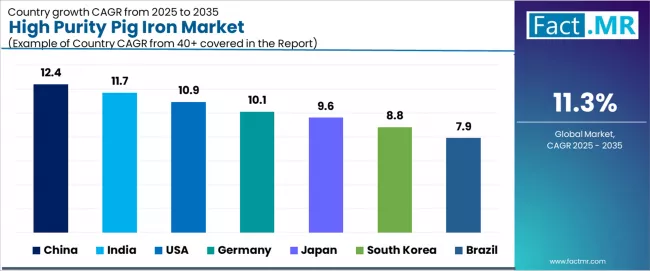
High Purity Pig Iron Market Cagr Analysis By Country | Source: Fact.MR
Market Outlook for High Purity Pig Iron in China
The China HPPI market is projected to grow at a CAGR of 12.4% through 2036. Demand is driven by the world's largest foundry production, automotive casting expansion, ductile iron pipe manufacturing, and growing EAF steelmaking requiring virgin iron supplements.
- World's largest foundry production drives HPPI consumption.
- Automotive casting expansion sustains high-purity feedstock demand.
- EAF steelmaking growth creates virgin iron supplement demand.
High Purity Pig Iron Demand Trends in India
The India market is projected to grow at a CAGR of 11.7% through 2036. Growth is supported by ductile iron pipe manufacturing, automotive foundry expansion, and steel production growth requiring quality metallurgical inputs.
- Ductile iron pipe manufacturing drives low-sulfur HPPI demand.
- Automotive foundry expansion creates high-purity feedstock procurement.
- Steel production growth supports metallurgical supplement consumption.
High Purity Pig Iron Demand Trends in USA
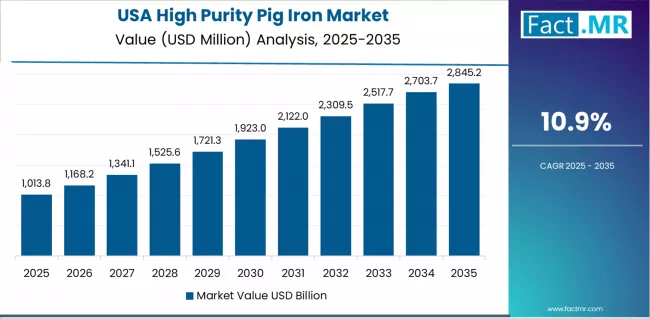
High Purity Pig Iron Market Country Value Analysis | Source: Fact.MR
The U.S. market is projected to grow at a CAGR of 10.9% through 2036. Demand is driven by ductile iron demand, green steel feedstock requirements, wind turbine component casting, and automotive tier-1 quality specifications.
- Ductile iron demand drives foundry-grade HPPI procurement.
- Green steel feedstock creates EAF-grade virgin iron demand.
- Wind turbine casting requirements sustain premium-grade specification.
Germany High Purity Pig Iron Market Demand Analysis
The Germany market is projected to grow at a CAGR of 10.1% through 2036. Demand is shaped by automotive casting specification, wind energy component needs, precision engineering requirements, and EAF steel production.
- Automotive casting specification drives premium HPPI procurement.
- Wind energy components sustain ductile-grade demand.
- EAF steel production creates steelmaking-grade consumption.
Japan High Purity Pig Iron Market Opportunity Outlook
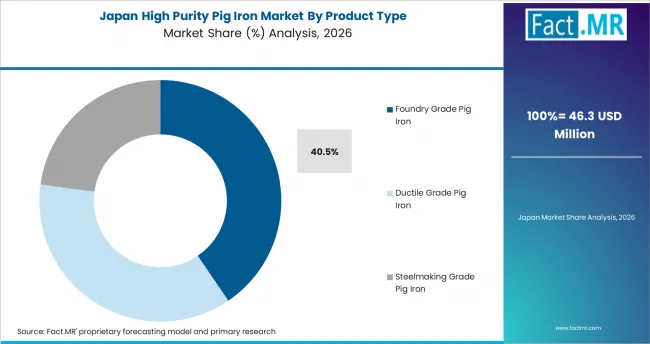
High Purity Pig Iron Market Japan Market Share Analysis By Product Type | Source: Fact.MR
The Japan market is projected to grow at a CAGR of 9.6% through 2036. Demand is supported by automotive precision casting, specialty steel production, and high-quality foundry manufacturing.
- Automotive precision casting drives ultra-high-purity demand.
- Specialty steel production sustains steelmaking-grade procurement.
- Kobe Steel's domestic presence anchors local HPPI supply.
Competitive Benchmarking and Company Positioning
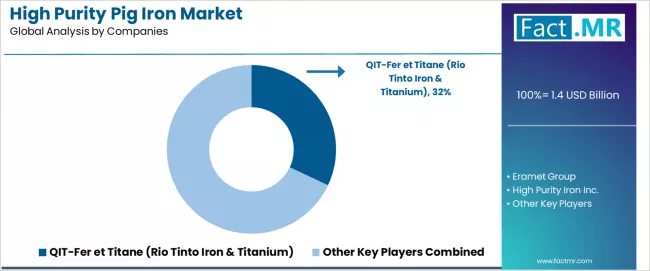
High Purity Pig Iron Market Analysis By Company | Source: Fact.MR
High Purity Pig Iron Market Analysis By Company
- QIT-Fer et Titane (Rio Tinto) dominates with approximately 32% market share through its Sorelmetal brand, the global benchmark for high purity pig iron quality.
- Eramet Group and High Purity Iron Inc. compete through established smelting operations and customer relationships across foundry and steelmaking sectors.
- Metallurgical purity consistency, supply reliability, chemical composition documentation, and logistics efficiency are primary differentiators.
The competitive landscape is highly concentrated. QIT-Fer et Titane, Rio Tinto's Canadian subsidiary, holds approximately 32% market share through its Sorelmetal brand, widely regarded as the global quality benchmark for HPPI. The company's vertically integrated operations from Quebec iron ore through smelting produce pig iron with naturally low residual elements serving Tier 1 automotive foundries worldwide.
Eramet Group, based in France, competes through manganese alloy and pig iron production operations. High Purity Iron Inc. serves niche ultra-high-purity applications. Richards Bay Minerals (RBM) in South Africa produces HPPI as a co-product of titanium slag operations, similar to Tronox Holdings.
Kobe Steel, Ironveld, Mineral-Loy, Saraf Group, and Sesa Goa (Vedanta) serve regional markets and specific quality tiers. The top three companies control 60 to 70% of global production capacity, creating a concentrated supply structure.
Strategic priorities include developing low-carbon production routes, expanding granulated pig iron capacity, securing long-term automotive foundry supply agreements, and building green steel feedstock positioning.
Key Companies in the High Purity Pig Iron Market
QIT-Fer et Titane (Rio Tinto) is the dominant global player through Sorelmetal quality leadership and vertically integrated Canadian operations.
Eramet Group, Richards Bay Minerals, and Tronox Holdings hold established positions through smelting operations and co-product pig iron supply.
High Purity Iron Inc., Ironveld Plc, Kobe Steel, Mineral-Loy, Saraf Group, and Sesa Goa (Vedanta) compete through regional manufacturing and specific quality tiers.
Recent Industry Developments
- Rio Tinto (QIT-Fer et Titane) - Green Investment / USD 143 Million BioIron Facility (2025)
- Rio Tinto announced a 143 million dollar investment in a new BioIron facility in Western Australia to develop a low-carbon iron production process using microwave energy and biomass, positioning for decarbonized high purity pig iron production.
- Eramet Group - Production Optimization / Smelting Efficiency Enhancement (2025)
- Eramet Group continued upgrading its smelting operations to improve energy efficiency and reduce emissions while maintaining ultra-tight impurity control, strengthening its competitive position in the high purity pig iron market.
- Kobe Steel - Quality Enhancement / Advanced Low-Phosphorus Pig Iron for Automotive (2025)
- Kobe Steel expanded its advanced low-phosphorus pig iron production for automotive precision casting applications, addressing growing quality specification requirements from Japanese and global automotive OEMs.
Leading Companies Shaping the High Purity Pig Iron Market
- QIT-Fer et Titane (Rio Tinto Iron & Titanium)
- Eramet Group
- High Purity Iron Inc.
- Ironveld Plc
- Kobe Steel
- Mineral-Loy
- Richards Bay Minerals (RBM)
- Saraf Group
- Sesa Goa Iron Ore (Vedanta)
- Tronox Holdings plc
Sources and Research References
- Rio Tinto (QIT-Fer et Titane). Sorelmetal product specifications and BioIron facility investment announcement.
- Eramet Group. Smelting operations and production optimization documentation.
- Global foundry production databases, automotive casting demand, and steel production statistics.
- Trade flow data, HPPI pricing databases, and production capacity analysis.
- Primary interviews with HPPI producers, foundries, steelmakers, and automotive casting companies.
This bibliography is provided for reader reference and is not exhaustive. The full report contains the complete reference list and detailed citations.
Key Questions This Report Addresses
- What is the current and future size of the High Purity Pig Iron market?
- How fast is the market expected to grow between 2026 and 2036?
- Which product type leads in 2026?
- Which application holds highest share?
- What drives demand?
- How is green steel influencing the market?
- Why is China the fastest-growing market?
- How is low-carbon production shaping the market?
- Which countries show fastest growth?
- Who are the key companies?
- How does Fact.MR validate the forecast?
Segmentation
Scope of Analysis
| Parameter | Details |
|---|---|
| Quantitative Units | USD 1.56 billion to USD 4.55 billion, at a CAGR of 11.3% |
| Market Definition | The market covers foundry, ductile, and steelmaking grade high purity pig iron with controlled low residual elements for casting, steelmaking, and precision manufacturing. |
| Regions Covered | North America, Latin America, Europe, East Asia, South Asia and Pacific, Middle East and Africa |
| Countries Covered | China, India, USA, Germany, Japan, South Korea, Brazil, 15 plus countries |
| Key Companies | QIT-Fer et Titane (Rio Tinto), Eramet, High Purity Iron, Ironveld, Kobe Steel, Mineral-Loy, Richards Bay Minerals, Saraf Group, Sesa Goa, Tronox |
| Forecast Period | 2026 to 2036 |
| Approach | Hybrid supply-demand methodology built on foundry production, automotive casting, steel production, and primary interviews across producers, foundries, and steelmakers |
Source: Fact.MR analysis. Updated May 25, 2026
High Purity Pig Iron Market Segmentation
-
High Purity Pig Iron Market Segmented by Product Type:
- Foundry Grade Pig Iron
- Basic Foundry Pig Iron
- General Casting
- Gray Iron Production
- Low Phosphorus Pig Iron
- High Quality Castings
- Automotive Components
- Basic Foundry Pig Iron
- Ductile Grade Pig Iron
- Nodular Pig Iron
- Ductile Iron Production
- High Strength Applications
- Low Sulfur Pig Iron
- Improved Mechanical Properties
- Precision Castings
- Nodular Pig Iron
- Steelmaking Grade Pig Iron
- Basic Pig Iron
- Steel Production
- Blast Furnace Use
- High Purity Pig Iron
- Low Impurities
- Specialty Steel
- Basic Pig Iron
- Foundry Grade Pig Iron
-
High Purity Pig Iron Market Segmented by Production Process:
- Blast Furnace Process
- Traditional Blast Furnace
- Large-scale Production
- High Output
- Mini Blast Furnace
- Small-scale Production
- Flexible Operations
- Traditional Blast Furnace
- Electric Arc Furnace (EAF)
- Primary EAF
- Scrap-based Production
- Energy Efficient
- Secondary EAF
- Refining Process
- Improved Purity
- Primary EAF
- Direct Reduction Process
- Gas-based Reduction
- Low Emissions
- High Purity
- Coal-based Reduction
- Cost-effective
- Industrial Use
- Gas-based Reduction
- Blast Furnace Process
-
High Purity Pig Iron Market Segmented by Purity Level:
- High Purity
- Low Impurity Content
- Controlled Composition
- Industrial Applications
- Standard High Purity
- Consistent Quality
- Casting Use
- Low Impurity Content
- Ultra High Purity
- Low Phosphorus
- Below 0.02%
- High-grade Steel
- Low Sulfur
- Below 0.01%
- Precision Applications
- Low Phosphorus
- Standard Purity
- Commercial Grade
- General Use
- Cost-effective
- Basic Grade
- Bulk Production
- Industrial Applications
- Commercial Grade
- High Purity
-
High Purity Pig Iron Market Segmented by Application:
- Casting
- Gray Iron Casting
- Automotive Parts
- Machinery Components
- Ductile Iron Casting
- Pipes
- Heavy Equipment
- Gray Iron Casting
- Steel Production
- Primary Steelmaking
- Basic Oxygen Furnace
- Electric Arc Furnace
- Alloy Steel Production
- High-grade Steel
- Specialty Steel
- Primary Steelmaking
- Automotive
- Engine Components
- Cylinder Blocks
- Crankshafts
- Brake Components
- Discs
- Drums
- Engine Components
- Construction
- Pipes and Fittings
- Water Supply
- Sewage Systems
- Structural Components
- Support Structures
- Infrastructure
- Pipes and Fittings
- Machinery Manufacturing
- Industrial Equipment
- Heavy Machinery
- Machine Tools
- Agricultural Equipment
- Tractors
- Implements
- Industrial Equipment
- Casting
-
High Purity Pig Iron Market Segmented by End Use Industry:
- Foundry Industry
- Automotive Foundries
- Engine Parts
- Structural Components
- Industrial Foundries
- Machinery Parts
- Equipment Components
- Automotive Foundries
- Steel Industry
- Integrated Steel Plants
- Bulk Steel Production
- High Volume
- Mini Mills
- Specialty Steel
- Flexible Production
- Integrated Steel Plants
- Automotive Industry
- OEM Manufacturers
- Vehicle Production
- Component Manufacturing
- Aftermarket
- Spare Parts
- Replacement Components
- OEM Manufacturers
- Construction Industry
- Infrastructure Projects
- Pipelines
- Urban Development
- Building Construction
- Residential
- Commercial
- Infrastructure Projects
- Heavy Machinery Industry
- Industrial Equipment
- Manufacturing Machinery
- Mining Equipment
- Agricultural Machinery
- Farm Equipment
- Implements
- Industrial Equipment
- Foundry Industry
-
High Purity Pig Iron Market Segmented by Form Type:
- Pig Form
- Standard Pigs
- Traditional Shape
- Easy Handling
- Custom Pigs
- Specific Weight
- Customized Shape
- Standard Pigs
- Granular Form
- Pig Iron Granules
- Easy Melting
- Efficient Handling
- Powder Form
- Fine Particles
- Special Applications
- Pig Iron Granules
- Molten Form
- Liquid Iron
- Direct Use
- Continuous Casting
- Hot Metal Supply
- Steel Plants
- Integrated Systems
- Liquid Iron
- Pig Form
-
High Purity Pig Iron Market by Region:
- North America
- USA
- Canada
- Mexico
- Latin America
- Brazil
- Chile
- Rest of Latin America
- Western Europe
- Germany
- UK
- Italy
- Spain
- France
- Nordic
- BENELUX
- Rest of Western Europe
- Eastern Europe
- Russia
- Poland
- Hungary
- Balkan & Baltic
- Rest of Eastern Europe
- East Asia
- China
- Japan
- South Korea
- South Asia and Pacific
- India
- ASEAN
- Australia & New Zealand
- Rest of South Asia and Pacific
- Middle East & Africa
- Kingdom of Saudi Arabia
- Other GCC Countries
- Turkiye
- South Africa
- Other African Union
- Rest of Middle East & Africa
- North America
High Purity Pig Iron Market Definition
The high purity pig iron market covers foundry grade, ductile grade, and steelmaking grade pig iron with controlled low levels of phosphorus, sulfur, and residual elements used as metallurgical feedstock in casting, steelmaking, and precision manufacturing.
High Purity Pig Iron Market Inclusions
- The scope covers global and regional market size and forecasts for 2026 to 2036 across product type, production process, purity level, application, end use industry, form type, and region.
- It includes analysis of ductile iron demand, automotive casting trends, green steel feedstock requirements, and wind energy component needs.
- The report covers pricing and cost analysis across HPPI grades including production costs, premium pricing, and logistics economics.
- It covers supply-demand dynamics, market drivers, and competitive landscape including production capacities and quality certifications of leading producers.
High Purity Pig Iron Market Exclusions
- The scope excludes standard commercial pig iron without controlled purity specifications.
- It excludes direct reduced iron (DRI) and hot briquetted iron (HBI) classified under different metallurgical feedstock categories.
- The report excludes iron ore, iron ore pellets, and beneficiated iron products upstream of pig iron production.
- It also excludes downstream casting and steelmaking equipment and processes.
High Purity Pig Iron Market Research Methodology
- The methodology combines secondary research, primary interviews, and forecast modelling.
- It draws on 40+ secondary sources and benchmarks production capacities of 15+ HPPI producers.
- Market sizing covers 15+ countries through a supply-demand model, supported by top-down validation.
- Key inputs include foundry production volumes, automotive casting demand, steel production, and purity specification trends.
- The model cross-checks demand with production capacities, trade flows, and pricing data.
- Primary validation includes 15+ interviews across HPPI producers, foundries, steelmakers, and automotive casting companies.
- Final estimates go through capacity-utilization checks, trade-flow analysis, and sensitivity testing.
Frequently Asked Questions
How big is the High Purity Pig Iron Market in 2025?
What will be the size of the High Purity Pig Iron Market by 2036?
How much will the High Purity Pig Iron Market grow between 2026 and 2036?
What are the key product types in the High Purity Pig Iron Market?
Which application holds the highest share in the High Purity Pig Iron Market in 2026?
Which production process holds the highest share in the High Purity Pig Iron Market in 2026?
Which purity level holds the highest share in the High Purity Pig Iron Market in 2026?
Which are the fastest-growing countries in the High Purity Pig Iron Market?
Who worked on this report


Preview the report firsthand - request a free sample
Free SampleGet the brochure for pricing and purchase details
Download PDF