Low-Creep High-Modulus Yarns Market
Low-Creep High-Modulus Yarns Market Size and Share Forecast Outlook 2026 to 2036
Low-creep high-modulus yarns market is projected to grow from USD 0.8 billion in 2026 to USD 1.7 billion by 2036, at a CAGR of 7.5%. High-tenacity Polyester will dominate with a 34.0% market share, while industrial ropes and cables will lead the application segment with a 32.0% share.
Low-Creep High-Modulus Yarns Market Forecast and Outlook 2026 to 2036
Valuation of the global low-creep high-modulus yarns market is projected to grow from USD 0.84 billion in 2026 to USD 1.7 billion by 2036, depicting a compound annual growth rate (CAGR) of 7.5% between 2026 and 2036. This translates into a total growth of 77.4%, with the market forecast to expand at a compound annual growth rate (CAGR) of 7.5% between 2026 and 2036. The high-tenacity polyester segment is set to register 34.0% of the low-creep high-modulus yarns market in 2026.
Key Takeaways for Low-Creep High-Modulus Yarns Market
- Low-Creep High-Modulus Yarns Market Value (2026): USD 0.84 billion
- Low-Creep High-Modulus Yarns Market Forecast Value (2036): USD 1.7 billion
- Low-Creep High-Modulus Yarns Market Forecast CAGR: 7.5%
- Leading Polymer Type in Low-Creep High-Modulus Yarns Market: High-Tenacity Polyester (34.0%)
- Key Growth Regions in Low-Creep High-Modulus Yarns Market: China, Brazil, Europe
- Key Players in Low-Creep High-Modulus Yarns Market: Toray Industries, Teijin Frontier, DSM Protective Materials, Honeywell, Hyosung
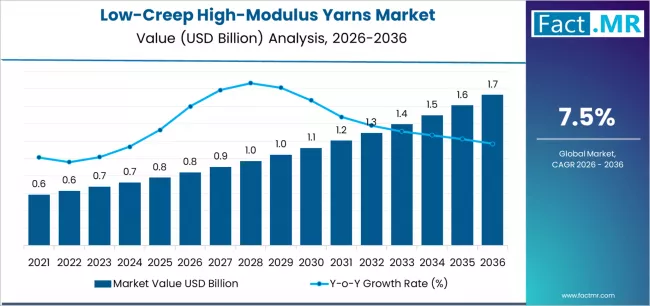
High-tenacity polyester yarns enable manufacturers to deliver superior load-bearing capabilities and dimensional stability with enhanced durability and precise performance characteristics across multiple processing environments, providing improved strength properties for advanced textile applications and composite manufacturing. Industrial ropes and cables are projected to register 32.0% of the low-creep high-modulus yarns market in 2026. Low-creep high-modulus yarns in industrial rope applications enable enhanced load distribution, standardized performance parameters, and mechanical compatibility processes that are essential for marine operators, construction contractors, and industrial users.
Low-Creep High-Modulus Yarns Market
| Metric | Value |
|---|---|
| Estimated Value in (2026E) | USD 0.84 billion |
| Forecast Value in (2036F) | USD 1.7 billion |
| Forecast CAGR (2026 to 2036) | 7.5% |
Category
| Category | Segments |
|---|---|
| Polymer Type | High-Tenacity Polyester; High-Modulus Polyethylene (HMPE); Aramid & Para-Aramid; Other High-Modulus Fibers |
| Application | Industrial Ropes & Cables; Reinforcement for Composites; Geo/Construction Textiles; Other Technical Uses |
| End Market | Marine & Offshore; Construction & Infrastructure; Energy & Utilities; Other Industrial Sectors |
| Yarn Form | Filament & Roving; Twisted & Plied Yarns; Engineered & Hybrid Yarns |
| Region | United States; China; Europe; Japan; South Korea; Germany; United Kingdom; Brazil; Other Regions |
Segmental Analysis
By Polymer Type, Which Segment Holds the Dominant Share in the Low-Creep High-Modulus Yarns Market?
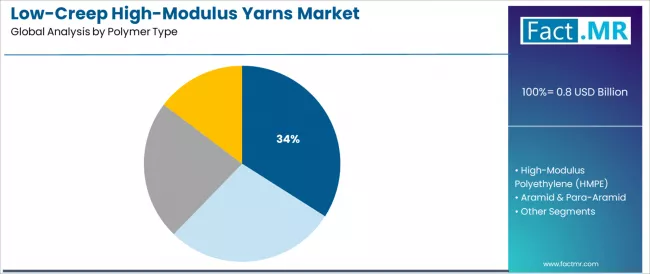
In terms of polymer type, the high-tenacity polyester segment leads the market with 34% share. Material professionals and manufacturing managers increasingly utilize high-tenacity polyester yarns for their superior strength properties and dimensional stability characteristics.
- Institutional investments in advanced yarn processing technology and materials engineering continue to strengthen adoption among quality-focused users.
- With composite operators prioritizing manufacturing infrastructure reliability and material uniformity, high-tenacity polyester yarns align with both operational objectives and performance requirements, making them the central component of comprehensive yarn processing strategies.
By Application, Which Segment Registers the Highest Share in the Low-Creep High-Modulus Yarns Market?
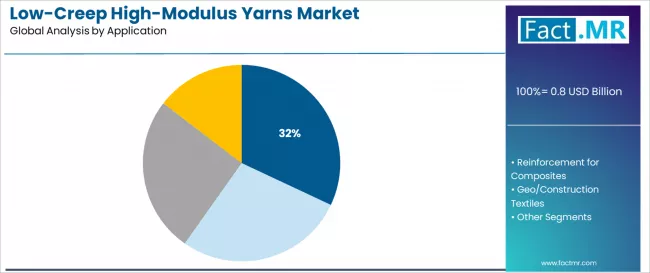
By application, industrial ropes and cables dominate with 32.0% share, underscoring their critical role as the primary application sector for performance-focused users seeking superior load-bearing properties and enhanced mechanical credentials. Marine facility users and industrial operators prefer high-modulus yarns for rope applications due to their established strength requirements.
- Marine facility users are optimizing yarn selections to support application-specific requirements and comprehensive load-bearing strategies.
- As high-modulus yarn technology continues to advance and facilities seek efficient material processing methods, industrial rope applications will continue to drive market growth while supporting material performance and operational optimization strategies.
What are the Drivers, Restraints, and Key Trends of the Low-Creep High-Modulus Yarns Market?
- Drivers: Marine industry expansion and advanced construction initiatives drive mandatory adoption of high-performance yarn solutions across industrial infrastructure.
- Restraint: High procurement costs and technical complexity of integrating specialized high-modulus yarns into existing manufacturing processes limit market penetration.
- Trend 1: Shift toward ready-to-use yarn formulations that minimize preparation requirements and reduce technical handling for deployment.
- Trend 2: Development of specialized multifunctional yarns supporting multiple application types and performance compatibility standards.
Analysis of the Low-Creep High-Modulus Yarns Market by Key Country
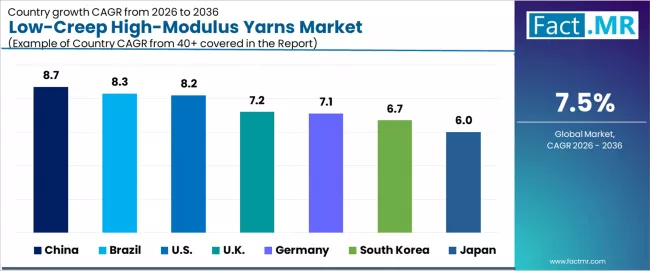
| Country | CAGR (2026 to 2036) |
|---|---|
| China | 8.7% |
| Brazil | 8.3% |
| U.S. | 8.2% |
| U.K. | 7.2% |
| Germany | 7.1% |
| South Korea | 6.7% |
| Japan | 6.0% |
The report covers an in-depth analysis of 40+ countries; top-performing countries are highlighted below.
What Opportunities Can Low-Creep High-Modulus Yarns Manufacturers Expect in China?
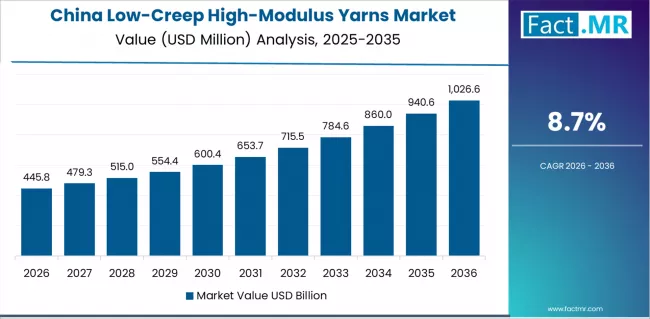
Revenue from low-creep high-modulus yarns consumption and sales in China is projected to exhibit exceptional growth with a CAGR of 8.7% through 2036, driven by the country's rapidly expanding marine sector, government policies promoting materials manufacturing standardization, and initiatives supporting professional yarn processing technologies across major industrial regions.
- Established marine infrastructure and expanding materials consciousness are driving demand for high-modulus yarn solutions across manufacturing facilities, commercial developments, and comprehensive material systems throughout Chinese industrial markets.
- Strong infrastructure development and formulation initiatives are supporting the rapid adoption of premium yarn systems among quality-focused institutions seeking to meet evolving marine standards and processing requirements.
What is the Brazilian Low-Creep High-Modulus Yarns Market Size?
Revenue from low-creep high-modulus yarns products in Brazil is projected to expand at a CAGR of 8.3%, supported by rising offshore industry investment, growing manufacturing consciousness, and expanding technology distributor capabilities. The country's developing materials infrastructure and increasing investment in professional technologies are driving demand for high-modulus yarn solutions across both traditional and modern composite applications.
- Rising commercial development and expanding materials capabilities are creating opportunities for yarn adoption across industrial projects.
- Growing offshore industry awareness initiatives and manufacturing technology advancement are driving the adoption of specialized yarn products and services among facility users.
What is the USA Low-Creep High-Modulus Yarns Market Size?
Revenue from low-creep high-modulus yarns products in the USA is projected to grow at a CAGR of 8.2% through 2036, supported by the country's emphasis on manufacturing precision, materials excellence, and advanced technology integration requiring efficient yarn solutions. American marine users and manufacturing-focused establishments prioritize technical performance and processing precision, making specialized yarn systems essential components for both traditional and modern composite applications.
- Advanced precision marine technology capabilities and growing technical manufacturing applications are driving demand for yarn systems across specialty composite applications.
- Strong focus on technical precision and materials excellence is encouraging users and distributors to adopt yarn solutions.
What Challenges Do Low-Creep High-Modulus Yarns Manufacturers Face in Germany?
Revenue from low-creep high-modulus yarns products in Germany is projected to grow at a CAGR of 7.1% through 2036, supported by established materials standards, expanding manufacturing markets, and emphasis on technical efficiency across automotive and marine sectors. German marine users and manufacturing professionals prioritize quality performance and technical consistency, creating steady demand for premium yarn solutions.
- Established materials markets and expanding manufacturing industry are driving demand for quality yarn systems across composite operations.
- Strong emphasis on quality standards and technical efficiency is supporting the adoption of premium yarn varieties among users seeking proven performance.
What are the Opportunities for South Korean Low-Creep High-Modulus Yarns Manufacturers?
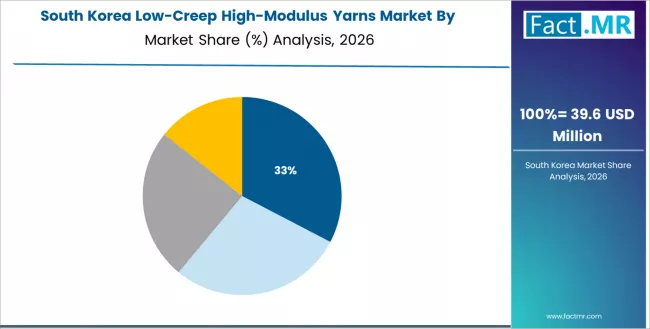
Revenue from low-creep high-modulus yarns products in South Korea is projected to grow at a CAGR of 6.7% through 2036, supported by the country's expanding marine industry standards, established government regulations, and leadership in materials technology implementation. South Korea's advanced marine development standards and strong support for innovative material systems are creating steady demand for both traditional and advanced yarn varieties.
- Advanced technology capabilities and established marine-focused markets are driving demand for premium yarn systems across manufacturing facilities, processing operations, and others.
- Strong marine industry culture and regulatory development are supporting the adoption of innovative material technology among users prioritizing manufacturing reliability and processing precision in composite applications.
What Challenges Do Japanese Low-Creep High-Modulus Yarns Manufacturers Face?
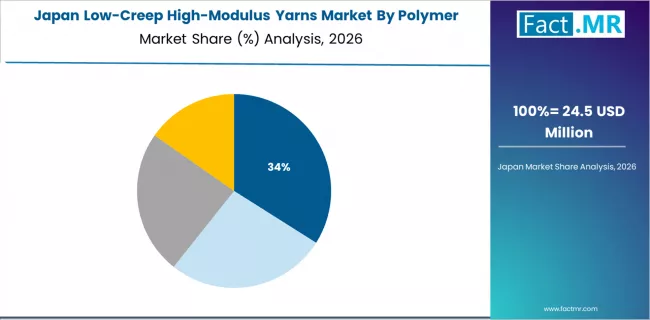
Revenue from low-creep high-modulus yarns products in Japan is projected to grow at a CAGR of 6.0% through 2036, supported by the country's emphasis on materials precision, technology excellence, and advanced manufacturing system integration requiring efficient yarn solutions. Japanese marine users and technology-focused establishments prioritize precision performance and manufacturing control, making specialized yarn systems essential components for both traditional and modern composite applications.
- Advanced precision technology capabilities and growing technical marine applications are driving demand for yarn systems across specialty manufacturing applications.
- Strong focus on technical precision and technology excellence is encouraging users and distributors to adopt yarn solutions that support materials objectives.
Competitive Landscape of the Low-Creep High-Modulus Yarns Market
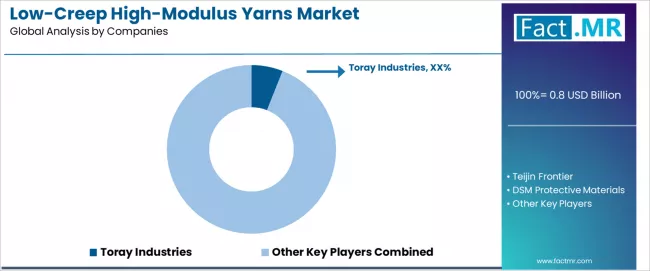
The low-creep high-modulus yarns market is characterized by competition among established chemical companies, specialized materials manufacturers, and integrated composite solution providers. Companies are investing in advanced yarn technologies, specialized fiber platforms, product innovation capabilities, and comprehensive distribution networks to deliver consistent, high-quality, and reliable yarn systems.
Market players include Toray Industries, Teijin Frontier, DSM Protective Materials, Honeywell, and others, offering institutional and commercial systems with emphasis on performance excellence and materials heritage. Toray Industries provides integrated material automation with a focus on marine market applications and precision yarn networks.
Key Players in the Low-Creep High-Modulus Yarns Market
- Toray Industries
- Teijin Frontier
- DSM Protective Materials
- Honeywell
- Hyosung
- Kolon Industries
- Indorama Ventures
- Kordsa
- SGL Carbon
- Mitsubishi Chemical Group
Scope of the Report
| Items | Values |
|---|---|
| Quantitative Units (2026) | USD 0.84 Billion |
| Polymer Type | High-Tenacity Polyester, High-Modulus Polyethylene (HMPE), Aramid & Para-Aramid, Other High-Modulus Fibers |
| Application | Industrial Ropes & Cables, Reinforcement for Composites, Geo/Construction Textiles, Other Technical Uses |
| End Market | Marine & Offshore, Construction & Infrastructure, Energy & Utilities, Other Industrial Sectors |
| Yarn Form | Filament & Roving, Twisted & Plied Yarns, Engineered & Hybrid Yarns |
| Regions Covered | United States, China, Europe, Japan, South Korea, Germany, United Kingdom, Brazil, Other Regions |
| Countries Covered | China, Brazil, Europe, U.S., U.K., Germany, South Korea, Japan, and other countries |
| Key Companies Profiled | Toray Industries, Teijin Frontier, DSM Protective Materials, Honeywell, Hyosung, and other leading yarn companies |
| Additional Attributes | Dollar sales by polymer type, application, end market, yarn form, and region; regional demand trends, competitive landscape, technological advancements in yarn engineering, performance optimization initiatives, manufacturing enhancement programs, and premium product development strategies |
Low-Creep High-Modulus Yarns Market by Segments
-
Polymer Type :
- High-Tenacity Polyester
- High-Modulus Polyethylene (HMPE)
- Aramid & Para-Aramid
- Other High-Modulus Fibers
-
Application :
- Industrial Ropes & Cables
- Reinforcement for Composites
- Geo/Construction Textiles
- Other Technical Uses
-
End Market :
- Marine & Offshore
- Construction & Infrastructure
- Energy & Utilities
- Other Industrial Sectors
-
Yarn Form :
- Filament & Roving
- Twisted & Plied Yarns
- Engineered & Hybrid Yarns
-
Region :
- North America
- USA
- Canada
- Mexico
- Europe
- Germany
- UK
- France
- Italy
- Spain
- Nordic Countries
- BENELUX
- Rest of Europe
- Asia Pacific
- China
- Japan
- South Korea
- India
- Australia
- Rest of Asia Pacific
- Latin America
- Brazil
- Argentina
- Rest of Latin America
- Middle East & Africa
- Kingdom of Saudi Arabia
- United Arab Emirates
- South Africa
- Rest of Middle East & Africa
- Other Regions
- Oceania
- Central Asia
- Other Markets
- North America
Table of Content
- Executive Summary
- Global Market Outlook
- Demand to side Trends
- Supply to side Trends
- Technology Roadmap Analysis
- Analysis and Recommendations
- Market Overview
- Market Coverage / Taxonomy
- Market Definition / Scope / Limitations
- Market Background
- Market Dynamics
- Drivers
- Restraints
- Opportunity
- Trends
- Scenario Forecast
- Demand in Optimistic Scenario
- Demand in Likely Scenario
- Demand in Conservative Scenario
- Opportunity Map Analysis
- Product Life Cycle Analysis
- Supply Chain Analysis
- Investment Feasibility Matrix
- Value Chain Analysis
- PESTLE and Porter’s Analysis
- Regulatory Landscape
- Regional Parent Market Outlook
- Production and Consumption Statistics
- Import and Export Statistics
- Market Dynamics
- Global Market Analysis 2021 to 2025 and Forecast, 2026 to 2036
- Historical Market Size Value (USD Million) Analysis, 2021 to 2025
- Current and Future Market Size Value (USD Million) Projections, 2026 to 2036
- Y to o to Y Growth Trend Analysis
- Absolute $ Opportunity Analysis
- Global Market Pricing Analysis 2021 to 2025 and Forecast 2026 to 2036
- Global Market Analysis 2021 to 2025 and Forecast 2026 to 2036, By Polymer Type
- Introduction / Key Findings
- Historical Market Size Value (USD Million) Analysis By Polymer Type, 2021 to 2025
- Current and Future Market Size Value (USD Million) Analysis and Forecast By Polymer Type, 2026 to 2036
- High-tenacity Polyester
- High-Modulus Polyethylene (HMPE)
- Aramid & Para-Aramid
- Other High-Modulus Fibers
- Y to o to Y Growth Trend Analysis By Polymer Type, 2021 to 2025
- Absolute $ Opportunity Analysis By Polymer Type, 2026 to 2036
- Global Market Analysis 2021 to 2025 and Forecast 2026 to 2036, By Application
- Introduction / Key Findings
- Historical Market Size Value (USD Million) Analysis By Application, 2021 to 2025
- Current and Future Market Size Value (USD Million) Analysis and Forecast By Application, 2026 to 2036
- Industrial Ropes and Cables
- Reinforcement for Composites
- Geo/Construction Textiles
- Other Technical Uses
- Y to o to Y Growth Trend Analysis By Application, 2021 to 2025
- Absolute $ Opportunity Analysis By Application, 2026 to 2036
- Global Market Analysis 2021 to 2025 and Forecast 2026 to 2036, By Region
- Introduction
- Historical Market Size Value (USD Million) Analysis By Region, 2021 to 2025
- Current Market Size Value (USD Million) Analysis and Forecast By Region, 2026 to 2036
- North America
- Latin America
- Western Europe
- Eastern Europe
- East Asia
- South Asia and Pacific
- Middle East & Africa
- Market Attractiveness Analysis By Region
- North America Market Analysis 2021 to 2025 and Forecast 2026 to 2036, By Country
- Historical Market Size Value (USD Million) Trend Analysis By Market Taxonomy, 2021 to 2025
- Market Size Value (USD Million) Forecast By Market Taxonomy, 2026 to 2036
- By Country
- USA
- Canada
- Mexico
- By Polymer Type
- By Application
- By Country
- Market Attractiveness Analysis
- By Country
- By Polymer Type
- By Application
- Key Takeaways
- Latin America Market Analysis 2021 to 2025 and Forecast 2026 to 2036, By Country
- Historical Market Size Value (USD Million) Trend Analysis By Market Taxonomy, 2021 to 2025
- Market Size Value (USD Million) Forecast By Market Taxonomy, 2026 to 2036
- By Country
- Brazil
- Chile
- Rest of Latin America
- By Polymer Type
- By Application
- By Country
- Market Attractiveness Analysis
- By Country
- By Polymer Type
- By Application
- Key Takeaways
- Western Europe Market Analysis 2021 to 2025 and Forecast 2026 to 2036, By Country
- Historical Market Size Value (USD Million) Trend Analysis By Market Taxonomy, 2021 to 2025
- Market Size Value (USD Million) Forecast By Market Taxonomy, 2026 to 2036
- By Country
- Germany
- UK
- Italy
- Spain
- France
- Nordic
- BENELUX
- Rest of Western Europe
- By Polymer Type
- By Application
- By Country
- Market Attractiveness Analysis
- By Country
- By Polymer Type
- By Application
- Key Takeaways
- Eastern Europe Market Analysis 2021 to 2025 and Forecast 2026 to 2036, By Country
- Historical Market Size Value (USD Million) Trend Analysis By Market Taxonomy, 2021 to 2025
- Market Size Value (USD Million) Forecast By Market Taxonomy, 2026 to 2036
- By Country
- Russia
- Poland
- Hungary
- Balkan & Baltic
- Rest of Eastern Europe
- By Polymer Type
- By Application
- By Country
- Market Attractiveness Analysis
- By Country
- By Polymer Type
- By Application
- Key Takeaways
- East Asia Market Analysis 2021 to 2025 and Forecast 2026 to 2036, By Country
- Historical Market Size Value (USD Million) Trend Analysis By Market Taxonomy, 2021 to 2025
- Market Size Value (USD Million) Forecast By Market Taxonomy, 2026 to 2036
- By Country
- China
- Japan
- South Korea
- By Polymer Type
- By Application
- By Country
- Market Attractiveness Analysis
- By Country
- By Polymer Type
- By Application
- Key Takeaways
- South Asia and Pacific Market Analysis 2021 to 2025 and Forecast 2026 to 2036, By Country
- Historical Market Size Value (USD Million) Trend Analysis By Market Taxonomy, 2021 to 2025
- Market Size Value (USD Million) Forecast By Market Taxonomy, 2026 to 2036
- By Country
- India
- ASEAN
- Australia & New Zealand
- Rest of South Asia and Pacific
- By Polymer Type
- By Application
- By Country
- Market Attractiveness Analysis
- By Country
- By Polymer Type
- By Application
- Key Takeaways
- Middle East & Africa Market Analysis 2021 to 2025 and Forecast 2026 to 2036, By Country
- Historical Market Size Value (USD Million) Trend Analysis By Market Taxonomy, 2021 to 2025
- Market Size Value (USD Million) Forecast By Market Taxonomy, 2026 to 2036
- By Country
- Kingdom of Saudi Arabia
- Other GCC Countries
- Turkiye
- South Africa
- Other African Union
- Rest of Middle East & Africa
- By Polymer Type
- By Application
- By Country
- Market Attractiveness Analysis
- By Country
- By Polymer Type
- By Application
- Key Takeaways
- Key Countries Market Analysis
- USA
- Pricing Analysis
- Market Share Analysis, 2025
- By Polymer Type
- By Application
- Canada
- Pricing Analysis
- Market Share Analysis, 2025
- By Polymer Type
- By Application
- Mexico
- Pricing Analysis
- Market Share Analysis, 2025
- By Polymer Type
- By Application
- Brazil
- Pricing Analysis
- Market Share Analysis, 2025
- By Polymer Type
- By Application
- Chile
- Pricing Analysis
- Market Share Analysis, 2025
- By Polymer Type
- By Application
- Germany
- Pricing Analysis
- Market Share Analysis, 2025
- By Polymer Type
- By Application
- UK
- Pricing Analysis
- Market Share Analysis, 2025
- By Polymer Type
- By Application
- Italy
- Pricing Analysis
- Market Share Analysis, 2025
- By Polymer Type
- By Application
- Spain
- Pricing Analysis
- Market Share Analysis, 2025
- By Polymer Type
- By Application
- France
- Pricing Analysis
- Market Share Analysis, 2025
- By Polymer Type
- By Application
- India
- Pricing Analysis
- Market Share Analysis, 2025
- By Polymer Type
- By Application
- ASEAN
- Pricing Analysis
- Market Share Analysis, 2025
- By Polymer Type
- By Application
- Australia & New Zealand
- Pricing Analysis
- Market Share Analysis, 2025
- By Polymer Type
- By Application
- China
- Pricing Analysis
- Market Share Analysis, 2025
- By Polymer Type
- By Application
- Japan
- Pricing Analysis
- Market Share Analysis, 2025
- By Polymer Type
- By Application
- South Korea
- Pricing Analysis
- Market Share Analysis, 2025
- By Polymer Type
- By Application
- Russia
- Pricing Analysis
- Market Share Analysis, 2025
- By Polymer Type
- By Application
- Poland
- Pricing Analysis
- Market Share Analysis, 2025
- By Polymer Type
- By Application
- Hungary
- Pricing Analysis
- Market Share Analysis, 2025
- By Polymer Type
- By Application
- Kingdom of Saudi Arabia
- Pricing Analysis
- Market Share Analysis, 2025
- By Polymer Type
- By Application
- Turkiye
- Pricing Analysis
- Market Share Analysis, 2025
- By Polymer Type
- By Application
- South Africa
- Pricing Analysis
- Market Share Analysis, 2025
- By Polymer Type
- By Application
- USA
- Market Structure Analysis
- Competition Dashboard
- Competition Benchmarking
- Market Share Analysis of Top Players
- By Regional
- By Polymer Type
- By Application
- Competition Analysis
- Competition Deep Dive
- Toray Industries
- Overview
- Product Portfolio
- Profitability by Market Segments (Product/Age /Sales Channel/Region)
- Sales Footprint
- Strategy Overview
- Marketing Strategy
- Product Strategy
- Channel Strategy
- Teijin Frontier
- DSM Protective Materials
- Honeywell
- Hyosung
- Kolon Industries
- Indorama Ventures
- Kordsa
- SGL Carbon
- Mitsubishi Chemical Group
- Toray Industries
- Competition Deep Dive
- Assumptions & Acronyms Used
- Research Methodology
List Of Table
- Table 1: Global Market Value (USD Million) Forecast by Region, 2021 to 2036
- Table 2: Global Market Value (USD Million) Forecast by Polymer Type, 2021 to 2036
- Table 3: Global Market Value (USD Million) Forecast by Application, 2021 to 2036
- Table 4: North America Market Value (USD Million) Forecast by Country, 2021 to 2036
- Table 5: North America Market Value (USD Million) Forecast by Polymer Type, 2021 to 2036
- Table 6: North America Market Value (USD Million) Forecast by Application, 2021 to 2036
- Table 7: Latin America Market Value (USD Million) Forecast by Country, 2021 to 2036
- Table 8: Latin America Market Value (USD Million) Forecast by Polymer Type, 2021 to 2036
- Table 9: Latin America Market Value (USD Million) Forecast by Application, 2021 to 2036
- Table 10: Western Europe Market Value (USD Million) Forecast by Country, 2021 to 2036
- Table 11: Western Europe Market Value (USD Million) Forecast by Polymer Type, 2021 to 2036
- Table 12: Western Europe Market Value (USD Million) Forecast by Application, 2021 to 2036
- Table 13: Eastern Europe Market Value (USD Million) Forecast by Country, 2021 to 2036
- Table 14: Eastern Europe Market Value (USD Million) Forecast by Polymer Type, 2021 to 2036
- Table 15: Eastern Europe Market Value (USD Million) Forecast by Application, 2021 to 2036
- Table 16: East Asia Market Value (USD Million) Forecast by Country, 2021 to 2036
- Table 17: East Asia Market Value (USD Million) Forecast by Polymer Type, 2021 to 2036
- Table 18: East Asia Market Value (USD Million) Forecast by Application, 2021 to 2036
- Table 19: South Asia and Pacific Market Value (USD Million) Forecast by Country, 2021 to 2036
- Table 20: South Asia and Pacific Market Value (USD Million) Forecast by Polymer Type, 2021 to 2036
- Table 21: South Asia and Pacific Market Value (USD Million) Forecast by Application, 2021 to 2036
- Table 22: Middle East & Africa Market Value (USD Million) Forecast by Country, 2021 to 2036
- Table 23: Middle East & Africa Market Value (USD Million) Forecast by Polymer Type, 2021 to 2036
- Table 24: Middle East & Africa Market Value (USD Million) Forecast by Application, 2021 to 2036
List Of Figures
- Figure 1: Global Market Pricing Analysis
- Figure 2: Global Market Value (USD Million) Forecast 2021 to 2036
- Figure 3: Global Market Value Share and BPS Analysis by Polymer Type, 2026 and 2036
- Figure 4: Global Market Y to o to Y Growth Comparison by Polymer Type, 2026 to 2036
- Figure 5: Global Market Attractiveness Analysis by Polymer Type
- Figure 6: Global Market Value Share and BPS Analysis by Application, 2026 and 2036
- Figure 7: Global Market Y to o to Y Growth Comparison by Application, 2026 to 2036
- Figure 8: Global Market Attractiveness Analysis by Application
- Figure 9: Global Market Value (USD Million) Share and BPS Analysis by Region, 2026 and 2036
- Figure 10: Global Market Y to o to Y Growth Comparison by Region, 2026 to 2036
- Figure 11: Global Market Attractiveness Analysis by Region
- Figure 12: North America Market Incremental Dollar Opportunity, 2026 to 2036
- Figure 13: Latin America Market Incremental Dollar Opportunity, 2026 to 2036
- Figure 14: Western Europe Market Incremental Dollar Opportunity, 2026 to 2036
- Figure 15: Eastern Europe Market Incremental Dollar Opportunity, 2026 to 2036
- Figure 16: East Asia Market Incremental Dollar Opportunity, 2026 to 2036
- Figure 17: South Asia and Pacific Market Incremental Dollar Opportunity, 2026 to 2036
- Figure 18: Middle East & Africa Market Incremental Dollar Opportunity, 2026 to 2036
- Figure 19: North America Market Value Share and BPS Analysis by Country, 2026 and 2036
- Figure 20: North America Market Value Share and BPS Analysis by Polymer Type, 2026 and 2036
- Figure 21: North America Market Y to o to Y Growth Comparison by Polymer Type, 2026 to 2036
- Figure 22: North America Market Attractiveness Analysis by Polymer Type
- Figure 23: North America Market Value Share and BPS Analysis by Application, 2026 and 2036
- Figure 24: North America Market Y to o to Y Growth Comparison by Application, 2026 to 2036
- Figure 25: North America Market Attractiveness Analysis by Application
- Figure 26: Latin America Market Value Share and BPS Analysis by Country, 2026 and 2036
- Figure 27: Latin America Market Value Share and BPS Analysis by Polymer Type, 2026 and 2036
- Figure 28: Latin America Market Y to o to Y Growth Comparison by Polymer Type, 2026 to 2036
- Figure 29: Latin America Market Attractiveness Analysis by Polymer Type
- Figure 30: Latin America Market Value Share and BPS Analysis by Application, 2026 and 2036
- Figure 31: Latin America Market Y to o to Y Growth Comparison by Application, 2026 to 2036
- Figure 32: Latin America Market Attractiveness Analysis by Application
- Figure 33: Western Europe Market Value Share and BPS Analysis by Country, 2026 and 2036
- Figure 34: Western Europe Market Value Share and BPS Analysis by Polymer Type, 2026 and 2036
- Figure 35: Western Europe Market Y to o to Y Growth Comparison by Polymer Type, 2026 to 2036
- Figure 36: Western Europe Market Attractiveness Analysis by Polymer Type
- Figure 37: Western Europe Market Value Share and BPS Analysis by Application, 2026 and 2036
- Figure 38: Western Europe Market Y to o to Y Growth Comparison by Application, 2026 to 2036
- Figure 39: Western Europe Market Attractiveness Analysis by Application
- Figure 40: Eastern Europe Market Value Share and BPS Analysis by Country, 2026 and 2036
- Figure 41: Eastern Europe Market Value Share and BPS Analysis by Polymer Type, 2026 and 2036
- Figure 42: Eastern Europe Market Y to o to Y Growth Comparison by Polymer Type, 2026 to 2036
- Figure 43: Eastern Europe Market Attractiveness Analysis by Polymer Type
- Figure 44: Eastern Europe Market Value Share and BPS Analysis by Application, 2026 and 2036
- Figure 45: Eastern Europe Market Y to o to Y Growth Comparison by Application, 2026 to 2036
- Figure 46: Eastern Europe Market Attractiveness Analysis by Application
- Figure 47: East Asia Market Value Share and BPS Analysis by Country, 2026 and 2036
- Figure 48: East Asia Market Value Share and BPS Analysis by Polymer Type, 2026 and 2036
- Figure 49: East Asia Market Y to o to Y Growth Comparison by Polymer Type, 2026 to 2036
- Figure 50: East Asia Market Attractiveness Analysis by Polymer Type
- Figure 51: East Asia Market Value Share and BPS Analysis by Application, 2026 and 2036
- Figure 52: East Asia Market Y to o to Y Growth Comparison by Application, 2026 to 2036
- Figure 53: East Asia Market Attractiveness Analysis by Application
- Figure 54: South Asia and Pacific Market Value Share and BPS Analysis by Country, 2026 and 2036
- Figure 55: South Asia and Pacific Market Value Share and BPS Analysis by Polymer Type, 2026 and 2036
- Figure 56: South Asia and Pacific Market Y to o to Y Growth Comparison by Polymer Type, 2026 to 2036
- Figure 57: South Asia and Pacific Market Attractiveness Analysis by Polymer Type
- Figure 58: South Asia and Pacific Market Value Share and BPS Analysis by Application, 2026 and 2036
- Figure 59: South Asia and Pacific Market Y to o to Y Growth Comparison by Application, 2026 to 2036
- Figure 60: South Asia and Pacific Market Attractiveness Analysis by Application
- Figure 61: Middle East & Africa Market Value Share and BPS Analysis by Country, 2026 and 2036
- Figure 62: Middle East & Africa Market Value Share and BPS Analysis by Polymer Type, 2026 and 2036
- Figure 63: Middle East & Africa Market Y to o to Y Growth Comparison by Polymer Type, 2026 to 2036
- Figure 64: Middle East & Africa Market Attractiveness Analysis by Polymer Type
- Figure 65: Middle East & Africa Market Value Share and BPS Analysis by Application, 2026 and 2036
- Figure 66: Middle East & Africa Market Y to o to Y Growth Comparison by Application, 2026 to 2036
- Figure 67: Middle East & Africa Market Attractiveness Analysis by Application
- Figure 68: Global Market - Tier Structure Analysis
- Figure 69: Global Market - Company Share Analysis
- FAQs -
How big is the low-creep high-modulus yarns market in 2026?
The global low-creep high-modulus yarns market is estimated to be valued at USD 0.8 billion in 2026.
What will be the size of low-creep high-modulus yarns market in 2036?
The market size for the low-creep high-modulus yarns market is projected to reach USD 1.7 billion by 2036.
How much will be the low-creep high-modulus yarns market growth between 2026 and 2036?
The low-creep high-modulus yarns market is expected to grow at a 7.5% CAGR between 2026 and 2036.
What are the key product types in the low-creep high-modulus yarns market?
The key product types in low-creep high-modulus yarns market are high-tenacity polyester, high-modulus polyethylene (hmpe), aramid & para-aramid and other high-modulus fibers.
Which application segment to contribute significant share in the low-creep high-modulus yarns market in 2026?
In terms of application, industrial ropes and cables segment to command 32.0% share in the low-creep high-modulus yarns market in 2026.