High-Solids Acrylic Polyol Resins Market (2026 - 2036)
High-Solids Acrylic Polyol Resins Market Size and Share Forecast Outlook 2026 to 2036
Core Findings
High-Solids Acrylic Polyol Resins Market Forecast and Outlook 2026 to 2036
The High-Solids Acrylic Polyol Resins market is projected to reach USD 3,650.0 million in 2026 and grow to USD 5,777.8 million by 2036, advancing at a CAGR of 4.7%. The shift in the industry is moving away from energy-intensive baking toward ambient-temperature productivity, driven by innovations in fast-cure (FC) technologies and the push for sustainability in coatings.
High-Solids Acrylic Polyol Resins Market Key Takeaways
- Market Value in 2026: USD 3,650.0 million
- Market Forecast Value in 2036: USD 5,777.8 million
- Market Forecast CAGR (2026-2036): 4.7%
- Dominant Resin Architecture: Solution Acrylic Polyols (High-Solids) with 54.0% market share
- Leading Application: Industrial OEM Coatings with 34.0% market share
- Key Market Players: BASF SE, Dow, Allnex, Arkema, Covestro, DIC Corporation, Kansai Paint, Nippon Paint Holdings, Eastman Chemical Company, Wanhua Chemical
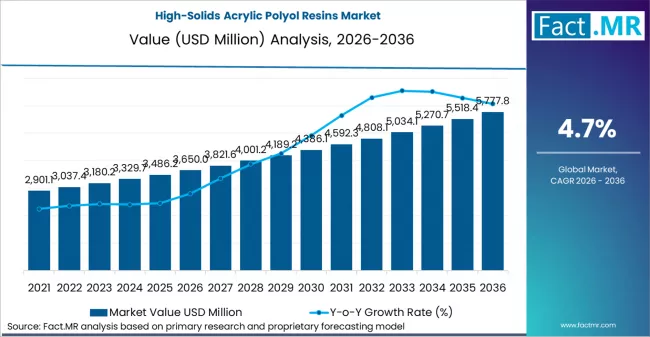
Allnex's launch of the SETALUX® FC portfolio, including resins that cure at room temperature in just 1 hour, is a major step in this transformation. The focus is on reducing energy consumption and drying times for vehicle refinish and industrial wood markets. BASF’s strategic expansion of its OEM coating capacity is focused on developing high-solids coatings for the automotive industry, especially for new color trends with superior durability. Arkema, with 70% of its facilities now ISCC PLUS certified, is advancing bio-attributed resins that align with "Green Transformation" mandates in Europe and the US.
BASF’s CEO, Martin Brudermüller, commented: “Our commitment to sustainability is reflected in our continuous innovation and investments, enabling us to provide high-performance coatings with a lower carbon footprint.”
By 2026, the market will be defined by energy-neutral curing processes, enhanced with bio-based and ISCC-certified resins, offering faster curing and low carbon impact while meeting the growing demand for ultra-durable finishes in the automotive and industrial sectors.
High-Solids Acrylic Polyol Resins Market
| Metric | Value |
|---|---|
| Estimated Value in (2026E) | USD 3,650.0 million |
| Forecast Value in (2036F) | USD 5,777.8 million |
| Forecast CAGR (2026 to 2036) | 4.7% |
Category
| Category | Segments |
|---|---|
| Resin Architecture | Solution Acrylic Polyols (High-Solids); Acrylic Polyols with Reactive Diluents; Water-Reducible High-Solids Acrylics; Other Architectures |
| Application | Industrial OEM Coatings; Automotive OEM & Refinish; Protective & Marine Coatings; Other Uses |
| Cure System Compatibility | 2K Polyurethane Systems; Melamine/Acid-Cured Systems; Other Crosslink Systems |
| End-Use Sector | Industrial Manufacturing; Automotive; Marine & Protective; Other Sectors |
| Region | North America; Europe; Asia Pacific; Latin America; Middle East & Africa |
Segmental Analysis
What Is the Impact of Resin Architecture on the High-Solids Acrylic Polyol Resins Market?
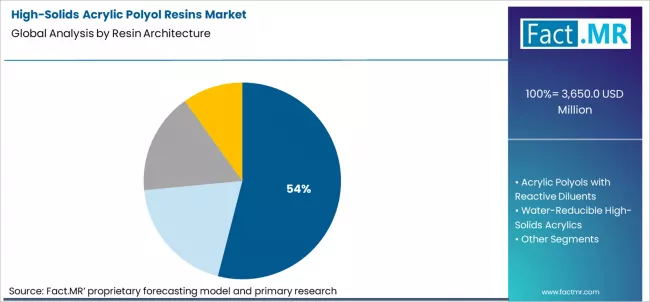
In the high-solids acrylic polyol resins market, resin architecture significantly influences the final coating performance, durability, and application flexibility. Solution acrylic polyols (high-solids) lead with a 54.0% share, as they offer high-performance properties such as excellent chemical resistance, abrasion resistance, and superior adhesion. These resins are favored in applications where high-build coatings are required, such as in industrial OEM coatings and protective coatings for harsh environments. The dominance of solution acrylic polyols is driven by their ability to provide higher solids content, reducing solvent usage and improving environmental compliance in industries facing strict VOC regulations. The versatility and ease of formulation with these resins support their use across a variety of demanding industrial applications.
How Does Application Influence Demand in the High-Solids Acrylic Polyol Resins Market?
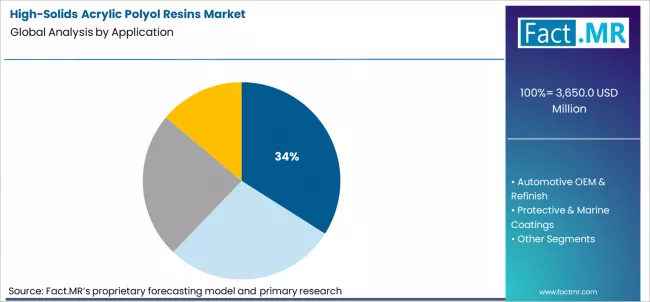
Application area is crucial in determining the resin type, as different industries require tailored properties such as durability, corrosion resistance, and adhesion strength. Industrial OEM coatings account for a 34.0% share, driven by the need for high-durability coatings in manufacturing environments that demand protection from abrasion, chemicals, and weathering. High-solids acrylic polyols provide long-lasting finishes for industrial equipment, machinery, and infrastructure, which require coatings that can withstand heavy use and environmental exposure. This segment continues to grow as industries demand more sustainable and durable solutions that offer higher solids content for improved efficiency in both production and environmental impact.
What are the Drivers, Restraints, and Key Trends in the High-Solids Acrylic Polyol Resins Market?
| Country | Driver | Restraint | Trend |
|---|---|---|---|
| USA | Strong demand from automotive and industrial coatings seeking lower VOC emissions. | Higher formulation and processing costs compared with conventional resins. | Growth in water reducible and high solids coatings with improved environmental profiles. |
| UK | Regulatory emphasis on air quality driving adoption of high solids technologies. | Limited domestic production scale for advanced acrylic polyol resins. | Collaboration between coatings manufacturers and OEMs for tailored high solids solutions. |
| Germany | Large automotive and machinery sectors requiring environmentally compliant coatings. | Stringent compliance and environmental standards increasing development complexity. | Shift toward high performance, low VOC coatings with enhanced durability. |
| China | Rapid expansion of construction and automotive industries increasing coatings demand. | Price competition from lower cost resin alternatives. | Rapid scaling of local high solids resin manufacturing and formulation innovation. |
| India | Increased focus on sustainable coatings and regulatory tightening. | Limited awareness and higher cost barriers for advanced high solids polyol adoption. | Growing imports and early local formulation development for industrial coatings. |
Analysis of the High-Solids Acrylic Polyol Resins Market by Key Country
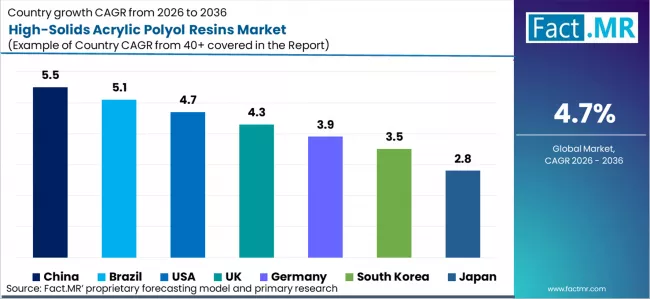
| Country | CAGR (%) |
|---|---|
| China | 5.5% |
| Brazil | 5.1% |
| USA | 4.7% |
| UK | 4.3% |
| Germany | 3.9% |
| South Korea | 3.5% |
| Japan | 2.8% |
The report covers an in-depth analysis of 40+ countries; top-performing countries are highlighted below.
How is the USA market evolving in the High Solids Acrylic Polyol Resins sector?
The USA market is forecast to grow at 4.7%, supported by demand for coatings that deliver strong performance with reduced volatile organic compound (VOC) emissions. High solids acrylic polyol resins are increasingly specified in automotive refinish, industrial maintenance, and architectural coatings where compliance with U.S. EPA VOC limits and state level low emission rules is required. According to the American Coatings Association, high solids systems help formulators achieve higher solids content without compromising film formation, durability, or gloss retention.
“High solids acrylic polyol resins balance environmental compliance with the mechanical performance that high value industrial and commercial coatings demand,” says Dr. Laura Reynolds, Senior Polymer Scientist at a U.S. coatings firm.
Replacement of solvent borne systems, combined with emphasis on safer chemistry profiles, continues to underpin moderate growth as formulators optimize low VOC architectures.
What drives growth in China for high solids acrylic polyol resins?
China is projected to grow at 5.5% CAGR, the strongest among major markets, driven by rapid urbanization, industrial expansion, and tightening air quality regulations. High solids acrylic polyol resins are used in automotive OEM coatings, general industrial finishes, and architectural systems that must meet increasingly stringent GB/T standards for VOC emissions and performance. Domestic coatings suppliers are reformulating to incorporate higher solids content while maintaining hardness, flexibility, and chemical resistance.
“In China, demand for high performance, low VOC coatings have accelerated due to regulatory drivers and rising quality expectations across infrastructure and vehicle production,” explains Li Wei, Product Director at a Chinese specialty polymers producer.
Large scale infrastructure construction and automotive production bolster ongoing uptake.
Why is the UK market important for high solids acrylic polyol resins?
The UK market is expanding at 4.3%, supported by EU aligned low emission frameworks that encourage reduced VOC content across coatings applications. High solids acrylic polyols are specified in architectural, industrial, and protective coatings where solvent reduction must be balanced with film performance and weathering resistance. The British Coatings Federation highlights that high solids technologies are central to meeting EU VOC Directive requirements without compromising coating longevity.
“Formulators in the UK prioritize resins that reduce VOC emissions while delivering robust performance in demanding environments,” says Dr. Amelia Clarke, Head of Coatings Innovation at a UK materials institute.
What fuels the rapid rise in Brazil?
Brazil’s high solids acrylic polyol resins market is forecast to grow at 5.1% CAGR, driven by growth in automotive manufacturing, infrastructure development, and decorative coatings demand. Formulators leverage high solids resins to reduce solvent use while improving throughput and coating quality. Brazilian industrial and architectural coatings producers increasingly adopt high solids systems to meet regional emission guidelines and operational efficiency goals.
“In Brazil, high performance coating systems that reduce solvent emissions while maintaining durability are becoming standard, especially in automotive and general industrial applications,” explains Ricardo Santos, Coatings Technical Manager at a Brazilian specialty chemicals supplier.
What is driving expansion in Germany?
Germany is projected to grow at 3.9% CAGR, supported by its advanced industrial base and strong environmental regulations favoring low VOC coatings. High solids acrylic polyol resins are integrated into automotive refinish, industrial protective coatings, and architectural paints that must meet exacting performance criteria while reducing emissions. German formulators emphasize resins that deliver high film build, chemical resistance, and weatherability without elevated solvent content.
“Coating specifications in Germany increasingly emphasize both performance and environmental compliance, making high solids resins a strategic choice,” says Dr. Petra Müller, Polymer Chemistry Lead at a German coatings research consortium.
How is South Korea shaping demand for high solids acrylic polyol resins?
South Korea’s market is growing at 3.5% CAGR, underpinned by demand from automotive, electronics, and industrial finishes where performance and environmental criteria are converging. High solids acrylic polyol resins support reduced VOC profiles while maintaining adhesion, flexibility, and solvent resistance, aligning with South Korean environmental guidelines. Local formulators invest in resin technologies that offer robust coatings performance with fewer regulatory liabilities.
“In high technology manufacturing environments, coatings that balance sustainability with performance are increasingly specified,” notes Min Jae Kim, Coatings Technology Specialist at a South Korean materials firm.
What fuels the gradual rise in Japan?
Japan’s high solids acrylic polyol resins market is forecast to grow at 2.8% CAGR, reflecting careful adoption in sectors where precision and low VOC performance are both priorities. Japanese formulators emphasize stability, film performance, and consistency in architectural and industrial coatings, and high solids resins help meet local environmental targets while preserving product quality. The Japan Paint Manufacturers Association highlights ongoing innovation in resin chemistry to support solvent reduction strategies without adverse impacts on mechanical performance.
“In Japan’s coatings sector, incremental enhancement of resin systems is critical to balancing environmental targets with performance expectations,” explains Hiroshi Tanaka, Senior Polymer Analyst at a Japanese coatings research institute.
Strategic Moves Are Defining Competitive Landscape?
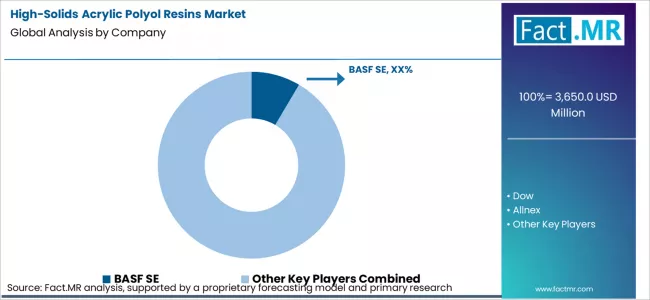
The High-Solids Acrylic Polyol Resins market is navigating a decisive shift from simple regulatory compliance toward a model of high-performance "material intelligence." Between 2020 and 2024 the industry was primarily defined by the transition away from high-VOC solvent-borne systems to meet tightening global emission standards. During this phase player like Allnex and Arkema focused on engineering resins that could achieve higher solids content without sacrificing the drying speed or haptic quality required by the automotive refinish and industrial wood sectors. This period successfully established the baseline for eco-friendly durable coatings yet it often resulted in siloed performance data that lacked real-time integration into the broader manufacturing lifecycle.
As the industry enters 2026 and beyond the strategic focus is evolving from basic durability to "Autonomous Coating Orchestration." The next frontier of value resides in the development of resins that support low-energy curing and AI-driven thermal optimization. Leading manufacturers such as BASF and Dow are increasingly prioritizing the "Zero-Downtime" factory model where resin performance is continuously monitored via digital twins. The competitive edge no longer rests on the resin's chemical properties alone but on its ability to integrate into a fully digitalized and carbon-neutral supply chain. Martin Brudermüller the former Chairman of the Board of Executive Directors at BASF previously highlighted this fundamental alignment of technology and sustainability.
"The digital transformation is a key driver for the green transformation. We are using digital tools to make our production even more efficient and sustainable while providing our customers with the data they need to achieve their own climate goals." - Martin Brudermüller, BASF
This evolution ensures that companies like Covestro and Wanhua Chemical stay ahead as the market moves toward a proactive "Asset Health" ecosystem. For leadership the priority has shifted from capital expenditure on raw materials to investing in high-fidelity simulation and predictive maintenance frameworks. Success is now measured by the ability to turn chemical precision into a measurable extension of an asset's remaining useful life and a direct lever for long-term fleet ROI.
Key Players in the High-Solids Acrylic Polyol Resins Market
- BASF SE
- Dow
- Allnex
- Arkema
- Covestro
- DIC Corporation
- Kansai Paint
- Nippon Paint Holdings
- Eastman Chemical Company
- Wanhua Chemical
Scope of the Report
| Items | Values |
|---|---|
| Quantitative Units | USD million |
| Resin Architecture | Solution Acrylic Polyols (High-Solids); Acrylic Polyols with Reactive Diluents; Water-Reducible High-Solids Acrylics; Other Architectures |
| Application | Industrial OEM Coatings; Automotive OEM & Refinish; Protective & Marine Coatings; Other Uses |
| Cure System Compatibility | 2K Polyurethane Systems; Melamine/Acid-Cured Systems; Other Crosslink Systems |
| End-Use Sector | Industrial Manufacturing; Automotive; Marine & Protective; Other Sectors |
| Regions Covered | Asia Pacific, Europe, North America, Latin America, Middle East & Africa |
| Countries Covered | China, Brazil, USA, UK, Germany, South Korea, Japan, and 40+ countries |
| Key Companies Profiled | BASF SE; Dow; Allnex; Arkema; Covestro; DIC Corporation; Kansai Paint; Nippon Paint Holdings; Eastman Chemical Company; Wanhua Chemical |
| Additional Attributes | Dollar sales by resin architecture, application, and cure system compatibility; high growth in demand for protective & marine coatings, driven by industrial and automotive sectors; innovations in water-reducible high-solids acrylics for environmentally friendly applications; significant shift towards 2K polyurethane systems for improved performance and durability in automotive OEM & refinish applications. |
High-Solids Acrylic Polyol Resins Market Key Segment
-
Resin Architecture :
- Solution Acrylic Polyols (High-Solids)
- Acrylic Polyols with Reactive Diluents
- Water-Reducible High-Solids Acrylics
- Other Architectures
-
Application :
- Industrial OEM Coatings
- Automotive OEM & Refinish
- Protective & Marine Coatings
- Other Uses
-
Cure System Compatibility :
- 2K Polyurethane Systems
- Melamine/Acid-Cured Systems
- Other Crosslink Systems
-
End-Use Sector :
- Industrial Manufacturing
- Automotive
- Marine & Protective
- Other Sectors
-
Region :
- North America
- USA
- Canada
- Mexico
- Europe
- Germany
- UK
- France
- Italy
- Spain
- Nordic Countries
- BENELUX
- Rest of Europe
- Asia Pacific
- China
- Japan
- South Korea
- India
- Australia
- Rest of Asia Pacific
- Latin America
- Brazil
- Argentina
- Rest of Latin America
- Middle East and Africa
- Kingdom of Saudi Arabia
- United Arab Emirates
- South Africa
- Rest of Middle East and Africa
- Other Regions
- Oceania
- Central Asia
- Other Markets
- North America
Bibliographies
- United States Environmental Protection Agency. (2023). National VOC emission standards for industrial and automotive coatings. U.S. EPA.
- European Chemicals Agency. (2024). VOC reduction pathways and solvent substitution under REACH for coating systems. ECHA.
- International Organization for Standardization. (2023). Paints and varnishes-Determination of volatile organic compound (VOC) content (ISO 11890-1:2023). ISO.
- American Coatings Association. (2024). High-solids and low-VOC resin technologies in industrial and automotive coatings. ACA Technical Bulletin.
- BASF SE. (2024). High-solids acrylic polyol resins for automotive OEM and industrial coatings. BASF Coatings Technical Documentation.
Table of Content
- Executive Summary
- Global Market Outlook
- Demand to side Trends
- Supply to side Trends
- Technology Roadmap Analysis
- Analysis and Recommendations
- Market Overview
- Market Coverage / Taxonomy
- Market Definition / Scope / Limitations
- Research Methodology
- Chapter Orientation
- Analytical Lens and Working Hypotheses
- Market Structure, Signals, and Trend Drivers
- Benchmarking and Cross-market Comparability
- Market Sizing, Forecasting, and Opportunity Mapping
- Research Design and Evidence Framework
- Desk Research Programme (Secondary Evidence)
- Company Annual and Sustainability Reports
- Peer-reviewed Journals and Academic Literature
- Corporate Websites, Product Literature, and Technical Notes
- Earnings Decks and Investor Briefings
- Statutory Filings and Regulatory Disclosures
- Technical White Papers and Standards Notes
- Trade Journals, Industry Magazines, and Analyst Briefs
- Conference Proceedings, Webinars, and Seminar Materials
- Government Statistics Portals and Public Data Releases
- Press Releases and Reputable Media Coverage
- Specialist Newsletters and Curated Briefings
- Sector Databases and Reference Repositories
- FMR Internal Proprietary Databases and Historical Market Datasets
- Subscription Datasets and Paid Sources
- Social Channels, Communities, and Digital Listening Inputs
- Additional Desk Sources
- Expert Input and Fieldwork (Primary Evidence)
- Primary Modes
- Qualitative Interviews and Expert Elicitation
- Quantitative Surveys and Structured Data Capture
- Blended Approach
- Why Primary Evidence is Used
- Field Techniques
- Interviews
- Surveys
- Focus Groups
- Observational and In-context Research
- Social and Community Interactions
- Stakeholder Universe Engaged
- C-suite Leaders
- Board Members
- Presidents and Vice Presidents
- R&D and Innovation Heads
- Technical Specialists
- Domain Subject-matter Experts
- Scientists
- Physicians and Other Healthcare Professionals
- Governance, Ethics, and Data Stewardship
- Research Ethics
- Data Integrity and Handling
- Primary Modes
- Tooling, Models, and Reference Databases
- Desk Research Programme (Secondary Evidence)
- Data Engineering and Model Build
- Data Acquisition and Ingestion
- Cleaning, Normalisation, and Verification
- Synthesis, Triangulation, and Analysis
- Quality Assurance and Audit Trail
- Market Background
- Market Dynamics
- Drivers
- Restraints
- Opportunity
- Trends
- Scenario Forecast
- Demand in Optimistic Scenario
- Demand in Likely Scenario
- Demand in Conservative Scenario
- Opportunity Map Analysis
- Product Life Cycle Analysis
- Supply Chain Analysis
- Investment Feasibility Matrix
- Value Chain Analysis
- PESTLE and Porter’s Analysis
- Regulatory Landscape
- Regional Parent Market Outlook
- Production and Consumption Statistics
- Import and Export Statistics
- Market Dynamics
- Global Market Analysis 2021 to 2025 and Forecast, 2026 to 2036
- Historical Market Size Value (USD Million) Analysis, 2021 to 2025
- Current and Future Market Size Value (USD Million) Projections, 2026 to 2036
- Y to o to Y Growth Trend Analysis
- Absolute $ Opportunity Analysis
- Global Market Pricing Analysis 2021 to 2025 and Forecast 2026 to 2036
- Global Market Analysis 2021 to 2025 and Forecast 2026 to 2036, By Resin Architecture
- Introduction / Key Findings
- Historical Market Size Value (USD Million) Analysis By Resin Architecture, 2021 to 2025
- Current and Future Market Size Value (USD Million) Analysis and Forecast By Resin Architecture, 2026 to 2036
- Solution Acrylic Polyols (High-Solids)
- Acrylic Polyols with Reactive Diluents
- Water-Reducible High-Solids Acrylics
- Other Architectures
- Solution Acrylic Polyols (High-Solids)
- Y to o to Y Growth Trend Analysis By Resin Architecture, 2021 to 2025
- Absolute $ Opportunity Analysis By Resin Architecture, 2026 to 2036
- Global Market Analysis 2021 to 2025 and Forecast 2026 to 2036, By Application
- Introduction / Key Findings
- Historical Market Size Value (USD Million) Analysis By Application, 2021 to 2025
- Current and Future Market Size Value (USD Million) Analysis and Forecast By Application, 2026 to 2036
- Industrial OEM Coatings
- Automotive OEM & Refinish
- Protective & Marine Coatings
- Other Uses
- Industrial OEM Coatings
- Y to o to Y Growth Trend Analysis By Application, 2021 to 2025
- Absolute $ Opportunity Analysis By Application, 2026 to 2036
- Global Market Analysis 2021 to 2025 and Forecast 2026 to 2036, By Cure System Compatibility
- Introduction / Key Findings
- Historical Market Size Value (USD Million) Analysis By Cure System Compatibility, 2021 to 2025
- Current and Future Market Size Value (USD Million) Analysis and Forecast By Cure System Compatibility, 2026 to 2036
- 2K Polyurethane Systems
- Melamine/Acid-Cured Systems
- Other Crosslink Systems
- 2K Polyurethane Systems
- Y to o to Y Growth Trend Analysis By Cure System Compatibility, 2021 to 2025
- Absolute $ Opportunity Analysis By Cure System Compatibility, 2026 to 2036
- Global Market Analysis 2021 to 2025 and Forecast 2026 to 2036, By End-Use Sector
- Introduction / Key Findings
- Historical Market Size Value (USD Million) Analysis By End-Use Sector, 2021 to 2025
- Current and Future Market Size Value (USD Million) Analysis and Forecast By End-Use Sector, 2026 to 2036
- Industrial Manufacturing
- Automotive
- Marine & Protective
- Other Sectors
- Industrial Manufacturing
- Y to o to Y Growth Trend Analysis By End-Use Sector, 2021 to 2025
- Absolute $ Opportunity Analysis By End-Use Sector, 2026 to 2036
- Global Market Analysis 2021 to 2025 and Forecast 2026 to 2036, By Region
- Introduction
- Historical Market Size Value (USD Million) Analysis By Region, 2021 to 2025
- Current Market Size Value (USD Million) Analysis and Forecast By Region, 2026 to 2036
- North America
- Latin America
- Western Europe
- Eastern Europe
- East Asia
- South Asia and Pacific
- Middle East & Africa
- Market Attractiveness Analysis By Region
- North America Market Analysis 2021 to 2025 and Forecast 2026 to 2036, By Country
- Historical Market Size Value (USD Million) Trend Analysis By Market Taxonomy, 2021 to 2025
- Market Size Value (USD Million) Forecast By Market Taxonomy, 2026 to 2036
- By Country
- USA
- Canada
- Mexico
- By Resin Architecture
- By Application
- By Cure System Compatibility
- By End-Use Sector
- By Country
- Market Attractiveness Analysis
- By Country
- By Resin Architecture
- By Application
- By Cure System Compatibility
- By End-Use Sector
- Key Takeaways
- Latin America Market Analysis 2021 to 2025 and Forecast 2026 to 2036, By Country
- Historical Market Size Value (USD Million) Trend Analysis By Market Taxonomy, 2021 to 2025
- Market Size Value (USD Million) Forecast By Market Taxonomy, 2026 to 2036
- By Country
- Brazil
- Chile
- Rest of Latin America
- By Resin Architecture
- By Application
- By Cure System Compatibility
- By End-Use Sector
- By Country
- Market Attractiveness Analysis
- By Country
- By Resin Architecture
- By Application
- By Cure System Compatibility
- By End-Use Sector
- Key Takeaways
- Western Europe Market Analysis 2021 to 2025 and Forecast 2026 to 2036, By Country
- Historical Market Size Value (USD Million) Trend Analysis By Market Taxonomy, 2021 to 2025
- Market Size Value (USD Million) Forecast By Market Taxonomy, 2026 to 2036
- By Country
- Germany
- UK
- Italy
- Spain
- France
- Nordic
- BENELUX
- Rest of Western Europe
- By Resin Architecture
- By Application
- By Cure System Compatibility
- By End-Use Sector
- By Country
- Market Attractiveness Analysis
- By Country
- By Resin Architecture
- By Application
- By Cure System Compatibility
- By End-Use Sector
- Key Takeaways
- Eastern Europe Market Analysis 2021 to 2025 and Forecast 2026 to 2036, By Country
- Historical Market Size Value (USD Million) Trend Analysis By Market Taxonomy, 2021 to 2025
- Market Size Value (USD Million) Forecast By Market Taxonomy, 2026 to 2036
- By Country
- Russia
- Poland
- Hungary
- Balkan & Baltic
- Rest of Eastern Europe
- By Resin Architecture
- By Application
- By Cure System Compatibility
- By End-Use Sector
- By Country
- Market Attractiveness Analysis
- By Country
- By Resin Architecture
- By Application
- By Cure System Compatibility
- By End-Use Sector
- Key Takeaways
- East Asia Market Analysis 2021 to 2025 and Forecast 2026 to 2036, By Country
- Historical Market Size Value (USD Million) Trend Analysis By Market Taxonomy, 2021 to 2025
- Market Size Value (USD Million) Forecast By Market Taxonomy, 2026 to 2036
- By Country
- China
- Japan
- South Korea
- By Resin Architecture
- By Application
- By Cure System Compatibility
- By End-Use Sector
- By Country
- Market Attractiveness Analysis
- By Country
- By Resin Architecture
- By Application
- By Cure System Compatibility
- By End-Use Sector
- Key Takeaways
- South Asia and Pacific Market Analysis 2021 to 2025 and Forecast 2026 to 2036, By Country
- Historical Market Size Value (USD Million) Trend Analysis By Market Taxonomy, 2021 to 2025
- Market Size Value (USD Million) Forecast By Market Taxonomy, 2026 to 2036
- By Country
- India
- ASEAN
- Australia & New Zealand
- Rest of South Asia and Pacific
- By Resin Architecture
- By Application
- By Cure System Compatibility
- By End-Use Sector
- By Country
- Market Attractiveness Analysis
- By Country
- By Resin Architecture
- By Application
- By Cure System Compatibility
- By End-Use Sector
- Key Takeaways
- Middle East & Africa Market Analysis 2021 to 2025 and Forecast 2026 to 2036, By Country
- Historical Market Size Value (USD Million) Trend Analysis By Market Taxonomy, 2021 to 2025
- Market Size Value (USD Million) Forecast By Market Taxonomy, 2026 to 2036
- By Country
- Kingdom of Saudi Arabia
- Other GCC Countries
- Turkiye
- South Africa
- Other African Union
- Rest of Middle East & Africa
- By Resin Architecture
- By Application
- By Cure System Compatibility
- By End-Use Sector
- By Country
- Market Attractiveness Analysis
- By Country
- By Resin Architecture
- By Application
- By Cure System Compatibility
- By End-Use Sector
- Key Takeaways
- Key Countries Market Analysis
- USA
- Pricing Analysis
- Market Share Analysis, 2025
- By Resin Architecture
- By Application
- By Cure System Compatibility
- By End-Use Sector
- Canada
- Pricing Analysis
- Market Share Analysis, 2025
- By Resin Architecture
- By Application
- By Cure System Compatibility
- By End-Use Sector
- Mexico
- Pricing Analysis
- Market Share Analysis, 2025
- By Resin Architecture
- By Application
- By Cure System Compatibility
- By End-Use Sector
- Brazil
- Pricing Analysis
- Market Share Analysis, 2025
- By Resin Architecture
- By Application
- By Cure System Compatibility
- By End-Use Sector
- Chile
- Pricing Analysis
- Market Share Analysis, 2025
- By Resin Architecture
- By Application
- By Cure System Compatibility
- By End-Use Sector
- Germany
- Pricing Analysis
- Market Share Analysis, 2025
- By Resin Architecture
- By Application
- By Cure System Compatibility
- By End-Use Sector
- UK
- Pricing Analysis
- Market Share Analysis, 2025
- By Resin Architecture
- By Application
- By Cure System Compatibility
- By End-Use Sector
- Italy
- Pricing Analysis
- Market Share Analysis, 2025
- By Resin Architecture
- By Application
- By Cure System Compatibility
- By End-Use Sector
- Spain
- Pricing Analysis
- Market Share Analysis, 2025
- By Resin Architecture
- By Application
- By Cure System Compatibility
- By End-Use Sector
- France
- Pricing Analysis
- Market Share Analysis, 2025
- By Resin Architecture
- By Application
- By Cure System Compatibility
- By End-Use Sector
- India
- Pricing Analysis
- Market Share Analysis, 2025
- By Resin Architecture
- By Application
- By Cure System Compatibility
- By End-Use Sector
- ASEAN
- Pricing Analysis
- Market Share Analysis, 2025
- By Resin Architecture
- By Application
- By Cure System Compatibility
- By End-Use Sector
- Australia & New Zealand
- Pricing Analysis
- Market Share Analysis, 2025
- By Resin Architecture
- By Application
- By Cure System Compatibility
- By End-Use Sector
- China
- Pricing Analysis
- Market Share Analysis, 2025
- By Resin Architecture
- By Application
- By Cure System Compatibility
- By End-Use Sector
- Japan
- Pricing Analysis
- Market Share Analysis, 2025
- By Resin Architecture
- By Application
- By Cure System Compatibility
- By End-Use Sector
- South Korea
- Pricing Analysis
- Market Share Analysis, 2025
- By Resin Architecture
- By Application
- By Cure System Compatibility
- By End-Use Sector
- Russia
- Pricing Analysis
- Market Share Analysis, 2025
- By Resin Architecture
- By Application
- By Cure System Compatibility
- By End-Use Sector
- Poland
- Pricing Analysis
- Market Share Analysis, 2025
- By Resin Architecture
- By Application
- By Cure System Compatibility
- By End-Use Sector
- Hungary
- Pricing Analysis
- Market Share Analysis, 2025
- By Resin Architecture
- By Application
- By Cure System Compatibility
- By End-Use Sector
- Kingdom of Saudi Arabia
- Pricing Analysis
- Market Share Analysis, 2025
- By Resin Architecture
- By Application
- By Cure System Compatibility
- By End-Use Sector
- Turkiye
- Pricing Analysis
- Market Share Analysis, 2025
- By Resin Architecture
- By Application
- By Cure System Compatibility
- By End-Use Sector
- South Africa
- Pricing Analysis
- Market Share Analysis, 2025
- By Resin Architecture
- By Application
- By Cure System Compatibility
- By End-Use Sector
- USA
- Market Structure Analysis
- Competition Dashboard
- Competition Benchmarking
- Market Share Analysis of Top Players
- By Regional
- By Resin Architecture
- By Application
- By Cure System Compatibility
- By End-Use Sector
- Competition Analysis
- Competition Deep Dive
- BASF SE
- Overview
- Product Portfolio
- Profitability by Market Segments (Product/Age /Sales Channel/Region)
- Sales Footprint
- Strategy Overview
- Marketing Strategy
- Product Strategy
- Channel Strategy
- Dow
- Allnex
- Arkema
- Covestro
- DIC Corporation
- Kansai Paint
- Nippon Paint Holdings
- Eastman Chemical Company
- Wanhua Chemical
- BASF SE
- Competition Deep Dive
- Assumptions & Acronyms Used
List Of Table
- Table 1: Global Market Value (USD Million) Forecast by Region, 2021 to 2036
- Table 2: Global Market Value (USD Million) Forecast by Resin Architecture, 2021 to 2036
- Table 3: Global Market Value (USD Million) Forecast by Application, 2021 to 2036
- Table 4: Global Market Value (USD Million) Forecast by Cure System Compatibility, 2021 to 2036
- Table 5: Global Market Value (USD Million) Forecast by End-Use Sector, 2021 to 2036
- Table 6: North America Market Value (USD Million) Forecast by Country, 2021 to 2036
- Table 7: North America Market Value (USD Million) Forecast by Resin Architecture, 2021 to 2036
- Table 8: North America Market Value (USD Million) Forecast by Application, 2021 to 2036
- Table 9: North America Market Value (USD Million) Forecast by Cure System Compatibility, 2021 to 2036
- Table 10: North America Market Value (USD Million) Forecast by End-Use Sector, 2021 to 2036
- Table 11: Latin America Market Value (USD Million) Forecast by Country, 2021 to 2036
- Table 12: Latin America Market Value (USD Million) Forecast by Resin Architecture, 2021 to 2036
- Table 13: Latin America Market Value (USD Million) Forecast by Application, 2021 to 2036
- Table 14: Latin America Market Value (USD Million) Forecast by Cure System Compatibility, 2021 to 2036
- Table 15: Latin America Market Value (USD Million) Forecast by End-Use Sector, 2021 to 2036
- Table 16: Western Europe Market Value (USD Million) Forecast by Country, 2021 to 2036
- Table 17: Western Europe Market Value (USD Million) Forecast by Resin Architecture, 2021 to 2036
- Table 18: Western Europe Market Value (USD Million) Forecast by Application, 2021 to 2036
- Table 19: Western Europe Market Value (USD Million) Forecast by Cure System Compatibility, 2021 to 2036
- Table 20: Western Europe Market Value (USD Million) Forecast by End-Use Sector, 2021 to 2036
- Table 21: Eastern Europe Market Value (USD Million) Forecast by Country, 2021 to 2036
- Table 22: Eastern Europe Market Value (USD Million) Forecast by Resin Architecture, 2021 to 2036
- Table 23: Eastern Europe Market Value (USD Million) Forecast by Application, 2021 to 2036
- Table 24: Eastern Europe Market Value (USD Million) Forecast by Cure System Compatibility, 2021 to 2036
- Table 25: Eastern Europe Market Value (USD Million) Forecast by End-Use Sector, 2021 to 2036
- Table 26: East Asia Market Value (USD Million) Forecast by Country, 2021 to 2036
- Table 27: East Asia Market Value (USD Million) Forecast by Resin Architecture, 2021 to 2036
- Table 28: East Asia Market Value (USD Million) Forecast by Application, 2021 to 2036
- Table 29: East Asia Market Value (USD Million) Forecast by Cure System Compatibility, 2021 to 2036
- Table 30: East Asia Market Value (USD Million) Forecast by End-Use Sector, 2021 to 2036
- Table 31: South Asia and Pacific Market Value (USD Million) Forecast by Country, 2021 to 2036
- Table 32: South Asia and Pacific Market Value (USD Million) Forecast by Resin Architecture, 2021 to 2036
- Table 33: South Asia and Pacific Market Value (USD Million) Forecast by Application, 2021 to 2036
- Table 34: South Asia and Pacific Market Value (USD Million) Forecast by Cure System Compatibility, 2021 to 2036
- Table 35: South Asia and Pacific Market Value (USD Million) Forecast by End-Use Sector, 2021 to 2036
- Table 36: Middle East & Africa Market Value (USD Million) Forecast by Country, 2021 to 2036
- Table 37: Middle East & Africa Market Value (USD Million) Forecast by Resin Architecture, 2021 to 2036
- Table 38: Middle East & Africa Market Value (USD Million) Forecast by Application, 2021 to 2036
- Table 39: Middle East & Africa Market Value (USD Million) Forecast by Cure System Compatibility, 2021 to 2036
- Table 40: Middle East & Africa Market Value (USD Million) Forecast by End-Use Sector, 2021 to 2036
List Of Figures
- Figure 1: Global Market Pricing Analysis
- Figure 2: Global Market Value (USD Million) Forecast 2021 to 2036
- Figure 3: Global Market Value Share and BPS Analysis by Resin Architecture, 2026 and 2036
- Figure 4: Global Market Y to o to Y Growth Comparison by Resin Architecture, 2026 to 2036
- Figure 5: Global Market Attractiveness Analysis by Resin Architecture
- Figure 6: Global Market Value Share and BPS Analysis by Application, 2026 and 2036
- Figure 7: Global Market Y to o to Y Growth Comparison by Application, 2026 to 2036
- Figure 8: Global Market Attractiveness Analysis by Application
- Figure 9: Global Market Value Share and BPS Analysis by Cure System Compatibility, 2026 and 2036
- Figure 10: Global Market Y to o to Y Growth Comparison by Cure System Compatibility, 2026 to 2036
- Figure 11: Global Market Attractiveness Analysis by Cure System Compatibility
- Figure 12: Global Market Value Share and BPS Analysis by End-Use Sector, 2026 and 2036
- Figure 13: Global Market Y to o to Y Growth Comparison by End-Use Sector, 2026 to 2036
- Figure 14: Global Market Attractiveness Analysis by End-Use Sector
- Figure 15: Global Market Value (USD Million) Share and BPS Analysis by Region, 2026 and 2036
- Figure 16: Global Market Y to o to Y Growth Comparison by Region, 2026 to 2036
- Figure 17: Global Market Attractiveness Analysis by Region
- Figure 18: North America Market Incremental Dollar Opportunity, 2026 to 2036
- Figure 19: Latin America Market Incremental Dollar Opportunity, 2026 to 2036
- Figure 20: Western Europe Market Incremental Dollar Opportunity, 2026 to 2036
- Figure 21: Eastern Europe Market Incremental Dollar Opportunity, 2026 to 2036
- Figure 22: East Asia Market Incremental Dollar Opportunity, 2026 to 2036
- Figure 23: South Asia and Pacific Market Incremental Dollar Opportunity, 2026 to 2036
- Figure 24: Middle East & Africa Market Incremental Dollar Opportunity, 2026 to 2036
- Figure 25: North America Market Value Share and BPS Analysis by Country, 2026 and 2036
- Figure 26: North America Market Value Share and BPS Analysis by Resin Architecture, 2026 and 2036
- Figure 27: North America Market Y to o to Y Growth Comparison by Resin Architecture, 2026 to 2036
- Figure 28: North America Market Attractiveness Analysis by Resin Architecture
- Figure 29: North America Market Value Share and BPS Analysis by Application, 2026 and 2036
- Figure 30: North America Market Y to o to Y Growth Comparison by Application, 2026 to 2036
- Figure 31: North America Market Attractiveness Analysis by Application
- Figure 32: North America Market Value Share and BPS Analysis by Cure System Compatibility, 2026 and 2036
- Figure 33: North America Market Y to o to Y Growth Comparison by Cure System Compatibility, 2026 to 2036
- Figure 34: North America Market Attractiveness Analysis by Cure System Compatibility
- Figure 35: North America Market Value Share and BPS Analysis by End-Use Sector, 2026 and 2036
- Figure 36: North America Market Y to o to Y Growth Comparison by End-Use Sector, 2026 to 2036
- Figure 37: North America Market Attractiveness Analysis by End-Use Sector
- Figure 38: Latin America Market Value Share and BPS Analysis by Country, 2026 and 2036
- Figure 39: Latin America Market Value Share and BPS Analysis by Resin Architecture, 2026 and 2036
- Figure 40: Latin America Market Y to o to Y Growth Comparison by Resin Architecture, 2026 to 2036
- Figure 41: Latin America Market Attractiveness Analysis by Resin Architecture
- Figure 42: Latin America Market Value Share and BPS Analysis by Application, 2026 and 2036
- Figure 43: Latin America Market Y to o to Y Growth Comparison by Application, 2026 to 2036
- Figure 44: Latin America Market Attractiveness Analysis by Application
- Figure 45: Latin America Market Value Share and BPS Analysis by Cure System Compatibility, 2026 and 2036
- Figure 46: Latin America Market Y to o to Y Growth Comparison by Cure System Compatibility, 2026 to 2036
- Figure 47: Latin America Market Attractiveness Analysis by Cure System Compatibility
- Figure 48: Latin America Market Value Share and BPS Analysis by End-Use Sector, 2026 and 2036
- Figure 49: Latin America Market Y to o to Y Growth Comparison by End-Use Sector, 2026 to 2036
- Figure 50: Latin America Market Attractiveness Analysis by End-Use Sector
- Figure 51: Western Europe Market Value Share and BPS Analysis by Country, 2026 and 2036
- Figure 52: Western Europe Market Value Share and BPS Analysis by Resin Architecture, 2026 and 2036
- Figure 53: Western Europe Market Y to o to Y Growth Comparison by Resin Architecture, 2026 to 2036
- Figure 54: Western Europe Market Attractiveness Analysis by Resin Architecture
- Figure 55: Western Europe Market Value Share and BPS Analysis by Application, 2026 and 2036
- Figure 56: Western Europe Market Y to o to Y Growth Comparison by Application, 2026 to 2036
- Figure 57: Western Europe Market Attractiveness Analysis by Application
- Figure 58: Western Europe Market Value Share and BPS Analysis by Cure System Compatibility, 2026 and 2036
- Figure 59: Western Europe Market Y to o to Y Growth Comparison by Cure System Compatibility, 2026 to 2036
- Figure 60: Western Europe Market Attractiveness Analysis by Cure System Compatibility
- Figure 61: Western Europe Market Value Share and BPS Analysis by End-Use Sector, 2026 and 2036
- Figure 62: Western Europe Market Y to o to Y Growth Comparison by End-Use Sector, 2026 to 2036
- Figure 63: Western Europe Market Attractiveness Analysis by End-Use Sector
- Figure 64: Eastern Europe Market Value Share and BPS Analysis by Country, 2026 and 2036
- Figure 65: Eastern Europe Market Value Share and BPS Analysis by Resin Architecture, 2026 and 2036
- Figure 66: Eastern Europe Market Y to o to Y Growth Comparison by Resin Architecture, 2026 to 2036
- Figure 67: Eastern Europe Market Attractiveness Analysis by Resin Architecture
- Figure 68: Eastern Europe Market Value Share and BPS Analysis by Application, 2026 and 2036
- Figure 69: Eastern Europe Market Y to o to Y Growth Comparison by Application, 2026 to 2036
- Figure 70: Eastern Europe Market Attractiveness Analysis by Application
- Figure 71: Eastern Europe Market Value Share and BPS Analysis by Cure System Compatibility, 2026 and 2036
- Figure 72: Eastern Europe Market Y to o to Y Growth Comparison by Cure System Compatibility, 2026 to 2036
- Figure 73: Eastern Europe Market Attractiveness Analysis by Cure System Compatibility
- Figure 74: Eastern Europe Market Value Share and BPS Analysis by End-Use Sector, 2026 and 2036
- Figure 75: Eastern Europe Market Y to o to Y Growth Comparison by End-Use Sector, 2026 to 2036
- Figure 76: Eastern Europe Market Attractiveness Analysis by End-Use Sector
- Figure 77: East Asia Market Value Share and BPS Analysis by Country, 2026 and 2036
- Figure 78: East Asia Market Value Share and BPS Analysis by Resin Architecture, 2026 and 2036
- Figure 79: East Asia Market Y to o to Y Growth Comparison by Resin Architecture, 2026 to 2036
- Figure 80: East Asia Market Attractiveness Analysis by Resin Architecture
- Figure 81: East Asia Market Value Share and BPS Analysis by Application, 2026 and 2036
- Figure 82: East Asia Market Y to o to Y Growth Comparison by Application, 2026 to 2036
- Figure 83: East Asia Market Attractiveness Analysis by Application
- Figure 84: East Asia Market Value Share and BPS Analysis by Cure System Compatibility, 2026 and 2036
- Figure 85: East Asia Market Y to o to Y Growth Comparison by Cure System Compatibility, 2026 to 2036
- Figure 86: East Asia Market Attractiveness Analysis by Cure System Compatibility
- Figure 87: East Asia Market Value Share and BPS Analysis by End-Use Sector, 2026 and 2036
- Figure 88: East Asia Market Y to o to Y Growth Comparison by End-Use Sector, 2026 to 2036
- Figure 89: East Asia Market Attractiveness Analysis by End-Use Sector
- Figure 90: South Asia and Pacific Market Value Share and BPS Analysis by Country, 2026 and 2036
- Figure 91: South Asia and Pacific Market Value Share and BPS Analysis by Resin Architecture, 2026 and 2036
- Figure 92: South Asia and Pacific Market Y to o to Y Growth Comparison by Resin Architecture, 2026 to 2036
- Figure 93: South Asia and Pacific Market Attractiveness Analysis by Resin Architecture
- Figure 94: South Asia and Pacific Market Value Share and BPS Analysis by Application, 2026 and 2036
- Figure 95: South Asia and Pacific Market Y to o to Y Growth Comparison by Application, 2026 to 2036
- Figure 96: South Asia and Pacific Market Attractiveness Analysis by Application
- Figure 97: South Asia and Pacific Market Value Share and BPS Analysis by Cure System Compatibility, 2026 and 2036
- Figure 98: South Asia and Pacific Market Y to o to Y Growth Comparison by Cure System Compatibility, 2026 to 2036
- Figure 99: South Asia and Pacific Market Attractiveness Analysis by Cure System Compatibility
- Figure 100: South Asia and Pacific Market Value Share and BPS Analysis by End-Use Sector, 2026 and 2036
- Figure 101: South Asia and Pacific Market Y to o to Y Growth Comparison by End-Use Sector, 2026 to 2036
- Figure 102: South Asia and Pacific Market Attractiveness Analysis by End-Use Sector
- Figure 103: Middle East & Africa Market Value Share and BPS Analysis by Country, 2026 and 2036
- Figure 104: Middle East & Africa Market Value Share and BPS Analysis by Resin Architecture, 2026 and 2036
- Figure 105: Middle East & Africa Market Y to o to Y Growth Comparison by Resin Architecture, 2026 to 2036
- Figure 106: Middle East & Africa Market Attractiveness Analysis by Resin Architecture
- Figure 107: Middle East & Africa Market Value Share and BPS Analysis by Application, 2026 and 2036
- Figure 108: Middle East & Africa Market Y to o to Y Growth Comparison by Application, 2026 to 2036
- Figure 109: Middle East & Africa Market Attractiveness Analysis by Application
- Figure 110: Middle East & Africa Market Value Share and BPS Analysis by Cure System Compatibility, 2026 and 2036
- Figure 111: Middle East & Africa Market Y to o to Y Growth Comparison by Cure System Compatibility, 2026 to 2036
- Figure 112: Middle East & Africa Market Attractiveness Analysis by Cure System Compatibility
- Figure 113: Middle East & Africa Market Value Share and BPS Analysis by End-Use Sector, 2026 and 2036
- Figure 114: Middle East & Africa Market Y to o to Y Growth Comparison by End-Use Sector, 2026 to 2036
- Figure 115: Middle East & Africa Market Attractiveness Analysis by End-Use Sector
- Figure 116: Global Market - Tier Structure Analysis
- Figure 117: Global Market - Company Share Analysis
- FAQs -
How big is the high-solids acrylic polyol resins market in 2026?
The global high-solids acrylic polyol resins market is estimated to be valued at USD 3,650.0 million in 2026.
What will be the size of high-solids acrylic polyol resins market in 2036?
The market size for the high-solids acrylic polyol resins market is projected to reach USD 5,777.8 million by 2036.
How much will be the high-solids acrylic polyol resins market growth between 2026 and 2036?
The high-solids acrylic polyol resins market is expected to grow at a 4.7?GR between 2026 and 2036.
What are the key product types in the high-solids acrylic polyol resins market?
The key product types in high-solids acrylic polyol resins market are solution acrylic polyols (high-solids), acrylic polyols with reactive diluents, water-reducible high-solids acrylics and other architectures.
Which application segment to contribute significant share in the high-solids acrylic polyol resins market in 2026?
In terms of application, industrial oem coatings segment to command 34.0% share in the high-solids acrylic polyol resins market in 2026.