- Market Value (2025): USD 1.6 Bn
- Estimated Value (2026): USD 1.7 Bn
- Forecast Value (2036): USD 3.6 Bn
- CAGR (2026-2036): 8.0%
What is the High-Stability Frying Fats Market forecast to be worth by 2036?
USD 1.7 billion in 2026 to USD 3.6 billion by 2036 at 8.0% CAGR.
- The High-Stability Frying Fats Market reached USD 1.6 billion in 2025.
- Demand is projected to increase from USD 1.7 billion in 2026 to USD 3.6 billion by 2036.
- The market is forecast to record an 8.0% CAGR from 2026 to 2036 as foodservice chains, bakeries and confectionery manufacturers require fats that protect texture after heat exposure.
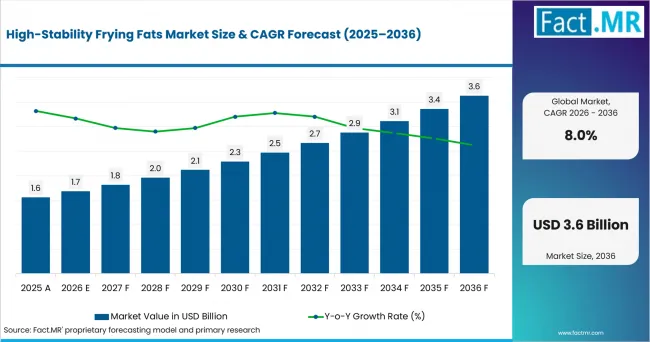
High Stability Frying Fats Market Value Analysis | Source: Fact.MR
What are the defining numbers behind High-Stability Frying Fats Market growth?
An absolute opportunity of USD 1.9 billion is expected between 2026 and 2036.
- Demand Drivers in the Market
- Foodservice chains need fryer media that holds flavor and color across long service windows.
- Oil refiners need predictable soybean and palm fraction supply so lauric and blended systems can meet plant trials with stable specifications.
- Confectionery manufacturers need fat systems that control bloom resistance in coatings and fillings where cocoa-butter cost pressure affects product margin.
- Prepared-food plants need block and liquid formats that meter cleanly into frying, coating and release applications with limited line downtime.
- Key Segments Analyzed
- By Fat System: Lauric is expected to hold 38.0% share in 2026 because quick set, clean melt and coating stability keep it central to confectionery and bakery fats.
- By Function: Heat stability is projected to account for 41.0% share in 2026 as fryer turnover, color retention and low oil weeping shape procurement tests.
- By Application: Confectionery is anticipated to capture 37.0% share in 2026 due to coating, filling and compound chocolate uses that need controlled crystallization.
- By Form: Blocks are estimated to represent 36.0% share in 2026 owing to dosing control and easier handling in bakeries, snack lines and confectionery plants.
- Analyst Opinion at Fact.MR
- Shambhu Nath Jha, Principal Consultant at Fact.MR, states, "Frying fats are moving into a performance-test market. Buyers ask how a fat behaves after heat, holding and transport because sensory failure is costly. Suppliers are expected to combine consistent melt profiles, fryer-life evidence and supply documents that shorten plant approval."
- Strategic Implications
- Refiners should document peroxide control, polymer behavior and sensory carryover so foodservice and snack accounts can compare stability across frying cycles.
- Ingredient distributors should offer block, flake and liquid options that match customer dosing systems and fit existing plant layouts.
- Confectionery formulators should test bloom resistance and snap performance before replacing standard fats in coatings or filled bars.
The USA is forecast to post 8.8% CAGR through 2036 supported by foodservice scale and soybean acreage. Germany is expected to record 8.4% CAGR due to processed-food depth and confectionery output. Japan is anticipated to reach 7.8% CAGR as convenience foods and export-oriented packaged foods require stable textures. France is projected to advance at 7.5% CAGR with oilseed supply and bakery-processing capacity. Brazil is estimated to grow at 7.2% CAGR as soybean output supports local refining economics.
How does the High-Stability Frying Fats Market break down by segment?
Heat stability leads Function at 41.0%; Lauric leads Fat System at 38.0%.
Which Fat System dominates?
Lauric is expected to hold 38.0% share in 2026.
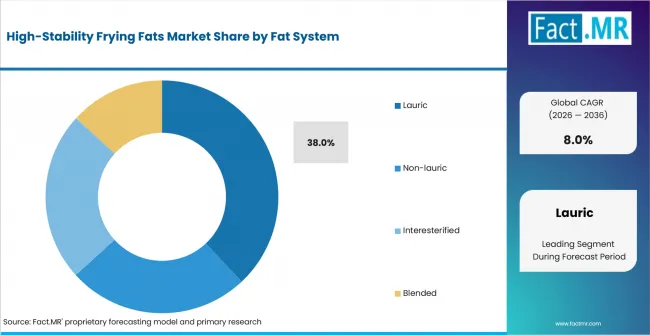
High Stability Frying Fats Market Analysis By Fat System | Source: Fact.MR
Lauric systems lead because they set quickly and support coatings that need gloss, snap and clean release. Their role is strongest in compound coatings, filled bars and bakery inclusions where cooling time affects line speed and surface quality.
Interesterified and blended fats are expected to gain attention where brands need structure with low trans-fat positioning. USDA NASS reported in March 2026 that U.S. soybean growers intended to plant 84.7 million acres in 2026, highlighting the scale of the country’s soybean production base and providing feedstock context for non-lauric vegetable-oil applications.
What leads the Function segment?
Heat stability is projected to account for 41.0% share in 2026.
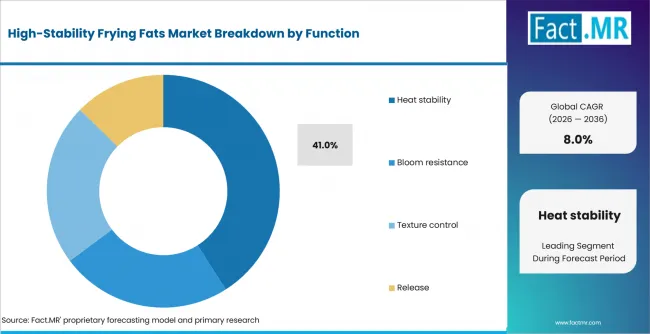
High Stability Frying Fats Market Analysis By Function | Source: Fact.MR
Heat stability leads because frying fats must tolerate repeated heating while preserving flavor, color and texture. Foodservice buyers measure fryer change frequency and finished-product appearance, so performance evidence carries weight during supplier approval.
Texture control and release functions remain relevant in bakery and confectionery lines. These uses require predictable melt behavior after cooling, and they reward suppliers that can keep specifications consistent across different feedstock origins.
How does Application shape demand?
Confectionery is anticipated to capture 37.0% share in 2026.
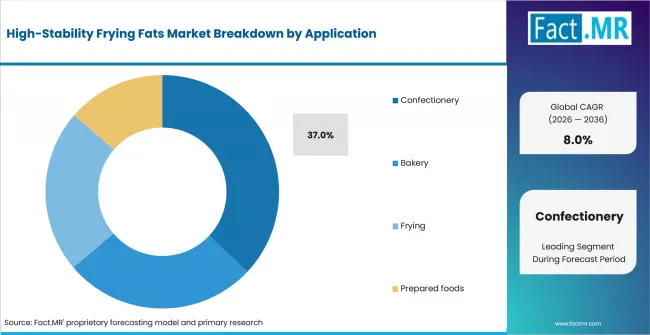
High Stability Frying Fats Market Analysis By Application | Source: Fact.MR
Confectionery leads because coatings and fillings place strict demands on crystallization, bloom resistance and mouthfeel. Destatis reported in December 2025 that Germany produced just under 1.07 million tonnes of cocoa-containing chocolate products in 2024, highlighting the scale of the country’s chocolate manufacturing base.
Frying and prepared-food applications are expected to grow as frozen snacks, doughnuts and coated foods move through foodservice and retail channels. The commercial test is simple: the fat must protect texture after heat and holding.
What supports Blocks within Form?
Blocks are estimated to represent 36.0% share in 2026.
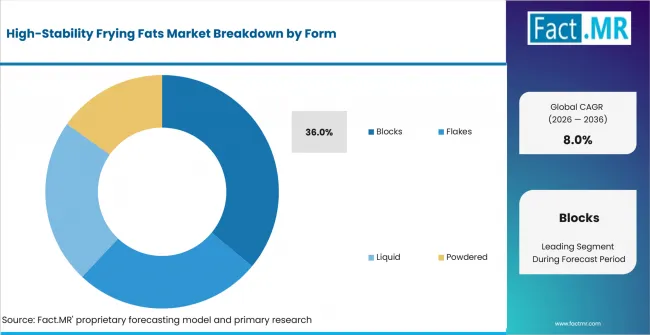
High Stability Frying Fats Market Analysis By Form | Source: Fact.MR
Blocks lead because they are easy to portion, store and meter in plants that make bakery, confectionery and prepared foods. Operators can dose blocks into kettles, mixers and coating systems with fewer changes to existing handling routines.
Flakes and liquids serve customers that need faster melting or pumpable delivery. Powdered formats remain narrower because high-stability frying and coating systems usually depend on melt behavior and crystallization control.
What is accelerating High-Stability Frying Fats Market adoption, and what is holding it back?
Demand is expected to rise through foodservice durability, confectionery reformulation and plant approval needs.
Drivers Impact Analysis
| DRIVER | (~) % IMPACT ON CAGR | GEOGRAPHIC RELEVANCE | IMPACT TIMELINE |
|---|---|---|---|
| Longer fryer-life requirements | +1.1% | North America, East Asia | Short term (<= 2 years) |
| Confectionery coating reformulation | +0.9% | Western Europe, North America | Medium term (2-4 years) |
| Trans-fat and label documentation | +0.7% | Global | Medium term (2-4 years) |
| Block-format handling in industrial plants | +0.5% | Europe, Latin America | Long term (>= 4 years) |
- Longer fryer-life requirements: Foodservice operators are expected to choose fats that maintain color and flavor across longer heating cycles, especially where labor and oil disposal costs affect margins.
- Confectionery coating reformulation: Higher cocoa and ingredient costs are anticipated to increase testing of lauric, non-lauric and blended fat systems in coatings and fillings.
- Trans-fat and label documentation: Regulatory and retailer scrutiny is projected to favor suppliers that provide clear certificates, ingredient statements and process records before plant trials begin.
Opportunity Impact Analysis
| OPPORTUNITY | (~) % IMPACT ON CAGR | GEOGRAPHIC RELEVANCE | IMPACT TIMELINE |
|---|---|---|---|
| Quick-service frying programs | +0.8% | USA, Japan | Short term (<= 2 years) |
| Bakery and snack plant conversion | +0.6% | France, Germany | Medium term (2-4 years) |
| Local soybean-oil blend development | +0.5% | USA, Brazil | Long term (>= 4 years) |
- Quick-service frying programs: Operators are expected to test products such as high-performance frying fats where oil weeping and reheated texture affect repeat purchases.
- Bakery and snack plant conversion: Industrial bakers are projected to qualify blocks and flakes that reduce dosing variation while preserving release behavior in pans and coatings.
- Local soybean-oil blend development: Brazil and the USA are anticipated to support blended systems where refiners can use nearby oilseed streams and still meet heat-stability targets.
Restraints Impact Analysis
| RESTRAINT | (~) % IMPACT ON CAGR | GEOGRAPHIC RELEVANCE | IMPACT TIMELINE |
|---|---|---|---|
| Feedstock price exposure | -0.6% | Global | Short term (<= 2 years) |
| Long plant qualification cycles | -0.4% | Europe, Japan | Medium term (2-4 years) |
| Palm and lauric sourcing documentation | -0.3% | Europe, North America | Long term (>= 4 years) |
- Feedstock price exposure: Oilseed and tropical-oil price swings are expected to slow reformulation where procurement teams focus on near-term cost control.
- Long plant qualification cycles: Manufacturers are anticipated to require repeated fry tests, bloom tests and storage checks before a fat system enters full commercial use.
- Palm and lauric sourcing documentation: Retailer and customer files are projected to create more approval work for suppliers serving confectionery and bakery accounts.
Which countries are scaling the High-Stability Frying Fats Market through 2036?
- The country comparison spans 1.6 percentage points across the forecast period.
- The USA remains 0.4 percentage point above Germany as foodservice scale and soybean availability support adoption.
- Germany remains 0.6 percentage point above Japan through processed-food depth and confectionery output.
- Japan remains 0.3 percentage point above France as convenience foods and export-oriented packaged foods require stable textures.
- France remains 0.3 percentage point above Brazil through oilseed supply and bakery-processing capability.
- Brazil closes the displayed range while soybean output supports local refining economics.
Comparable CAGRs create different entry conditions because foodservice demand, oilseed supply, label review and plant qualification depth vary by country. Full report coverage includes North America, Latin America, Western Europe, Eastern Europe, East Asia, South Asia & Pacific, Middle East & Africa.
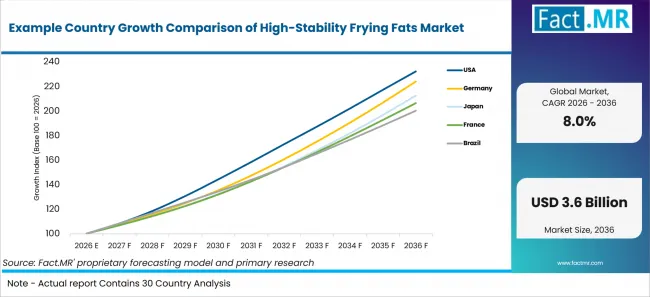
Example Country Growth Comparison Of High Stability Frying Fats Market | Source: Fact.MR
| Country | CAGR (2026-2036) |
|---|---|
| USA | 8.8% |
| Germany | 8.4% |
| Japan | 7.8% |
| France | 7.5% |
| Brazil | 7.2% |
What supports USA adoption?
8.8% CAGR, supported by foodservice scale and soybean-oil availability.
U.S. foodservice and snack manufacturers evaluate high-stability frying fats through fryer life, sensory carryover and reheated texture. USDA ERS reported that inflation-adjusted U.S. food spending reached USD 2.51 trillion in 2025, including USD 1.41 trillion for food away from home. The USA is forecast to post 8.8% CAGR through 2036 as refiners use domestic oilseed streams and performance claims to support foodservice trials.
How is Germany scaling demand?
8.4% CAGR, shaped by processed-food depth and confectionery output.
German food manufacturers place strong emphasis on repeatable texture, coating behavior and documentation before approving a new fat system. USDA FAS reported in March 2026 that Germany produced an estimated USD 270.1 billion in processed food and beverages in 2024. Germany is expected to record 8.4% CAGR through 2036 as confectionery, bakery and prepared-food plants test lauric and blended systems under strict retail specifications.
What supports Japan’s outlook?
7.8% CAGR, backed by convenience foods and export-oriented packaged foods.
Japan’s prepared-food and convenience channels require fats that preserve texture after chilled storage, reheating and short service windows. USDA FAS reported in April 2026 that Japan’s food processing sector was valued at USD 174 billion in 2025. Japan is anticipated to reach 7.8% CAGR through 2036 as food manufacturers use stable frying and coating systems to protect quality in frozen snacks, bakery items and premium packaged foods.
How is France developing demand?
7.5% CAGR, supported by oilseed supply and bakery-processing depth.
France has a large bakery and prepared-food base where block fats are used for release behavior, melt control and coating consistency. Agreste estimated France’s oilseed production at 6.520 million tonnes for the 2025 harvest, highlighting the scale of the country’s domestic oilseed production base and providing feedstock context for vegetable-oil and refined-fat applications. France is projected to advance at 7.5% CAGR through 2036 as industrial bakers and confectionery manufacturers qualify fats that perform through processing and distribution.
How does Brazil perform?
7.2% CAGR, led by soybean output and food-processing revenue.
Brazil’s refiners and food processors can pair soybean-oil availability with imported lauric fractions for blended frying and coating systems. Conab estimated in December 2025 that Brazil’s 2025/26 soybean crop would reach 177.1 million tonnes. Brazil is estimated to grow at 7.2% CAGR through 2036 as snack, bakery and foodservice operators test fats that hold texture in warm distribution conditions.
Who leads the High-Stability Frying Fats Market?
Cargill, Incorporated is active through specialty fats and high-performance frying solutions for foodservice and food manufacturing. Its March 2026 Port Klang expansion added specialty-fat capacity for frying and other food applications, including Cargill, Incorporated Bakefry™, a frying fat positioned for foodservice and quick-service restaurant operators. The site also houses Cargill, Incorporated’s Lipid R&D center for product and process development.
Bunge Global SA, ADM, AAK and Wilmar International Limited maintain edible-oil or specialty-fat portfolios relevant to frying applications. Bunge Global SA announced in March 2025 that it had agreed to sell its European margarines and spreads business to Vandemoortele, while emphasizing its future focus on oils, emulsifiers, proteins and other B2B ingredient value chains.
AAK announced in October 2025 a joint venture with Kuala Lumpur Kepong Berhad to strengthen access to specialty palm fractions used in the production of cocoa butter alternatives.
Which companies are the key providers?
Key companies include Cargill, Incorporated; Bunge Global SA; ADM; AAK; and Wilmar International Limited.
- Cargill, Incorporated
- Bunge Global SA
- ADM
- AAK
- Wilmar International Limited
Bibliography
- AAK. (2025, October 24). AAK strengthens supply of specialty palm fractions.
- Bunge. (2025, March 25). Bunge agrees to sell its European margarines and spreads business to Vandemoortele.
- Cargill. (2026, March 31). Cargill strengthens global specialty fats portfolio with expansion of Port Klang, Malaysia facility.
- Companhia Nacional de Abastecimento. (2025, December 11). Nova estimativa da Conab aponta para uma produção de 354,4 milhões de toneladas de grãos na safra 2025/26.
- Federal Statistical Office (Destatis). (2025, December 2). 12,8 Kilo Schokolade pro Kopf wurden 2024 produziert [12.8 kilograms of chocolate per capita were produced in 2024].
- Zeballos, E., & Sinclair, W. (2026, June 11). Total U.S. food spending reached $2.51 trillion in 2025. U.S. Department of Agriculture, Economic Research Service.
- U.S. Department of Agriculture, Foreign Agricultural Service. (2026, March 30). Food processing ingredients annual: Germany (GAIN Report No. GM2026-0007).
- U.S. Department of Agriculture, Foreign Agricultural Service. (2026, April 1). Food processing ingredients annual: Japan (GAIN Report No. JA2026-0012).
- U.S. Department of Agriculture, National Agricultural Statistics Service. (2026, March 31). US farmers expect to plant less corn and more soybean acres.
- Colas, T., & Boudour, D. (2026, July 7). Statistique agricole annuelle 2025 – Chiffres provisoires (Version révisée). Agreste.
This Report Answers
- The report explains where high-stability frying fats are used across fat system, function, application and form.
- Segment analysis identifies the leading subsegments and the operational reasons manufacturers prioritize them.
- Country analysis examines the listed markets and the food-processing or oilseed mechanisms supporting adoption.
- Competitive analysis reviews active providers across specialty fats, refined oils and customer formulation support.
- Application analysis assesses how heat stability, bloom resistance and texture control influence purchase decisions.
What does the High-Stability Frying Fats Market cover?
The High-Stability Frying Fats Market covers fats used to improve heat tolerance, surface finish and texture in fried, baked, coated and prepared foods. It includes lauric, non-lauric, interesterified and blended systems sold in block, flake, liquid and powdered forms.
The assessment covers confectionery, bakery, frying and prepared-food applications. Vegetable oils and fats and oils provide wider context for edible oil and lipid inputs used by manufacturers.
What is included in the scope?
The scope includes high-stability fats designed for fryer life, bloom resistance, texture control and release. It includes specialty fat systems used in industrial food plants and foodservice supply chains.
The scope covers commercial ingredients where stability is a central selling point. It includes products serving bakery, confectionery and foodservice users. Margarine products and butter and margarine supports comparison with adjacent spreads and baking fats.
What is excluded from the scope?
Outside the scope are commodity oils sold for price-only use, household cooking products and raw oilseed commodities. General bakery ingredients are outside the boundary except when the fat system is purchased for frying, coating or release performance.
How Was the Analysis Built?
The analysis draws on 120+ sources, 35+ company portfolios, 25+ countries, and more than 20 industry interviews.
- Primary Research: Primary research includes discussions with manufacturers, service providers, technology developers, distributors, end users, and subject-matter experts. These conversations examine purchasing priorities, product adoption, operational challenges, approval requirements, competitive positioning, and the factors that influence wider market acceptance.
- Desk Research: Desk research covers government statistics, regulatory publications, company filings, trade data, technical studies, industry associations, standards, public policy, and other authoritative sources. Every source used in the analysis is documented in the bibliography.
- Market Sizing and Forecasting: Market estimates combine historical performance, demand indicators, pricing and volume trends, segment shares, company participation, country-level growth, adoption patterns, investment activity, and barriers to market expansion.
- Data Validation and Update Cycle: Findings are validated by comparing primary interviews with public data, company activity, regulatory changes, trade patterns, and industry developments. Regular updates review new product launches, capacity changes, partnerships, approvals, and shifts in commercial adoption.
What is the report’s scope and coverage?
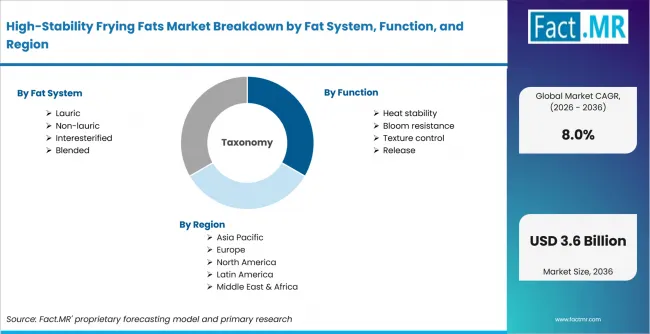
High Stability Frying Fats Market Breakdown By Fat System, Function, And Region | Source: Fact.MR
| Attribute | Details |
|---|---|
| Quantitative Units | USD billion |
| Market Definition | High-stability frying fats are structured or refined fat systems designed to maintain frying, coating, release and texture performance under repeated heat and holding conditions. |
| Fat System | Lauric; Non-lauric; Interesterified; Blended |
| Function | Heat stability; Bloom resistance; Texture control; Release |
| Application | Confectionery; Bakery; Frying; Prepared foods |
| Form | Blocks; Flakes; Liquid; Powdered |
| Regions Covered | North America; Latin America; Western Europe; Eastern Europe; East Asia; South Asia & Pacific; Middle East & Africa |
| Countries Covered | USA; Germany; Japan; France; Brazil |
| Key Companies Profiled | Cargill, Incorporated; Bunge Global SA; ADM; AAK; Wilmar International Limited |
| Forecast Period | 2026 to 2036 |
| Approach | Hybrid top-down and bottom-up approach using foodservice demand, oilseed availability, confectionery use, format preference, country adoption and provider portfolio review. |
How is the market segmented?
-
By Fat System:
- Lauric
- Non-lauric
- Interesterified
- Blended
-
By Function:
- Heat stability
- Bloom resistance
- Texture control
- Release
-
By Application:
- Confectionery
- Bakery
- Frying
- Prepared foods
-
By Form:
- Blocks
- Flakes
- Liquid
- Powdered
-
By Region:
- North America
- Latin America
- Western Europe
- Eastern Europe
- East Asia
- South Asia & Pacific
- Middle East & Africa