- Market Value (2025): USD 166.7 Mn
- Estimated Value (2026): USD 210 Mn
- Forecast Value (2036): USD 2118 Mn
- CAGR (2026-2036): 26.0%
What is the Fermented Specialty Fats Market forecast to be worth by 2036?
USD 210 million in 2026 to USD 2118 million by 2036, at 26.0% CAGR.
- The fermented specialty fats market crossed a valuation of USD 166.7 million in 2025.
- Demand is projected to rise from USD 210 million in 2026 to USD 2118 million by 2036.
- The market is forecast to record a 26.0% CAGR from 2026 to 2036 as meat-alternative and dairy-alternative formulators seek controlled fat performance.
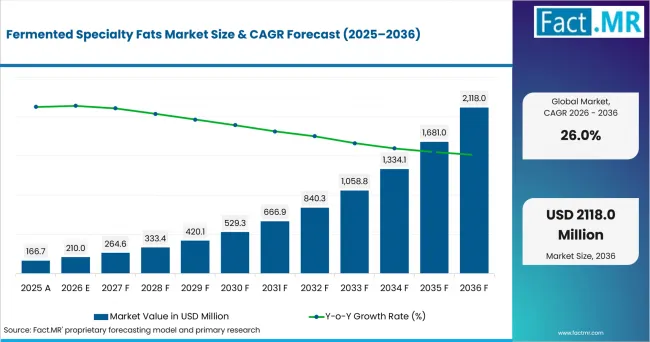
Fermented Specialty Fats Market Value Analysis | Source: Fact.MR
What are the defining numbers behind Fermented Specialty Fats Market growth?
USD 1,908 million absolute opportunity by 2036, led by oleaginous yeast oils, alternative meat and the USA.
- Demand Drivers in the Market
- Alternative-meat brands need fats that release aroma during cooking and soften under heat. Defra reported in July 2026 that Great Britain’s food and drink sector employed 3.7 million people in 2025, illustrating the broad scale of the downstream food economy in which ingredient suppliers operate.”.
- Dairy-alternative teams need creamy mouthfeel without butterfat, supported by structured microbial fats that improve melt and coating behavior in cheese and spoonable formats.
- Bakery and confectionery developers need repeatable solid-fat profiles because cocoa-butter and palm-linked costs keep reformulation under review.
- Personal-care manufacturers need tailored triglycerides for skin feel, while food-grade lipid work creates a parallel learning base for fermentation scale-up and purification control.
- Key Segments Analyzed
- By Fat Platform: Oleaginous yeast oils are expected to hold 43.0% share in 2026 because yeast strains offer a direct path to triglyceride-rich oils.
- By Function: Animal-fat mimicry is projected to account for 30.0% share in 2026, supported by the need for grill aroma and juiciness in alternative meat.
- By Application: Alternative meat is anticipated to capture 49.0% share in 2026 owing to the sensory gap between plant protein and animal fat.
- By Form: Bulk oil is estimated to represent 41.0% share in 2026, reinforced by easier dosing in industrial mixing and emulsion systems.
- Analyst Opinion at Fact.MR
- Shambhu Nath Jha, Principal Consultant at Fact.MR, states, “Fermented fats draw attention because fat carries much of the animal-eating experience. The category is expected to reward suppliers that prove sensory value and scale reliability in the same dossier. Strong offers combine strain control, food safety files and application testing.”
- Strategic Implications
- Ingredient developers should document melt profile, oxidation stability and flavor release in the same application matrix used by food brands.
- Food manufacturers should test fermented fats at low inclusion levels before replacing full fat systems in high-volume products and validate finished-product flavor after heating.
- Contract manufacturers should separate food-grade process controls from cosmetic or industrial lipid runs to protect regulatory acceptance.
- Regulatory teams should prepare compositional dossiers early. FDA proposed a GRAS oversight rule in August 2026, suggesting that safety documentation may become more visible during U.S. food-ingredient commercialization.
The USA is forecast to post 31.6% CAGR through 2036, supported by food spending scale and ingredient-review visibility. South Korea is projected to record 28.7% CAGR due to food-tech funds and export policy. Germany is anticipated to advance at 27.5% CAGR, owing to meat-substitute output and oils-balance exposure. The UK is estimated to reach 21.3% CAGR because food manufacturing scale pairs with precision-fermentation guidance. Japan is forecast at 18.9% CAGR, shaped by food-security needs and cautious approval behavior.
How does the Fermented Specialty Fats Market break down by segment?
Oleaginous yeast oils lead at 43.0%; alternative meat leads at 49.0%.
Which Fat Platform dominates?
Oleaginous yeast oils hold 43.0% share in 2026.
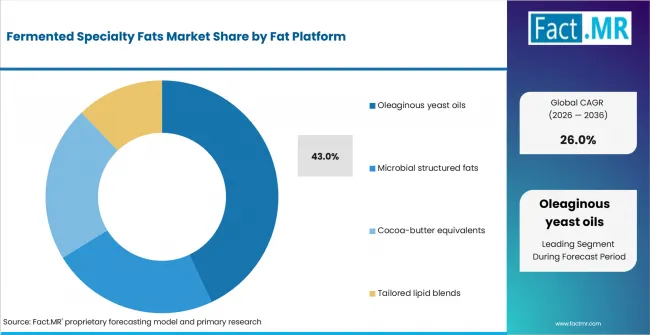
Fermented Specialty Fats Market Analysis By Fat Platform | Source: Fact.MR
Oleaginous yeast oils are expected to lead because yeast offers a direct path to triglyceride-rich oils. Microbial structured fats target sharper melting behavior. Cocoa-butter equivalents support snap and gloss in confectionery. Tailored blends match flavor-release needs where one oil profile cannot serve meat, dairy and bakery use cases. NoPalm Ingredients B.V. reported in February 2025 that it scaled yeast-based oil fermentation from food-industry side streams to 120,000 L in an industrial-scale trial.
What leads the Function segment?
Animal-fat mimicry accounts for 30.0% share in 2026.
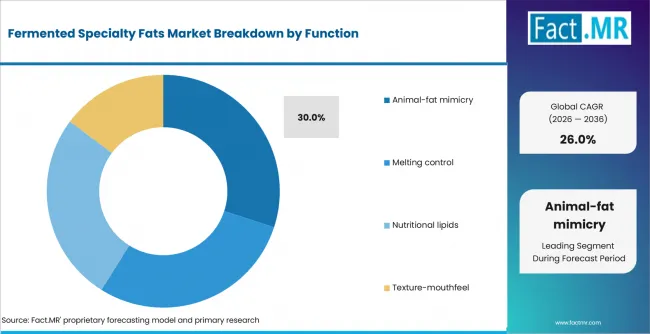
Fermented Specialty Fats Market Analysis By Function | Source: Fact.MR
Animal-fat mimicry is projected to lead because plant proteins rarely deliver cooked-fat aroma on their own. Melting control supports cheese and bakery fillings. Nutritional lipids need deeper safety files. Texture-mouthfeel functions support targeted reformulation where brands need fatty perception without adding animal inputs. Melt&Marble AB announced in March 2026 that it had completed a self-affirmed GRAS determination for MeltyMarble, which the company says enables U.S. sales. This is a company-led GRAS conclusion, not an FDA “no questions” letter or FDA approval.
How does Application shape demand?
Alternative meat leads with 49.0% share in 2026.
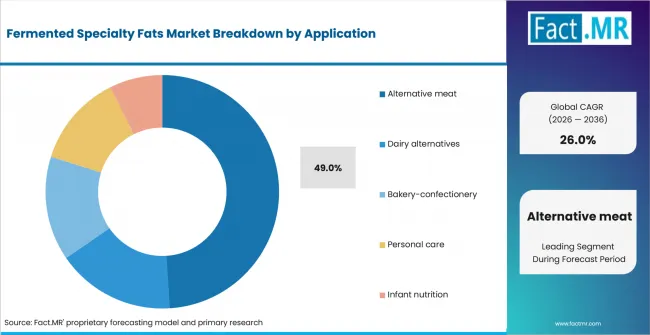
Fermented Specialty Fats Market Analysis By Application | Source: Fact.MR
Alternative meat is anticipated to lead because fat behavior is visible during cooking. Dairy alternatives follow where fat supports creaminess. Bakery-confectionery focuses on bloom control. Personal care and infant nutrition require higher documentation before broad use. The FSA announced in March 2025 that DSIT had awarded it £1.4 million to support a new innovation hub focused on precision-fermented foods and wider innovative and novel food technologies.
What supports Bulk oil within Form?
Bulk oil holds 41.0% share in 2026.
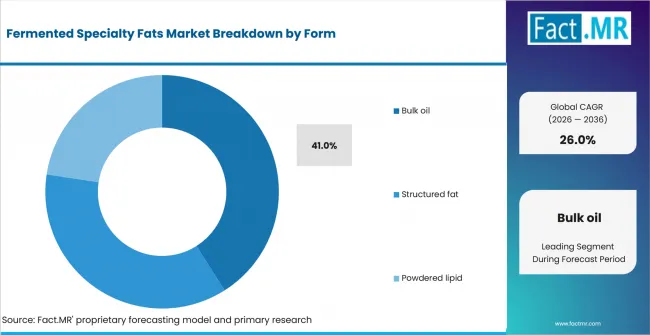
Fermented Specialty Fats Market Analysis By Form | Source: Fact.MR
Bulk oil is estimated to lead because factories are able to dose it with limited process changes. Structured fats suit crystalline behavior. Powdered lipids fit dry mixes and flavor systems. Form choice follows the processing line more than the supplier story. Checkerspot, Inc.’s current portfolio work in algal oils shows why suppliers present form and function together when selling specialty lipids.
What is accelerating Fermented Specialty Fats Market adoption, and what is holding it back?
Animal-fat mimicry drives it; scale cost restrains it.
Drivers Impact Analysis
| Driver | (~) % Impact on CAGR | Geographic Relevance | Impact Timeline |
|---|---|---|---|
| Animal-fat mimicry in alternative meat | +2.8% | North America, Western Europe, East Asia | Short term (<= 2 years) |
| Precision fermentation capacity buildout | +2.2% | USA, South Korea, Europe | Medium term (2-4 years) |
| Cocoa-butter and palm exposure in food applications | +1.6% | Europe, Japan, UK | Medium term (2-4 years) |
| Application testing in dairy alternatives | +1.1% | USA, UK, Germany | Long term (>= 4 years) |
Source: Fact.MR analysis. Updated Aug 24, 2026
- Animal-fat mimicry in alternative meat: Brands need fat that browns, melts and releases aroma at low inclusion levels. The role is clearest in burgers, grounds and fillings where aroma forms during heating.
- Precision fermentation capacity buildout: Partnerships with fermentation operators help suppliers move beyond pilot lots. Melt&Marble AB announced a January 2025 partnership with Valio to develop next-generation food products using precision-fermentation-based designer fats, including plant-based applications. Buyers still need batch-to-batch data before long purchase agreements.
- Cocoa-butter and palm exposure: Bakery and confectionery teams test fermented fats when cost or traceability concerns rise. Cocoa-butter equivalents need snap and gloss without altering product identity. The best fit is expected in fillings, coatings and specialty formats.
- Dairy-alternative testing: Fermented fats help dairy alternatives improve creaminess and melt without changing protein systems. The UK Food Standards Agency launched a precision-fermentation business support service in September 2025, which helps developers understand authorization expectations.
Opportunity Impact Analysis
| Opportunity | (~) % Impact on CAGR | Geographic Relevance | Impact Timeline |
|---|---|---|---|
| Low-inclusion flavor-fat systems | +1.5% | USA, UK, Germany | Short term (<= 2 years) |
| Structured lipids for infant nutrition | +1.2% | USA, Japan, South Korea | Long term (>= 4 years) |
| Beauty and personal-care lipid crossover | +0.8% | USA, Europe, South Korea | Medium term (2-4 years) |
| CDMO support for food-grade fermentation | +0.7% | Global | Medium term (2-4 years) |
Source: Fact.MR analysis. Updated Aug 24, 2026
- Low-inclusion flavor-fat systems: Suppliers improve the value case by proving performance at small dosage. Zero Acre describes its fermented oil as an all-purpose cooking oil made by converting sugarcane sugar into oil. The opportunity is commercially useful only when finished products keep flavor after processing.
- Structured lipids for infant nutrition: Checkerspot, Inc. identifies high sn-2 palmitate algal oil for infant-nutrition use. Huvepharma support provides adjacent scale context.
- Beauty and personal-care lipid crossover: Food and personal-care lipids share strain, purification and fatty-acid learning. Melt&Marble AB reported in March 2026 that the Personal Care Products Council approved the INCI name r-Saccharomyces Butter for its Marble7 personal-care lipid.
Restraints Impact Analysis
| Restraint | (~) % Impact on CAGR | Geographic Relevance | Impact Timeline |
|---|---|---|---|
| Cost gap against commodity fats | -1.1% | Global | Short term (<= 2 years) |
| Novel-food and GRAS documentation burden | -0.8% | USA, UK, Europe, Japan | Medium term (2-4 years) |
| Scale-up consistency in fermentation | -0.7% | Global | Medium term (2-4 years) |
| Application-specific taste risk | -0.5% | Alternative meat and dairy | Short term (<= 2 years) |
Source: Fact.MR analysis. Updated Aug 24, 2026
- Cost gap against commodity fats: Palm, coconut, butter and tallow set low-cost benchmarks that fermented fats must justify. Large food categories compare each specialty ingredient against delivered cost and sensory gain. Fermented fats need lower use rates or premium positioning to pass procurement review.
- Novel-food and GRAS documentation burden: Microbial fats need safety narratives and composition data before broad launches. FDA proposed a GRAS oversight rule in August 2026 that, if finalized, would require GRAS notices for certain food-substance uses and place greater emphasis on documented scientific support for GRAS conclusions.
- Scale-up consistency in fermentation: Lipid profiles sometimes shift during scale-up, so customers require batch consistency. Commercial partners test taste, viscosity and oxidation after processing before repeat purchasing. Inconsistent output slows repeat orders.
- Application-specific taste risk: A burger fat does not automatically work in cheese or chocolate. Each format changes heating, water activity and flavor release. Suppliers need application labs that connect molecule design to finished-product performance.
Which countries are scaling the Fermented Specialty Fats Market through 2036?
- The country comparison spans 12.7 percentage points across the five displayed markets.
- The USA remains 2.9 percentage points above South Korea because food spending scale gives ingredient developers a larger launch base.
- South Korea remains 1.2 percentage points above Germany as food-tech policy and export programs improve industrial support.
- Germany remains 6.2 percentage points above the UK due to meat-substitute manufacturing and oils-balance exposure.
- The UK remains 2.4 percentage points above Japan as Food Standards Agency guidance supports precision-fermentation review preparation.
- Japan closes the displayed range because food-security interest is high, while approval and cost hurdles keep adoption more selective.
Comparable CAGRs create different entry conditions because each country weighs food safety, ingredient cost and application fit differently. Full coverage includes North America, Latin America, Western Europe, Eastern Europe, East Asia, South Asia & Pacific, Middle East & Africa.
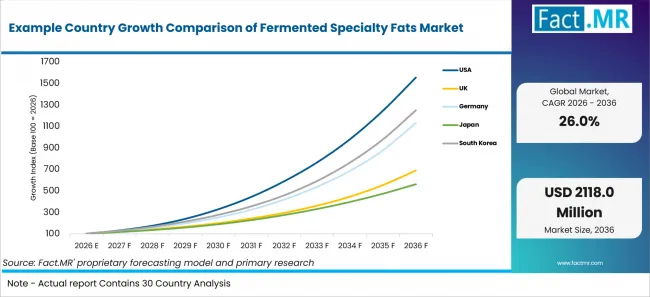
Example Country Growth Comparison Of Fermented Specialty Fats Market | Source: Fact.MR
| Country | CAGR |
|---|---|
| USA | 31.6% |
| South Korea | 28.7% |
| Germany | 27.5% |
| UK | 21.3% |
| Japan | 18.9% |
Source: Fact.MR analysis. Updated Aug 24, 2026
What supports USA adoption?
31.6% CAGR, supported by food spending scale and GRAS review visibility.
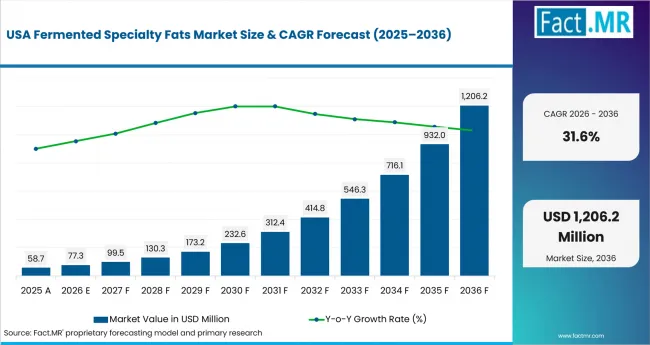
Fermented Specialty Fats Market Country Value Analysis | Source: Fact.MR
U.S. food manufacturers give fermented fats a broad launch base because large categories already test texture and flavor systems. USDA ERS reported in June 2026 that total U.S. food spending reached USD 2.51 trillion in 2025.
How is South Korea scaling demand?
28.7% CAGR, driven by food-tech policy and export-led processing.
South Korea links food technology with export policy, which gives microbial fats a structured route into application trials. MFDS reported in May 2026 that food-industry production reached KRW 119 trillion in 2025, and MAFRA said in July 2026 that cumulative food-tech policy funds would reach KRW 81 billion in 2026. South Korea is projected to record 28.7% CAGR through 2036 as processors test fats for frozen meals, sauces and alternative proteins.
What supports Germany adoption?
27.5% CAGR, supported by meat-substitute production and oils-balance exposure.
Germany’s alternative-meat base gives animal-fat mimicry a direct commercial reference point. Destatis reported in May 2026 that Germany produced 124,900 tonnes of meat-substitute products in 2025, while BLE data updated in August 2026 showed total domestic use of oils and fats at 5.9 million tonnes of crude oil in 2024. Germany is anticipated to advance at 27.5% CAGR through 2036 because brands need documented melt and taste data before replacement.
What supports the UK outlook?
21.3% CAGR, backed by food manufacturing depth and precision-fermentation guidance.
The UK gives fermented fats a food-manufacturing base and a regulator-led route for early guidance. ONS reported in July 2026 that food manufacturing represented 22.9% of total UK manufacturers’ sales in 2025. The UK is estimated to reach 21.3% CAGR through 2036.
How does Japan perform?
18.9% CAGR, led by food-security needs and measured food-tech adoption.
Japan’s food-security debate favors localizable ingredient routes, but commercial adoption remains careful. MAFF reported in August 2026 that Japan’s fiscal 2025 calorie-basis food self-sufficiency ratio was 37%, and the Statistics Bureau said in January 2026 that food prices rose 6.8% in 2025. Japan is forecast at 18.9% CAGR through 2036 as cost pressure and safety review slow broader use.
Who leads the Fermented Specialty Fats Market?
C16 Biosciences and Nourish Ingredients Pty Ltd. as direct specialty-lipid participants, with Melt&Marble AB and NoPalm Ingredients B.V. profiled for structured-fat and fermentation-scale activity.
C16 Biosciences is active through Palmless ingredients for beauty and food applications. Nourish Ingredients Pty Ltd. is active in animal-free fats through Tastilux and Creamilux, and CABIO’s April 2025 announcement confirms commercial-scale support for Tastilux. Melt&Marble AB adds designer fats for food and personal care, including MeltyMarble for meat alternatives, dairy, bakery and snacks.
NoPalm Ingredients B.V. competes through yeast-based oil fermentation from food side streams. Checkerspot, Inc. is active in microalgae-derived fats and oils, including high sn-2 palmitate algal oil and tropical-fat alternatives. Zero Acre Farms gives the market a consumer-facing fermentation oil reference, although its cooking-oil model is broader than specialty B2B fat systems.
Which companies are the key providers?
Key companies include C16 Biosciences, Nourish Ingredients Pty Ltd., Melt&Marble AB, NoPalm Ingredients B.V., Checkerspot, Inc., Zero Acre Farms.
- C16 Biosciences
- Nourish Ingredients Pty Ltd.
- Melt&Marble AB
- NoPalm Ingredients B.V.
- Checkerspot, Inc.
- Zero Acre Farms
Bibliography
- Bundesanstalt für Landwirtschaft und Ernährung. (2026, August 1). Versorgungsbilanz Öle und Fette [Data set].
- CABIO Biotech. (2025, April 9). Pioneering the global commercialization of precision fermentation fats.
- Food Standards Agency. (2025, March 28). FSA announces £1.4 million funding for launch of new innovation hub.
- Food Standards Agency. (2025, September 23). FSA champions food innovation in the UK with the launch of a new Innovation Research Programme.
- Food Standards Agency. (2026, February 18). UK safety guidance on precision fermentation products. GOV.UK.
- Melt&Marble. (2025, January 13). Melt&Marble and Valio to develop next-gen food products.
- Melt&Marble. (2026, March 11). Melt&Marble accelerates commercial readiness with regulatory approvals and team growth.
- Ministry of Agriculture, Food and Rural Affairs. (2026, July 20). S. Korea unveils master plan to integrate advanced technologies into the food sector.
- Office for National Statistics. (2026, July 24). UK manufacturers' sales by product: 2025.
- Statistics Bureau of Japan. (2026, January 23). Japan 2025.
- Statistisches Bundesamt. (2026, May 18). Nach jahrelangem Anstieg: Fleischersatz-Produktion sinkt 2025 um 1,2 % gegenüber dem Vorjahr [After years of growth: Meat-substitute production falls by 1.2% in 2025 compared with the previous year].
- U.S. Food and Drug Administration. (2026, August 11). Substances generally recognized as safe (proposed rule).
This Report Answers
- The report explains where fermented specialty fats are used across fat platform and application. It also covers function, form and region.
- Segment analysis identifies the leading subsegments and the formulation reasons brands prioritize them.
- Country analysis examines the USA, South Korea, Germany, the UK and Japan through official food, price and policy data.
- Competitive analysis reviews C16 Biosciences, Nourish Ingredients Pty Ltd., Melt&Marble AB, NoPalm Ingredients B.V., Checkerspot, Inc. and Zero Acre Farms.
- Application analysis assesses how animal-fat mimicry, melting control and nutritional lipid needs affect purchase decisions.
What does the Fermented Specialty Fats Market cover?
The Fermented Specialty Fats Market covers specialty fats and oils produced or functionally shaped through microbial fermentation. It includes yeast oils, structured fats, cocoa-butter equivalents and tailored lipid blends.
The market is part of broader specialty fats and oils, but it excludes conventional palm, coconut, butterfat and tallow sold without fermentation-derived functionality.
What is included in the scope?
The scope includes fermented lipid ingredients used in alternative meat, dairy alternatives, bakery-confectionery, personal care and infant nutrition. Related specialty fat and oil systems define the broader ingredient base.
Plant-based meat products are included where juiciness and aroma release shape repeat purchase. precision fermentation dairy alternatives are included when creaminess and melt define the brief.
What is excluded from the scope?
Commodity oils and conventional animal fats are outside the scope unless used as comparison benchmarks.
The report excludes fermentation equipment, enzymes without lipid functionality and finished foods counted outside the ingredient value. Commodity palm, coconut, butterfat and tallow remain outside the value pool.
How Was the Analysis Built?
The analysis draws on 120+ sources, 35+ company portfolios, 25+ countries, and more than 20 industry interviews.
- Primary Research: Primary research includes discussions with manufacturers, service providers, technology developers, distributors, end users, procurement teams, and subject-matter experts. These conversations examine purchasing priorities, product adoption, operational challenges, approval requirements, competitive positioning, and the factors that influence wider market acceptance.
- Desk Research: Desk research covers government statistics, regulatory publications, company filings, trade data, technical studies, industry associations, standards, public policy, and other authoritative sources. Every source used in the analysis is documented in the bibliography.
- Market Sizing and Forecasting: Market estimates combine historical performance, demand indicators, pricing and volume trends, segment shares, company participation, country-level growth, adoption patterns, investment activity, and barriers to market expansion.
- Data Validation and Update Cycle: Findings are validated by comparing primary interviews with public data, company activity, regulatory changes, trade patterns, and industry developments. Regular updates review new product launches, capacity changes, partnerships, approvals, procurement trends, and shifts in commercial adoption.
Segmentation
What is the report’s scope and coverage?
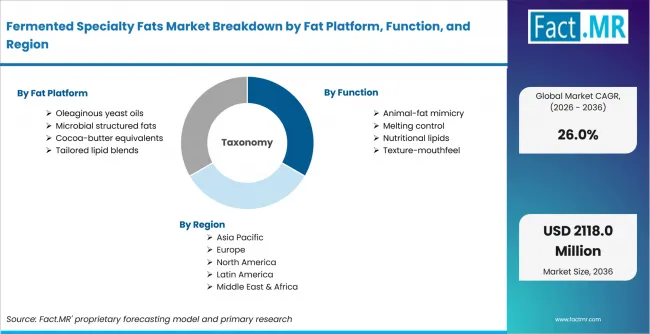
Fermented Specialty Fats Market Breakdown By Fat Platform, Function, And Region | Source: Fact.MR
| Attribute | Details |
|---|---|
| Quantitative Units | USD million |
| Market Definition | Fermentation-derived specialty fats used to provide controlled melt, mouthfeel, aroma release, nutritional lipid positioning and bulk-oil functionality in food and adjacent personal-care applications. |
| Fat Platform | Oleaginous yeast oils; Microbial structured fats; Cocoa-butter equivalents; Tailored lipid blends |
| Function | Animal-fat mimicry; Melting control; Nutritional lipids; Texture-mouthfeel |
| Application | Alternative meat; Dairy alternatives; Bakery-confectionery; Personal care; Infant nutrition |
| Form | Bulk oil; Structured fat; Powdered lipid |
| Regions Covered | North America; Latin America; Western Europe; Eastern Europe; East Asia; South Asia & Pacific; Middle East & Africa |
| Countries Covered | USA; South Korea; Germany; UK; Japan |
| Key Companies Profiled | C16 Biosciences, Nourish Ingredients Pty Ltd., Melt&Marble AB, NoPalm Ingredients B.V., Checkerspot, Inc., Zero Acre Farms |
| Forecast Period | 2026 to 2036 |
| Approach | Hybrid top-down and bottom-up approach using application intensity, segment shares, country CAGRs, fermentation capacity, official statistics and provider portfolio review. |
Source: Fact.MR analysis. Updated Aug 24, 2026
How is the market segmented?
-
By Fat Platform:
- Oleaginous yeast oils
- Microbial structured fats
- Cocoa-butter equivalents
- Tailored lipid blends
-
By Function:
- Animal-fat mimicry
- Melting control
- Nutritional lipids
- Texture-mouthfeel
-
By Application:
- Alternative meat
- Dairy alternatives
- Bakery-confectionery
- Personal care
- Infant nutrition
-
By Form:
- Bulk oil
- Structured fat
- Powdered lipid
-
By Region:
- North America
- Latin America
- Western Europe
- Eastern Europe
- East Asia
- South Asia & Pacific
- Middle East & Africa
Frequently Asked Questions
How big is the fermented specialty fats market in 2026?
What is the CAGR of the fermented specialty fats market from 2026 to 2036?
Which fat platform leads the fermented specialty fats market?
Which function leads the fermented specialty fats market?
Who are the leading companies in the fermented specialty fats market?
Who worked on this report


Preview the report firsthand - request a free sample
Free SampleGet the brochure for pricing and purchase details
Download PDF