- Base Value(2025): 5.0 Bn
- Estimated Value(2026): 5.6 Bn
- Forecast Value (2036): 14.7 Bn
- CAGR (2026 - 2036): 10.1%
Butter and Margarine Market Forecast and Outlook By Fact.MR
In 2025, the butter and margarine market was valued at USD 5.0 billion. Based on Fact.MR analysis, demand for butter and margarine is estimated to grow to USD 5.6 billion in 2026 and USD 14.7 billion by 2036. FACT.MR projects a CAGR of 10.1% during the forecast period.
During this period, the market is expected to generate USD 9.1 billion in new revenue opportunities. Growth will largely come from rising butter consumption in India and Brazil, expanding modern trade distribution of premium dairy spreads in emerging markets, and reformulated plant-based margarine adoption in health-conscious developed economies. Challenges include dairy commodity price volatility driven by feed cost fluctuations, competition from olive oil and coconut oil as household cooking fats, and regulatory pressure on partially hydrogenated oils in several jurisdictions.
The butter and margarine market is expanding as rising incomes in Asia Pacific and Latin America increase dairy fat consumption, while reformulated premium margarine products are capturing health-oriented retail segments in Europe and North America.
Country growth reflects dairy sector development, retail modernisation, and dietary fat preference shifts. India leads at 7.5% CAGR driven by rising bakery ingredient butter consumption and white butter market expansion. Brazil follows at 7.0% supported by premium butter adoption through supermarket and foodservice channels. The United States posts 6.5% supported by premium cultured and European-style butter demand. China records 6.1% driven by bakery and Western food preparation butter adoption. Germany grows at 5.8% through premium grass-fed and organic butter premiumisation. The United Kingdom grows at 5.0%, with mature replacement demand constrained by market saturation and private label pricing pressure in standard butter categories.
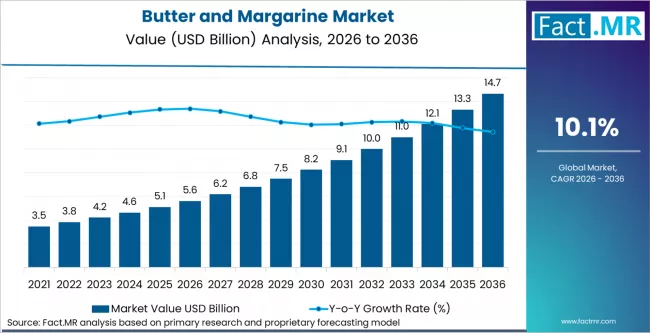
Butter And Margarine Market Market Value Analysis | Source: Fact.MR
| Metric | Value |
|---|---|
| Estimated Value in 2026 | USD 5.6 billion |
| Forecast Value in 2036 | USD 14.7 billion |
| Forecast CAGR (2026 to 2036) | 10.1% |
Source: Fact.MR analysis. Updated Mar 12, 2026
Market Definition of Butter and Margarine Market
The butter and margarine market includes dairy butter made from cream and margarine made from vegetable oils used as spreads, cooking fats, and baking ingredients.
Market Inclusions
Includes global forecasts from 2026 to 2036 by product type, usage, and processing method across retail, foodservice, and industrial channels.
Market Exclusions
Excludes ghee, lard, shortening, vegan butter alternatives, and industrial fats not sold as butter or margarine.
Research Methodology
- Primary Research: Interviews with dairy cooperatives, retail buyers, bakery ingredient purchasers, foodservice distributors, and dairy brand executives.
- Desk Research: Sources include IDF dairy statistics, EU dairy observatory data, USDA reports, OEM filings, and food regulation databases.
- Market Sizing and Forecasting: Hybrid model using dairy production volumes, per-capita fat consumption, retail sales data, price trends, and foodservice spending forecasts.
- Data Validation and Update Cycle: Forecasts validated with OEM revenue reports, IDF dairy data, EU dairy price monitoring, and expert interviews.
Summary of Butter and Margarine Market
- Market Definition
- The market includes dairy butter and vegetable oil margarine used as spreads, bakery ingredients, and cooking fats in households and food industries.
- Demand Drivers
- Growing bakery and confectionery production in India and Brazil is increasing industrial butter and margarine demand.
- Consumer preference for natural dairy products is boosting premium butter consumption in developed markets.
- Western-style food adoption in China and Southeast Asia is expanding butter use in households and foodservice.
- Key Segments Analyzed
- By Type: Traditional butter and margarine hold about 46% share in 2026 due to widespread household and foodservice usage.
- By Usage: Spreadable products dominate with about 68% share in 2026 due to breakfast and snacking demand.
- By Processing Method: Salted butter leads due to longer shelf life and strong preference in Europe and North America.
- Analyst Opinion at FACT.MR
- • Shambhu Nath Jha, Principal Consultant at Fact.MR, notes strongest growth in premium butter, trans-fat-free margarine for baking, and small-pack butter in emerging markets.
- Strategic Implications
- Butter producers should expand cultured, organic, and grass-fed variants for premium retail markets.
- Margarine companies should reformulate products to remove trans fats and use natural ingredients.
- Companies should launch small-pack butter products for India, Brazil, and Africa to support rising household demand.
- Methodology
- Market sizing used dairy production and retail sales data validated with IDF statistics and OEM revenue reports.
- EU dairy price data, USDA commodity reports, and foodservice procurement studies supported demand analysis.
- Forecasts included bakery industry growth, dietary fat trends, retail expansion data, and expert interviews.
Segmental Analysis
Butter and Margarine Market Analysis by Type
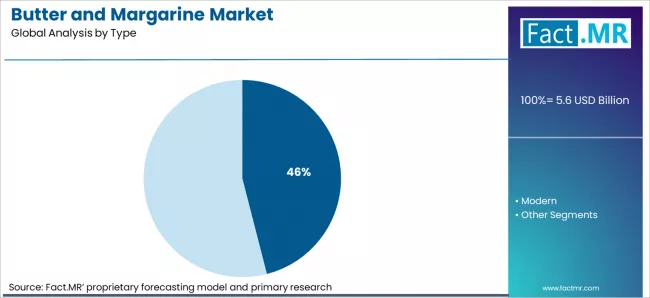
Butter And Margarine Market Analysis By Type | Source: Fact.MR
Based on FACT.MR analysis, traditional butter and margarine are projected to hold about 46% share in 2026 due to established household use and wide retail distribution.
- Arla Foods Butter Investment: Arla expanded Lurpak butter production capacity at its Denmark creamery in February 2025 to support growing premium butter demand. [5]
- FrieslandCampina Margarine Development: FrieslandCampina launched reformulated Becel Pro.activ margarine in September 2024 with plant sterols and no partially hydrogenated fats. [6]
- Premium Butter Growth Trend: The International Dairy Federation reported that cultured and premium butter products are growing twice as fast as standard butter in developed markets. [7]
Butter and Margarine Market Analysis by Usage
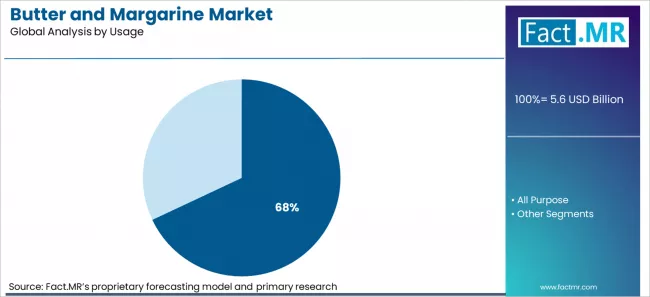
Butter And Margarine Market Analysis By Usage | Source: Fact.MR
Based on FACT.MR analysis, spreadable butter and margarine products are expected to hold about 68% share in 2026 due to convenience and strong breakfast consumption patterns.
- Kraft Heinz Spreadable Expansion: Kraft Heinz expanded its spreadable butter and cream cheese distribution in Brazil and Mexico in November 2024 through retail partnerships. [8]
- NMGK Margarine Reformulation: NMGK Group launched a new spreadable margarine line in August 2024 eliminating partially hydrogenated oils to meet updated safety regulations. [9]
- Foodservice Butter Demand Trend: US Dairy Export Council data showed butter exports to Mexico and the Philippines grew 22% and 31% in 2024 driven by bakery and café demand. [10]
Drivers, Restraints, and Opportunities
FACT.MR analysts note that the butter and margarine market reflects changing dietary views where natural dairy butter is regaining preference while traditional margarine faces scrutiny due to trans-fat concerns.
The market is shifting toward premium butter and reformulated margarine. Standard margarine is declining in developed markets while cultured and premium butter products gain higher pricing and retail demand.
- WHO Trans-Fat Elimination Policy: The WHO REPLACE initiative targets elimination of industrial trans fats, with enforcement continuing through 2025. Margarine producers are reformulating products using alternative fat systems, increasing production costs. [2]
- India Dairy Sector Expansion: India’s National Dairy Development Board expanded milk procurement infrastructure in 2024, increasing dairy supply. AMUL expanded butter processing capacity at its Anand plant in October 2024 targeting bakery and retail demand. [3]
- European Premium Butter Growth: EU organic dairy certification under Regulation (EU) 2018/848 supports premium butter categories. Organic and grass-fed butter sells at 30-50% price premium across European retail markets. [4]
Regional Analysis
The butter and margarine market is analysed across Asia Pacific, Europe, North America, Latin America, and Middle East and Africa, covering 40+ countries with distinct demand profiles shaped by dairy sector development, dietary fat preferences, retail channel maturity, and food safety regulations. The full report offers market attractiveness analysis based on per-capita butter consumption trajectories, dairy production growth forecasts, and retail channel expansion timelines.
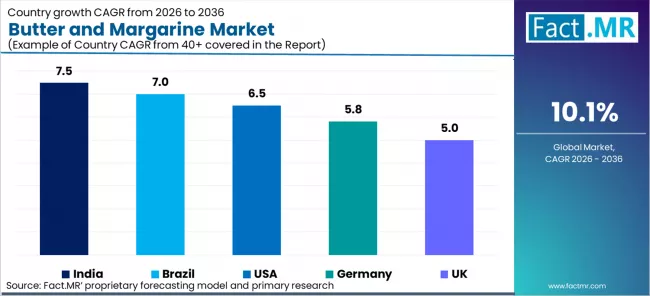
Butter And Margarine Market Cagr Analysis By Country | Source: Fact.MR
| Country | CAGR (2026-2036) |
|---|---|
| India | 7.5% |
| Brazil | 7.0% |
| United States | 6.5% |
| Germany | 5.8% |
| United Kingdom | 5.0% |
Source: Fact.MR analysis. Updated Mar 12, 2026
Source: Fact.MR (FACT.MR) analysis, based on proprietary forecasting model and primary research
Asia Pacific Butter and Margarine Market Analysis
Asia Pacific is the fastest-growing butter consumption region, supported by India’s dairy production and rising bakery demand. AMUL dominates domestic supply while Arla targets premium retail through the Lurpak brand.
- India: Butter and margarine demand in India is projected to grow at 7.5% CAGR through 2036. AMUL increased butter capacity at its Anand plant in October 2024 by 15,000 tonnes annually to support bakery and retail demand. India’s organised bakery sector expanded about 12% in 2024 as Britannia, Parle, and ITC increased production. The Food Safety and Standards Authority of India tightened margarine trans-fat limits to 2% in November 2024, requiring reformulation by producers.
FACT.MR’s analysis of the butter and margarine market in South Asia and Pacific covers India, ASEAN, Australia and New Zealand, and Rest of South Asia and Pacific. The report includes country CAGR forecasts, dairy production trends, bakery ingredient demand, and regulatory compliance tracking.
Latin America Butter and Margarine Market Analysis
Latin America is seeing steady growth in butter and margarine consumption due to modern retail expansion and foodservice demand. BRF and Grupo Lala lead domestic supply while international brands compete in premium imports.
- Brazil: Butter and margarine demand in Brazil is expected to grow at 7.0% CAGR through 2036. BRF announced a BRL 180 million investment in October 2024 to expand Qualy butter and margarine production in Santa Catarina. ANVISA updated fat product regulation in August 2024 reducing margarine trans-fat limits to 1%, requiring reformulation before 2025. Grupo Pão de Açúcar expanded its private label butter distribution to around 1,200 stores in 2024, increasing retail volume.
FACT.MR’s analysis of the butter and margarine market in Latin America includes Brazil, Chile, Ecuador, and Rest of Latin America. The report highlights regulatory compliance, retail demand trends, and forecasts by product type and usage.
North America Butter and Margarine Market Analysis
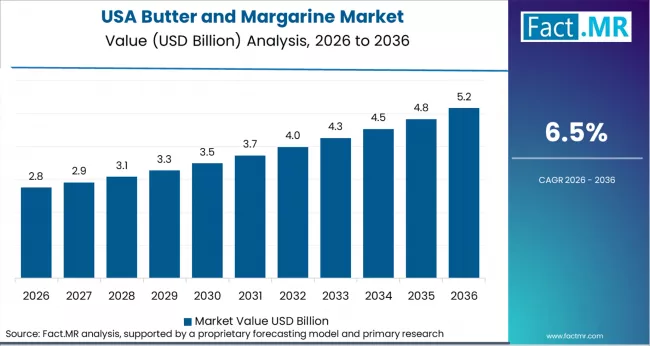
Butter And Margarine Market Country Value Analysis | Source: Fact.MR
North America records the highest premium butter consumption globally as consumers increasingly prefer natural dairy products. Domestic cooperatives supply mainstream butter while imported brands compete in premium segments.
- United States: Butter and margarine demand in the United States is projected to grow at 6.5% CAGR through 2036. USDA organic dairy data published in November 2024 showed organic butter production increasing 9%. Dean Foods restructuring in December 2024 transferred several processing facilities to regional cooperatives maintaining butter supply for retail contracts. The US FDA regulation restricting partially hydrogenated oils requires margarine reformulation before December 2025.
FACT.MR’s analysis of the butter and margarine market in North America covers the United States, Canada, and Mexico. The report includes USDA production data, FDA compliance timelines, and premium butter demand forecasts.
Europe Butter and Margarine Market Analysis
Europe remains a premium butter market shaped by organic certification, geographical indications, and strict fat regulations. Arla Foods and FrieslandCampina hold strong positions in both butter and margarine segments.
- Germany: Butter and margarine demand in Germany is projected to expand at 5.8% CAGR through 2036. Germany increased organic dairy subsidies in November 2024 supporting milk supply for premium butter. Arla expanded organic butter production at its Upahl creamery in January 2025 following strong retail growth. FrieslandCampina completed removal of partially hydrogenated oils from margarine products in December 2024.
- United Kingdom: Butter and margarine demand in the United Kingdom is expected to grow at 5.0% CAGR through 2036. The UK Competition and Markets Authority reported stable pricing for premium butter brands during 2024. Arla confirmed in November 2024 that Lurpak remained the leading butter brand by value in the UK. The UK Food Standards Agency increased monitoring of trans-fat levels in margarine products in September 2024.
FACT.MR’s analysis of the butter and margarine market in Europe covers Germany, France, the United Kingdom, Italy, Spain, Nordic countries, BENELUX, and Rest of Western Europe. The report includes organic dairy certification data, regulatory compliance trends, and country forecasts by processing method.
Competitive Aligners for Market Players
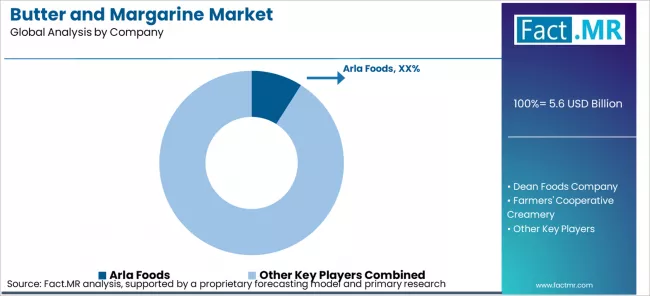
Butter And Margarine Market Analysis By Company | Source: Fact.MR
The global butter and margarine market combines intense price competition in commodity products with stronger brand differentiation in premium categories. In Europe, companies such as Arla Foods and FrieslandCampina maintain strong positions in the premium butter segment through established dairy supply chains, trusted brands, and long-standing relationships with major supermarket retailers. In India, AMUL dominates the butter market through its cooperative dairy model, which connects millions of farmers and ensures a stable and cost-efficient supply of raw milk. In Latin America, companies such as BRF and Grupo Lala benefit from vertically integrated dairy processing and strong distribution networks across modern retail channels.
Arla Foods has built a strong premium identity through its Lurpak brand, which is widely recognized in the UK, Middle East, and Asia Pacific markets and often commands a price premium compared to standard butter. FrieslandCampina’s Becel margarine brand maintains a health-focused positioning, supported by its presence in pharmacy and wellness retail channels. Meanwhile, AMUL’s cooperative structure gives it consistent access to milk supply, reducing exposure to global cream price fluctuations.
Large retailers including Walmart, Carrefour, Tesco, and Reliance Retail maintain multi-brand shelves that combine premium brands with private labels, increasing competition and limiting pricing power in mainstream butter and margarine categories.
Key Players
- Arla Foods
- Dean Foods Company
- Farmers' Cooperative Creamery
- OJSC Creative Group
- AMUL India
- Kraft Foods
- Friesland Campina
- NMGK Group
- BRF
- Groupo Lala
Bibliography
- [1] World Health Organization. (2024). REPLACE Trans Fat Global Progress Update: Country-Level Partially Hydrogenated Oil Elimination Policy Implementation and 2025 Enforcement Status Review. December 2024. who.int/nutrition/topics/replace-transfat
- [2] National Dairy Development Board, Government of India. (2024). National Action Plan for Dairy Development: Butter Processing Capacity Expansion at AMUL Anand Plant and Cooperative Milk Procurement Infrastructure Extension. October 2024. nddb.coop
- [3] European Commission. (2024). EU Organic Farming Regulation 2018/848 Compliance Monitoring Update: Certified Organic Dairy Production Volumes, Member State Audit Status, and Organic Butter Premium Retail Segment Growth Data. November 2024. ec.europa.eu/agriculture/organic
- [4] Arla Foods amba. (2025). Press Release: Lurpak Butter Production Capacity Expansion at Videbaek Denmark Creamery Targeting UK, Middle East and Asia Pacific Premium Spreadable Butter Demand Growth. February 2025. arla.com/company/news-and-press
- [5] FrieslandCampina. (2024). Product Launch: Becel Pro.activ Reformulated Plant Sterol Margarine without Partially Hydrogenated Fats for European Pharmacy and Specialty Retail Health-Conscious Consumer Segment. September 2024. frieslandcampina.com/news
- [6] International Dairy Federation. (2024). World Dairy Situation 2024: Global Butter Production and Trade Statistics, Premium Modern Butter Variant Growth Rates, and Per-Capita Dairy Fat Consumption Trends by Region. October 2024. fil-idf.org
- [7] Kraft Heinz Company. (2024). Press Release: Latin America Distribution Partnership Expansion with Grupo Pão de Açúcar for Kraft Spreadable Butter and Philadelphia Cream Cheese in Brazil and Mexico Modern Trade. November 2024. ir.kraftheinzcompany.com
- [8] NMGK Group. (2024). Product Launch: Pyshka Spreadable Margarine Reformulation Programme Eliminating Partially Hydrogenated Oils for TR CU 024/2011 Technical Regulation Compliance in Russian Retail Market. August 2024. nmgk.ru/press
- [9] U.S. Dairy Export Council. (2024). U.S. Butter and Dairy Fat Export Data 2024: Volume Growth to Mexico and Philippines, Foodservice and Bakery Demand Drivers, and Western-Style Food Preparation Adoption Trends. December 2024. usdec.org/research
This Report Addresses
- Strategic intelligence on WHO REPLACE trans-fat targets, EU organic dairy regulation, FSSAI India fat limits, ANVISA Brazil reformulation rules, and US FDA hydrogenated oil enforcement shaping market demand.
- Market forecast from USD 5.6 billion in 2026 to USD 14.7 billion by 2036 at 10.1% CAGR by product type, usage, processing method, and region.
- Growth opportunities across India AMUL butter expansion, Brazil modern trade butter adoption, US organic butter retail growth, Germany organic dairy subsidies, and UK premium spreadable demand.
- Country CAGR outlook for India 7.5%, Brazil 7.0%, United States 6.5%, China 6.1%, Germany 5.8%, and United Kingdom 5.0% with dairy investment and retail expansion drivers.
- Competitive analysis of Arla Foods, Dean Foods, Farmers’ Cooperative Creamery, AMUL India, Kraft Foods, FrieslandCampina, NMGK Group, BRF, and Grupo Lala covering portfolios and distribution strategies.
- Technology tracking covering cultured butter, grass-fed dairy production, trans-fat-free margarine reformulation, organic dairy supply chains, and blended butter-oil products.
- Regulatory analysis including WHO trans-fat elimination programme, EU organic dairy rules, FSSAI India standards, ANVISA Brazil limits, TR CU 024/2011 safety rules, and US FDA enforcement.
- Report delivered in PDF, Excel datasets, PowerPoint summary, and dashboard formats supported by IDF dairy data, OEM disclosures, retail sales analysis, and primary interviews.
Segmentation
Scope of Report
| Attribute | Details |
|---|---|
| Quantitative Units | USD 5.6 billion (2026) to USD 14.7 billion (2036), at a CAGR of 10.1% |
| Market Definition | Dairy-based butter and plant-oil-based margarine products used as spreads, baking ingredients, and cooking fats across household and foodservice channels globally. |
| Type Segmentation | Traditional (46%), Modern |
| Usage Segmentation | Spreadable (68%), All Purpose |
| Processing Method Segmentation | Churned, Blended, Cultured, Salted, Unsalted |
| Application Coverage | Household spreading and cooking, bakery and confectionery ingredient use, foodservice and institutional catering, and processed food manufacturing. |
| Regions Covered | Asia Pacific, Europe, North America, Latin America, Middle East and Africa |
| Countries Covered | China, Japan, South Korea, India, Australia and New Zealand, ASEAN, Rest of South Asia and Pacific, Germany, UK, France, Italy, Spain, Nordic, BENELUX, Rest of Western Europe, Russia, Poland, Hungary, USA, Canada, Mexico, Brazil, Chile, Ecuador, Rest of Latin America, Saudi Arabia, GCC, Turkey, South Africa, Rest of MEA |
| Key Companies Profiled | Arla Foods, Dean Foods Company, Farmers' Cooperative Creamery, OJSC Creative Group, AMUL India, Kraft Foods, Friesland Campina, NMGK Group, BRF, Groupo Lala |
| Forecast Period | 2026 to 2036 |
| Approach | Hybrid top-down and bottom-up model using dairy commodity production data, per-capita fat consumption trends, retail channel sales volumes, and primary interviews with dairy brand managers and foodservice procurement buyers. |
Source: Fact.MR analysis. Updated Mar 12, 2026
Butter and Margarine Market by Segments
-
By Type:
- Traditional
- Modern
-
By Usage:
- Spreadable
- All Purpose
-
By Processing Method:
- Churned
- Blended
- Cultured
- Salted
- Unsalted
-
By Region:
- North America
- United States
- Canada
- Mexico
- Latin America
- Brazil
- Chile
- Ecuador
- Rest of Latin America
- Western Europe
- Germany
- United Kingdom
- France
- Italy
- Spain
- Nordic
- BENELUX
- Rest of Western Europe
- Eastern Europe
- Russia
- Poland
- Hungary
- Balkan and Baltic
- Rest of Eastern Europe
- East Asia
- China
- Japan
- South Korea
- South Asia and Pacific
- India
- ASEAN
- Australia and New Zealand
- Rest of South Asia and Pacific
- Middle East and Africa
- Kingdom of Saudi Arabia
- Other GCC Countries
- Turkey
- South Africa
- Other African Union
- Rest of Middle East and Africa
- North America
Frequently Asked Questions
How large is the butter and margarine market in 2025?
What will the market size be in 2026?
What is the projected market size by 2036?
What is the expected CAGR?
Which type segment leads the market?
Which usage segment dominates?
Which country shows the fastest growth?
What is the primary restraint?
Who worked on this report


Preview the report firsthand - request a free sample
Free SampleGet the brochure for pricing and purchase details
Download PDF