- Base Value(2025): 114.0 Bn
- Estimated Value(2026): 119.0 Bn
- Forecast Value (2036): 183.1 Bn
- CAGR (2026 - 2036): 4.4%
Home Healthcare Market Analysis and Forecast by Fact.MR
- The global home healthcare market is estimated at USD 114.0 billion in 2025 and is forecast to reach USD 119.0 billion in 2026 before expanding to USD 183.1 billion by 2036, progressing at a CAGR of 4.4% over the 2026 to 2036 forecast period.
- Home Medical Devices is anticipated to account for 32.8% share of the product segment in 2026, supported by sustained demand for respiratory care, infusion therapy, and patient monitoring equipment used in home-based clinical settings.
- India (6.1%) and China (5.4%) are the fastest growing country markets through 2036.
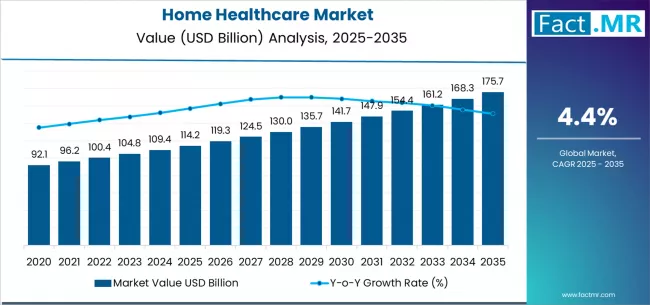
Home Healthcare Market Market Value Analysis | Source: Fact.MR
Summary of Home Healthcare Market
- Market Snapshot
- In 2025, the global Home Healthcare Market was valued at approximately USD 114.0 billion.
- The market is estimated to reach USD 119.0 billion in 2026 and is projected to attain USD 183.1 billion by 2036.
- The home healthcare market is likely to expand at a CAGR of 4.4% during the forecast period.
- The market is anticipated to create an absolute dollar opportunity of USD 64.1 billion between 2026 and 2036.
- Home medical devices account for 32.8% of market share in 2026.
- India (6.1%) and China (5.4%) are the key growth markets during the forecast period.
- Demand and Growth Drivers
- Payer economics favoring lower-cost home-based care over extended inpatient stays create structural incentives for hospitals, insurers, and government healthcare programs to expand home healthcare utilization.
- Aging population demographics across all major economies increase the volume of chronic disease patients requiring ongoing home-based monitoring, therapy, and skilled nursing support.
- Technology advances in telehealth, remote patient monitoring, and connected medical devices enable clinical-grade care delivery in residential settings with real-time clinician oversight.
- Rising institutional procurement volumes across hospitals, government programs, and organized care networks create a sustained base-level demand less sensitive to short-term economic cycles.
- Expanding distribution through specialized channels and technology-enabled platforms is improving accessibility across underpenetrated geographies.
- Product and Segment View
- Home Medical Devices accounts for 32.8% of the product segment in 2026.
- Telehealth Technology represents 35.7% of the technology segment in 2026.
- The home healthcare market is segmented by product, service, care setting, end use, technology, and region.
- Geography and Competitive Outlook
- India leads growth at 6.1%.
- The USA at 4.1% reflects a mature market with established procurement.
- Germany at 3.3% supported by regulatory standards and institutional procurement.
- Philips Healthcare, GE Healthcare, Fresenius Medical Care hold strong positions through broad portfolios and distribution networks.
- Analyst Opinion
- Shambhu Nath Jha, Principal Consultant at Fact.MR, says 'The home healthcare market is benefiting from a structural realignment of care delivery away from inpatient facilities and toward residential settings. This shift is driven by payer economics that favor lower-cost home-based care, patient preference for recovery in familiar environments, and technology advances that enable clinical-grade monitoring outside hospital walls. Respiratory care and infusion therapy devices remain the largest product categories because they address chronic and post-acute conditions that require ongoing management. Telehealth and remote monitoring platforms are the fastest-growing technology layer, supported by reimbursement policy changes that expanded during the pandemic era and have largely been maintained. The geriatric population accounts for the largest end-use share, but maternal and pediatric home care segments are growing as hospitals shorten inpatient stays and shift post-discharge monitoring to home settings. India and China represent the largest growth opportunities as their aging populations expand and healthcare systems build the infrastructure to support home-based care delivery at scale.'
Key Growth Drivers, Constraints, and Opportunities
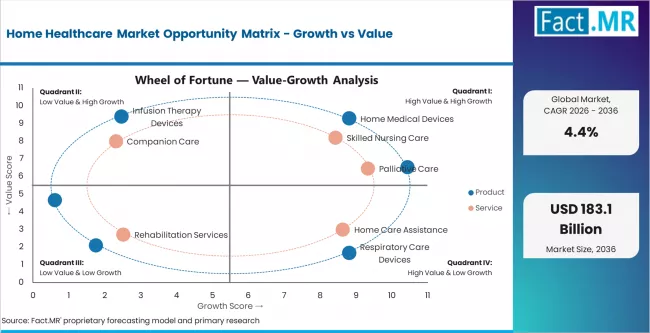
Home Healthcare Market Opportunity Matrix Growth Vs Value | Source: Fact.MR
Key Factors Driving Growth
- Payer economics favoring lower-cost home-based care over extended inpatient stays create structural incentives for hospitals, insurers, and government healthcare programs to expand home healthcare utilization.
- Aging population demographics across all major economies increase the volume of chronic disease patients requiring ongoing home-based monitoring, therapy, and skilled nursing support.
- Technology advances in telehealth, remote patient monitoring, and connected medical devices enable clinical-grade care delivery in residential settings with real-time clinician oversight.
Key Market Constraints
- Workforce shortages in skilled nursing and home health aide positions limit service capacity in markets where demand is growing faster than caregiver supply.
- Reimbursement variability across different payer systems and geographies creates uncertainty in revenue models for home health service providers and device manufacturers.
- Regulatory complexity for medical devices used in home settings, including safety standards, connectivity requirements, and data privacy rules, increases compliance costs.
Key Opportunity Areas
- Expansion of hospital-at-home programs that deliver acute-level care in residential settings creates demand for advanced monitoring equipment and skilled care coordination platforms.
- Growth of chronic disease management programs for diabetes, COPD, and heart failure in home settings supports sustained demand for connected monitoring devices and consumables.
- Integration of AI-enabled clinical decision support into home monitoring platforms creates opportunities for predictive analytics that reduce hospital readmissions and improve patient outcomes.
Segment-wise Analysis of the Home Healthcare Market
- Home Medical Devices holds 32.8% of the product segment in 2026.
- Telehealth Technology represents 35.7% of the technology segment in 2026.
The home healthcare market is segmented by product, service, care setting, end use, technology, and region.
Which Product Segment Leads the Home Healthcare Market?
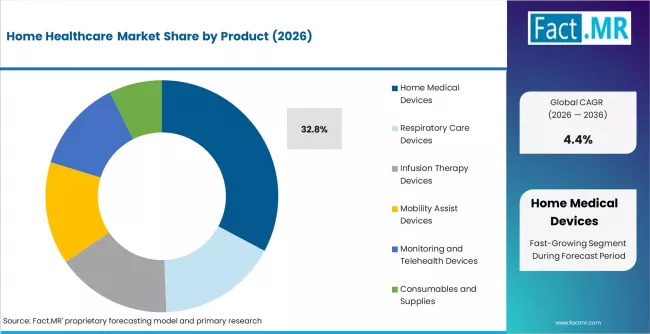
Home Healthcare Market Analysis By Product | Source: Fact.MR
Home Medical Devices accounts for 32.8% of the product segment in 2026. This position reflects sustained demand for respiratory care, infusion therapy, and patient monitoring equipment used in home-based clinical settings.
Which Technology Segment Leads the Home Healthcare Market?
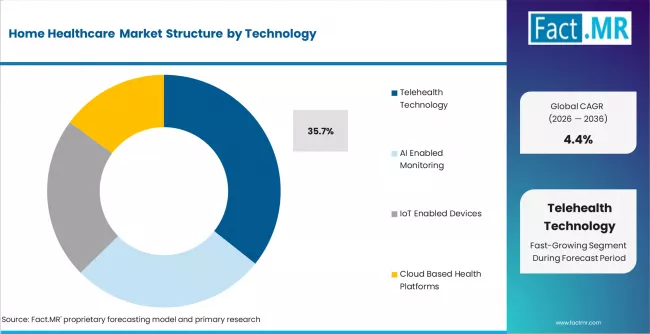
Home Healthcare Market Analysis By Technology | Source: Fact.MR
Telehealth Technology is expected to account for 35.7% of the technology segment in 2026. This segment represents the largest concentration of demand.
Which Trend is Shaping the Next Phase of Growth in the Home Healthcare Market?
Hospital-at-home programs are emerging as a transformative delivery model that extends acute-level medical care into residential settings. These programs use advanced remote monitoring, connected medical devices, and coordinated skilled nursing visits to manage conditions that traditionally required inpatient hospitalization. Adoption accelerated during the pandemic and has been sustained by favorable clinical outcome data and cost-effectiveness evidence.
Payers including Medicare in the United States are maintaining reimbursement pathways for hospital-at-home services, creating a structural demand channel for home-grade monitoring equipment, infusion therapy devices, and telehealth platforms. As clinical evidence matures and operational models standardize, hospital-at-home is positioned to become a permanent component of healthcare delivery rather than a pandemic-era exception.
Regional Outlook Across Key Markets
.webp "Top Country Growth Comparison Home Healthcare Market Cagr (2026 2036)")
Top Country Growth Comparison Home Healthcare Market Cagr (2026 2036) | Source: Fact.MR
- India leads growth at 6.1%.
- The USA at 4.1% reflects mature demand with established procurement.
- Germany at 3.3% supported by regulatory frameworks.
- Asia Pacific is the fastest growing region overall.
Country CAGR Table
| Country | CAGR (%) |
|---|---|
| India | 6.1% |
| China | 5.4% |
| Brazil | 4.8% |
| USA | 4.1% |
| South Korea | 3.7% |
| Germany | 3.3% |
| Japan | 3.0% |
Source: Fact.MR analysis. Updated May 7, 2026
Source: Fact.MR analysis, based on proprietary forecasting model and primary research.
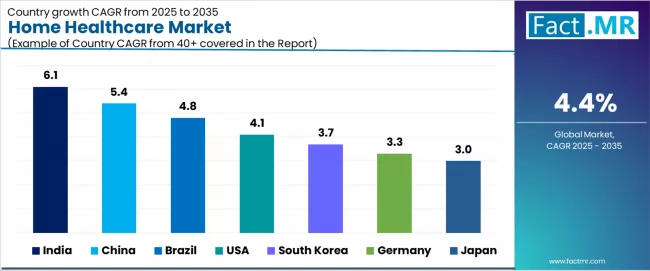
Home Healthcare Market Cagr Analysis By Country | Source: Fact.MR
Home Healthcare Market in India
India leads global market expansion with a projected CAGR of 6.1% through 2036. Growth reflects an aging population, rising chronic disease prevalence, limited hospital bed capacity relative to demand, and expanding private home healthcare service networks in urban centers.
- Limited hospital capacity relative to demand creates structural incentive for home-based care adoption.
- Private home healthcare service networks expand across major urban centers.
- Connected monitoring devices improve remote clinical oversight for chronic disease patients.
Home Healthcare Market in China
China is projected to grow at a CAGR of 5.4% through 2036. Demand reflects rapid population aging, government investment in community and home-based elder care infrastructure, and strong domestic manufacturing of home medical devices.
- Government elder care infrastructure investment supports home healthcare service development.
- Domestic medical device manufacturing ensures affordable equipment supply.
- Population aging at scale creates one of the largest addressable home healthcare markets globally.
Home Healthcare Market in Brazil
Brazil is projected to grow at a CAGR of 4.8% through 2036. Expansion reflects improving healthcare access, growing private home care services, and increasing adoption of remote monitoring in chronic disease management.
- Private home care service growth creates institutional demand for home medical equipment.
- Remote monitoring adoption improves chronic disease management outside hospital settings.
- Healthcare access improvement increases patient volumes requiring home-based follow-up care.
Home Healthcare Market in USA
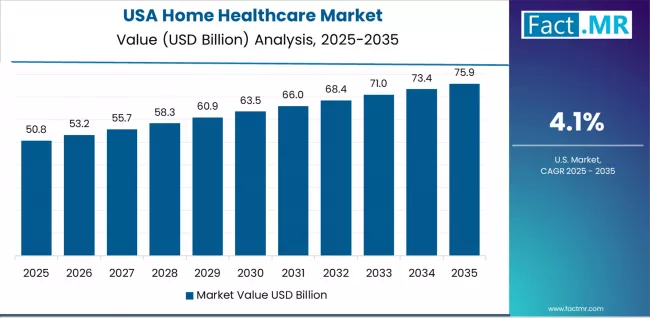
Home Healthcare Market Country Value Analysis | Source: Fact.MR
The United States is projected to grow at a CAGR of 4.1% through 2036. The market benefits from established Medicare home health coverage, hospital-at-home program expansion, and advanced telehealth infrastructure supporting remote patient management.
- Medicare home health reimbursement provides a stable demand floor for skilled home care services.
- Hospital-at-home programs create new demand channels for acute-grade monitoring equipment.
- Telehealth infrastructure enables continuous remote clinical oversight for home-based patients.
Home Healthcare Market in South Korea
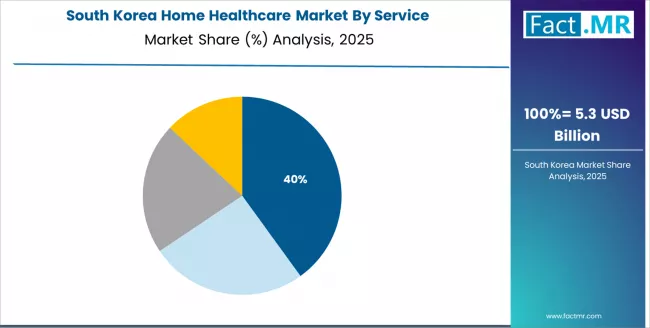
Home Healthcare Market South Korea Market Share Analysis By Service | Source: Fact.MR
South Korea is projected to grow at a CAGR of 3.7% through 2036. Growth reflects rapid aging demographics, government long-term care programs, and strong digital health infrastructure supporting connected home care.
- Rapid aging demographics support expanding home healthcare demand.
- Government long-term care programs provide reimbursement for home health services.
- Digital health infrastructure supports connected device adoption in home settings.
Home Healthcare Market in Germany
Germany is projected to grow at a CAGR of 3.3% through 2036. Demand reflects statutory long-term care insurance coverage, established home nursing service infrastructure, and preference for quality-certified home medical devices.
- Statutory care insurance supports consistent home healthcare service demand.
- Established home nursing infrastructure provides reliable service delivery.
- Quality certification standards maintain premium product positioning.
Home Healthcare Market in Japan
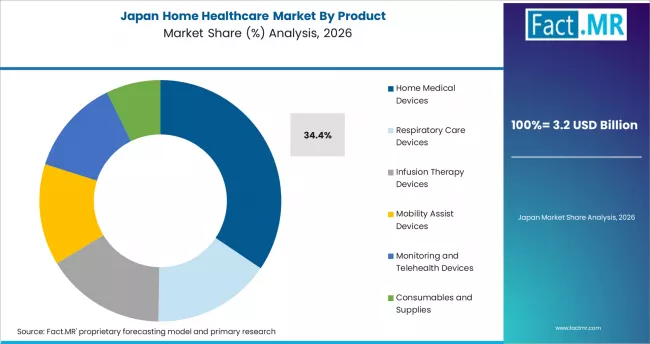
Home Healthcare Market Japan Market Share Analysis By Product | Source: Fact.MR
Japan is projected to grow at a CAGR of 3.0% through 2036. The market is mature, with growth shaped by the world's oldest population, comprehensive long-term care insurance, and advanced adoption of robotic and AI-assisted home care technologies.
- World's oldest population sustains high per-capita home healthcare demand.
- Comprehensive long-term care insurance provides broad reimbursement coverage.
- Robotic and AI-assisted home care technologies reflect domestic innovation leadership.
Competitive Benchmarking and Company Positioning
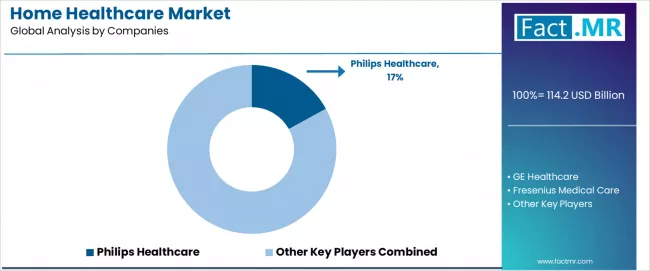
Home Healthcare Market Analysis By Company | Source: Fact.MR
Home Healthcare Market Analysis By Company
- Philips Healthcare, GE Healthcare, Fresenius Medical Care hold strong positions.
- ResMed Inc., Medtronic, Abbott Laboratories participate meaningfully across specific segments.
Philips Healthcare and GE Healthcare hold strong positions through comprehensive connected health portfolios that span patient monitoring, respiratory care, and telehealth platforms designed for home deployment.
ResMed Inc. and Medtronic compete through specialized respiratory and infusion therapy device portfolios with established home healthcare distribution channels and clinical support infrastructure.
Home health service companies including Amedisys, Kindred at Home, and LHC Group compete on service delivery capacity, geographic coverage, and payer relationship management rather than product manufacturing.
The competitive landscape spans both device manufacturing and service delivery, with established medtech companies competing on product innovation and connected care platforms while home health agencies compete on workforce capacity, clinical outcomes, and payer contracting.
Recent Industry Developments
- Philips Healthcare expanded its hospital-at-home monitoring platform in early 2026, integrating advanced vital sign tracking with AI-enabled clinical decision support for remote patient management.
- ResMed Inc. launched an updated connected respiratory care device in 2025 for home COPD and sleep apnea management, featuring improved data transmission and patient compliance monitoring.
- Medtronic introduced a next-generation home infusion pump system in 2025, targeting outpatient chemotherapy and antibiotic delivery with simplified patient interface and remote clinician monitoring capabilities.
Leading Companies in the Home Healthcare Market
-
Major Players
- Philips Healthcare
- GE Healthcare
- Fresenius Medical Care
- ResMed Inc.
- Medtronic
- Abbott Laboratories
- Baxter International
- Omron Healthcare
-
Emerging Players
- Cardinal Health
- Invacare Corporation
- BioTelemetry
- Amedisys
- LHC Group
- Kindred at Home
- BrightSpring Health
Sources and Research References
- World Health Organization (WHO). Home-Based and Community Care Framework.
- U.S. Centers for Medicare and Medicaid Services (CMS). Home Health Services Utilization and Reimbursement Data.
- Philips Healthcare. Connected Care and Home Monitoring Portfolio Updates.
- Organisation for Economic Co-operation and Development (OECD). Long-Term Care and Home Health Expenditure Reports.
- Primary interviews with home health agencies, medical device manufacturers, hospital discharge planners, and telehealth service providers.
This bibliography is provided for reader reference and is not exhaustive.
Key Questions This Report Addresses
- What is the current and future size of the home healthcare market?
- How fast is the market expected to grow between 2026 and 2036?
- Which product is likely to lead by 2026?
- Which technology segment accounts for the highest demand?
- What factors are driving demand globally?
- Which countries show the fastest growth?
- Who are the key companies?
- How does Fact.MR validate the forecast?
Home Healthcare Market Definition
The home healthcare market covers medical devices, skilled nursing services, rehabilitation care, remote monitoring platforms, and associated consumables used for patient treatment and monitoring in residential settings across geriatric, maternal, and pediatric care applications.
Home Healthcare Market Inclusions
The scope covers global and regional market size and forecasts for 2026 to 2036 across product, service, care setting, end use, technology, and region.
Home Healthcare Market Exclusions
The scope excludes general-purpose devices, products, or services not purpose-built for the applications defined within this market.
Home Healthcare Market Research Methodology
- Primary research includes interviews with manufacturers, service providers, end users, and procurement teams.
- Secondary research draws on industry publications, regulatory filings, and company reports.
- Market sizing follows a demand-side model supported by top-down validation across 30 plus countries.
- Final estimates are validated through trade-flow checks, pricing analysis, and sensitivity testing.
Segmentation
Scope of Analysis
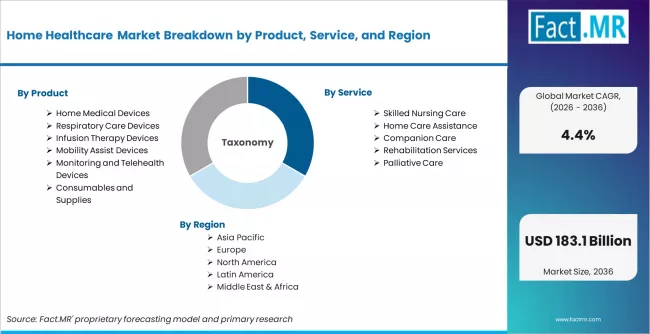
Home Healthcare Market Breakdown By Product, Service, And Region | Source: Fact.MR
| Parameter | Details |
|---|---|
| Quantitative Units | USD 119.0 billion to USD 183.1 billion, at a CAGR of 4.4% |
| Market Definition | The home healthcare market covers medical devices, skilled nursing services, rehabilitation care, remote monitoring platforms, and associated consumables used for patient treatment and monitoring in residential settings across geriatric, maternal, and pediatric care applications. |
| Regions Covered | North America, Latin America, Europe, East Asia, South Asia and Pacific, Middle East and Africa |
| Countries Covered | USA, India, China, Brazil, Germany, South Korea, Japan, and 30 plus countries |
| Key Companies | Philips Healthcare, GE Healthcare, Fresenius Medical Care, ResMed Inc., Medtronic, Abbott Laboratories, Baxter International, Omron Healthcare, Cardinal Health, Invacare Corporation |
| Forecast Period | 2026 to 2036 |
| Approach | Hybrid demand-side and top-down methodology built on country-level aging demographics, healthcare expenditure data, home care reimbursement analysis, and primary interviews across device manufacturers, home health agencies, hospital discharge planners, and payer organizations |
Source: Fact.MR analysis. Updated May 7, 2026
Market Segmentation Analysis
-
Home Healthcare Market Segmented by Product:
- Home Medical Devices
- Blood Pressure Monitors
- Glucose Monitoring Devices
- Oximeters
- Thermometers
- Respiratory Care Devices
- Oxygen Concentrators
- Nebulizers
- CPAP Devices
- Infusion Therapy Devices
- Insulin Pumps
- Infusion Pumps
- Delivery Sets
- Mobility Assist Devices
- Wheelchairs
- Walking Aids
- Adjustable Beds
- Monitoring and Telehealth Devices
- Remote Patient Monitoring Systems
- Wearable Health Monitors
- Telehealth Kits
- Consumables and Supplies
- Catheters
- Wound Care Supplies
- Diabetic Care Consumables
- Home Medical Devices
-
Home Healthcare Market Segmented by Service:
- Skilled Nursing Care
- Post Acute Care
- Chronic Disease Management
- Physiotherapy Services
- Home Care Assistance
- Personal Care Assistance
- Hygiene Support Services
- Companion Care
- Elderly Companionship
- Social Support Services
- Rehabilitation Services
- Physical Rehabilitation
- Occupational Therapy
- Speech Therapy
- Palliative Care
- Pain Management Support
- End of Life Care
- Skilled Nursing Care
-
Home Healthcare Market Segmented by Care Setting:
- Skilled Home Care
- Medical Supervised Home Care
- Post Hospital Discharge Care
- Non Skilled Home Care
- Assistance with Daily Activities
- Elderly Care Support
- Remote Care
- Telehealth Supported Care
- Digital Monitoring Based Care
- Skilled Home Care
-
Home Healthcare Market Segmented by End Use:
- Geriatric Population
- Aged Care Patients
- Chronic Disease Patients
- Post Surgical Patients
- Disabled Individuals
- Pregnancy and Maternal Care
- High Risk Pregnancy Monitoring
- Postpartum Care Support
- Pediatric Home Care
- Chronic Pediatric Conditions
- Disability Care in Children
- Geriatric Population
-
Home Healthcare Market Segmented by Technology:
- Telehealth Technology
- Video Consultation Platforms
- Remote Diagnosis Systems
- AI Enabled Monitoring
- Predictive Health Analytics
- Early Warning Systems
- IoT Enabled Devices
- Connected Health Devices
- Real Time Patient Monitoring
- Cloud Based Health Platforms
- Electronic Health Records Integration
- Remote Data Sharing Systems
- Telehealth Technology
-
Home Healthcare Market by Region:
- North America
- USA
- Canada
- Mexico
- Latin America
- Brazil
- Chile
- Rest of Latin America
- Western Europe
- Germany
- UK
- Italy
- Spain
- France
- Nordic
- BENELUX
- Rest of Western Europe
- Eastern Europe
- Russia
- Poland
- Hungary
- Balkan & Baltic
- Rest of Eastern Europe
- East Asia
- China
- Japan
- South Korea
- South Asia and Pacific
- India
- ASEAN
- Australia & New Zealand
- Rest of South Asia and Pacific
- Middle East & Africa
- Kingdom of Saudi Arabia
- Other GCC Countries
- Turkiye
- South Africa
- Other African Union
- Rest of Middle East & Africa
- North America
Frequently Asked Questions
How big is the home healthcare market in 2025?
What will be the market size in 2036?
What is the expected CAGR?
What are the key product types?
Which technology segment leads?
Which countries grow fastest?
What is the market definition?
What methodology is used?
How big is the home healthcare market in 2025?
What will be the market size in 2036?
What is the expected CAGR?
What are the key product types?
Which technology segment leads?
Which countries grow fastest?
What is the market definition?
What methodology is used?
Who worked on this report


Preview the report firsthand - request a free sample
Free SampleGet the brochure for pricing and purchase details
Download PDF