- Market Value (2025): USD 42.3 Bn
- Estimated Value (2026): USD 45.5 Bn
- Forecast Value (2036): USD 93.8 Bn
- CAGR (2026-2036): 7.5%
What is the Hospital Food Service Market forecast to be worth by 2036?
USD 45.5 billion in 2026 to USD 93.8 billion by 2036 at 7.5% CAGR.
- The hospital food service market reached USD 42.3 billion in 2025 as hospitals kept nutrition services tied to patient experience and recovery planning.
- Demand is projected to increase from USD 45.5 billion in 2026 to USD 93.8 billion by 2036.
- The market is forecast to record 7.5% CAGR from 2026 to 2036 owing to outsourced patient dining, clinical nutrition programs and hospital retail food renewal.
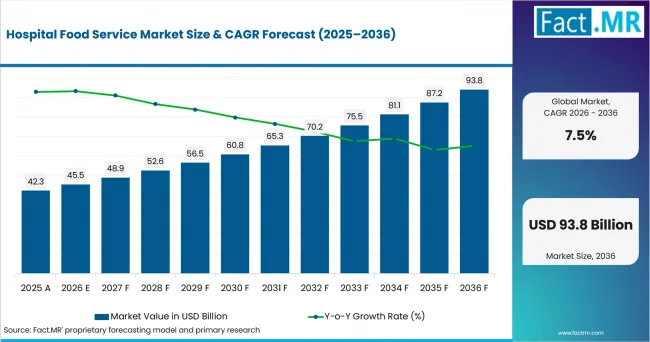
Hospital Food Service Market Value Analysis | Source: Fact.MR
What are the defining numbers behind Hospital Food Service Market growth?
USD 48.3 billion absolute opportunity by 2036, led by Patient Services, Acute Care Settings and Germany.
- Demand Drivers in the Market
- Hospital administrators need dependable meal operations because ward diets must reach patients on schedule across daily service windows.
- Clinical nutrition teams require menu controls so therapeutic diets match allergen records and recovery plans.
- Procurement teams are expected to prefer contracted providers that document labor coverage and cost per meal.
- Retail dining managers need visitor and staff outlets that extend service beyond patient trays without disrupting kitchen workflow.
- Key Segments Analyzed
- By Product: Patient Services is expected to hold 36.2% share in 2026 because inpatient meals carry the clearest link to clinical diet compliance.
- By Settings: Acute Care Settings are projected to account for 55.2% share in 2026 as general hospitals manage high patient turnover and varied diets.
- Analyst Opinion at Fact.MR
- Shambhu Nath Jha, Principal Consultant at Fact.MR, states, "Hospital food service is no longer a back-kitchen function when patients expect clear nutrition support. Service acceptance is expected to depend on meal accuracy, diet documentation and labor stability. Providers should combine clinical diet knowledge with retail discipline and waste controls."
- Strategic Implications
- Hospital executives should measure meal accuracy alongside patient satisfaction when reviewing food service contracts.
- Contract caterers should show proof of menu compliance and diet-change response time during bid reviews.
- Nutrition teams should link bedside ordering data with discharge planning where patients require follow-up diet guidance.
- Investors should separate general catering revenue from hospital food service exposure because clinical diet work carries different staffing requirements.
Germany is expected to record 8.2% CAGR through 2036 supported by inpatient meal recovery and hospital reform pressure. Brazil is projected to advance at 7.5% CAGR due to hospital-network scale and public-care volume. The USA is forecast to post 6.8% CAGR owing to broad hospital capacity and outsourced dining models. The U.K. is anticipated to reach 6.1% CAGR as NHS food spending keeps contract renewal visible. Japan is estimated to record 5.4% CAGR supported by ageing demand and clinical nutrition needs.
How does the Hospital Food Service Market break down by segment?
Patient Services leads at 36.2%; Acute Care Settings leads at 55.2%.
Which product dominates?
Patient Services is projected to account for 36.2% share in 2026.
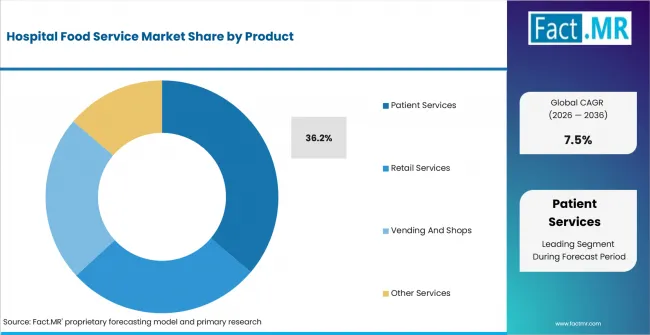
Hospital Food Service Market Analysis By Product | Source: Fact.MR
Patient Services is projected to lead Product because inpatient meal delivery remains the core hospital task. Bedside dining adds flexibility where patients choose approved meals within clinical limits. Clinical nutrition services gain weight when dietitians need traceable meal plans. Sodexo states that its healthcare teams cover hospital food service, clinical nutrition and retail outlets.
What leads the Settings segment?
Acute Care Settings are expected to hold 55.2% share in 2026.
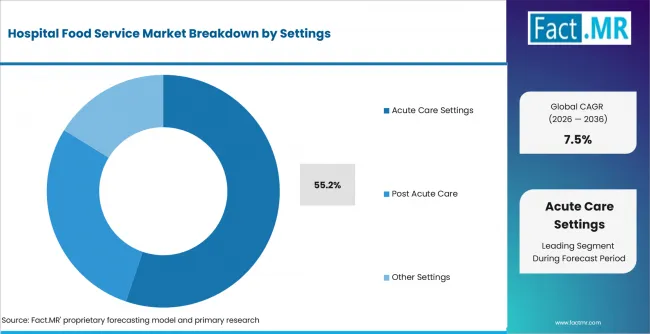
Hospital Food Service Market Analysis By Settings | Source: Fact.MR
Acute Care Settings are expected to lead because general hospitals serve high patient volumes and varied medical diets. Specialty hospitals require targeted nutrition support for defined care pathways. Trauma centers add demand where food service must fit urgent admissions. OECD reported in November 2025 that member countries averaged 4.2 hospital beds per 1,000 people in 2023.
What is accelerating Hospital Food Service Market adoption, and what is holding it back?
Patient meal compliance drives it; labor and food-cost pressure restrain it.
Drivers Impact Analysis
| DRIVER | (~) % IMPACT ON CAGR | GEOGRAPHIC RELEVANCE | IMPACT TIMELINE |
|---|---|---|---|
| Patient meal compliance | +2.0% | Germany, USA, U.K. | Short term (<= 2 years) |
| Outsourced labor coverage | +1.7% | USA, Brazil, U.K. | Short term (<= 2 years) |
| Clinical nutrition documentation | +1.4% | Japan, Germany, USA | Medium term (2-4 years) |
| Retail food renewal | +1.1% | USA and Europe | Medium term (2-4 years) |
| Waste and cost control | +0.9% | Hospital networks | Long term (>= 4 years) |
Source: Fact.MR analysis. Updated Aug 19, 2026
- Patient meal compliance: Hospitals are expected to raise scrutiny when tray accuracy affects recovery and satisfaction scores. Acute hospital care pathways reinforce this need because nutrition must fit discharge planning and short patient stays.
- Outsourced labor coverage: Contract caterers are anticipated to gain where hospitals face staff shortages across long meal periods. The U.S. Bureau of Labor Statistics reported in August 2025 that food and beverage serving and related workers held about 5.0 million jobs in 2024.
- Clinical nutrition documentation: Dietitians are projected to require clearer records when meals support diabetes care, swallowing safety or recovery diets. Enteral medical nutrition and medical food use create adjacent documentation habits for hospitals.
Opportunity Impact Analysis
| OPPORTUNITY | (~) % IMPACT ON CAGR | GEOGRAPHIC RELEVANCE | IMPACT TIMELINE |
|---|---|---|---|
| Bedside ordering integration | +1.3% | USA, Germany, Japan | Medium term (2-4 years) |
| Texture-modified meals | +1.0% | Japan and Europe | Medium term (2-4 years) |
| Automated overnight retail | +0.8% | USA and U.K. | Long term (>= 4 years) |
| Dietary consulting services | +0.6% | Acute and post-acute settings | Long term (>= 4 years) |
Source: Fact.MR analysis. Updated Aug 19, 2026
- Bedside ordering integration: Digital meal selection is expected to create opportunity where hospitals need diet changes reflected quickly. Providers that reduce tray corrections are anticipated to gain stronger contract renewal positions.
- Texture-modified meals: Senior-specific texture-modified food is expected to gain relevance where older patients need safer swallowing. Japan’s Cabinet Office reported in its 2025 Annual Report on the Ageing Society that 44.5% of long-term-care insurance Category 1 insured persons aged 85 and older were certified as requiring long-term care.
- Automated overnight retail: Automated retail food points are projected to support hospitals after cafeterias close. Aramark and RoboEatz announced the healthcare meal-service development in October 2025.
Restraints Impact Analysis
| RESTRAINT | (~) % IMPACT ON CAGR | GEOGRAPHIC RELEVANCE | IMPACT TIMELINE |
|---|---|---|---|
| Food inflation and contract pressure | -1.2% | USA, U.K., Brazil | Short term (<= 2 years) |
| Dietary error risk | -0.9% | Acute hospitals | Short term (<= 2 years) |
| Kitchen staffing shortages | -0.8% | USA, Germany, Japan | Medium term (2-4 years) |
| Procurement documentation burden | -0.6% | Public hospital systems | Long term (>= 4 years) |
Source: Fact.MR analysis. Updated Aug 19, 2026
- Food inflation and contract pressure: Hospital food service contracts are expected to face pricing pressure when ingredient costs rise faster than budgets. USDA ERS reported in July 2026 that food-away-from-home prices are predicted to rise 3.5% in 2026.
- Dietary error risk: Meal-service adoption is constrained when hospitals cannot verify allergens, textures and therapeutic diets. Suppliers are expected to invest in order controls before hospitals broaden outsourcing.
- Procurement documentation burden: Public hospital systems are anticipated to require more evidence on safety, food waste and service quality. NHS England’s 2024/25 ERIC review raised 228 validation queries for total food waste.
Which countries are scaling Hospital Food Service Market fastest?
Germany 8.2%; Brazil 7.5%; USA 6.8%; U.K. 6.1%; Japan 5.4%.
- The country comparison spans 2.8 percentage points.
- Germany remains 0.7 point above Brazil due to inpatient recovery.
- Brazil remains 0.7 point above the USA through hospital network scale.
- The USA remains 0.7 point above the U.K. through hospital capacity.
- The U.K. remains 0.7 point above Japan through NHS food spending.
- Japan closes the range through ageing demand and clinical nutrition needs.
Comparable CAGRs create different entry conditions because hospital capacity, public procurement rules and inpatient nutrition needs vary. Full report coverage includes North America, Latin America, Europe, East Asia, South Asia and Pacific, Middle East and Africa.
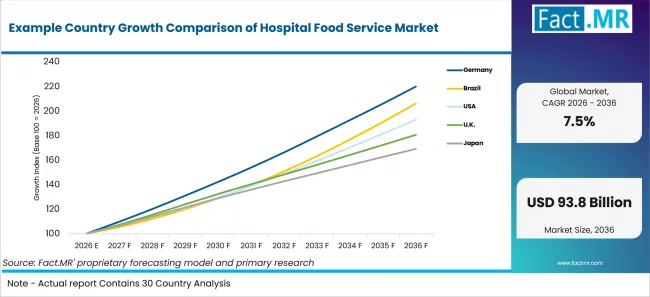
Example Country Growth Comparison Of Hospital Food Service Market | Source: Fact.MR
| Country | CAGR |
|---|---|
| Germany | 8.2% |
| Brazil | 7.5% |
| USA | 6.8% |
| U.K. | 6.1% |
| Japan | 5.4% |
Source: Fact.MR analysis. Updated Aug 19, 2026
What is powering Germany’s lead?
8.2% CAGR, driven by inpatient recovery and hospital cost reform.
Germany’s hospital operators are expected to review catering contracts as inpatient volumes recover and reform pressure raises cost scrutiny. Destatis reported in November 2025 that German hospitals treated about 17.5 million inpatients in 2024, while OECD’s 2025 Germany profile reported 7.7 hospital beds per 1,000 population.
How is Brazil scaling hospital food service demand?
7.5% CAGR, supported by hospital network scale and public-care volume.
Brazil’s demand is tied to a large hospital base and heavy public-care throughput. CNES data summarized by Fiocruz showed 9,077 hospitals in June 2025. Public hospitals are expected to favor cost-controlled service models where patient meal volume and kitchen staffing remain difficult to manage.
What supports USA adoption?
6.8% CAGR, driven by hospital scale and labor-managed dining models.
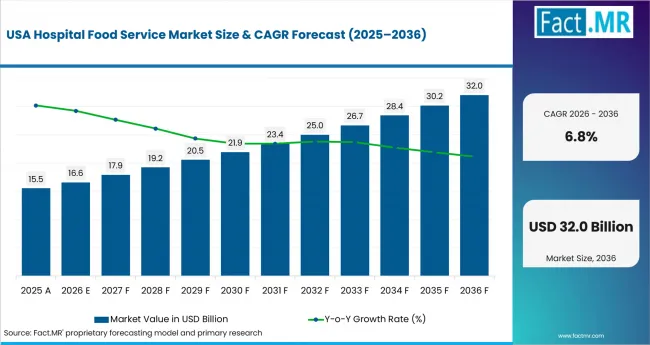
Hospital Food Service Market Country Value Analysis | Source: Fact.MR
The USA is expected to remain a large market for outsourced patient meals and hospital retail food. The American Hospital Association reported in February 2026 that the country had 6,100 hospitals and 907,216 staffed beds. Contract providers are anticipated to gain where health systems need predictable labor coverage, retail dining and diet-compliant meal preparation.
What underpins the U.K. outlook?
6.1% CAGR, shaped by NHS estate needs and outsourced catering renewals.
The U.K. outlook is shaped by NHS estate reporting and continued scrutiny of food cost. NHS England reported in October 2025 that the total cost of providing inpatient food reached GBP 0.8 billion in 2024/25. Hospitals are expected to prefer providers that improve meal quality while supplying evidence on waste, hygiene and patient nutrition outcomes.
How does Japan perform?
5.4% CAGR, supported by ageing demand and clinical nutrition needs.
Japan’s growth is expected to be selective because hospital capacity is tightening while older patients need more precise nutrition support. Japan’s Ministry of Health, Labour and Welfare reported in November 2025 that the number of hospital beds at the end of September 2025 had decreased by 6,138 from the previous month. Food service providers are projected to gain where texture-modified meals and small-kitchen efficiency become central to hospital operations.
Who leads the Hospital Food Service Market?
Compass Group and Sodexo lead direct hospital food service coverage, while Aramark and Elior Group strengthen healthcare dining models.
Compass Group and Sodexo have broad healthcare dining portfolios across patient meals, staff dining and retail outlets. Compass Group links healthcare food service with senior living and patient experience. Sodexo connects clinical nutrition, patient meals and visitor catering across hospitals. Their scale gives hospitals access to menu systems and labor planning.
Aramark, Elior Group, Healthcare Services Group and regional providers extend the field. Competition is expected to be shaped by bedside dining controls, clinical diet support, cafeteria renewal and outsourced-kitchen proof.
Which companies are the key providers?
Key companies include Compass Group plc., Sodexo, Aramark, Elior Group, Healthcare Services Group, Inc., ISS A/S (ISS), Culinary Services Group, Metz Culinary Management, AVI Foodsystems, Inc., Thomas Cuisine, Hospital Housekeeping Systems (HHS), Whitsons Culinary Group, The Nutrition Group, Food Management Group, Inc. (FMG), Prince Food Systems.
- Compass Group plc.
- Sodexo
- Aramark
- Elior Group
- Healthcare Services Group, Inc.
- ISS A/S (ISS)
- Culinary Services Group
- Metz Culinary Management
- AVI Foodsystems, Inc.
- Thomas Cuisine
- Hospital Housekeeping Systems (HHS)
- Whitsons Culinary Group
- The Nutrition Group
- Food Management Group, Inc. (FMG)
- Prince Food Systems
Bibliography
- American Hospital Association. (2026, February 5). Fast facts on U.S. hospitals, 2026.
- Aramark. (2025, October 6). Aramark and RoboEatz develop robotic meal service to support healthcare workers around the clock.
- Compass Group PLC. (2025). Annual report 2025.
- Statistisches Bundesamt (Destatis). (2025, November 6). 2,0 % mehr stationäre Krankenhausbehandlungen im Jahr 2024 [2.0% more inpatient hospital treatments in 2024].
- U.S. Department of Agriculture, Economic Research Service. (2026, July 24). Food Price Outlook.
- Cabinet Office, Government of Japan. (2025, June 10). Annual report on the ageing society 2025.
- NHS England. (2025, October 16). Estates Returns Information Collection, Summary page and dataset for ERIC 2024/25.
- Organisation for Economic Co-operation and Development. (2025, November 13). Health at a Glance 2025: Germany.
- Sodexo. (2025, April 5). Greener by Default announces expanded partnership with Sodexo to offer plant-based meals at 400 U.S. hospitals.
- U.S. Bureau of Labor Statistics. (2025, August 28). Food and beverage serving and related workers. Occupational Outlook Handbook.
This Report Answers
- The report provides intelligence on choices that shape hospital catering programs.
- Segment analysis covers Patient Services and Acute Care Settings as 2026 share leaders.
- Country outlook evaluates Germany, Brazil, the USA, U.K. and Japan.
- Competitive analysis profiles Compass Group, Sodexo, Aramark, Elior Group and Healthcare Services Group.
- Service assessment covers inpatient meals, retail outlets and digital ordering.
What does the Hospital Food Service Market cover?
Hospital food service covers patient meals, clinical nutrition support, retail dining and contracted food operations in healthcare facilities.
The Hospital Food Service Market covers food and nutrition services delivered inside hospitals and related care settings. Patient Services include inpatient meal delivery, bedside dining and clinical nutrition support. Retail Services include cafeterias, food courts and coffee shops. Vending and Shops cover vending machines, convenience stores and gift food outlets. Other Services include catering and dietary consulting.
What is included in the scope?
The scope includes Product, Settings, Service Model, Patient Group and Ordering Mode across hospital and care settings.
The scope includes patient tray service, clinical diet support, hospital services, retail dining and catering services. Acute Care Settings include general hospitals, specialty hospitals and trauma centers. Post Acute Care includes rehabilitation centers and long-term care facilities. Other Settings include ambulatory care centers, psychiatric facilities and government healthcare facilities.
What is excluded from the scope?
The scope excludes general restaurant food service and non-clinical catering without a hospital operating link.
The scope excludes food service sold only through restaurants, hotels, schools and corporate campuses. Standalone home meal delivery is excluded unless it is tied to hospital discharge or clinical nutrition. Food-as-medicine prescription services are outside the core market unless hospitals manage the meal pathway directly. Packaged senior-specific texture-modified food, medical food and enteral medical nutrition are included only when they shape hospital menu planning.
How Was the Analysis Built?
The analysis draws on 120+ sources and 35+ company portfolios.
- Primary Research: Primary research includes discussions with providers, procurement teams, nutrition managers and healthcare administrators. These conversations examine service models, menu controls and contract renewal criteria.
- Desk Research: Desk research covers government statistics, hospital datasets, company filings and healthcare service standards. Every source used is documented in the bibliography.
- Market Sizing and Forecasting: Market estimates combine historical performance, demand indicators, segment shares, inpatient activity and outsourcing patterns.
- Data Validation and Update Cycle: Findings are validated against public data, company activity and country adoption patterns. Updates review launches, contracts and hospital operations.
Segmentation
What is the report’s scope and coverage?
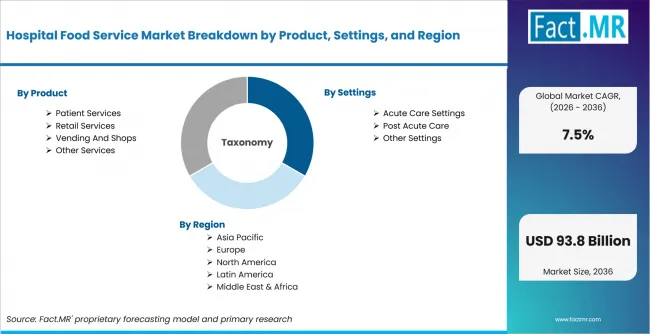
Hospital Food Service Market Breakdown By Product, Settings, And Region | Source: Fact.MR
| Attribute | Details |
|---|---|
| Quantitative Units | USD billion |
| Market Definition | Hospital-based food and nutrition services used to feed patients, visitors, staff and long-stay care users inside clinical facilities |
| Product | Patient Services; Retail Services; Vending and Shops; Other Services |
| Settings | Acute Care Settings; Post Acute Care; Other Settings |
| Regions Covered | North America; Latin America; Europe; East Asia; South Asia and Pacific; Middle East and Africa |
| Countries Covered | Germany; Brazil; USA; U.K.; Japan |
| Key Companies Profiled | Compass Group plc.; Sodexo; Aramark; Elior Group; Healthcare Services Group, Inc.; and other profiled providers listed in the company section |
| Forecast Period | 2026 to 2036 |
| Approach | Hybrid top-down and bottom-up approach using hospital demand; inpatient activity; catering contracts; patient meal mix; clinical nutrition needs; retail dining and company portfolio review |
Source: Fact.MR analysis. Updated Aug 19, 2026
How is the market segmented?
-
By Product:
- atient Services
- Inpatient Meal Services
- Bedside Dining Services
- Clinical Nutrition Services
- Retail Services
- Cafeterias
- Food Courts
- Coffee Shops
- Vending And Shops
- Vending Machines
- Convenience Stores
- Gift And Food Shops
- Other Services
- Catering Services
- Dietary Consulting Services
- atient Services
-
By Settings:
- Acute Care Settings
- General Hospitals
- Specialty Hospitals
- Trauma Centers
- Post Acute Care
- Rehabilitation Centers
- Long Term Care Facilities
- Hospice Care Facilities
- Other Settings
- Ambulatory Care Centers
- Psychiatric Facilities
- Government Healthcare Facilities
- Acute Care Settings
-
By Region:
- North America
- Latin America
- Western Europe
- Eastern Europe
- East Asia
- South Asia and Pacific
- Middle East & Africa
Frequently Asked Questions
How big is the hospital food service market in 2026?
What is the CAGR of the hospital food service market from 2026 to 2036?
Which product leads the hospital food service market?
Which setting leads the hospital food service market?
Who are the leading companies in the hospital food service market?
Who worked on this report


Preview the report firsthand - request a free sample
Free SampleGet the brochure for pricing and purchase details
Download PDF