- Market Value (2025): USD 5.4 Bn
- Estimated Value (2026): USD 5.7 Bn
- Forecast Value (2036): USD 10.7 Bn
- CAGR (2026-2036): 6.5%
What is the Hot Briquetted Iron Market forecast to be worth by 2036?
USD 5.7 billion in 2026 to USD 10.7 billion by 2036 at 6.5% CAGR.
- The hot briquetted iron market reached USD 5.4 billion in 2025 as steel mills reviewed cleaner metallic charge options.
- Demand is projected to increase from USD 5.7 billion in 2026 to USD 10.7 billion by 2036.
- The market is forecast to record 6.5% CAGR from 2026 to 2036 owing to EAF demand and low-residual feedstock use.
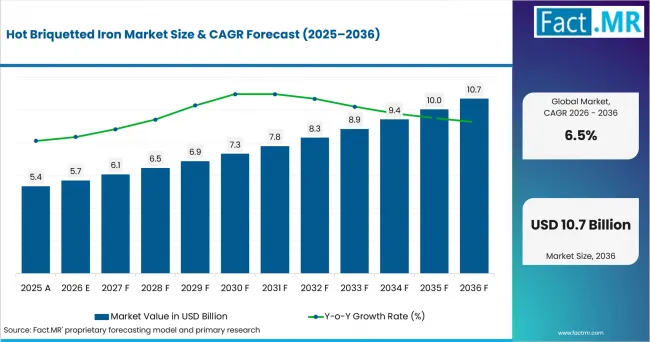
Hot Briquetted Iron Market Value Analysis | Source: Fact.MR
What are the defining numbers behind Hot Briquetted Iron Market growth?
USD 5.0 billion absolute opportunity by 2036.
- Demand Drivers in the Market
- Electric arc furnace operators need clean metallic feedstock when scrap quality varies by cargo. HBI gives them a steadier input for yield control.
- Construction steel orders are anticipated to support purchasing where rebar and structural products require regular metallic supply. Producers must still prove delivery reliability.
- Natural gas-based reduction is expected to support HBI supply where gas access and pellet quality make dense briquette output commercially workable.
- Key Segments Analyzed
- By Product Type: Fe Content 90-92% is projected to hold 37.1% share in 2026 because this range fits common steelmaking chemistry requirements.
- By Application: Electric Arc Furnace Steelmaking is expected to hold 30.3% share in 2026 as mills use HBI to balance scrap variability.
- By End Use: Construction is anticipated to capture 29.2% share in 2026 since project steel requires dependable melt-shop inputs.
- By Distribution Channel: Direct Sales is estimated to represent 29.8% share in 2026 due to clearer technical approval between producers and mills.
- By Process: Natural Gas-Based Reduction is forecast to hold 43.6% share in 2026 as gas-based plants remain the main commercial HBI route.
- Analyst Opinion at Fact.MR
- Shambhu Nath Jha, Principal Consultant at Fact.MR, states: “Hot briquetted iron demand depends on whether mills can trust the chemistry before changing their metallics mix. Producers that connect Fe Content 90-92% supply with handling evidence and furnace results are expected to win repeat orders.”
- Strategic Implications
- Steel mills should compare HBI with scrap, pig iron and DRI through the same melt-shop record.
- Producers can improve approval by showing how briquette density and Fe content affect EAF yield.
- Investors should separate ore exposure from HBI conversion economics.
Brazil is projected at 5.2% through 2036. The USA is expected to record 8.4% as EAF mills test low-residual metallics. Australia is forecast at 4.6% through export-facing raw-material strength. Germany is anticipated to post 7.2% with careful industrial approval. Canada is estimated at 5.9% where distance and service coverage affect purchasing. Japan is projected at 7.8% due to quality-led material review. The UK is expected to reach 6.5% as steel transition plans remain selective.
How does the Hot Briquetted Iron Market break down by segment?
Fe Content 90-92% is expected to lead Product Type at 37.1% share in 2026. Electric Arc Furnace Steelmaking is projected to lead Application at 30.3% share in 2026.
Which product type dominates?
Fe Content 90-92% is projected to account for 37.1% share in 2026.
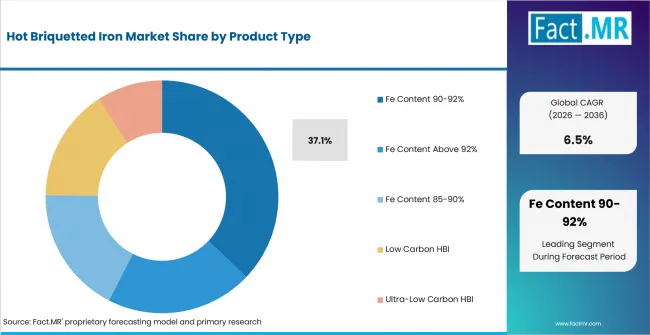
Hot Briquetted Iron Market Analysis By Product Type | Source: Fact.MR
This range gives mills a practical balance between iron content and cost. Standard Grade HBI remains useful for routine melt programs. Low Residual HBI serves mills that need cleaner chemistry for tighter steel grades.
What leads the Application segment?
Electric Arc Furnace Steelmaking is expected to hold 30.3% share in 2026.
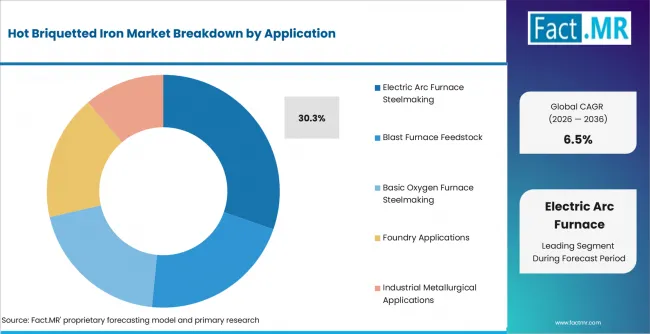
Hot Briquetted Iron Market Analysis By Application | Source: Fact.MR
EAF mills use HBI to dilute copper and tin when scrap quality changes. Long Product Steelmaking keeps demand steady through rebar production. Flat Product Steelmaking needs more testing before wider substitution.
Why does Construction lead End Use?
Construction is anticipated to account for 29.2% share in 2026.
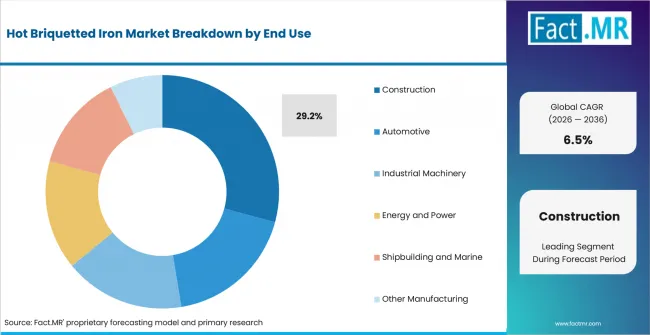
Hot Briquetted Iron Market Analysis By End Use | Source: Fact.MR
Construction connects HBI demand with rebar, beams and reinforcement steel. Automotive customers require tighter grade checks. Industrial machinery buyers tend to approve HBI only when product chemistry supports the intended part.
What supports Direct Sales within Distribution Channel?
Direct Sales is estimated to represent 29.8% share in 2026.
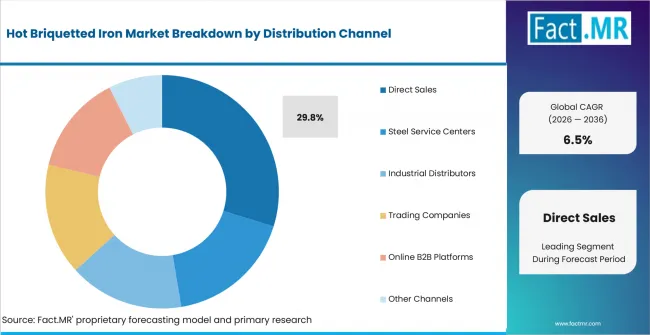
Hot Briquetted Iron Market Analysis By Distribution Channel | Source: Fact.MR
Direct negotiations help producers answer mill questions on chemistry and delivery. Long-Term Supply Contracts become more useful after trial melts. Spot Sales serve customers that already understand the material.
What supports Natural Gas-Based Reduction?
Natural Gas-Based Reduction is forecast to hold 43.6% share in 2026.
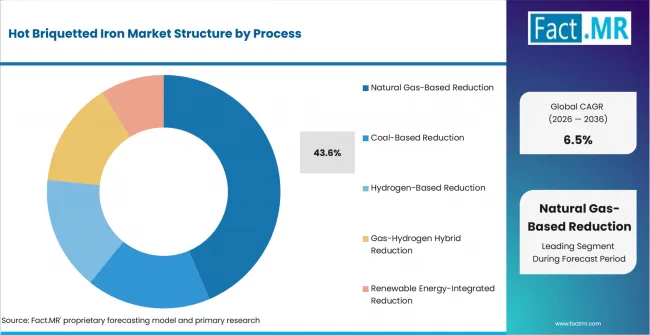
Hot Briquetted Iron Market Analysis By Process | Source: Fact.MR
Gas-based reduction has the widest commercial base for DRI and HBI production. Midrex Process and HYL/Energiron Process retain demand through operating experience. Hydrogen-Based Reduction remains a future-facing route.
What is accelerating Hot Briquetted Iron Market adoption, and what is holding it back?
Demand is expected to rise with greater EAF use and the need for cleaner metal feedstock. High energy costs, mill testing and careful handling may limit growth.
Drivers Impact Analysis
| DRIVER | (~) % IMPACT ON CAGR GEOGRAPHIC RELEVANCE | IMPACT TIMELINE | |
|---|---|---|---|
| Fe content 90-92% specification fit | +2.0% | Brazil, USA, Australia | Short term (<= 2 years) |
| Electric arc furnace metallics demand | +1.6% | USA, Germany, Japan | Short term (<= 2 years) |
| Low-residual feed quality requirements | +1.2% | Construction and automotive steel clusters | Medium term (2-4 years) |
| Natural gas-based reduction capacity | +0.9% | Middle East and North America | Medium term (2-4 years) |
| Direct sales and contract visibility | +0.6% | Export-oriented HBI producers | Long term (>= 4 years) |
Source: Fact.MR analysis. Updated Jul 31, 2026
- Fe content 90-92% specification fit: Mills are expected to approve HBI faster when the grade range matches existing melt-shop targets.
- Electric arc furnace metallics demand: EAF operators use compact metallics when scrap quality changes across cargoes. HBI then becomes a practical balancing material.
- Natural gas-based reduction capacity: Gas-based plants are expected to support supply where pellet quality and energy access allow commercial HBI production.
Opportunity Impact Analysis
| OPPORTUNITY | (~) % IMPACT ON CAGR | GEOGRAPHIC RELEVANCE | IMPACT TIMELINE |
|---|---|---|---|
| EAF metallics blending support | +1.1% | USA and Germany | Medium term (2-4 years) |
| Lower-emission steel feedstock programs | +0.9% | Europe and Japan | Medium term (2-4 years) |
| Regional inventory and shipping hubs | +0.7% | Brazil, Canada, UK | Long term (>= 4 years) |
| Hydrogen-ready HBI positioning | +0.5% | Australia and export hubs | Long term (>= 4 years) |
Source: Fact.MR analysis. Updated Jul 31, 2026
- EAF metallics blending support: Producers can help mills compare HBI with pig iron and prime scrap during charge planning.
- Lower-emission steel feedstock programs: HBI is expected to gain visibility where customers need cleaner input options for low-carbon steel targets.
- Regional inventory and shipping hubs: Stock points near ports can reduce delivery risk for mills that cannot wait for long seaborne lead times.
Restraints Impact Analysis
| RESTRAINT | (~) % IMPACT ON CAGR | GEOGRAPHIC RELEVANCE | IMPACT TIMELINE |
|---|---|---|---|
| Gas and pellet cost exposure | -0.8% | Global HBI production hubs | Short term (<= 2 years) |
| Technical approval before substitution | -0.7% | Steel mills using tight grade controls | Short term (<= 2 years) |
| Shipping and handling control | -0.5% | Seaborne trade routes | Medium term (2-4 years) |
| Limited local DRI capacity | -0.4% | Import-dependent steel markets | Long term (>= 4 years) |
Source: Fact.MR analysis. Updated Jul 31, 2026
- Gas and pellet cost exposure: Production economics are sensitive to reducing gas and pellet quality. Cost swings can delay new contract discussions.
- Technical approval before substitution: Mills must test chemistry and furnace behavior before replacing familiar metallics with HBI.
- Shipping and handling control: Customers need clear storage rules because dense briquettes require moisture and temperature control during logistics.
Which countries are scaling Hot Briquetted Iron Market fastest?
- Brazil leads at 5.2% as nearby mining supports HBI supply and steelmaking plans. The USA remains above the global rate through EAF demand and changing scrap quality.
- Australia follows with strong ore resources and export potential. Germany, Canada and Japan grow at a measured pace because buyers require technical proof, reliable logistics and import security. The UK records the lowest CAGR at 6.5%.
- Comparable CAGRs can produce different entry conditions. Producers need country-specific proof around chemistry, storage and furnace performance.
The full report provides country-level CAGR analysis across North America; Latin America; Europe; East Asia; South Asia and Oceania; and the Middle East and Africa.
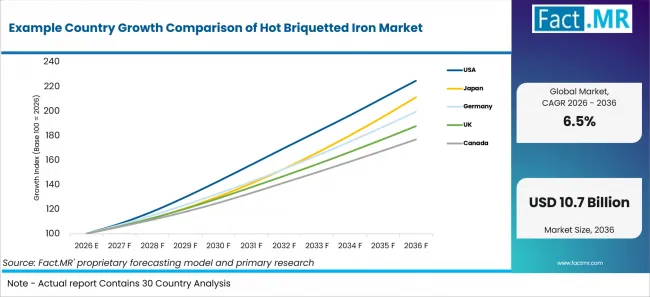
Example Country Growth Comparison Of Hot Briquetted Iron Market | Source: Fact.MR
| Country | CAGR (2026-2036) |
|---|---|
| Brazil | 5.2% |
| USA | 8.4% |
| Australia | 4.6% |
| Germany | 7.2% |
| Canada | 5.9% |
| Japan | 7.8% |
| UK | 6.5% |
Source: Fact.MR analysis. Updated Jul 31, 2026
What supports Brazil adoption?
7.5% CAGR, supported by local steel demand and stronger ties between iron ore supply and metallics planning.
Brazilian mills are expected to review HBI through feedstock availability before price alone. Local mining depth gives producers a clearer story on chemistry and supply. Construction steel customers still need delivery proof before they approve repeated cargoes.
How is USA scaling demand?
6.9% CAGR, driven by EAF metallics use and demand for low-residual charge materials.
U.S. EAF customers are expected to compare HBI with scrap and pig iron during trial melts. Direct sales matter at this stage because mills need fast answers on chemistry. Growth depends on steady logistics and practical furnace results.
What is driving Australia’s growth from 2026 to 2036?
6.7% CAGR, backed by raw-material depth and export-facing lower-emission iron opportunities.
Australia is expected to build HBI interest around ore quality and export relationships. Customers outside the country still need safe handling proof. Port distance means producers must explain moisture control and delivery timing clearly.
How is Germany developing demand?
6.3% CAGR, supported by industrial steel customers and careful approval of lower-residual metallics.
German demand is expected to move through careful mill testing. Customers assess HBI through chemistry control and furnace behavior. Purchasing stays measured when import cost and quality evidence do not align.
How does Canada perform?
6.1% CAGR, led by regional steelmaking needs and service coverage across large operating distances.
Canada’s market is expected to depend on reliable delivery across dispersed steel locations. Mills need a consistent response when trial shipments raise handling questions. Seasonal movement can slow qualification when cargo timing becomes uncertain.
What supports Japan’s growth?
5.9% CAGR, backed by quality-focused steelmaking and strict material qualification.
Japanese mills are expected to review HBI through chemistry consistency before broad ordering. High-quality steel applications support the value case. Imported cargoes still require patient qualification because customers have little tolerance for material variation.
How does the UK perform?
5.6% CAGR, supported by steel transition planning and selective demand for imported metallics.
The UK outlook reflects a smaller steelmaking base with selective EAF planning. HBI can serve mills that need cleaner metallics during transition. Landed cost and storage proof remain the main barriers to wider use.
Who leads the Hot Briquetted Iron Market?
Metalloinvest Management Company LLC and Cleveland-Cliffs show direct relevance in HBI supply. ArcelorMittal S.A. strengthens the field through metallics and steelmaking exposure. Jindal Steel Sohar LLC completes the profiled group with Qatar Steel.
Competition is expected to depend on chemistry proof, contract reliability and service support. Producers that explain furnace yield and residual control are better placed with EAF customers. The same reasoning connects HBI with high purity pig iron substitution and steel tubes production. Electrode-cost review in the carbon and graphite market can affect the timing of EAF charge-mix changes.
Which companies are the key providers?
Key companies include Metalloinvest Management Company LLC; Cleveland-Cliffs; ArcelorMittal S.A.; Jindal Steel Sohar LLC; Qatar Steel.
- Metalloinvest Management Company LLC
- Cleveland-Cliffs
- ArcelorMittal S.A.
- Jindal Steel Sohar LLC
- Qatar Steel
Bibliography
- U.S. Department of Energy. (2024, February 14). Department of Energy announces $10 million to demonstrate innovative hydrogen solution for industrial processes.
- Australian Renewable Energy Agency. (2024, March 1). ANU—De-risking large-scale Australian fine-ore hydrogen ironmaking. Australian Government.
- U.S. Department of Energy. (2024, September 4). 100 percent hydrogen-ready flex-fuel direct reduced ironmaking and electric melting furnace retrofit at Cleveland-Cliffs integrated iron and steel facility—Phase 1.
- Cleveland-Cliffs Inc. (2024, January 26). Cleveland-Cliffs completes successful blast furnace hydrogen injection trial at Indiana Harbor No. 7 blast furnace.
This Report Answers
- The report provides strategic intelligence on the Hot Briquetted Iron Market across Product Type and Application choices that shape steelmaking metallics procurement.
- Segment analysis covers Fe Content 90-92% and Electric Arc Furnace Steelmaking as the share leaders within the 2026 market.
- Country outlook evaluates Brazil and USA alongside Australia and Germany. Canada, Japan and the UK complete the growth comparison across the profiled markets.
- Competitive analysis profiles Metalloinvest Management Company LLC and Cleveland-Cliffs alongside ArcelorMittal S.A.. Jindal Steel Sohar LLC completes the provider set with Qatar Steel.
- Process assessment covers Natural Gas-Based Reduction and Midrex Process. HYL/Energiron Process and hydrogen-based routes complete the process view alongside coal-based alternatives.
What does the Hot Briquetted Iron Market cover?
Hot briquetted iron is compacted direct reduced iron used as metallic feedstock where chemistry control and safe shipping matter to steel producers.
The Hot Briquetted Iron Market covers HBI products used in EAF steelmaking and long products. Flat products, blast furnace feedstock and selected metallurgical applications are included. It includes sales channels when the purchase is tied to HBI supply or mill use.
What is included in the scope?
HBI products are used across electric arc furnaces and blast furnace feedstock. Construction steel, automotive steel and industrial metallurgical applications are included when HBI acts as a charge material.
The scope includes Product Type and Application alongside End Use, Distribution Channel and Process. Fe Content Above 92%, High Purity HBI and low-carbon HBI variants are included when sold as compact direct reduced iron.
What is excluded from the scope?
Unrelated mining products, finished steel and general construction materials remain outside the scope of this market.
The scope excludes iron ore that is not tied to direct reduction or HBI production. Scrap, pig iron and pellets are excluded unless they are compared directly with HBI in metallics decisions.
How Was the Analysis Built?
The analysis draws on 120+ sources, 35+ company portfolios, 25+ countries, and more than 20 interviews.
- Primary Research: Interviews with manufacturers, retailers, salon operators, and experts examine purchase priorities, adoption, approval requirements, and competitive positioning.
- Desk Research: Desk research covers government statistics, regulatory publications, company filings, trade data, technical studies, industry associations, standards, and public policy.
- Market Sizing and Forecasting: Estimates combine historical performance, demand indicators, pricing, segment shares, company participation, country growth, adoption patterns, and barriers to expansion.
- Data Validation and Update Cycle: Findings are validated against public data, company activity, regulatory changes, product launches, recalls, and adoption shifts.
Segmentation
What is the report’s scope and coverage?
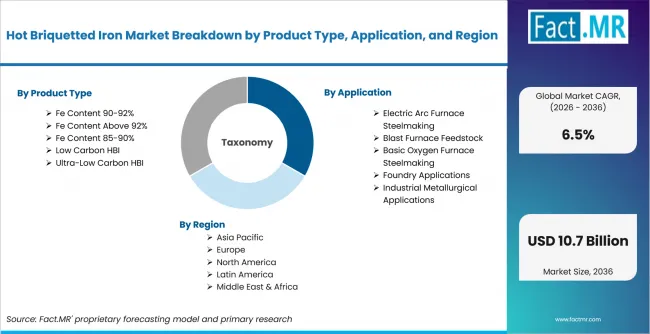
Hot Briquetted Iron Market Breakdown By Product Type, Application, And Region | Source: Fact.MR
| Attribute | Details |
|---|---|
| Quantitative Units | USD billion in 2026 to USD billion by 2036 at CAGR |
| Market Definition | Compacted direct reduced iron used as dense metallic feedstock for steelmaking where chemistry control, residual management and safer shipping determine customer approval |
| Product Type | Fe Content 90-92%; Standard Grade HBI; Low Residual HBI; Fe Content Above 92%; High Purity HBI |
| Application | Electric Arc Furnace Steelmaking; Long Product Steelmaking; Flat Product Steelmaking; Blast Furnace Feedstock; Hot Metal Production |
| End Use | Construction; Structural Steel; Rebar and Reinforcement Steel; Automotive; Industrial Machinery |
| Distribution Channel | Direct Sales; Long-Term Supply Contracts; Spot Sales; Steel Service Centers; Trading Companies |
| Process | Natural Gas-Based Reduction; Midrex Process; HYL/Energiron Process; Hydrogen-Based Reduction; Coal-Based Reduction |
| Regions Covered | North America; Latin America; Europe; East Asia; South Asia and Oceania; Middle East and Africa |
| Countries Covered | Brazil; USA; Australia; Germany; Canada; Japan; UK |
| Key Companies Profiled | Metalloinvest Management Company LLC; Cleveland-Cliffs; ArcelorMittal S.A.; Jindal Steel Sohar LLC; Qatar Steel |
| Forecast Period | 2026 to 2036 |
| Approach | Hybrid top-down and bottom-up approach using steelmaking metallics demand; Fe content requirements; EAF charge-mix review; DRI and HBI supply routes; construction steel use; distribution channel checks; process-route adoption; country growth patterns and company portfolio review |
Source: Fact.MR analysis. Updated Jul 31, 2026
How is the market segmented?
-
By Product Type
- Fe Content 90-92%
- Standard Grade HBI
- Low Residual HBI
- Fe Content Above 92%
- High Purity HBI
- Premium Grade HBI
- Fe Content 85-90%
- Standard DRI-Derived HBI
- Industrial Grade HBI
- Low Carbon HBI
- Natural Gas-Based HBI
- Hydrogen-Enhanced HBI
- Ultra-Low Carbon HBI
- Green Hydrogen-Based HBI
- Renewable Energy-Based HBI
- Fe Content 90-92%
-
By Application
- Electric Arc Furnace Steelmaking
- Long Product Steelmaking
- Flat Product Steelmaking
- Blast Furnace Feedstock
- Hot Metal Production
- Iron Ore Substitute
- Basic Oxygen Furnace Steelmaking
- BOF Metallic Charge
- Trim Coolant Application
- Foundry Applications
- Iron Casting
- Specialty Foundry Production
- Industrial Metallurgical Applications
- Metal Processing
- Specialty Alloy Production
- Electric Arc Furnace Steelmaking
-
By End Use
- Construction
- Structural Steel
- Rebar and Reinforcement Steel
- Automotive
- Automotive Flat Steel
- Automotive Components
- Industrial Machinery
- Heavy Machinery
- Industrial Equipment
- Energy and Power
- Wind Turbine Components
- Power Infrastructure
- Shipbuilding and Marine
- Ship Plate Steel
- Marine Structures
- Other Manufacturing
- Appliances
- General Fabrication
- Construction
-
By Distribution Channel
- Direct Sales
- Long-Term Supply Contracts
- Spot Sales
- Steel Service Centers
- Regional Steel Service Centers
- Integrated Metallics Hubs
- Industrial Distributors
- Specialty Metal Distributors
- Industrial Raw Material Distributors
- Trading Companies
- International Commodity Traders
- Regional Commodity Traders
- Online B2B Platforms
- Digital Commodity Marketplaces
- Online Industrial Procurement
- Other Channels
- Government Procurement
- Industry Consortium Procurement
- Direct Sales
-
By Process
- Natural Gas-Based Reduction
- Midrex Process
- HYL/Energiron Process
- Coal-Based Reduction
- Coal Gasification Reduction
- Solid Fuel Reduction
- Hydrogen-Based Reduction
- Green Hydrogen Reduction
- Blended Hydrogen Reduction
- Gas-Hydrogen Hybrid Reduction
- Natural Gas-Hydrogen Blending
- Transition Hydrogen Production
- Renewable Energy-Integrated Reduction
- Renewable Power-Based Production
- Integrated Green Iron Production
- Natural Gas-Based Reduction
-
By Region
- North America
- Latin America
- Europe
- East Asia
- South Asia and Oceania
- Middle East and Africa
Frequently Asked Questions
Which Product Type leads the market?
Which Application leads the market?
Which End Use leads the market?
Which Distribution Channel leads the market?
Which Process leads the market?
Which country records the highest listed CAGR?
What is the primary driver in this market?
What is the main restraint?
Why does construction lead demand?
Who worked on this report


Preview the report firsthand - request a free sample
Free SampleGet the brochure for pricing and purchase details
Download PDF