- Market Value (2025): USD 7.3 Bn
- Estimated Value (2026): USD 7.6 Bn
- Forecast Value (2036): USD 11.5 Bn
- CAGR (2026-2036): 4.2%
What is the Steel Tubes Market forecast to be worth by 2036?
USD 7.6 billion in 2026 to USD 11.5 billion by 2036 at a 4.2% CAGR.
- The Steel Tubes Market reached USD 7.3 billion in 2025.
- Demand is projected to increase from USD 7.6 billion in 2026 to USD 11.5 billion by 2036.
- The market is projected to expand at a 4.2% CAGR from 2026 to 2036.
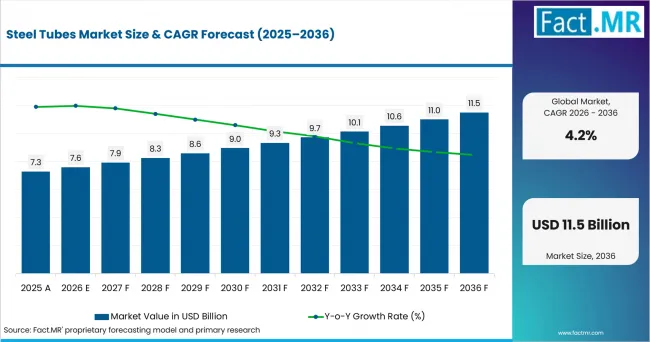
Steel Tubes Market Value Analysis | Source: Fact.MR
What are the defining numbers behind Steel Tubes Market growth?
An absolute opportunity of USD 3.9 billion is expected between 2026 and 2036.
- Demand Drivers in the Market
- Gas transmission and LNG-linked pipeline additions create direct demand for tube and pipe products that can carry pressure over long service lives. The U.S. Energy Information Administration reported that natural gas pipeline projects completed in 2025 added about 6.3 Bcf/d of capacity. This supports procurement for line pipe, gathering systems and associated steel tubular products.
- Oil and gas investment continues to support tubular demand across upstream and midstream systems. Fact.MR coverage of oil gas pipes shows how casing, tubing and transmission requirements translate energy activity into recurring pipe procurement.
- Construction remains a broad demand base because steel tubes are used in hollow structural sections, foundations, fire-protection systems and building services. Worldsteel projected global steel demand at about 1,773 million tonnes in 2026, with public infrastructure investment supporting demand across several economies.
- Industrial users require tubing that can tolerate pressure, temperature and corrosive media in process plants. Petrochemical and refining systems therefore sustain demand for seamless carbon tubes, stainless grades and selected alloy tubes where failure risk or maintenance cost is high.
- Hydrogen and carbon-management infrastructure adds a longer-cycle requirement for qualified tubular products. Germany is planning a hydrogen network of about 9,241 km by 2037 under the 2026 gas and hydrogen network development plan, while the UK is developing a regulatory framework for hydrogen pipeline networks.
- Shipbuilding and marine equipment support tube demand in East Asia. South Korea is funding green ship technology and marine equipment development, while Japan continues policy support for domestic shipbuilding capability and marine manufacturing.
- Key Segments Analyzed
- Carbon Steel Tubes account for 26.9% of Product in 2026 because their cost-to-strength balance fits structural, general industrial and energy applications.
- Seamless Steel Tubes hold 45.2% of Application in 2026, supported by high-pressure service where a continuous tube wall reduces dependence on a longitudinal weld.
- Oil and Gas represents 32.9% of End Use in 2026 as drilling, gathering and transmission systems consume tubing across upstream, midstream and downstream operations.
- Seamless Tube Manufacturing Technology accounts for 44.3% of Technology in 2026 because hot rolling and cold drawing support tubes for pressure-critical and precision applications.
- Analyst Opinion at Fact.MR
- Shambhu Nath Jha, Principal Consultant at Fact.MR, states, “Steel tube demand is tied to the replacement and expansion of physical infrastructure. Buyers in energy and process industries focus on pressure capability, dimensional consistency and qualification history. Construction buyers place more weight on availability and fabrication efficiency. Suppliers that match grade, wall thickness and finishing method to the operating duty can protect value even when commodity steel prices move.”
- Strategic Implications
- Tube producers should organize commercial offers around operating duty and specification instead of treating all steel tubes as interchangeable commodity products.
- Seamless capacity should be prioritized for high-pressure work where qualification history and wall consistency have a direct effect on buyer approval.
- Coating and surface-treatment capability can extend addressable demand in infrastructure where corrosion exposure affects lifecycle cost.
- Regional production and service centres can reduce freight exposure while helping buyers manage project schedules and specification changes.
How does the Steel Tubes Market break down by segment?
The market is segmented by Product, Application, End Use and Technology.
Why do Carbon Steel Tubes lead Product?
Carbon Steel Tubes are projected to account for a 26.9% share in 2026.
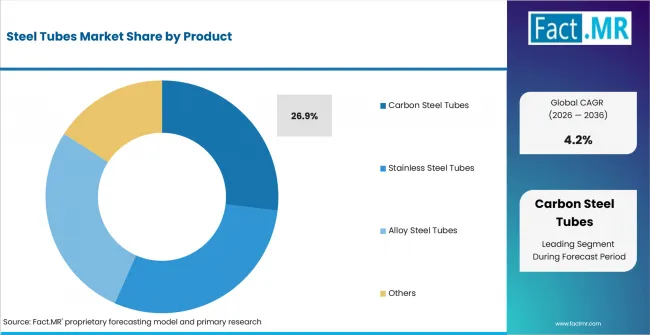
Steel Tubes Market Analysis By Product | Source: Fact.MR
Carbon steel tubes lead because they cover a wide range of structural and mechanical duties without the material cost associated with stainless or higher-alloy grades. They are used where strength, weldability and established fabrication practices matter more than resistance to aggressive corrosion.
The segment also benefits from an established supply base for steel tubes across construction, energy and manufactured equipment. Buyers can select welded or seamless carbon products according to pressure level and dimensional requirements without moving to a different base material family.
Why do Seamless Steel Tubes lead Application?
Seamless Steel Tubes are projected to account for a 45.2% share in 2026.
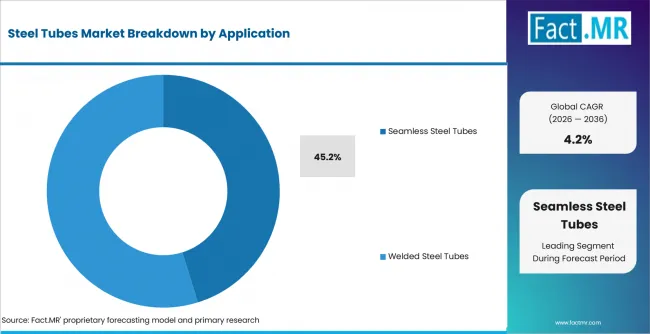
Steel Tubes Market Analysis By Application | Source: Fact.MR
Seamless tubes lead in applications where pressure containment and uniform wall behaviour are important. The absence of a longitudinal welded joint reduces one potential discontinuity, which supports use in pressure service, process equipment and precision engineering.
The use case is reflected in the wider seamless pipes market, where oil and gas remains a major end-use area. For steel tube buyers, the purchase decision is usually tied to pressure class, wall thickness and inspection requirements rather than tube form alone.
Why does Oil and Gas lead End Use?
Oil and Gas is projected to account for a 32.9% share in 2026.
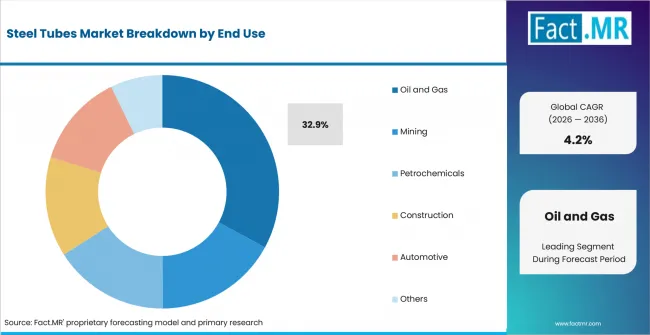
Steel Tubes Market Analysis By End Use | Source: Fact.MR
Oil and gas leads because tubular products are required across well construction, gathering lines and process facilities. Upstream operations consume pressure-rated tubes in wells and surface equipment, while midstream networks require pipe for transmission and gathering. Downstream facilities use tube in process and utility systems.
EIA data show that U.S. pipeline capacity continued to expand in 2025, providing a direct link between energy infrastructure additions and steel tubular procurement. Maintenance of existing networks adds replacement demand even when new project activity moderates.
Why does Seamless Tube Manufacturing Technology lead Technology?
Seamless Tube Manufacturing Technology is projected to account for a 44.3% share in 2026.
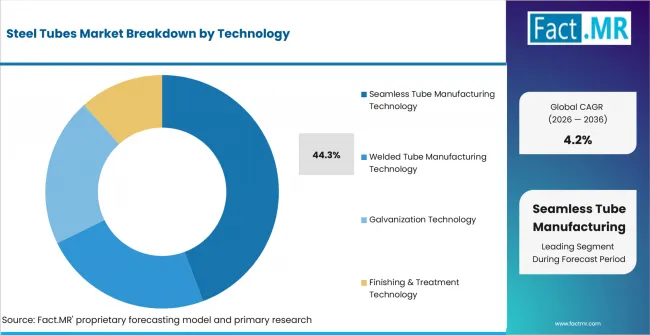
Steel Tubes Market Analysis By Technology | Source: Fact.MR
Seamless manufacturing leads because hot rolling can produce pressure-capable tube without a welded seam, while cold drawing can improve dimensional accuracy and surface finish for tighter-tolerance applications. This gives manufacturers a route to serve both energy applications and precision engineering from the same technology family.
Welded technologies remain important for structural and fluid-transport applications where production efficiency and size flexibility can outweigh the need for a seam-free wall. The technology split therefore follows end-use duty rather than a single performance hierarchy.
What is accelerating Steel Tubes Market adoption, and what is holding it back?
Demand is being supported by pipeline additions, construction activity and pressure-rated industrial applications. Steel price volatility, trade measures and project-cycle exposure can delay purchasing or compress supplier margins.
Drivers Impact Analysis
| Factor | (~) % Impact on CAGR | Geographic Relevance | Impact Timeline |
|---|---|---|---|
| Gas and LNG pipeline additions | +0.8% | USA; Europe | Short term (<= 2 years) |
| Construction and civil engineering demand | +0.6% | Europe; USA | Medium term (2-4 years) |
| High-pressure process applications | +0.5% | Global | Medium term (2-4 years) |
| Hydrogen and CCUS pipeline development | +0.4% | Germany; UK | Long term (>= 4 years) |
| Shipbuilding and marine equipment demand | +0.3% | South Korea; Japan | Medium term (2-4 years) |
Source: Fact.MR analysis. Updated Aug 25, 2026
Opportunity Impact Analysis
| Factor | (~) % Impact on CAGR | Geographic Relevance | Impact Timeline |
|---|---|---|---|
| Hydrogen-compatible tubular products | +0.4% | Germany; UK | Long term (>= 4 years) |
| Premium seamless tubes for pressure service | +0.3% | USA; Europe; East Asia | Medium term (2-4 years) |
| Coated and treated tubes for infrastructure | +0.3% | Global | Medium term (2-4 years) |
| Precision tubes for vehicle and machinery platforms | +0.2% | Germany; Japan; South Korea | Long term (>= 4 years) |
Source: Fact.MR analysis. Updated Aug 25, 2026
Restraints Impact Analysis
| Factor | (~) % Impact on CAGR | Geographic Relevance | Impact Timeline |
|---|---|---|---|
| Steel input-price volatility | -0.5% | Global | Short term (<= 2 years) |
| Trade duties and local-content requirements | -0.4% | USA; Europe | Medium term (2-4 years) |
| Oil and gas project-cycle variability | -0.3% | USA; UK | Medium term (2-4 years) |
| Construction weakness in selected markets | -0.2% | France; Germany | Short term (<= 2 years) |
Source: Fact.MR analysis. Updated Aug 25, 2026
Which countries are scaling the Steel Tubes Market through 2036?
- USA: Pipeline construction remains a direct source of tubular demand. EIA reported about 6.3 Bcf/d of natural gas pipeline capacity completed in 2025, with much of the addition serving South Central markets and LNG-linked demand.
- UK: The government is developing economic regulation and a network code for hydrogen pipelines, while CCUS clusters are being built around pipeline-connected transport and storage systems. These projects create future demand for qualified tube and pipe products.
- France: Construction investment was EUR 287.8 billion in 2025 according to INSEE. Civil engineering and specialised construction remain relevant outlets for structural and service tubing even as building activity varies by quarter.
- Germany: The 2026 Gas and Hydrogen Network Development Plan proposes a hydrogen network of about 9,241 km by 2037 and continued natural gas network measures. New-build and converted pipeline systems support demand for qualified tubular products and related finishing.
- Italy: Istat reported that calendar-adjusted construction production increased 4.8% on average in 2025. Continued civil and building activity supports structural tubing, service pipe and fabricated steel tube demand.
- South Korea: Shipbuilding policy is focused on green propulsion and marine equipment. Tube demand is supported by ship systems, offshore equipment and industrial fabrication that require corrosion-resistant or pressure-capable products.
- Japan: Government policy continues to support domestic shipbuilding productivity and marine manufacturing. This sustains tube demand across ship systems, power equipment and precision industrial applications.
Country CAGR (2026-2036)
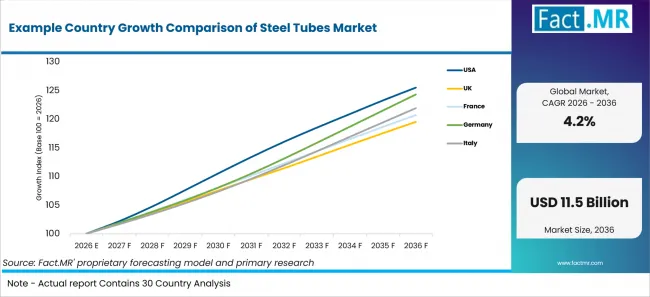
Example Country Growth Comparison Of Steel Tubes Market | Source: Fact.MR
| Country | CAGR, 2026-2036 |
|---|---|
| USA | 2.3% |
| UK | 1.8% |
| France | 1.9% |
| Germany | 2.2% |
| Italy | 2.0% |
| South Korea | 2.4% |
| Japan | 2.1% |
Source: Fact.MR analysis. Updated Aug 25, 2026
What is driving USA’s growth through 2036?
The USA is forecast to expand at a 2.3% CAGR from 2026 to 2036.
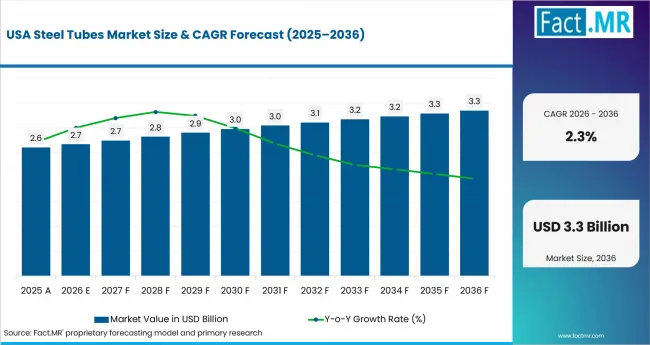
Steel Tubes Market Country Value Analysis | Source: Fact.MR
Growth is supported by energy infrastructure and replacement demand. EIA reported that natural gas pipeline projects completed in 2025 added about 6.3 Bcf/d of capacity. Each new gathering or transmission project requires line pipe and associated tubular products, while maintenance creates a recurring market for replacement sections.
The same requirement supports related demand for pipe coatings where buried or exposed pipelines need corrosion protection over long operating periods.
What is driving the UK’s growth through 2036?
The UK is forecast to expand at a 1.8% CAGR from 2026 to 2036.
The UK is creating the regulatory framework for early hydrogen pipeline networks and is progressing CCUS clusters that depend on pipeline transport. Government documents published in 2025 and 2026 cover hydrogen network regulation, network codes and pipeline-connected carbon transport. This gives tube suppliers a future demand path beyond conventional gas infrastructure.
Construction remains another outlet. ONS construction statistics track ongoing project output and new orders, supporting structural and service-tube demand across commercial and infrastructure work.
What is driving France’s growth through 2036?
France is forecast to expand at a 1.9% CAGR from 2026 to 2036.
France combines civil-engineering activity with a broad industrial base. INSEE reported construction investment of EUR 287.8 billion in 2025. Steel tubes are used in structural frames, service systems and civil works, giving suppliers demand across new construction and refurbishment.
Manufacturing activity in transport equipment also improved late in 2025, which supports precision and fabricated tube requirements in vehicle and industrial supply chains.
What is driving Germany’s growth through 2036?
Germany is forecast to expand at a 2.2% CAGR from 2026 to 2036.
Pipeline transition is a distinct demand mechanism. In June 2026, the Bundesnetzagentur opened consultation on a network plan that envisages about 9,241 km of hydrogen network by 2037, with proposed hydrogen-network measures costing EUR 24.3 billion. The plan also includes natural gas measures where short-term supply needs remain.
Germany also has a substantial machinery and automotive manufacturing base, supporting demand for precision tube and process tubing even when construction cycles soften.
What is driving Italy’s growth through 2036?
Italy is forecast to expand at a 2.0% CAGR from 2026 to 2036.
Construction provides a practical volume base for structural tube demand. Istat reported that calendar-adjusted construction production increased 4.8% on average in 2025. Ongoing building and civil work supports hollow sections, service pipe and fabricated tube products.
Industrial processing and energy infrastructure add demand for seamless or treated tube where pressure conditions and corrosion exposure influence material choice.
What is driving South Korea’s growth through 2036?
South Korea is forecast to expand at a 2.4% CAGR from 2026 to 2036.
Growth is supported by shipbuilding and industrial fabrication. The Ministry of Trade, Industry and Energy has set a technology roadmap covering green propulsion, ship materials and marine equipment. These systems use pressure tubing and corrosion-resistant products across fuel, hydraulic and process circuits.
Demand from extraction and handling projects also supports specialist mining pipes where abrasion, pressure and material handling requirements shape tube selection.
What is driving Japan’s growth through 2036?
Japan is forecast to expand at a 2.1% CAGR from 2026 to 2036.
Japan retains domestic capability in shipbuilding and marine equipment. MLIT policy has focused on productivity and technology investment across shipyards, while the 2025 maritime report continues to track shipbuilding and marine-industry activity. This supports tube demand for fluid systems and machinery supplied into vessels.
Precision manufacturing also supports cold-drawn and stainless tube where dimensional control and surface finish affect downstream assembly.
Who Leads the Steel Tubes Market?
Nucor Corporation, Jindal SAW Ltd., POSCO, Gerdau, Ansteel, and Bao Pipes and Tubes are key providers in the market.
Nucor competes through a tubular portfolio that includes hollow structural sections, mechanical tubing, piling, sprinkler pipe and conduit. Its domestic U.S. production network supports construction and infrastructure customers that value specification coverage with shorter supply routes.
Jindal SAW Ltd., POSCO and Gerdau compete through established steelmaking and tubular capabilities. Ansteel, Shagang Group and Hebei Iron and Steel add substantial steel production capacity in Asia. Bao Pipes and Tubes, Jiaoyang Steel Tube Co., Ltd. and AK Pipes and Tubes participate through tube-focused portfolios, while Salzgitter AG serves European industrial requirements.
Three company names require current corporate context. United States Steel Corporation became a wholly owned part of Nippon Steel on June 18, 2025. ChelPipe Group has been integrated into TMK since the 2021 acquisition. EVRAZ North America was acquired by Atlas Holdings on July 31, 2025 and its operating businesses were reorganized as Orion Steel.
Competition is shaped by grade availability and dimensional range. Qualification for pressure service matters in energy applications, while construction buyers place greater weight on delivery reliability and fabrication compatibility. Surface treatment and testing capability can also influence procurement where corrosion or code compliance affects service life.
Which companies are the key providers?
Key Companies includes Nucor Corporation; Jindal SAW Ltd.; POSCO; Gerdau; Ansteel; Bao Pipes and Tubes; Jiaoyang Steel Tube Co., Ltd.; Shagang Group; Hebei Iron and Steel; United States Steel Corporation (USSC); AK Pipes and Tubes; ChelPipe Group; EVRAZ North America; Salzgitter AG
- Nucor Corporation
- Jindal SAW Ltd.
- POSCO
- Gerdau
- Ansteel
- Bao Pipes and Tubes
- Jiaoyang Steel Tube Co., Ltd.
- Shagang Group
- Hebei Iron and Steel
- United States Steel Corporation (USSC)
- AK Pipes and Tubes
- ChelPipe Group
- EVRAZ North America
- Salzgitter AG
Bibliography
- Atlas Holdings. (2025). Atlas Completes Acquisition of Steelmaker EVRAZ North America; Forms Orion Steel and Appoints Doug Matthews CEO.
- Bundesnetzagentur. (2026). Gas and Hydrogen Network Development Plan 2025-2037/2045: Consultation.
- Department for Energy Security and Net Zero. (2025). Hydrogen Economic Regulatory Framework: Government Response. UK Government.
- Department for Energy Security and Net Zero. (2026). Hydrogen Network Code: Industry Engagement. UK Government.
- INSEE. (2026). Construction Investment: Annual Data to 2025. Government of France.
- Istat. (2026). Production in the Construction Sector: December 2025. Government of Italy.
- Ministry of Land, Infrastructure, Transport and Tourism, Japan. (2025). Maritime Report 2025.
- Ministry of Trade, Industry and Energy, Republic of Korea. (2024). K-Shipbuilding Super Gap Vision 2040.
- Nippon Steel Corporation. (2025). Nippon Steel Corporation and U. S. Steel Finalize Historic Partnership.
- Nucor Corporation. (2026). Steel HSS, Pipe & Tube Product Information.
- Office for National Statistics. (2026). Construction Output in Great Britain: December 2025.
- TMK. (2021). TMK Signs Acquisition Deal with ChelPipe Controlling Shareholder.
- U.S. Energy Information Administration. (2026). Most Natural Gas Pipelines Built in 2025 Connect the South Central United States to Supply.
- World Steel Association. (2025). Short Range Outlook: October 2025.
This Report Answers
- Which steel tube product categories shape demand across structural and process applications?
- Why are seamless tubes preferred in selected pressure and precision applications?
- How do energy, construction and industrial activity translate into tube procurement?
- Which country-specific infrastructure mechanisms support demand through 2036?
- How are ownership changes affecting the competitive identities of selected steel producers?
What does the Steel Tubes Market cover?
The Steel Tubes Market covers commercial steel tubes sold across Product, Application, End Use and Technology. Revenue is counted when finished tubular products are sold for structural use, fluid transport, process equipment or other covered applications.
The market includes carbon steel, stainless steel and alloy steel tubes, together with the other specified tube categories. It also includes seamless and welded products manufactured through the covered technology routes.
What is included in the scope?
The scope includes finished steel tubes used in oil and gas, mining, petrochemicals, construction and automotive applications. It also includes aerospace, marine and power-generation applications under Other End Use.
Product coverage includes the listed carbon, stainless and alloy tube subcategories. Application coverage includes seamless and welded steel tubes. Technology coverage includes seamless production, welded production, galvanization and finishing or treatment methods.
What is excluded from the scope?
The scope excludes steel products that are not sold as tubes, including flat products and solid bars. Finished machinery, complete vehicles and process equipment are excluded when the tube is only an embedded component of the downstream product.
Non-steel plastic pipe and non-ferrous tube products are outside the market. Standalone coating services or fabrication services are excluded unless their value is included in the sale of the steel tube product itself.
How Was the Analysis Built?
The analysis combines primary interviews with desk research and market-specific forecasting variables.
- Primary Research: Discussions with steel tube producers, distributors, fabricators and procurement teams examine grade selection, buying specifications and delivery requirements across energy and industrial applications.
- Desk Research: The review covers official construction statistics, pipeline project data and industrial policy. Company disclosures are used for portfolio and ownership context, while standards-related material is used to understand application requirements.
- Market Sizing and Forecasting: Market estimates use finished tube demand by end use, product mix and seamless-versus-welded requirements. The model considers country growth, tube pricing and manufacturing technology as well as replacement demand.
- Data Validation and Update Cycle: Findings are cross-checked against public infrastructure data and company activity. Updates account for project timing, ownership changes and shifts in construction or energy investment.
Segmentation
What is the report's scope and coverage?
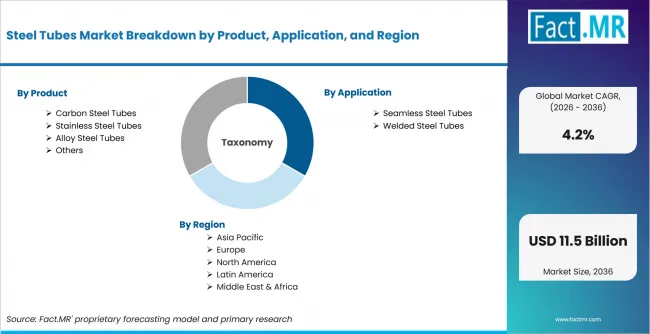
Steel Tubes Market Breakdown By Product, Application, And Region | Source: Fact.MR
| Attribute | Details |
|---|---|
| Quantitative Units | USD billion |
| Market Definition | Commercial steel tubes sold across Product, Application, End Use and Technology categories |
| Segments Covered | Product; Application; End Use; Technology |
| Regions Covered | North America; Latin America; Europe; East Asia; South Asia and Pacific; Middle East and Africa |
| Countries Covered | USA; UK; France; Germany; Italy; South Korea; Japan |
| Key Companies Profiled | Nucor Corporation; Jindal SAW Ltd.; POSCO; Gerdau; Ansteel; Bao Pipes and Tubes; Jiaoyang Steel Tube Co., Ltd.; Shagang Group; Hebei Iron and Steel; United States Steel Corporation (USSC); AK Pipes and Tubes; ChelPipe Group; EVRAZ North America; Salzgitter AG |
| Forecast Period | 2026 to 2036 |
| Base Year | 2026 |
| Market Value, 2026 | USD 7.6 billion |
| Market Value, 2036 | USD 11.5 billion |
| CAGR, 2026-2036 | 4.2% |
| Absolute Opportunity | USD 3.9 billion |
| Approach | Hybrid demand-side and top-down approach using tube demand by end use, product mix, pricing and country activity |
Source: Fact.MR analysis. Updated Aug 25, 2026
How is the market segmented?
-
By Product:
- Carbon Steel Tubes
- Seamless Carbon Steel Tubes
- Welded Carbon Steel Tubes
- Structural Carbon Steel Tubes
- Stainless Steel Tubes
- Seamless Stainless Steel Tubes
- Welded Stainless Steel Tubes
- Precision Stainless Steel Tubes
- Alloy Steel Tubes
- Chromium Alloy Steel Tubes
- Nickel Alloy Steel Tubes
- Molybdenum Alloy Steel Tubes
- Others
- Galvanized Steel Tubes
- Tool Steel Tubes
- Specialty Steel Tubes
- Carbon Steel Tubes
-
By Application:
- Seamless Steel Tubes
- High Pressure Applications
- Industrial Process Applications
- Precision Engineering Applications
- Welded Steel Tubes
- Structural Applications
- Fluid Transport Applications
- Automotive Applications
- Seamless Steel Tubes
-
By End Use:
- Oil and Gas
- Upstream Operations
- Midstream Operations
- Downstream Operations
- Mining
- Mineral Extraction
- Material Handling
- Processing Operations
- Petrochemicals
- Chemical Processing
- Refining Operations
- Storage Infrastructure
- Construction
- Commercial Construction
- Infrastructure Development
- Residential Construction
- Automotive
- Vehicle Manufacturing
- Heavy Commercial Vehicles
- Electric Vehicles
- Others
- Aerospace Applications
- Marine Applications
- Power Generation
- Oil and Gas
-
By Technology:
- Seamless Tube Manufacturing Technology
- Hot Rolling Technology
- Cold Drawing Technology
- Welded Tube Manufacturing Technology
- Electric Resistance Welding
- Laser Welding Technology
- Galvanization Technology
- Hot Dip Coating Technology
- Electroplating Technology
- Finishing & Treatment Technology
- Heat Treatment Systems
- Surface Treatment Technology
- Seamless Tube Manufacturing Technology
-
By Region:
- North America
- Latin America
- Western Europe
- Eastern Europe
- East Asia
- South Asia and Pacific
- Middle East & Africa
Frequently Asked Questions
What is the Steel Tubes Market value in 2026?
At what CAGR is the market projected to grow?
What is the projected market value by 2036?
Which Product leads the market?
Which Application leads the market?
Which End Use leads the market?
Which Technology leads the market?
Which country records the leading listed CAGR?
Which company leads the Steel Tubes Market?
What is the primary driver in this market?
What is the main restraint?
Which companies are included in the market assessment?
Who worked on this report


Preview the report firsthand - request a free sample
Free SampleGet the brochure for pricing and purchase details
Download PDF