- Market Value (2025): USD 202.4 Mn
- Estimated Value (2026): USD 232.0 Mn
- Forecast Value (2036): USD 905.0 Mn
- CAGR (2026-2036): 14.6%
What is the Hybrid Bonding Cleaners Market forecast to be worth by 2036?
USD 232.0 million in 2026 to USD 905.0 million by 2036, at a 14.6% CAGR.
- The Hybrid Bonding Cleaners Market crossed a valuation of USD 202.4 million in 2025, supported by demand from Memory manufacturers serving Dilute acid chemistries workflows that require removing particles, CMP residue, organic films and copper oxide without changing topography or recontaminating the surface before bonding.
- Demand is projected to increase from USD 232.0 million in 2026 to USD 905.0 million by 2036.
- The market is forecast to record a 14.6% CAGR from 2026 to 2036 as particle control is a named yield variable, voids at the interface are the measurable outcome and rca/sc-1 + megasonic remains the baseline chemistry remain central purchase reasons.
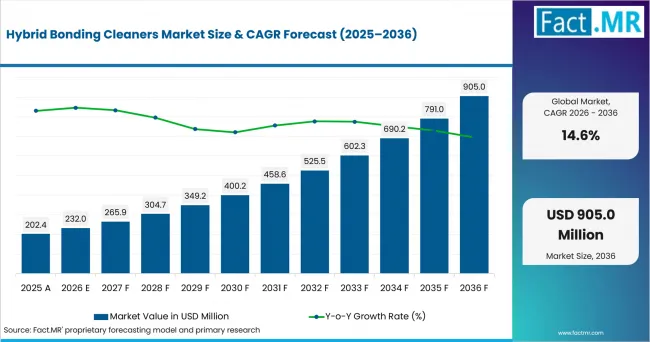
Hybrid Bonding Cleaners Market Value Analysis | Source: Fact.MR
What are the defining numbers behind Hybrid Bonding Cleaners Market growth?
USD 673.0 million absolute opportunity is expected by 2036.
- Demand Drivers in the Market
- Particle control is a named yield variable: Equipment buyers are treating particle control as a core spec rather than a housekeeping detail: EV Group's Dielacher notes that particle control inside the equipment - air-flow management, mini-environments, optimized substrate handling, and in-situ process monitoring - is what keeps hybrid-bonding yield from being eroded by contamination the cleaner itself should have removed. [1]
- Voids at the interface are the measurable outcome: Demand for tighter pre-bond cleaning traces directly to a visible failure mode: C-SAM acoustic microscopy, the industry-standard void screen, shows voids as white specs against the black image of a void-free bond, and failure-analysis practice runs C-SAM first for full-wafer screening before X-ray/CT localizes any remaining defect in 3D, giving buyers a fast way to link cleaning quality to bond outcome. [2]
- RCA/SC-1 + megasonic remains the baseline chemistry: The dominant chemistry buyers specify is a modified SC-1 clean (NH4OH:H2O2:H2O at 1:2:40 or 1:2:80) with chelating agents, megasonic energy at 1.13 W/cm2, sub-5-second dilute HF exposure, and up to 0.2% surfactant, validated against 0.2 micrometer Si3N4 challenge particles - a well-documented baseline that keeps procurement specs consistent across suppliers. [3]
- Frequency choice trades removal vs damage: Tool selection increasingly comes down to megasonic frequency: operating at roughly 0.8-2 MHz, higher frequencies generate smaller cavitation bubbles that remove sub-micron particles while limiting damage to fragile hybrid-bond topographies such as recessed copper pads in dielectric, making frequency tuning a direct lever on yield. [4]
- Key Segments Analyzed
- By Cleaning Technology: Megasonic wet clean is projected to hold 31.0% share in 2026, supported by a clear process advantage: Megasonic wet cleaning applies acoustic energy through liquid to dislodge nanoscale particles without physical brush contact. It is well suited to full-wafer surfaces where one remaining particle can prevent intimate dielectric contact.
- By Contaminant Target: Particle removal is projected to hold 37.1% share in 2026, supported by a clear process advantage: Particle removal leads because a particle at the interface creates a local non-contact area that can grow into a void or delamination. Unlike some chemical films, a hard particle cannot be corrected by the bonding anneal.
- By Process Chemistry: Dilute acid chemistries are projected to hold 43.4% share in 2026, supported by a clear process advantage: Dilute acid chemistry can remove copper oxide and selected metallic residues while limiting copper loss and topography change. Its value rises as the clean must restore a bondable metal surface without deepening pad recess.
- By Integration: Cluster-integrated clean is projected to hold 43.1% share in 2026, supported by a clear process advantage: A cluster-integrated clean links particle removal, rinse, dry and bonding under a controlled transfer path. The resulting metric is post-transfer cleanliness at contact, not cleanliness measured only at the cleaner exit.
- By End User: Memory manufacturers are projected to hold 29.1% share in 2026, supported by a clear process advantage: Memory manufacturers operate repetitive high-volume stacks in which a small interface-defect rate compounds across many bonded layers. That makes cleaner stability, chamber matching and preventive maintenance economically visible at the finished-stack level.
- Analyst Opinion at Fact.MR
- Shambhu Nath Jha, Sr. Consultant at Fact.MR, states, 'Buyers should evaluate the complete process sequence around removing particles, CMP residue, organic films and copper oxide without changing topography or recontaminating the surface before bonding. Technical review should focus on repeatability, integration, defect control and production throughput rather than a single headline specification. Suppliers that connect tool performance to measurable yield and qualification results are likely to build trust faster.'
- Strategic Implications
- Buyers should measure post-clean particle adders, copper recess stability and time-to-bond, not simply removal efficiency at the cleaner exit.
- Equipment suppliers should document how their systems address the challenge of removing particles, CMP residue, organic films and copper oxide without changing topography or recontaminating the surface before bonding across production-representative wafers, panels, dies or packages.
- Procurement teams can compare process capability, integration burden, service coverage and qualification evidence before prioritizing nominal throughput or a single accuracy claim.
South Korea is projected to record a 16.0% CAGR as high-volume memory, HBM and vertically integrated semiconductor manufacturing supports relevant capital spending; Taiwan is projected to record a 15.7% CAGR as leading foundry production, advanced packaging and a dense OSAT and substrate supply chain supports relevant capital spending; Japan is projected to record a 15.3% CAGR as semiconductor equipment, materials, inspection and memory-process expertise supports relevant capital spending; Singapore is projected to record a 14.8% CAGR as advanced-packaging R&D, specialty fabs and regional assembly and test operations supports relevant capital spending; while USA is projected to record a 16.0% CAGR as leading-edge logic, high-performance computing, federally supported semiconductor R&D and a large domestic equipment base supports relevant capital spending through 2036.
How does the Hybrid Bonding Cleaners Market break down by segment?
Megasonic wet clean leads Cleaning Technology with a 31.0% share, while Particle removal accounts for 37.1% of Contaminant Target in 2026.
Why does Megasonic wet clean lead Cleaning Technology?
Megasonic wet clean is projected to account for 31.0% share in 2026.
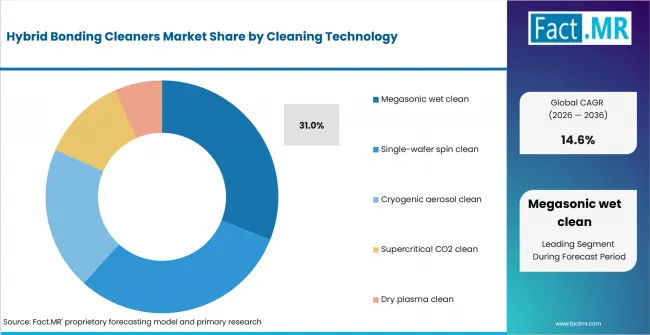
Hybrid Bonding Cleaners Market Analysis By Cleaning Technology | Source: Fact.MR
Megasonic wet cleaning applies acoustic energy through liquid to dislodge nanoscale particles without physical brush contact. It is well suited to full-wafer surfaces where one remaining particle can prevent intimate dielectric contact. Single-wafer spin cleaning offers strong chemical and drying control, but particle removal at the smallest sizes may require added megasonic energy or multiple steps. Cryogenic CO2/aerosol cleaning is being evaluated as a no-watermark, no-surface-tension alternative for sub-50 nm particles on bond-ready surfaces (industry direction; complements megasonic wet cleans). Buyers therefore tend to treat megasonic wet clean as the practical choice when qualification must balance process capability, repeatability and production economics.
Why does Particle removal lead Contaminant Target?
Particle removal is projected to account for 37.1% share in 2026.
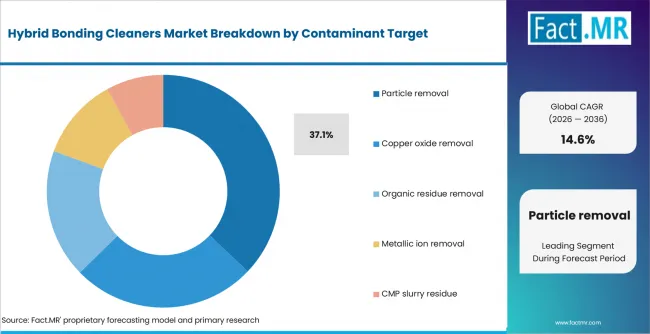
Hybrid Bonding Cleaners Market Analysis By Contaminant Target | Source: Fact.MR
Particle removal leads because a particle at the interface creates a local non-contact area that can grow into a void or delamination. Unlike some chemical films, a hard particle cannot be corrected by the bonding anneal. Copper oxide is electrically important, but it can often be addressed with targeted chemistry after the particle-removal sequence is stabilized. Electrochemical Society proceedings on semiconductor cleaning: modified SC-1 (NH4OH:H2O2:H2O at 1:2:40 and 1:2:80) with chelating agents (12-200 ppm), megasonic energy at 1.13 W/cm², <5 s dilute HF (1:100) exposure, and up to 0.2% surfactant; particle-removal efficiency measured with 0.2 µm Si3N4 challenge particles on 300 mm wafers (Tencor SP-1), metals by VPD-ICPMS, residues by TOF-SIMS. [3] Buyers therefore tend to treat particle removal as the practical choice when qualification must balance process capability, repeatability and production economics.
Why do Dilute acid chemistries lead Process Chemistry?
Dilute acid chemistries are projected to account for 43.4% share in 2026.
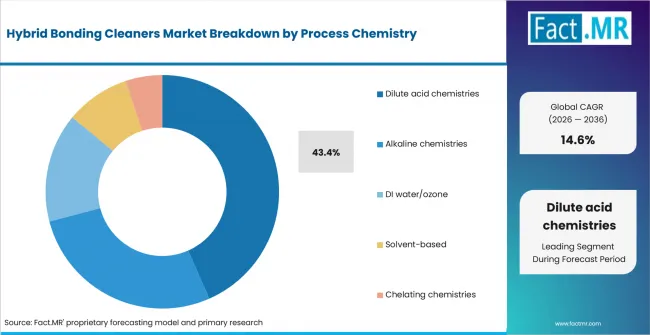
Hybrid Bonding Cleaners Market Analysis By Process Chemistry | Source: Fact.MR
Dilute acid chemistry can remove copper oxide and selected metallic residues while limiting copper loss and topography change. Its value rises as the clean must restore a bondable metal surface without deepening pad recess. Alkaline chemistry is useful for organics and particle control, but it may need a separate metal-surface step for hybrid copper interfaces. EV Group's Dielacher, on hybrid bonding: Particle control inside the equipment includes air flow management, the use of mini-environments, and optimized substrate handling. In addition, in-situ process monitoring can help further reduce particle contamination. [1] Buyers therefore tend to treat dilute acid chemistries as the practical choice when qualification must balance process capability, repeatability and production economics.
Why does Cluster-integrated clean lead Integration?
Cluster-integrated clean is projected to account for 43.1% share in 2026.
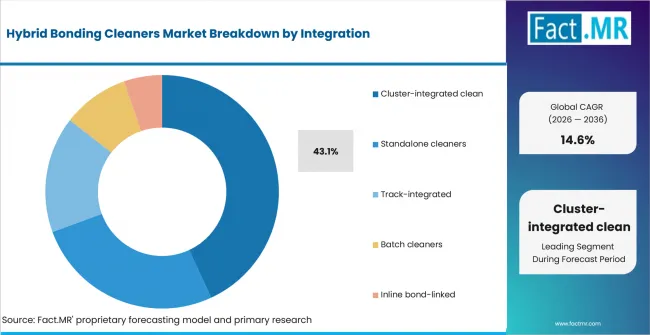
Hybrid Bonding Cleaners Market Analysis By Integration | Source: Fact.MR
A cluster-integrated clean links particle removal, rinse, dry and bonding under a controlled transfer path. The resulting metric is post-transfer cleanliness at contact, not cleanliness measured only at the cleaner exit. Standalone cleaners can serve multiple tools, but the added transport step reopens the queue-time and airborne-contamination problem. Cleaners are being physically integrated into bond clusters so the cleantoactivatetobond window drops to minutes; standalone wet benches create re-contamination risk during queue time (see activated-surface decay evidence: ). [7] Buyers therefore tend to treat cluster-integrated clean as the practical choice when qualification must balance process capability, repeatability and production economics.
Why do Memory manufacturers lead End User?
Memory manufacturers are projected to account for 29.1% share in 2026.
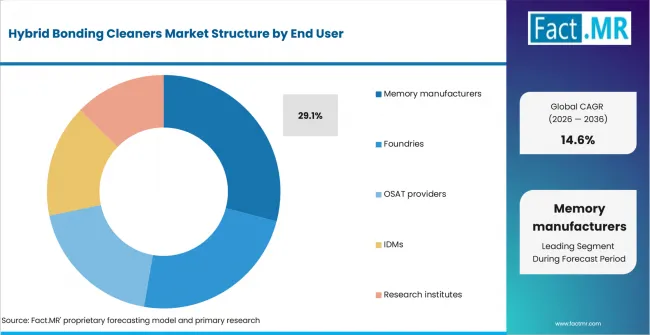
Hybrid Bonding Cleaners Market Analysis By End User | Source: Fact.MR
Memory manufacturers operate repetitive high-volume stacks in which a small interface-defect rate compounds across many bonded layers. That makes cleaner stability, chamber matching and preventive maintenance economically visible at the finished-stack level. Foundries need broader recipe flexibility, while memory lines can justify dedicated cleaning sequences around a narrow high-volume architecture. C-SAM acoustic microscopy is the standard void screen: Voids will appear as white specs, whereas a void-free bond results in a black acoustic microscopy image (Semiconductor Engineering). Failure-analysis practice runs C-SAM first for full-wafer screening, then X-ray/CT to localize in 3D. [2] Buyers therefore tend to treat memory manufacturers as the practical choice when qualification must balance process capability, repeatability and production economics.
What is accelerating Hybrid Bonding Cleaners Market adoption, and what is holding it back?
The strongest accelerator is particle control is a named yield variable, while the main restraint is that aggressive chemistry or megasonic energy can damage fine features, and weak rinsing or drying can leave watermarks and ionic residue.
Drivers Impact Analysis
| DRIVER | (~) % IMPACT ON CAGR | GEOGRAPHIC RELEVANCE | IMPACT TIMELINE |
|---|---|---|---|
| Particle control is a named yield variable | +4.1% | Global leading-edge fabs | Medium term (2-4 years) |
| Voids at the interface are the measurable outcome | +3.4% | Global leading-edge fabs | Medium term (2-4 years) |
| RCA/SC-1 + megasonic remains the baseline chemistry | +2.8% | Global leading-edge fabs | Medium term (2-4 years) |
| Frequency choice trades removal vs damage | +2.2% | Global leading-edge fabs | Medium term (2-4 years) |
Source: Fact.MR analysis. Updated Jul 22, 2026
- Particle control is a named yield variable: EV Group's Dielacher, on hybrid bonding: Particle control inside the equipment includes air flow management, the use of mini-environments, and optimized substrate handling. In addition, in-situ process monitoring can help further reduce particle contamination. [1]
- Voids at the interface are the measurable outcome: C-SAM acoustic microscopy is the standard void screen: Voids will appear as white specs, whereas a void-free bond results in a black acoustic microscopy image (Semiconductor Engineering). Failure-analysis practice runs C-SAM first for full-wafer screening, then X-ray/CT to localize in 3D. [2]
- RCA/SC-1 + megasonic remains the baseline chemistry: Electrochemical Society proceedings on semiconductor cleaning: modified SC-1 (NH4OH:H2O2:H2O at 1:2:40 and 1:2:80) with chelating agents (12-200 ppm), megasonic energy at 1.13 W/cm², <5 s dilute HF (1:100) exposure, and up to 0.2% surfactant; particle-removal efficiency measured with 0.2 µm Si3N4 challenge particles on 300 mm wafers (Tencor SP-1), metals by VPD-ICPMS, residues by TOF-SIMS. [3]
- Frequency choice trades removal vs damage: Megasonic cleaning operates ~0.8-2 MHz; higher MHz generates smaller cavitation bubbles, removing sub-micron particles while minimizing pattern/feature damage - the same trade-off applies to fragile hybrid-bond topographies (recessed Cu pads in dielectric). [4]
Opportunity Impact Analysis
| OPPORTUNITY | (~) % IMPACT ON CAGR | GEOGRAPHIC RELEVANCE | IMPACT TIMELINE |
|---|---|---|---|
| Co-location with activation/bond (queue-time compression) | +2.5% | Global leading-edge fabs | Medium term (2-4 years) |
| Post-CMP cleaning specialization | +1.9% | Global leading-edge fabs | Medium term (2-4 years) |
| Dry/cryogenic aerosol options | +1.5% | Global leading-edge fabs | Medium term (2-4 years) |
Source: Fact.MR analysis. Updated Jul 22, 2026
- Co-location with activation/bond (queue-time compression): Cleaners are being physically integrated into bond clusters so the cleantoactivatetobond window drops to minutes; standalone wet benches create re-contamination risk during queue time (see activated-surface decay evidence: ). [7]
- Post-CMP cleaning specialization: Because CMP defines the up to 5 nm Cu-dishing budget (BESI, via Semiconductor Engineering), post-CMP cleans must remove slurry and organic residues without altering dishing or eroding dielectric - over-etch/recess beyond a few nm shifts bonding force onto the oxide and weakens the Cu-Cu interface (SMTA paper, §7).
- Dry/cryogenic aerosol options: Cryogenic CO2/aerosol cleaning is being evaluated as a no-watermark, no-surface-tension alternative for sub-50 nm particles on bond-ready surfaces (industry direction; complements megasonic wet cleans).
Restraints Impact Analysis
| RESTRAINT | (~) % IMPACT ON CAGR | GEOGRAPHIC RELEVANCE | IMPACT TIMELINE |
|---|---|---|---|
| Primary qualification constraint | -2.2% | Global leading-edge fabs | Medium term (2-4 years) |
| Contamination and defect risk | -1.8% | Global leading-edge fabs | Medium term (2-4 years) |
| Buried-defect escape | -1.3% | Global leading-edge fabs | Medium term (2-4 years) |
Source: Fact.MR analysis. Updated Jul 22, 2026
- Primary qualification constraint: Aggressive chemistry or megasonic energy can damage fine features, and weak rinsing or drying can leave watermarks and ionic residue. [1]
- Contamination and defect risk: EV Group's Dielacher, on hybrid bonding: Particle control inside the equipment includes air flow management, the use of mini-environments, and optimized substrate handling. In addition, in-situ process monitoring can help further reduce particle contamination. [1]
- Buried-defect escape: C-SAM acoustic microscopy is the standard void screen: Voids will appear as white specs, whereas a void-free bond results in a black acoustic microscopy image (Semiconductor Engineering). Failure-analysis practice runs C-SAM first for full-wafer screening, then X-ray/CT to localize in 3D. [2]
Which countries are scaling Hybrid Bonding Cleaners Market fastest?
In USA, Hybrid Bonding Cleaners Market is projected to advance at 16.0% CAGR, supported by leading-edge logic, high-performance computing, federally supported semiconductor R&D and a large domestic equipment base.
- Countries differ less by the headline CAGR than by the type of semiconductor work creating demand for the Hybrid Bonding Cleaners Market.
- South Korea follows a pathway shaped by high-volume memory, HBM and vertically integrated semiconductor manufacturing. USA takes a different path through leading-edge logic, high-performance computing, federally supported semiconductor R&D and a large domestic equipment base.
- Taiwan remain aligned through distinct combinations of device production, equipment development and advanced packaging investment.
- Japan develops through semiconductor equipment, materials, inspection and memory-process expertise, while Singapore relies on advanced-packaging R&D, specialty fabs and regional assembly and test operations.
- Markets with similar CAGRs can follow different development paths because installed fabs, device mix, local equipment capability, export controls and qualification cycles differ.
The full report compares the six named country markets within the wider regional coverage of North America, Latin America, Europe, East Asia, South Asia & Oceania, and the Middle East & Africa.
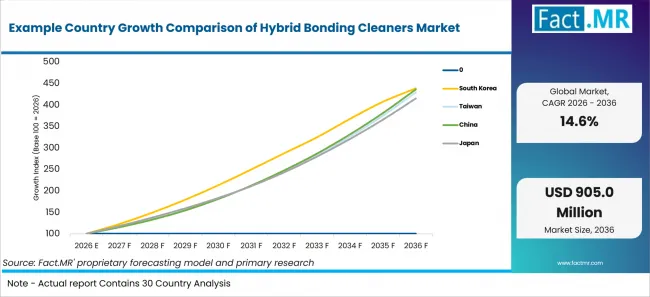
Example Country Growth Comparison Of Hybrid Bonding Cleaners Market | Source: Fact.MR
| COUNTRY | CAGR, 2026 to 2036 |
|---|---|
| South Korea | 16.0% |
| USA | 16.0% |
| Taiwan | 15.7% |
| Japan | 15.3% |
| Singapore | 14.8% |
Source: Fact.MR analysis. Updated Jul 22, 2026
What is driving South Korea's growth through 2036?
16.0% CAGR, supported by high-volume memory, HBM and vertically integrated semiconductor manufacturing.
What is driving USA's growth through 2036?
16.0% CAGR, supported by leading-edge logic, high-performance computing, federally supported semiconductor R&D and a large domestic equipment base.
ACM Research (US/China dual footprint) pushes SAPS/TEBO megasonic variants; CHIPS-funded packaging lines specify US-installable clean capacity. This environment creates a clear qualification pathway for the Hybrid Bonding Cleaners Market because buyers must solve the problem of removing particles, CMP residue, organic films and copper oxide without changing topography or recontaminating the surface before bonding at production scale.
What is driving Taiwan's growth through 2036?
15.7% CAGR, supported by leading foundry production, advanced packaging and a dense OSAT and substrate supply chain.
Taiwan combines leading foundry production, advanced packaging and a dense OSAT and substrate supply chain with a 17.4% share of 2026 demand across the six profiled countries. EV Group's Dielacher, on hybrid bonding: Particle control inside the equipment includes air flow management, the use of mini-environments, and optimized substrate handling. [1] The commercial link is the need to solve the problem of removing particles, CMP residue, organic films and copper oxide without changing topography or recontaminating the surface before bonding as capacity and process complexity increase.
What is driving Japan's growth through 2036?
15.3% CAGR, supported by semiconductor equipment, materials, inspection and memory-process expertise.
SCREEN and TEL dominate single-wafer clean share; TEL couples cleans with its Synapse bonding line; Japanese suppliers lead megasonic nozzle engineering. This environment creates a clear qualification pathway for the Hybrid Bonding Cleaners Market because buyers must solve the problem of removing particles, CMP residue, organic films and copper oxide without changing topography or recontaminating the surface before bonding at production scale.
What is driving Singapore's growth through 2036?
14.8% CAGR, supported by advanced-packaging R&D, specialty fabs and regional assembly and test operations.
Singapore combines advanced-packaging R&D, specialty fabs and regional assembly and test operations with a 10.1% share of 2026 demand across the six profiled countries. Electrochemical Society proceedings on semiconductor cleaning: modified SC-1 (NH4OH:H2O2:H2O at 1:2:40 and 1:2:80) with chelating agents (12-200 ppm), megasonic energy at 1.13 W/cm², <5 s dilute HF (1:100) exposure, and up to 0.2% surfactant; particle-removal efficiency measured with 0.2 µm Si3N4 challenge particles on 300 mm wafers (Tencor SP-1). [3] The commercial link is the need to solve the problem of removing particles, CMP residue, organic films and copper oxide without changing topography or recontaminating the surface before bonding as capacity and process complexity increase.
Who leads the Hybrid Bonding Cleaners Market?
SCREEN Semiconductor and Tokyo Electron lead the competitive landscape, followed by Lam Research and SUSS MicroTec as the next tier of challengers.
SCREEN Semiconductor participates through single-wafer cleaning and surface preparation. Integrated clean+activation modules feeding bonders; megasonic with damage-free recipes for Cu/dielectric surfaces. Tokyo Electron participates through etch, clean, deposition and wafer-bonding process equipment. Integrated clean+activation modules feeding bonders; megasonic with damage-free recipes for Cu/dielectric surfaces. Lam Research participates through etch, deposition, clean and advanced memory process integration, with relevance determined by its ability to address the challenge of removing particles, CMP residue, organic films and copper oxide without changing topography or recontaminating the surface before bonding. SUSS MicroTec participates through wafer alignment, bonding and advanced-packaging lithography, with relevance determined by its ability to address the challenge of removing particles, CMP residue, organic films and copper oxide without changing topography or recontaminating the surface before bonding.
Applied Materials holds a more specialized role through deposition, etch, materials engineering and integrated process modules, particularly where custom integration and service coverage affect qualification. ACM Research holds a more specialized role through wet cleaning and plating process equipment, particularly where custom integration and service coverage affect qualification.
Competition is expected to center on repeatable process performance, integration with adjacent modules, installed-base service and documented capability to address the challenge of removing particles, CMP residue, organic films and copper oxide without changing topography or recontaminating the surface before bonding. Buyers are likely to compare accuracy, defect prevention, throughput, recipe stability and the completeness of the delivered process cell.
Which companies are the key providers?
Key companies include SCREEN Semiconductor; Tokyo Electron; Lam Research; SUSS MicroTec; Applied Materials; ACM Research.
- SCREEN Semiconductor
- Tokyo Electron
- Lam Research
- SUSS MicroTec
- Applied Materials
- ACM Research
Bibliography
- [1] Semiconductor Engineering. (n.d.). Making Hybrid Bonding Better.
- [2] Ninescrolls. (n.d.). Hybrid Bonding Failure Analysis.
- [3] Electrochem. (n.d.). Pv 2001 26.
- [4] Modutek. (n.d.). Precision Megasonic Cleaning For Silicon Carbide Wafers.
- [7] Congressional Research Service / Congress.gov. (n.d.). R48642.4.
This Report Addresses
- The report provides strategic intelligence on Hybrid Bonding Cleaners Market across Cleaning Technology and Contaminant Target choices that shape purchasing decisions.
- Segment analysis covers Megasonic wet clean as the share leader within the 2026 market structure.
- Regional outlook evaluates South Korea and Taiwan alongside Japan, while Singapore and USA complete the growth comparison.
- Competitive analysis profiles SCREEN Semiconductor and Tokyo Electron alongside Lam Research and SUSS MicroTec, followed by additional active providers.
- Use-case assessment covers the categories and applications that shape demand in the Hybrid Bonding Cleaners Market across the forecast period.
What does the Hybrid Bonding Cleaners Market cover?
The market covers equipment and process systems configured to address the challenge of removing particles, CMP residue, organic films and copper oxide without changing topography or recontaminating the surface before bonding.
Hybrid bonding cleaners are wafer-cleaning systems (single-wafer and batch) dedicated to the pre-bond clean immediately upstream of direct/hybrid bonding: post-CMP residue removal, sub-micron particle removal without re-roughening the surface, organic/metal contamination removal, and controlled DI rinse/dry before plasma activation and bonding. The segment is defined by defectivity specs at the <0.1 µm particle scale combined with <0.5 nm surface-roughness preservation.
Commercial value arises from the complete configured system, including process control, handling, software and integrated modules required for repeatable operation. Finished semiconductor devices, package value and unrelated parent-market equipment are excluded.
What is included in the scope?
The scope includes systems used by memory manufacturers and the other end-user groups listed in the segmentation.
The market is segmented by Cleaning Technology, including Megasonic wet clean, Single-wafer spin clean, Cryogenic aerosol clean, Supercritical CO2 clean, Dry plasma clean; Contaminant Target, including Particle removal, Copper oxide removal, Organic residue removal, Metallic ion removal, CMP slurry residue; Process Chemistry, including Dilute acid chemistries, Alkaline chemistries, DI water/ozone, Solvent-based, Chelating chemistries; Integration, including Cluster-integrated clean, Standalone cleaners, Track-integrated, Batch cleaners, Inline bond-linked; End User, including Memory manufacturers, Foundries, OSAT providers, IDMs, Research institutes.
Integrated handling, metrology, cleaning, activation, process-control or support modules are included when delivered as part of the configured market system.
What is excluded from the scope?
The scope excludes unrelated semiconductor equipment, standalone materials and components sold independently of the configured system.
It also excludes facility construction, cleanroom infrastructure, the value of processed wafers or packages, and adjacent process steps that are not part of the defined equipment category.
How Was the Analysis Built?
Fact.MR is of the opinion that this assessment combines structured market analysis with a review of public information and industry evidence relevant to the market.
- Market Assessment: The analysis considers demand patterns, supply conditions, segment mix, country activity, company participation, and adoption trends.
- Evidence Review: Public company disclosures, government and regulatory publications, trade information, technical literature, and industry records inform the assessment.
- Validation and Updates: Findings are cross-checked against available market indicators and reviewed when material market developments emerge.
Segmentation
What is the report's scope and coverage?
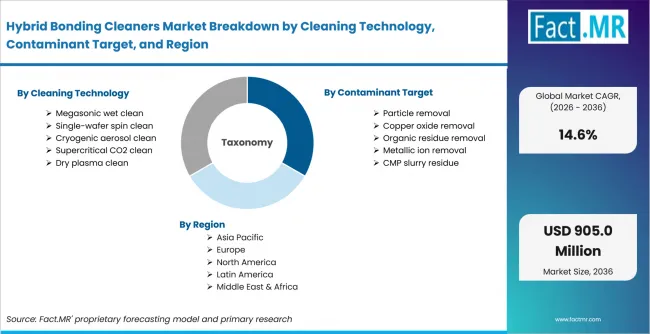
Hybrid Bonding Cleaners Market Breakdown By Cleaning Technology, Contaminant Target, And Region | Source: Fact.MR
| Attribute | Details |
|---|---|
| Quantitative Units | USD 232.0 million in 2026 to USD 905.0 million by 2036 at a 14.6% CAGR |
| Market Definition | Hybrid bonding cleaners are wafer-cleaning systems (single-wafer and batch) dedicated to the pre-bond clean immediately upstream of direct/hybrid bonding: post-CMP residue removal, sub-micron particle removal without re-roughening the surface, organic/metal contamination removal, and controlled DI rinse/dry before plasma activation and bonding. The segment is defined by defectivity specs at the <0.1 µm particle scale combined with <0.5 nm surface-roughness preservation. |
| Cleaning Technology | Megasonic wet clean; Single-wafer spin clean; Cryogenic aerosol clean; Supercritical CO2 clean; Dry plasma clean |
| Contaminant Target | Particle removal; Copper oxide removal; Organic residue removal; Metallic ion removal; CMP slurry residue |
| Process Chemistry | Dilute acid chemistries; Alkaline chemistries; DI water/ozone; Solvent-based; Chelating chemistries |
| Integration | Cluster-integrated clean; Standalone cleaners; Track-integrated; Batch cleaners; Inline bond-linked |
| End User | Memory manufacturers; Foundries; OSAT providers; IDMs; Research institutes |
| Regions Covered | North America; Latin America; Europe; East Asia; South Asia & Oceania; Middle East & Africa |
| Countries Covered | South Korea; Taiwan;Japan; Singapore; USA |
| Key Companies Profiled | SCREEN Semiconductor; Tokyo Electron; Lam Research; SUSS MicroTec; Applied Materials; ACM Research |
| Forecast Period | 2026 to 2036 |
| Approach | Hybrid top-down and bottom-up approach using demand indicators across Cleaning Technology; Contaminant Target; Process Chemistry; Integration; End User; country-level growth; company participation and adoption trends |
Source: Fact.MR analysis. Updated Jul 22, 2026
How is the market segmented?
-
By Cleaning Technology
- Megasonic wet clean
- Single-wafer spin clean
- Cryogenic aerosol clean
- Supercritical CO2 clean
- Dry plasma clean
-
By Contaminant Target
- Particle removal
- Copper oxide removal
- Organic residue removal
- Metallic ion removal
- CMP slurry residue
-
By Process Chemistry
- Dilute acid chemistries
- Alkaline chemistries
- DI water/ozone
- Solvent-based
- Chelating chemistries
-
By Integration
- Cluster-integrated clean
- Standalone cleaners
- Track-integrated
- Batch cleaners
- Inline bond-linked
-
By End User
- Memory manufacturers
- Foundries
- OSAT providers
- IDMs
- Research institutes
-
By Region
- North America
- USA
- Latin America
- Other regional markets assessed at aggregate level
- Europe
- Other regional markets assessed at aggregate level
- East Asia
- South Korea
- Taiwan
- Japan
- South Asia & Oceania
- Singapore
- Middle East & Africa
- Other regional markets assessed at aggregate level
- North America
Frequently Asked Questions
Which Cleaning Technology leads the Hybrid Bonding Cleaners Market?
Which Contaminant Target leads the Hybrid Bonding Cleaners Market?
Which Process Chemistry leads the Hybrid Bonding Cleaners Market?
Which Integration leads the Hybrid Bonding Cleaners Market?
Which End User leads the Hybrid Bonding Cleaners Market?
What CAGR is projected for South Korea in the Hybrid Bonding Cleaners Market?
What CAGR is projected for USA in the Hybrid Bonding Cleaners Market?
What CAGR is projected for Taiwan in the Hybrid Bonding Cleaners Market?
What CAGR is projected for Japan in the Hybrid Bonding Cleaners Market?
What CAGR is projected for Singapore in the Hybrid Bonding Cleaners Market?
What is the primary driver of the Hybrid Bonding Cleaners Market?
What is the main restraint in the Hybrid Bonding Cleaners Market?
Who worked on this report


Preview the report firsthand - request a free sample
Free SampleGet the brochure for pricing and purchase details
Download PDF