- Market Value (2025): USD 8.6 Bn
- Estimated Value (2026): USD 9.3 Bn
- Forecast Value (2036): USD 21.7 Bn
- CAGR (2026-2036): 8.8%
What is the Transparent High-Barrier Films Market forecast to be worth by 2036?
USD 9.3 Billion in 2026 to USD 21.7 Billion by 2036 at an 8.8% CAGR.
- The Transparent High-Barrier Films Market reached USD 8.6 Billion in 2025.
- Demand is projected to increase from USD 9.3 Billion in 2026 to USD 21.7 Billion by 2036.
- The market is forecast to record an 8.8% CAGR from 2026 to 2036, supported by clear-pack shelf appeal and recyclable film redesign.
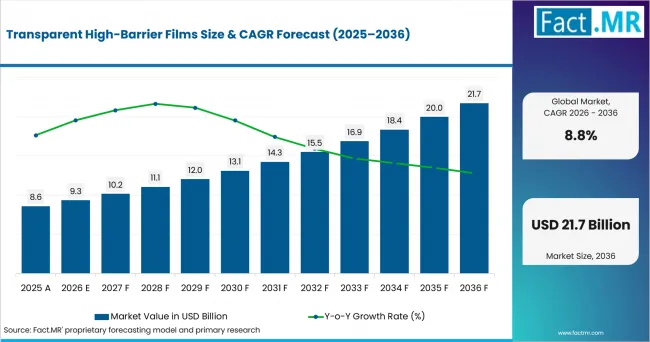
Transparent High Barrier Films Value Analysis | Source: Fact.MR
What are the defining numbers behind Transparent High-Barrier Films Market growth?
USD 12.4 Billion absolute opportunity by 2036, led by PE mono-material, EVOH-compatible barrier and printed rollstock.
- Demand Drivers in the Market
- Recyclability pressure is shaping flexible-pack redesign. Eurostat reported that the EU generated 35.3 kg of plastic packaging waste per resident in 2023, of which 14.8 kg was recycled.
- Food packers face increasing demand for recyclable packaging structures as Regulation (EU) 2025/40 places recyclability and design-for-recycling requirements at the center of EU packaging compliance.
- Dairy and chilled-food brands need clear barrier structures that protect products and support recyclable-pack goals.
- Converters need materials that run on existing web-fed lines and still provide oxygen, moisture and puncture performance for retail packs.
- Key Segments Analyzed
- By Polymer Platform: PE mono-material is projected to hold 31.0% share in 2026, supported by its fit with recyclable flexible films and pouches.
- By Barrier Technology: EVOH-compatible barrier is anticipated to account for 29.0% share in 2026, owing to its use in oxygen-sensitive packaged foods.
- By Format: Printed rollstock is estimated to capture 36.0% share in 2026, driven by high-speed snack and chilled-food wrapping lines.
- By End-use: Snacks are forecast to represent 34.0% share in 2026, reinforced by moisture control and printed shelf presentation needs.
- Analyst Opinion at Fact.MR
- Shambhu Nath Jha, Principal Consultant at Fact.MR, states, “Transparent barrier films are drawing attention because brands want clear packs that protect oxygen-sensitive products. Commercial pull is expected to come from structures that combine barrier proof with recyclable design. Suppliers should pair film science with sealing guidance and approval documentation.”
- Strategic Implications
- Film producers should document oxygen and water-vapor results for each PE and PP mono-material structure before customer trials begin.
- Converters should align coating, printing and sealing windows with existing rollstock equipment so line trials remain practical.
- Brand owners should connect shelf-life testing with recyclability files before moving snacks, dairy or pet-food packs into new structures.
- Retail packaging teams should compare clear film performance against metalized and foil-based packs where visibility carries value.
China is projected to record 9.8% CAGR through 2036, led by packaged-food retail and domestic film conversion. The USA is forecast to advance at 9.3% CAGR due to large food spending and retailer packaging requirements. Japan is estimated to post 9.3% CAGR, supported by food processing and collection discipline. Germany is anticipated to hold 9.1% CAGR, owing to prepared-meal output and recycling enforcement. France is projected to reach 8.6% CAGR as food demand and EU packaging rules shape pack redesign.
How does the Transparent High-Barrier Films Market break down by segment?
PE mono-material leads at 31.0%; printed rollstock leads at 36.0%.
Which Polymer Platform dominates?
PE mono-material holds 31.0% share in 2026.
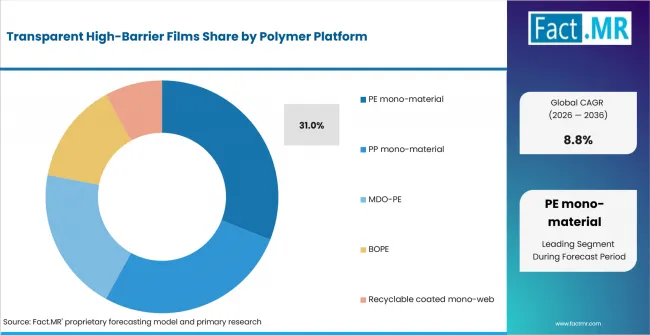
Transparent High Barrier Films Analysis By Polymer Platform | Source: Fact.MR
PE mono-material leads because it gives converters a practical route to recyclable flexible packaging while maintaining clear shelf presentation. The structure works across pouches, rollstock and flow-wrap formats, helping brands balance visibility, sealing performance, material simplification and compatibility with existing converting equipment.
What leads the Barrier Technology segment?
EVOH-compatible barrier leads with 29.0% share in 2026.
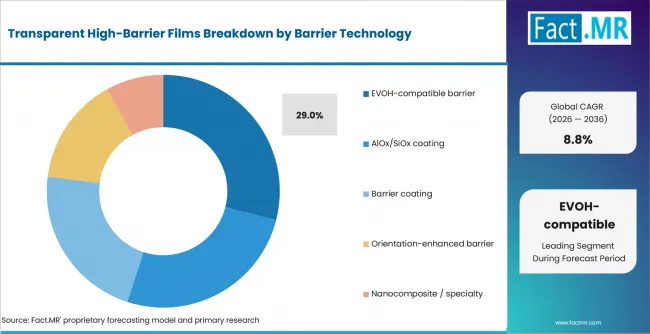
Transparent High Barrier Films Analysis By Barrier Technology | Source: Fact.MR
EVOH-compatible structures lead because they provide oxygen barrier performance while keeping packaging transparent. They suit snacks, cheese and pet-food applications where brands want product visibility without a metalized appearance, while converters still need dependable sealing, multilayer compatibility and protection through distribution.
How does Format shape demand?
Printed rollstock accounts for 36.0% share in 2026.
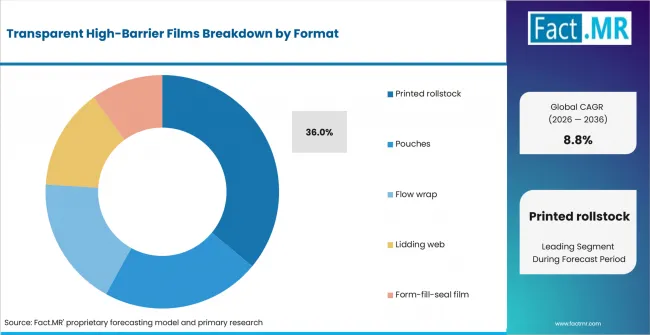
Transparent High Barrier Films Analysis By Format | Source: Fact.MR
Printed rollstock leads because snack and frozen-food lines rely on high-speed web-fed packaging equipment. Films that print consistently, track smoothly and seal reliably can reduce changeover and qualification effort, while supporting branded graphics, repeatable pack formation and efficient production across large runs.
What supports demand for Snacks within End-use?
Snacks capture 34.0% share in 2026.
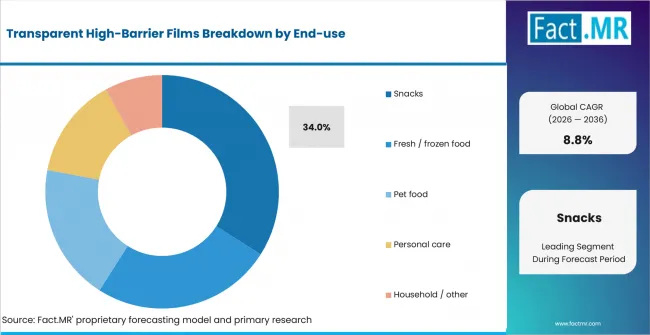
Transparent High Barrier Films Analysis By End Use | Source: Fact.MR
Snacks lead because moisture control, aroma retention and shelf visibility strongly influence packaging selection. Clear barrier films help preserve crispness while allowing shoppers to see product cues, giving brands a format that combines protection, visual appeal, sealing performance and compatibility with high-speed snack lines.
What is accelerating Transparent High-Barrier Films Market adoption, and what is holding it back?
Demand is expected to rise through recyclable film redesign and clear-pack shelf appeal. Growth is constrained by recycling-stream limits and barrier-cost tradeoffs.
Drivers Impact Analysis
| DRIVER | (~) % IMPACT ON CAGR | GEOGRAPHIC RELEVANCE | IMPACT TIMELINE |
|---|---|---|---|
| Recyclable mono-material redesign | +1.5% | North America, Europe, East Asia | Short term (<= 2 years) |
| Clear-pack shelf-life protection | +1.3% | Global | Medium term (2-4 years) |
| Rollstock conversion on existing lines | +1.0% | Global | Short term (<= 2 years) |
| Retail and brand packaging rules | +0.8% | USA, Europe, Japan | Long term (>= 4 years) |
Source: Fact.MR analysis. Updated Sep 19, 2026
Opportunity Impact Analysis
| OPPORTUNITY | (~) % IMPACT ON CAGR | GEOGRAPHIC RELEVANCE | IMPACT TIMELINE |
|---|---|---|---|
| High-barrier recyclable pouches | +1.2% | North America, Europe | Medium term (2-4 years) |
| Transparent lidding and flow-wrap webs | +0.9% | Europe, Japan | Short term (<= 2 years) |
| Barrier coatings for mono-web films | +0.7% | Global | Long term (>= 4 years) |
Source: Fact.MR analysis. Updated Sep 19, 2026
Restraints Impact Analysis
| RESTRAINT | (~) % IMPACT ON CAGR | GEOGRAPHIC RELEVANCE | IMPACT TIMELINE |
|---|---|---|---|
| Recycling-stream acceptance gaps | -0.7% | Global | Short term (<= 2 years) |
| Barrier performance versus downgauging limits | -0.5% | Food packaging hubs | Medium term (2-4 years) |
| Food-contact qualification cost | -0.4% | North America, Europe, Japan | Long term (>= 4 years) |
Source: Fact.MR analysis. Updated Sep 19, 2026
Which countries are scaling the Transparent High-Barrier Films Market through 2036?
- The country comparison spans 1.2 percentage points and forms a narrow growth band across the forecast period.
- China remains above the listed countries as packaged-food retail and domestic film conversion support demand.
- The USA and Japan share a 9.3% CAGR, although demand mechanisms differ across food spending and packaging collection systems.
- Germany remains close to the USA and Japan through prepared-food output and strict recycling oversight.
- France closes the displayed range as food demand supports volume while recycling targets raise documentation needs.
Comparable CAGRs create different entry conditions because transparent high-barrier films must satisfy local recycling rules and food-channel needs. Full report coverage includes North America, Latin America, Western Europe, Eastern Europe, East Asia, South Asia & Pacific, Middle East & Africa.
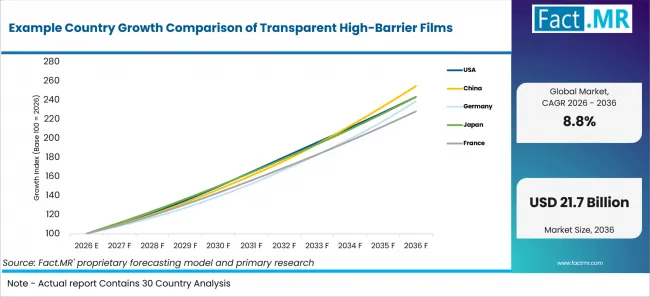
Example Country Growth Comparison Of Transparent High Barrier Films | Source: Fact.MR
| Country | CAGR (2026-2036) |
|---|---|
| China | 9.8% |
| USA | 9.3% |
| Japan | 9.3% |
| Germany | 9.1% |
| France | 8.6% |
Source: Fact.MR analysis. Updated Sep 19, 2026
What supports China adoption?
9.8% CAGR, supported by packaged-food retail and domestic flexible-pack conversion.
China’s National Bureau of Statistics reported 13,092.3 billion yuan in physical-goods online retail sales in 2025, with online food sales also expanding strongly. This e-commerce scale supports clear barrier films for snacks, household goods and flexible packs where converters are qualifying PE, PP and coated mono-web structures.
What supports USA adoption?
9.3% CAGR, backed by food spending and retailer packaging requirements.
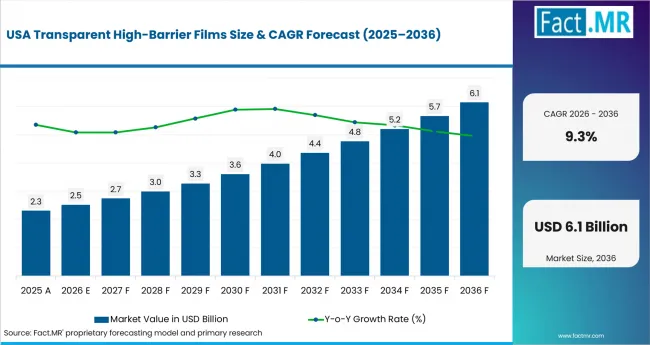
Transparent High Barrier Films Country Value Analysis | Source: Fact.MR
USDA ERS reported total U.S. food spending of USD 2.51 trillion in 2025. This large food market supports transparent barrier films across cheese, snacks and pet food, where brands need shelf visibility alongside oxygen and moisture protection while retailers increasingly request clearer recyclability documentation for flexible-film structures.
How does Japan perform?
9.3% CAGR, led by food-processing demand and packaging collection discipline.
USDA FAS reported that the value of food produced by Japan’s food-processing sector reached approximately USD 174 billion in 2025. This manufacturing base supports clear barrier films across convenience food, ready meals, seafood and pet food, where converters need packaging that preserves freshness, maintains visual quality and performs reliably on established filling and wrapping lines.
What is supporting Germany’s adoption?
9.1% CAGR, backed by prepared-food output and recycling enforcement.
Destatis reported that Germany produced 1.7 million tonnes of ready meals in 2024. This prepared-food scale supports demand for transparent barrier films across chilled meals, snacks and pet food, while retailer recyclability requirements encourage converters to evaluate mono-material and coated-film structures that can meet performance and documentation expectations.
What supports France adoption?
8.6% CAGR, driven by food demand and EU packaging rules.
ADEME reported that 4,893 kt of household packaging and graphic papers were sorted for recycling in France in 2024. This recovery activity supports interest in recyclable film structures as snack, frozen-food and personal-care brands assess transparent packaging that combines shelf visibility with barrier performance and evolving EU recyclability requirements.
Who leads the Transparent High-Barrier Films Market?
Amcor participates through its AmPrima® recycle-ready portfolio, which includes PE and PP formats with transparent or metallized barrier options. Its April 2025 combination with Berry Global broadened Amcor’s packaging portfolio and material-science and innovation capabilities, with the former Berry Global business now forming part of Amcor.
Mondi participates through recyclable mono-material barrier packaging based on PE and PP structures. Its portfolio includes high oxygen- and moisture-barrier options for applications including food, snacks, pet food, and home and personal care.
Coveris, Constantia Flexibles and ProAmpac also offer recyclable mono-material films and lidding solutions. Across these portfolios, suppliers emphasize barrier performance, compatibility with existing packaging lines, sealing performance and documented recyclability.
Which companies are the key providers?
Key companies include Amcor; Mondi; Berry Global, now part of Amcor; Coveris; Constantia Flexibles; and ProAmpac.
- Amcor
- Mondi
- Berry Global, now part of Amcor
- Coveris
- Constantia Flexibles
- ProAmpac
Bibliography
- ADEME. (2026, March). Household packaging and graphic papers: Data 2024.
- Amcor plc. (2025, April 30). Amcor completes combination with Berry Global; Positioned to significantly enhance value for customers and shareholders.
- CalRecycle. (2026, May 1). California approves new plastic and packaging rules that put consumers first.
- Constantia Flexibles. (2025, August 12). FACHPACK 2025: Constantia Flexibles invests over €100 million and expands product portfolio.
- Coveris. (2025, September 10). Coveris combines freshness and sustainability with new monomaterial pack for refrigerated goods.
- European Parliament & Council of the European Union. (2025, January 22). Regulation (EU) 2025/40 of the European Parliament and of the Council of 19 December 2024 on packaging and packaging waste, amending Regulation (EU) 2019/1020 and Directive (EU) 2019/904, and repealing Directive 94/62/EC. Official Journal of the European Union.
- Eurostat. (2025, October 22). Plastic packaging waste in the EU: 35.3 kg per person.
- Statistisches Bundesamt (Destatis). (2026, January 14). Produktion von Fertiggerichten binnen fünf Jahren mengenmäßig um 25,6 % gestiegen [Production of ready meals increased by 25.6% in volume within five years].
- German Environment Agency, & Central Agency Packaging Register. (2026, January 27). Facts against myths: Packaging waste recycling in Germany is working.
- Beretti, P.-A., & Pereira, É. (2026, June 16). Household consumption in 2025: Household consumption slowed despite a sharp deceleration in prices. Insee Première, (2110).
- Xinhua. (2026, May 25). China targets 76 percent urban waste recycling rate by 2030. The State Council of the People’s Republic of China.
- Ministères de la Transition écologique, de l’Aménagement du territoire, des Transports, de la Ville et du Logement. (2026, September 4). Plan plastique : le Gouvernement invite à finaliser la concertation sur le Plan plastique et propose une consigne volontaire et territorialisée des bouteilles en plastique.
- National Bureau of Statistics of China. (2026, January 20). Total retail sales of consumer goods in December 2025.
- ProAmpac. (2025, August 14). ProAmpac commercializes high-performance, recyclable ready packaging for chunk cheese.
- U.S. Census Bureau. (2026, September 3). All sectors: Summary statistics for industry groups and industries for employer firms in the U.S. and selected geographies: 2024 (Table AIES00BASIC) [Data table].
- Zeballos, E., & Sinclair, W. (2026, June 11). Total U.S. food spending reached $2.51 trillion in 2025. U.S. Department of Agriculture, Economic Research Service.
- Aoki, S. (2026, April 1). Food processing ingredients annual (Report No. JA2026-0012). U.S. Department of Agriculture, Foreign Agricultural Service.
This Report Addresses
- The report explains use across polymer platform, barrier technology, format and end use.
- Segment analysis identifies leading subsegments and converter selection reasons.
- Country analysis examines listed markets and adoption mechanisms.
- Competitive analysis reviews providers across mono-material films and clear coatings.
- Application analysis assesses how shelf life and line performance shape decisions.
What does the Transparent High-Barrier Films Market cover?
The Transparent High-Barrier Films Market covers flexible films that protect packaged goods from oxygen, moisture and aroma loss while keeping packs clear or printable. It includes mono-material PE and PP structures, MDO-PE, BOPE and clear coatings.
What is included in the scope?
The scope includes transparent high-barrier films sold as rollstock, pouch films, lidding webs, flow-wrap films and form-fill-seal films. It covers EVOH layers, AlOx, SiOx and orientation-enhanced designs.
What is excluded from the scope?
The scope excludes opaque metalized films, aluminum-foil laminates, rigid trays, bottles, cartons and paper packs outside a transparent film barrier layer. Separate resin additives are outside scope.
General flexible packaging is outside scope when the product lacks a defined oxygen, moisture or aroma barrier function. Labels and shrink sleeves qualify only as transparent high-barrier packaging films.
How Was the Analysis Built?
The analysis draws on 120+ sources, 35+ company portfolios, 25+ countries, and more than 20 industry interviews.
- Primary Research: Primary research includes discussions with manufacturers, service providers, technology developers, distributors, end users, and subject-matter experts. These conversations examine purchasing priorities, product adoption, operational challenges, approval requirements, competitive positioning, and the factors that influence wider market acceptance.
- Desk Research: Desk research covers government statistics, regulatory publications, company filings, trade data, technical studies, industry associations, standards, public policy, and other authoritative sources. Every source used in the analysis is documented in the bibliography.
- Market Sizing and Forecasting: Market estimates combine historical performance, demand indicators, pricing and volume trends, segment shares, company participation, country-level growth, adoption patterns, investment activity, and barriers to market expansion.
- Data Validation and Update Cycle: Findings are validated by comparing primary interviews with public data, company activity, regulatory changes, trade patterns, and industry developments. Regular updates review new product launches, capacity changes, partnerships, approvals, and shifts in commercial adoption.
Segmentation
What is the report’s scope and coverage?
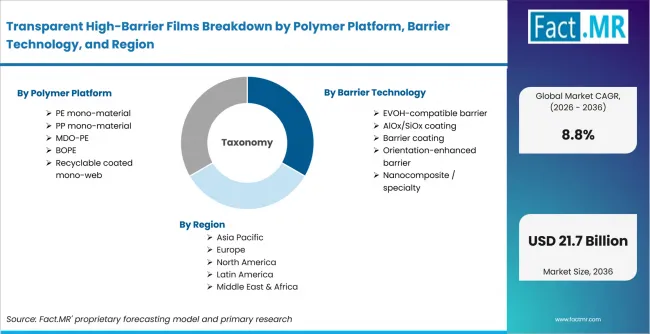
Transparent High Barrier Films Breakdown By Polymer Platform, Barrier Technology, And Region | Source: Fact.MR
| Attribute | Details |
|---|---|
| Quantitative Units | USD Billion |
| Market Definition | Transparent flexible films that provide oxygen, moisture or aroma barrier performance while retaining a clear pack face. |
| Polymer Platform | PE mono-material; PP mono-material; MDO-PE; BOPE; Recyclable mono-web |
| Barrier Technology | EVOH-compatible barrier; AlOx/SiOx coating; Barrier coating; Orientation-enhanced barrier; Specialty |
| Format | Printed rollstock; Pouches; Flow wrap; Lidding web; Form-fill-seal film |
| End-use | Snacks; Fresh/frozen food; Pet food; Personal care; Household/other |
| Regions Covered | North America; Latin America; Western Europe; Eastern Europe; East Asia; South Asia & Pacific; Middle East & Africa |
| Countries Covered | USA; China; Germany; Japan; France |
| Key Companies Profiled | Amcor; Mondi; Berry Global, now part of Amcor; Coveris; Constantia Flexibles; ProAmpac |
| Forecast Period | 2026 to 2036 |
| Approach | Hybrid top-down and bottom-up approach using food-packaging demand, film conversion, barrier technology and portfolio review. |
Source: Fact.MR analysis. Updated Sep 19, 2026
How is the market segmented?
-
By Polymer Platform
- PE mono-material
- PP mono-material
- MDO-PE
- BOPE
- Recyclable coated mono-web
-
By Barrier Technology
- EVOH-compatible barrier
- AlOx/SiOx coating
- Barrier coating
- Orientation-enhanced barrier
- Nanocomposite/specialty
-
By Format
- Printed rollstock
- Pouches
- Flow wrap
- Lidding web
- Form-fill-seal film
-
By End-use
- Snacks
- Fresh/frozen food
- Pet food
- Personal care
- Household/other
-
By Region
- North America
- Latin America
- Western Europe
- Eastern Europe
- East Asia
- South Asia & Pacific
- Middle East & Africa
Frequently Asked Questions
How big is the Transparent High-Barrier Films Market in 2026?
What is the CAGR of the Transparent High-Barrier Films Market from 2026 to 2036?
Which polymer platform leads the Transparent High-Barrier Films Market?
Which format leads demand?
Who are the leading companies in the Transparent High-Barrier Films Market?
Who worked on this report


Preview the report firsthand - request a free sample
Free SampleGet the brochure for pricing and purchase details
Download PDF