- Market Value (2025): USD 1.4 Bn
- Estimated Value (2026): USD 1.5 Bn
- Forecast Value (2036): USD 3.7 Bn
- CAGR (2026-2036): 9.1%
What is the Hydrophilic Thermoplastic Resins Market forecast to be worth by 2036?
USD 1.5 Billion in 2026 to USD 3.7 Billion by 2036, at 9.1% CAGR.
- The Hydrophilic Thermoplastic Resins Market crossed a valuation of USD 1.4 Billion in 2025.
- Demand is projected to increase from USD 1.5 Billion in 2026 to USD 3.7 Billion by 2036.
- The market is forecast to record a 9.1% CAGR from 2026 to 2036 as medical, filtration and hygiene users specify resins that combine controlled water interaction with thermoplastic processing.
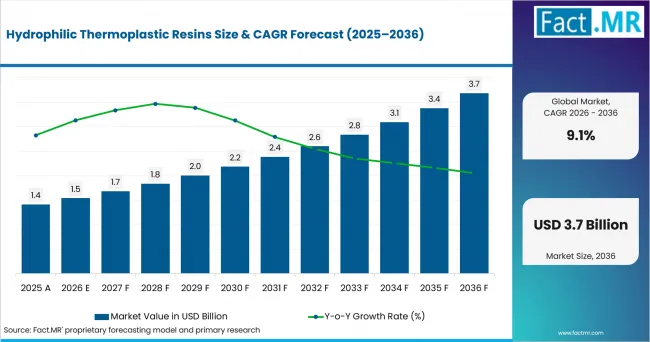
Hydrophilic Thermoplastic Resins Value Analysis | Source: Fact.MR
What are the defining numbers behind Hydrophilic Thermoplastic Resins Market growth?
USD 2.1 Billion absolute opportunity by 2036, led by Hydrophilic TPU, Polyether incorporation and medical devices.
- Demand Drivers in the Market
- Medical device engineers need flexible, biocompatible resin choices supported by device-grade documentation and repeatable extrusion behavior.
- Membrane producers need polymers that move moisture or solutes and retain film strength, pore support and sealing performance.
- Hygiene product developers need absorbent layers and breathable films that manage moisture without switching to brittle or non-melt-processable materials.
- Packaging converters need barrier and compatibility options as recycled-content rules increase scrutiny of multilayer structures and resin selection.
- Key Segments Analyzed
- By Resin Family: Hydrophilic TPU is expected to hold 29.0% share in 2026 because polyether TPU can combine flexibility, water uptake and clean film formation.
- By Hydrophilicity Route: Polyether incorporation is projected to account for 31.0% share in 2026 owing to built-in moisture affinity across TPU and block-copolymer systems.
- By Application: Medical devices are anticipated to capture 27.0% share in 2026 supported by catheter, tubing, wound-care and drug-delivery material needs.
- By Processing: Extrusion film and sheet is estimated to represent 30.0% share in 2026 since breathable films and membranes rely on stable melt flow.
- Analyst Opinion at Fact.MR
- Shambhu Nath Jha, Principal Consultant at Fact.MR, states, "Qualification and hydrophilicity are linked in this market. Device makers and converters want resins that absorb or move water in a predictable way and still run on existing thermoplastic equipment. Suppliers are expected to gain preference when they combine resin chemistry, processing support and compliance files that shorten validation work."
- Strategic Implications
- Resin producers should publish water-uptake, moisture-vapor and sterilization data in formats that application engineers can compare quickly.
- Compounders should align hydrophilic additives with base-resin compatibility so converters avoid haze, migration and sealing problems.
- Packaging specialists should test EVOH and compatibilizer systems against recycled-content and recyclability criteria before customer trials begin.
France is projected to post 10.2% CAGR through 2036 as medical-device spending and chemical processing capacity support specialized resin use. The UK is expected to advance at 9.4% CAGR as packaging-tax rules and water investment steer converter trials. Japan is anticipated to record 8.9% CAGR owing to medical-device output and local EVOH resin capability. Germany is forecast to hold 8.5% CAGR as plastics conversion and casing applications favor process-ready polyamides. The USA is estimated to reach 7.5% CAGR supported by water infrastructure renewal and healthcare material qualification.
How does the Hydrophilic Thermoplastic Resins Market break down by segment?
Hydrophilic TPU leads Resin Family at 29.0%; Polyether incorporation leads Hydrophilicity Route at 31.0%.
Which Resin Family dominates?
Hydrophilic TPU holds 29.0% share in 2026.
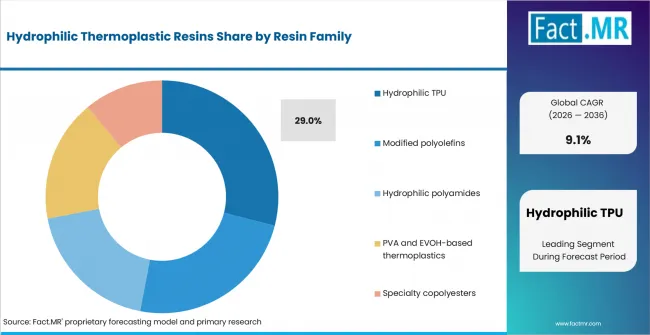
Hydrophilic Thermoplastic Resins Analysis By Resin Family | Source: Fact.MR
Hydrophilic TPU leads because it combines flexibility, water uptake and film-forming behavior. In September 2026, Lubrizol began local production of medical-grade Isoplast TPU at Songjiang, Shanghai, expanding medical-grade material supply in Asia Pacific.
What leads the Hydrophilicity Route segment?
Polyether incorporation leads with 31.0% share in 2026.
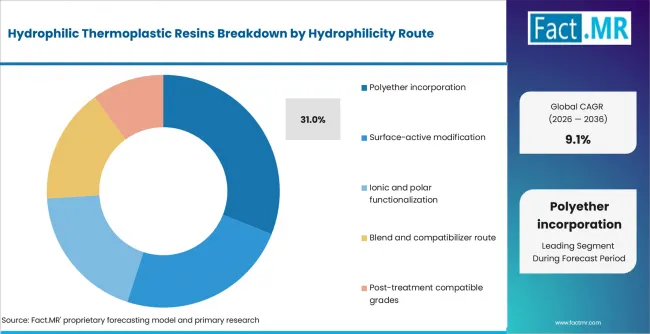
Hydrophilic Thermoplastic Resins Analysis By Hydrophilicity Route | Source: Fact.MR
Polyether incorporation leads because moisture affinity is built into the polymer structure. Arkema Pebax grades support breathable films and membranes where vapor transfer is needed and the surface retains liquid resistance.
How does Application shape demand?
Medical devices capture 27.0% share in 2026.
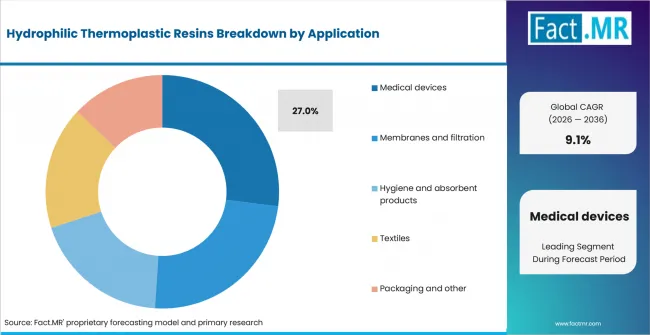
Hydrophilic Thermoplastic Resins Analysis By Application | Source: Fact.MR
Medical devices capture the main application share because resin changes face patient-contact and sterilization reviews. FDA CDRH received 21,780 medical-device submissions in 2025.
What supports Processing demand?
Extrusion film and sheet represents 30.0% share in 2026.
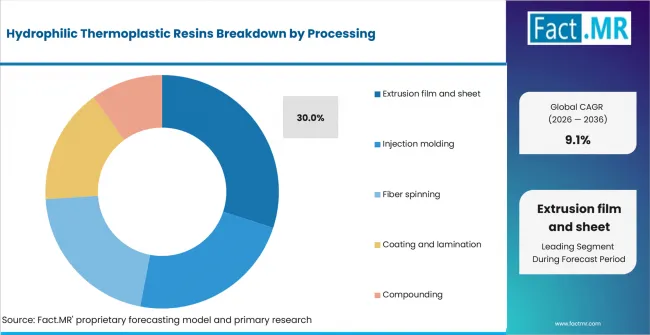
Hydrophilic Thermoplastic Resins Analysis By Processing | Source: Fact.MR
Extrusion film and sheet holds the main processing share because many applications start as thin films, membranes or laminated layers. BASF Ultramid H33 L adds a water-permeable polyamide route for artificial casings.
What is accelerating Hydrophilic Thermoplastic Resins Market adoption, and what is holding it back?
Demand is expected to rise through medical devices and filtration; expansion is constrained by qualification cost, resin price volatility and recyclability testing.
Drivers Impact Analysis
| DRIVER | (~) % IMPACT ON CAGR | GEOGRAPHIC RELEVANCE | IMPACT TIMELINE |
|---|---|---|---|
| Medical-device material qualification | +1.4% | USA, Japan, France | Short term (<= 2 years) |
| Water treatment and membrane demand | +1.1% | USA, UK, France | Medium term (2-4 years) |
| Breathable films and hygiene conversion | +0.9% | Europe, Japan | Medium term (2-4 years) |
| Recyclable and thinner thermoplastic structures | +0.7% | UK, Germany, Japan | Long term (>= 4 years) |
- Medical-device material qualification: Device manufacturers evaluate hydrophilic thermoplastics for biocompatibility, flexibility, sterilization performance, and processing consistency. Well-documented TPU grades can reduce qualification friction and support use in medical tubing, films, wearable components, and other healthcare applications.
- Water treatment and membrane demand: Investment in water treatment and filtration infrastructure supports demand for hydrophilic thermoplastics used in membranes and separation systems. These materials are relevant where controlled moisture interaction, chemical resistance, and durable processing performance are required.
- Breathable films and hygiene conversion: Hygiene and textile converters need films that allow moisture-vapor transmission while limiting liquid-water penetration. Hydrophilic block copolymers and TPU films fit this requirement across breathable laminates, hygiene products, protective textiles, and specialty film applications.
- Recyclable and thinner thermoplastic structures: Polymer suppliers are refining EVOH, compatibilizer, and thermoplastic systems as brands pursue thinner barrier structures with improved recyclability. Materials that maintain barrier performance while reducing overall layer complexity can support next-generation packaging and film designs.
Opportunity Impact Analysis
| OPPORTUNITY | (~) % IMPACT ON CAGR | GEOGRAPHIC RELEVANCE | IMPACT TIMELINE |
|---|---|---|---|
| Hydrophilic medical films and tubing | +1.0% | USA, Japan, France | Short term (<= 2 years) |
| Water-vapor permeable polyamide casings | +0.8% | Germany, France | Medium term (2-4 years) |
| EVOH and PVA compatibility in packaging | +0.6% | UK, Japan, USA | Long term (>= 4 years) |
- Hydrophilic medical films and tubing: Suppliers can strengthen design wins by combining moisture-control performance with medical-grade production controls, material consistency, and regional technical support. Clear documentation can help device manufacturers evaluate hydrophilic thermoplastics for films, tubing, and other healthcare applications.
- Water-vapor permeable polyamide casings: Hydrophilic polyamide grades create opportunities in smoked-sausage casings that require controlled water-vapor transmission during drying. These materials can help casing producers balance moisture release, mechanical strength, and processing performance in specialty food applications.
- EVOH and PVA compatibility in packaging: EVOH- and PVA-based barrier systems can gain relevance where packaging teams seek improved recyclability, lower-impact material sourcing, and dependable oxygen-barrier performance. Certification and recycling-compatibility documentation can support qualification in multilayer flexible-packaging structures.
Restraints Impact Analysis
| RESTRAINT | (~) % IMPACT ON CAGR | GEOGRAPHIC RELEVANCE | IMPACT TIMELINE |
|---|---|---|---|
| Long validation cycles in medical use | -0.5% | USA, Japan, France | Short term (<= 2 years) |
| Resin and additive price movement | -0.4% | Global | Medium term (2-4 years) |
| Recyclability limits in multilayer packaging | -0.3% | UK, Germany, Japan | Long term (>= 4 years) |
- Long validation cycles in medical use: Hydrophilic thermoplastic resins can face lengthy approval timelines when patient-contact safety, sterilization compatibility, and change-control documentation must be reviewed before commercial conversion. These requirements can slow adoption even when the material meets core performance needs.
- Resin and additive price movement: Changes in thermoplastic resin and additive pricing can affect formulation economics and material selection. Buyers may delay switching to specialty hydrophilic grades when input costs are volatile, particularly in applications with tight conversion margins.
- Recyclability limits in multilayer packaging: Hydrophilic layers can complicate recycling claims when multilayer structures also require tie layers, barrier polymers, or surface-active additives. Packaging teams therefore need to balance moisture-management performance with material compatibility and end-of-life requirements.
Which countries are scaling the Hydrophilic Thermoplastic Resins Market through 2036?
- The country comparison spans 2.76 percentage points and forms three practical growth bands across the forecast period.
- France remains 0.81 percentage point above the UK through medical-device spending and chemical production depth.
- The UK remains 0.52 percentage point above Japan as packaging-tax rules and water-sector upgrades support converter trials.
- Japan remains 0.42 percentage point above Germany through medical-device output and local EVOH capabilities.
- Germany remains 1.01 percentage points above the USA through plastics conversion depth and packaging recyclability pressure.
- The USA closes the displayed range through water infrastructure renewal and healthcare material qualification.
Comparable CAGRs create different entry conditions because each country combines medical validation, converter capacity and policy pressure differently. Full report coverage includes North America, Latin America, Western Europe, Eastern Europe, East Asia, South Asia & Pacific, Middle East & Africa.
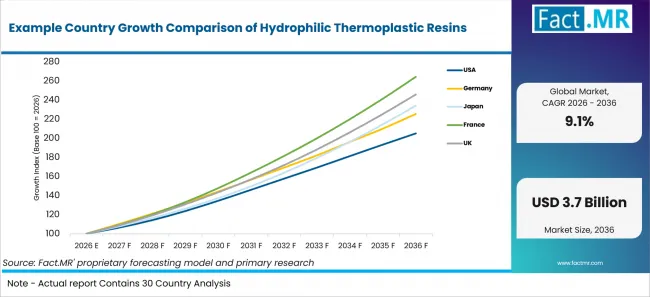
Example Country Growth Comparison Of Hydrophilic Thermoplastic Resins | Source: Fact.MR
| Country | CAGR |
|---|---|
| France | 10.2% |
| United Kingdom | 9.4% |
| Japan | 8.9% |
| Germany | 8.5% |
| USA | 7.5% |
What supports France adoption?
10.2% CAGR, supported by medical-device spending and chemical production depth.
France benefits from healthcare material demand and a local chemicals base that supports resin qualification. Hydrophilic TPU, polyamide and EVOH grades fit contact films, tubing and packaging structures where compatibility files and predictable moisture behavior shape material approval. French converters therefore favor grades that keep hydrophilicity stable after sterilization or coating.
What supports the United Kingdom’s growth?
9.4% CAGR, backed by packaging compliance and water-sector upgrades.
The UK opportunity is tied to packaging redesign and filtration work in regulated water systems. HMRC reported that 1,569 thousand tonnes of plastic packaging manufactured in or imported into the UK in 2024–25 were declared as containing 30% or more recycled plastic. Hydrophilic films and compatibilizer systems are therefore evaluated with barrier performance, moisture transport and recyclability evidence in the same material package. The same requirement supports extruded sheet, coating and lamination routes where end users ask for fewer material changes.
How is Japan developing demand?
8.9% CAGR, led by medical-device output and local specialty polymer capability.
Japan combines strict medical manufacturing with established polymer processing for EVOH, PVA and specialty elastomers. On December 24, 2025, MHLW reported JPY 2.6642 trillion in domestic medical-device production for 2024. That production base favors hydrophilic resins used in tubing, films and device parts where sterilization behavior and supplier documentation carry weight. Local approval pathways reward suppliers that keep resin chemistry stable across medical and packaging lines.
What is supporting Germany’s adoption?
8.5% CAGR, supported by plastics conversion and packaging recyclability rules.
Germany’s converter base supports demand for grades that run on existing extrusion and film equipment. Recyclability pressure encourages resin systems that keep hydrophilic layers thin and maintain barrier function with processing stability. Casing and hygiene converters therefore prefer materials that add water transport without forcing new film equipment.
What supports USA adoption?
7.5% CAGR, supported by water infrastructure renewal and healthcare material qualification.
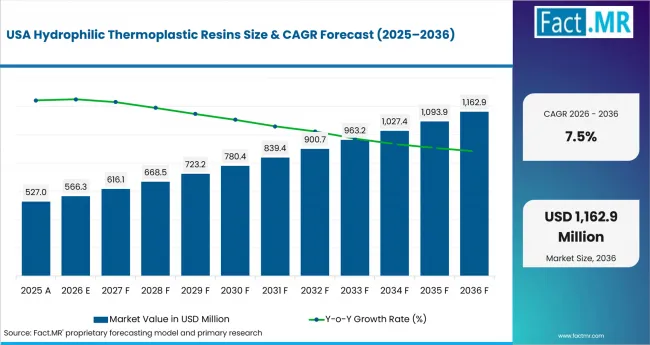
Hydrophilic Thermoplastic Resins Country Value Analysis | Source: Fact.MR
The USA links hydrophilic resin use to drinking-water assets and medical-material validation. The U.S. EPA estimates that drinking-water systems will require USD 625 billion in infrastructure investment over 20 years, including treatment-plant upgrades and water-storage infrastructure. Filtration membranes, tubing and device materials therefore need documented wetting behavior, stable conversion and reliable supply across qualified grades. The same qualification path favors suppliers with local technical service and consistent compound availability.
Who leads the Hydrophilic Thermoplastic Resins Market?
Lubrizol participates through hydrophilic TPU technologies used in drug-delivery, wound-care and medical-film applications. Its portfolio includes water-absorbing TPU grades with customizable mechanical properties, supported by medical and pharmaceutical documentation for regulated applications.
Covestro is relevant as an adjacent medical-grade TPU supplier. In June 2025, the company launched local production of Desmopan® Rx TPU at its Changhua, Taiwan site, expanding Asia-Pacific supply for healthcare applications including flexible tubing, endoscopes, hemodialysis, drug-delivery systems and wound care.
BASF expanded the hydrophilic polyamide landscape with Ultramid® H33 L in September 2025, combining polyamide strength with high water permeability for applications such as artificial casings. Kuraray supplies EVAL™ EVOH barrier materials for medical and pharmaceutical packaging alongside PVA/PVOH technologies used in pharmaceutical applications, while Mitsubishi Chemical supplies pharmaceutical-grade PVA/PVOH and EVOH-containing multilayer films for medical and pharmaceutical uses. Arkema supplies hydrophilic Pebax® grades for breathable films and membranes that enable moisture-vapor transfer while resisting liquid-water penetration.
Which companies are the key providers?
Relevant companies include Lubrizol; BASF; Kuraray; Mitsubishi Chemical Corporation; Arkema; and Covestro as an adjacent medical-grade TPU supplier.
- Lubrizol
- Covestro
- BASF
- Kuraray
- Mitsubishi Chemical Corporation
- Arkema
Bibliography
- BASF. (2025, September 9). BASF launches the world’s first thermoplastic polyamide with high water permeability.
- Covestro. (2025, June 25). Covestro launches localized production of medical-grade TPU in Asia Pacific.
- Department for Environment, Food & Rural Affairs. (2025, December 1). Wastewater Environment Act target delivery plan.
- Delecourt, C., & Didier, M. (Eds.). (2025). Health expenditure in 2024 – Results of the health accounts – Edition 2025. Direction de la recherche, des études, de l’évaluation et des statistiques.
- HM Revenue & Customs. (2025, August 28). Plastic Packaging Tax (PPT) statistics commentary.
- Kuraray Co., Ltd. (2025, December 29). Kuraray acquires ISCC PLUS certification for EVAL™ EVOH resin produced in Texas, U.S.
- The Lubrizol Corporation. (2026, September 1). Lubrizol advances medical device industry development through local production and material innovation at Medtec China 2026.
- Mitsubishi Chemical Corporation Corporation. (2025, October 17). Multilayer films containing Mitsubishi Chemical’s SoarnoL™ EVOH resins up to 10 weight% receive RecyClass Technology Approval.
- U.S. Bureau of Labor Statistics. (2026, July 15). Producer Price Indexes – June 2026.
- U.S. Environmental Protection Agency. (2026, May 20). EPA’s 7th Drinking Water Infrastructure Needs Survey and Assessment.
- U.S. Food and Drug Administration, Center for Devices and Radiological Health. (2026). CDRH annual report 2025.
- German Environment Agency, & Central Agency Packaging Register. (2026, January 27). Facts against myths: Packaging waste recycling in Germany is working.
This Report Addresses
- The report analyzes hydrophilic thermoplastic resins by resin family, hydrophilicity route, application and processing.
- Segment analysis reviews resin family and hydrophilicity route, together with application and processing choices for hydrophilic thermoplastic systems.
- Country analysis covers France, the United Kingdom, Japan, Germany and the USA using healthcare, packaging and water-infrastructure indicators.
- Competitive analysis reviews suppliers across hydrophilic TPU, hydrophilic polyamide, PVA/EVOH and related specialty thermoplastic systems.
- Application analysis focuses on medical films and tubing, membranes and filtration, hygiene products, textiles and packaging.
What does the Hydrophilic Thermoplastic Resins Market cover?
The Hydrophilic Thermoplastic Resins Market covers polymers that add moisture affinity to melt-processable materials. It includes TPU, hydrophilic polyamides, modified polyolefins, specialty copolyesters, medical plastic compounds and PVA or EVOH-based thermoplastics.
The assessment covers extrusion film and sheet, injection molding, fiber spinning, coating and lamination. Compounding is included where the hydrophilic function is part of the resin system.
What is included in the scope?
The scope includes commercial hydrophilic TPU, hydrophilic polyamide, modified polyolefin, PVA, EVOH and specialty copolyester resin grades. These grades are used in medical, membrane, hygiene, textile and packaging applications.
It includes melt-processable resins used for films, sheets, fibers, molded parts and laminates. Related packaging coverage is limited to materials that directly use hydrophilic thermoplastic functions.
What is excluded from the scope?
Outside scope are water-soluble powders, thermoset hydrogels, non-polymeric absorbents and finished medical devices sold as standalone products.
Commodity polyolefins, standard nylon, conventional TPU and ordinary packaging film are outside scope unless the grade carries a hydrophilic function or water-vapor role.
How Was the Analysis Built?
The analysis draws on 120+ sources, 35+ company portfolios, 25+ countries, and more than 20 industry interviews.
- Primary Research: Primary research includes discussions with manufacturers, service providers, technology developers, distributors, end users, and subject-matter experts. These conversations examine purchasing priorities, product adoption, operational challenges, approval requirements, competitive positioning, and the factors that influence wider market acceptance.
- Desk Research: Desk research covers government statistics, regulatory publications, company filings, trade data, technical studies, industry associations, standards, public policy, and other authoritative sources. Every source used in the analysis is documented in the bibliography.
- Market Sizing and Forecasting: Market estimates combine historical performance, demand indicators, pricing and volume trends, segment shares, company participation, country-level growth, adoption patterns, investment activity, and barriers to market expansion.
- Data Validation and Update Cycle: Findings are validated by comparing primary interviews with public data, company activity, regulatory changes, trade patterns, and industry developments. Regular updates review new product launches, capacity changes, partnerships, approvals, and shifts in commercial adoption.
What is the report’s scope and coverage?
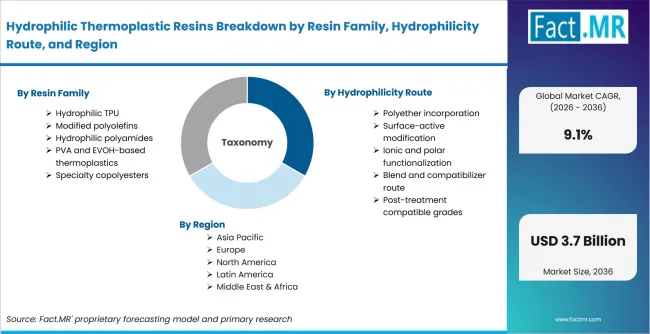
Hydrophilic Thermoplastic Resins Breakdown By Resin Family, Hydrophilicity Route, And Region | Source: Fact.MR
| Attribute | Details |
|---|---|
| Quantitative Units | USD Billion |
| Market Definition | Hydrophilic thermoplastic resins are melt-processable polymers engineered to absorb, move or interact with water while retaining thermoplastic conversion properties. |
| Resin Family | Hydrophilic TPU; Modified polyolefins; Hydrophilic polyamides; PVA and EVOH-based thermoplastics; Specialty copolyesters |
| Hydrophilicity Route | Polyether incorporation; Surface-active modification; Ionic and polar functionalization; Blend and compatibilizer route; Post-treatment compatible grades |
| Application | Medical devices; Membranes and filtration; Hygiene and absorbent products; Textiles; Packaging and other |
| Processing | Extrusion film and sheet; Injection molding; Fiber spinning; Coating and lamination; Compounding |
| Regions Covered | North America; Latin America; Western Europe; Eastern Europe; East Asia; South Asia & Pacific; Middle East & Africa |
| Countries Covered | France; United Kingdom; Japan; Germany; USA |
| Key Companies Profiled | Lubrizol; Covestro; BASF; Kuraray; Mitsubishi Chemical Corporation; Arkema |
| Forecast Period | 2026 to 2036 |
| Approach | Hybrid top-down and bottom-up approach using application demand, resin-family shares, hydrophilicity routes, processing mix, country indicators and provider portfolio review. |
How is the market segmented?
-
By Resin Family
- Hydrophilic TPU
- Modified polyolefins
- Hydrophilic polyamides
- PVA and EVOH-based thermoplastics
- Specialty copolyesters
-
By Hydrophilicity Route
- Polyether incorporation
- Surface-active modification
- Ionic and polar functionalization
- Blend and compatibilizer route
- Post-treatment compatible grades
-
By Application
- Medical devices
- Membranes and filtration
- Hygiene and absorbent products
- Textiles
- Packaging and other
-
By Processing
- Extrusion film and sheet
- Injection molding
- Fiber spinning
- Coating and lamination
- Compounding
-
By Region
- North America
- Latin America
- Western Europe
- Eastern Europe
- East Asia
- South Asia & Pacific
- Middle East & Africa