- Base Value(2025): 393.0 Mn
- Estimated Value(2026): 420.0 Mn
- Forecast Value (2036): 811.0 Mn
- CAGR (2026 - 2036): 6.8%
Hydrophilic Waterstops Market Forecast and Outlook 2026 to 2036
In 2025, the hydrophilic waterstops market was valued at USD 393.0 million. Based on Fact.MR analysis, demand for hydrophilic waterstops is estimated to grow to USD 420.0 million in 2026 and USD 811.0 million by 2036. Fact.MR projects a CAGR of 6.8% during the forecast period. Growth is supported by sustained construction of underground structures and water retaining concrete assets where joint sealing performance is specified at the design stage.
The market expands by approximately USD 418.0 million over the decade, reflecting steady compounding anchored in project specifications. Demand progression follows metro systems, basements, tunnels, and water infrastructure, while pricing reflects material formulation, swelling characteristics, and compliance with joint sealing guidance. Value growth is reinforced by wider use of hydrophilic profiles in place of passive waterstops where long term leakage risk is a primary concern.
As Thomas Hasler, Chief Executive Officer of Sika, stated while discussing 2024 performance drivers, “The organic growth has mainly been driven by concrete, engineered refurbishment, roofing, and waterproofing.” [1] The comment reflects the role of waterproofing systems, including hydrophilic waterstops, within Sika broader growth engine, as assessed by Fact.MR through supplier disclosures and segment reporting.
India records the fastest growth at 7.9% CAGR due to underground transit, basement construction, and water infrastructure projects. Vietnam follows at 7.4% through metro and urban development works, while Indonesia grows at 7.1% tied to tunnel and foundation construction. The Philippines posts 6.8% supported by flood control and drainage projects, and China reaches 6.5% through large scale urban infrastructure. Mature markets including the United States at 3.8% and Germany at 2.9% remain replacement led, constrained by long design lives and stringent approval processes for joint sealing systems.
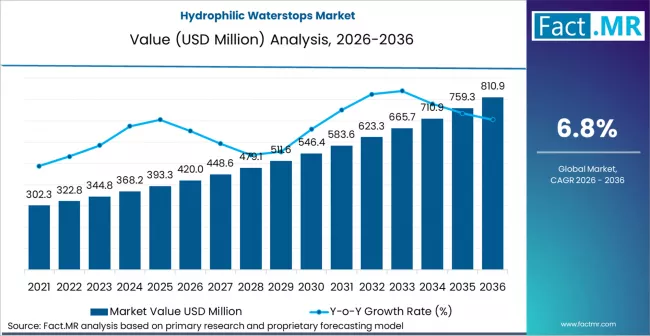
Hydrophilic Waterstops Market Market Value Analysis | Source: Fact.MR
Hydrophilic Waterstops Market Definition
The hydrophilic waterstops market covers water-reactive sealing materials installed in concrete joints to prevent water ingress. These products are made from rubber or polymer compounds that expand when exposed to water, creating pressure against surrounding concrete to block leakage, as defined in construction joint sealing guidance issued by ACI Committee 504 [2]. Hydrophilic waterstops are used in cast-in-place and precast concrete joints in basements, tunnels, water tanks, sewage structures, and underground foundations where permanent waterproofing is required.
Hydrophilic Waterstops Market Inclusions
The report covers global and regional market size estimates in volume and value terms with a forecast period from 2026 to 2036. It includes segmentation by material type such as rubber based and polymer based hydrophilic waterstops [3]. Application coverage includes construction joints and cold joints, while end use sectors include infrastructure, water management, and commercial construction. Regional demand patterns and pricing benchmarks are also covered.
Hydrophilic Waterstops Market Exclusions
The scope excludes PVC waterstops, metal waterstops, and injection hose systems that do not rely on water-reactive expansion as their sealing mechanism. Surface applied waterproofing membranes, crystalline coatings, and liquid sealants are not included. Finished waterproofing systems sold as integrated foundation packages, consumer grade sealing products, laboratory scale materials, and experimental joint sealing solutions without documented use in concrete construction are also excluded.
Hydrophilic Waterstops Market Research Methodology
- Primary Research: Primary research involved interviews with waterstop manufacturers, civil contractors, structural engineers, and infrastructure owners responsible for underground and water retaining structures.
- Desk Research: Desk research used technical guidance from the American Concrete Institute, EN construction standards issued by CEN, public infrastructure tender documents, water authority specifications, and company annual reports and technical product datasheets filed with securities regulators.
- Market Sizing and Forecasting: Market sizing applied a hybrid top down and bottom up model using concrete construction area data from government infrastructure statistics and joint length estimates based on standard design practices.
Data Validation and Update Cycle
Outputs were validated through cross checks against public procurement records, trade statistics for rubber and polymer materials, and regulatory documentation, with updates applied when verified public data sources issue revisions.
Summary of hydrophilic waterstops market
Market definition
The hydrophilic waterstops market covers water-reactive sealing materials installed in concrete joints that expand on contact with moisture to block water ingress in underground and water-retaining structures, as defined under guidance issued by ACI Committee 504
Demand drivers
- Infrastructure owners and contractors specify hydrophilic waterstops for basements, tunnels, and water-retaining structures where watertight joint performance is mandated at the design stage, based on Fact.MR analysis.
- Expansion of metro systems, underground utilities, and flood control projects across Asia Pacific is increasing use of swellable joint sealing materials over passive waterstops, as per Fact.MR.
- Long design lives and limited post-construction access in below-grade structures drive demand for water-reactive sealing solutions that maintain joint integrity over time, according to Fact.MR.
Key segments analyzed
- Material: Bentonite-based hydrophilic waterstops lead with an estimated 40% share in 2026 due to predictable swelling behavior and compatibility with cast-in-place concrete, based on Fact.MR.
- Application: Basements and foundations account for about 35% of demand, reflecting sustained construction of below-grade residential, commercial, and public infrastructure structures, as per Fact.MR.
- Geography: Asia Pacific records the fastest growth led by India, Vietnam, Indonesia, and the Philippines, while North America and Europe remain replacement-driven markets, based on Fact.MR analysis.
Analyst opinion at Fact.MR
- Shambhu Nath Jha, Principal Consultant at Fact.MR, opines, ‘CXOs will find that hydrophilic waterstop demand is tied to underground construction intensity and specification-led waterproofing requirements rather than surface-level building activity.’
Strategic implications and executive takeaways
- Fact.MR is of the opinion that suppliers should align product portfolios with underground and water-retaining infrastructure rather than above-grade construction cycles.
- Fact.MR opines that expanding bentonite-based and hybrid hydrophilic systems can improve participation in projects governed by joint sealing and waterproofing specifications.
- Fact.MR analysts recommend strengthening technical documentation and installer guidance to support specification approval in large civil and infrastructure tenders.
Methodology
- Based on Fact.MR’s report, estimates draw on primary interviews with waterstop manufacturers, civil contractors, structural engineers, and infrastructure owners.
- Fact.MR analysis integrates ACI joint sealing guidance and EN construction standards with public infrastructure tender documentation
- Outputs were validated through cross-checks against procurement records, material trade statistics, and regulatory documentation.
Segmental Analysis
Hydrophilic waterstops market analysis by material
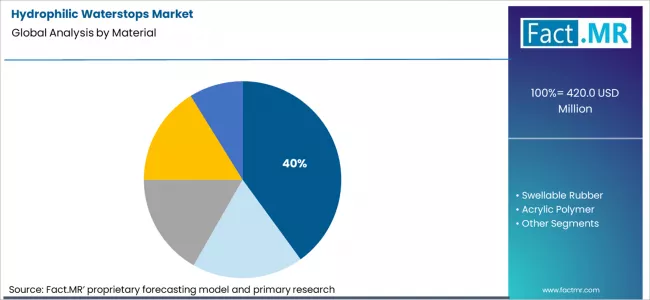
Hydrophilic Waterstops Market Analysis By Material | Source: Fact.MR
Based on FACT.MR's hydrophilic waterstops market report, consumption of bentonite-based hydrophilic waterstops is estimated to hold 40% share in 2026. FACT.MR analysts associate this lead position with bentonite’s predictable swelling behavior when exposed to water, which provides a passive sealing mechanism without external activation. As per FACT.MR, bentonite-based systems address buyer requirements for cost control, ease of installation, and long-term joint sealing performance in below-grade concrete structures.
- Production expansion: Trelleborg manufactures bentonite-based hydrophilic waterstops within its engineered polymer solutions portfolio, supporting large-scale civil and infrastructure projects through regional production facilities.
- Material specification: Sika publishes product data for bentonite-based hydrophilic profiles that expand on water contact and are specified for construction joints in basements and tunnels .
Application pattern: Fact.MRanalysis references public infrastructure and underground construction specifications that continue to list bentonite waterstops due to their tolerance to minor joint movement and compatibility with cast-in-place concrete.
Hydrophilic waterstops market analysis by application
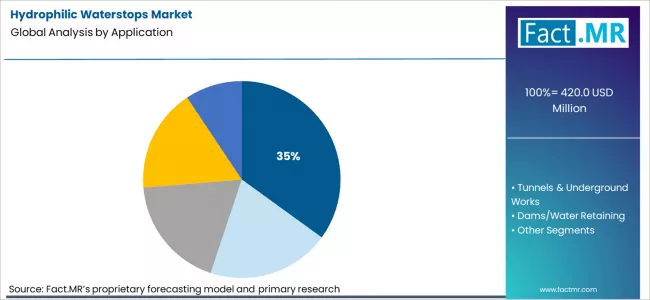
Hydrophilic Waterstops Market Analysis By Application | Source: Fact.MR
Based on FACT.MR's hydrophilic waterstops market report, consumption in basements and foundations is estimated to hold 35% share in 2026. FACT.MR is of the opinion that this segment leads due to sustained construction of below-grade residential, commercial, and public infrastructure structures that require long-term groundwater ingress control. As per FACT.MR, hydrophilic waterstops solve joint leakage issues at raft slabs, retaining walls, and pile connections where external waterproofing access is limited after construction.
- Construction demand: Central Public Works Department specifications for basement and foundation works include hydrophilic waterstops for construction joints in water-retaining and substructure elements.
- Product usage: Master Builders Solutions documents hydrophilic joint sealing systems for foundation slabs and retaining walls within its concrete waterproofing product literature.
- Urban development linkage: FACT.MR analysts reference government housing and urban development programs that increase the volume of basement and podium structures, supporting recurring demand for joint sealing materials in foundation construction
Hydrophilic Waterstops Market Drivers, Restraints, And Opportunities
Fact.MR analysis indicates that the hydrophilic waterstops market exists as a targeted protective solutions segment within concrete construction and waterproofing systems, used to seal joints against water migration in cast-in-place concrete structures. As per FACT.MR, hydrophilic waterstops expand on contact with moisture to close joint gaps and prevent leakage, a function defined in standards such as ASTM D5926 for sealing waterstop performance and test guide procedures [4]. FACT.MR analysts observe that large-scale infrastructure and subterranean projects maintain stable demand for hydrophilic waterstops because joint integrity directly influences structural service life and risk reduction for tunnels, basements, bridges, and reservoirs.
FACT.MR is of the opinion that the market is transitioning from basic PVC and rubber waterstops toward advanced hydrophilic profiles that respond dynamically to moisture conditions and deliver longer service life in aggressive environments. Based on FACT.MR’s report, traditional waterstop types with fixed dimensions are losing ground where project specifications call for hydration-activated expansion properties and measurable sealing performance. These advanced hydrophilic products generally carry higher formulation costs and quality assurance testing, meaning unit prices are higher even where total volume shipments grow moderately, resulting in net value contribution from performance differentiation rather than pure tonnage expansion.
- ASTM performance guidance: FACT.MR analysts note that ASTM D5926 outlines essential test methods and material expectations for waterstop products, prompting project specifications to favour hydrophilic grades that demonstrate measurable swelling and sealing behaviour
- Infrastructure waterproofing demand: Based on FACT.MR’s report, sustained investment in bridges, transit stations, parking structures, and water containment facilities in North America and Europe drives demand for hydrophilic waterstops because joint sealing performance affects long-term asset maintenance decisions.
- Asia Pacific construction dynamics: FACT.MR opines that growing urban infrastructure and underground civil works in China, India, and Southeast Asia increase hydrophilic waterstop adoption as project owners seek materials that align with international joint performance expectations referenced by designers.
Regional Analysis
Based on regional assessment, the hydrophilic waterstops sector is analyzed across North America, Latin America, Europe, East Asia, South Asia, Oceania, and the Middle East & Africa, spanning more than 40+ countries. Regional performance varies according to infrastructure construction intensity, underground development activity, and standards governing water leakage prevention in concrete structures. The report also presents a comparative market attractiveness evaluation grounded in region-specific demand trends.
Hydrophilic Waterstops Market CAGR Analysis by Country (2026-2036)
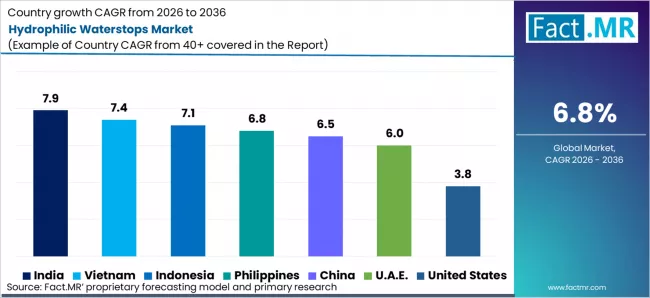
Hydrophilic Waterstops Market Cagr Analysis By Country | Source: Fact.MR
| Country | CAGR |
|---|---|
| India | 7.9% |
| Vietnam | 7.4% |
| Indonesia | 7.1% |
| Philippines | 6.8% |
| China | 6.5% |
| U.A.E. | 6.0% |
| United States | 3.8% |
| Germany | 2.9% |
Source: Fact.MR analysis. Updated Feb 16, 2026
Source: Fact.MR analysis, based on proprietary forecasting models and primary research.
Asia Pacific Hydrophilic Waterstops Market Analysis
Asia Pacific functions as a construction execution-led region for hydrophilic waterstops, with usage tied to underground structures, metro systems, and water-retaining concrete works. Demand follows public infrastructure standards and tender specifications issued by government agencies. Adoption is largely specification-based across transport, utilities, and urban development projects.
- India: Demand for hydrophilic waterstops in India is projected to rise at 7.9% CAGR through 2036. Use is specified under CPWD General Specifications updated in March 2021 and reinforced through underground station and tunnel contracts issued by Delhi Metro Rail Corporation during August 2022, as per Fact.MR.
- Vietnam: Demand for hydrophilic waterstops in Vietnam is projected to rise at 7.4% CAGR through 2036. Application is referenced in underground structure standards issued by the Ministry of Construction in June 2020 and metro construction packages approved for Ho Chi Minh City in September 2022, according to Fact.MR.
- Indonesia: Demand for hydrophilic waterstops in Indonesia is projected to rise at 7.1% CAGR through 2036. Usage is documented in basement and tunnel waterproofing guidelines under National Strategic Projects released in July 2021 and MRT Jakarta civil works tenders issued in February 2023, based on Fact.MR.
- Philippines: Demand for hydrophilic waterstops in the Philippines is projected to rise at 6.8% CAGR through 2036. Use is specified in flood control and underground drainage works tendered by the Department of Public Works and Highways in May 2021 and reinforced through metro rail contracts issued in October 2022, as per Fact.MR.
- China: Demand for hydrophilic waterstops in China is projected to rise at 6.5% CAGR through 2036. Application is governed by waterproofing requirements under GB construction standards revised in October 2020 and reinforced through municipal metro and utility tunnel projects tendered during May 2022, according to Fact.MR.
Fact.MR’s analysis of the hydrophilic waterstops market in Asia Pacific consists of country-wise assessment that includes India, Vietnam, Indonesia, Philippines, and China. Readers can find construction standards, underground project tenders, and application-level specification references.
Middle East Hydrophilic Waterstops Market Analysis
The Middle East operates as a specification-driven market for hydrophilic waterstops, with demand linked to basements, tunnels, and water-retaining structures in urban developments. Usage follows municipal construction codes and infrastructure project requirements rather than discretionary adoption.
- U.A.E.: Demand for hydrophilic waterstops in the U.A.E. is projected to rise at 6.0% CAGR through 2036. Application is specified under Dubai Municipality waterproofing requirements updated in February 2021 and reinforced through underground works contracts issued by Abu Dhabi Department of Municipalities and Transport in November 2022, as per Fact.MR.
Fact.MR’s analysis of the hydrophilic waterstops market in the Middle East consists of country-wise assessment that includes the U.A.E. Readers can find municipal codes, infrastructure tenders, and waterproofing specification references.
North America Hydrophilic Waterstops Market Analysis
North America functions as a standards-led underground construction market for hydrophilic waterstops. Demand is tied to water containment structures and transit infrastructure governed by federal and state specifications.
- United States: Demand for hydrophilic waterstops in the United States is projected to rise at 3.8% CAGR through 2036. Use is referenced in tunnel and water-retaining structure specifications issued by the Federal Highway Administration in March 2022 and reinforced through transit authority contracts under federally funded programs, according to Fact.MR.
Fact.MR’s analysis of the hydrophilic waterstops market in North America consists of country-wise assessment that includes the United States. Readers can find federal standards references and underground infrastructure documentation.
Europe Hydrophilic Waterstops Market Analysis
Europe operates as a regulated underground construction market where hydrophilic waterstops are specified under harmonized concrete and waterproofing standards. Demand follows public infrastructure maintenance and expansion cycles.
- Germany: Demand for hydrophilic waterstops in Germany is projected to rise at 2.9% CAGR through 2036. Application is specified in waterproofing standards under DIN norms revised in June 2020 and reinforced through rail and underground infrastructure projects tendered by Deutsche Bahn in February 2022, as per Fact.MR.
Fact.MR’s analysis of the hydrophilic waterstops market in Europe consists of country-wise assessment that includes Germany. Readers can find standards adoption, underground construction activity, and application-level references.
Competitive aligners for Market Players
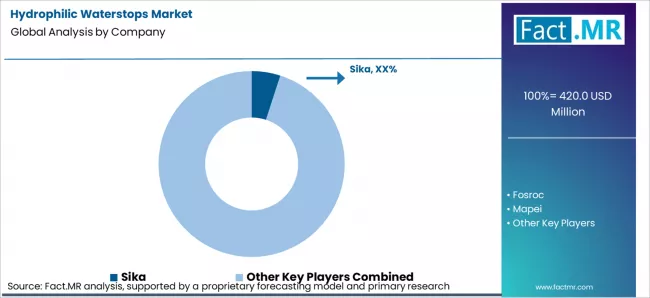
Hydrophilic Waterstops Market Analysis By Company | Source: Fact.MR
The hydrophilic waterstops segment is moderately concentrated, with competition centered on suppliers that provide swellable sealing solutions for concrete construction joints. Hydrophilic waterstops expand in contact with moisture to seal against water ingress in structures such as retaining walls, basements, tunnels, and reservoirs. Their performance in critical sealing applications determines specification inclusion with major contractors and infrastructure projects. Common product categories include strip applied profiles and swellable sealants designed for watertight concrete systems.
Structural advantages lie with firms that combine technical product breadth with global distribution and on-site support. Suppliers offering multiple hydrophilic formulations and integration with other joint sealing systems secure wider usage across project types. Companies such as Sika and Fosroc feature hydrophilic and swellable waterstop products on their official portfolios, allowing specification across concrete waterproofing applications. Mapei also lists a high performance hydrophilic waterproofing profile for concrete joints on its official product pages.
Buyer leverage is reinforced by tendering practices that include dual sourcing and approved vendor lists. Large contractors and infrastructure owners typically require certified performance and installation support documentation before awarding contracts, which limits dependency on single suppliers and focuses negotiation on long term reliability and project delivery timelines.
Recent developments
- Saint-Gobain Finalizes Fosroc Acquisition (October 2025): Saint-Gobain officially completed its acquisition of Fosroc, a global leader in construction chemicals, establishing a massive footprint in India and the Middle East. This strategic move creates a construction chemicals powerhouse with combined pro forma sales of €6.5 billion across 76 countries, specifically bolstering their high-performance waterproofing and technical mortar segments. [5]
- Sika AG Expands Global Manufacturing (February 2026): In February 2026, Sika AG inaugurated five new production facilities simultaneously in the United States, Argentina, Colombia, Bangladesh, and Tanzania. The flagship plant in Florida is a state-of-the-art automated site designed to produce advanced concrete admixtures and waterproofing solutions, featuring specialized systems expected to reduce carbon emissions by 8,000 tons by 2032.[6]
Key Players in Hydrophilic Waterstops Market
- Sika
- Fosroc
- Mapei
- Master Builders Solutions
- Kryton International
- CETCO (Minerals Technologies)
- ADEKA Corporation
- Tremco CPG
- Drizoro
- Greenstreak
Bibliography
- [1] Sika AG. (2025). Annual report 2024. Sika AG.
- [2] American Concrete Institute. (2010). ACI 504R-10: Guide to sealing joints in concrete structures. ACI.
- [3] European Committee for Standardization. (2018). EN 12390 series: Testing hardened concrete. CEN.
- [4] ASTM International. (2019). ASTM D5926-19: Standard guide for selection and installation of waterstops. ASTM International.
- [5] Saint-Gobain. (2025). Saint-Gobain completes acquisition of Fosroc, a leading player in construction chemicals in Asia and emerging markets. Saint-Gobain.
- [6] Sika AG. (2026). Sika reports preliminary 2025 sales. Sika AG.
Segmentation
Scope of the Report
| Metric | Value |
|---|---|
| Quantitative Units | USD 420.0 million (2026) to USD 811.0 million (2036), at a CAGR of 6.8% |
| Market Definition | The hydrophilic waterstops market covers water-reactive sealing materials installed in concrete joints that expand upon contact with moisture to prevent water ingress in basements, tunnels, water-retaining structures, and underground foundations, as defined under ACI Committee 504 joint sealing guidance. These materials ensure watertight performance for critical below-grade infrastructure where long-term joint integrity is essential. |
| Material Segmentation | Bentonite-Based, Swellable Rubber, Acrylic Polymer, Hybrid (Bentonite + Rubber), Other |
| Application Segmentation | Basements & Foundations, Tunnels & Underground Works, Dams/Water Retaining Structures, Precast Joint Sealing, Wastewater Structures |
| Product Form Segmentation | Swellable Strips, Profiles & Gaskets, Coatings/Pastes, Other |
| Regions Covered | Asia Pacific, Europe, North America, Latin America, Middle East & Africa |
| Countries Covered | India, Vietnam, Indonesia, Philippines, China, U.A.E., United States, Germany, Japan, South Korea, Australia & New Zealand, ASEAN, Rest of Asia Pacific, Italy, France, United Kingdom, Spain, Benelux, Nordics, Central & Eastern Europe, Rest of Europe, Canada, Mexico, Brazil, Argentina, Chile, Rest of Latin America, South Africa, Turkey, Rest of Middle East & Africa |
| Key Companies Profiled | Sika, Fosroc, Mapei, Master Builders Solutions, Kryton International, CETCO (Minerals Technologies), ADEKA Corporation, Tremco CPG, Drizoro, Greenstreak |
| Forecast Period | 2026 to 2036 |
| Approach | Hybrid top-down and bottom-up market modeling validated through primary interviews with waterstop manufacturers, civil contractors, structural engineers, and infrastructure owners, supported by ACI 504 and EN construction standards, public infrastructure tender data, and material trade statistics. |
Source: Fact.MR analysis. Updated Feb 16, 2026
Hydrophilic Waterstops Market Analysis by Segments
-
Material :
- Bentonite-Based
- Swellable Rubber
- Acrylic Polymer
- Hybrid (Bentonite + Rubber)
- Other
-
Application :
- Basements & Foundations
- Tunnels & Underground Works
- Dams/Water Retaining
- Precast Joint Sealing
- Wastewater Structures
-
Product Form :
- Swellable Strips
- Profiles & Gaskets
- Coatings/Pastes
- Other
-
Region :
- Asia Pacific
- India
- China
- Japan
- South Korea
- Indonesia
- Australia & New Zealand
- ASEAN
- Rest of Asia Pacific
- Europe
- Germany
- Italy
- France
- United Kingdom
- Spain
- Benelux
- Nordics
- Central & Eastern Europe
- Rest of Europe
- North America
- United States
- Canada
- Mexico
- Latin America
- Brazil
- Argentina
- Chile
- Rest of Latin America
- Middle East & Africa
- Kingdom of Saudi Arabia
- United Arab Emirates
- South Africa
- Turkey
- Rest of Middle East & Africa
- Asia Pacific
Frequently Asked Questions
How large is the hydrophilic waterstops market in 2026?
What will the hydrophilic waterstops market size be by 2036?
What is the expected CAGR of the hydrophilic waterstops market during the forecast period?
What was the market value of hydrophilic waterstops in 2025?
How much absolute value growth will this market add over the decade?
Which material segment is expected to lead the market in 2026?
How significant are basements and foundations as an application segment?
Which country is expected to record the fastest growth in hydrophilic waterstops?
What is the growth outlook for Vietnam in this market?
How fast is the hydrophilic waterstops market expected to grow in Indonesia?
What is the projected CAGR for the Philippines market?
How strong is the growth outlook for China?
What is the expected growth rate for the U.A.E.?
How does the U.S. hydrophilic waterstops market perform in growth terms?
What is the projected growth rate for Germany?
Which region functions as the primary growth engine for this market?
How does growth in emerging markets compare with mature markets?
What is the value trajectory of the market over the forecast period?
Is market growth driven by surface construction or below-grade structures?
How should executives assess the long-term opportunity size in hydrophilic waterstops?
Who worked on this report


Preview the report firsthand - request a free sample
Free SampleGet the brochure for pricing and purchase details
Download PDF