- Market Value (2025): USD 752.1 Mn
- Estimated Value (2026): USD 880.0 Mn
- Forecast Value (2036): USD 4230.0 Mn
- CAGR (2026-2036): 17.0%
What is the Hygienic Cobot Palletizers Market forecast to be worth by 2036?
USD 880.0 million in 2026 to USD 4,230.0 million by 2036 at a 17.0% CAGR.
- The hygienic cobot palletizers market reached USD 752.1 million in 2025.
- Demand is projected to increase from USD 880.0 million in 2026 to USD 4,230.0 million by 2036.
- The market is forecast to record 17.0% CAGR from 2026 to 2036 as food processors, beverage fillers and pharma packers automate clean secondary-packaging flows.
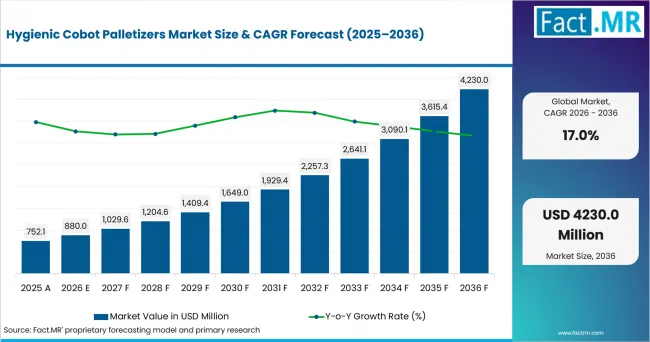
Hygienic Cobot Palletizers Market Value Analysis | Source: Fact.MR
What are the defining numbers behind Hygienic Cobot Palletizers Market growth?
USD 3,350.0 million absolute opportunity is expected between 2026 and 2036.
- Demand Drivers in the Market
- Food processors need cleanable palletizing cells that reduce manual lifting near packed products. The International Federation of Robotics reported in September 2025 that 542,076 industrial robots were installed worldwide in 2024, indicating the substantial scale of industrial automation investment across manufacturing industries.
- Beverage plants need compact automation that handles repetitive layer building without a fenced robot footprint. Palletizing robot systems are relevant where operators still adjust recipes and pallet patterns during the shift.
- Pharma packers need repeatable case movement with documentation that supports line clearance and batch discipline. Hygienic cobot cells are expected to gain preference where secondary packaging rooms handle sealed cartons under audit routines.
- Cold-chain operators need palletizing equipment that works near wrapped products and reduces worker exposure to low-temperature handling. Cobot cells fit sites where space is tight and pallet loads change with customer mix.
- Consumer-goods plants need faster changeover because mixed-case formats and shorter runs reduce the value of fixed palletizing equipment. Packaging robot cells support the same shift toward programmable end-of-line handling.
- Key Segments Analyzed
- By Offering: Robot arm is expected to hold 37.0% share in 2026 because it is the main motion platform inside a hygienic cobot palletizing cell.
- By Payload: Below 10 kg is projected to account for 46.0% share in 2026 due to the lighter cartons and trays common in food and beverage packaging rooms.
- By Function: Case handling is anticipated to capture 41.0% share in 2026 since packed cases are the main items moved from conveyors to pallet patterns.
- By End User: Food processing is estimated to represent 37.0% share in 2026 owing to hygiene control, repetitive carton movement and labor pressure at secondary-packaging lines.
- Analyst Opinion at Fact.MR
- Shambhu Nath Jha, Principal Consultant at Fact.MR, states, “The commercial test is only partly about payload. Plant teams compare cleanability, changeover time, safety documentation and gripper behavior after sanitation. Vendors are expected to win repeat orders when compact cells come with validated tooling and operator-friendly pallet software.”
- Strategic Implications
- Robot vendors should document hygienic use cases by payload, reach and surface-cleaning exposure so plant engineers approve cells faster.
- Tooling suppliers should pair vacuum cups, mechanical grippers and washdown hardware with case-weight guidance because hygienic lines vary widely by package format.
- System integrators should provide pattern-change templates and sanitation checklists so operators adjust pallets without delaying line clearance.
- Food and pharma plant teams should compare total cell footprint, gripper replacement time and safety documentation before selecting material handling robots.
Germany is projected to record 21.1% CAGR through 2036, supported by robotics density and food-line modernization. The UK is expected to post 20.1% CAGR as packaged-food flows and worker-safety reviews push plants toward compact cells. South Korea is anticipated to advance at 19.4% CAGR, driven by food output and smart-factory funding. Japan is forecast to reach 15.0% CAGR as food manufacturers pursue labor-saving production technology. The USA is estimated to hold 14.2% CAGR as food manufacturing scale and packaging automation sustain demand.
How does the Hygienic Cobot Palletizers Market break down by segment?
Robot arm leads Offering at 37.0%; Below 10 kg leads Payload at 46.0%.
Which Offering dominates?
Robot arm is expected to hold 37.0% share in 2026.
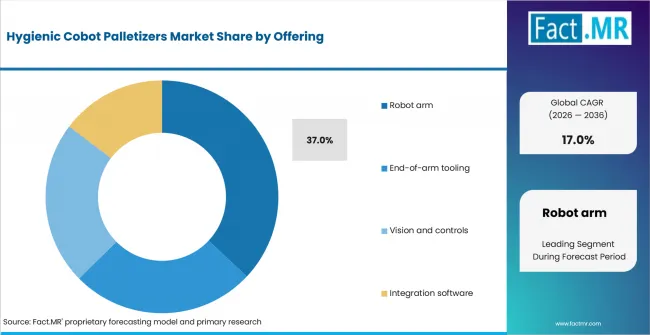
Hygienic Cobot Palletizers Market Analysis By Offering | Source: Fact.MR
Robot arms lead because they determine reach, payload behavior and collaborative safety limits inside the cell. The arm also shapes how easily a palletizing system fits around conveyors, pallet positions and operator walkways.
Food and beverage plants usually assess the arm together with tooling and controls. A clean arm design, intuitive teaching and repeatable motion give integrators a practical base for hygienic palletizing cell systems.
What leads the Payload segment?
Below 10 kg is projected to account for 46.0% share in 2026.
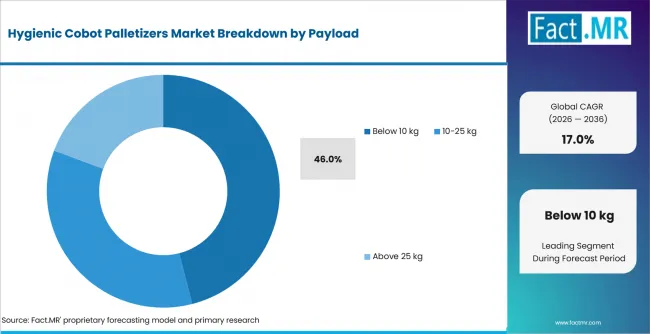
Hygienic Cobot Palletizers Market Analysis By Payload | Source: Fact.MR
Below 10 kg payload leads because many hygienic packaging rooms move cartons, trays and wrapped cases that fall within lighter handling ranges. Lower-payload arms also fit compact cells where floor space and operator access are limited.
The segment gains further support from food lines with frequent case-format changes. Lighter payloads make end-of-arm tool changes easier and reduce the mechanical stress placed on cobot joints during repeated stacking cycles.
How does Function shape demand?
Case handling is anticipated to capture 41.0% share in 2026.
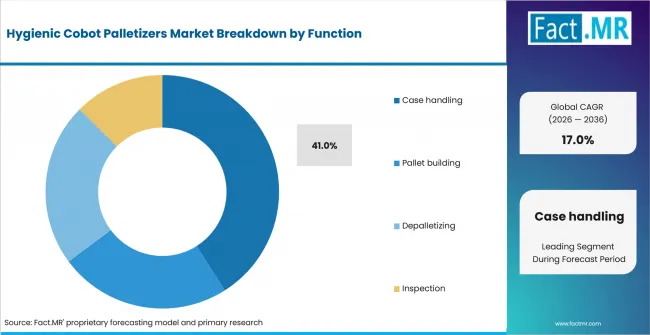
Hygienic Cobot Palletizers Market Analysis By Function | Source: Fact.MR
Case handling leads because secondary packaging usually ends with cartons leaving a conveyor before pallet formation. Hygienic cobot palletizers are positioned near this handoff, where workers currently lift the same case type through long shifts.
Vision and controls support mixed cases when labels, carton sizes or seal positions vary. This makes automatic palletizer equipment more relevant for plants that want compact systems without losing pattern reliability.
What supports Food processing within End User?
Food processing is estimated to represent 37.0% share in 2026.
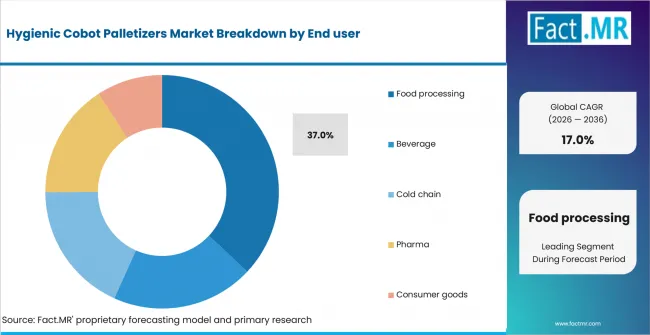
Hygienic Cobot Palletizers Market Analysis By End User | Source: Fact.MR
Food processing leads because packed products often move through clean rooms, chilled rooms or audited secondary-packaging areas. Cobot palletizers are suited to these sites when the cell is cleanable and documented with the rest of the line.
USDA ERS reported in June 2026 that total U.S. food spending reached USD 2.51 trillion in 2025. That spending base supports investment in packaging rooms where repeatable palletizing affects dispatch reliability and labor planning.
What is accelerating Hygienic Cobot Palletizers Market adoption, and what is holding it back?
Demand rises through labor replacement and hygienic line fit; adoption is constrained by validation and payload limits.
Drivers Impact Analysis
| DRIVER | (~) % IMPACT ON CAGR | GEOGRAPHIC RELEVANCE | IMPACT TIMELINE |
|---|---|---|---|
| Hygienic end-of-line labor replacement | +1.8% | North America, Europe, East Asia | Short term (<= 2 years) |
| Food and pharma sanitation documentation | +1.3% | Europe, Japan, South Korea | Medium term (2-4 years) |
| Compact cells for SME packaging rooms | +1.0% | Global | Medium term (2-4 years) |
| Vision-guided case handling and mixed pallet patterns | +0.8% | North America, Europe | Long term (>= 4 years) |
- Hygienic end-of-line labor replacement: Manual palletizing remains one of the most repetitive tasks in packaging rooms. Cobot cells are expected to reduce lifting exposure while keeping operators close enough to handle changeovers and checks.
- Sanitation documentation: Food and pharma plants need material records, cleaning routines and safety files before a palletizing cell enters service. Strong documentation is expected to shorten engineering review and reduce installation friction.
- Compact SME packaging rooms: Smaller plants often lack space for fenced robots. Portable collaborative robots fit sites where the same cell must move between lines or handle seasonal output changes.
- Vision-guided handling: Cameras and pallet-pattern software are expected to expand the number of case sizes handled by each cell. The feature is useful where retailers require frequent carton and label changes.
Opportunity Impact Analysis
| OPPORTUNITY | (~) % IMPACT ON CAGR | GEOGRAPHIC RELEVANCE | IMPACT TIMELINE |
|---|---|---|---|
| Washdown-ready end-of-arm tooling | +1.1% | Europe, North America | Medium term (2-4 years) |
| Cold-chain and regulated goods palletizing | +0.7% | Japan, South Korea, USA | Long term (>= 4 years) |
| Integration software for SKU changeover | +0.5% | Global | Short term (<= 2 years) |
- Washdown-ready end-of-arm tooling: Tooling suppliers are expected to win more integration work by proving that grippers survive cleaning cycles and still hold wet or film-wrapped cartons safely.
- Cold-chain and regulated goods palletizing: Chilled rooms and controlled areas reward systems that reduce manual handling while keeping pallet formation close to the packing line.
- Integration software for SKU changeover: Pattern libraries and operator screens are expected to reduce reliance on engineering staff when packaging teams switch case sizes or pallet counts.
Restraints Impact Analysis
| RESTRAINT | (~) % IMPACT ON CAGR | GEOGRAPHIC RELEVANCE | IMPACT TIMELINE |
|---|---|---|---|
| Validation and sanitation documentation burden | -0.8% | Food, pharma and beverage sites | Short term (<= 2 years) |
| Payload and speed limits of cobots | -0.6% | Global | Medium term (2-4 years) |
| Washdown tooling and integration cost | -0.4% | SME packaging sites | Medium term (2-4 years) |
- Validation burden: Hygienic sites need records for materials, cleaning and safe operation. Incomplete documentation is expected to delay projects even when the robot is technically suitable.
- Payload and speed limits: Heavy cases or tall pallet patterns are expected to favor industrial robots in some sites. Cobot suppliers must show where collaborative operation meets the required cycle time.
- Tooling and integration cost: Washdown-ready grippers, guards and conveyors add cost to the base robot. Modular palletizers are expected to reduce this barrier when they standardize layouts.
Which countries are scaling the Hygienic Cobot Palletizers Market through 2036?
- The country comparison spans 6.9 percentage points between Germany and the USA across the forecast period.
- Germany remains 1.0 percentage point above the UK through robotics density and food-line modernization.
- The UK remains 0.7 percentage point above South Korea as packaged-food flows and worker-safety reviews support compact cell adoption.
- South Korea remains 4.4 percentage points above Japan because smart-factory programs and food output create a clear automation route.
- Japan remains 0.8 percentage point above the USA as food manufacturers pursue labor-saving production technology.
- The USA closes the range through food manufacturing scale and established packaging-line automation.
Comparable CAGRs create different entry conditions due to robotics density, hygiene review, packaging-room space and integrator availability. Full report coverage includes North America, Latin America, Western Europe, Eastern Europe, East Asia, South Asia & Pacific, Middle East & Africa.
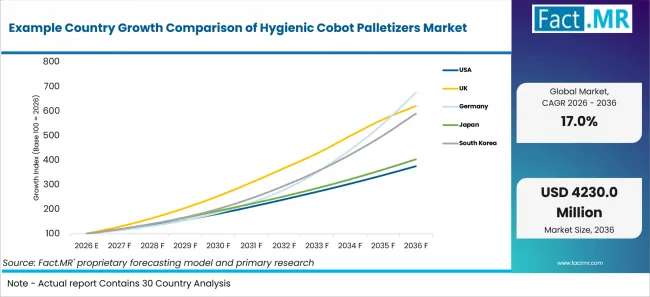
Example Country Growth Comparison Of Hygienic Cobot Palletizers Market | Source: Fact.MR
| Country | CAGR (2026-2036) |
|---|---|
| Germany | 21.1% |
| United Kingdom | 20.1% |
| South Korea | 19.4% |
| Japan | 15.0% |
| USA | 14.2% |
What supports Germany adoption?
21.1% CAGR, supported by robotics density and food-line modernization.
Germany records 21.1% CAGR because automation is already familiar to plant engineers. Germany Trade & Invest reported in September 2025 that Germany had 449 industrial robots per 10,000 persons employed in manufacturing. Destatis reported in June 2025 that German food-industry production increased 5.7% month over month in April 2025 on a seasonally and calendar-adjusted basis. Hygienic cobot palletizers fit plants that want clean case handling with less floor space than a fenced robot cell.
How is the United Kingdom scaling demand?
20.1% CAGR, backed by food-chain scale and worker-safety review.
The UK market is tied to packaged-food flows and secondary-packaging upgrades. Defra reported in July 2026 that, in real terms at constant 2023 prices, UK consumer expenditure on food and alcoholic drinks reached GBP 303.3 billion in 2025. HSE’s 2025 statistics recorded 59,219 employee work-related non-fatal injuries reported by employers under RIDDOR in 2024/25 across Great Britain. Cobot palletizers fit plants that want safer manual-lift replacement while keeping operators close to changeover and sanitation routines.
How does South Korea develop demand?
19.4% CAGR, led by food output and smart-factory support.
South Korea develops demand through food production scale and policy-backed factory upgrades. MFDS reported in May 2026 that Korea’s food-industry production reached about KRW 119 trillion in 2025, up 4.3% from the previous year. MSS announced in February 2025 a Region-Specific Smart Factory Construction project with KRW 6 billion in central-government support, supplemented by KRW 10.45 billion from local governments for total investment of KRW 16.45 billion. Hygienic cobot palletizers fit K-food exporters that need cleaner case handling and flexible pallet patterns for overseas packaging formats.
What supports Japan’s growth?
15.0% CAGR, shaped by food-sector labor saving and production technology.
Japan’s adoption is shaped by labor-saving needs in food manufacturing. MAFF’s FY2024 White Paper, published in May 2025, reported that Japan’s food-industry domestic production value reached JPY 105.8 trillion in 2023, up 8.7% from the previous year. In June 2025, MAFF established the Food Enterprise Productivity Improvement Forum to support measures including automation-equipment introduction, mechanization, DX, and production-technology workforce development. Cobot palletizers fit compact plants where operators need simpler programming and clean secondary-packaging handling.
How does the USA perform?
14.2% CAGR, supported by food manufacturing scale and packing-line automation.
The USA has a broad food manufacturing base and established packaging automation channels. BLS recorded a preliminary 43,328 private food-manufacturing establishments in the fourth quarter of 2025. USDA ERS reported in June 2026 that inflation-adjusted total U.S. food spending reached USD 2.51 trillion in 2025. Hygienic cobot palletizers fit facilities that need flexible case handling for varied product mixes while keeping programming and pattern changes accessible to operators.
Who leads the Hygienic Cobot Palletizers Market?
Universal Robots A/S provides collaborative robots for palletizing applications, including food and beverage end-of-line operations. Its May 2025 UR15 launch introduced a 15 kg cobot with payload capacity increasing to 17.5 kg in wrist-down orientations such as palletizing, combined with a compact footprint suitable for space-constrained automation cells.
FANUC CORPORATION participates through its CRX collaborative range and food-grade cobots. In April 2026, FANUC CORPORATION America introduced the CRX-3iA and announced an enhanced wrist-down palletizing option allowing the CRX-30iA to handle payloads of up to 40 kg.
Yaskawa Electric Corporation announced the MOTOMAN-HC35 in July 2026 with a 35 kg payload and 2,030 mm reach, while stating that sales had begun on May 11, 2026. ABB LTD., KUKA AG and Stäubli International AG also maintain collaborative, food-grade or hygienic robotic portfolios for food handling, packaging and palletizing applications. Stäubli International AG’s IFFA 2025 material specifically covered hygienic robotic automation extending through packaging and palletizing.
Competition is centered on hygienic integration beyond the robot arm. Providers that document cleanability, payload behavior, operator programming and gripper service routines have a stronger route into food, beverage and pharma packaging rooms.
Which companies are the key providers?
Key companies include Universal Robots A/S; FANUC CORPORATION; ABB LTD.; Yaskawa Electric Corporation; KUKA AG; and Stäubli International AG.
- Universal Robots A/S
- FANUC CORPORATION
- ABB LTD.
- Yaskawa Electric Corporation
- KUKA AG
- Stäubli International AG
Bibliography
- ABB Robotics. (2026, April 22). ABB Robotics launches high-speed PoWa™ cobot family.
- Department for Environment, Food & Rural Affairs. (2026, July 29). Chapter 14: The food chain. In Agriculture in the United Kingdom 2025. GOV.UK.
- Federal Statistical Office. (2025, June 6). Production in April 2025: -1.4% on the previous month.
- FANUC America Corporation. (2026, April 20). FANUC America debuts ultra lightweight CRX-3iA collaborative robot and new capabilities across the CRX lineup.
- Germany Trade & Invest. (2025, September 29). Germany is Europe’s leading robotics nation.
- Health and Safety Executive. (2025, November 20). Health and safety at work: Summary statistics for Great Britain 2025.
- International Federation of Robotics. (2025, September 25). World Robotics 2025 report – INDUSTRIAL ROBOTS – released by IFR.
- Ministry of SMEs and Startups. (2025, February 26). MSS supports smart factory construction in collaboration with local governments.
- Universal Robots. (2025, May 12). Universal Robots introduces its fastest ever cobot to enable unprecedented performance in collaborative automation.
- Yaskawa Electric Corporation. (2026, July 21). Launch of collaborative robot MOTOMAN-HC35 with 35 kg payload capacity and 2030 mm reach—Enhanced payload capacity, usability, and safety to better address customers’ needs.
- Stäubli. (2025, March 11). Making hygienic food production highly efficient.
This Report Answers
- The report explains where hygienic cobot palletizers are used across offering, payload, function and end user.
- Segment analysis identifies the leading subsegments and the operational reasons plant teams prioritize them.
- Country analysis examines Germany, the UK, South Korea, Japan and the USA with local evidence for adoption.
- Competitive analysis reviews current providers across cobot arms, palletizing cells and hygienic automation support.
- Application analysis assesses how payload, cleanability and changeover routines influence purchase decisions.
What does the Hygienic Cobot Palletizers Market cover?
The Hygienic Cobot Palletizers Market covers collaborative robot palletizing systems used in hygienic production and packaging rooms. It includes compact cells for case handling, pallet building, depalletizing and inspection after primary or secondary packaging.
The assessment also covers supporting automation such as AI palletizing robots, portable collaborative robots and modular palletizers when they serve clean end-of-line environments.
What is included in the scope?
The scope includes robot arms, end-of-arm tools, vision and controls, integration software and service packages used in clean palletizing. It also includes automatic palletizer equipment where collaborative operation and hygienic line fit are central to the purchase.
Adjacent coverage includes palletizing cell systems, palletizing robot systems and packaging robot cells when the same buyer need centers on flexible end-of-line handling.
What is excluded from the scope?
The scope excludes traditional high-speed palletizers sold outside collaborative operation. It also excludes case packing machines when they perform upstream packing without pallet formation.
General packaging automation solution coverage is outside the scope when the system lacks cobot palletizing hardware or pallet pattern control. Standard industrial robot cells are outside the scope when they lack a hygienic-use configuration.
How Was the Analysis Built?
The analysis draws on 120+ sources, 35+ company portfolios, 25+ countries, and more than 20 industry interviews.
- Primary Research: Primary research includes discussions with manufacturers, service providers, technology developers, distributors, end users, procurement teams, and subject-matter experts. These conversations examine purchasing priorities, product adoption, operational challenges, approval requirements, competitive positioning, and the factors that influence wider market acceptance.
- Desk Research: Desk research covers government statistics, regulatory publications, company filings, trade data, technical studies, industry associations, standards, public policy, and other authoritative sources. Every source used in the analysis is documented in the bibliography.
- Market Sizing and Forecasting: Market estimates combine historical performance, demand indicators, pricing and volume trends, segment shares, company participation, country-level growth, adoption patterns, investment activity, and barriers to market expansion.
- Data Validation and Update Cycle: Findings are validated by comparing primary interviews with public data, company activity, regulatory changes, trade patterns, and industry developments. Regular updates review new product launches, capacity changes, partnerships, approvals, procurement trends, and shifts in commercial adoption.
What is the report’s scope and coverage?
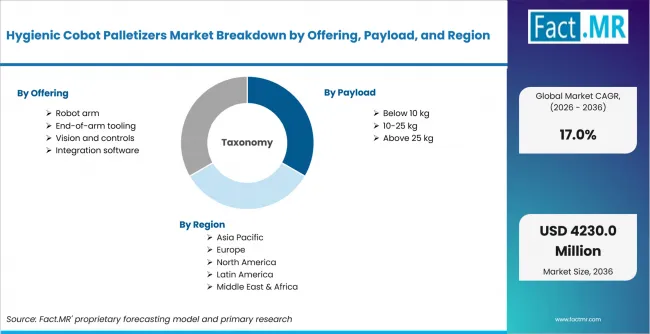
Hygienic Cobot Palletizers Market Breakdown By Offering, Payload, And Region | Source: Fact.MR
| Attribute | Details |
|---|---|
| Quantitative Units | USD million |
| Market Definition | Collaborative robot-based palletizing systems designed for hygienic production and packaging environments, including robot arms, end-of-arm tooling, vision and controls, and integration software used after primary packaging. |
| Offering | Robot arm; End-of-arm tooling; Vision and controls; Integration software |
| Payload | Below 10 kg; 10-25 kg; Above 25 kg |
| Function | Case handling; Pallet building; Depalletizing; Inspection |
| End User | Food processing; Beverage; Cold chain; Pharma; Consumer goods |
| Regions Covered | North America; Latin America; Western Europe; Eastern Europe; East Asia; South Asia & Pacific; Middle East & Africa |
| Countries Covered | USA; UK; Germany; Japan; South Korea |
| Key Companies Profiled | Universal Robots A/S; FANUC CORPORATION; ABB LTD.; Yaskawa Electric Corporation; KUKA AG; Stäubli International AG |
| Forecast Period | 2026 to 2036 |
| Approach | Hybrid top-down and bottom-up approach using packaging automation demand, food and beverage production indicators, segment shares, country growth, provider portfolios and integrator evidence. |
How is the market segmented?
-
By Offering:
- Robot arm
- End-of-arm tooling
- Vision and controls
- Integration software
-
By Payload:
- Below 10 kg
- 10-25 kg
- Above 25 kg
-
By Function:
- Case handling
- Pallet building
- Depalletizing
- Inspection
-
By End User:
- Food processing
- Beverage
- Cold chain
- Pharma
- Consumer goods
-
By Region:
- North America
- Latin America
- Western Europe
- Eastern Europe
- East Asia
- South Asia & Pacific
- Middle East & Africa