Packaging Robots Market Size, Share, Growth and Forecast (2026 - 2036)

The Packaging Robots Market is segmented by Gripper Type (Claw, Clamp, Vacuum, and Others), Packaging Type (Primary Packaging, Secondary Packaging, and Tertiary Packaging), Application (Food & Beverages, Pharmaceuticals, Consumer Products, Logistics, and Others), Robot Type (Articulated Robots, Delta Robots, SCARA Robots, and Collaborative Robots), Function (Pick & Place, Packing, Palletizing, Filling, and Labeling) and Region. Forecast for 2026 to 2036.

Packaging Robots Market Forecast and Outlook By Fact.MR

  • In 2025, the packaging robots market was valued at USD 4.7 billion.
  • Based on Fact.MR analysis, demand for packaging robots is estimated to grow to USD 5.0 billion in 2026 and USD 10.9 billion by 2036.
  • FACT.MR projects a CAGR of 8.0% during the forecast period.
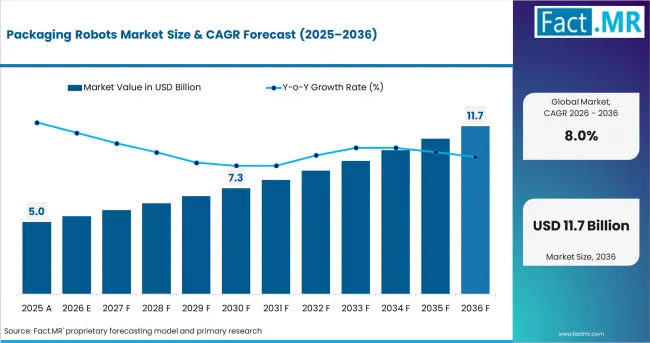
Packaging Robots Market Market Value Analysis

Metric Value
Estimated Value in 2026 USD 5.0 billion
Forecast Value in 2036 USD 10.9 billion
Forecast CAGR (2026 to 2036) 8.0%

Summary of Packaging Robots Market

  • Market Definition
    • The market covers robotic systems automating pick-and-place, palletising, packing, filling, and labelling operations across food and beverage, pharmaceutical, logistics, and consumer goods manufacturing globally.
  • Demand Drivers
    • Labour cost inflation and post-pandemic workforce shortages in the UK, US, and Europe are forcing FMCG and logistics operators to accelerate packaging robot capital deployment to maintain throughput targets.
    • E-commerce order fulfilment velocity requirements are driving logistics operators to invest in high-speed pick-and-place and palletising systems capable of handling diverse SKU formats without manual reconfiguration.
    • Food safety hygiene standards and pharmaceutical GMP requirements are mandating automation in packaging environments where human contact introduces contamination risk, expanding addressable procurement volumes.
  • Key Segments Analyzed
    • By Gripper Type: Clamp & Claw grippers lead at approximately 50% in 2026. Versatility across varied product shapes and high-speed line compatibility sustain their structural advantage.
    • By Packaging Type: Secondary Packaging leads at approximately 45% in 2026. Bulk handling and sorting automation delivers maximum efficiency gains in FMCG and e-commerce operations.
    • By Application: Food & Beverages leads at approximately 40% in 2026. High production volumes, hygiene requirements, and speed and precision demands anchor its dominance.
    • By Robot Type: Articulated Robots lead at approximately 55% in 2026. Multi-axis flexibility and suitability for complex palletising and pick-and-place tasks sustain their market leadership.
    • By Function: Pick & Place leads at approximately 35% in 2026. It is the most widely deployed packaging automation function across high-speed production environments globally.
    • By Geography: China leads at 8.9% CAGR through 2036. Government robotics subsidies and e-commerce fulfilment expansion are the primary growth forces.
  • Analyst Opinion at FACT.MR
    • Shambhu Nath Jha, Principal Analyst at Fact.MR, opines, ‘CXO’s are likely to observe a clear split emerging in the market between low-margin, fixed automation solutions and more advanced, flexible robotic systems that command higher value. Demand is increasingly shifting toward adaptable technologies that can handle diverse packaging needs with greater efficiency.’
  • Strategic Implications
    • Invest in collaborative robot portfolios targeting food and beverage packaging lines in the UK and US, where labour shortages are creating urgent automation capital expenditure cycles at mid-scale manufacturers.
    • Develop AI-integrated vision and gripper systems for variable SKU e-commerce fulfilment centres in China and South Korea, where rapid format changeover capability determines system contract awards.
    • Build pharmaceutical GMP-validated packaging robot configurations to capture regulatory-driven automation demand in sterile and cleanroom packaging environments across European and North American markets.
  • Methodology
    • Market sizing based on robot unit shipments, average system integration values, and end-user capital expenditure benchmarks by application and function. Validated with 2024 to 2025 IFR and manufacturer data.
    • Supported by FANUC, ABB, and Yaskawa investor disclosures, IFR World Robotics reports, and national automation policy announcements from 2024 and 2025.
    • Forecasts incorporate e-commerce fulfilment volume growth, labour cost inflation trends, food safety regulatory requirements, and primary interviews with automation procurement decision-makers.

The market is expected to generate USD 5.9 billion in incremental revenue between 2026 and 2036. Growth is consistent and demand-led. Labour cost inflation, e-commerce fulfilment velocity requirements, and food safety hygiene standards are the primary structural forces. High upfront capital expenditure for system integration constrains adoption among smaller manufacturers.

Adoption is accelerating across food processing and logistics. Collaborative robots are gaining traction in facilities where human-robot coexistence is operationally necessary. FANUC Corporation reported strong packaging robot order intake across Asian and North American food processing accounts in 2024, reflecting sustained capital investment in automation.

China leads at 8.9% CAGR through 2036, underpinned by government robotics subsidies and rapid e-commerce fulfilment infrastructure expansion. South Korea follows at 8.1%, driven by electronics and food industry flexible automation investment. Japan records 7.4%, supported by advanced robotics adoption and workforce ageing. The United Kingdom records 7.8%, driven by post-Brexit labour shortages and smart manufacturing investment. The United States grows at 6.0%, anchored by food processing and logistics automation. Mature Western European markets generate replacement and upgrade demand, constrained by high integration costs and long procurement cycles.

Segmental Analysis

Packaging Robots Market Analysis by Gripper Type
Packaging Robots Market Analysis By Gripper Type

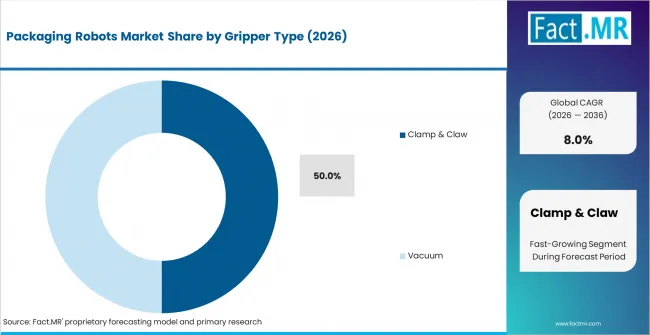
Based on FACT.MR's packaging robots market report, Clamp & Claw grippers are estimated to hold approximately 50% share in 2026. Their versatility in handling varied product weights and geometries across food, consumer goods, and logistics lines makes them the default gripper choice for high-speed packaging automation system integrators.

  • ABB Group Investment: ABB expanded its FlexGripper clamp-based palletising robot product line in 2024, targeting food and beverage and FMCG packaging line deployments in Europe and North America. The updated system supports variable-geometry carton and bag handling without mechanical reconfiguration. [1]
  • Vacuum Gripper Development: Schmalz GmbH launched its next-generation vacuum gripper series for high-speed packaging in early 2025, incorporating multi-zone suction control and integrated leak detection. The system targets pharmaceutical blister pack and consumer goods pouch handling automation. [2]
  • Gripper Adoption Trend: IFR World Robotics 2024 report confirmed a 12% increase in gripper-equipped packaging robot installations globally. Growth is concentrated in food and logistics sectors adopting flexible gripper systems to handle increasing SKU variety without manual changeover. [3]

Packaging Robots Market Analysis by Packaging Type
Packaging Robots Market Analysis By Packaging Type

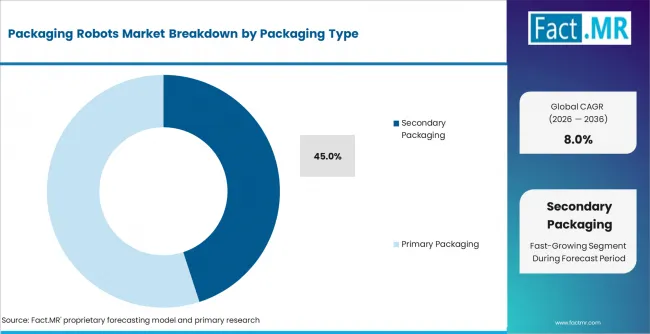
Based on FACT.MR's packaging robots market report, Secondary Packaging holds approximately 45% share in 2026. Bulk handling, carton erecting, case packing, and sortation automation in FMCG and e-commerce logistics delivers the highest throughput efficiency gains, making secondary packaging the dominant automation investment priority.

  • Krones AG System Expansion: Krones AG expanded its robotic secondary packaging line portfolio in 2024, introducing modular case packing and shrink wrapping robot cells targeting beverage and food manufacturers in Europe and Asia. Systems are designed for rapid SKU changeover in mixed-product production environments. [4]
  • Tertiary Packaging Technology: FANUC Corporation launched updated M-410 series palletising robots in 2025 targeting tertiary packaging at logistics distribution centres. The updated arm reach and payload specifications support high-stack mixed-pallet formation for e-commerce and grocery fulfilment operations. [5]
  • E-Commerce Secondary Demand: Amazon disclosed in its 2024 operations update that secondary packaging robot deployments at European fulfilment centres increased 18%, driven by volume growth and labour cost reduction targets. Robotic case sealing and sortation now cover a majority of its UK and German facilities. [6]

Packaging Robots Market Analysis by Application
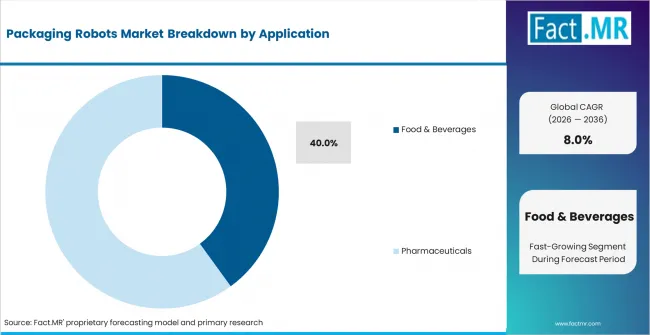
Packaging Robots Market Analysis By Application

Based on FACT.MR's packaging robots market report, Food & Beverages holds approximately 40% share in 2026. High production volumes, strict hygiene requirements, and throughput speed mandates make food and beverage the deepest and most consistent source of packaging robot procurement across all geographies.

  • Bosch Packaging Technology Investment: Bosch Packaging Technology expanded its food-grade robotic packaging cell portfolio in 2024, introducing IP-rated stainless steel robot configurations for dairy and ready-meal packaging lines in Europe. Products are validated for washdown environments under EU food hygiene regulations. [7]
  • Pharmaceutical Application Development: Mitsubishi Electric Corporation launched GMP-compliant SCARA robot systems for pharmaceutical blister pack and vial packaging in early 2025. Systems are validated for ISO 5 cleanroom deployment and integrate with serialisation and track-and-trace platforms. [8]
  • Logistics Application Growth: DHL Supply Chain disclosed in its 2024 sustainability and operations report that robotic packaging automation deployments at European logistics facilities grew 21%, driven by e-commerce order volume growth and labour availability constraints. [9]

Packaging Robots Market Analysis by Robot Type
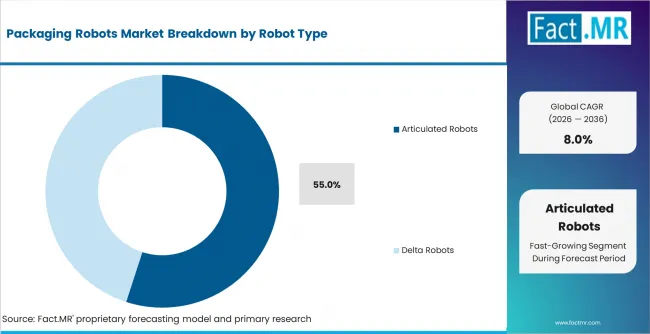
Packaging Robots Market Analysis By Robot Type

Based on FACT.MR's packaging robots market report, Articulated Robots hold approximately 55% share in 2026. Multi-axis movement, high payload capacity, and suitability for palletising, case packing, and complex pick-and-place tasks give articulated robots structural leadership across most packaging automation applications.

  • FANUC Articulated Robot Expansion: FANUC Corporation disclosed strong order growth for its M-710 and M-900 articulated robot series in packaging applications during 2024, with food and logistics customers in Japan, the US, and China leading procurement. The company expanded its packaging-specific robot cell configuration service in 2024. [5]
  • Collaborative Robot Development: Universal Robots A/S launched the UR20 and UR30 cobot platforms in 2024, targeting secondary packaging and palletising co-worker applications at mid-scale food manufacturers. Systems are designed for rapid deployment without safety fencing in shared human-robot workspaces. [10]
  • Delta Robot Adoption Trend: Delta robot installations in primary packaging applications grew 15% in 2024, driven by confectionery, snack food, and pharmaceutical pick-and-place operations requiring sub-second cycle times. Adoption is strongest in Japan, Germany, and the United States.

Packaging Robots Market Analysis by Function
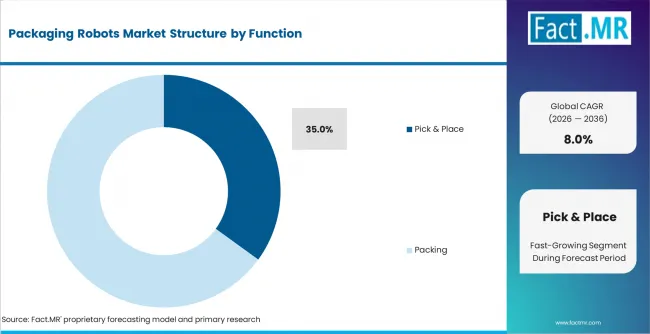
Packaging Robots Market Analysis By Function

Based on FACT.MR's packaging robots market report, Pick & Place holds approximately 35% share in 2026. It is the most universally deployed packaging automation function, covering primary and secondary packaging lines across food, pharmaceutical, consumer goods, and logistics applications at the highest installation frequency globally.

  • Yaskawa Motoman Pick & Place: Yaskawa Motoman expanded its MPP3H delta robot pick-and-place product line in 2024, targeting confectionery and pharmaceutical primary packaging lines in Japan and Europe. Cycle times of 200 picks per minute position the system for high-speed retail packaging requirements. [11]
  • Palletising Function Growth: ABB Group reported a 16% increase in palletising robot orders in 2024 across food and consumer goods customers in North America and Europe. Growth reflects warehouse automation investment driven by e-commerce volume and reduced manual pallet stacking labour availability. [1]
  • Filling Function Technology: Schneider Electric SA launched AI-enabled filling robot control systems in early 2025, incorporating machine vision for container positioning and fill level verification. Targets dairy, beverage, and pharmaceutical liquid packaging lines seeking to eliminate overfill waste and regulatory non-conformances. [12]

Drivers, Restraints, and Opportunities
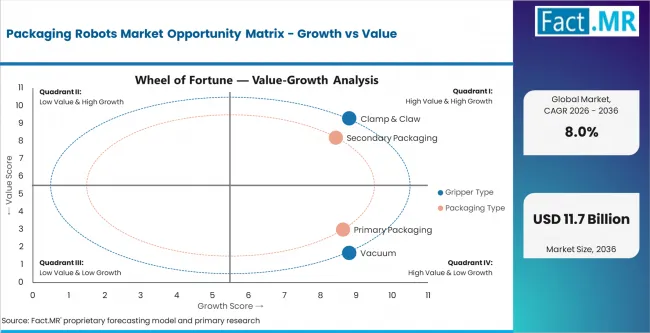
Packaging Robots Market Opportunity Matrix Growth Vs Value

FACT.MR analysts observe the packaging robots market as a structural automation transition segment. Growth is grounded in labour economics and throughput demands, not discretionary capital investment cycles. E-commerce fulfilment, food safety mandates, and pharmaceutical GMP requirements are the three load-bearing demand pillars.

Fixed-format dedicated packaging machinery is losing share to flexible robotic systems in mixed-SKU production environments. Per-unit robot system costs are declining as collaborative and delta robot platforms mature.

  • Labour Shortage Structural Driver: The UK's Office for National Statistics reported a 14% decline in available manufacturing packaging workers in 2024, driven by post-Brexit migration changes. This is forcing FMCG and food manufacturers to accelerate robot capital deployment. IFR data confirmed a corresponding 19% increase in UK packaging robot unit orders in 2024.
  • China Government Robotics Policy: China's Ministry of Industry and Information Technology issued its 2024 Robot Industry Development Action Plan, targeting 200 robots per 10,000 manufacturing workers by 2025. Subsidies for domestic robot procurement are accelerating packaging automation adoption at food, consumer goods, and e-commerce logistics operators.
  • Pharmaceutical GMP Automation Mandate: The European Medicines Agency's GMP Annex 1 revision, implemented in August 2023 and enforced through 2024 audits, mandates contamination risk reduction in sterile packaging operations. Pharmaceutical manufacturers are deploying ISO-classified robot systems in blister pack and vial packaging to achieve regulatory compliance.

Regional Analysis

The packaging robots market is assessed across Asia Pacific, North America, Europe, Latin America, and Middle East and Africa. Coverage spans 40+ countries across distinct manufacturing automation maturity, regulatory, and e-commerce infrastructure frameworks. The full report offers market attractiveness analysis by region and country.

Top Country Growth Comparison Packaging Robots Market Cagr (2026 2036)

Country CAGR (2026 to 2036)
China 8.9%
United Kingdom 7.8%
United States 6.0%
Japan 7.4%
South Korea 8.1%

Source: Fact.MR (FACT.MR) analysis, based on proprietary forecasting model and primary research
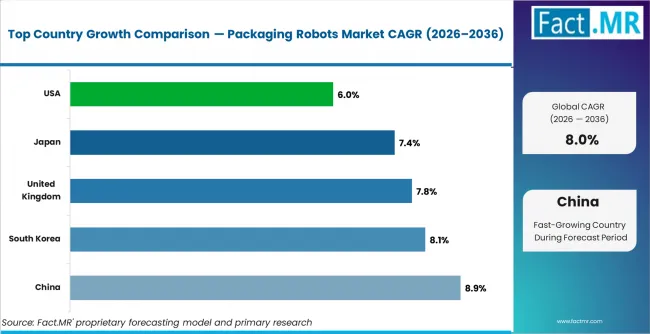
Packaging Robots Market Cagr Analysis By Country

Asia Pacific Packaging Robots Market Analysis

Asia Pacific stands out as the most dynamic region, combining high deployment volumes with strong policy-backed automation growth across manufacturing and logistics sectors.

  • China: China’s packaging robotics market is scaling rapidly, supported by aggressive industrial automation policies and expanding e-commerce infrastructure, with growth estimated at around 8.9% CAGR through 2036. The Ministry of Industry and Information Technology’s 2024 Robot Industry Development Action Plan allocated CNY 20 billion to accelerate domestic robot adoption, particularly in food processing and logistics. JD Logistics reported a 27% increase in packaging robot deployments in 2024, driven by peak e-commerce demand such as Singles Day and supported by subsidy-linked automation investments.
  • Japan: Japan’s market continues to advance through precision-driven automation and strong alignment with labour productivity initiatives, expanding at an estimated 7.4% CAGR through 2036. The Ministry of Economy, Trade and Industry’s 2024 Manufacturing White Paper identified packaging automation as a priority area to address workforce ageing challenges.
  • South Korea: South Korea is strengthening its automation footprint through focused smart factory investments and SME-driven robotics adoption, progressing at roughly 8.1% CAGR through 2036. The Ministry of Trade, Industry and Energy allocated KRW 15 billion in 2024 toward robotics deployment across food and electronics packaging lines. Samsung Electro-Mechanics reported expanded robotic packaging cell integration at its Busan facilities, incorporating collaborative robots into flexible secondary packaging operations.

FACT.MR's analysis of the packaging robots market in Asia Pacific consists of country-wise assessment that includes China, Japan, South Korea, India, ASEAN, and Australia and New Zealand. Readers can find government robotics subsidy programme data, IFR robot density benchmarks, and e-commerce fulfilment automation investment trends.

North America Packaging Robots Market Analysis
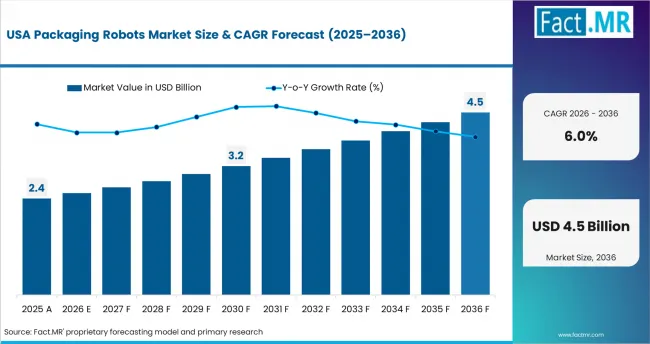
Packaging Robots Market Country Value Analysis

North America is the largest absolute revenue market for packaging robots. The United States anchors demand through food processing scale, logistics automation investment, and a mature system integrator ecosystem. FANUC Corporation, ABB Group, and Universal Robots A/S hold strong positions through established integrator networks and pharma-validated product portfolios.

  • United States: Demand for packaging robots in the United States is projected to rise at 6.0% CAGR through 2036. The Automation Federation's 2024 US Manufacturing Automation Report identified packaging as the highest capital expenditure automation category, with food processing and logistics together accounting for 58% of packaging robot installations. Amazon Web Services disclosed in its 2024 operations report continued expansion of robotic packaging systems at US fulfilment centres, with over 750,000 robots deployed across its network, including pick-and-place and palletising units at primary packaging lines.

FACT.MR covers the United States, Canada, and Mexico. Includes food processing automation investment data, logistics robot deployment rates, and pharmaceutical GMP packaging compliance benchmarks.

Europe Packaging Robots Market Analysis
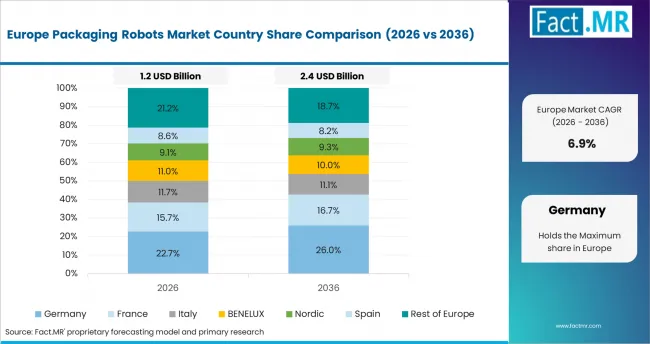
Packaging Robots Market Europe Country Market Share Analysis, 2026 & 2036

Europe is a compliance-led and labour-constrained packaging automation market. UK post-Brexit labour dynamics and EU GMP Annex 1 enforcement are structural drivers. Bosch Packaging Technology, Krones AG, and ABB Group anchor the competitive landscape through validated system portfolios and established FMCG integrator relationships.

  • United Kingdom: The United Kingdom’s packaging robotics landscape is evolving in response to persistent labour constraints and rising automation investments, with growth estimated at around 7.8% CAGR through 2036. The UK Food and Drink Federation reported in 2024 that 68% of member manufacturers identified labour shortages as the primary factor driving packaging automation, with robot system procurement increasing 22% year-on-year. Ocado Group highlighted continued expansion of robotic secondary packaging and sortation systems across its Andover and Erith fulfilment centres, integrating AI-enabled pick-and-place cobots to support high-volume grocery order assembly.

FACT.MR covers Germany, France, the UK, Italy, Spain, and Rest of Europe. Includes post-Brexit labour impact data, EU GMP Annex 1 compliance timelines, and FMCG robot procurement benchmarks.

Competitive Aligners for Market Players
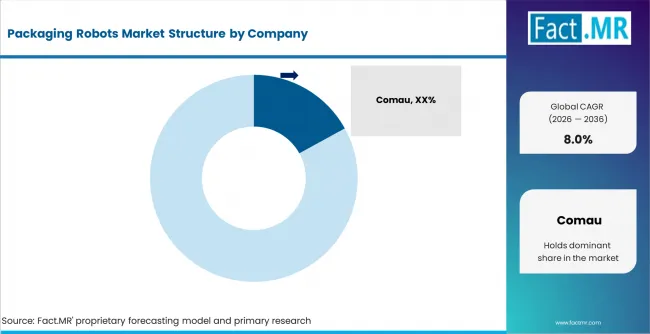
Packaging Robots Market Analysis By Company

Companies in the packaging robots market are operating in an environment where speed, flexibility, and reliability are becoming essential rather than optional. One of the most noticeable shifts is the move away from rigid, single-purpose automation toward systems that can handle multiple product types and changing production requirements. Businesses that invest in flexible robotic platforms are better equipped to respond to fluctuations in demand, especially in sectors like food, e-commerce, and consumer goods.

Another important factor is the integration of intelligent technologies. Robotics combined with AI, machine vision, and real-time data analytics is helping improve accuracy and reduce operational errors. Players that build these capabilities into their systems are not only improving performance but also creating stronger long-term value for customers.

Cost efficiency remains a key concern, particularly as companies try to balance capital investment with operational savings. Vendors that can demonstrate clear returns through reduced labor dependency and faster throughput are more likely to secure contracts. At the same time, ease of integration is becoming a decisive factor, as manufacturers prefer solutions that fit seamlessly into existing production lines without major disruptions. Service and support are also gaining importance. Customers increasingly look for partners who can provide ongoing maintenance, upgrades, and technical assistance. In this market, success is less about selling a machine and more about delivering a reliable, adaptable system that continues to perform over time.

Key Players

  • Comau
  • DENSO Robotics
  • FANUC Corporation
  • Krones AG
  • ABB Group
  • Bosch Packaging Technology
  • Bosch Rexroth AG
  • Brenton, LLC.
  • Mitsubishi Electric Corporation
  • Remtec Automation, LLC.
  • Schneider Electric SA
  • Universal Robots A/S

Bibliography

  • ABB Group. (March 2025 and FY2024). Investor Update and Product Launch: FlexGripper Palletising System Expansion and IRB 5710/5720 Robot Launch for Food and Consumer Goods Packaging Applications in North America and Europe. abb.com/investor-relations
  • Schmalz GmbH. (Early 2025). Product Launch: Next-Generation Vacuum Gripper Series for High-Speed Pharmaceutical and Consumer Goods Packaging Automation with Multi-Zone Suction Control. schmalz.com/news
  • International Federation of Robotics. (2024). World Robotics Report 2024: Packaging Robot Installation Data, Gripper Type Adoption Trends, and Global Manufacturing Automation Benchmarks. ifr.org/reports
  • Krones AG. (FY2024). Annual Report: Robotic Secondary Packaging Line Portfolio Expansion for Beverage and Food Manufacturers in Europe and Asia. krones.com/investor-relations
  • FANUC Corporation. (FY2024 and January 2025). Financial Results and Product Launch: M-410 Palletising Robot Update and AI-Integrated Packaging Cell Launch for Food and Pharmaceutical Applications. fanuc.co.jp/en/news
  • Amazon. (FY2024). Operations Update: Robotic Secondary Packaging and Sortation Deployment Expansion at European Fulfilment Centres Including UK and Germany Sites. aboutamazon.com/news/operations
  • Bosch Packaging Technology. (FY2024). Product Portfolio Update: Food-Grade IP-Rated Robotic Packaging Cell Expansion for Dairy and Ready-Meal Lines in Europe. boschpackaging.com/news
  • Mitsubishi Electric Corporation. (Early 2025). Product Launch: GMP-Compliant SCARA Robot Systems for Pharmaceutical Blister Pack and Vial Packaging in ISO 5 Cleanroom Environments. mitsubishielectric.com/fa/news
  • DHL Supply Chain. (FY2024). Sustainability and Operations Report: Robotic Packaging Automation Deployment Growth at European Logistics Facilities Driven by E-Commerce Volume and Labour Constraints. dhl.com/sustainability
  • Universal Robots A/S. (November 2024). Product Launch: UR30 Cobot Platform for Heavy-Payload Secondary Packaging and Palletising Co-Worker Applications at Food Manufacturers. universal-robots.com/news
  • Yaskawa Motoman. (FY2024). Product Update: MPP3H Delta Robot Pick-and-Place System Expansion for Confectionery and Pharmaceutical Primary Packaging Lines in Japan and Europe. yaskawa.eu.com/news
  • Schneider Electric SA. (Early 2025). Product Launch: AI-Enabled Filling Robot Control System for Dairy, Beverage, and Pharmaceutical Liquid Packaging Lines. se.com/news

This Report Addresses

  • Strategic intelligence on packaging robot demand across gripper type, packaging type, application, robot type, and function segments in food, pharmaceutical, logistics, and consumer goods sectors globally.
  • Market forecast from USD 5.0 billion in 2026 to USD 10.9 billion by 2036 at a CAGR of 8.0%, with USD 5.9 billion in absolute dollar opportunity.
  • Growth opportunity mapping across China government robotics subsidies, UK labour shortage automation demand, Japan workforce ageing investment, South Korea smart factory programmes, and US logistics fulfilment expansion.
  • Segment analysis by gripper type, packaging type, application, robot type, and function with leading sub-segment identification and share benchmarks.
  • Regional outlook covering Asia Pacific government-driven automation, North America logistics and food processing demand, and Europe GMP compliance and labour-constrained packaging investment.
  • Competitive landscape of FANUC Corporation, ABB Group, Universal Robots, Yaskawa Motoman, Bosch Packaging Technology, Krones AG, and Mitsubishi Electric covering robot type portfolios, application validation depth, and integrator network reach.
  • Regulatory impact analysis covering EU GMP Annex 1 sterile packaging mandates, China MIIT robotics development plan, UK food safety automation requirements, and IFR robot density benchmarks.
  • Report delivered in PDF, Excel, and presentation formats supported by IFR shipment data, manufacturer revenue disclosures, and system integrator procurement benchmarks.

Packaging Robots Market Definition

The packaging robots market covers robotic systems used to automate primary, secondary, and tertiary packaging operations including pick-and-place, palletising, filling, and labelling. These systems serve food and beverage manufacturers, pharmaceutical producers, logistics operators, and consumer goods companies seeking to reduce labour dependency and improve throughput.

Packaging Robots Market Market Inclusions

Covers global and regional forecasts from 2026 to 2036. Includes articulated, delta, SCARA, and collaborative robot types. Segments by gripper type, packaging type, application, robot type, and function. Covers FMCG, pharmaceutical, logistics, and consumer goods procurement channels.

Packaging Robots Market Exclusions

Excludes standalone conveyor systems and packaging machinery not incorporating robotic arms or programmable motion control. Omits industrial robots deployed exclusively in non-packaging manufacturing stages. Also excludes end-of-line packing supplies and consumables. Scope remains on packaging robot systems and their immediate integration hardware.

Packaging Robots Market Research Methodology

  • Primary Research
  • Interviews with automation system integrators, procurement managers at FMCG and pharmaceutical companies, and operations directors at logistics and fulfilment centre operators across key markets.
  • Desk Research
  • Uses FANUC Corporation, ABB Group, and Yaskawa America public filings. Includes IFR World Robotics data, national manufacturing automation policy documents, and industry procurement disclosures from 2024 to 2025.
  • Market-Sizing and Forecasting
  • Hybrid top-down and bottom-up model based on robot unit shipment volumes, average system integration values by application, and end-user capital expenditure benchmarks segmented by function and robot type.
  • Data Validation and Update Cycle
  • Validated against IFR robot shipment statistics, manufacturer revenue disclosures, and system integrator project announcements. Cross-checked with primary interviews and updated regularly.

Scope of the Report

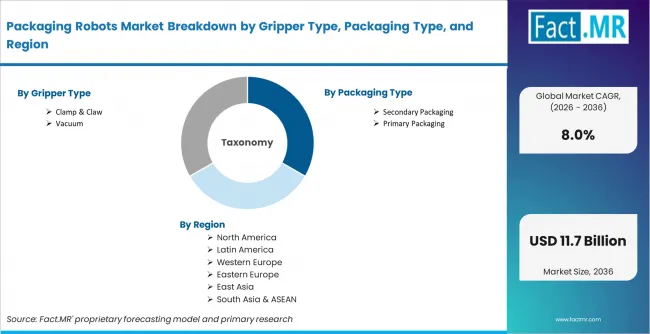
Packaging Robots Market Breakdown By Gripper Type, Packaging Type, And Region

Attribute Details
Quantitative Units USD 5.0 billion (2026) to USD 10.9 billion (2036), at a CAGR of 8.0%
Market Definition Robotic systems automating pick-and-place, palletising, packing, filling, and labelling operations across food and beverage, pharmaceutical, logistics, and consumer goods packaging globally.
Gripper Type Segmentation Claw, Clamp, Vacuum, Others
Packaging Type Segmentation Primary Packaging, Secondary Packaging, Tertiary Packaging
Application Segmentation Food & Beverages, Pharmaceuticals, Consumer Products, Logistics, Others
Robot Type Segmentation Articulated Robots, Delta Robots, SCARA Robots, Collaborative Robots
Function Segmentation Pick & Place, Packing, Palletizing, Filling, Labeling
Application Coverage Food and beverage packaging line automation, pharmaceutical GMP packaging, e-commerce fulfilment pick-and-place, logistics palletising, and consumer goods secondary packaging.
Regions Covered North America, Europe, Asia Pacific, Latin America, Middle East and Africa
Countries Covered USA, Canada, Mexico, Germany, UK, France, Italy, Spain, Nordic, BENELUX, China, Japan, South Korea, India, ASEAN, Australia and New Zealand, Brazil, Argentina, Chile, Saudi Arabia, GCC, Turkey, South Africa, Rest of MEA
Key Companies Profiled Comau, DENSO Robotics, FANUC Corporation, Krones AG, ABB Group, Bosch Packaging Technology, Mitsubishi Electric Corporation, Universal Robots A/S, Yaskawa America Inc., Yaskawa Motoman, Schneider Electric SA
Forecast Period 2026 to 2036
Approach Hybrid top-down and bottom-up model using robot unit shipment volumes, average system integration values by application, end-user capital expenditure benchmarks, IFR robotics data, and primary interviews with automation procurement managers.

Packaging Robots Market by Segments

  • By Gripper Type:

    • Claw
    • Clamp
    • Vacuum
    • Others
  • By Packaging Type:

    • Primary Packaging
    • Secondary Packaging
    • Tertiary Packaging
  • By Application:

    • Food & Beverages
    • Pharmaceuticals
    • Consumer Products
    • Logistics
    • Others
  • By Robot Type:

    • Articulated Robots
    • Delta Robots
    • SCARA Robots
    • Collaborative Robots (Cobots)
  • By Function:

    • Pick & Place
    • Packing
    • Palletizing
    • Filling
    • Labeling
  • By Region:

    • North America
      • United States
      • Canada
      • Mexico
    • Latin America
      • Brazil
      • Mexico
      • Argentina
      • Chile
      • Rest of Latin America
    • Western Europe
      • Germany
      • United Kingdom
      • France
      • Italy
      • Spain
      • Nordic Countries
      • BENELUX
      • Rest of Western Europe
    • Eastern Europe
      • Russia
      • Poland
      • Hungary
      • Balkan and Baltic
      • Rest of Eastern Europe
    • East Asia
      • China
      • Japan
      • South Korea
    • South Asia and Pacific
      • India
      • ASEAN
      • Australia and New Zealand
      • Rest of South Asia and Pacific
    • Middle East and Africa
      • Kingdom of Saudi Arabia
      • Other GCC Countries
      • Turkey
      • South Africa
      • Rest of Middle East and Africa

- Frequently Asked Questions -

How large is the packaging robots market in 2025?

The packaging robots market was valued at USD 4.7 billion in 2025.

What will the market size be in 2026?

Based on Fact.MR analysis, demand is estimated to grow to USD 5.0 billion in 2026.

What is the projected market size by 2036?

The market is projected to reach USD 10.9 billion by 2036, generating USD 5.9 billion in absolute dollar opportunity over the forecast period.

What is the expected CAGR from 2026 to 2036?

FACT.MR projects a CAGR of 8.0% for the global packaging robots market during the 2026 to 2036 forecast period.

Which gripper type segment is poised to lead?

Clamp & Claw grippers lead with approximately 50% share in 2026, driven by their versatility across product geometries and dominance in high-speed food, logistics, and consumer goods packaging lines.

Which application segment holds the largest share?

Food & Beverages holds approximately 40% share in 2026, anchored by high production volumes, hygiene mandates, and throughput speed requirements across global food processing operations.

Which robot type leads the market?

Articulated Robots lead with approximately 55% share in 2026, supported by multi-axis flexibility, high payload capacity, and suitability for palletising and complex pick-and-place packaging operations.

Which country shows the fastest growth?

China leads with approximately 8.9% CAGR through 2036, driven by government robotics subsidies under the MIIT 2024 Robot Industry Development Action Plan and rapid e-commerce fulfilment infrastructure expansion.

Table of Content

  1. Executive Summary
    • Global Market Outlook
    • Demand to side Trends
    • Supply to side Trends
    • Technology Roadmap Analysis
    • Analysis and Recommendations
  2. Market Overview
    • Market Coverage / Taxonomy
    • Market Definition / Scope / Limitations
  3. Research Methodology
    • Chapter Orientation
    • Analytical Lens and Working Hypotheses
      • Market Structure, Signals, and Trend Drivers
      • Benchmarking and Cross-market Comparability
      • Market Sizing, Forecasting, and Opportunity Mapping
    • Research Design and Evidence Framework
      • Desk Research Programme (Secondary Evidence)
        • Company Annual and Sustainability Reports
        • Peer-reviewed Journals and Academic Literature
        • Corporate Websites, Product Literature, and Technical Notes
        • Earnings Decks and Investor Briefings
        • Statutory Filings and Regulatory Disclosures
        • Technical White Papers and Standards Notes
        • Trade Journals, Industry Magazines, and Analyst Briefs
        • Conference Proceedings, Webinars, and Seminar Materials
        • Government Statistics Portals and Public Data Releases
        • Press Releases and Reputable Media Coverage
        • Specialist Newsletters and Curated Briefings
        • Sector Databases and Reference Repositories
        • Fact.MR Internal Proprietary Databases and Historical Market Datasets
        • Subscription Datasets and Paid Sources
        • Social Channels, Communities, and Digital Listening Inputs
        • Additional Desk Sources
      • Expert Input and Fieldwork (Primary Evidence)
        • Primary Modes
          • Qualitative Interviews and Expert Elicitation
          • Quantitative Surveys and Structured Data Capture
          • Blended Approach
        • Why Primary Evidence is Used
        • Field Techniques
          • Interviews
          • Surveys
          • Focus Groups
          • Observational and In-context Research
          • Social and Community Interactions
        • Stakeholder Universe Engaged
          • C-suite Leaders
          • Board Members
          • Presidents and Vice Presidents
          • R&D and Innovation Heads
          • Technical Specialists
          • Domain Subject-matter Experts
          • Scientists
          • Physicians and Other Healthcare Professionals
        • Governance, Ethics, and Data Stewardship
          • Research Ethics
          • Data Integrity and Handling
      • Tooling, Models, and Reference Databases
    • Data Engineering and Model Build
      • Data Acquisition and Ingestion
      • Cleaning, Normalisation, and Verification
      • Synthesis, Triangulation, and Analysis
    • Quality Assurance and Audit Trail
  4. Market Background
    • Market Dynamics
      • Drivers
      • Restraints
      • Opportunity
      • Trends
    • Scenario Forecast
      • Demand in Optimistic Scenario
      • Demand in Likely Scenario
      • Demand in Conservative Scenario
    • Opportunity Map Analysis
    • Product Life Cycle Analysis
    • Supply Chain Analysis
    • Investment Feasibility Matrix
    • Value Chain Analysis
    • PESTLE and Porter’s Analysis
    • Regulatory Landscape
    • Regional Parent Market Outlook
    • Production and Consumption Statistics
    • Import and Export Statistics
  5. Global Market Analysis 2021 to 2025 and Forecast, 2026 to 2036
    • Historical Market Size Value (USD Million) Analysis, 2021 to 2025
    • Current and Future Market Size Value (USD Million) Projections, 2026 to 2036
      • Y to o to Y Growth Trend Analysis
      • Absolute $ Opportunity Analysis
  6. Global Market Pricing Analysis 2021 to 2025 and Forecast 2026 to 2036
  7. Global Market Analysis 2021 to 2025 and Forecast 2026 to 2036, By Product
    • Introduction / Key Findings
    • Historical Market Size Value (USD Million) Analysis By Product , 2021 to 2025
    • Current and Future Market Size Value (USD Million) Analysis and Forecast By Product , 2026 to 2036
      • Chicken
      • Vegetable
      • Seafood
      • Spicy/Hot
      • Other Flavors
    • Y to o to Y Growth Trend Analysis By Product , 2021 to 2025
    • Absolute $ Opportunity Analysis By Product , 2026 to 2036
  8. Global Market Analysis 2021 to 2025 and Forecast 2026 to 2036, By Raw Material
    • Introduction / Key Findings
    • Historical Market Size Value (USD Million) Analysis By Raw Material, 2021 to 2025
    • Current and Future Market Size Value (USD Million) Analysis and Forecast By Raw Material, 2026 to 2036
      • Wheat
      • Rice
      • Oats
      • Millet/Multigrain
      • Other Raw Materials
    • Y to o to Y Growth Trend Analysis By Raw Material, 2021 to 2025
    • Absolute $ Opportunity Analysis By Raw Material, 2026 to 2036
  9. Global Market Analysis 2021 to 2025 and Forecast 2026 to 2036, By Packaging
    • Introduction / Key Findings
    • Historical Market Size Value (USD Million) Analysis By Packaging, 2021 to 2025
    • Current and Future Market Size Value (USD Million) Analysis and Forecast By Packaging, 2026 to 2036
      • Packet
      • Cup/Bowl
      • Multi-Pack
      • Premium Bowl
      • Single-Serve Pouch
    • Y to o to Y Growth Trend Analysis By Packaging, 2021 to 2025
    • Absolute $ Opportunity Analysis By Packaging, 2026 to 2036
  10. Global Market Analysis 2021 to 2025 and Forecast 2026 to 2036, By End Use
    • Introduction / Key Findings
    • Historical Market Size Value (USD Million) Analysis By End Use, 2021 to 2025
    • Current and Future Market Size Value (USD Million) Analysis and Forecast By End Use, 2026 to 2036
      • Household
      • Foodservice
      • Institutional
      • Convenience Retail
      • Online Grocery
    • Y to o to Y Growth Trend Analysis By End Use, 2021 to 2025
    • Absolute $ Opportunity Analysis By End Use, 2026 to 2036
  11. Global Market Analysis 2021 to 2025 and Forecast 2026 to 2036, By Distribution Channel
    • Introduction / Key Findings
    • Historical Market Size Value (USD Million) Analysis By Distribution Channel, 2021 to 2025
    • Current and Future Market Size Value (USD Million) Analysis and Forecast By Distribution Channel, 2026 to 2036
      • Supermarkets & Hypermarkets
      • Convenience Stores
      • Online Retail
      • Specialty Stores
      • Foodservice Distributors
    • Y to o to Y Growth Trend Analysis By Distribution Channel, 2021 to 2025
    • Absolute $ Opportunity Analysis By Distribution Channel, 2026 to 2036
  12. Global Market Analysis 2021 to 2025 and Forecast 2026 to 2036, By Region
    • Introduction
    • Historical Market Size Value (USD Million) Analysis By Region, 2021 to 2025
    • Current Market Size Value (USD Million) Analysis and Forecast By Region, 2026 to 2036
      • North America
      • Latin America
      • Western Europe
      • Eastern Europe
      • East Asia
      • South Asia and Pacific
      • Middle East & Africa
    • Market Attractiveness Analysis By Region
  13. North America Market Analysis 2021 to 2025 and Forecast 2026 to 2036, By Country
    • Historical Market Size Value (USD Million) Trend Analysis By Market Taxonomy, 2021 to 2025
    • Market Size Value (USD Million) Forecast By Market Taxonomy, 2026 to 2036
      • By Country
        • USA
        • Canada
        • Mexico
      • By Product
      • By Raw Material
      • By Packaging
      • By End Use
      • By Distribution Channel
    • Market Attractiveness Analysis
      • By Country
      • By Product
      • By Raw Material
      • By Packaging
      • By End Use
      • By Distribution Channel
    • Key Takeaways
  14. Latin America Market Analysis 2021 to 2025 and Forecast 2026 to 2036, By Country
    • Historical Market Size Value (USD Million) Trend Analysis By Market Taxonomy, 2021 to 2025
    • Market Size Value (USD Million) Forecast By Market Taxonomy, 2026 to 2036
      • By Country
        • Brazil
        • Chile
        • Rest of Latin America
      • By Product
      • By Raw Material
      • By Packaging
      • By End Use
      • By Distribution Channel
    • Market Attractiveness Analysis
      • By Country
      • By Product
      • By Raw Material
      • By Packaging
      • By End Use
      • By Distribution Channel
    • Key Takeaways
  15. Western Europe Market Analysis 2021 to 2025 and Forecast 2026 to 2036, By Country
    • Historical Market Size Value (USD Million) Trend Analysis By Market Taxonomy, 2021 to 2025
    • Market Size Value (USD Million) Forecast By Market Taxonomy, 2026 to 2036
      • By Country
        • Germany
        • UK
        • Italy
        • Spain
        • France
        • Nordic
        • BENELUX
        • Rest of Western Europe
      • By Product
      • By Raw Material
      • By Packaging
      • By End Use
      • By Distribution Channel
    • Market Attractiveness Analysis
      • By Country
      • By Product
      • By Raw Material
      • By Packaging
      • By End Use
      • By Distribution Channel
    • Key Takeaways
  16. Eastern Europe Market Analysis 2021 to 2025 and Forecast 2026 to 2036, By Country
    • Historical Market Size Value (USD Million) Trend Analysis By Market Taxonomy, 2021 to 2025
    • Market Size Value (USD Million) Forecast By Market Taxonomy, 2026 to 2036
      • By Country
        • Russia
        • Poland
        • Hungary
        • Balkan & Baltic
        • Rest of Eastern Europe
      • By Product
      • By Raw Material
      • By Packaging
      • By End Use
      • By Distribution Channel
    • Market Attractiveness Analysis
      • By Country
      • By Product
      • By Raw Material
      • By Packaging
      • By End Use
      • By Distribution Channel
    • Key Takeaways
  17. East Asia Market Analysis 2021 to 2025 and Forecast 2026 to 2036, By Country
    • Historical Market Size Value (USD Million) Trend Analysis By Market Taxonomy, 2021 to 2025
    • Market Size Value (USD Million) Forecast By Market Taxonomy, 2026 to 2036
      • By Country
        • China
        • Japan
        • South Korea
      • By Product
      • By Raw Material
      • By Packaging
      • By End Use
      • By Distribution Channel
    • Market Attractiveness Analysis
      • By Country
      • By Product
      • By Raw Material
      • By Packaging
      • By End Use
      • By Distribution Channel
    • Key Takeaways
  18. South Asia and Pacific Market Analysis 2021 to 2025 and Forecast 2026 to 2036, By Country
    • Historical Market Size Value (USD Million) Trend Analysis By Market Taxonomy, 2021 to 2025
    • Market Size Value (USD Million) Forecast By Market Taxonomy, 2026 to 2036
      • By Country
        • India
        • ASEAN
        • Australia & New Zealand
        • Rest of South Asia and Pacific
      • By Product
      • By Raw Material
      • By Packaging
      • By End Use
      • By Distribution Channel
    • Market Attractiveness Analysis
      • By Country
      • By Product
      • By Raw Material
      • By Packaging
      • By End Use
      • By Distribution Channel
    • Key Takeaways
  19. Middle East & Africa Market Analysis 2021 to 2025 and Forecast 2026 to 2036, By Country
    • Historical Market Size Value (USD Million) Trend Analysis By Market Taxonomy, 2021 to 2025
    • Market Size Value (USD Million) Forecast By Market Taxonomy, 2026 to 2036
      • By Country
        • Kingdom of Saudi Arabia
        • Other GCC Countries
        • Turkiye
        • South Africa
        • Other African Union
        • Rest of Middle East & Africa
      • By Product
      • By Raw Material
      • By Packaging
      • By End Use
      • By Distribution Channel
    • Market Attractiveness Analysis
      • By Country
      • By Product
      • By Raw Material
      • By Packaging
      • By End Use
      • By Distribution Channel
    • Key Takeaways
  20. Key Countries Market Analysis
    • USA
      • Pricing Analysis
      • Market Share Analysis, 2025
        • By Product
        • By Raw Material
        • By Packaging
        • By End Use
        • By Distribution Channel
    • Canada
      • Pricing Analysis
      • Market Share Analysis, 2025
        • By Product
        • By Raw Material
        • By Packaging
        • By End Use
        • By Distribution Channel
    • Mexico
      • Pricing Analysis
      • Market Share Analysis, 2025
        • By Product
        • By Raw Material
        • By Packaging
        • By End Use
        • By Distribution Channel
    • Brazil
      • Pricing Analysis
      • Market Share Analysis, 2025
        • By Product
        • By Raw Material
        • By Packaging
        • By End Use
        • By Distribution Channel
    • Chile
      • Pricing Analysis
      • Market Share Analysis, 2025
        • By Product
        • By Raw Material
        • By Packaging
        • By End Use
        • By Distribution Channel
    • Germany
      • Pricing Analysis
      • Market Share Analysis, 2025
        • By Product
        • By Raw Material
        • By Packaging
        • By End Use
        • By Distribution Channel
    • UK
      • Pricing Analysis
      • Market Share Analysis, 2025
        • By Product
        • By Raw Material
        • By Packaging
        • By End Use
        • By Distribution Channel
    • Italy
      • Pricing Analysis
      • Market Share Analysis, 2025
        • By Product
        • By Raw Material
        • By Packaging
        • By End Use
        • By Distribution Channel
    • Spain
      • Pricing Analysis
      • Market Share Analysis, 2025
        • By Product
        • By Raw Material
        • By Packaging
        • By End Use
        • By Distribution Channel
    • France
      • Pricing Analysis
      • Market Share Analysis, 2025
        • By Product
        • By Raw Material
        • By Packaging
        • By End Use
        • By Distribution Channel
    • India
      • Pricing Analysis
      • Market Share Analysis, 2025
        • By Product
        • By Raw Material
        • By Packaging
        • By End Use
        • By Distribution Channel
    • ASEAN
      • Pricing Analysis
      • Market Share Analysis, 2025
        • By Product
        • By Raw Material
        • By Packaging
        • By End Use
        • By Distribution Channel
    • Australia & New Zealand
      • Pricing Analysis
      • Market Share Analysis, 2025
        • By Product
        • By Raw Material
        • By Packaging
        • By End Use
        • By Distribution Channel
    • China
      • Pricing Analysis
      • Market Share Analysis, 2025
        • By Product
        • By Raw Material
        • By Packaging
        • By End Use
        • By Distribution Channel
    • Japan
      • Pricing Analysis
      • Market Share Analysis, 2025
        • By Product
        • By Raw Material
        • By Packaging
        • By End Use
        • By Distribution Channel
    • South Korea
      • Pricing Analysis
      • Market Share Analysis, 2025
        • By Product
        • By Raw Material
        • By Packaging
        • By End Use
        • By Distribution Channel
    • Russia
      • Pricing Analysis
      • Market Share Analysis, 2025
        • By Product
        • By Raw Material
        • By Packaging
        • By End Use
        • By Distribution Channel
    • Poland
      • Pricing Analysis
      • Market Share Analysis, 2025
        • By Product
        • By Raw Material
        • By Packaging
        • By End Use
        • By Distribution Channel
    • Hungary
      • Pricing Analysis
      • Market Share Analysis, 2025
        • By Product
        • By Raw Material
        • By Packaging
        • By End Use
        • By Distribution Channel
    • Kingdom of Saudi Arabia
      • Pricing Analysis
      • Market Share Analysis, 2025
        • By Product
        • By Raw Material
        • By Packaging
        • By End Use
        • By Distribution Channel
    • Turkiye
      • Pricing Analysis
      • Market Share Analysis, 2025
        • By Product
        • By Raw Material
        • By Packaging
        • By End Use
        • By Distribution Channel
    • South Africa
      • Pricing Analysis
      • Market Share Analysis, 2025
        • By Product
        • By Raw Material
        • By Packaging
        • By End Use
        • By Distribution Channel
  21. Market Structure Analysis
    • Competition Dashboard
    • Competition Benchmarking
    • Market Share Analysis of Top Players
      • By Regional
      • By Product
      • By Raw Material
      • By Packaging
      • By End Use
      • By Distribution Channel
  22. Competition Analysis
    • Competition Deep Dive
      • Nissin Foods Holdings Co., Ltd.
        • Overview
        • Product Portfolio
        • Profitability by Market Segments (Product/Age /Sales Channel/Region)
        • Sales Footprint
        • Strategy Overview
          • Marketing Strategy
          • Product Strategy
          • Channel Strategy
      • Nestlé S.A.
      • Toyo Suisan Kaisha, Ltd.
      • Nongshim Co., Ltd.
      • Samyang Foods Co., Ltd.
      • Indofood CBP Sukses Makmur Tbk
      • Thai President Foods Public Company Limited
      • Acecook Co., Ltd.
      • Ajinomoto Co., Inc.
      • Unilever PLC
      • Campbell Soup Company
      • Capital Foods Pvt. Ltd.
  23. Assumptions & Acronyms Used

List Of Table

  • Table 1: Global Market Value (USD Million) Forecast by Region, 2021 to 2036
  • Table 2: Global Market Value (USD Million) Forecast by Product, 2021 to 2036
  • Table 3: Global Market Value (USD Million) Forecast by Raw Material, 2021 to 2036
  • Table 4: Global Market Value (USD Million) Forecast by Packaging, 2021 to 2036
  • Table 5: Global Market Value (USD Million) Forecast by End Use, 2021 to 2036
  • Table 6: Global Market Value (USD Million) Forecast by Distribution Channel, 2021 to 2036
  • Table 7: North America Market Value (USD Million) Forecast by Country, 2021 to 2036
  • Table 8: North America Market Value (USD Million) Forecast by Product, 2021 to 2036
  • Table 9: North America Market Value (USD Million) Forecast by Raw Material, 2021 to 2036
  • Table 10: North America Market Value (USD Million) Forecast by Packaging, 2021 to 2036
  • Table 11: North America Market Value (USD Million) Forecast by End Use, 2021 to 2036
  • Table 12: North America Market Value (USD Million) Forecast by Distribution Channel, 2021 to 2036
  • Table 13: Latin America Market Value (USD Million) Forecast by Country, 2021 to 2036
  • Table 14: Latin America Market Value (USD Million) Forecast by Product, 2021 to 2036
  • Table 15: Latin America Market Value (USD Million) Forecast by Raw Material, 2021 to 2036
  • Table 16: Latin America Market Value (USD Million) Forecast by Packaging, 2021 to 2036
  • Table 17: Latin America Market Value (USD Million) Forecast by End Use, 2021 to 2036
  • Table 18: Latin America Market Value (USD Million) Forecast by Distribution Channel, 2021 to 2036
  • Table 19: Western Europe Market Value (USD Million) Forecast by Country, 2021 to 2036
  • Table 20: Western Europe Market Value (USD Million) Forecast by Product, 2021 to 2036
  • Table 21: Western Europe Market Value (USD Million) Forecast by Raw Material, 2021 to 2036
  • Table 22: Western Europe Market Value (USD Million) Forecast by Packaging, 2021 to 2036
  • Table 23: Western Europe Market Value (USD Million) Forecast by End Use, 2021 to 2036
  • Table 24: Western Europe Market Value (USD Million) Forecast by Distribution Channel, 2021 to 2036
  • Table 25: Eastern Europe Market Value (USD Million) Forecast by Country, 2021 to 2036
  • Table 26: Eastern Europe Market Value (USD Million) Forecast by Product, 2021 to 2036
  • Table 27: Eastern Europe Market Value (USD Million) Forecast by Raw Material, 2021 to 2036
  • Table 28: Eastern Europe Market Value (USD Million) Forecast by Packaging, 2021 to 2036
  • Table 29: Eastern Europe Market Value (USD Million) Forecast by End Use, 2021 to 2036
  • Table 30: Eastern Europe Market Value (USD Million) Forecast by Distribution Channel, 2021 to 2036
  • Table 31: East Asia Market Value (USD Million) Forecast by Country, 2021 to 2036
  • Table 32: East Asia Market Value (USD Million) Forecast by Product, 2021 to 2036
  • Table 33: East Asia Market Value (USD Million) Forecast by Raw Material, 2021 to 2036
  • Table 34: East Asia Market Value (USD Million) Forecast by Packaging, 2021 to 2036
  • Table 35: East Asia Market Value (USD Million) Forecast by End Use, 2021 to 2036
  • Table 36: East Asia Market Value (USD Million) Forecast by Distribution Channel, 2021 to 2036
  • Table 37: South Asia and Pacific Market Value (USD Million) Forecast by Country, 2021 to 2036
  • Table 38: South Asia and Pacific Market Value (USD Million) Forecast by Product, 2021 to 2036
  • Table 39: South Asia and Pacific Market Value (USD Million) Forecast by Raw Material, 2021 to 2036
  • Table 40: South Asia and Pacific Market Value (USD Million) Forecast by Packaging, 2021 to 2036
  • Table 41: South Asia and Pacific Market Value (USD Million) Forecast by End Use, 2021 to 2036
  • Table 42: South Asia and Pacific Market Value (USD Million) Forecast by Distribution Channel, 2021 to 2036
  • Table 43: Middle East & Africa Market Value (USD Million) Forecast by Country, 2021 to 2036
  • Table 44: Middle East & Africa Market Value (USD Million) Forecast by Product, 2021 to 2036
  • Table 45: Middle East & Africa Market Value (USD Million) Forecast by Raw Material, 2021 to 2036
  • Table 46: Middle East & Africa Market Value (USD Million) Forecast by Packaging, 2021 to 2036
  • Table 47: Middle East & Africa Market Value (USD Million) Forecast by End Use, 2021 to 2036
  • Table 48: Middle East & Africa Market Value (USD Million) Forecast by Distribution Channel, 2021 to 2036

List Of Figures

  • Figure 1: Global Market Pricing Analysis
  • Figure 2: Global Market Value (USD Million) Forecast 2021-2036
  • Figure 3: Global Market Value Share and BPS Analysis by Product , 2026 and 2036
  • Figure 4: Global Market Y-o-Y Growth Comparison by Product , 2026 to 2036
  • Figure 5: Global Market Attractiveness Analysis by Product
  • Figure 6: Global Market Value Share and BPS Analysis by Raw Material, 2026 and 2036
  • Figure 7: Global Market Y-o-Y Growth Comparison by Raw Material, 2026 to 2036
  • Figure 8: Global Market Attractiveness Analysis by Raw Material
  • Figure 9: Global Market Value Share and BPS Analysis by Packaging, 2026 and 2036
  • Figure 10: Global Market Y-o-Y Growth Comparison by Packaging, 2026 to 2036
  • Figure 11: Global Market Attractiveness Analysis by Packaging
  • Figure 12: Global Market Value Share and BPS Analysis by End Use, 2026 and 2036
  • Figure 13: Global Market Y-o-Y Growth Comparison by End Use, 2026 to 2036
  • Figure 14: Global Market Attractiveness Analysis by End Use
  • Figure 15: Global Market Value Share and BPS Analysis by Distribution Channel, 2026 and 2036
  • Figure 16: Global Market Y-o-Y Growth Comparison by Distribution Channel, 2026 to 2036
  • Figure 17: Global Market Attractiveness Analysis by Distribution Channel
  • Figure 18: Global Market Value (USD Million) Share and BPS Analysis by Region, 2026 and 2036
  • Figure 19: Global Market Y-o-Y Growth Comparison by Region, 2026 to 2036
  • Figure 20: Global Market Attractiveness Analysis by Region
  • Figure 21: North America Market Incremental Dollar Opportunity, 2026 to 2036
  • Figure 22: Latin America Market Incremental Dollar Opportunity, 2026 to 2036
  • Figure 23: Western Europe Market Incremental Dollar Opportunity, 2026 to 2036
  • Figure 24: Eastern Europe Market Incremental Dollar Opportunity, 2026 to 2036
  • Figure 25: East Asia Market Incremental Dollar Opportunity, 2026 to 2036
  • Figure 26: South Asia and Pacific Market Incremental Dollar Opportunity, 2026 to 2036
  • Figure 27: Middle East & Africa Market Incremental Dollar Opportunity, 2026 to 2036
  • Figure 28: North America Market Value Share and BPS Analysis by Country, 2026 and 2036
  • Figure 29: North America Market Value Share and BPS Analysis by Product , 2026 and 2036
  • Figure 30: North America Market Y-o-Y Growth Comparison by Product , 2026 to 2036
  • Figure 31: North America Market Attractiveness Analysis by Product
  • Figure 32: North America Market Value Share and BPS Analysis by Raw Material, 2026 and 2036
  • Figure 33: North America Market Y-o-Y Growth Comparison by Raw Material, 2026 to 2036
  • Figure 34: North America Market Attractiveness Analysis by Raw Material
  • Figure 35: North America Market Value Share and BPS Analysis by Packaging, 2026 and 2036
  • Figure 36: North America Market Y-o-Y Growth Comparison by Packaging, 2026 to 2036
  • Figure 37: North America Market Attractiveness Analysis by Packaging
  • Figure 38: North America Market Value Share and BPS Analysis by End Use, 2026 and 2036
  • Figure 39: North America Market Y-o-Y Growth Comparison by End Use, 2026 to 2036
  • Figure 40: North America Market Attractiveness Analysis by End Use
  • Figure 41: North America Market Value Share and BPS Analysis by Distribution Channel, 2026 and 2036
  • Figure 42: North America Market Y-o-Y Growth Comparison by Distribution Channel, 2026 to 2036
  • Figure 43: North America Market Attractiveness Analysis by Distribution Channel
  • Figure 44: Latin America Market Value Share and BPS Analysis by Country, 2026 and 2036
  • Figure 45: Latin America Market Value Share and BPS Analysis by Product , 2026 and 2036
  • Figure 46: Latin America Market Y-o-Y Growth Comparison by Product , 2026 to 2036
  • Figure 47: Latin America Market Attractiveness Analysis by Product
  • Figure 48: Latin America Market Value Share and BPS Analysis by Raw Material, 2026 and 2036
  • Figure 49: Latin America Market Y-o-Y Growth Comparison by Raw Material, 2026 to 2036
  • Figure 50: Latin America Market Attractiveness Analysis by Raw Material
  • Figure 51: Latin America Market Value Share and BPS Analysis by Packaging, 2026 and 2036
  • Figure 52: Latin America Market Y-o-Y Growth Comparison by Packaging, 2026 to 2036
  • Figure 53: Latin America Market Attractiveness Analysis by Packaging
  • Figure 54: Latin America Market Value Share and BPS Analysis by End Use, 2026 and 2036
  • Figure 55: Latin America Market Y-o-Y Growth Comparison by End Use, 2026 to 2036
  • Figure 56: Latin America Market Attractiveness Analysis by End Use
  • Figure 57: Latin America Market Value Share and BPS Analysis by Distribution Channel, 2026 and 2036
  • Figure 58: Latin America Market Y-o-Y Growth Comparison by Distribution Channel, 2026 to 2036
  • Figure 59: Latin America Market Attractiveness Analysis by Distribution Channel
  • Figure 60: Western Europe Market Value Share and BPS Analysis by Country, 2026 and 2036
  • Figure 61: Western Europe Market Value Share and BPS Analysis by Product , 2026 and 2036
  • Figure 62: Western Europe Market Y-o-Y Growth Comparison by Product , 2026 to 2036
  • Figure 63: Western Europe Market Attractiveness Analysis by Product
  • Figure 64: Western Europe Market Value Share and BPS Analysis by Raw Material, 2026 and 2036
  • Figure 65: Western Europe Market Y-o-Y Growth Comparison by Raw Material, 2026 to 2036
  • Figure 66: Western Europe Market Attractiveness Analysis by Raw Material
  • Figure 67: Western Europe Market Value Share and BPS Analysis by Packaging, 2026 and 2036
  • Figure 68: Western Europe Market Y-o-Y Growth Comparison by Packaging, 2026 to 2036
  • Figure 69: Western Europe Market Attractiveness Analysis by Packaging
  • Figure 70: Western Europe Market Value Share and BPS Analysis by End Use, 2026 and 2036
  • Figure 71: Western Europe Market Y-o-Y Growth Comparison by End Use, 2026 to 2036
  • Figure 72: Western Europe Market Attractiveness Analysis by End Use
  • Figure 73: Western Europe Market Value Share and BPS Analysis by Distribution Channel, 2026 and 2036
  • Figure 74: Western Europe Market Y-o-Y Growth Comparison by Distribution Channel, 2026 to 2036
  • Figure 75: Western Europe Market Attractiveness Analysis by Distribution Channel
  • Figure 76: Eastern Europe Market Value Share and BPS Analysis by Country, 2026 and 2036
  • Figure 77: Eastern Europe Market Value Share and BPS Analysis by Product , 2026 and 2036
  • Figure 78: Eastern Europe Market Y-o-Y Growth Comparison by Product , 2026 to 2036
  • Figure 79: Eastern Europe Market Attractiveness Analysis by Product
  • Figure 80: Eastern Europe Market Value Share and BPS Analysis by Raw Material, 2026 and 2036
  • Figure 81: Eastern Europe Market Y-o-Y Growth Comparison by Raw Material, 2026 to 2036
  • Figure 82: Eastern Europe Market Attractiveness Analysis by Raw Material
  • Figure 83: Eastern Europe Market Value Share and BPS Analysis by Packaging, 2026 and 2036
  • Figure 84: Eastern Europe Market Y-o-Y Growth Comparison by Packaging, 2026 to 2036
  • Figure 85: Eastern Europe Market Attractiveness Analysis by Packaging
  • Figure 86: Eastern Europe Market Value Share and BPS Analysis by End Use, 2026 and 2036
  • Figure 87: Eastern Europe Market Y-o-Y Growth Comparison by End Use, 2026 to 2036
  • Figure 88: Eastern Europe Market Attractiveness Analysis by End Use
  • Figure 89: Eastern Europe Market Value Share and BPS Analysis by Distribution Channel, 2026 and 2036
  • Figure 90: Eastern Europe Market Y-o-Y Growth Comparison by Distribution Channel, 2026 to 2036
  • Figure 91: Eastern Europe Market Attractiveness Analysis by Distribution Channel
  • Figure 92: East Asia Market Value Share and BPS Analysis by Country, 2026 and 2036
  • Figure 93: East Asia Market Value Share and BPS Analysis by Product , 2026 and 2036
  • Figure 94: East Asia Market Y-o-Y Growth Comparison by Product , 2026 to 2036
  • Figure 95: East Asia Market Attractiveness Analysis by Product
  • Figure 96: East Asia Market Value Share and BPS Analysis by Raw Material, 2026 and 2036
  • Figure 97: East Asia Market Y-o-Y Growth Comparison by Raw Material, 2026 to 2036
  • Figure 98: East Asia Market Attractiveness Analysis by Raw Material
  • Figure 99: East Asia Market Value Share and BPS Analysis by Packaging, 2026 and 2036
  • Figure 100: East Asia Market Y-o-Y Growth Comparison by Packaging, 2026 to 2036
  • Figure 101: East Asia Market Attractiveness Analysis by Packaging
  • Figure 102: East Asia Market Value Share and BPS Analysis by End Use, 2026 and 2036
  • Figure 103: East Asia Market Y-o-Y Growth Comparison by End Use, 2026 to 2036
  • Figure 104: East Asia Market Attractiveness Analysis by End Use
  • Figure 105: East Asia Market Value Share and BPS Analysis by Distribution Channel, 2026 and 2036
  • Figure 106: East Asia Market Y-o-Y Growth Comparison by Distribution Channel, 2026 to 2036
  • Figure 107: East Asia Market Attractiveness Analysis by Distribution Channel
  • Figure 108: South Asia and Pacific Market Value Share and BPS Analysis by Country, 2026 and 2036
  • Figure 109: South Asia and Pacific Market Value Share and BPS Analysis by Product , 2026 and 2036
  • Figure 110: South Asia and Pacific Market Y-o-Y Growth Comparison by Product , 2026 to 2036
  • Figure 111: South Asia and Pacific Market Attractiveness Analysis by Product
  • Figure 112: South Asia and Pacific Market Value Share and BPS Analysis by Raw Material, 2026 and 2036
  • Figure 113: South Asia and Pacific Market Y-o-Y Growth Comparison by Raw Material, 2026 to 2036
  • Figure 114: South Asia and Pacific Market Attractiveness Analysis by Raw Material
  • Figure 115: South Asia and Pacific Market Value Share and BPS Analysis by Packaging, 2026 and 2036
  • Figure 116: South Asia and Pacific Market Y-o-Y Growth Comparison by Packaging, 2026 to 2036
  • Figure 117: South Asia and Pacific Market Attractiveness Analysis by Packaging
  • Figure 118: South Asia and Pacific Market Value Share and BPS Analysis by End Use, 2026 and 2036
  • Figure 119: South Asia and Pacific Market Y-o-Y Growth Comparison by End Use, 2026 to 2036
  • Figure 120: South Asia and Pacific Market Attractiveness Analysis by End Use
  • Figure 121: South Asia and Pacific Market Value Share and BPS Analysis by Distribution Channel, 2026 and 2036
  • Figure 122: South Asia and Pacific Market Y-o-Y Growth Comparison by Distribution Channel, 2026 to 2036
  • Figure 123: South Asia and Pacific Market Attractiveness Analysis by Distribution Channel
  • Figure 124: Middle East & Africa Market Value Share and BPS Analysis by Country, 2026 and 2036
  • Figure 125: Middle East & Africa Market Value Share and BPS Analysis by Product , 2026 and 2036
  • Figure 126: Middle East & Africa Market Y-o-Y Growth Comparison by Product , 2026 to 2036
  • Figure 127: Middle East & Africa Market Attractiveness Analysis by Product
  • Figure 128: Middle East & Africa Market Value Share and BPS Analysis by Raw Material, 2026 and 2036
  • Figure 129: Middle East & Africa Market Y-o-Y Growth Comparison by Raw Material, 2026 to 2036
  • Figure 130: Middle East & Africa Market Attractiveness Analysis by Raw Material
  • Figure 131: Middle East & Africa Market Value Share and BPS Analysis by Packaging, 2026 and 2036
  • Figure 132: Middle East & Africa Market Y-o-Y Growth Comparison by Packaging, 2026 to 2036
  • Figure 133: Middle East & Africa Market Attractiveness Analysis by Packaging
  • Figure 134: Middle East & Africa Market Value Share and BPS Analysis by End Use, 2026 and 2036
  • Figure 135: Middle East & Africa Market Y-o-Y Growth Comparison by End Use, 2026 to 2036
  • Figure 136: Middle East & Africa Market Attractiveness Analysis by End Use
  • Figure 137: Middle East & Africa Market Value Share and BPS Analysis by Distribution Channel, 2026 and 2036
  • Figure 138: Middle East & Africa Market Y-o-Y Growth Comparison by Distribution Channel, 2026 to 2036
  • Figure 139: Middle East & Africa Market Attractiveness Analysis by Distribution Channel
  • Figure 140: Global Market - Tier Structure Analysis
  • Figure 141: Global Market - Company Share Analysis

Packaging Robots Market