- Market Value (2025): USD 4.7 Bn
- Estimated Value (2026): USD 5.0 Bn
- Forecast Value (2036): USD 10.3 Bn
- CAGR (2026-2036): 7.5%
What is the Hypoallergenic Dog Food market forecast to be worth by 2036?
USD 5.0 billion in 2026 to USD 10.3 billion by 2036 at 7.5% CAGR.
- The hypoallergenic dog food market crossed a valuation of USD 4.7 billion in 2025 as owners kept food sensitivity management inside routine feeding budgets.
- Demand is projected to increase from USD 5.0 billion in 2026 to USD 10.3 billion by 2036.
- The market is forecast to record a 7.5% CAGR from 2026 to 2036 as veterinary teams, specialty retailers and owners use diet trials to manage skin and digestive reactions.
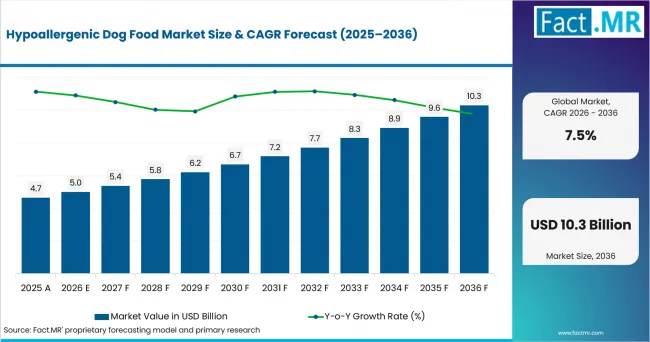
Hypoallergenic Dog Food Market Value Analysis | Source: Fact.MR
What are the defining numbers behind Hypoallergenic Dog Food market growth?
USD 5.3 billion absolute opportunity by 2036, led by Dry Dog Food and Hydrolyzed Protein Diets alongside Offline Sales.
- Demand Drivers in the Market
- Veterinary clinics need reliable recommendation diets because elimination feeding depends on strict ingredient control and owner discipline.
- Pet specialty retailers benefit from dry hypoallergenic formulas since repeat purchases are easier to manage on fixed shelves.
- Dog owners seek clear diet labels supported by known protein sources and feeding guidance.
- Online retailers are expected to support reorders when owners remain on long elimination or maintenance diets.
- Key Segments Analyzed
- By Product: Dry dog food is expected to hold 55.9% share in 2026 owing to storage convenience and daily feeding use.
- By Life Stage: Puppies are projected to account for 33.8% share in 2026 as early sensitivity management shapes long-term diet selection.
- By Diet Type: Hydrolyzed Protein Diets are anticipated to capture 54.9% share in 2026 due to veterinary use during elimination feeding.
- By Sales Channel: Offline Sales are estimated to represent 58.3% share in 2026 because veterinary clinics and pet stores guide first purchases.
- Analyst Opinion at Fact.MR
- Shambhu Nath Jha, Principal Consultant at Fact.MR, states, “Hypoallergenic dog food is a compliance category. Owners need simple feeding rules and low ingredient risk. Suppliers are expected to gain trust through veterinary credibility, clear protein sourcing and reliable channel access.”
- Strategic Implications
- Pet food brands should keep claims specific to hydrolyzed protein, novel protein and limited ingredient use.
- Veterinary distributors should support repeat ordering so diet trials do not fail due to product gaps.
- Retail teams should separate hypoallergenic products from general sensitive stomach ranges to reduce confusion.
- Investors should review whether brand portfolios include clinical diets and everyday maintenance options.
Germany is estimated to record 8.2% CAGR through 2036. Brazil is projected at 7.5%. The USA is forecast to post 6.8%. The U.K. is anticipated to hold 6.1%, while Japan is expected to reach 5.4%.
How does the Hypoallergenic Dog Food market break down by segment?
Dry Dog Food leads at 55.9%; Hydrolyzed Protein Diets lead at 54.9%.
Which product dominates?
Dry Dog Food holds 55.9% share in 2026.
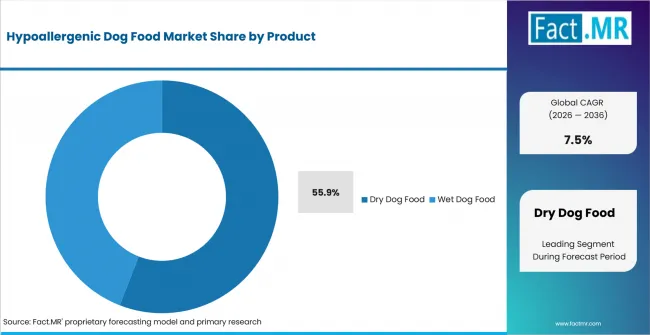
Hypoallergenic Dog Food Market Analysis By Product | Source: Fact.MR
Dry Dog Food is expected to lead Product due to daily feeding convenience and lower storage complexity. Grain Free Dry Food serves owners who want cereal exclusion. Canned dog food remains relevant where palatability supports trial feeding. The Pet Food Institute reported in April 2025 that U.S. dog and cat food manufacturers produced 9.8 million tons in 2024 using more than 600 ingredients.
What leads the Life Stage segment?
Puppies lead with 33.8% share in 2026.
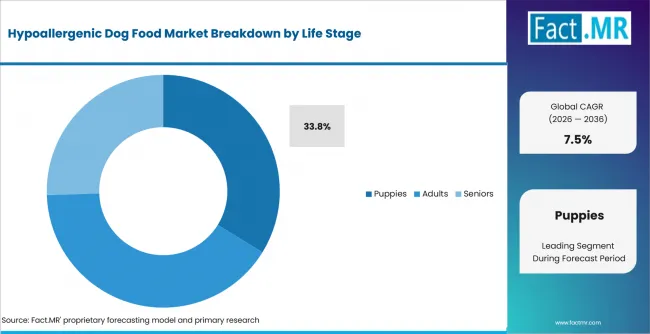
Hypoallergenic Dog Food Market Analysis By Life Stage | Source: Fact.MR
Puppies are projected to lead Life Stage as early digestive upset pushes owners toward controlled diets. Small Breed Puppies fit trial packs. Large Breed Puppies need stricter feeding guidance. Adult and Senior lines remain necessary after diagnosis.
How does Diet Type shape demand?
Hydrolyzed Protein Diets capture 54.9% share in 2026.
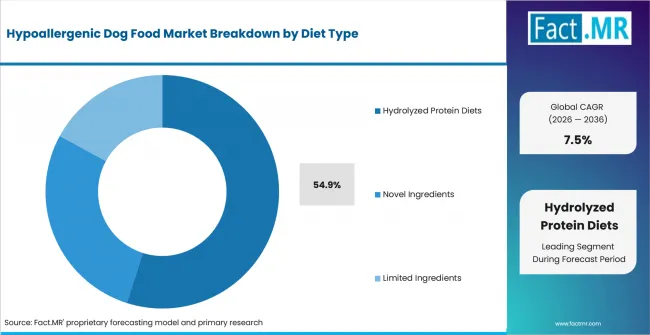
Hypoallergenic Dog Food Market Analysis By Diet Type | Source: Fact.MR
Hydrolyzed Protein Diets are anticipated to lead Diet Type because they reduce exposure to intact proteins during elimination feeding. Novel Ingredients create a second route for dogs that need unfamiliar proteins, while air-dried venison supports premium single-protein positioning. Limited Ingredients help owners understand what changed in the bowl. FDA states that disease-related pet food claims can indicate new animal drug intent, so brands must keep label wording disciplined.
What supports Offline Sales within Sales Channel?
Offline Sales represent 58.3% share in 2026.
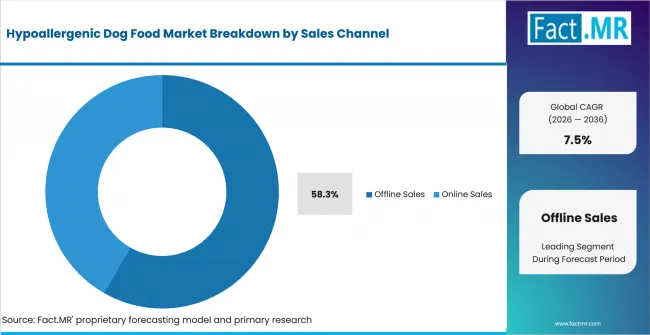
Hypoallergenic Dog Food Market Analysis By Sales Channel | Source: Fact.MR
Offline Sales are estimated to lead Sales Channel because diagnosis and diet change often start in clinics or pet stores. Hypermarkets and Supermarkets support maintenance purchases after owners know the product. Online Sales serve repeat buyers, and direct-to-customer pet food models are expected to support refill convenience. ZZF and IVH reported EUR 2,820 million of German prepared pet food sales through food retail in 2025.
What is accelerating Hypoallergenic Dog Food Market adoption, and what is holding it back?
Diet sensitivity management drives it; cost and claim control restrain it.
Drivers Impact Analysis
| Driver | (~) % Impact on CAGR | Geographic Relevance | Impact Timeline |
|---|---|---|---|
| Veterinary diet trials | +2.0% | USA, Germany, U.K. | Short term (<= 2 years) |
| Dry format repeat use | +1.7% | Global retail channels | Short term (<= 2 years) |
| Hydrolyzed protein trust | +1.4% | Veterinary-led markets | Medium term (2-4 years) |
| Premium owner spending | +1.1% | USA, Germany, Japan | Medium term (2-4 years) |
| Online refill ordering | +0.8% | USA, U.K., Brazil | Long term (>= 4 years) |
- Veterinary diet trials: Food sensitivity work often begins with an elimination diet. Clinics influence the first product choice, so clear feeding instructions are expected to reduce trial failure.
- Dry format repeat use: Dry Dog Food carries routine feeding because owners can measure portions and store products without spoilage risk.
- Hydrolyzed protein trust: Hydrolyzed diets help veterinarians simplify ingredient exposure. Hill’s announced on January 24, 2025, that Prescription Diet z/d for dogs and cats was being upgraded with ActivBiome+ Digestion as part of its 2025 Prescription Diet product updates.
Opportunity Impact Analysis
| Opportunity | (~) % Impact on CAGR | Geographic Relevance | Impact Timeline |
|---|---|---|---|
| Veterinary e-commerce refills | +1.1% | USA, U.K., Germany | Medium term (2-4 years) |
| Puppy sensitivity lines | +0.9% | Germany, Brazil, USA | Medium term (2-4 years) |
| Novel protein expansion | +0.8% | Japan and premium markets | Long term (>= 4 years) |
| Clearer label education | +0.6% | Regulated markets | Long term (>= 4 years) |
- Veterinary e-commerce refills: Clinics can connect diagnosis with scheduled reordering after the first bag or case. That approach is expected to protect diet continuity.
- Novel protein expansion: Novel Ingredients provide an option when familiar proteins are unsuitable. Pet allergy immune supplements are adjacent to the same owner need for skin and immune support. Single-protein positioning is projected to support premium maintenance feeding after elimination work is complete.
- Clearer label education: FDA’s 2026 animal food labeling guidance states that disease-related claims on pet foods may indicate an intended use as a new animal drug and therefore may require approval through the new animal drug process. Staff training is anticipated to lower compliance risk.
Restraints Impact Analysis
| Restraint | (~) % Impact on CAGR | Geographic Relevance | Impact Timeline |
|---|---|---|---|
| High retail price | -1.2% | Brazil, U.K., USA | Short term (<= 2 years) |
| Diet trial discipline | -0.9% | Global | Short term (<= 2 years) |
| Claim review burden | -0.7% | USA, EU, Japan | Medium term (2-4 years) |
| Ingredient availability | -0.5% | Global suppliers | Long term (>= 4 years) |
- High retail price: Higher protein and quality-control costs are expected to push some households toward partial switching or shorter trials.
- Diet trial discipline: Elimination feeding fails when treats enter the routine. Simple owner instructions are anticipated to protect repeat purchasing.
- Claim review burden: Disease-related wording requires caution. Companies must separate veterinary diet claims from general wellness language before updating packaging.
- Ingredient availability: Limited and novel proteins depend on stable sourcing. Manufacturers are expected to qualify alternate suppliers before expanding niche products.
Which countries are scaling Hypoallergenic Dog Food Market fastest?
- The country comparison spans 2.8 percentage points across the forecast period.
- Germany remains 0.7 percentage point above Brazil through premium dog food spending and strict retail quality expectations.
- Brazil remains 0.7 point above the USA as a large dog base sustains dry food volume.
- The USA remains 0.7 point above the U.K. through high household dog ownership and developed specialty channels.
- The U.K. remains 0.7 point above Japan because owner willingness to protect essential food remains visible despite cost pressure.
- Japan closes the displayed range as smaller household sizes and older pets keep clinical diet use selective.
Comparable CAGRs create different entry conditions due to veterinary access, retail mix and owner price sensitivity. Coverage spans all listed regions.
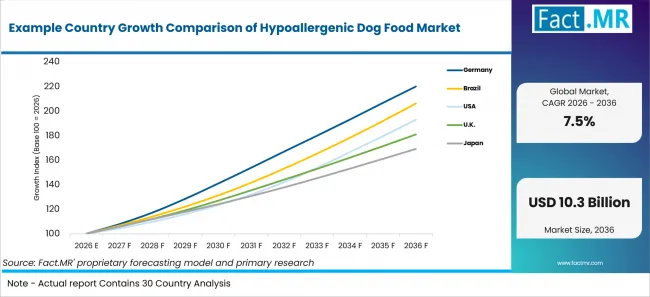
Example Country Growth Comparison Of Hypoallergenic Dog Food Market | Source: Fact.MR
| Country | CAGR (2026-2036) |
|---|---|
| Germany | 8.2% |
| Brazil | 7.5% |
| USA | 6.8% |
| U.K. | 6.1% |
| Japan | 5.4% |
What supports Germany adoption?
8.2% CAGR, supported by dog food spending and controlled retail advice.
Germany’s growth is supported by strong prepared pet food spending and a large household pet base. IVH and ZZF reported EUR 4,272 million in prepared pet food sales through bricks-and-mortar trade in Germany in 2025, while 33.4 million pets, excluding fish and reptiles, lived in German households. Premium pricing, weaker dry dog food sales and limited specialty shelf space may restrain adoption.
How is Brazil scaling demand?
7.5% CAGR, driven by pet ownership depth and pet food production needs.
Brazil’s growth reflects broad pet ownership and substantial industrialized pet food sales. ABEMPET reported 1.8 pets per residence in Brazil and BRL 40.8 billion in industrialized pet food sales in 2024. Pet-food production declined 0.6% in 2024, while ABEMPET places the sector’s tax burden at around 50%; together with MAPA registration and ingredient-compliance requirements, these factors may create cost and regulatory pressures for premium specialized diets.
What supports USA growth?
6.8% CAGR, backed by dog ownership and veterinary diet channels.
USA growth is supported by a large dog-owning population and established veterinary diet channels. APPA reported 71 million U.S. households owned dogs in 2025, while manufacturers produced 9.8 million tons of dog and cat food in 2024. Veterinary costs, claim restrictions and value-oriented feeding may restrain premium diet uptake.
How is the U.K. developing demand?
6.1% CAGR, supported by dog ownership and cost-aware essential feeding.
U.K. growth is supported by high dog ownership and continued spending on essential feeding. UK Pet Food reported 13.5 million pet dogs in 2024, with 36% of households owning a dog. Veterinary cost concerns, closer diet comparisons and food-safety scrutiny may slow adoption of specialized hypoallergenic products.
How does Japan perform?
5.4% CAGR, led by controlled feeding and smaller household routines.
Japan’s growth reflects controlled feeding habits and demand for smaller specialty diet formats. The Japan Pet Food Association reported a dog food market value of JPY 186,339 million and a distribution volume of 229,841 tons in 2024. Declining volumes, regulatory requirements and selective spending among older-pet households may restrain growth.
Who leads the Hypoallergenic Dog Food Market?
Mars Petcare, Nestle Purina Pet Care and Hill’s Pet Nutrition show the clearest veterinary and specialty diet reach.
Mars Petcare participates through Virbac. Nestle Purina Pet Care supports Pro Plan Veterinary Diets. Hill’s Pet Nutrition remains active through Prescription Diet sensitivity lines. Retail and limited ingredient brands complete the field.
Which companies are the key providers?
Key companies include Mars Petcare, Nestle Purina Pet Care, Hill’s Pet Nutrition, Farmina Pet Foods, Ethos Pet Brands (Canidae), Diamond Pet Foods, Arden Grange, Blue Buffalo (General Mills) and Monge & C. S.p.A.
- Mars Petcare, Inc.
- Nestle Purina Pet Care
- Hill’s Pet Nutrition
- Farmina Pet Foods
- Ethos Pet Brands (Canidae)
- Diamond Pet Foods
- Arden Grange
- Blue Buffalo (General Mills)
- Virbac
- Midwestern Pet Foods (Earthborn Holistic)
- Brothers Dog Food / Brothers Complete
- Monge & C. S.p.A.
Bibliography
- American Pet Products Association. (2026, March 26). U.S. pet industry reaches $158 billion in 2025, poised for continued growth in 2026.
- American Pet Products Association. (2026, July 22). America’s dog owners are becoming smarter spenders: New APPA report reveals how 71 million households are prioritizing their pets in a tight economy.
- Associação Brasileira das Empresas do Setor de Animais de Estimação. (2025, October 27). No digital, o varejo especializado mantém a liderança.
- FEDIAF EuropeanPetFood. (2026, June). European pet population and market data 2024.
- U.S. Food and Drug Administration. (2026, March 2). Animal food labeling and pet food claims.
- Food Standards Agency. (2026, February 13). FSA highlights importance of safe handling for raw pet food.
- Hill’s Pet Nutrition. (2025, January 24). Hill’s Pet Nutrition leads the way in microbiome science at VMX 2025, unveiling breakthrough product innovation.
- Zentralverband der Heimtierbranche e.V., & Industrieverband Heimtierbedarf e.V. (2026, April 23). Der Deutsche Heimtiermarkt 2025 [The German pet market 2025].
- PDSA. (2025, November 6). Pet owners fear having to choose between “heating, eating, and caring for their pets”.
- Nestlé Purina PetCare Company. (2025, May 13). Purina Pro Plan Veterinary Supplements introduces new Skin Care supplement for dogs.
This Report Addresses
- The report provides strategic intelligence on the Hypoallergenic Dog Food Market across Product and Diet Type choices that shape sensitivity-diet purchasing.
- Segment analysis covers Dry Dog Food and Hydrolyzed Protein Diets as the share leaders within the 2026 market.
- Country outlook evaluates Germany and Brazil alongside the USA and U.K. Japan completes the growth comparison across the profiled markets.
- Competitive analysis profiles Mars Petcare and Nestle Purina Pet Care alongside Hill’s Pet Nutrition. Retail and limited ingredient brands complete the provider set.
- Channel assessment covers Offline Sales and Online Sales. Veterinary clinics and pet stores remain central to first-product selection.
What does the Hypoallergenic Dog Food Market cover?
Hypoallergenic dog food covers products designed to reduce ingredient exposure for dogs with food sensitivities. Organic dog food and general wellness products are included only when the product carries a sensitivity-specific use case.
The market includes dry, wet and pouch products when formulas use hydrolyzed protein, novel protein or limited ingredients. Retail and veterinary channels are covered.
What is included in the scope?
The scope includes hydrolyzed protein diets and novel protein formulas used in veterinary or retail diet management. Grain-free dog food is included only when cereal avoidance is part of a broader sensitivity formula.
Coverage extends to clinical diets, limited ingredient maintenance diets and adjacent support products where the sale is tied to sensitivity care. Vegan dog food is included only when plant-based protein substitution is used for allergy or intolerance management.
What is excluded from the scope?
General wellness food is excluded when it does not use controlled ingredients or sensitivity claims. Pet premixes are excluded unless they are incorporated into finished hypoallergenic dog food formulas.
How Was the Analysis Built?
The analysis draws on 120+ sources, 35+ company portfolios, 25+ countries, and more than 20 industry interviews.
- Primary Research: Primary research includes discussions with manufacturers, service providers, technology developers, distributors, end users, procurement teams, and subject-matter experts. These conversations examine purchasing priorities, product adoption, operational challenges, approval requirements, competitive positioning, and the factors that influence wider market acceptance.
- Desk Research: Desk research covers government statistics, regulatory publications, company filings, trade data, technical studies, industry associations, standards, public policy, and other authoritative sources. Every source used in the analysis is documented in the bibliography.
- Market Sizing and Forecasting: Market estimates combine historical performance, demand indicators, pricing and volume trends, segment shares, company participation, country-level growth, adoption patterns, investment activity, and barriers to market expansion.
- Data Validation and Update Cycle: Findings are validated by comparing primary interviews with public data, company activity, regulatory changes, trade patterns, and industry developments. Regular updates review new product launches, capacity changes, partnerships, approvals, procurement trends, and shifts in commercial adoption.
What is the report’s scope and coverage?
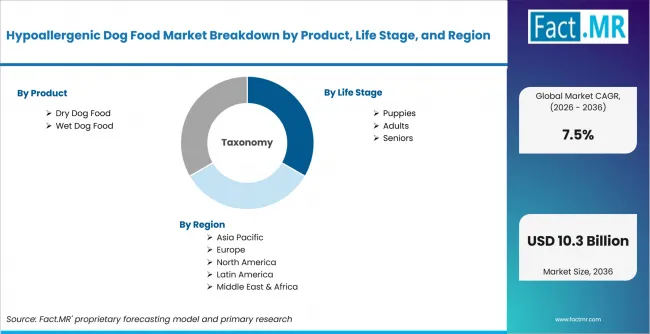
Hypoallergenic Dog Food Market Breakdown By Product, Life Stage, And Region | Source: Fact.MR
| Attribute | Details |
|---|---|
| Quantitative Units | USD billion |
| Market Definition | Commercial dog food formulated for dogs with suspected or confirmed food sensitivities where ingredient control and feeding compliance shape purchasing. |
| Product | Dry Dog Food; Grain Free Dry Food; Hypoallergenic Kibble; Wet Dog Food; Canned Dog Food; Pouch Dog Food |
| Life Stage | Puppies; Small Breed Puppies; Large Breed Puppies; Adults; Small Breed Adults; Large Breed Adults; Seniors; Senior Maintenance Diets; Senior Specialty Diets |
| Diet Type | Hydrolyzed Protein Diets; Hydrolyzed Poultry Protein; Hydrolyzed Animal Protein; Novel Ingredients; Novel Animal Proteins; Plant Based Alternatives; Limited Ingredients; Single Protein Diets; Reduced Ingredient Diets |
| Sales Channel | Offline Sales; Hypermarkets and Supermarkets; Pet Stores; Veterinary Clinics; Other Offline Channels; Online Sales; Brand and Company Websites; E Commerce Websites |
| Regions Covered | North America; Latin America; Europe; East Asia; South Asia and Pacific; Middle East and Africa |
| Countries Covered | Germany; Brazil; USA; U.K.; Japan |
| Key Companies Profiled | Mars Petcare, Inc.; Nestle Purina Pet Care; Hill’s Pet Nutrition; Farmina Pet Foods; Ethos Pet Brands (Canidae); Diamond Pet Foods; Arden Grange; Blue Buffalo (General Mills); Virbac; Midwestern Pet Foods (Earthborn Holistic); Brothers Dog Food / Brothers Complete; Monge & C. S.p.A. |
| Forecast Period | 2026 to 2036 |
| Approach | Hybrid approach using dog ownership, pet food spending, veterinary diet use, channel behavior, country patterns and portfolio review. |
How is the market segmented?
-
By Product:
- Dry Dog Food
- Grain Free Dry Food
- Hypoallergenic Kibble
- Wet Dog Food
- Canned Dog Food
- Pouch Dog Food
- Dry Dog Food
-
By Life Stage
- Puppies
- Small Breed Puppies
- Large Breed Puppies
- Adults
- Small Breed Adults
- Large Breed Adults
- Seniors
- Senior Maintenance Diets
- Senior Specialty Diets
- Puppies
-
By Diet Type
- Hydrolyzed Protein Diets
- Hydrolyzed Poultry Protein
- Hydrolyzed Animal Protein
- Novel Ingredients
- Novel Animal Proteins
- Plant Based Alternatives
- Limited Ingredients
- Single Protein Diets
- Reduced Ingredient Diets
- Hydrolyzed Protein Diets
-
By Sales Channel
- Offline Sales
- Hypermarkets And Supermarkets
- Pet Stores
- Veterinary Clinics
- Other Offline Channels
- Online Sales
- Brand And Company Websites
- E Commerce Websites
- Offline Sales
-
By Region
- North America
- Latin America
- Western Europe
- Eastern Europe
- East Asia
- South Asia and Pacific
- Middle East & Africa