- Estimated Value(2026): 1.3 Bn
- Forecast Value (2036): 2.5 Bn
- CAGR (2026 - 2036): 7.8%
Air-Dried Venison Dog Food Market Forecast and Outlook 2026 to 2036
In 2025, the air-dried venison dog food market value crossed USD 1.2 billion. Based on Fact.MR analysis, demand for air-dried venison dog food is estimated to grow to USD 1.3 billion in 2026 and USD 2.5 billion by 2036. Fact.MR projects a CAGR of 7.8% during the forecast period.
The air-dried venison dog food market is expected to create an absolute dollar opportunity of about USD 1.2 billion between 2026 and 2036. Growth is fueled by rising pet humanization, the expanding veterinary recommendation of novel protein diets for dogs with chicken or beef sensitivities, and strong e-commerce penetration enabling direct-to-consumer premium brands to reach pet owners in markets previously underserved by specialty retail. Growth is moderated by high venison raw material costs relative to commodity proteins, limited large-scale venison supply chains in several regions, and the premium price point that restricts mass adoption in price-sensitive markets.
ZIWI Peak’s CEO noted that “We pioneered the world’s first air-drying technology to lock in the nutrition from our pure and natural ingredients.” “ZIWI pioneered a gentle air-drying process designed to preserve the nutrition of raw ingredients while creating a convenient alternative to raw feeding.”
Country growth reflects pet humanization intensity, premium pet food retail infrastructure, and veterinary novel protein diet awareness. India leads with 9.3% CAGR, driven by rapidly expanding urban pet ownership and accelerating premiumisation of the organised pet food segment. China follows at 8.7%, supported by a growing millennial pet owner base willing to spend on premium imported and domestic natural formats. Brazil registers 8.3% as Latin America's largest pet market expands its premium segment through e-commerce and specialty retail. Germany posts 7.0% where advanced natural pet food retail and strong veterinary diet culture sustain steady demand. The United States grows at 6.8%, the most mature market, generating steady replacement and trade-up demand constrained by market saturation in the premium tier.
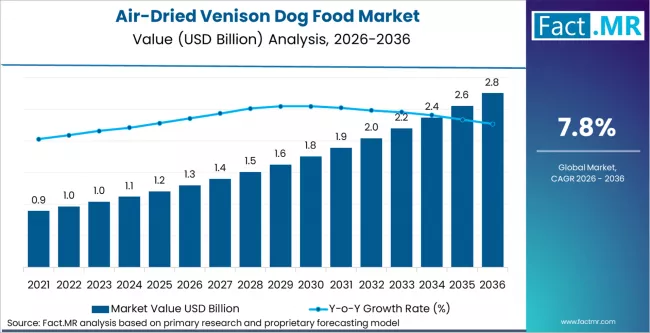
Air Dried Venison Dog Food Market Market Value Analysis | Source: Fact.MR
| Metric | Value |
|---|---|
| Estimated Value in 2026 | USD 1.3 billion |
| Forecast Value in 2036 | USD 2.5 billion |
| Forecast CAGR (2026 to 2036) | 7.8% |
Source: Fact.MR analysis. Updated Mar 9, 2026
Market Definition
The air-dried venison dog food market includes pet food products where venison is the main protein and air-drying is used for preservation. The process removes moisture at low temperatures, maintaining nutrition and flavour without high heat processing. Products are sold as complete diets, toppers, or treats for premium pet food consumers.
Market Inclusions
Includes global and regional revenue forecasts (2026-2036). Covers dog food, cat food, and other air-dried venison products across animal-based, plant-based, and mixed ingredients. Distribution channels include online stores, supermarkets, specialty stores, and others across India, China, Germany, Brazil, and the United States.
Market Exclusions
Excludes freeze-dried venison food, extruded venison kibble, and raw venison diets unless part of air-dried blends. Venison-flavoured foods with minimal venison content and veterinary prescription venison diets are also excluded.
Research Methodology
- Primary Research: Interviews with premium pet food brand managers, specialty pet retailers, veterinary nutritionists, e-commerce category managers, and venison supply chain executives.
- Desk Research: Analysis of pet industry surveys, brand investor reports, veterinary nutrition guidelines, retail sales data, e-commerce reports, and food safety regulations.
- Market Sizing and Forecasting: A hybrid top-down and bottom-up model using premium pet food category size, air-dried format share, venison SKU pricing, and consumer adoption trends.
- Data Validation and Update Cycle: Forecasts validated using brand revenue data, specialty retailer sales reports, and e-commerce performance data, with annual updates based on supply trends and retail channel shifts.
Summary
- Market Definition
- Air-dried venison dog food includes minimally processed dog food made using venison as the main protein and preserved through low-temperature air-drying.
- Demand Drivers
- Veterinary use of novel protein diets for dogs with food sensitivities is increasing demand for venison-based pet food.
- Rising pet humanization in India, China, and Brazil is driving demand for premium natural pet food.
- Growth of e-commerce pet food platforms is helping niche air-dried venison brands reach wider consumers.
- Key Segments Analyzed
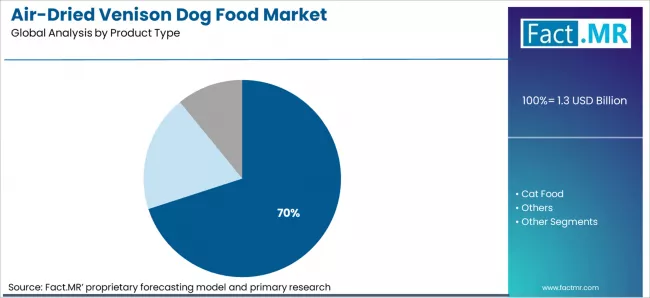
- By Product Type: Dog food holds about 70% share in 2026 due to higher dog population and frequent dietary recommendations.
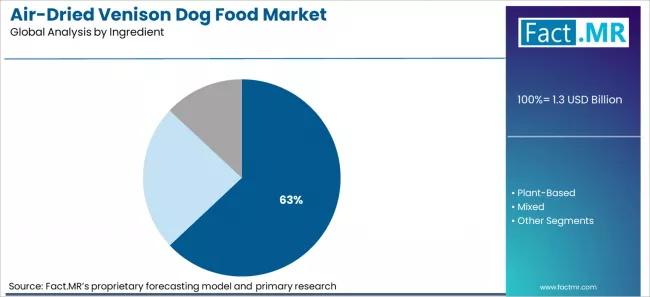
- By Ingredient: Animal-based formulations account for about 63% share in 2026 due to demand for meat-first ingredient diets.
- By Distribution Channel: Supermarkets and hypermarkets hold around 45% share in 2026 as the main purchase channel for premium pet food.
- By Geography: Asia Pacific shows fastest volume growth.
- Analyst Opinion at FACT.MR
- Shambhu Nath Jha, Principal Consultant at Fact.MR, opines that CXOs will find the market driven by veterinary diet adoption, premium pet food demand, and expanding e-commerce sales channels.
- Strategic Implications
- Brands should strengthen veterinary partnerships to promote venison-based elimination diets.
- Manufacturers should explore local production partnerships in India and China to reduce costs and meet regulations.
- Companies should develop subscription-based e-commerce sales models to capture repeat purchases.
- Methodology
- Market sizing used premium pet food revenues, air-dried format penetration, and venison product pricing data.
- Veterinary diet guidelines, regulations, and e-commerce adoption trends supported demand analysis.
- Forecasts incorporated pet ownership data, premium pet food spending trends, and industry interviews.
Segmental Analysis
Air-Dried Venison Dog Food Market Analysis by Product Type
Air Dried Venison Dog Food Market Analysis By Product Type | Source: Fact.MR
Based on FACT.MR analysis, dog food is expected to hold about 70% share in 2026 due to higher dog ownership and frequent veterinary recommendations for novel protein diets in canine nutrition.
- Ziwi Pets Air-Dried Venison Range Expansion: In 2025, Ziwi Pets expanded its air-dried venison range with life-stage specific formulations targeting puppies and senior dogs. [5]
- Champion Petfoods Orijen Novel Protein Platform: In 2024, Champion Petfoods introduced a limited-ingredient air-dried venison dog food under the Orijen brand aligned with AAFCO novel protein diet guidelines. [6]
- Specialty Pet Retail Category Growth Trend: Major pet retailers reported strong growth in premium natural dog food segments, with venison-based products among the fastest growing categories. [7]
Air-Dried Venison Dog Food Market Analysis by Ingredient
Air Dried Venison Dog Food Market Analysis By Ingredient | Source: Fact.MR
FACT.MR estimates animal-based formulations will account for around 63% share in 2026 as single-protein meat formulations remain preferred for elimination diets and premium pet nutrition.
- K9 Natural Single-Protein Formulation Investment: In 2025, K9 Natural launched an updated single-protein air-dried venison formulation targeting veterinary therapeutic diet channels. [8]
- Stella and Chewy's Mixed Ingredient Air-Dried Innovation: In 2024, Stella and Chewy's introduced an air-dried venison dog food combining venison with plant-based supplements such as spirulina and pumpkin. [9]
- Clean Label Pet Food Ingredient Transparency Trend: Consumer research in 2024 highlighted ingredient transparency and minimal processing as key drivers for premium natural pet food purchases. [10]
Key Dynamics
Drivers, Restraints, and Opportunities
FACT.MR analysts observe that the air-dried venison dog food market has shifted from a niche premium segment to a recognised therapeutic and natural pet food category. Growth reflects rising pet humanisation, veterinary dietary recommendations, and consumer demand for minimally processed, high-protein pet food.
The market faces supply constraints due to limited venison sourcing capacity, which restricts large-scale production. However, premium pricing and e-commerce distribution are helping brands expand reach while maintaining profitability.
- AAFCO Novel Protein Diet Recognition and Veterinary Adoption: Updated AAFCO labelling guidance in 2024 clarified standards for novel protein diets, strengthening veterinary confidence in recommending venison-based elimination diets. This regulatory clarity is increasing clinical demand for air-dried venison products in North America. [2]
- India Pet Food Premiumisation and E-Commerce Expansion: Rapid growth of premium pet food categories on Indian e-commerce platforms such as Flipkart and Amazon India is accelerating demand for natural and imported air-dried venison pet food among urban pet owners. [3]
- EU Pet Food Regulation and Clean Label Compliance: Updated European pet food guidelines in 2024 strengthened transparency requirements for protein sourcing and manufacturing processes, supporting differentiation for air-dried venison brands that emphasise clean-label production. [4]
Regional Analysis
The air-dried venison dog food market is analysed across Asia Pacific, Europe, North America, Latin America, and Middle East and Africa, covering 35-plus countries with distinct demand profiles shaped by pet ownership density, premium pet food retail infrastructure, veterinary diet recommendation culture, and venison supply chain accessibility. The full report offers market attractiveness analysis based on premiumisation timelines and distribution channel maturity.
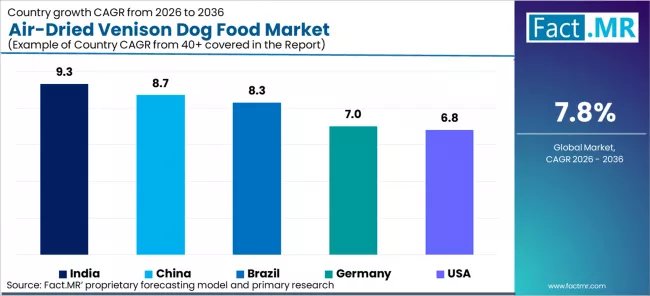
Air Dried Venison Dog Food Market Cagr Analysis By Country | Source: Fact.MR
| Country | CAGR (2026-2036) |
|---|---|
| India | 9.3% |
| China | 8.7% |
| Brazil | 8.3% |
| Germany | 7.0% |
| USA | 6.8% |
Source: Fact.MR analysis. Updated Mar 9, 2026
Source: Fact.MR (FACT.MR) analysis, based on proprietary forecasting model and primary research
Asia Pacific Air-Dried Venison Dog Food Market Analysis
Asia Pacific is the fastest-growing region for air-dried venison dog food, driven by rising pet ownership, premium pet food spending, and expanding e-commerce access. International brands lead premium segments while regional brands compete in mid-premium offerings.
- China: Demand for air-dried venison dog food in China is projected to grow at about 8.7% CAGR through 2036. Rising urban pet ownership and strong cross-border e-commerce sales of premium imported pet food are supporting demand growth.
- India: Demand for air-dried venison dog food in India is expected to expand at nearly 9.1% CAGR through 2036. Growth is supported by increasing premium pet food adoption and expansion of specialty pet retail and online platforms.
FACT.MR's Asia Pacific analysis of the air-dried venison dog food market covers China, Japan, South Korea, India, Australia and New Zealand, ASEAN, and Rest of Asia Pacific. Readers can find country CAGR forecasts, premium pet food retail expansion trends, e-commerce adoption data, and import regulation timelines.
Europe Air-Dried Venison Dog Food Market Analysis
Europe represents a mature premium pet food market supported by strong veterinary diet culture, advanced specialty pet retail networks, and strict product labelling regulations.
- Germany: Demand for air-dried venison dog food in Germany is forecast to grow at around 7.0% CAGR through 2036. Expansion of premium natural pet food categories and growing veterinary recommendations for novel protein diets support demand.
FACT.MR's European analysis of the air-dried venison dog food market covers Germany, France, the United Kingdom, Italy, Spain, the Netherlands, the Nordics, and Rest of Europe. Readers can find EU regulation compliance investment data, specialty retail expansion trends, veterinary diet recommendation rates, and country-level CAGR forecasts.
North America Air-Dried Venison Dog Food Market Analysis
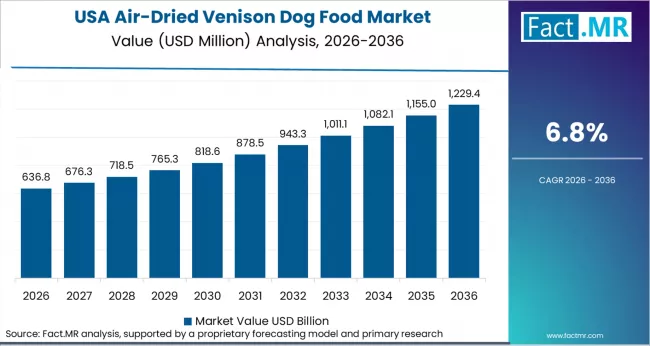
Air Dried Venison Dog Food Market Country Value Analysis | Source: Fact.MR
North America is the largest revenue market for air-dried venison dog food due to strong premium pet food demand, veterinary novel protein diet adoption, and developed pet specialty retail channels.
- United States: Demand for air-dried venison dog food in the United States is projected to rise at roughly 6.8% CAGR through 2036. Premium natural pet food growth, veterinary diet recommendations, and direct-to-consumer subscription models are supporting market expansion.
FACT.MR's North American analysis of the air-dried venison dog food market covers the United States, Canada, and Mexico. Readers can find AAFCO regulation timelines, veterinary diet recommendation trends, e-commerce subscription growth data, and country growth forecasts by product type and distribution channel.
Latin America Air-Dried Venison Dog Food Market Analysis
Latin America is an emerging growth region for premium pet food supported by large pet populations, increasing online retail penetration, and growing demand for natural pet food formats.
- Brazil: Demand for air-dried venison dog food in Brazil is projected to increase at approximately 8.2% CAGR through 2036. Premium pet food spending growth and strong e-commerce penetration are driving adoption of imported natural pet food brands.
FACT.MR's Latin American analysis of the air-dried venison dog food market covers Brazil, Mexico, Colombia, and Rest of Latin America. Readers can find pet population data, e-commerce pet food growth trends, import regulation timelines, and country-level forecasts by product type and distribution channel.
Competitive Aligners for Market Players
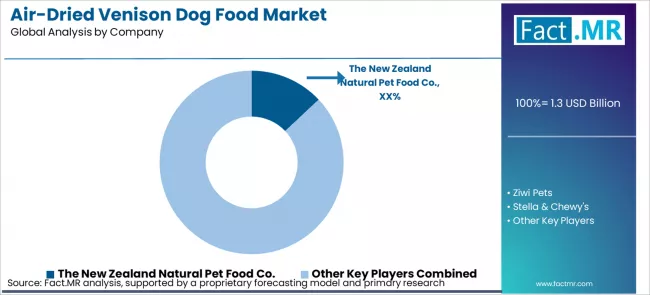
Air Dried Venison Dog Food Market Analysis By Company | Source: Fact.MR
The global air-dried venison dog food market is highly fragmented, with several premium brands competing across regions rather than a single dominant player. New Zealand-based brands such as Ziwi Pets and K9 Natural hold strong global positioning due to their reputation for high-quality venison sourcing and trusted relationships with veterinarians. In North America, companies including Champion Petfoods, Stella and Chewy’s, and Primal Pet Foods compete actively in the premium natural pet food segment. In this market, transparency around ingredient origin, sourcing practices, and production methods has become a key competitive differentiator because premium pet owners closely evaluate product authenticity.
Brands that control venison sourcing or maintain long-term partnerships with deer farms gain advantages in cost stability and ingredient consistency. Ziwi Pets benefits from New Zealand’s grass-fed venison supply, while Champion Petfoods promotes its biologically appropriate sourcing philosophy to strengthen brand trust. Larger natural pet food companies such as WellPet LLC and Nature’s Variety leverage wider distribution networks to introduce new venison products efficiently across retail channels.
Veterinary-recommended diets tend to create strong customer loyalty, leading to repeat purchases and relatively low price sensitivity. Specialty retailers typically stock a few competing premium brands, while subscription-based e-commerce models are helping brands secure recurring revenue and reduce reliance on traditional retail channels.
Key Players
- The New Zealand Natural Pet Food Co.
- Ziwi Pets
- Stella & Chewy's
- Primal Pet Foods
- K9 Natural
- Champion Petfoods (Orijen & Acana)
- WellPet LLC (Wellness Pet Food)
- Nature's Variety (Instinct)
- Steve's Real Food
- V.I.P. Petfoods
- Grandma Lucy's
- Nulo Pet Food
Bibliography
- [2] Association of American Feed Control Officials. (2024). AAFCO Model Pet Food Regulations: Novel Protein Limited Ingredient Diet Labelling Standards Update. AAFCO Official Publications. June 2024. aafco.org
- [3] Confederation of Indian Industry. (2024). CII Pet Industry Report 2024: Premium Pet Food Market Growth, E-Commerce Penetration, and Urban Consumer Spending Benchmarks. CII Publications. October 2024. cii.in
- [4] European Pet Food Industry Federation (FEDIAF). (2024). FEDIAF Nutritional Guidelines Update: Protein Source Transparency and Manufacturing Process Disclosure Standards for Pet Food Labelling. FEDIAF Publications. July 2024. fediaf.org
- [5] Ziwi Pets. (2025). Product Announcement: Air-Dried Venison Life-Stage Formulation Expansion for Senior and Puppy Dogs with Extended North American and European Distribution. January 2025. ziwipets.com
- [6] Champion Petfoods. (2024). Press Release: Orijen Limited Ingredient Novel Protein Air-Dried Venison Formulation Launch for Veterinary Elimination Diet Channel. October 2024. championpetfoods.com
- [7] PetSmart Inc. / Petco Health and Wellness Company. (2024). Annual Investor Reports 2024: Premium Natural and Limited-Ingredient Dog Food Category Performance and Novel Protein SKU Growth Data. petsmart.com; petco.com
- [8] K9 Natural. (2025). Product Launch: Updated Single-Protein Air-Dried Venison Formulation with Enhanced Organ Meat Inclusion for Veterinary Therapeutic Diet Channel. February 2025. k9natural.com
- [9] Stella and Chewy's. (2024). Product Update: Mixed Ingredient Air-Dried Venison Dog Food Line with Plant-Based Supplements Targeting Wellness-Oriented Premium Consumer Segment. August 2024. stellaandchewys.com
- [10] Pet Food Institute. (2024). Consumer Research Report: Ingredient Transparency and Minimal Processing as Primary Purchase Drivers in Premium Natural Pet Food. September 2024. petfoodinstitute.org
This Report Addresses
- Strategic intelligence on premiumisation trends in air-dried dog food, veterinary novel protein diet adoption, e-commerce channel growth, venison supply chain dynamics, and clean-label regulatory requirements.
- Market forecast from USD 1.3 billion in 2026 to USD 2.5 billion by 2036 at 7.8% CAGR, segmented by product type, ingredient, pet type, distribution channel, and region.
- Growth opportunities in India and China's rapidly premiumising pet food markets, Brazil's expanding specialty retail infrastructure, and North American veterinary channel novel protein diet programmes.
- Country CAGR outlook for India 9.3%, China 8.7%, Brazil 8.3%, Germany 7.0%, and USA 6.8%, with key demand drivers and retail channel dynamics per country.
- Competitive analysis of Ziwi Pets, K9 Natural, Champion Petfoods, Stella and Chewy's, and WellPet covering product portfolios, sourcing strategies, veterinary channel relationships, and distribution reach.
- Technology and product tracking including life-stage air-dried formulations, single-protein elimination diet formats, mixed ingredient wellness lines, and subscription e-commerce programme development.
- Regulatory analysis covering AAFCO novel protein labelling guidance, EU FEDIAF nutritional guidelines, FSSAI India pet food import standards, Brazil MAPA import registration rules, and China General Administration of Customs pet food requirements.
- Report delivered in PDF, Excel datasets, PowerPoint summary, and dashboard formats supported by brand disclosures, veterinary association data, and primary research.
Segmentation
Air-Dried Venison Dog Food Market by Segment
-
By Product Type :
- Dog Food
- Cat Food
- Others
-
By Ingredient :
- Animal-Based
- Plant-Based
- Mixed
-
By Pet Type :
- Dogs
- Cats
- Others
-
By Distribution Channel :
- Online Stores
- Supermarkets/Hypermarkets
- Specialty Stores
- Others
-
By Region :
- North America
- United States
- Canada
- Mexico
- Europe
- Germany
- United Kingdom
- France
- Italy
- Spain
- Netherlands
- Nordics
- Rest of Europe
- Asia Pacific
- China
- Japan
- South Korea
- India
- Australia and New Zealand
- ASEAN
- Rest of Asia Pacific
- Latin America
- Brazil
- Mexico
- Colombia
- Rest of Latin America
- Middle East and Africa
- Kingdom of Saudi Arabia
- United Arab Emirates
- South Africa
- Turkey
- Rest of Middle East and Africa
- North America
Scope of Report
| Metric | Value |
|---|---|
| Quantitative Units | USD 1.3 billion (2026) to USD 2.5 billion (2036), at a CAGR of 7.8% |
| Market Definition | Commercially produced dog food using venison as primary protein and air-drying as the preservation method, sold as complete diets or toppers in premium and therapeutic diet segments. |
| Product Type Segmentation | Dog Food (70%), Cat Food, Others |
| Ingredient Segmentation | Animal-Based (63%), Plant-Based, Mixed |
| Pet Type Segmentation | Dogs (70%), Cats, Others |
| Distribution Channel Segmentation | Online Stores, Supermarkets/Hypermarkets (45%), Specialty Stores, Others |
| Application Coverage | Veterinary novel protein elimination diets, premium daily complete feeding, limited-ingredient wellness diets, and food sensitivity management for companion dogs. |
| Regions Covered | Asia Pacific, Europe, North America, Latin America, Middle East and Africa |
| Countries Covered | China, Japan, South Korea, India, Australia and New Zealand, ASEAN, Rest of Asia Pacific, Germany, UK, France, Italy, Spain, Netherlands, Nordics, Rest of Europe, USA, Canada, Mexico, Brazil, Colombia, Rest of Latin America, Saudi Arabia, UAE, South Africa, Turkey, Rest of MEA |
| Key Companies Profiled | Ziwi Pets, K9 Natural, Stella & Chewy's, Primal Pet Foods, Champion Petfoods, WellPet LLC, Nature's Variety, Steve's Real Food, V.I.P. Petfoods, Grandma Lucy's, Nulo Pet Food |
| Forecast Period | 2026 to 2036 |
| Approach | Hybrid top-down and bottom-up model using premium pet food category data, air-dried format penetration rates, venison SKU pricing, and primary interviews with brand managers, retailers, and veterinary nutritionists. |
Source: Fact.MR analysis. Updated Mar 9, 2026
Frequently Asked Questions
How large is the air-dried venison dog food market in 2025?
What will the market size be in 2026?
What is the projected market size by 2036?
What is the expected CAGR from 2026 to 2036?
Which product type segment is poised to lead?
Which ingredient segment holds the largest share?
Which distribution channel dominates the market?
Which country shows the fastest growth rate?
How fast is the market expected to expand in China?
What is the forecast CAGR for the United States?
What are the main growth drivers of the market?
Who worked on this report


Preview the report firsthand - request a free sample
Free SampleGet the brochure for pricing and purchase details
Download PDF