Indoor Air Purification Chemicals and Coatings Market
Indoor Air Purification Chemicals and Coatings Market Size and Share Forecast Outlook 2026 to 2036
Indoor air purification chemicals and coatings market is projected to grow from USD 0.8 billion in 2026 to USD 1.8 billion by 2036, at a CAGR of 8.9%. Photocatalytic (TiO₂-Based) Coatings will dominate with a 28.0% market share, while residential buildings will lead the application area segment with a 32.0% share.
Indoor Air Purification Chemicals and Coatings Market Forecast and Outlook 2026 to 2036
The global market for indoor air purification chemicals and coatings is experiencing significant expansion, propelled by heightened awareness of indoor air quality and its impact on health and productivity. Projected to grow from USD 0.78 billion in 2026 to USD 1.83 billion by 2036, the market is set to advance at an 8.9% CAGR.
Key Takeaways from the Indoor Air Purification Chemicals and Coatings Market
- Market Value for 2026: USD 0.78 Billion
- Market Value for 2036: USD 1.83 Billion
- Forecast CAGR (2026-2036): 8.9%
- Leading Coating Type Share (2026): Photocatalytic (TiO₂-Based) Coatings (28%)
- Leading Application Area Share (2026): Residential Buildings (32%)
- Leading Integration Type Share (2026): HVAC System Integrated Coatings & Chemicals (36%)
- Key Players in the Market: BASF SE, PPG Industries, Akzo Nobel, Sherwin-Williams, RPM International
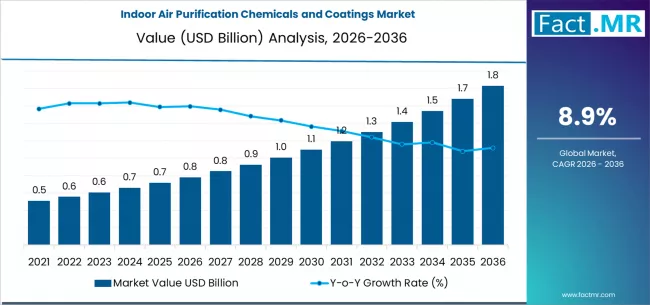
Photocatalytic coatings, primarily titanium dioxide based formulations, represent the dominant technology, capturing a 28% market share. Residential buildings constitute the largest application area, accounting for 32% of demand. Integration within HVAC systems emerges as the leading method, with a 36% share, reflecting a preference for centralized, whole-building air quality management solutions.
This growth is driven by a sustained post-pandemic focus on health and wellness in indoor environments, coupled with stricter building standards and green certification programs that mandate low indoor pollutant levels. Advanced chemicals and coatings offer an active approach to air purification, moving beyond filtration to neutralize airborne contaminants at the molecular level on treated surfaces. These technologies address pervasive concerns regarding volatile organic compounds (VOCs), pathogens, and particulate matter, contributing to healthier living and working spaces.
Innovation in this market is centered on enhancing the efficacy, longevity, and safety of active ingredients while enabling seamless integration into building materials and systems. The development of these solutions is critical for meeting evolving occupant expectations and regulatory requirements, transforming passive indoor spaces into actively protective environments.
Metric
| Metric | Value |
|---|---|
| Market Value (2026) | USD 0.78 Billion |
| Market Forecast Value (2036) | USD 1.83 Billion |
| Forecast CAGR (2026-2036) | 8.9% |
Category
| Category | Segments |
|---|---|
| Coating Type | Photocatalytic (TiO₂-Based) Coatings, Antimicrobial & Antiviral Chemical Coatings, VOC & Formaldehyde Neutralizing Agents, Activated Carbon & Adsorbent Coatings, Other Specialty Indoor Air Purification Chemicals |
| Application Area | Residential Buildings, Commercial Buildings (Offices, Hotels, Malls), Healthcare Facilities, Industrial Indoor Environments, Educational & Public Infrastructure |
| Integration Type | HVAC System Integrated Coatings & Chemicals, Interior Wall & Surface Coatings, Filter-Enhanced Chemical Media, Standalone Indoor Air Purification Devices, Smart Sensor-Activated Chemical Systems |
| Region | North America, Latin America, Western Europe, Eastern Europe, East Asia, South Asia & Pacific, MEA |
Segmental Analysis
By Coating Type, Which Technology Holds the Largest Market Share?
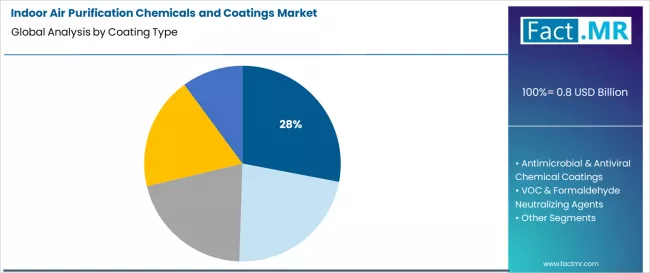
Photocatalytic coatings, especially those utilizing titanium dioxide (TiO₂), lead this segment with a 28% share. Their dominance is rooted in a broad-spectrum, catalyst-driven action. When activated by light, these coatings generate reactive oxygen species that continuously break down a wide range of organic pollutants, including VOCs, odors, and some microbial cells, directly on the coated surface.
This self-cleaning and perpetual air-purifying functionality, without consuming the coating itself, offers a compelling value proposition for long-term indoor air quality management in sunlit or artificially lit spaces.
By Application Area, Which Sector Drives Core Demand?
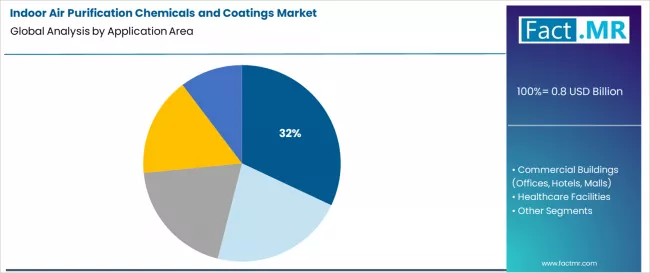
Residential buildings represent the largest application area, commanding a 32% share. Growing homeowner awareness of health risks associated with indoor pollutants, from off-gassing furniture to cooking fumes, is a primary driver.
The residential renovation and new construction markets are increasingly incorporating air-purifying paints, coatings, and integrated systems as standard wellness features. This consumer-driven demand, often linked to smart home trends, creates a high-volume, consistent market for these technologies.
By Integration Type, Which Method is Most Effective for Whole-Building Solutions?
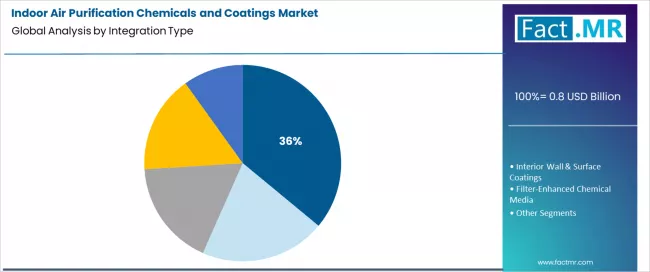
HVAC system integration is the leading method, with a 36% share. Incorporating purification chemicals or coated components directly into heating, ventilation, and air conditioning systems allows for the continuous treatment of all air circulated throughout a building.
This centralized approach ensures consistent air quality, leverages existing airflow for maximum contact with active agents, and simplifies maintenance. It is particularly favored in commercial and large residential buildings for its efficiency and scalability, making it the backbone of engineered indoor air quality solutions.
What are the Drivers, Restraints, and Key Trends of the Indoor Air Purification Chemicals and Coatings Market?
The primary market driver is a lasting global emphasis on health and wellness, transforming indoor air quality from a niche concern into a mainstream priority for homeowners, employers, and building managers. Stricter building codes and green certification standards (like WELL, LEED) that reward low VOC emissions and pathogen mitigation are mandating higher performance. Rising urbanization and increased time spent indoors further amplify demand for technologies that create safer, cleaner indoor environments, moving beyond mere ventilation.
A significant market restraint is the need for clear, standardized metrics and certifications to validate product efficacy claims, as performance can vary drastically based on environmental conditions. The longevity and re-activation requirements of some technologies, like photocatalysts needing specific light wavelengths, pose practical challenges. Higher upfront costs compared to conventional paints or filters can also be a barrier to widespread adoption, especially in price-sensitive market segments, necessitating clear demonstrations of long-term value.
Key trends include the rapid development of multi-functional smart coatings that combine VOC neutralization, antimicrobial properties, and even humidity regulation in a single product. There is a strong movement toward biobased and eco-friendly chemical formulations to ensure the purification process does not introduce new toxins. The market is also advancing through integration with IoT ecosystems, where sensor networks monitor air quality in real-time and automatically activate or modulate purification systems—such as releasing neutralizing agents from HVAC units—ensuring optimal performance and energy efficiency.
Analysis of the Indoor Air Purification Chemicals and Coatings Market by Key Countries
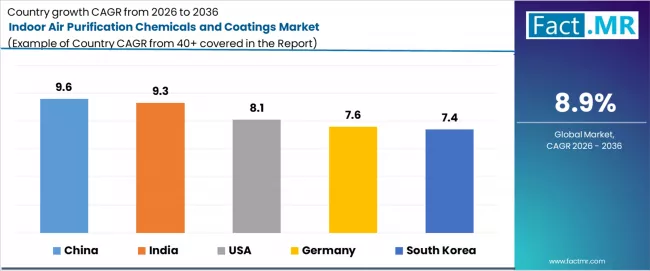
| Country | CAGR (2026-2036) |
|---|---|
| China | 9.60% |
| India | 9.30% |
| USA | 8.10% |
| Germany | 7.60% |
| South Korea | 7.40% |
How do China’s Urban Air Quality Challenges and Construction Boom Influence Demand?
Severe outdoor air pollution issues that have heightened public sensitivity to all air quality matters, including indoors, drive China’s leading CAGR of 9.60%. The massive volume of new residential and commercial construction, along with national Healthy China initiatives, fuels the integration of air-purifying technologies as standard features.
Government standards promoting green buildings and a burgeoning middle-class demand for healthier homes create a vast, policy-supported market for advanced coatings and integrated purification systems.
What is the Impact of India’s Rapid Urbanization and Growing Health Awareness?
India’s 9.30% growth is propelled by its explosive urban development and increasing health consciousness among its large population. Rising disposable incomes are driving demand for premium residential and commercial spaces with wellness amenities, including advanced air purification.
The country's challenging outdoor air quality in major cities further accelerates the need for effective indoor sanctuaries, making air-purifying paints and HVAC-integrated solutions key selling points in real estate and a growing retail category.
How does the USA’s Mature Wellness Market and Renovation Cycle Drive Adoption?
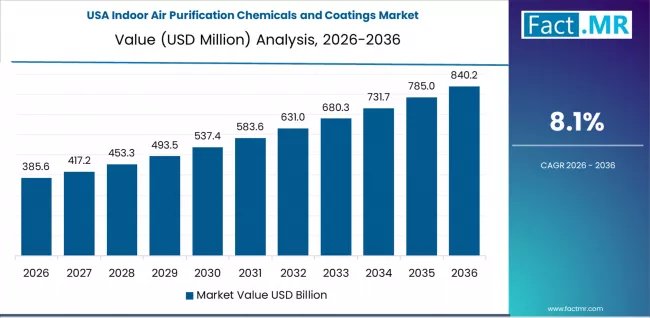
A sophisticated consumer and commercial market for health and wellness products support the USA’s 8.10% CAGR. High awareness, robust green building programs, and a strong renovation cycle in both residential and commercial sectors create steady demand.
The market is characterized by a shift from standalone purifiers to built-in solutions, with manufacturers of paints, coatings, and HVAC equipment actively developing and marketing integrated air-purifying technologies as premium, value-added offerings.
Why is Germany a Key Market for High-Performance and Sustainable Building Solutions?
Germany’s 7.60% growth reflects its stringent building energy efficiency (EnEV) and indoor climate standards. German engineers and consumers prioritize holistic, high-performance solutions that are also environmentally sustainable.
This drives innovation and demand for highly effective, durable, and preferably eco-certified air purification coatings and chemicals, particularly for integration into passive house designs and commercial retrofits where ventilation is minimized and air quality is paramount.
What Role does South Korea’s Tech-Savvy Population and Dense Living Play?
South Korea’s 7.40% growth is anchored in its technologically advanced society and high-density urban living. Consumers are quick to adopt smart home technologies that include integrated air quality monitoring and purification.
The prevalence of officetels (combined office-residences) and a cultural focus on cleanliness and innovation create a ripe market for smart sensor-activated chemical systems, advanced photocatalytic coatings, and sleek, integrated purification devices that align with the country’s high-tech aesthetic.
Competitive Landscape of the Indoor Air Purification Chemicals and Coatings Market
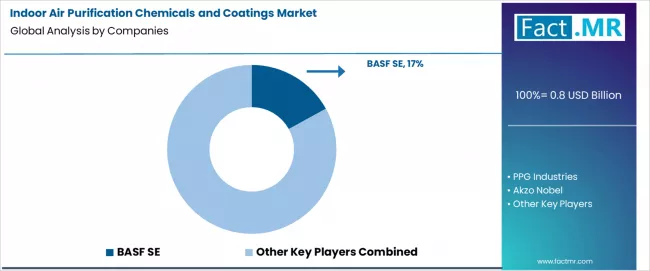
Established global paint, coating, and specialty chemical corporations leveraging their brands, distribution networks, and R&D capabilities dominate the competitive landscape. Leaders like BASF, PPG, and Akzo Nobel compete through proprietary chemical formulations, such as advanced photocatalysts or novel VOC-absorbing polymers, integrated into their core product lines.
Competition centers on securing third-party health and environmental certifications, forming partnerships with HVAC manufacturers and property developers, and marketing the wellness benefits directly to consumers and business clients. A key differentiator is the ability to provide a complete ecosystem of compatible products, from wall paints to HVAC treatments, supported by performance data.
Key Players in the Indoor Air Purification Chemicals and Coatings Market
- BASF SE
- PPG Industries
- Akzo Nobel
- Sherwin-Williams
- RPM International
Scope of Report
| Items | Values |
|---|---|
| Quantitative Units | USD Billion |
| Coating Type | Photocatalytic, Antimicrobial, VOC Neutralizing, Adsorbent Coatings, Specialty Chemicals |
| Application Area | Residential, Commercial, Healthcare, Industrial, Educational |
| Integration Type | HVAC Integration, Surface Coatings, Filter Media, Standalone Devices, Smart Systems |
| Key Countries | China, India, USA, Germany, South Korea |
| Key Companies | BASF SE, PPG Industries, Akzo Nobel, Sherwin-Williams, RPM International |
| Additional Analysis | Analysis of photocatalytic activation spectra and efficiency; long-term durability and re-activation requirements; impact on indoor ozone levels; antimicrobial efficacy testing protocols; regulatory landscape for health and environmental claims; consumer perception and willingness-to-pay studies. |
Market by Segments
-
Coating Type :
- Photocatalytic (TiO₂-Based) Coatings
- Antimicrobial & Antiviral Chemical Coatings
- VOC & Formaldehyde Neutralizing Agents
- Activated Carbon & Adsorbent Coatings
- Other Specialty Indoor Air Purification Chemicals
-
Application Area :
- Residential Buildings
- Commercial Buildings (Offices, Hotels, Malls)
- Healthcare Facilities
- Industrial Indoor Environments
- Educational & Public Infrastructure
-
Integration Type :
- HVAC System Integrated Coatings & Chemicals
- Interior Wall & Surface Coatings
- Filter-Enhanced Chemical Media
- Standalone Indoor Air Purification Devices
- Smart Sensor-Activated Chemical Systems
-
Region :
-
North America
- USA
- Canada
-
Latin America
- Brazil
- Mexico
- Argentina
- Rest of Latin America
-
Western Europe
- Germany
- UK
- France
- Spain
- Italy
- BENELUX
- Rest of Western Europe
-
Eastern Europe
- Russia
- Poland
- Czech Republic
- Rest of Eastern Europe
-
East Asia
- China
- Japan
- South Korea
- Rest of East Asia
-
South Asia & Pacific
- India
- ASEAN
- Australia
- Rest of South Asia & Pacific
-
MEA
- Saudi Arabia
- UAE
- Turkiye
- Rest of MEA
-
Table of Content
- Executive Summary
- Global Market Outlook
- Demand to side Trends
- Supply to side Trends
- Technology Roadmap Analysis
- Analysis and Recommendations
- Market Overview
- Market Coverage / Taxonomy
- Market Definition / Scope / Limitations
- Market Background
- Market Dynamics
- Drivers
- Restraints
- Opportunity
- Trends
- Scenario Forecast
- Demand in Optimistic Scenario
- Demand in Likely Scenario
- Demand in Conservative Scenario
- Opportunity Map Analysis
- Product Life Cycle Analysis
- Supply Chain Analysis
- Investment Feasibility Matrix
- Value Chain Analysis
- PESTLE and Porter’s Analysis
- Regulatory Landscape
- Regional Parent Market Outlook
- Production and Consumption Statistics
- Import and Export Statistics
- Market Dynamics
- Global Market Analysis 2021 to 2025 and Forecast, 2026 to 2036
- Historical Market Size Value (USD Million) Analysis, 2021 to 2025
- Current and Future Market Size Value (USD Million) Projections, 2026 to 2036
- Y to o to Y Growth Trend Analysis
- Absolute $ Opportunity Analysis
- Global Market Pricing Analysis 2021 to 2025 and Forecast 2026 to 2036
- Global Market Analysis 2021 to 2025 and Forecast 2026 to 2036, By Coating Type
- Introduction / Key Findings
- Historical Market Size Value (USD Million) Analysis By Coating Type, 2021 to 2025
- Current and Future Market Size Value (USD Million) Analysis and Forecast By Coating Type, 2026 to 2036
- Photocatalytic (TiO₂-Based) Coatings
- Antimicrobial & Antiviral Chemical Coatings
- VOC & Formaldehyde Neutralizing Agents
- Activated Carbon & Adsorbent Coatings
- Other Specialty Indoor Air Purification Chemicals
- Photocatalytic (TiO₂-Based) Coatings
- Y to o to Y Growth Trend Analysis By Coating Type, 2021 to 2025
- Absolute $ Opportunity Analysis By Coating Type, 2026 to 2036
- Global Market Analysis 2021 to 2025 and Forecast 2026 to 2036, By Application Area
- Introduction / Key Findings
- Historical Market Size Value (USD Million) Analysis By Application Area, 2021 to 2025
- Current and Future Market Size Value (USD Million) Analysis and Forecast By Application Area, 2026 to 2036
- Residential Buildings
- Commercial Buildings (Offices, Hotels, Malls)
- Healthcare Facilities
- Industrial Indoor Environments
- Educational & Public Infrastructure
- Residential Buildings
- Y to o to Y Growth Trend Analysis By Application Area, 2021 to 2025
- Absolute $ Opportunity Analysis By Application Area, 2026 to 2036
- Global Market Analysis 2021 to 2025 and Forecast 2026 to 2036, By Integration Type
- Introduction / Key Findings
- Historical Market Size Value (USD Million) Analysis By Integration Type, 2021 to 2025
- Current and Future Market Size Value (USD Million) Analysis and Forecast By Integration Type, 2026 to 2036
- HVAC System Integrated Coatings & Chemicals
- Interior Wall & Surface Coatings
- Filter-Enhanced Chemical Media
- Standalone Indoor Air Purification Devices
- Smart Sensor-Activated Chemical Systems
- HVAC System Integrated Coatings & Chemicals
- Y to o to Y Growth Trend Analysis By Integration Type, 2021 to 2025
- Absolute $ Opportunity Analysis By Integration Type, 2026 to 2036
- Global Market Analysis 2021 to 2025 and Forecast 2026 to 2036, By Region
- Introduction
- Historical Market Size Value (USD Million) Analysis By Region, 2021 to 2025
- Current Market Size Value (USD Million) Analysis and Forecast By Region, 2026 to 2036
- North America
- Latin America
- Western Europe
- Eastern Europe
- East Asia
- South Asia and Pacific
- Middle East & Africa
- Market Attractiveness Analysis By Region
- North America Market Analysis 2021 to 2025 and Forecast 2026 to 2036, By Country
- Historical Market Size Value (USD Million) Trend Analysis By Market Taxonomy, 2021 to 2025
- Market Size Value (USD Million) Forecast By Market Taxonomy, 2026 to 2036
- By Country
- USA
- Canada
- Mexico
- By Coating Type
- By Application Area
- By Integration Type
- By Country
- Market Attractiveness Analysis
- By Country
- By Coating Type
- By Application Area
- By Integration Type
- Key Takeaways
- Latin America Market Analysis 2021 to 2025 and Forecast 2026 to 2036, By Country
- Historical Market Size Value (USD Million) Trend Analysis By Market Taxonomy, 2021 to 2025
- Market Size Value (USD Million) Forecast By Market Taxonomy, 2026 to 2036
- By Country
- Brazil
- Chile
- Rest of Latin America
- By Coating Type
- By Application Area
- By Integration Type
- By Country
- Market Attractiveness Analysis
- By Country
- By Coating Type
- By Application Area
- By Integration Type
- Key Takeaways
- Western Europe Market Analysis 2021 to 2025 and Forecast 2026 to 2036, By Country
- Historical Market Size Value (USD Million) Trend Analysis By Market Taxonomy, 2021 to 2025
- Market Size Value (USD Million) Forecast By Market Taxonomy, 2026 to 2036
- By Country
- Germany
- UK
- Italy
- Spain
- France
- Nordic
- BENELUX
- Rest of Western Europe
- By Coating Type
- By Application Area
- By Integration Type
- By Country
- Market Attractiveness Analysis
- By Country
- By Coating Type
- By Application Area
- By Integration Type
- Key Takeaways
- Eastern Europe Market Analysis 2021 to 2025 and Forecast 2026 to 2036, By Country
- Historical Market Size Value (USD Million) Trend Analysis By Market Taxonomy, 2021 to 2025
- Market Size Value (USD Million) Forecast By Market Taxonomy, 2026 to 2036
- By Country
- Russia
- Poland
- Hungary
- Balkan & Baltic
- Rest of Eastern Europe
- By Coating Type
- By Application Area
- By Integration Type
- By Country
- Market Attractiveness Analysis
- By Country
- By Coating Type
- By Application Area
- By Integration Type
- Key Takeaways
- East Asia Market Analysis 2021 to 2025 and Forecast 2026 to 2036, By Country
- Historical Market Size Value (USD Million) Trend Analysis By Market Taxonomy, 2021 to 2025
- Market Size Value (USD Million) Forecast By Market Taxonomy, 2026 to 2036
- By Country
- China
- Japan
- South Korea
- By Coating Type
- By Application Area
- By Integration Type
- By Country
- Market Attractiveness Analysis
- By Country
- By Coating Type
- By Application Area
- By Integration Type
- Key Takeaways
- South Asia and Pacific Market Analysis 2021 to 2025 and Forecast 2026 to 2036, By Country
- Historical Market Size Value (USD Million) Trend Analysis By Market Taxonomy, 2021 to 2025
- Market Size Value (USD Million) Forecast By Market Taxonomy, 2026 to 2036
- By Country
- India
- ASEAN
- Australia & New Zealand
- Rest of South Asia and Pacific
- By Coating Type
- By Application Area
- By Integration Type
- By Country
- Market Attractiveness Analysis
- By Country
- By Coating Type
- By Application Area
- By Integration Type
- Key Takeaways
- Middle East & Africa Market Analysis 2021 to 2025 and Forecast 2026 to 2036, By Country
- Historical Market Size Value (USD Million) Trend Analysis By Market Taxonomy, 2021 to 2025
- Market Size Value (USD Million) Forecast By Market Taxonomy, 2026 to 2036
- By Country
- Kingdom of Saudi Arabia
- Other GCC Countries
- Turkiye
- South Africa
- Other African Union
- Rest of Middle East & Africa
- By Coating Type
- By Application Area
- By Integration Type
- By Country
- Market Attractiveness Analysis
- By Country
- By Coating Type
- By Application Area
- By Integration Type
- Key Takeaways
- Key Countries Market Analysis
- USA
- Pricing Analysis
- Market Share Analysis, 2025
- By Coating Type
- By Application Area
- By Integration Type
- Canada
- Pricing Analysis
- Market Share Analysis, 2025
- By Coating Type
- By Application Area
- By Integration Type
- Mexico
- Pricing Analysis
- Market Share Analysis, 2025
- By Coating Type
- By Application Area
- By Integration Type
- Brazil
- Pricing Analysis
- Market Share Analysis, 2025
- By Coating Type
- By Application Area
- By Integration Type
- Chile
- Pricing Analysis
- Market Share Analysis, 2025
- By Coating Type
- By Application Area
- By Integration Type
- Germany
- Pricing Analysis
- Market Share Analysis, 2025
- By Coating Type
- By Application Area
- By Integration Type
- UK
- Pricing Analysis
- Market Share Analysis, 2025
- By Coating Type
- By Application Area
- By Integration Type
- Italy
- Pricing Analysis
- Market Share Analysis, 2025
- By Coating Type
- By Application Area
- By Integration Type
- Spain
- Pricing Analysis
- Market Share Analysis, 2025
- By Coating Type
- By Application Area
- By Integration Type
- France
- Pricing Analysis
- Market Share Analysis, 2025
- By Coating Type
- By Application Area
- By Integration Type
- India
- Pricing Analysis
- Market Share Analysis, 2025
- By Coating Type
- By Application Area
- By Integration Type
- ASEAN
- Pricing Analysis
- Market Share Analysis, 2025
- By Coating Type
- By Application Area
- By Integration Type
- Australia & New Zealand
- Pricing Analysis
- Market Share Analysis, 2025
- By Coating Type
- By Application Area
- By Integration Type
- China
- Pricing Analysis
- Market Share Analysis, 2025
- By Coating Type
- By Application Area
- By Integration Type
- Japan
- Pricing Analysis
- Market Share Analysis, 2025
- By Coating Type
- By Application Area
- By Integration Type
- South Korea
- Pricing Analysis
- Market Share Analysis, 2025
- By Coating Type
- By Application Area
- By Integration Type
- Russia
- Pricing Analysis
- Market Share Analysis, 2025
- By Coating Type
- By Application Area
- By Integration Type
- Poland
- Pricing Analysis
- Market Share Analysis, 2025
- By Coating Type
- By Application Area
- By Integration Type
- Hungary
- Pricing Analysis
- Market Share Analysis, 2025
- By Coating Type
- By Application Area
- By Integration Type
- Kingdom of Saudi Arabia
- Pricing Analysis
- Market Share Analysis, 2025
- By Coating Type
- By Application Area
- By Integration Type
- Turkiye
- Pricing Analysis
- Market Share Analysis, 2025
- By Coating Type
- By Application Area
- By Integration Type
- South Africa
- Pricing Analysis
- Market Share Analysis, 2025
- By Coating Type
- By Application Area
- By Integration Type
- USA
- Market Structure Analysis
- Competition Dashboard
- Competition Benchmarking
- Market Share Analysis of Top Players
- By Regional
- By Coating Type
- By Application Area
- By Integration Type
- Competition Analysis
- Competition Deep Dive
- BASF SE
- Overview
- Product Portfolio
- Profitability by Market Segments (Product/Age /Sales Channel/Region)
- Sales Footprint
- Strategy Overview
- Marketing Strategy
- Product Strategy
- Channel Strategy
- PPG Industries
- Akzo Nobel
- Sherwin-Williams
- RPM International
- BASF SE
- Competition Deep Dive
- Assumptions & Acronyms Used
- Research Methodology
List Of Table
- Table 1: Global Market Value (USD Million) Forecast by Region, 2021 to 2036
- Table 2: Global Market Value (USD Million) Forecast by Coating Type, 2021 to 2036
- Table 3: Global Market Value (USD Million) Forecast by Application Area, 2021 to 2036
- Table 4: Global Market Value (USD Million) Forecast by Integration Type, 2021 to 2036
- Table 5: North America Market Value (USD Million) Forecast by Country, 2021 to 2036
- Table 6: North America Market Value (USD Million) Forecast by Coating Type, 2021 to 2036
- Table 7: North America Market Value (USD Million) Forecast by Application Area, 2021 to 2036
- Table 8: North America Market Value (USD Million) Forecast by Integration Type, 2021 to 2036
- Table 9: Latin America Market Value (USD Million) Forecast by Country, 2021 to 2036
- Table 10: Latin America Market Value (USD Million) Forecast by Coating Type, 2021 to 2036
- Table 11: Latin America Market Value (USD Million) Forecast by Application Area, 2021 to 2036
- Table 12: Latin America Market Value (USD Million) Forecast by Integration Type, 2021 to 2036
- Table 13: Western Europe Market Value (USD Million) Forecast by Country, 2021 to 2036
- Table 14: Western Europe Market Value (USD Million) Forecast by Coating Type, 2021 to 2036
- Table 15: Western Europe Market Value (USD Million) Forecast by Application Area, 2021 to 2036
- Table 16: Western Europe Market Value (USD Million) Forecast by Integration Type, 2021 to 2036
- Table 17: Eastern Europe Market Value (USD Million) Forecast by Country, 2021 to 2036
- Table 18: Eastern Europe Market Value (USD Million) Forecast by Coating Type, 2021 to 2036
- Table 19: Eastern Europe Market Value (USD Million) Forecast by Application Area, 2021 to 2036
- Table 20: Eastern Europe Market Value (USD Million) Forecast by Integration Type, 2021 to 2036
- Table 21: East Asia Market Value (USD Million) Forecast by Country, 2021 to 2036
- Table 22: East Asia Market Value (USD Million) Forecast by Coating Type, 2021 to 2036
- Table 23: East Asia Market Value (USD Million) Forecast by Application Area, 2021 to 2036
- Table 24: East Asia Market Value (USD Million) Forecast by Integration Type, 2021 to 2036
- Table 25: South Asia and Pacific Market Value (USD Million) Forecast by Country, 2021 to 2036
- Table 26: South Asia and Pacific Market Value (USD Million) Forecast by Coating Type, 2021 to 2036
- Table 27: South Asia and Pacific Market Value (USD Million) Forecast by Application Area, 2021 to 2036
- Table 28: South Asia and Pacific Market Value (USD Million) Forecast by Integration Type, 2021 to 2036
- Table 29: Middle East & Africa Market Value (USD Million) Forecast by Country, 2021 to 2036
- Table 30: Middle East & Africa Market Value (USD Million) Forecast by Coating Type, 2021 to 2036
- Table 31: Middle East & Africa Market Value (USD Million) Forecast by Application Area, 2021 to 2036
- Table 32: Middle East & Africa Market Value (USD Million) Forecast by Integration Type, 2021 to 2036
List Of Figures
- Figure 1: Global Market Pricing Analysis
- Figure 2: Global Market Value (USD Million) Forecast 2021 to 2036
- Figure 3: Global Market Value Share and BPS Analysis by Coating Type, 2026 and 2036
- Figure 4: Global Market Y to o to Y Growth Comparison by Coating Type, 2026 to 2036
- Figure 5: Global Market Attractiveness Analysis by Coating Type
- Figure 6: Global Market Value Share and BPS Analysis by Application Area, 2026 and 2036
- Figure 7: Global Market Y to o to Y Growth Comparison by Application Area, 2026 to 2036
- Figure 8: Global Market Attractiveness Analysis by Application Area
- Figure 9: Global Market Value Share and BPS Analysis by Integration Type, 2026 and 2036
- Figure 10: Global Market Y to o to Y Growth Comparison by Integration Type, 2026 to 2036
- Figure 11: Global Market Attractiveness Analysis by Integration Type
- Figure 12: Global Market Value (USD Million) Share and BPS Analysis by Region, 2026 and 2036
- Figure 13: Global Market Y to o to Y Growth Comparison by Region, 2026 to 2036
- Figure 14: Global Market Attractiveness Analysis by Region
- Figure 15: North America Market Incremental Dollar Opportunity, 2026 to 2036
- Figure 16: Latin America Market Incremental Dollar Opportunity, 2026 to 2036
- Figure 17: Western Europe Market Incremental Dollar Opportunity, 2026 to 2036
- Figure 18: Eastern Europe Market Incremental Dollar Opportunity, 2026 to 2036
- Figure 19: East Asia Market Incremental Dollar Opportunity, 2026 to 2036
- Figure 20: South Asia and Pacific Market Incremental Dollar Opportunity, 2026 to 2036
- Figure 21: Middle East & Africa Market Incremental Dollar Opportunity, 2026 to 2036
- Figure 22: North America Market Value Share and BPS Analysis by Country, 2026 and 2036
- Figure 23: North America Market Value Share and BPS Analysis by Coating Type, 2026 and 2036
- Figure 24: North America Market Y to o to Y Growth Comparison by Coating Type, 2026 to 2036
- Figure 25: North America Market Attractiveness Analysis by Coating Type
- Figure 26: North America Market Value Share and BPS Analysis by Application Area, 2026 and 2036
- Figure 27: North America Market Y to o to Y Growth Comparison by Application Area, 2026 to 2036
- Figure 28: North America Market Attractiveness Analysis by Application Area
- Figure 29: North America Market Value Share and BPS Analysis by Integration Type, 2026 and 2036
- Figure 30: North America Market Y to o to Y Growth Comparison by Integration Type, 2026 to 2036
- Figure 31: North America Market Attractiveness Analysis by Integration Type
- Figure 32: Latin America Market Value Share and BPS Analysis by Country, 2026 and 2036
- Figure 33: Latin America Market Value Share and BPS Analysis by Coating Type, 2026 and 2036
- Figure 34: Latin America Market Y to o to Y Growth Comparison by Coating Type, 2026 to 2036
- Figure 35: Latin America Market Attractiveness Analysis by Coating Type
- Figure 36: Latin America Market Value Share and BPS Analysis by Application Area, 2026 and 2036
- Figure 37: Latin America Market Y to o to Y Growth Comparison by Application Area, 2026 to 2036
- Figure 38: Latin America Market Attractiveness Analysis by Application Area
- Figure 39: Latin America Market Value Share and BPS Analysis by Integration Type, 2026 and 2036
- Figure 40: Latin America Market Y to o to Y Growth Comparison by Integration Type, 2026 to 2036
- Figure 41: Latin America Market Attractiveness Analysis by Integration Type
- Figure 42: Western Europe Market Value Share and BPS Analysis by Country, 2026 and 2036
- Figure 43: Western Europe Market Value Share and BPS Analysis by Coating Type, 2026 and 2036
- Figure 44: Western Europe Market Y to o to Y Growth Comparison by Coating Type, 2026 to 2036
- Figure 45: Western Europe Market Attractiveness Analysis by Coating Type
- Figure 46: Western Europe Market Value Share and BPS Analysis by Application Area, 2026 and 2036
- Figure 47: Western Europe Market Y to o to Y Growth Comparison by Application Area, 2026 to 2036
- Figure 48: Western Europe Market Attractiveness Analysis by Application Area
- Figure 49: Western Europe Market Value Share and BPS Analysis by Integration Type, 2026 and 2036
- Figure 50: Western Europe Market Y to o to Y Growth Comparison by Integration Type, 2026 to 2036
- Figure 51: Western Europe Market Attractiveness Analysis by Integration Type
- Figure 52: Eastern Europe Market Value Share and BPS Analysis by Country, 2026 and 2036
- Figure 53: Eastern Europe Market Value Share and BPS Analysis by Coating Type, 2026 and 2036
- Figure 54: Eastern Europe Market Y to o to Y Growth Comparison by Coating Type, 2026 to 2036
- Figure 55: Eastern Europe Market Attractiveness Analysis by Coating Type
- Figure 56: Eastern Europe Market Value Share and BPS Analysis by Application Area, 2026 and 2036
- Figure 57: Eastern Europe Market Y to o to Y Growth Comparison by Application Area, 2026 to 2036
- Figure 58: Eastern Europe Market Attractiveness Analysis by Application Area
- Figure 59: Eastern Europe Market Value Share and BPS Analysis by Integration Type, 2026 and 2036
- Figure 60: Eastern Europe Market Y to o to Y Growth Comparison by Integration Type, 2026 to 2036
- Figure 61: Eastern Europe Market Attractiveness Analysis by Integration Type
- Figure 62: East Asia Market Value Share and BPS Analysis by Country, 2026 and 2036
- Figure 63: East Asia Market Value Share and BPS Analysis by Coating Type, 2026 and 2036
- Figure 64: East Asia Market Y to o to Y Growth Comparison by Coating Type, 2026 to 2036
- Figure 65: East Asia Market Attractiveness Analysis by Coating Type
- Figure 66: East Asia Market Value Share and BPS Analysis by Application Area, 2026 and 2036
- Figure 67: East Asia Market Y to o to Y Growth Comparison by Application Area, 2026 to 2036
- Figure 68: East Asia Market Attractiveness Analysis by Application Area
- Figure 69: East Asia Market Value Share and BPS Analysis by Integration Type, 2026 and 2036
- Figure 70: East Asia Market Y to o to Y Growth Comparison by Integration Type, 2026 to 2036
- Figure 71: East Asia Market Attractiveness Analysis by Integration Type
- Figure 72: South Asia and Pacific Market Value Share and BPS Analysis by Country, 2026 and 2036
- Figure 73: South Asia and Pacific Market Value Share and BPS Analysis by Coating Type, 2026 and 2036
- Figure 74: South Asia and Pacific Market Y to o to Y Growth Comparison by Coating Type, 2026 to 2036
- Figure 75: South Asia and Pacific Market Attractiveness Analysis by Coating Type
- Figure 76: South Asia and Pacific Market Value Share and BPS Analysis by Application Area, 2026 and 2036
- Figure 77: South Asia and Pacific Market Y to o to Y Growth Comparison by Application Area, 2026 to 2036
- Figure 78: South Asia and Pacific Market Attractiveness Analysis by Application Area
- Figure 79: South Asia and Pacific Market Value Share and BPS Analysis by Integration Type, 2026 and 2036
- Figure 80: South Asia and Pacific Market Y to o to Y Growth Comparison by Integration Type, 2026 to 2036
- Figure 81: South Asia and Pacific Market Attractiveness Analysis by Integration Type
- Figure 82: Middle East & Africa Market Value Share and BPS Analysis by Country, 2026 and 2036
- Figure 83: Middle East & Africa Market Value Share and BPS Analysis by Coating Type, 2026 and 2036
- Figure 84: Middle East & Africa Market Y to o to Y Growth Comparison by Coating Type, 2026 to 2036
- Figure 85: Middle East & Africa Market Attractiveness Analysis by Coating Type
- Figure 86: Middle East & Africa Market Value Share and BPS Analysis by Application Area, 2026 and 2036
- Figure 87: Middle East & Africa Market Y to o to Y Growth Comparison by Application Area, 2026 to 2036
- Figure 88: Middle East & Africa Market Attractiveness Analysis by Application Area
- Figure 89: Middle East & Africa Market Value Share and BPS Analysis by Integration Type, 2026 and 2036
- Figure 90: Middle East & Africa Market Y to o to Y Growth Comparison by Integration Type, 2026 to 2036
- Figure 91: Middle East & Africa Market Attractiveness Analysis by Integration Type
- Figure 92: Global Market - Tier Structure Analysis
- Figure 93: Global Market - Company Share Analysis
- FAQs -
How big is the indoor air purification chemicals and coatings market in 2026?
The global indoor air purification chemicals and coatings market is estimated to be valued at USD 0.8 billion in 2026.
What will be the size of indoor air purification chemicals and coatings market in 2036?
The market size for the indoor air purification chemicals and coatings market is projected to reach USD 1.8 billion by 2036.
How much will be the indoor air purification chemicals and coatings market growth between 2026 and 2036?
The indoor air purification chemicals and coatings market is expected to grow at a 8.9% CAGR between 2026 and 2036.
What are the key product types in the indoor air purification chemicals and coatings market?
The key product types in indoor air purification chemicals and coatings market are photocatalytic (tio₂-based) coatings, antimicrobial & antiviral chemical coatings, voc & formaldehyde neutralizing agents, activated carbon & adsorbent coatings and other specialty indoor air purification chemicals.
Which application area segment to contribute significant share in the indoor air purification chemicals and coatings market in 2026?
In terms of application area, residential buildings segment to command 32.0% share in the indoor air purification chemicals and coatings market in 2026.