Solid Sorbents for Direct Air Capture Market
Solid Sorbents for Direct Air Capture Market Size and Share Forecast Outlook 2026 to 2036
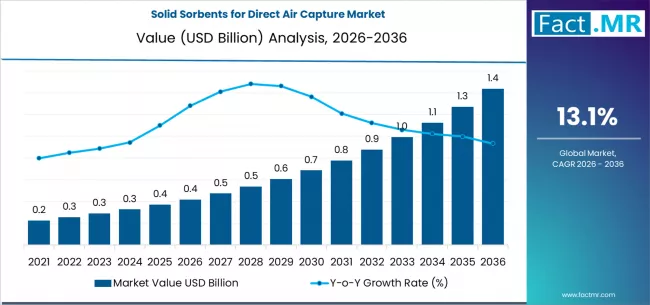
Solid sorbents for direct air capture market is projected to grow from USD 0.4 billion in 2026 to USD 1.4 billion by 2036, at a CAGR of 13.1%. Amine-Functionalized Solid Sorbents will dominate with a 36.0% market share, while temperature swing adsorption (tsa) will lead the technology type segment with a 38.0% share.
Solid Sorbents for Direct Air Capture Market Forecast and Outlook 2026 to 2036
The market for solid sorbents for direct air capture (DAC) is entering a phase of exponential growth, driven by the escalating need for scalable carbon removal solutions. Projected to surge from USD 0.42 billion in 2026 to USD 1.44 billion by 2036, the market is set to expand at a remarkable CAGR of 13.1% over the forecast period.
Key Takeaways from the Solid Sorbents for Direct Air Capture Market
- Market Value for 2026: USD 0.42 Billion
- Market Value for 2036: USD 1.44 Billion
- Forecast CAGR (2026-2036): 13.1%
- Leading Sorbent Material Share (2026): Amine-Functionalized Solid Sorbents (36%)
- Leading Technology Type Share (2026): Temperature Swing Adsorption (TSA) (38%)
- Leading End-Use Sector Share (2026): Carbon Removal & Trading (Credits Market) (34%)
- Key Players in the Market: Climeworks, Carbon Engineering (Occidental), Global Thermostat, Heirloom Carbon Technologies, Carbon Capture Inc.
Amine-functionalized solid sorbents represent the dominant material class, capturing a 36% market share. Temperature Swing Adsorption (TSA) is the leading technology type, employed in 38% of systems. The carbon removal and trading sector, driven by voluntary and compliance credit markets, is the primary end-use, constituting 34% of demand.
This exceptional growth is fueled by the urgent global imperative to achieve net-zero emissions and the recognition that emission reductions alone are insufficient. DAC technology, which extracts CO₂ directly from ambient air, is increasingly viewed as essential for offsetting emissions from hard-to-abate sectors and addressing historical atmospheric carbon. Solid sorbents are at the heart of the most promising DAC systems, offering potential advantages in energy efficiency, durability, and scalability over liquid solvent approaches.
The market's trajectory is defined by the race to develop sorbents with higher CO₂ capacity, faster adsorption-desorption kinetics, and exceptional stability over thousands of cycles. Performance breakthroughs in these materials are critical for driving down the high energy requirements and capital costs of DAC, thereby enabling gigaton-scale deployment and making carbon removal a commercially and environmentally viable pillar of climate strategy.
Metric
| Metric | Value |
|---|---|
| Market Value (2026) | USD 0.42 Billion |
| Market Forecast Value (2036) | USD 1.44 Billion |
| Forecast CAGR (2026-2036) | 13.1% |
Category
| Category | Segments |
|---|---|
| Sorbent Material Type | Amine-Functionalized Solid Sorbents, Metal-Organic Frameworks, Zeolites & Activated Alumina, Activated Carbon & Carbon Fiber Sorbents, Other Hybrid & Emerging Sorbents |
| Technology Type | Temperature Swing Adsorption, Vacuum Swing Adsorption, Pressure Swing Adsorption, Electrochemical & Moisture Swing Systems, Hybrid & Novel DAC Processes |
| End-Use Sector | Carbon Removal & Trading (Credits Market), Synthetic Fuels & e-Fuels Production, Industrial Carbon Utilization (CCU), Direct Geological Storage (CCS), Other Emerging Use Cases |
| Region | North America, Latin America, Western Europe, Eastern Europe, East Asia, South Asia & Pacific, MEA |
Segmental Analysis
By Sorbent Material Type, Which Segment is the Current Industry Workhorse?
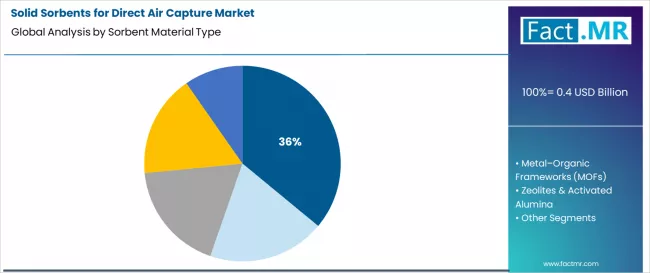
Amine-functionalized solid sorbents lead the market with a 36% share. Their dominance is based on a well-understood chemistry that grafts active amine sites onto porous solid supports like silica or alumina. This approach combines the high CO₂ selectivity of amines with the practical handling and cycling benefits of a solid material. These sorbents form the core of several first-generation commercial DAC plants, offering a balance of performance, manufacturability, and relatively proven durability that newer materials are still scaling to match.
By Technology Type, Which Process Dominates Early Commercialization?
Temperature Swing Adsorption (TSA) is the leading technology, holding a 38% share. In TSA systems, ambient air is passed over solid sorbents at near-ambient temperature to capture CO₂; the sorbent is then heated using low-grade steam or renewable electricity to release a pure CO₂ stream. This method's prominence stems from its operational simplicity, direct integration with renewable thermal energy sources, and suitability for the moderate-temperature regeneration of amine-based sorbents, making it a preferred choice for initial large-scale deployments.
By End-Use Sector, Which Application is Unlocking Immediate Revenue?
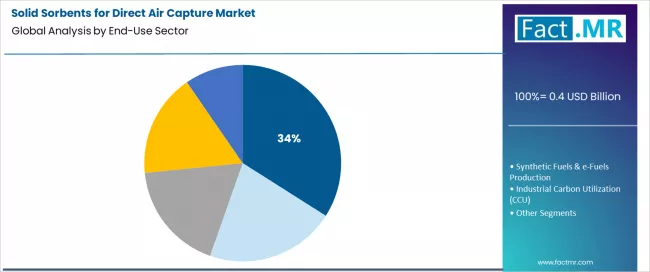
The carbon removal and trading sector, encompassing the voluntary carbon market (VCM) and emerging compliance schemes, is the largest end-use, accounting for a 34% share. High-quality DAC credits are increasingly sought by corporations to meet net-zero pledges, creating a vital early revenue stream that funds technology scale-up. This sector's demand is less sensitive to the absolute cost per ton than other applications, provided the permanence and additionality of the removal are verified, making it the foundational market for first-of-a-kind DAC facilities.
What are the Drivers, Restraints, and Key Trends of the Solid Sorbents for DAC Market?
The primary market driver is the soaring corporate and governmental demand for high-permanence, measurable carbon removal to meet net-zero commitments. Supportive policy frameworks, such as the 45Q tax credit in the USA and procurement commitments like the Frontier advance market commitment, are de-risking capital investment. Growing recognition of DAC's necessity in climate models, alongside plummeting renewable energy costs, is improving the long-term economic outlook for the technology, attracting significant venture capital and strategic investment.
A significant market restraint is the exceptionally high energy intensity and consequent operational cost of DAC processes, which is directly tied to sorbent performance. The capital expenditure for building first-of-a-kind DAC plants remains prohibitively high for widespread adoption. Sorbent degradation from impurities in ambient air (e.g., SOx, NOx, humidity) and the logistical challenges of manufacturing novel materials like MOFs at multi-kiloton scale also present substantial technical and economic hurdles.
Key trends include the intense R&D focus on low-temperature sorbents for use in Moisture or Vacuum Swing systems, which promise significant reductions in thermal energy demand. There is growing innovation in electro-swing adsorption using redox-active materials, which could allow DAC to be powered solely by renewable electricity with high efficiency. The market is also moving toward hybrid process designs that combine solid sorbents with passive air contactors or liquid systems to optimize energy use and capital cost across different climatic conditions.
Analysis of the Solid Sorbents for Direct Air Capture Market by Key Countries
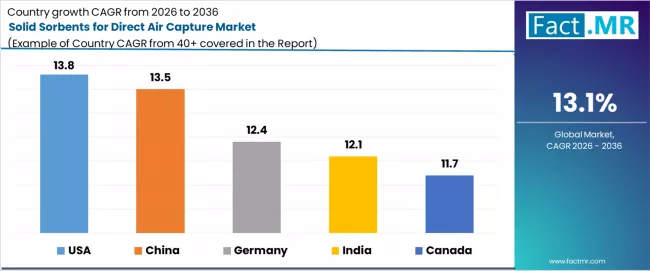
| Country | CAGR (2026-2036) |
|---|---|
| USA | 13.80% |
| China | 13.50% |
| Germany | 12.40% |
| India | 12.10% |
| Canada | 11.70% |
How is the USA’s Policy and Investment Landscape Catalyzing Market Leadership?
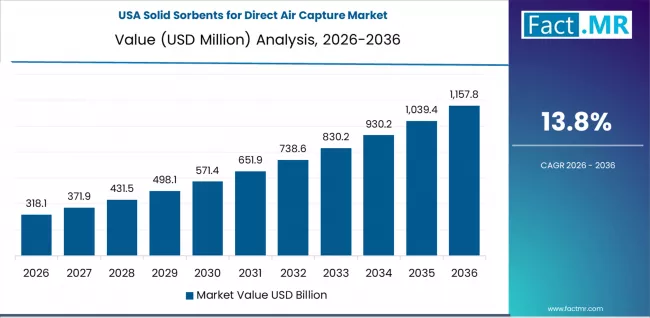
The USA’s leading CAGR of 13.80% is propelled by the world's most aggressive policy support, including the enhanced 45Q tax credit and substantial DOE funding through programs like the Regional DAC Hubs. A vibrant ecosystem of technology startups, corporate off-takers, and project finance is concentrated in the country. This environment enables rapid piloting, scale-up, and deployment of diverse solid sorbent-based DAC approaches, from amine-functionalized systems to novel electrochemical methods.
What Role does China’s Climate Strategy and Manufacturing Prowess Play?
China’s 13.50% growth is tied to its national carbon neutrality goals and its unique capacity for industrial scaling. While initially focused on point-source capture, China is increasingly directing R&D toward DAC as a strategic climate technology. Its unparalleled ability to manufacture advanced materials-including potential sorbents like MOFs and advanced carbons at low cost-positions it to become a crucial global supplier of core DAC components, even as domestic deployment accelerates.
Why is Germany a Center for High-Tech Sorbent and Process Innovation?
Germany’s 12.40% CAGR reflects its deep expertise in materials science, catalysis, and precision engineering, funded by strong public R&D grants for climate technologies. German research institutions and companies are pioneering advanced sorbents like tailored MOFs and developing highly efficient, low-energy VSA or electro-swing processes. The market focuses on technological excellence and integration with the country's industrial and renewable energy sectors.
How is India’s Unique Position Creating a Distinct Market Pathway?
India’s 12.10% growth is driven by its dual challenge of achieving development goals while managing climate vulnerability. India is exploring DAC not only for carbon removal but also for potential on-site CO₂ utilization in greenhouses or for synthetic fuels, leveraging its abundant solar potential. This focus may drive demand for durable, low-cost sorbents suited to warmer climates and decentralized applications, fostering niche innovation.
What is Driving Canada’s Focus on DAC for Storage and Fuels?
Canada’s 11.70% growth is anchored in its vast geological storage capacity, skilled energy sector workforce, and existing CO₂ pipeline infrastructure. Projects led by companies like Carbon Engineering focus on integrating solid sorbent DAC plants with enhanced oil recovery or dedicated geological storage. The country's clear regulatory framework for CCS and expertise in carbon management create a conducive environment for large-scale, storage-focused DAC deployment.
Competitive Landscape of the Solid Sorbents for Direct Air Capture Market
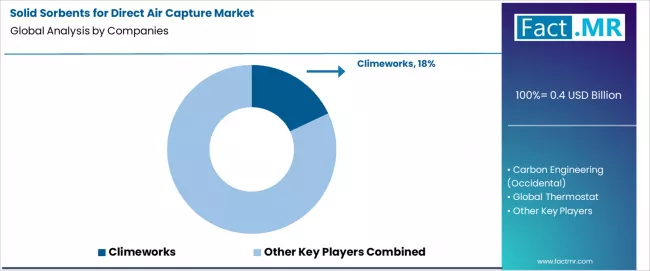
Specialized pure-play DAC technology developers, each championing a distinct sorbent and process pathway, define the competitive landscape. Leaders like Climeworks (solid amine TSA) and Heirloom (accelerated mineralization) compete on the basis of proprietary sorbent chemistry, validated plant performance data, and levelized cost reduction roadmaps.
Competition centers on securing strategic partnerships with energy companies and corporate off-takers, demonstrating durability through multi-cyclic testing, and achieving manufacturing scale for core sorbent materials. A key differentiator is the ability to move from pilot modules to integrated, multi-ton per day plants that validate cost and performance projections.
Key Players in the Solid Sorbents for Direct Air Capture Market
- Climeworks
- Carbon Engineering (Occidental)
- Global Thermostat
- Heirloom Carbon Technologies
- Carbon Capture Inc.
Scope of Report
| Items | Values |
|---|---|
| Quantitative Units | USD Billion |
| Sorbent Material Type | Amine-Functionalized Solids, MOFs, Zeolites/Alumina, Activated Carbon, Hybrid Materials |
| Technology Type | TSA, VSA, PSA, Electro/Moisture Swing, Hybrid Processes |
| End-Use Sector | Carbon Removal Credits, Synthetic Fuels, Industrial CCU, Geological Storage, Emerging Uses |
| Key Countries | USA, China, Germany, India, Canada |
| Key Companies | Climeworks, Carbon Engineering (Occidental), Global Thermostat, Heirloom Carbon Technologies, Carbon Capture Inc. |
| Additional Analysis | Analysis of sorbent adsorption isotherms and kinetics; lifetime degradation studies under real air conditions; energy balance modeling for different swing processes; techno-economic analysis linking sorbent performance to LCOC (Levelized Cost of Capture); supply chain analysis for key raw materials (amines, linker molecules for MOFs, minerals). |
Market by Segments
-
Sorbent Material Type :
- Amine-Functionalized Solid Sorbents
- Metal-Organic Frameworks (MOFs)
- Zeolites & Activated Alumina
- Activated Carbon & Carbon Fiber Sorbents
- Other Hybrid & Emerging Sorbents
-
Technology Type :
- Temperature Swing Adsorption
- Vacuum Swing Adsorption
- Pressure Swing Adsorption
- Electrochemical & Moisture Swing Systems
- Hybrid & Novel DAC Processes
-
End-Use Sector :
- Carbon Removal & Trading (Credits Market)
- Synthetic Fuels & e-Fuels Production
- Industrial Carbon Utilization (CCU)
- Direct Geological Storage (CCS)
- Other Emerging Use Cases
-
Region :
- North America
- USA
- Canada
- Latin America
- Brazil
- Mexico
- Argentina
- Rest of Latin America
- Western Europe
- Germany
- UK
- France
- Spain
- Italy
- BENELUX
- Rest of Western Europe
- Eastern Europe
- Russia
- Poland
- Czech Republic
- Rest of Eastern Europe
- East Asia
- China
- Japan
- South Korea
- Rest of East Asia
- South Asia & Pacific
- India
- ASEAN
- Australia
- Rest of South Asia & Pacific
- MEA
- Saudi Arabia
- UAE
- Turkiye
- Rest of MEA
- North America
Table of Content
- Executive Summary
- Global Market Outlook
- Demand to side Trends
- Supply to side Trends
- Technology Roadmap Analysis
- Analysis and Recommendations
- Market Overview
- Market Coverage / Taxonomy
- Market Definition / Scope / Limitations
- Market Background
- Market Dynamics
- Drivers
- Restraints
- Opportunity
- Trends
- Scenario Forecast
- Demand in Optimistic Scenario
- Demand in Likely Scenario
- Demand in Conservative Scenario
- Opportunity Map Analysis
- Product Life Cycle Analysis
- Supply Chain Analysis
- Investment Feasibility Matrix
- Value Chain Analysis
- PESTLE and Porter’s Analysis
- Regulatory Landscape
- Regional Parent Market Outlook
- Production and Consumption Statistics
- Import and Export Statistics
- Market Dynamics
- Global Market Analysis 2021 to 2025 and Forecast, 2026 to 2036
- Historical Market Size Value (USD Million) Analysis, 2021 to 2025
- Current and Future Market Size Value (USD Million) Projections, 2026 to 2036
- Y to o to Y Growth Trend Analysis
- Absolute $ Opportunity Analysis
- Global Market Pricing Analysis 2021 to 2025 and Forecast 2026 to 2036
- Global Market Analysis 2021 to 2025 and Forecast 2026 to 2036, By Sorbent Material Type
- Introduction / Key Findings
- Historical Market Size Value (USD Million) Analysis By Sorbent Material Type, 2021 to 2025
- Current and Future Market Size Value (USD Million) Analysis and Forecast By Sorbent Material Type, 2026 to 2036
- Amine-Functionalized Solid Sorbents
- Metal-Organic Frameworks (MOFs)
- Zeolites & Activated Alumina
- Activated Carbon & Carbon Fiber Sorbents
- Other Hybrid & Emerging Sorbents
- Amine-Functionalized Solid Sorbents
- Y to o to Y Growth Trend Analysis By Sorbent Material Type, 2021 to 2025
- Absolute $ Opportunity Analysis By Sorbent Material Type, 2026 to 2036
- Global Market Analysis 2021 to 2025 and Forecast 2026 to 2036, By Technology Type
- Introduction / Key Findings
- Historical Market Size Value (USD Million) Analysis By Technology Type, 2021 to 2025
- Current and Future Market Size Value (USD Million) Analysis and Forecast By Technology Type, 2026 to 2036
- Temperature Swing Adsorption (TSA)
- Vacuum Swing Adsorption (VSA)
- Pressure Swing Adsorption (PSA)
- Electrochemical & Moisture Swing Systems
- Hybrid & Novel DAC Processes
- Temperature Swing Adsorption (TSA)
- Y to o to Y Growth Trend Analysis By Technology Type, 2021 to 2025
- Absolute $ Opportunity Analysis By Technology Type, 2026 to 2036
- Global Market Analysis 2021 to 2025 and Forecast 2026 to 2036, By End-Use Sector
- Introduction / Key Findings
- Historical Market Size Value (USD Million) Analysis By End-Use Sector, 2021 to 2025
- Current and Future Market Size Value (USD Million) Analysis and Forecast By End-Use Sector, 2026 to 2036
- Carbon Removal & Trading (Credits Market)
- Synthetic Fuels & e-Fuels Production
- Industrial Carbon Utilization (CCU)
- Direct Geological Storage (CCS)
- Other Emerging Use Cases
- Carbon Removal & Trading (Credits Market)
- Y to o to Y Growth Trend Analysis By End-Use Sector, 2021 to 2025
- Absolute $ Opportunity Analysis By End-Use Sector, 2026 to 2036
- Global Market Analysis 2021 to 2025 and Forecast 2026 to 2036, By Region
- Introduction
- Historical Market Size Value (USD Million) Analysis By Region, 2021 to 2025
- Current Market Size Value (USD Million) Analysis and Forecast By Region, 2026 to 2036
- North America
- Latin America
- Western Europe
- Eastern Europe
- East Asia
- South Asia and Pacific
- Middle East & Africa
- Market Attractiveness Analysis By Region
- North America Market Analysis 2021 to 2025 and Forecast 2026 to 2036, By Country
- Historical Market Size Value (USD Million) Trend Analysis By Market Taxonomy, 2021 to 2025
- Market Size Value (USD Million) Forecast By Market Taxonomy, 2026 to 2036
- By Country
- USA
- Canada
- Mexico
- By Sorbent Material Type
- By Technology Type
- By End-Use Sector
- By Country
- Market Attractiveness Analysis
- By Country
- By Sorbent Material Type
- By Technology Type
- By End-Use Sector
- Key Takeaways
- Latin America Market Analysis 2021 to 2025 and Forecast 2026 to 2036, By Country
- Historical Market Size Value (USD Million) Trend Analysis By Market Taxonomy, 2021 to 2025
- Market Size Value (USD Million) Forecast By Market Taxonomy, 2026 to 2036
- By Country
- Brazil
- Chile
- Rest of Latin America
- By Sorbent Material Type
- By Technology Type
- By End-Use Sector
- By Country
- Market Attractiveness Analysis
- By Country
- By Sorbent Material Type
- By Technology Type
- By End-Use Sector
- Key Takeaways
- Western Europe Market Analysis 2021 to 2025 and Forecast 2026 to 2036, By Country
- Historical Market Size Value (USD Million) Trend Analysis By Market Taxonomy, 2021 to 2025
- Market Size Value (USD Million) Forecast By Market Taxonomy, 2026 to 2036
- By Country
- Germany
- UK
- Italy
- Spain
- France
- Nordic
- BENELUX
- Rest of Western Europe
- By Sorbent Material Type
- By Technology Type
- By End-Use Sector
- By Country
- Market Attractiveness Analysis
- By Country
- By Sorbent Material Type
- By Technology Type
- By End-Use Sector
- Key Takeaways
- Eastern Europe Market Analysis 2021 to 2025 and Forecast 2026 to 2036, By Country
- Historical Market Size Value (USD Million) Trend Analysis By Market Taxonomy, 2021 to 2025
- Market Size Value (USD Million) Forecast By Market Taxonomy, 2026 to 2036
- By Country
- Russia
- Poland
- Hungary
- Balkan & Baltic
- Rest of Eastern Europe
- By Sorbent Material Type
- By Technology Type
- By End-Use Sector
- By Country
- Market Attractiveness Analysis
- By Country
- By Sorbent Material Type
- By Technology Type
- By End-Use Sector
- Key Takeaways
- East Asia Market Analysis 2021 to 2025 and Forecast 2026 to 2036, By Country
- Historical Market Size Value (USD Million) Trend Analysis By Market Taxonomy, 2021 to 2025
- Market Size Value (USD Million) Forecast By Market Taxonomy, 2026 to 2036
- By Country
- China
- Japan
- South Korea
- By Sorbent Material Type
- By Technology Type
- By End-Use Sector
- By Country
- Market Attractiveness Analysis
- By Country
- By Sorbent Material Type
- By Technology Type
- By End-Use Sector
- Key Takeaways
- South Asia and Pacific Market Analysis 2021 to 2025 and Forecast 2026 to 2036, By Country
- Historical Market Size Value (USD Million) Trend Analysis By Market Taxonomy, 2021 to 2025
- Market Size Value (USD Million) Forecast By Market Taxonomy, 2026 to 2036
- By Country
- India
- ASEAN
- Australia & New Zealand
- Rest of South Asia and Pacific
- By Sorbent Material Type
- By Technology Type
- By End-Use Sector
- By Country
- Market Attractiveness Analysis
- By Country
- By Sorbent Material Type
- By Technology Type
- By End-Use Sector
- Key Takeaways
- Middle East & Africa Market Analysis 2021 to 2025 and Forecast 2026 to 2036, By Country
- Historical Market Size Value (USD Million) Trend Analysis By Market Taxonomy, 2021 to 2025
- Market Size Value (USD Million) Forecast By Market Taxonomy, 2026 to 2036
- By Country
- Kingdom of Saudi Arabia
- Other GCC Countries
- Turkiye
- South Africa
- Other African Union
- Rest of Middle East & Africa
- By Sorbent Material Type
- By Technology Type
- By End-Use Sector
- By Country
- Market Attractiveness Analysis
- By Country
- By Sorbent Material Type
- By Technology Type
- By End-Use Sector
- Key Takeaways
- Key Countries Market Analysis
- USA
- Pricing Analysis
- Market Share Analysis, 2025
- By Sorbent Material Type
- By Technology Type
- By End-Use Sector
- Canada
- Pricing Analysis
- Market Share Analysis, 2025
- By Sorbent Material Type
- By Technology Type
- By End-Use Sector
- Mexico
- Pricing Analysis
- Market Share Analysis, 2025
- By Sorbent Material Type
- By Technology Type
- By End-Use Sector
- Brazil
- Pricing Analysis
- Market Share Analysis, 2025
- By Sorbent Material Type
- By Technology Type
- By End-Use Sector
- Chile
- Pricing Analysis
- Market Share Analysis, 2025
- By Sorbent Material Type
- By Technology Type
- By End-Use Sector
- Germany
- Pricing Analysis
- Market Share Analysis, 2025
- By Sorbent Material Type
- By Technology Type
- By End-Use Sector
- UK
- Pricing Analysis
- Market Share Analysis, 2025
- By Sorbent Material Type
- By Technology Type
- By End-Use Sector
- Italy
- Pricing Analysis
- Market Share Analysis, 2025
- By Sorbent Material Type
- By Technology Type
- By End-Use Sector
- Spain
- Pricing Analysis
- Market Share Analysis, 2025
- By Sorbent Material Type
- By Technology Type
- By End-Use Sector
- France
- Pricing Analysis
- Market Share Analysis, 2025
- By Sorbent Material Type
- By Technology Type
- By End-Use Sector
- India
- Pricing Analysis
- Market Share Analysis, 2025
- By Sorbent Material Type
- By Technology Type
- By End-Use Sector
- ASEAN
- Pricing Analysis
- Market Share Analysis, 2025
- By Sorbent Material Type
- By Technology Type
- By End-Use Sector
- Australia & New Zealand
- Pricing Analysis
- Market Share Analysis, 2025
- By Sorbent Material Type
- By Technology Type
- By End-Use Sector
- China
- Pricing Analysis
- Market Share Analysis, 2025
- By Sorbent Material Type
- By Technology Type
- By End-Use Sector
- Japan
- Pricing Analysis
- Market Share Analysis, 2025
- By Sorbent Material Type
- By Technology Type
- By End-Use Sector
- South Korea
- Pricing Analysis
- Market Share Analysis, 2025
- By Sorbent Material Type
- By Technology Type
- By End-Use Sector
- Russia
- Pricing Analysis
- Market Share Analysis, 2025
- By Sorbent Material Type
- By Technology Type
- By End-Use Sector
- Poland
- Pricing Analysis
- Market Share Analysis, 2025
- By Sorbent Material Type
- By Technology Type
- By End-Use Sector
- Hungary
- Pricing Analysis
- Market Share Analysis, 2025
- By Sorbent Material Type
- By Technology Type
- By End-Use Sector
- Kingdom of Saudi Arabia
- Pricing Analysis
- Market Share Analysis, 2025
- By Sorbent Material Type
- By Technology Type
- By End-Use Sector
- Turkiye
- Pricing Analysis
- Market Share Analysis, 2025
- By Sorbent Material Type
- By Technology Type
- By End-Use Sector
- South Africa
- Pricing Analysis
- Market Share Analysis, 2025
- By Sorbent Material Type
- By Technology Type
- By End-Use Sector
- USA
- Market Structure Analysis
- Competition Dashboard
- Competition Benchmarking
- Market Share Analysis of Top Players
- By Regional
- By Sorbent Material Type
- By Technology Type
- By End-Use Sector
- Competition Analysis
- Competition Deep Dive
- Climeworks
- Overview
- Product Portfolio
- Profitability by Market Segments (Product/Age /Sales Channel/Region)
- Sales Footprint
- Strategy Overview
- Marketing Strategy
- Product Strategy
- Channel Strategy
- Carbon Engineering (Occidental)
- Global Thermostat
- Heirloom Carbon Technologies
- Carbon Capture Inc.
- Climeworks
- Competition Deep Dive
- Assumptions & Acronyms Used
- Research Methodology
List Of Table
- Table 1: Global Market Value (USD Million) Forecast by Region, 2021 to 2036
- Table 2: Global Market Value (USD Million) Forecast by Sorbent Material Type, 2021 to 2036
- Table 3: Global Market Value (USD Million) Forecast by Technology Type, 2021 to 2036
- Table 4: Global Market Value (USD Million) Forecast by End-Use Sector, 2021 to 2036
- Table 5: North America Market Value (USD Million) Forecast by Country, 2021 to 2036
- Table 6: North America Market Value (USD Million) Forecast by Sorbent Material Type, 2021 to 2036
- Table 7: North America Market Value (USD Million) Forecast by Technology Type, 2021 to 2036
- Table 8: North America Market Value (USD Million) Forecast by End-Use Sector, 2021 to 2036
- Table 9: Latin America Market Value (USD Million) Forecast by Country, 2021 to 2036
- Table 10: Latin America Market Value (USD Million) Forecast by Sorbent Material Type, 2021 to 2036
- Table 11: Latin America Market Value (USD Million) Forecast by Technology Type, 2021 to 2036
- Table 12: Latin America Market Value (USD Million) Forecast by End-Use Sector, 2021 to 2036
- Table 13: Western Europe Market Value (USD Million) Forecast by Country, 2021 to 2036
- Table 14: Western Europe Market Value (USD Million) Forecast by Sorbent Material Type, 2021 to 2036
- Table 15: Western Europe Market Value (USD Million) Forecast by Technology Type, 2021 to 2036
- Table 16: Western Europe Market Value (USD Million) Forecast by End-Use Sector, 2021 to 2036
- Table 17: Eastern Europe Market Value (USD Million) Forecast by Country, 2021 to 2036
- Table 18: Eastern Europe Market Value (USD Million) Forecast by Sorbent Material Type, 2021 to 2036
- Table 19: Eastern Europe Market Value (USD Million) Forecast by Technology Type, 2021 to 2036
- Table 20: Eastern Europe Market Value (USD Million) Forecast by End-Use Sector, 2021 to 2036
- Table 21: East Asia Market Value (USD Million) Forecast by Country, 2021 to 2036
- Table 22: East Asia Market Value (USD Million) Forecast by Sorbent Material Type, 2021 to 2036
- Table 23: East Asia Market Value (USD Million) Forecast by Technology Type, 2021 to 2036
- Table 24: East Asia Market Value (USD Million) Forecast by End-Use Sector, 2021 to 2036
- Table 25: South Asia and Pacific Market Value (USD Million) Forecast by Country, 2021 to 2036
- Table 26: South Asia and Pacific Market Value (USD Million) Forecast by Sorbent Material Type, 2021 to 2036
- Table 27: South Asia and Pacific Market Value (USD Million) Forecast by Technology Type, 2021 to 2036
- Table 28: South Asia and Pacific Market Value (USD Million) Forecast by End-Use Sector, 2021 to 2036
- Table 29: Middle East & Africa Market Value (USD Million) Forecast by Country, 2021 to 2036
- Table 30: Middle East & Africa Market Value (USD Million) Forecast by Sorbent Material Type, 2021 to 2036
- Table 31: Middle East & Africa Market Value (USD Million) Forecast by Technology Type, 2021 to 2036
- Table 32: Middle East & Africa Market Value (USD Million) Forecast by End-Use Sector, 2021 to 2036
List Of Figures
- Figure 1: Global Market Pricing Analysis
- Figure 2: Global Market Value (USD Million) Forecast 2021 to 2036
- Figure 3: Global Market Value Share and BPS Analysis by Sorbent Material Type, 2026 and 2036
- Figure 4: Global Market Y to o to Y Growth Comparison by Sorbent Material Type, 2026 to 2036
- Figure 5: Global Market Attractiveness Analysis by Sorbent Material Type
- Figure 6: Global Market Value Share and BPS Analysis by Technology Type, 2026 and 2036
- Figure 7: Global Market Y to o to Y Growth Comparison by Technology Type, 2026 to 2036
- Figure 8: Global Market Attractiveness Analysis by Technology Type
- Figure 9: Global Market Value Share and BPS Analysis by End-Use Sector, 2026 and 2036
- Figure 10: Global Market Y to o to Y Growth Comparison by End-Use Sector, 2026 to 2036
- Figure 11: Global Market Attractiveness Analysis by End-Use Sector
- Figure 12: Global Market Value (USD Million) Share and BPS Analysis by Region, 2026 and 2036
- Figure 13: Global Market Y to o to Y Growth Comparison by Region, 2026 to 2036
- Figure 14: Global Market Attractiveness Analysis by Region
- Figure 15: North America Market Incremental Dollar Opportunity, 2026 to 2036
- Figure 16: Latin America Market Incremental Dollar Opportunity, 2026 to 2036
- Figure 17: Western Europe Market Incremental Dollar Opportunity, 2026 to 2036
- Figure 18: Eastern Europe Market Incremental Dollar Opportunity, 2026 to 2036
- Figure 19: East Asia Market Incremental Dollar Opportunity, 2026 to 2036
- Figure 20: South Asia and Pacific Market Incremental Dollar Opportunity, 2026 to 2036
- Figure 21: Middle East & Africa Market Incremental Dollar Opportunity, 2026 to 2036
- Figure 22: North America Market Value Share and BPS Analysis by Country, 2026 and 2036
- Figure 23: North America Market Value Share and BPS Analysis by Sorbent Material Type, 2026 and 2036
- Figure 24: North America Market Y to o to Y Growth Comparison by Sorbent Material Type, 2026 to 2036
- Figure 25: North America Market Attractiveness Analysis by Sorbent Material Type
- Figure 26: North America Market Value Share and BPS Analysis by Technology Type, 2026 and 2036
- Figure 27: North America Market Y to o to Y Growth Comparison by Technology Type, 2026 to 2036
- Figure 28: North America Market Attractiveness Analysis by Technology Type
- Figure 29: North America Market Value Share and BPS Analysis by End-Use Sector, 2026 and 2036
- Figure 30: North America Market Y to o to Y Growth Comparison by End-Use Sector, 2026 to 2036
- Figure 31: North America Market Attractiveness Analysis by End-Use Sector
- Figure 32: Latin America Market Value Share and BPS Analysis by Country, 2026 and 2036
- Figure 33: Latin America Market Value Share and BPS Analysis by Sorbent Material Type, 2026 and 2036
- Figure 34: Latin America Market Y to o to Y Growth Comparison by Sorbent Material Type, 2026 to 2036
- Figure 35: Latin America Market Attractiveness Analysis by Sorbent Material Type
- Figure 36: Latin America Market Value Share and BPS Analysis by Technology Type, 2026 and 2036
- Figure 37: Latin America Market Y to o to Y Growth Comparison by Technology Type, 2026 to 2036
- Figure 38: Latin America Market Attractiveness Analysis by Technology Type
- Figure 39: Latin America Market Value Share and BPS Analysis by End-Use Sector, 2026 and 2036
- Figure 40: Latin America Market Y to o to Y Growth Comparison by End-Use Sector, 2026 to 2036
- Figure 41: Latin America Market Attractiveness Analysis by End-Use Sector
- Figure 42: Western Europe Market Value Share and BPS Analysis by Country, 2026 and 2036
- Figure 43: Western Europe Market Value Share and BPS Analysis by Sorbent Material Type, 2026 and 2036
- Figure 44: Western Europe Market Y to o to Y Growth Comparison by Sorbent Material Type, 2026 to 2036
- Figure 45: Western Europe Market Attractiveness Analysis by Sorbent Material Type
- Figure 46: Western Europe Market Value Share and BPS Analysis by Technology Type, 2026 and 2036
- Figure 47: Western Europe Market Y to o to Y Growth Comparison by Technology Type, 2026 to 2036
- Figure 48: Western Europe Market Attractiveness Analysis by Technology Type
- Figure 49: Western Europe Market Value Share and BPS Analysis by End-Use Sector, 2026 and 2036
- Figure 50: Western Europe Market Y to o to Y Growth Comparison by End-Use Sector, 2026 to 2036
- Figure 51: Western Europe Market Attractiveness Analysis by End-Use Sector
- Figure 52: Eastern Europe Market Value Share and BPS Analysis by Country, 2026 and 2036
- Figure 53: Eastern Europe Market Value Share and BPS Analysis by Sorbent Material Type, 2026 and 2036
- Figure 54: Eastern Europe Market Y to o to Y Growth Comparison by Sorbent Material Type, 2026 to 2036
- Figure 55: Eastern Europe Market Attractiveness Analysis by Sorbent Material Type
- Figure 56: Eastern Europe Market Value Share and BPS Analysis by Technology Type, 2026 and 2036
- Figure 57: Eastern Europe Market Y to o to Y Growth Comparison by Technology Type, 2026 to 2036
- Figure 58: Eastern Europe Market Attractiveness Analysis by Technology Type
- Figure 59: Eastern Europe Market Value Share and BPS Analysis by End-Use Sector, 2026 and 2036
- Figure 60: Eastern Europe Market Y to o to Y Growth Comparison by End-Use Sector, 2026 to 2036
- Figure 61: Eastern Europe Market Attractiveness Analysis by End-Use Sector
- Figure 62: East Asia Market Value Share and BPS Analysis by Country, 2026 and 2036
- Figure 63: East Asia Market Value Share and BPS Analysis by Sorbent Material Type, 2026 and 2036
- Figure 64: East Asia Market Y to o to Y Growth Comparison by Sorbent Material Type, 2026 to 2036
- Figure 65: East Asia Market Attractiveness Analysis by Sorbent Material Type
- Figure 66: East Asia Market Value Share and BPS Analysis by Technology Type, 2026 and 2036
- Figure 67: East Asia Market Y to o to Y Growth Comparison by Technology Type, 2026 to 2036
- Figure 68: East Asia Market Attractiveness Analysis by Technology Type
- Figure 69: East Asia Market Value Share and BPS Analysis by End-Use Sector, 2026 and 2036
- Figure 70: East Asia Market Y to o to Y Growth Comparison by End-Use Sector, 2026 to 2036
- Figure 71: East Asia Market Attractiveness Analysis by End-Use Sector
- Figure 72: South Asia and Pacific Market Value Share and BPS Analysis by Country, 2026 and 2036
- Figure 73: South Asia and Pacific Market Value Share and BPS Analysis by Sorbent Material Type, 2026 and 2036
- Figure 74: South Asia and Pacific Market Y to o to Y Growth Comparison by Sorbent Material Type, 2026 to 2036
- Figure 75: South Asia and Pacific Market Attractiveness Analysis by Sorbent Material Type
- Figure 76: South Asia and Pacific Market Value Share and BPS Analysis by Technology Type, 2026 and 2036
- Figure 77: South Asia and Pacific Market Y to o to Y Growth Comparison by Technology Type, 2026 to 2036
- Figure 78: South Asia and Pacific Market Attractiveness Analysis by Technology Type
- Figure 79: South Asia and Pacific Market Value Share and BPS Analysis by End-Use Sector, 2026 and 2036
- Figure 80: South Asia and Pacific Market Y to o to Y Growth Comparison by End-Use Sector, 2026 to 2036
- Figure 81: South Asia and Pacific Market Attractiveness Analysis by End-Use Sector
- Figure 82: Middle East & Africa Market Value Share and BPS Analysis by Country, 2026 and 2036
- Figure 83: Middle East & Africa Market Value Share and BPS Analysis by Sorbent Material Type, 2026 and 2036
- Figure 84: Middle East & Africa Market Y to o to Y Growth Comparison by Sorbent Material Type, 2026 to 2036
- Figure 85: Middle East & Africa Market Attractiveness Analysis by Sorbent Material Type
- Figure 86: Middle East & Africa Market Value Share and BPS Analysis by Technology Type, 2026 and 2036
- Figure 87: Middle East & Africa Market Y to o to Y Growth Comparison by Technology Type, 2026 to 2036
- Figure 88: Middle East & Africa Market Attractiveness Analysis by Technology Type
- Figure 89: Middle East & Africa Market Value Share and BPS Analysis by End-Use Sector, 2026 and 2036
- Figure 90: Middle East & Africa Market Y to o to Y Growth Comparison by End-Use Sector, 2026 to 2036
- Figure 91: Middle East & Africa Market Attractiveness Analysis by End-Use Sector
- Figure 92: Global Market - Tier Structure Analysis
- Figure 93: Global Market - Company Share Analysis
- FAQs -
How big is the solid sorbents for direct air capture market in 2026?
The global solid sorbents for direct air capture market is estimated to be valued at USD 0.4 billion in 2026.
What will be the size of solid sorbents for direct air capture market in 2036?
The market size for the solid sorbents for direct air capture market is projected to reach USD 1.4 billion by 2036.
How much will be the solid sorbents for direct air capture market growth between 2026 and 2036?
The solid sorbents for direct air capture market is expected to grow at a 13.1% CAGR between 2026 and 2036.
What are the key product types in the solid sorbents for direct air capture market?
The key product types in solid sorbents for direct air capture market are amine-functionalized solid sorbents, metal–organic frameworks (mofs), zeolites & activated alumina, activated carbon & carbon fiber sorbents and other hybrid & emerging sorbents.
Which technology type segment to contribute significant share in the solid sorbents for direct air capture market in 2026?
In terms of technology type, temperature swing adsorption (tsa) segment to command 38.0% share in the solid sorbents for direct air capture market in 2026.