Indoor Leafy Green Precision Nutrition Program Market
Indoor Leafy Green Precision Nutrition Program Market Size and Share Forecast Outlook 2026 to 2036
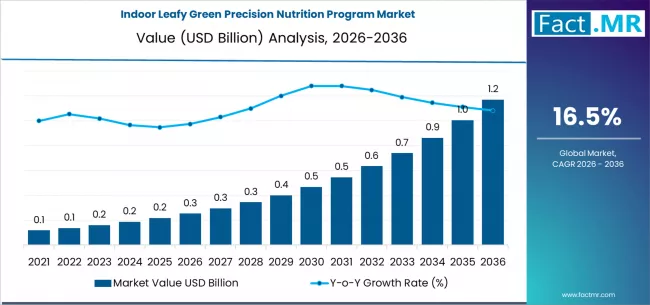
Indoor leafy green precision nutrition program market is projected to grow from USD 0.3 billion in 2026 to USD 1.2 billion by 2036, at a CAGR of 16.5%. Standard will dominate with a 44.2% market share, while liquid will lead the form segment with a 36.9% share.
Indoor Leafy Green Precision Nutrition Program Market Forecast and Outlook 2026 to 2036
The global market for indoor leafy green precision nutrition programs is projected to grow from USD 0.25 billion in 2026 to USD 1.17 billion by 2036, advancing at a strong CAGR of 16.5%. This market is a specialized and high-growth segment within controlled environment agriculture, dedicated to optimizing the yield, quality, and nutritional density of fast-growing crops like lettuce, kale, arugula, and herbs.
Key Takeaways from the Indoor Leafy Green Precision Nutrition Program Market
- Market Value for 2026: USD 0.25 Billion
- Market Value for 2036: USD 1.17 Billion
- Forecast CAGR (2026-2036): 16.5%
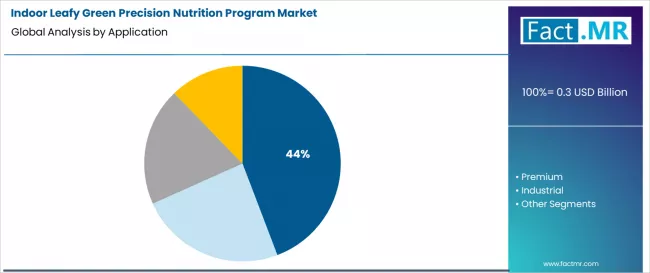
- Leading Application Segment (2026): Standard (44%)
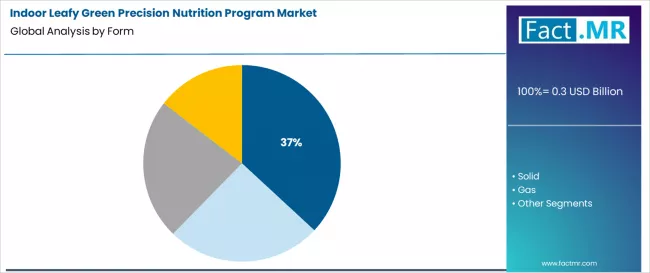
- Leading Form Segment (2026): Liquid (37%)
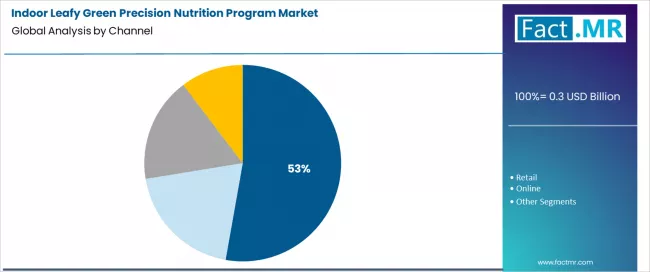
- Leading Channel Segment (2026): Direct (53%)
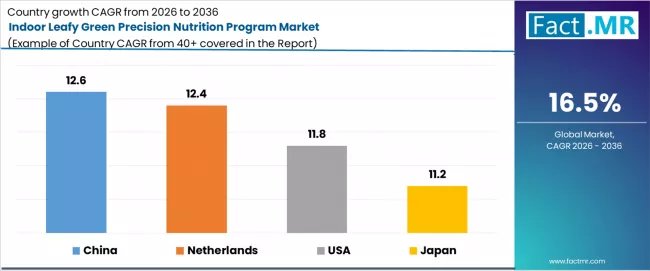
- Key Growth Countries: China (12.6% CAGR), Netherlands (12.4% CAGR), USA (11.8% CAGR), Japan (11.2% CAGR)
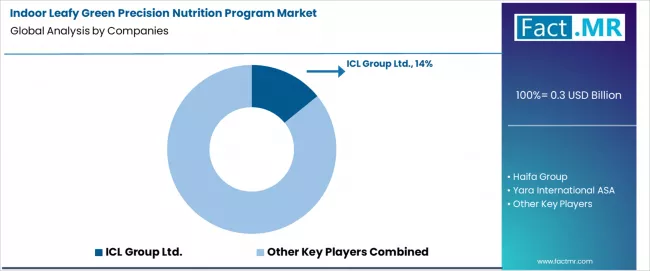
- Key Players in the Market: ICL Group Ltd., Haifa Group, Yara International ASA, Nutrien, BASF SE, Syngenta AG

These programs transcend simple fertilizer dosing, representing integrated, data-driven management systems that continuously tailor nutrient delivery to the precise physiological stage, environmental conditions, and genetic profile of the crop within indoor vertical farms and advanced greenhouses.
Growth is fueled by the explosive consumer demand for locally sourced, clean-label, and pesticide-free leafy greens, coupled with the rapid scaling of indoor farming infrastructure. Precision nutrition is the core operational technology that makes hyper-efficient production possible, directly impacting growth speed, leaf size, color, texture, and shelf-life.
These programs synchronize nutrient ions, pH, and electrical conductivity with LED light spectra and climate controls, creating a perfectly tuned recipe for plant growth that maximizes output per unit of energy, water, and space. The market’s expansion signifies the transition of indoor farming from a novel concept to a optimized manufacturing process for fresh produce.
Metric
| Metric | Value |
|---|---|
| Market Value (2026) | USD 0.25 Billion |
| Market Forecast Value (2036) | USD 1.17 Billion |
| Forecast CAGR (2026-2036) | 16.5% |
Category
| Category | Segments |
|---|---|
| Application | Standard, Premium, Industrial, Other |
| Form | Liquid, Solid, Gas, Gel |
| Channel | Direct, Retail, Online, Distributor |
| Region | North America, Latin America, Western Europe, Eastern Europe, East Asia, South Asia & Pacific, MEA |
Segmental Analysis
By Application, Which Program Type Forms the Industry Backbone?

The standard application segment leads with a 44% share. These programs provide optimized, proven recipes for high-volume crops like butterhead and romaine lettuce. They offer a reliable balance of yield, speed, and quality, forming the economic foundation for most large-scale vertical farms.
Their dominance is due to broad applicability and lower operational complexity, providing a dependable baseline nutrition strategy that commercial operators can deploy with confidence across thousands of growth cycles.
By Form, Which is Indispensable for Automated Fertigation?

Liquid form holds a 37% share and is fundamentally essential for indoor leafy green production. Liquid nutrients are perfectly suited for integration with automated fertigation and hydroponic systems, allowing for real-time adjustment of EC and pH.
They enable the precise, minute-by-minute control required in deep water culture (DWC) and nutrient film technique (NFT) systems, where roots are directly exposed to the feeding solution. This compatibility with high-tech infrastructure makes liquids the dominant delivery method.
By Channel, How are Integrated Technical Solutions Delivered?

Direct sales constitute the leading channel at 53%. Implementing a precision nutrition program is not a simple product purchase; it requires integration with climate control software, sensors, and irrigation hardware.
A direct relationship between the program provider and the indoor farm allows for customized implementation, ongoing technical support, and fine-tuning of recipes based on the farm’s specific operational data and production goals, ensuring optimal performance.
What are the Drivers, Restraints, and Key Trends of the Indoor Leafy Green Precision Nutrition Program Market?
The primary driver is the relentless growth of the indoor farming sector itself, backed by significant investment and consumer trends favoring local, sustainable produce. The extreme resource efficiency of these systems relies entirely on precision nutrition to achieve viability. The ability to enhance nutritional content, including boosting vitamin or antioxidant levels, through tailored programs creates a valuable product differentiation and premiumization opportunity for growers.
A significant restraint remains the high capital and operational energy cost of indoor farms, which pressures every component of the business, including nutrition, to deliver maximum efficiency and return. The technical expertise required to manage these programs can be a barrier to entry, creating a reliance on external specialists. Furthermore, the lack of universal standards for "optimal" recipes across different cultivars and systems can lead to fragmentation and trial-and-error costs.
Key trends include the full automation of recipe management, with AI algorithms adjusting nutrient delivery based on real-time sensor data from the root zone and canopy. Biofortification programs are emerging, specifically designed to elevate levels of iron, calcium, or vitamins in the harvested leaves. There is also a trend toward circular resource integration, where programs are adapted to utilize recovered nutrients from onsite water loops or organic waste streams, pushing toward fully closed-loop systems.
Analysis of the Indoor Leafy Green Precision Nutrition Program Market by Key Countries

| Country | CAGR (2026-2036) |
|---|---|
| China | 12.6% |
| Netherlands | 12.4% |
| USA | 11.8% |
| Japan | 11.2% |
How is China's Push for Food Security and Urban Agriculture Driving Scale?
China’s leading CAGR of 12.6% is powered by national policies actively promoting vertical farming as a solution for urban food security. Massive, state-supported indoor farming projects are being deployed.
This scale drives demand for standardized, high-volume precision nutrition programs that can be reliably deployed across vast, automated facilities, focusing on yield consistency and operational simplicity at an immense scale.
Why is the Netherlands a Global Center for R&D and High-Tech Export?
The Netherlands' 12.4% growth builds on its world-leading greenhouse horticulture sector, now pivoting to vertical farming innovation. The country is a hub for R&D in plant physiology under artificial light.
Dutch companies excel at developing and exporting the integrated technology packages, including the precision nutrition software and formulations that underpin successful indoor farms worldwide, setting the benchmark for technical sophistication.
What is the Impact of the USA's Dynamic Venture-Funded CEA Sector?

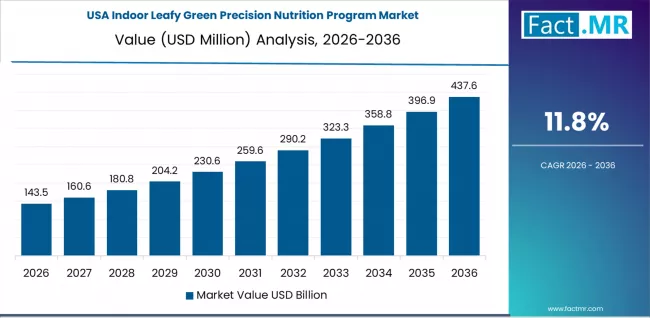
The USA’s 11.8% growth is characterized by a vibrant landscape of venture-funded vertical farming startups and large-scale controlled environment greenhouses. This market demands both cutting-edge, data-intensive nutrition platforms for new ventures and reliable, cost-optimized programs for scaled production. The competitive drive for unit economics superiority fuels continuous innovation and adoption of advanced nutritional strategies.
How is Japan's Focus on Quality and Automation Influencing the Market?
Japan’s 11.2% CAGR stems from its early adoption of plant factories and an intense focus on producing flawless, high-sensory-quality greens for discerning retailers. Japanese programs emphasize precision that influences taste, texture, and appearance. The integration of nutrition management with complete robotic automation from seeding to harvest creates demand for exceptionally stable and predictable formulation performance.
Competitive Landscape of the Indoor Leafy Green Precision Nutrition Program Market

The competitive landscape blends specialized horticultural nutrition companies with major agriscience firms expanding into CEA. Competition is fierce around the superiority of proprietary nutrient recipes, the seamless integration of software platforms with farm management systems, and the provision of agronomic data science services.
Success hinges on forming strategic alliances with key players in LED lighting and automation, and on building a track record of demonstrably improving key performance indicators like grams per kWh or growth cycle time for commercial farm clients.
Key Players in the Indoor Leafy Green Precision Nutrition Program Market
- ICL Group Ltd.
- Haifa Group
- Yara International ASA
- Nutrien
- BASF SE
- Syngenta AG
Scope of Report
| Items | Values |
|---|---|
| Quantitative Units | USD Billion |
| Application | Standard, Premium, Industrial, Other |
| Form | Liquid, Solid, Gas, Gel |
| Channel | Direct, Retail, Online, Distributor |
| Key Countries | Netherlands, USA, China, Japan |
| Key Companies | ICL Group Ltd., Haifa Group, Yara International ASA, Nutrien, BASF SE, Syngenta AG |
| Additional Analysis | Impact of light spectra (LED recipes) on nutrient uptake dynamics; optimization of nitrate-to-potassium ratios for taste and shelf-life; economic modeling of nutrient cost per kg of output; analysis of sensor technologies for real-time root zone monitoring; review of food safety protocols in recirculating nutrient systems. |
Market by Segments
-
Application :
- Standard
- Premium
- Industrial
- Other
-
Form :
- Liquid
- Solid
- Gas
- Gel
-
Channel :
- Direct
- Retail
- Online
- Distributor
-
Region :
-
North America
- USA
- Canada
-
Latin America
- Brazil
- Mexico
- Argentina
- Rest of Latin America
-
Western Europe
- Germany
- UK
- France
- Spain
- Italy
- Netherlands
- BENELUX
- Rest of Western Europe
-
Eastern Europe
- Russia
- Poland
- Czech Republic
- Rest of Eastern Europe
-
East Asia
- China
- Japan
- South Korea
- Rest of East Asia
-
South Asia & Pacific
- India
- ASEAN
- Australia
- Rest of South Asia & Pacific
-
MEA
- Saudi Arabia
- UAE
- Turkiye
- Rest of MEA
-
Table of Content
- Executive Summary
- Global Market Outlook
- Demand to side Trends
- Supply to side Trends
- Technology Roadmap Analysis
- Analysis and Recommendations
- Market Overview
- Market Coverage / Taxonomy
- Market Definition / Scope / Limitations
- Market Background
- Market Dynamics
- Drivers
- Restraints
- Opportunity
- Trends
- Scenario Forecast
- Demand in Optimistic Scenario
- Demand in Likely Scenario
- Demand in Conservative Scenario
- Opportunity Map Analysis
- Product Life Cycle Analysis
- Supply Chain Analysis
- Investment Feasibility Matrix
- Value Chain Analysis
- PESTLE and Porter’s Analysis
- Regulatory Landscape
- Regional Parent Market Outlook
- Production and Consumption Statistics
- Import and Export Statistics
- Market Dynamics
- Global Market Analysis 2021 to 2025 and Forecast, 2026 to 2036
- Historical Market Size Value (USD Million) Analysis, 2021 to 2025
- Current and Future Market Size Value (USD Million) Projections, 2026 to 2036
- Y to o to Y Growth Trend Analysis
- Absolute $ Opportunity Analysis
- Global Market Pricing Analysis 2021 to 2025 and Forecast 2026 to 2036
- Global Market Analysis 2021 to 2025 and Forecast 2026 to 2036, By Application
- Introduction / Key Findings
- Historical Market Size Value (USD Million) Analysis By Application, 2021 to 2025
- Current and Future Market Size Value (USD Million) Analysis and Forecast By Application, 2026 to 2036
- Standard
- Premium
- Industrial
- Other
- Standard
- Y to o to Y Growth Trend Analysis By Application, 2021 to 2025
- Absolute $ Opportunity Analysis By Application, 2026 to 2036
- Global Market Analysis 2021 to 2025 and Forecast 2026 to 2036, By Form
- Introduction / Key Findings
- Historical Market Size Value (USD Million) Analysis By Form, 2021 to 2025
- Current and Future Market Size Value (USD Million) Analysis and Forecast By Form, 2026 to 2036
- Liquid
- Solid
- Gas
- Gel
- Liquid
- Y to o to Y Growth Trend Analysis By Form, 2021 to 2025
- Absolute $ Opportunity Analysis By Form, 2026 to 2036
- Global Market Analysis 2021 to 2025 and Forecast 2026 to 2036, By Channel
- Introduction / Key Findings
- Historical Market Size Value (USD Million) Analysis By Channel, 2021 to 2025
- Current and Future Market Size Value (USD Million) Analysis and Forecast By Channel, 2026 to 2036
- Direct
- Retail
- Online
- Distributor
- Direct
- Y to o to Y Growth Trend Analysis By Channel, 2021 to 2025
- Absolute $ Opportunity Analysis By Channel, 2026 to 2036
- Global Market Analysis 2021 to 2025 and Forecast 2026 to 2036, By Region
- Introduction
- Historical Market Size Value (USD Million) Analysis By Region, 2021 to 2025
- Current Market Size Value (USD Million) Analysis and Forecast By Region, 2026 to 2036
- North America
- Latin America
- Western Europe
- Eastern Europe
- East Asia
- South Asia and Pacific
- Middle East & Africa
- Market Attractiveness Analysis By Region
- North America Market Analysis 2021 to 2025 and Forecast 2026 to 2036, By Country
- Historical Market Size Value (USD Million) Trend Analysis By Market Taxonomy, 2021 to 2025
- Market Size Value (USD Million) Forecast By Market Taxonomy, 2026 to 2036
- By Country
- USA
- Canada
- Mexico
- By Application
- By Form
- By Channel
- By Country
- Market Attractiveness Analysis
- By Country
- By Application
- By Form
- By Channel
- Key Takeaways
- Latin America Market Analysis 2021 to 2025 and Forecast 2026 to 2036, By Country
- Historical Market Size Value (USD Million) Trend Analysis By Market Taxonomy, 2021 to 2025
- Market Size Value (USD Million) Forecast By Market Taxonomy, 2026 to 2036
- By Country
- Brazil
- Chile
- Rest of Latin America
- By Application
- By Form
- By Channel
- By Country
- Market Attractiveness Analysis
- By Country
- By Application
- By Form
- By Channel
- Key Takeaways
- Western Europe Market Analysis 2021 to 2025 and Forecast 2026 to 2036, By Country
- Historical Market Size Value (USD Million) Trend Analysis By Market Taxonomy, 2021 to 2025
- Market Size Value (USD Million) Forecast By Market Taxonomy, 2026 to 2036
- By Country
- Germany
- UK
- Italy
- Spain
- France
- Nordic
- BENELUX
- Rest of Western Europe
- By Application
- By Form
- By Channel
- By Country
- Market Attractiveness Analysis
- By Country
- By Application
- By Form
- By Channel
- Key Takeaways
- Eastern Europe Market Analysis 2021 to 2025 and Forecast 2026 to 2036, By Country
- Historical Market Size Value (USD Million) Trend Analysis By Market Taxonomy, 2021 to 2025
- Market Size Value (USD Million) Forecast By Market Taxonomy, 2026 to 2036
- By Country
- Russia
- Poland
- Hungary
- Balkan & Baltic
- Rest of Eastern Europe
- By Application
- By Form
- By Channel
- By Country
- Market Attractiveness Analysis
- By Country
- By Application
- By Form
- By Channel
- Key Takeaways
- East Asia Market Analysis 2021 to 2025 and Forecast 2026 to 2036, By Country
- Historical Market Size Value (USD Million) Trend Analysis By Market Taxonomy, 2021 to 2025
- Market Size Value (USD Million) Forecast By Market Taxonomy, 2026 to 2036
- By Country
- China
- Japan
- South Korea
- By Application
- By Form
- By Channel
- By Country
- Market Attractiveness Analysis
- By Country
- By Application
- By Form
- By Channel
- Key Takeaways
- South Asia and Pacific Market Analysis 2021 to 2025 and Forecast 2026 to 2036, By Country
- Historical Market Size Value (USD Million) Trend Analysis By Market Taxonomy, 2021 to 2025
- Market Size Value (USD Million) Forecast By Market Taxonomy, 2026 to 2036
- By Country
- India
- ASEAN
- Australia & New Zealand
- Rest of South Asia and Pacific
- By Application
- By Form
- By Channel
- By Country
- Market Attractiveness Analysis
- By Country
- By Application
- By Form
- By Channel
- Key Takeaways
- Middle East & Africa Market Analysis 2021 to 2025 and Forecast 2026 to 2036, By Country
- Historical Market Size Value (USD Million) Trend Analysis By Market Taxonomy, 2021 to 2025
- Market Size Value (USD Million) Forecast By Market Taxonomy, 2026 to 2036
- By Country
- Kingdom of Saudi Arabia
- Other GCC Countries
- Turkiye
- South Africa
- Other African Union
- Rest of Middle East & Africa
- By Application
- By Form
- By Channel
- By Country
- Market Attractiveness Analysis
- By Country
- By Application
- By Form
- By Channel
- Key Takeaways
- Key Countries Market Analysis
- USA
- Pricing Analysis
- Market Share Analysis, 2025
- By Application
- By Form
- By Channel
- Canada
- Pricing Analysis
- Market Share Analysis, 2025
- By Application
- By Form
- By Channel
- Mexico
- Pricing Analysis
- Market Share Analysis, 2025
- By Application
- By Form
- By Channel
- Brazil
- Pricing Analysis
- Market Share Analysis, 2025
- By Application
- By Form
- By Channel
- Chile
- Pricing Analysis
- Market Share Analysis, 2025
- By Application
- By Form
- By Channel
- Germany
- Pricing Analysis
- Market Share Analysis, 2025
- By Application
- By Form
- By Channel
- UK
- Pricing Analysis
- Market Share Analysis, 2025
- By Application
- By Form
- By Channel
- Italy
- Pricing Analysis
- Market Share Analysis, 2025
- By Application
- By Form
- By Channel
- Spain
- Pricing Analysis
- Market Share Analysis, 2025
- By Application
- By Form
- By Channel
- France
- Pricing Analysis
- Market Share Analysis, 2025
- By Application
- By Form
- By Channel
- India
- Pricing Analysis
- Market Share Analysis, 2025
- By Application
- By Form
- By Channel
- ASEAN
- Pricing Analysis
- Market Share Analysis, 2025
- By Application
- By Form
- By Channel
- Australia & New Zealand
- Pricing Analysis
- Market Share Analysis, 2025
- By Application
- By Form
- By Channel
- China
- Pricing Analysis
- Market Share Analysis, 2025
- By Application
- By Form
- By Channel
- Japan
- Pricing Analysis
- Market Share Analysis, 2025
- By Application
- By Form
- By Channel
- South Korea
- Pricing Analysis
- Market Share Analysis, 2025
- By Application
- By Form
- By Channel
- Russia
- Pricing Analysis
- Market Share Analysis, 2025
- By Application
- By Form
- By Channel
- Poland
- Pricing Analysis
- Market Share Analysis, 2025
- By Application
- By Form
- By Channel
- Hungary
- Pricing Analysis
- Market Share Analysis, 2025
- By Application
- By Form
- By Channel
- Kingdom of Saudi Arabia
- Pricing Analysis
- Market Share Analysis, 2025
- By Application
- By Form
- By Channel
- Turkiye
- Pricing Analysis
- Market Share Analysis, 2025
- By Application
- By Form
- By Channel
- South Africa
- Pricing Analysis
- Market Share Analysis, 2025
- By Application
- By Form
- By Channel
- USA
- Market Structure Analysis
- Competition Dashboard
- Competition Benchmarking
- Market Share Analysis of Top Players
- By Regional
- By Application
- By Form
- By Channel
- Competition Analysis
- Competition Deep Dive
- ICL Group Ltd.
- Overview
- Product Portfolio
- Profitability by Market Segments (Product/Age /Sales Channel/Region)
- Sales Footprint
- Strategy Overview
- Marketing Strategy
- Product Strategy
- Channel Strategy
- Haifa Group
- Yara International ASA
- Nutrien
- BASF SE
- Syngenta AG
- ICL Group Ltd.
- Competition Deep Dive
- Assumptions & Acronyms Used
- Research Methodology
List Of Table
- Table 1: Global Market Value (USD Million) Forecast by Region, 2021 to 2036
- Table 2: Global Market Value (USD Million) Forecast by Application, 2021 to 2036
- Table 3: Global Market Value (USD Million) Forecast by Form, 2021 to 2036
- Table 4: Global Market Value (USD Million) Forecast by Channel, 2021 to 2036
- Table 5: North America Market Value (USD Million) Forecast by Country, 2021 to 2036
- Table 6: North America Market Value (USD Million) Forecast by Application, 2021 to 2036
- Table 7: North America Market Value (USD Million) Forecast by Form, 2021 to 2036
- Table 8: North America Market Value (USD Million) Forecast by Channel, 2021 to 2036
- Table 9: Latin America Market Value (USD Million) Forecast by Country, 2021 to 2036
- Table 10: Latin America Market Value (USD Million) Forecast by Application, 2021 to 2036
- Table 11: Latin America Market Value (USD Million) Forecast by Form, 2021 to 2036
- Table 12: Latin America Market Value (USD Million) Forecast by Channel, 2021 to 2036
- Table 13: Western Europe Market Value (USD Million) Forecast by Country, 2021 to 2036
- Table 14: Western Europe Market Value (USD Million) Forecast by Application, 2021 to 2036
- Table 15: Western Europe Market Value (USD Million) Forecast by Form, 2021 to 2036
- Table 16: Western Europe Market Value (USD Million) Forecast by Channel, 2021 to 2036
- Table 17: Eastern Europe Market Value (USD Million) Forecast by Country, 2021 to 2036
- Table 18: Eastern Europe Market Value (USD Million) Forecast by Application, 2021 to 2036
- Table 19: Eastern Europe Market Value (USD Million) Forecast by Form, 2021 to 2036
- Table 20: Eastern Europe Market Value (USD Million) Forecast by Channel, 2021 to 2036
- Table 21: East Asia Market Value (USD Million) Forecast by Country, 2021 to 2036
- Table 22: East Asia Market Value (USD Million) Forecast by Application, 2021 to 2036
- Table 23: East Asia Market Value (USD Million) Forecast by Form, 2021 to 2036
- Table 24: East Asia Market Value (USD Million) Forecast by Channel, 2021 to 2036
- Table 25: South Asia and Pacific Market Value (USD Million) Forecast by Country, 2021 to 2036
- Table 26: South Asia and Pacific Market Value (USD Million) Forecast by Application, 2021 to 2036
- Table 27: South Asia and Pacific Market Value (USD Million) Forecast by Form, 2021 to 2036
- Table 28: South Asia and Pacific Market Value (USD Million) Forecast by Channel, 2021 to 2036
- Table 29: Middle East & Africa Market Value (USD Million) Forecast by Country, 2021 to 2036
- Table 30: Middle East & Africa Market Value (USD Million) Forecast by Application, 2021 to 2036
- Table 31: Middle East & Africa Market Value (USD Million) Forecast by Form, 2021 to 2036
- Table 32: Middle East & Africa Market Value (USD Million) Forecast by Channel, 2021 to 2036
List Of Figures
- Figure 1: Global Market Pricing Analysis
- Figure 2: Global Market Value (USD Million) Forecast 2021 to 2036
- Figure 3: Global Market Value Share and BPS Analysis by Application, 2026 and 2036
- Figure 4: Global Market Y to o to Y Growth Comparison by Application, 2026 to 2036
- Figure 5: Global Market Attractiveness Analysis by Application
- Figure 6: Global Market Value Share and BPS Analysis by Form, 2026 and 2036
- Figure 7: Global Market Y to o to Y Growth Comparison by Form, 2026 to 2036
- Figure 8: Global Market Attractiveness Analysis by Form
- Figure 9: Global Market Value Share and BPS Analysis by Channel, 2026 and 2036
- Figure 10: Global Market Y to o to Y Growth Comparison by Channel, 2026 to 2036
- Figure 11: Global Market Attractiveness Analysis by Channel
- Figure 12: Global Market Value (USD Million) Share and BPS Analysis by Region, 2026 and 2036
- Figure 13: Global Market Y to o to Y Growth Comparison by Region, 2026 to 2036
- Figure 14: Global Market Attractiveness Analysis by Region
- Figure 15: North America Market Incremental Dollar Opportunity, 2026 to 2036
- Figure 16: Latin America Market Incremental Dollar Opportunity, 2026 to 2036
- Figure 17: Western Europe Market Incremental Dollar Opportunity, 2026 to 2036
- Figure 18: Eastern Europe Market Incremental Dollar Opportunity, 2026 to 2036
- Figure 19: East Asia Market Incremental Dollar Opportunity, 2026 to 2036
- Figure 20: South Asia and Pacific Market Incremental Dollar Opportunity, 2026 to 2036
- Figure 21: Middle East & Africa Market Incremental Dollar Opportunity, 2026 to 2036
- Figure 22: North America Market Value Share and BPS Analysis by Country, 2026 and 2036
- Figure 23: North America Market Value Share and BPS Analysis by Application, 2026 and 2036
- Figure 24: North America Market Y to o to Y Growth Comparison by Application, 2026 to 2036
- Figure 25: North America Market Attractiveness Analysis by Application
- Figure 26: North America Market Value Share and BPS Analysis by Form, 2026 and 2036
- Figure 27: North America Market Y to o to Y Growth Comparison by Form, 2026 to 2036
- Figure 28: North America Market Attractiveness Analysis by Form
- Figure 29: North America Market Value Share and BPS Analysis by Channel, 2026 and 2036
- Figure 30: North America Market Y to o to Y Growth Comparison by Channel, 2026 to 2036
- Figure 31: North America Market Attractiveness Analysis by Channel
- Figure 32: Latin America Market Value Share and BPS Analysis by Country, 2026 and 2036
- Figure 33: Latin America Market Value Share and BPS Analysis by Application, 2026 and 2036
- Figure 34: Latin America Market Y to o to Y Growth Comparison by Application, 2026 to 2036
- Figure 35: Latin America Market Attractiveness Analysis by Application
- Figure 36: Latin America Market Value Share and BPS Analysis by Form, 2026 and 2036
- Figure 37: Latin America Market Y to o to Y Growth Comparison by Form, 2026 to 2036
- Figure 38: Latin America Market Attractiveness Analysis by Form
- Figure 39: Latin America Market Value Share and BPS Analysis by Channel, 2026 and 2036
- Figure 40: Latin America Market Y to o to Y Growth Comparison by Channel, 2026 to 2036
- Figure 41: Latin America Market Attractiveness Analysis by Channel
- Figure 42: Western Europe Market Value Share and BPS Analysis by Country, 2026 and 2036
- Figure 43: Western Europe Market Value Share and BPS Analysis by Application, 2026 and 2036
- Figure 44: Western Europe Market Y to o to Y Growth Comparison by Application, 2026 to 2036
- Figure 45: Western Europe Market Attractiveness Analysis by Application
- Figure 46: Western Europe Market Value Share and BPS Analysis by Form, 2026 and 2036
- Figure 47: Western Europe Market Y to o to Y Growth Comparison by Form, 2026 to 2036
- Figure 48: Western Europe Market Attractiveness Analysis by Form
- Figure 49: Western Europe Market Value Share and BPS Analysis by Channel, 2026 and 2036
- Figure 50: Western Europe Market Y to o to Y Growth Comparison by Channel, 2026 to 2036
- Figure 51: Western Europe Market Attractiveness Analysis by Channel
- Figure 52: Eastern Europe Market Value Share and BPS Analysis by Country, 2026 and 2036
- Figure 53: Eastern Europe Market Value Share and BPS Analysis by Application, 2026 and 2036
- Figure 54: Eastern Europe Market Y to o to Y Growth Comparison by Application, 2026 to 2036
- Figure 55: Eastern Europe Market Attractiveness Analysis by Application
- Figure 56: Eastern Europe Market Value Share and BPS Analysis by Form, 2026 and 2036
- Figure 57: Eastern Europe Market Y to o to Y Growth Comparison by Form, 2026 to 2036
- Figure 58: Eastern Europe Market Attractiveness Analysis by Form
- Figure 59: Eastern Europe Market Value Share and BPS Analysis by Channel, 2026 and 2036
- Figure 60: Eastern Europe Market Y to o to Y Growth Comparison by Channel, 2026 to 2036
- Figure 61: Eastern Europe Market Attractiveness Analysis by Channel
- Figure 62: East Asia Market Value Share and BPS Analysis by Country, 2026 and 2036
- Figure 63: East Asia Market Value Share and BPS Analysis by Application, 2026 and 2036
- Figure 64: East Asia Market Y to o to Y Growth Comparison by Application, 2026 to 2036
- Figure 65: East Asia Market Attractiveness Analysis by Application
- Figure 66: East Asia Market Value Share and BPS Analysis by Form, 2026 and 2036
- Figure 67: East Asia Market Y to o to Y Growth Comparison by Form, 2026 to 2036
- Figure 68: East Asia Market Attractiveness Analysis by Form
- Figure 69: East Asia Market Value Share and BPS Analysis by Channel, 2026 and 2036
- Figure 70: East Asia Market Y to o to Y Growth Comparison by Channel, 2026 to 2036
- Figure 71: East Asia Market Attractiveness Analysis by Channel
- Figure 72: South Asia and Pacific Market Value Share and BPS Analysis by Country, 2026 and 2036
- Figure 73: South Asia and Pacific Market Value Share and BPS Analysis by Application, 2026 and 2036
- Figure 74: South Asia and Pacific Market Y to o to Y Growth Comparison by Application, 2026 to 2036
- Figure 75: South Asia and Pacific Market Attractiveness Analysis by Application
- Figure 76: South Asia and Pacific Market Value Share and BPS Analysis by Form, 2026 and 2036
- Figure 77: South Asia and Pacific Market Y to o to Y Growth Comparison by Form, 2026 to 2036
- Figure 78: South Asia and Pacific Market Attractiveness Analysis by Form
- Figure 79: South Asia and Pacific Market Value Share and BPS Analysis by Channel, 2026 and 2036
- Figure 80: South Asia and Pacific Market Y to o to Y Growth Comparison by Channel, 2026 to 2036
- Figure 81: South Asia and Pacific Market Attractiveness Analysis by Channel
- Figure 82: Middle East & Africa Market Value Share and BPS Analysis by Country, 2026 and 2036
- Figure 83: Middle East & Africa Market Value Share and BPS Analysis by Application, 2026 and 2036
- Figure 84: Middle East & Africa Market Y to o to Y Growth Comparison by Application, 2026 to 2036
- Figure 85: Middle East & Africa Market Attractiveness Analysis by Application
- Figure 86: Middle East & Africa Market Value Share and BPS Analysis by Form, 2026 and 2036
- Figure 87: Middle East & Africa Market Y to o to Y Growth Comparison by Form, 2026 to 2036
- Figure 88: Middle East & Africa Market Attractiveness Analysis by Form
- Figure 89: Middle East & Africa Market Value Share and BPS Analysis by Channel, 2026 and 2036
- Figure 90: Middle East & Africa Market Y to o to Y Growth Comparison by Channel, 2026 to 2036
- Figure 91: Middle East & Africa Market Attractiveness Analysis by Channel
- Figure 92: Global Market - Tier Structure Analysis
- Figure 93: Global Market - Company Share Analysis
- FAQs -
How big is the indoor leafy green precision nutrition program market in 2026?
The global indoor leafy green precision nutrition program market is estimated to be valued at USD 0.3 billion in 2026.
What will be the size of indoor leafy green precision nutrition program market in 2036?
The market size for the indoor leafy green precision nutrition program market is projected to reach USD 1.2 billion by 2036.
How much will be the indoor leafy green precision nutrition program market growth between 2026 and 2036?
The indoor leafy green precision nutrition program market is expected to grow at a 16.5% CAGR between 2026 and 2036.
What are the key product types in the indoor leafy green precision nutrition program market?
The key product types in indoor leafy green precision nutrition program market are standard, premium, industrial and other.
Which form segment to contribute significant share in the indoor leafy green precision nutrition program market in 2026?
In terms of form, liquid segment to command 36.9% share in the indoor leafy green precision nutrition program market in 2026.