- Base Value(2025): 21.9 Bn
- Estimated Value(2026): 22.8 Bn
- Forecast Value (2036): 41.4 Bn
- CAGR (2026 - 2036): 4.1%
Industrial Evaporators Market Size, Share and Forecast by Fact.MR
In 2025, the industrial evaporators market was valued at USD 21.9 billion. Fact MR analysis indicates demand for industrial evaporators is expected to reach USD 22.8 billion in 2026 and USD 41.4 billion by 2036. FMR estimates the market will expand at a CAGR of 4.1% across the forecast period.
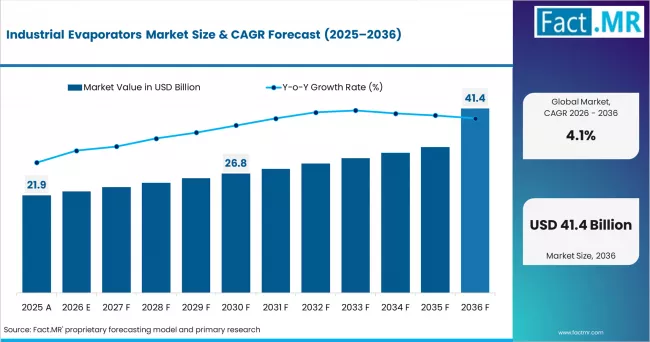
Industrial Evaporators Market | Source: Fact.MR
Industrial Evaporators Market
| Metric | Details |
|---|---|
| Industry Size (2026E) | USD 22.8 billion |
| Industry Value (2036F) | USD 41.4 billion |
| CAGR (2026 to 2036) | 4.1% |
Source: Fact.MR analysis. Updated Apr 28, 2026
The increase from USD 22.8 billion in 2026 to USD 41.4 billion in 2036 represents an absolute dollar opportunity of USD 18.6 billion, indicating incremental expansion across process industries requiring concentration and separation systems. Demand is supported by wastewater treatment requirements and process efficiency improvements, while moderated by high capital costs, energy intensity, and maintenance complexity in corrosive operating environments.
China records the fastest growth at 6.4%, supported by increasing installation of evaporation systems in chemical processing and wastewater concentration facilities. India follows at 6.1%, driven by rising use of industrial evaporation equipment in pharmaceutical and food processing production lines. The USA shows 5.6% growth, linked to modernization of thermal separation equipment across specialty manufacturing industries. Germany at 5.3% and the United Kingdom at 5.2% represent mature markets where demand is largely replacement-driven due to established installed base of process evaporation systems. A structural constraint across mature markets is high capital replacement cost, which limits rapid equipment upgrade cycles across legacy industrial plants.
Segmental Analysis
Industrial Evaporators Market Analysis by Material
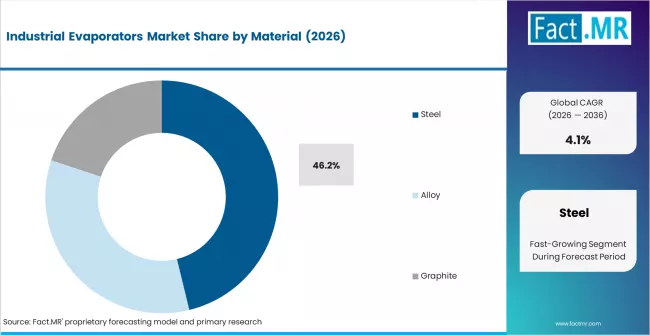
Industrial Evaporators Market Analysis By Material | Source: Fact.MR
- Market Overview: Steel is projected to hold 46.2% share of the industrial evaporators market in 2026. Material preference reflects structural strength, corrosion resistance options through alloy selection, and compatibility with high-temperature industrial evaporation processes used across chemical processing, wastewater treatment, and food concentration systems. Steel construction supports durability under high pressure and continuous thermal exposure environments.
- Demand Drivers:
- Structural Durability Requirements: Steel evaporator systems maintain mechanical integrity under high pressure and temperature conditions associated with industrial-scale concentration processes.
- Corrosion Resistance Adaptability: Alloyed steel grades enable resistance to chemical exposure across aggressive process fluids encountered in industrial evaporation applications.
- Fabrication Flexibility: Steel enables manufacturing of large-capacity evaporator units designed for continuous processing environments requiring stable mechanical performance.
Industrial Evaporators Market Analysis by Functionality
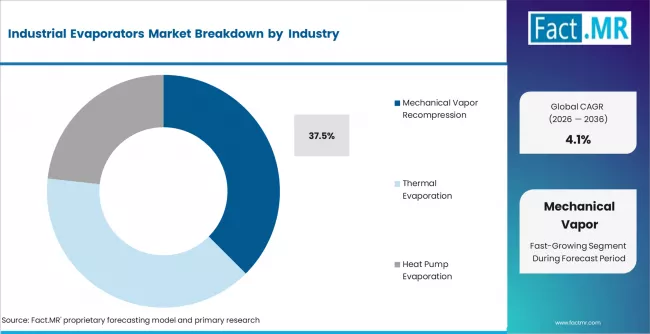
Industrial Evaporators Market Analysis By Functionality | Source: Fact.MR
- Market Overview: Mechanical vapor recompression is estimated to account for 37.5% share in 2026, supported by its ability to improve energy utilization efficiency through reuse of vapor heat energy within evaporation systems. Process configuration enables reduction of external steam requirements across industrial concentration operations.
- Demand Drivers:
- Energy Optimization Requirements: Mechanical vapor recompression systems recycle latent heat from generated vapor, supporting reduced overall thermal energy consumption in evaporation processes.
- Operational Cost Control: Industrial operators utilize recompression systems to reduce steam usage and improve cost efficiency across continuous processing installations.
- Process Efficiency Improvement: Mechanical vapor recompression supports stable evaporation performance across applications including wastewater concentration, chemical processing, and food ingredient production systems.
Industrial Evaporators Market Drivers, Restraints, and Opportunities
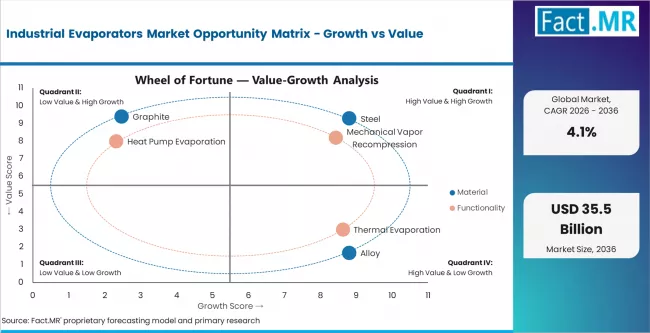
Industrial Evaporators Market Opportunity Matrix Growth Vs Value | Source: Fact.MR
Fact MR analysis indicates the market reflects a mature but continuously upgrading process equipment segment anchored in concentration, separation, and solvent recovery applications across food processing, chemicals, pharmaceuticals, and wastewater treatment industries. Market size exists because evaporation enables reduction of liquid volume, recovery of valuable solutes, and extension of shelf stability in products such as dairy concentrates, juices, APIs, and industrial chemicals. Historical adoption has been sustained by large-scale industrial production systems where removal of water or solvents improves transport efficiency and reduces disposal costs, creating stable baseline demand for thermal separation equipment.
Current market dynamics show declining reliance on single-effect and energy-intensive evaporation systems as manufacturers transition toward multi-effect evaporators (MEE) and mechanical vapor recompression (MVR) technologies designed to reduce steam consumption and operating cost per unit of output. Higher-capital advanced evaporator systems command premium pricing due to improved heat transfer efficiency and reduced energy intensity, offsetting moderate replacement cycles across mature processing industries. Demand growth is increasingly tied to wastewater concentration requirements and circular water reuse strategies that require high-efficiency solvent separation technologies.
- Zero Liquid Discharge: Environmental compliance frameworks promoting zero liquid discharge systems are increasing installation of multi-effect evaporators capable of minimizing wastewater disposal volumes.
- Food Processing Expansion: Asia Pacific demand growth is supported by increasing processed food production requiring concentration of dairy, juice, and syrup formulations.
- Energy Efficiency Upgrade: Transition from single-effect systems toward MVR and falling film evaporators improves thermal efficiency and reduces steam consumption in continuous industrial processing.
Regional Analysis
The industrial evaporators market is assessed across Asia Pacific, Europe, and North America, segmented by country-level demand for thermal evaporation systems used in wastewater treatment, food processing concentration, pharmaceutical manufacturing, and chemical processing applications. Geographic variation reflects industrial production intensity, environmental compliance requirements, and demand for process efficiency optimization. The full report offers market attractiveness analysis.
.webp "Top Country Growth Comparison Industrial Evaporators Market Cagr (2026 2036)")
Top Country Growth Comparison Industrial Evaporators Market Cagr (2026 2036) | Source: Fact.MR
CAGR Table
| Country | CAGR (2026–2036) |
|---|---|
| China | 6.4% |
| India | 6.1% |
| USA | 5.6% |
| Germany | 5.3% |
| UK | 5.2% |
Source: Fact.MR analysis. Updated Apr 28, 2026
Source: Fact MR analysis, based on proprietary forecasting model and primary research
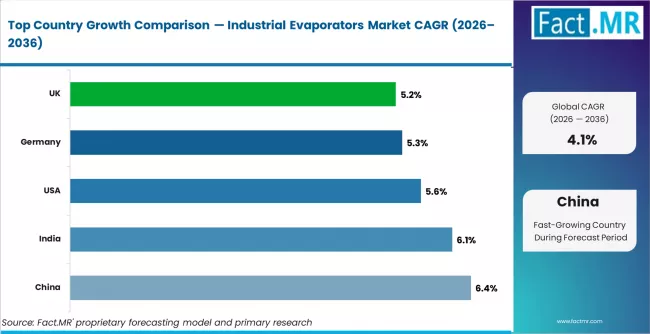
Industrial Evaporators Market Cagr Analysis By Country | Source: Fact.MR
Asia Pacific
Asia Pacific functions as the process engineering equipment deployment hub supported by expansion of chemical processing capacity and increasing industrial wastewater treatment requirements. GEA Group AG strengthens thermal evaporation system engineering capability. SPX FLOW expands industrial concentration technology portfolio. Veolia Water Technologies supports process efficiency equipment integration.
- China: China is projected to record 6.4% CAGR in industrial evaporators through 2036. Water Pollution Prevention Action Plan update (Ministry of Ecology and Environment, February 2023) supports wastewater treatment technology adoption. GEA Group AG expanded evaporation system engineering capability (June 2023).
- India: India is expected to observe 6.1% CAGR in industrial evaporators through 2036. National Mission for Clean Ganga industrial discharge compliance update (Ministry of Jal Shakti, March 2023) supports wastewater evaporation system demand. Veolia Water Technologies expanded industrial treatment equipment deployment capability (July 2023).
North America
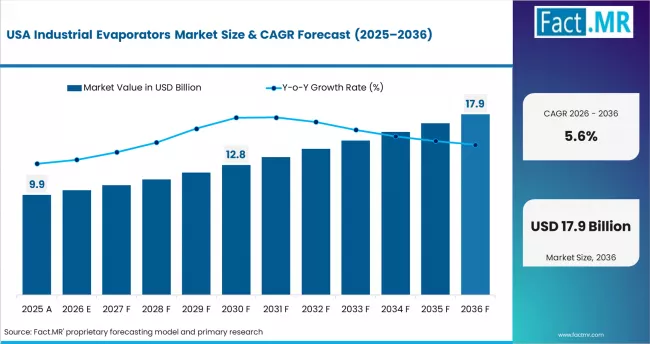
Industrial Evaporators Market Country Value Analysis | Source: Fact.MR
North America operates as the process optimization commercialization center supported by demand for concentration systems in food processing and pharmaceutical manufacturing. SPX FLOW strengthens industrial evaporation technology capability. Alfa Laval expands thermal separation equipment portfolio depth. Koch Separation Solutions supports process equipment innovation.
- USA: The USA is anticipated to expand at 5.6% CAGR in industrial evaporators through 2036. EPA industrial wastewater discharge guideline update (April 2023) supports adoption of evaporation based treatment systems. SPX FLOW expanded industrial evaporation equipment application development capability (August 2023).
Europe
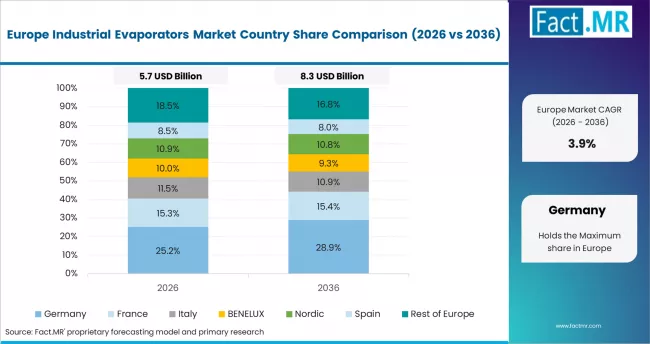
Industrial Evaporators Market Europe Country Market Share Analysis, 2026 & 2036 | Source: Fact.MR
Europe functions as the environmental compliance engineering laboratory supported by strict industrial emission standards and process efficiency requirements. GEA Group AG strengthens evaporation system engineering expertise. Alfa Laval expands industrial separation technology capability. Veolia Water Technologies supports thermal concentration innovation.
- Germany: Germany is forecast to grow at 5.3% CAGR in industrial evaporators through 2036. Industrial Emissions Directive compliance update (European Commission, January 2023) supports process efficiency equipment adoption. GEA Group AG expanded industrial evaporation technology development capability (May 2023).
- UK: The UK is projected to register 5.2% CAGR in industrial evaporators through 2036. Environmental Permitting Regulations update (Environment Agency, February 2023) supports industrial wastewater treatment technology demand. Alfa Laval expanded thermal separation equipment distribution capability (June 2023).
Fact MR's analysis of industrial evaporators market in global regions consists of country-wise assessment that includes China, India, USA, Germany, and UK. Readers can find process equipment demand trends, wastewater treatment developments, regulatory positioning frameworks, and competitive engineering technology insights.
Competitive Landscape
What is the Competitive Structure of the Industrial Evaporators Market?
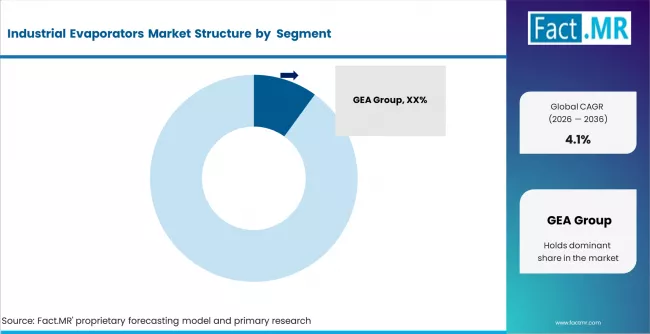
Industrial Evaporators Market Analysis By Company | Source: Fact.MR
The Industrial Evaporators Market demonstrates a moderately concentrated competitive structure, supported by process equipment manufacturers with expertise in thermal separation and industrial fluid concentration systems. Leading companies including GEA Group, Alfa Laval, SPX Flow, Veolia Water Technologies, and Bucher Industries collectively account for nearly 55–65% of global market share, particularly in multiple-effect, falling film, and forced circulation evaporator systems used in food processing, chemicals, and wastewater treatment applications. Competitive positioning is primarily determined by thermal efficiency, energy recovery capability, corrosion resistance, and adaptability to varying feed compositions. High engineering complexity and customization requirements create entry barriers, limiting participation to companies with established process design capabilities and global service networks supporting industrial installation and maintenance requirements.
Structural advantages are observed among companies possessing integrated process engineering expertise and long-term relationships with food processing, pharmaceutical, and chemical manufacturers. Alfa Laval and GEA Group benefit from strong application engineering capabilities and broad portfolios covering heat exchangers, separators, and evaporation systems designed for optimized process efficiency. Buyers typically manage supplier dependency through technical benchmarking of evaporation performance and evaluation of lifecycle operating costs across multiple equipment providers. Procurement decisions often consider energy consumption efficiency, maintenance requirements, and compatibility with existing plant infrastructure. Pricing power remains relatively balanced, though suppliers retain moderate leverage where customized engineering design and validated process efficiency create switching constraints for industrial facilities requiring reliable concentration and separation performance.
Key Players of the Industrial Evaporators Market
- GEA Group
- Alfa Laval
- SPX Flow
- Veolia Water Technologies
- Bucher Industries
- Condorchem Envitech
- H2O GmbH
- Hebeler Process Solutions
- Vobis
- Thermal Kinetics
Bibliographies
- [1] Ministry of Ecology and Environment (China). (2023, February). Water Pollution Prevention Action Plan update.
- [2] Ministry of Jal Shakti (India). (2023, March). National Mission for Clean Ganga industrial discharge compliance update.
- [3] U.S. Environmental Protection Agency. (2023, April). Industrial wastewater discharge guideline update.
- [4] European Commission. (2023, January). Industrial Emissions Directive compliance update.
- [5] Environment Agency (UK). (2023, February). Environmental Permitting Regulations update.
- [6] GEA Group AG. (2023, June). Evaporation system engineering capability expansion.
- [7] SPX FLOW. (2023, August). Industrial evaporation equipment application development capability expansion.
- [8] Veolia Water Technologies. (2023, July). Industrial treatment equipment deployment capability expansion.
- [9] Alfa Laval. (2023, June). Thermal separation equipment distribution capability expansion.
- [10] Bucher Industries. (2023). Process engineering and evaporation systems portfolio.
This Report Addresses
- Market size estimation and revenue forecasts from 2026 to 2036, supported by validated capacity and trade benchmarks.
- Growth opportunity mapping across gummy, extruded, and strip functional variants.
- Segment and regional revenue forecasts covering berry, citrus, and mixed fruit applications.
- Competition strategy assessment including integration models and compliance capability benchmarking.
- Regulatory impact analysis covering ingredient mandates and clean-label specification upgrades.
- Market report delivery in PDF, Excel, PPT, and interactive dashboard formats for executive and operational use.
- Supply chain vulnerability assessments identifying regional purification concentration risks.
Industrial Evaporators Market Definition
The industrial evaporators market refers to equipment used to concentrate liquids or separate dissolved substances by removing solvents, usually water, through controlled heating and vaporization. These systems are widely applied in food processing, chemicals, pharmaceuticals, wastewater treatment, and power industries to improve product concentration and process efficiency.
Industrial Evaporators Market Inclusions
The report covers global and regional market size estimation and forecast outlook across the defined period. It includes segmentation by evaporator type such as falling film, rising film, forced circulation, plate, and multiple-effect systems, applications across chemical processing, food and beverage, pharmaceuticals, and wastewater treatment, and end users across industrial manufacturing sectors.
Industrial Evaporators Market Exclusions
The scope excludes small laboratory evaporators, domestic cooling evaporators, and refrigeration components not designed for industrial process concentration. It does not include downstream finished products such as processed foods or chemicals. The analysis focuses strictly on industrial evaporation equipment and associated process systems used in large-scale manufacturing operations.
Industrial Evaporators Market Research Methodology
- Primary Research
- Interviews were conducted with equipment manufacturers, process engineers, plant operators, and procurement specialists involved in thermal separation technologies and industrial fluid concentration systems.
- Desk Research
- Technical journals, engineering publications, company product documentation, and industrial processing databases were reviewed to identify technology adoption patterns and application demand trends.
- Market-Sizing and Forecasting
- A hybrid model combining bottom-up assessment of equipment supplier revenues and top-down evaluation of demand across chemical, food, and water treatment industries was applied.
- Data Validation and Update Cycle
- Estimates were validated through triangulation using engineering literature, supplier technical specifications, and expert consultations. Periodic updates reflect process efficiency improvements and changes in industrial production requirements.
Segmentation
Report Scope
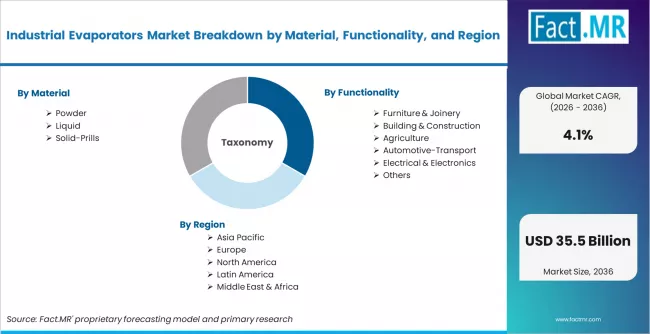
Industrial Evaporators Market Breakdown By Material Functionality And Region | Source: Fact.MR
| Metric | Value |
|---|---|
| Quantitative Units | USD 22.8 billion (2026) to USD 41.4 billion (2036), at a CAGR of 4.1% |
| Market Definition | The industrial evaporators market includes thermal separation equipment designed to concentrate liquids through controlled evaporation of solvents under varying temperature and pressure conditions. These systems are deployed in industrial processing environments requiring volume reduction, solvent recovery, concentration of dissolved solids, and waste minimization across continuous and batch production processes. |
| Type Segmentation | Shell & tube, Plate, Falling film, Rising film, Forced circulation |
| Functionality Segmentation | Mechanical vapor recompression, Thermal evaporation, Heat pump evaporation, Multi effect evaporation |
| End Use Segmentation | Food & beverage, Pharma, Chemical, Pulp & paper, Water treatment |
| Material Segmentation | Steel, Alloy, Graphite, Nickel |
| Regions Covered | North America, Latin America, Europe, East Asia, South Asia, Oceania, Middle East and Africa |
| Countries Covered | United States, Canada, Mexico, Brazil, Argentina, Germany, France, United Kingdom, Italy, Spain, China, India, Japan, South Korea, Indonesia, Australia, and 40+ countries |
| Key Companies Profiled | GEA Group, Alfa Laval, SPX Flow, Veolia Water Technologies, Bucher Industries, Condorchem Envitech, H2O GmbH, Hebeler Process Solutions, Vobis, Thermal Kinetics |
| Forecast Period | 2026 to 2036 |
| Approach | Hybrid top-down and bottom-up market estimation validated through primary interviews with process equipment manufacturers, industrial plant engineers, chemical processing specialists, and system integrators, supported by capacity benchmarking, process technology evaluation, and assessment of adoption trends across liquid concentration and solvent recovery applications |
Source: Fact.MR analysis. Updated Apr 28, 2026
Industrial Evaporators Market Key Segments
-
Type
- Shell and Tube
- Plate
- Falling Film
- Rising Film
- Forced Circulation
-
Functionality
- Mechanical Vapor Recompression
- Thermal Evaporation
- Heat Pump Evaporation
- Multi Effect Evaporation
-
End Use
- Food and Beverage
- Pharma
- Chemical
- Pulp and Paper
- Water Treatment
-
Material
- Steel
- Alloy
- Graphite
- Nickel
-
Region
- North America
- USA
- Canada
- Mexico
- Europe
- Germany
- UK
- France
- Italy
- Spain
- Nordic Countries
- BENELUX
- Rest of Europe
- Asia Pacific
- China
- Japan
- South Korea
- India
- Australia
- Rest of Asia Pacific
- Latin America
- Brazil
- Argentina
- Rest of Latin America
- Middle East and Africa
- Kingdom of Saudi Arabia
- United Arab Emirates
- South Africa
- Rest of Middle East and Africa
- Other Regions
- Oceania
- Central Asia
- Other Markets
- North America
Frequently Asked Questions
How large is the demand for Industrial Evaporators in the global market in 2026?
What will be the market size of Industrial Evaporators in the global market by 2036?
What is the expected demand growth for Industrial Evaporators in the global market between 2026 and 2036?
Which Material is poised to lead global demand by 2026?
What is Driving Industrial Evaporator Demand in China?
What is the China Growth Outlook in this Report?
What is Driving Industrial Evaporator Demand in India?
What is the India Growth Outlook in this Report?
What is Driving Industrial Evaporator Demand in the United States?
What is the United States Growth Outlook in this Report?
What is Driving Industrial Evaporator Demand in Germany?
What is the Germany Growth Outlook in this Report?
What is Driving Industrial Evaporator Demand in the United Kingdom?
What is the United Kingdom Growth Outlook in this Report?
Which Companies are Identified as Leading Participants in the Industrial Evaporators Market?
What are Industrial Evaporators and What are They Mainly Used For?
What does Industrial Evaporators Market Mean in this Report?
What is Included in the Scope of this Industrial Evaporators Market Report?
What is Excluded from the Scope of this Report?
What does Market Forecast Mean on this Page?
How is the Industrial Evaporators Market Forecast Developed in this Report?
What does Data Validation Approach Mean in this Report?
Who worked on this report


Preview the report firsthand - request a free sample
Free SampleGet the brochure for pricing and purchase details
Download PDF