The Insect-Repellent Sacks Market is analyzed across its key product, application and end-use segments, with the study covering market dynamics, regional trends and demand outlook, forecast 2026 to 2036.
By Fact.MR Consumer Goods DeskLead analyst:
Ayush RajPublished :
Updated :
10 min read
Fact-checked under the Fact.MR editorial process
Insect-Repellent Sacks Market Forecast and Outlook 2026 to 2036
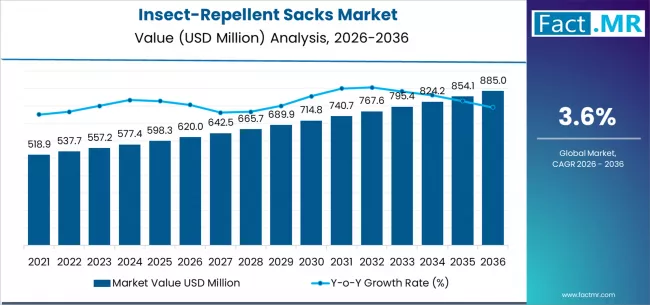
The global insect-repellent sacks market is projected to attain a valuation of USD 589.00 million in 2026, rising to USD 840.75 million by 2036, progressing at a CAGR of 3.6%. This measured growth is anchored in the critical, non-negotiable need to protect vital agricultural commodities and processed goods from pest infestation throughout the storage and logistics chain. The market represents a functional convergence of material science and agrochemical expertise, evolving from simple containment to active protection.
Insect Repellent Sacks Market Market Value Analysis | Source: Fact.MR
Summary of Insect Repellent Sacks Market
Market Snapshot
Global insect repellent sacks market revenue stood at USD 589.0 million in 2026 and is forecast to reach USD 840.7 million by 2036.
At a 3.6% CAGR from 2026 to 2036, this market is set to expand ~1.4x in value, adding USD 251.7 million in absolute opportunity.
This market represents a niche but functionally critical segment within protective packaging and storage solutions, particularly in agriculture and food supply chains.
Insect repellent sacks are evolving into integrated protection systems, combining storage functionality with embedded pest control to reduce contamination and post-harvest losses.
Demand and Growth Drivers
Rising incidence of insect-driven crop losses and storage infestations is a primary demand driver, particularly in emerging agricultural economies.
Increasing awareness of post-harvest loss prevention and food security is reinforcing adoption of treated storage materials.
Growth in grain storage, transport logistics, and bulk commodity handling is supporting steady demand.
Shift toward non-chemical and integrated pest management (IPM) approaches is accelerating development of safer, treated sack materials.
Broader growth in the insect control ecosystem—driven by disease and pest risks—continues to underpin demand across applications
Product and Segment View
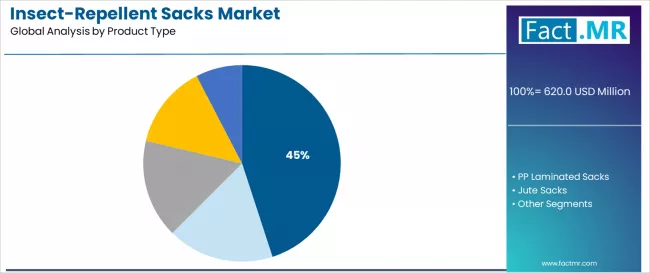
HDPE Woven Sacks dominate material share in 2026, due to durability, cost efficiency, and compatibility with insect-repellent coatings.
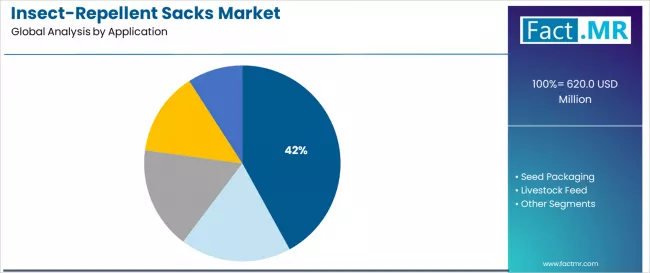
Grain storage accounts for the largest application share, driven by grain handling, seed storage, and bulk commodity packaging.
Functional features include:
Embedded insect-repellent additives
Moisture resistance and durability
Reusability and extended lifecycle
Product innovation is focused on:
Bio-based and non-toxic repellent treatments
Enhanced barrier performance
Lightweight but high-strength designs
Geography and Competitive Outlook
Asia Pacific and Africa represent the largest and fastest-growing markets, driven by high agricultural dependency and post-harvest loss challenges.
India, China, Nigeria, Brazil, and Indonesia are key growth markets, reflecting strong grain production and storage demand.
Market expansion is closely tied to:
Agricultural output growth
Storage infrastructure development
Government programs on food security
Competitive landscape includes players across:
Agricultural packaging manufacturers
Polymer and material suppliers
Pest control solution providers
Insect Repellent Sacks Market — At a Glance
Attribute
Details
Market Value 2026
USD 589.0 million
Market Value 2036
USD 840.7 million
Absolute Dollar Opportunity 2026–2036
USD 251.7 million
Total Growth 2026–2036
43%
CAGR 2026–2036
3.6%
Growth Multiple
~1.4x
Key Demand Theme
Integration of pest-control functionality into storage and transport sacks to reduce post-harvest losses
North America, Latin America, Europe, Asia Pacific, MEA
Source: Fact.MR analysis. Updated Apr 15, 2026
Current trends highlight a strategic shift towards integrated pest management solutions that minimize chemical use while maximizing efficacy. There is a growing emphasis on developing repellent technologies safe for direct food contact and effective over extended storage periods.
Sustainability pressures are driving innovation in substrate materials, balancing the durability required for bulk handling with end-of-life environmental considerations. The market is increasingly characterized by tailored solutions, where sack specifications are finely tuned to the specific vulnerability of the stored product, be it grains, seeds, or animal feed.
North America, Latin America, Western Europe, Eastern Europe, East Asia, South Asia & Pacific, MEA
Source: Fact.MR analysis. Updated Apr 15, 2026
Segmental Analysis
By Application, Which Segment Demands the Highest Level of Protective Assurance?
Insect Repellent Sacks Market Analysis By Application | Source: Fact.MR
The grain storage segment commands a leading 44.1% share. This dominance is driven by the colossal economic and food security implications of post-harvest losses due to pests like weevils and moths.
Protecting stored cereals and pulses over months in silos or warehouses requires sacks that offer robust, long-lasting repellency, making this application the primary driver for high-efficacy, high-durability insect-repellent sack solutions.
By Product Type, Which Material Offers the Optimal Balance of Strength and Treatability?
Insect Repellent Sacks Market Analysis By Product Type | Source: Fact.MR
HDPE woven sacks constitute the dominant product type with a 47.3% share. Their leadership stems from their exceptional tensile strength, moisture resistance, and cost-effectiveness for bulk handling.
The woven polyolefin structure provides an ideal substrate for applying and retaining repellent coatings or laminations, creating a durable barrier that withstands rough handling while actively protecting the contents.
By Technology, Which Method Provides the Most Direct and Reliable Defense?
Insect Repellent Sacks Market Analysis By Technology | Source: Fact.MR
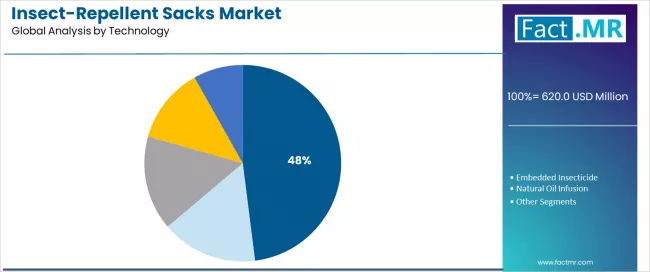
Repellent coating is the predominant technology, holding a 50.4% share. This method involves applying a layer containing insecticidal or repellent agents directly onto the sack material, either internally or externally.
It is favored for its manufacturing simplicity, cost efficiency at scale, and the direct barrier it creates, offering immediate and consistent protection that is crucial for safeguarding high-volume, perishable commodities.
What are the Principal Drivers, Restraints, Opportunities, and Threats of this Market?
The market is primarily driven by the urgent global imperative to reduce post-harvest food losses, which significantly impacts food security and farmer incomes. Strict phytosanitary regulations for international trade of agricultural products further mandate the use of protected packaging.
A major restraint is the increasing regulatory scrutiny and consumer concern over synthetic insecticide residues, potentially leading to usage bans or complex compliance requirements. The higher cost of repellent sacks compared to standard packaging also limits adoption in price-sensitive markets.
A significant opportunity lies in the advancement of bio-based repellents and the integration of smart indicators that signal pest breach. The threat landscape includes the development of alternative bulk storage solutions, such as silo-based gaseous fumigation systems, and the risk of pests developing resistance to common chemical repellents, necessitating continuous and costly innovation.
Analysis of the Insect-Repellent Sacks Market by Key Countries
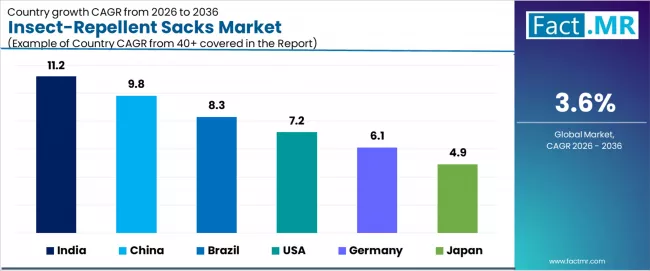
Insect Repellent Sacks Market Cagr Analysis By Country | Source: Fact.MR
Country
CAGR (2026-2036)
India
10.6%
China
10.3%
Brazil
7.9%
USA
7.6%
Germany
5.8%
Japan
5.1%
Source: Fact.MR analysis. Updated Apr 15, 2026
What Factors Underpin India's Commanding Growth in Demand for Insect-Repellent Sacks?
India's leading 10.6% CAGR is fueled by its status as a major producer and consumer of grains and pulses, coupled with significant post-harvest losses. Government initiatives to modernize storage infrastructure and growing awareness among farmers about preserving crop value are driving the adoption of advanced protective packaging. The vast network of small and medium-scale storages presents a massive, yet fragmented, addressable market for cost-effective repellent sack solutions.
How is China's Agricultural Modernization Shaping Demand for Insect-Repellent Sacks?
China's 10.3% CAGR is linked to its massive grain reserves and the centralized management of strategic crop stockpiles. The push towards higher efficiency and reduced waste in the agricultural supply chain supports investment in improved packaging. Domestic innovation in polymer and coating technologies allows local manufacturers to produce repellent sacks that meet both the scale of demand and evolving safety standards.
Why does Brazil's Export-Oriented Agribusiness Rely on Insect-Repellent Sacks?
Brazil's 7.9% CAGR is intrinsically tied to its role as a global agricultural exporting powerhouse. Meeting the stringent import phytosanitary standards of international markets for soybeans, corn, and coffee necessitates guaranteed pest-free transportation. Insect-repellent sacks are a critical component of this assurance, protecting commodities during inland transit and port storage before shipment.
How do Integrated Farming Systems in the USA Influence Product Development?
The USA's 7.6% CAGR is supported by large-scale, integrated farming and livestock operations that require reliable, bulk packaging for seeds and processed feed. The demand is for high-performance sacks that protect high-value genetically modified seeds and ensure feed quality. Growth is steady, driven by a focus on optimizing supply chain integrity and reducing losses in a high-volume, mechanized agricultural environment.
What Drives Germany's Demand for Precision and Regulatory Compliance?
Germany's 5.8% CAGR reflects a mature market where demand is driven by precision agriculture and strict EU regulations on pesticide use and packaging waste. The need is for highly engineered sacks that offer precise, controlled repellent release for specialty seeds and high-value agricultural products, while also aligning with circular economy principles through recyclability or compostability.
What Characterizes Japan's Niche-Driven and Quality-Focused Market?
Japan's 5.1% CAGR is characterized by its focus on protecting high-value specialty grains, seeds for controlled horticulture, and premium imported commodities. The market demands technologically advanced sacks with ultra-reliable, often natural, repellent systems for smaller batch storage, where any loss represents a significant financial impact, driving adoption despite the higher cost.
Competitive Landscape of the Insect-Repellent Sacks Market
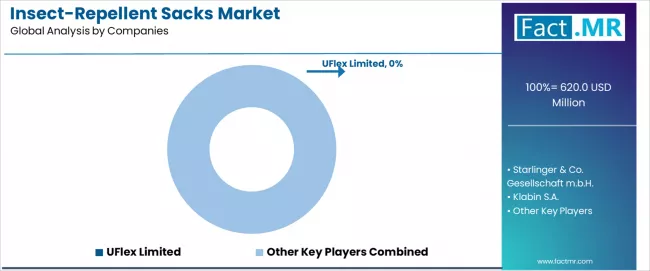
Insect Repellent Sacks Market Analysis By Company | Source: Fact.MR
The competitive environment is segmented between global flexible packaging giants and specialized agricultural packaging suppliers. Competition is less about pure volume and more about technical expertise in regulatory compliance and efficacy validation. Key battlegrounds include developing repellent formulations that are both highly effective and approved for global food-contact use, and engineering sack structures that allow for controlled release of active ingredients over a product's specified shelf life.
Success hinges on securing partnerships with large agribusinesses, cooperatives, and government procurement agencies for storage programs. The ability to provide verifiable data on repellency rates and residue levels, alongside offering a range of material options from synthetic to natural fibers, serves as a critical differentiator in this market where performance assurance is paramount.
Key Players in the Insect-Repellent Sacks Market
UFlex
Starlinger & Co.
Klabin
Berry Global Group Inc.
Mondi plc.
SCG Packaging
References
Food and Agriculture Organization of the United Nations. (2025). Guidelines for the reduction of post-harvest losses in grains. FAO Agricultural Services Bulletin.
Hedges, S. A., & Lacey, M. S. (2024). Field guide to the management of stored-product insects. Insect Limited Publications.
Mullen, M. A., & Pedersen, J. R. (2025). Preservation of stored grains using packaging and modified atmospheres. Annual Review of Entomology.
Pesticide Action Network International. (2024). Regulatory trends in post-harvest pesticide use. PAN Standards Watch.
World Health Organization. (2025). Safety evaluation of certain food additives and contaminants: Insect repellents in food-contact materials. WHO Food Additives Series.
UFlex, Starlinger & Co., Klabin, Berry Global Group Inc., Mondi plc., SCG Packaging
Additional Analysis
Efficacy testing protocols and pest-specific repellency rates; analysis of chemical migration and food safety compliance; total cost of ownership comparison versus fumigation; impact on seed germination and feed nutritional quality; study of degradation and recyclability of treated sack materials.
Source: Fact.MR analysis. Updated Apr 15, 2026
Market by Segments
Application :
Grain Storage
Seed Packaging
Livestock Feed
Fertilizer Bags
Others
Product Type :
HDPE Woven Sacks
PP Laminated Sacks
Jute Sacks
Multiwall Paper Sacks
Others
Technology :
Repellent Coating
Embedded Insecticide
Natural Oil Infusion
Barrier Micro-Coating
Others
Region :
North America
USA
Canada
Latin America
Brazil
Mexico
Argentina
Rest of Latin America
Western Europe
Germany
France
Italy
Spain
UK
BENELUX
Rest of Western Europe
Eastern Europe
Russia
Poland
Czech Republic
Rest of Eastern Europe
East Asia
China
Japan
South Korea
Rest of East Asia
South Asia & Pacific
India
ASEAN
Australia
Rest of South Asia & Pacific
MEA
GCC Countries
South Africa
Turkiye
Rest of MEA
Questions Answered
Frequently Asked Questions
How big is the insect-repellent sacks market in 2026?
The global insect-repellent sacks market is estimated to be valued at USD 620.0 million in 2026.
What will be the size of insect-repellent sacks market in 2036?
The market size for the insect-repellent sacks market is projected to reach USD 885.0 million by 2036.
How much will be the insect-repellent sacks market growth between 2026 and 2036?
The insect-repellent sacks market is expected to grow at a 3.6% CAGR between 2026 and 2036.
What are the key product types in the insect-repellent sacks market?
The key product types in insect-repellent sacks market are grain storage, seed packaging, livestock feed, fertilizer bags and others.
Which product type segment to contribute significant share in the insect-repellent sacks market in 2026?
In terms of product type, hdpe woven sacks segment to command 45.0% share in the insect-repellent sacks market in 2026.