- Base Value(2026): 1.0 Bn
- Estimated Value(2026): 1.0 Bn
- Forecast Value (2036): 2.0 Bn
- CAGR (2026 - 2036): 6.7%
Infant Transport Devices Market Forecast and Outlook 2026 to 2036
The global Infant transport devices market is expected to total USD 1.04 billion in 2026, and eventually at USD 1.99 billion in 2036. Expected to rise at a 6.7% CAGR, This growth is anchored in the critical need to provide continuity of intensive care for neonates during their most vulnerable period, between delivery suites, specialized units, and between hospitals.
These devices are far more than mere transport vehicles; they are mobile, regulated micro-environments designed to replicate the stability of a neonatal intensive care unit. Their integration of advanced thermoregulation, respiratory support, and hemodynamic monitoring is essential for stabilizing critically ill newborns and minimizing the risks associated with movement.
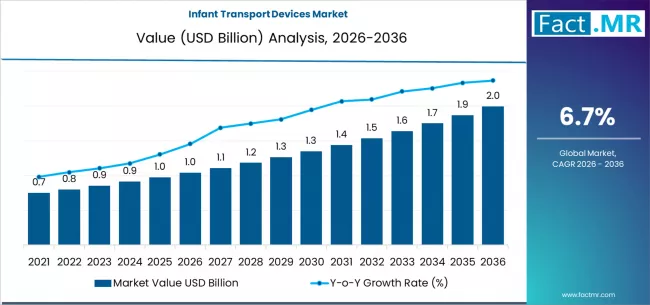
Infant Transport Devices Market Market Value Analysis | Source: Fact.MR
Summary of Infant Transport Devices Market
- Market Snapshot
-
Global infant transport devices market revenue stood at USD 1.04 billion in 2026 and is forecast to reach USD 1.99 billion by 2036.
-
At a 6.7% CAGR from 2026 to 2036, this market is set to expand ~1.9x in value, adding USD 0.95 billion in absolute opportunity.
-
This growth is anchored in the critical need to provide continuity of intensive neonatal care during transport, particularly between delivery suites, specialized units, and inter-hospital transfers for high-risk infants.
-
Increasing survival rates of extremely premature infants, combined with the centralization of neonatal care into specialized facilities, is positioning infant transport devices as essential systems enabling safe, controlled, andmonitoredneonatal mobility.
-
- Demand and Growth Drivers
-
Rising global incidence of preterm births and neonatal complications is driving demand for specialized transport systems capable ofmaintainingstable clinical conditions during transfers.
-
Increasing healthcare focus on centralized neonatal intensive care units (NICUs) isnecessitatingreliable transport solutions for moving infants from primary care settings to advanced treatmentcenters.
-
Growing reliance on structured neonatal transport systems across healthcare networks is reinforcing the importance of devices that ensure thermal regulation, monitoring, and stability during movement.
-
Advancements in neonatal care and transport protocols are improving survival outcomes, further increasing adoption of integrated transport devices across hospitals and emergency services.
-
- Product and Segment View
-
Transport incubators hold 64.1% of device type share in 2026,emergingas the leading segment due to their ability to provide controlled thermal environments and integrated monitoring during neonatal transport.
-
NICU transport accounts for 74.6% of application share in 2026, positioning it as the dominant application, driven by the need for immediate transfer of high-risk newborns to specialized intensive care units.
-
Hospitalsrepresent79.8% of end-use share in 2026, supported by concentration of neonatal care infrastructure and specialized clinical capabilitiesrequiredfor critical infant transport.
-
- Geography and Competitive Outlook
-
Growth is closely tied to regions investing in centralized neonatal care systems and transport infrastructure, particularly across developing healthcare ecosystems.
-
India (10.2% CAGR), China (10.0%), and Brazil (9.5%) are among the fastest-growing countries, supported by expanding neonatal care capabilities and improving healthcare access.
-
Developed markets such as the United States and Europe continue tomaintainstrong demand due toestablishedneonatal care systems and structured inter-hospital transfer networks.
-
Key companies active in this market include Dräger, GE HealthCare, Atom Medical, Inspiration Healthcare, and Phoenix Medical.
-
Infant Transport Devices Market — At a Glance
| Attribute | Details |
|---|---|
| Market Value 2026 | USD 1.04 billion |
| Market Value 2036 | USD 1.99 billion |
| Absolute Dollar Opportunity 2026–2036 | USD 0.95 billion |
| Total Growth 2026–2036 | 91.3% |
| CAGR 2026–2036 | 6.7% |
| Growth Multiple | ~1.9x |
| Key Demand Theme | Increasing need for continuous neonatal care during intra- and inter-hospital transport driven by rising preterm births and centralized NICU systems |
| Leading Segment by Device Type (2026) | Transport Incubators |
| Device Type Segment Share (2026) | 64.1% |
| Leading Segment by Application (2026) | NICU Transport |
| Application Segment Share (2026) | 74.6% |
| Leading Segment by End Use (2026) | Hospitals |
| End Use Segment Share (2026) | 79.8% |
| Fastest Growing Countries | India, China, Brazil |
| Key Growth Regions | North America, Europe, Asia Pacific |
| Country CAGRs | India 10.2%, China 10.0%, Brazil 9.5%, USA 8.9% |
| Top Companies | Dräger, GE HealthCare, Atom Medical, Inspiration Healthcare, Phoenix Medical |
| Segmentation by Device Type | Transport Incubators, Transport Warmers, Monitoring Accessories |
| Segmentation by Application | NICU Transport, Inter-hospital Transfer |
| Segmentation by End Use | Hospitals, Emergency Services, Others |
| Segmentation by Region | North America, Latin America, Europe, Asia Pacific, Middle East & Africa |
Source: Fact.MR analysis. Updated Mar 31, 2026
The market evolution is closely tied to regional efforts to centralize high-risk obstetric and neonatal care, which inherently increases the necessity for safe, long-distance transports. Furthermore, rising survival rates of extremely premature infants, who are most dependent on such technology, sustains demand.
The development of more rugged, connected, and user-friendly transport systems reflects the ongoing pursuit to extend the reach of lifesaving interventions to neonates born in settings with limited resources, making these devices a cornerstone of equitable perinatal care networks.
Category of Infant Transport Devices Market
| Category | Segments |
|---|---|
| Device Type | Transport Incubators, Transport Warmers, Monitoring Accessories |
| Application | NICU Transport, Inter-hospital Transfer |
| End User | Hospitals, Emergency Services, Others |
| Region | North America, Latin America, Western Europe, Eastern Europe, East Asia, South Asia & Pacific, MEA |
Source: Fact.MR analysis. Updated Mar 31, 2026
Segmental Analysis
By Device Type, Which System is the Foundation of Mobile Neonatal Care?
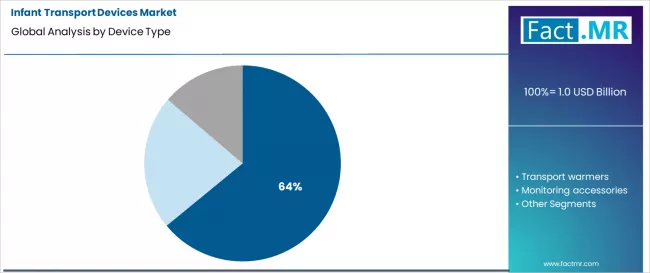
Infant Transport Devices Market Analysis By Device Type | Source: Fact.MR
Transport incubators command a dominant 64.1% share. This segment's leadership is due to its role as an all-in-one mobile life-support system, providing a controlled thermal environment, protection from external elements, and a secure platform for integrating ventilators and monitors. It is the essential workhorse for lengthy or complex transfers of critically ill neonates, where maintaining a stable microclimate is as crucial as the medical interventions themselves.
By Application, Where is the Clinical Need Most Acute?
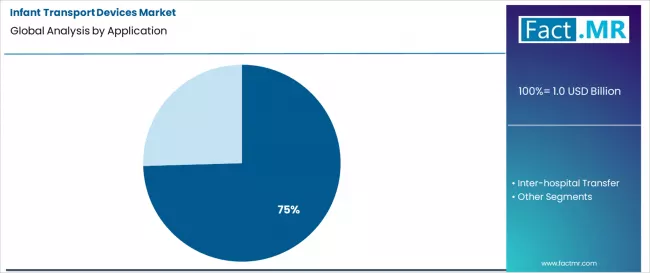
Infant Transport Devices Market Analysis By Application | Source: Fact.MR
NICU transport is the leading application with a 74.6% share. This encompasses the initial, critical movement of a high-risk newborn from a delivery room or community hospital to a tertiary NICU.
The acuity of these patients, often requiring immediate respiratory and temperature support, makes this the most demanding and protocol-driven use case, mandating the highest-performance transport devices and trained teams.
By End User, Who Manages the Most Critical Transfers?
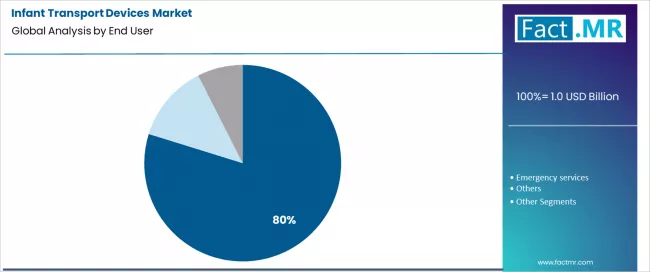
Infant Transport Devices Market Analysis By End User | Source: Fact.MR
Hospitals constitute the primary end-user segment at 79.8%. Regional perinatal centers and children's hospitals operate dedicated neonatal transport teams and fleets. These institutions bear the ultimate clinical and legal responsibility for patient outcomes during transfer, driving their investment in the most reliable, technologically advanced equipment and their role as the central purchasers and maintainers of these specialized systems.
What are the Principal Drivers, Constraints, and Evolving Dynamics of this Market?
The paramount driver is the global trend toward centralization of advanced neonatal care into specialized tertiary centers, which inherently increases the volume and distance of infant transports.
A key restraint is the exceptionally high cost of advanced transport incubator systems, which includes not only the capital purchase but also significant ongoing costs for maintenance, calibration, and vehicle integration, posing a substantial burden for hospital budgets.
A significant opportunity lies in the development of more affordable, robust, and intuitive transport solutions tailored for emerging markets, where geographic distances and resource limitations are greatest.
The dominant trend is the integration of telemedicine capabilities, advanced data logging into transport devices, allowing remote neonatologists to monitor vital parameters in real-time, and receive a complete electronic record of the transport environment, thereby supporting decision-making and quality assurance.
Analysis of the Infant Transport Devices Market by Key Countries
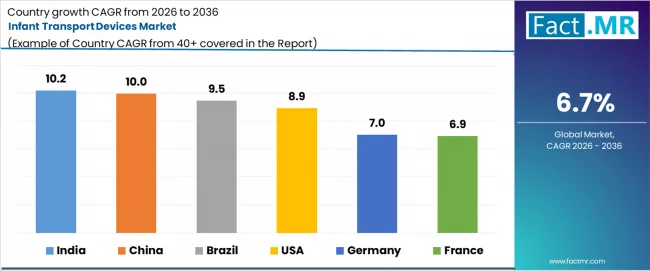
Infant Transport Devices Market Cagr Analysis By Country | Source: Fact.MR
| Country | CAGR 2026 to 2036 |
|---|---|
| India | 10.2% |
| China | 10.0% |
| Brazil | 9.5% |
| USA | 8.9% |
| Germany | 7.0% |
| France | 6.9% |
Source: Fact.MR analysis. Updated Mar 31, 2026
How is India's Healthcare System Addressing Regional Disparities in Neonatal Care?
India's leading CAGR of 10.2% is propelled by national and state-level initiatives to reduce neonatal mortality by improving access to specialized care. This involves creating formalized referral networks that connect rural birth centers to urban NICUs, generating systematic demand for transport solutions.
Growth is characterized by the need for devices that are rugged enough for varied road conditions and intuitive for use by diverse medical staff, with increasing investment from both public health programs and private hospital chains expanding their neonatal services.
What Strategic Health Infrastructure Goals Underpin China's Growth?
China's robust 10.0% CAGR is driven by the strategic upgrade of its maternal and child health infrastructure, including the construction of new perinatal care centers and the standardization of neonatal transport protocols. Government-led quality improvement campaigns are mandating better equipment for emergency neonatal transfers.
The market is further shaped by a growing domestic manufacturing base for medical devices aiming to produce technologically capable yet cost-competitive transport incubators to serve this expanding public health need.
Why is Brazil's Focus on Reducing Neonatal Mortality a Key Market Driver?
Brazil's significant 9.5% CAGR is linked to sustained public health campaigns targeting a reduction in infant mortality, which highlight the need for effective neonatal transport between municipalities.
The unified health system's focus on regionalizing care creates a structured demand for equipment. Growth is fueled by the expansion of private neonatal care networks and the need to serve vast geographical areas, making reliable transport a critical component of service delivery.
How does the USA's Mature but Evolving Regionalized Care System Sustain Demand?
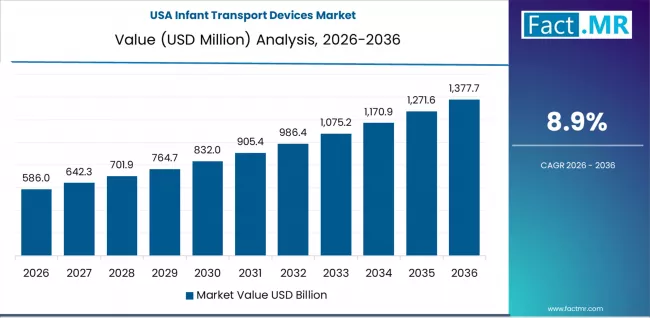
Infant Transport Devices Market Country Value Analysis | Source: Fact.MR
The USA's strong 8.9% CAGR operates within a mature regionalized system for perinatal care. Demand is driven by the replacement and upgrade cycles of existing hospital-based transport fleets, as well as the adoption of newer technologies offering enhanced safety features, data connectivity, and ergonomic designs.
Growth is supported by the clinical need to transport an increasing number of extremely low birth weight infants and by the expansion of specialized pediatric emergency ground and air transport services.
What Characterizes the Steady, Technology-Driven Demand in Germany?
Germany's 7.0% CAGR reflects a stable market driven by engineering excellence and a focus on lifecycle asset management. Demand is primarily generated by the scheduled replacement of aging transport fleets within well-funded hospital networks.
Growth is characterized by a preference for technologically advanced devices that offer demonstrable improvements in data integration with hospital IT systems, superior reliability, and compliance with the latest DIN and EU safety standards for medical devices and ambulance equipment. Procurement decisions are heavily influenced by technical specifications, long-term durability, and the quality of manufacturer service support, leading to methodical, investment-based growth cycles.
What Defines the Steady, System-Centric Demand in France?
France's 6.9% growth is shaped by its centralized public health infrastructure and regionalized SAMU networks. Demand is steady, driven by national and regional budgeting cycles for modernizing publicly funded medical transport resources.
The focus is on acquiring devices that offer optimal performance within a value-based framework, emphasizing interoperability with centralized dispatch systems, user-friendly operation for diverse clinical teams, and adherence to strict Haute Autorité de Santé guidelines. Growth is incremental, tied to public investment plans aimed at maintaining high standards of care and operational efficiency across the national perinatal network.
Competitive Landscape of the Infant Transport Devices Market
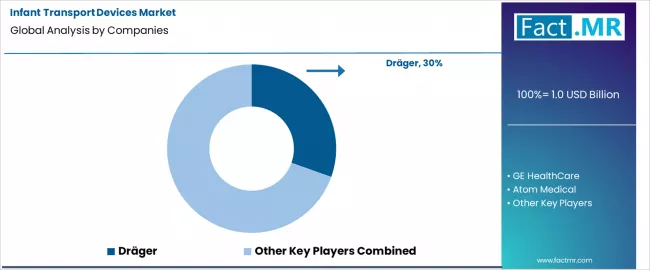
Infant Transport Devices Market Analysis By Company | Source: Fact.MR
The competitive landscape is consolidated around a few global leaders with deep expertise in neonatal critical care, alongside several strong regional players. Competition is based on clinical reputation, product reliability and durability, the breadth of integrated monitoring and support features, and the strength of service networks capable of ensuring device uptime for mission-critical applications.
Success is heavily dependent on long-term relationships with major children’s hospitals and public health authorities who make large fleet purchases. Innovation focuses on enhancing ease of use for transport teams, improving battery technology for longer operational independence, and developing seamless data handoff systems to receiving NICUs.
Key Players in the Infant Transport Devices Market
- Dräger
- GE HealthCare
- Atom Medical
- Inspiration Healthcare
- Phoenix Medical
- Others
References
- American Academy of Pediatrics. (2025). Guidelines for Air and Ground Transport of Neonatal and Pediatric Patients. AAP.
- European Society for Paediatric Research. (2024). Standards for Equipment Used in Neonatal Transport. ESPR.
- International Confederation of Neonatal Transport. (2025). Core Competencies and Equipment for Neonatal Transport. ICNT.
- World Health Organization. (2025). Recommendations for Management of Common Childhood Conditions: Newborn Transport. WHO.
- Zahr, L. K., & Balian, S. (2024). Neonatal Transport: A Comprehensive Guide to Principles, Practice, and Equipment. Springer.
Segmentation
Scope of Report
| Items | Values |
|---|---|
| Quantitative Units | USD Billion |
| Device Type | Transport Incubators, Transport Warmers, Monitoring Accessories |
| Application | NICU Transport, Inter-hospital Transfer |
| End User | Hospitals, Emergency Services, Others |
| Key Countries | India, China, Brazil, USA, Germany, France |
| Key Companies | Dräger, GE HealthCare, Atom Medical, Inspiration Healthcare, Phoenix Medical, Others |
| Additional Analysis | Analysis of device performance under varying ambient conditions and vehicle motion; study of training requirements and competency for transport teams; total cost of ownership analysis including maintenance and parts; impact of device design on infection control and cleaning protocols; assessment of power source reliability and backup systems. |
Source: Fact.MR analysis. Updated Mar 31, 2026
Market by Segments
-
Device Type :
- Transport Incubators
- Transport Warmers
- Monitoring Accessories
-
Application :
- NICU Transport
- Inter-hospital Transfer
-
End User :
- Hospitals
- Emergency Services
- Others
-
Region :
- North America
- USA
- Canada
- Latin America
- Brazil
- Mexico
- Argentina
- Rest of Latin America
- Western Europe
- Germany
- France
- Italy
- Spain
- UK
- BENELUX
- Rest of Western Europe
- Eastern Europe
- Russia
- Poland
- Czech Republic
- Rest of Eastern Europe
- East Asia
- China
- Japan
- South Korea
- Rest of East Asia
- South Asia & Pacific
- India
- ASEAN
- Australia
- Rest of South Asia & Pacific
- MEA
- GCC Countries
- South Africa
- Turkiye
- Rest of MEA
- North America
Frequently Asked Questions
How big is the infant transport devices market in 2026?
What will be the size of infant transport devices market in 2036?
How much will be the infant transport devices market growth between 2026 and 2036?
What are the key product types in the infant transport devices market?
Which application segment to contribute significant share in the infant transport devices market in 2026?
Who worked on this report


Preview the report firsthand - request a free sample
Free SampleGet the brochure for pricing and purchase details
Download PDF