- Base Value(2025): 13.0 Bn
- Estimated Value(2026): 14.7 Bn
- Forecast Value (2036): 49.5 Bn
- CAGR (2026 - 2036): 12.7%
Integrated HVAC and Comfort Control Display Systems Market Forecast and Outlook by Fact.MR
In 2025, the integrated HVAC and comfort control display systems market was valued at USD 13.0 billion. Based on Fact.MR analysis, demand for integrated HVAC and comfort control display systems is estimated to grow to USD 14.7 billion in 2026 and USD 49.5 billion by 2036. FACT.MR projects a CAGR of 12.7% during the forecast period.
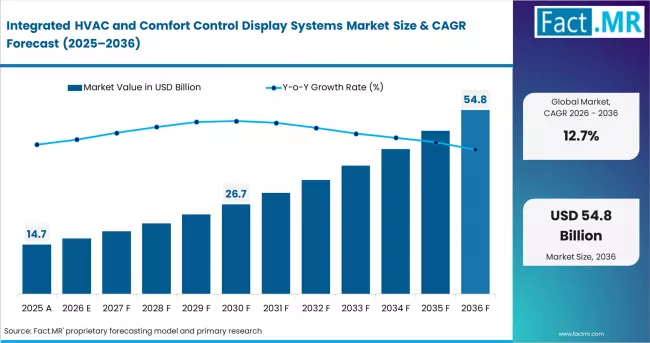
Integrated Hvac And Comfort Control Display Systems Market Value Analysis | Source: Fact.MR
Summary of Integrated HVAC and Comfort Control Display Systems Market
- Market Definition
- The market covers automatic and manual climate control systems with integrated touchscreen, hybrid, and physical display interfaces supplying cabin temperature, airflow, and comfort management for passenger and commercial vehicle OEM programmes globally.
- Demand Drivers
- EV OEM platforms require integrated thermal management systems combining battery cooling, cabin heating, and occupant comfort control into a single unified HVAC interface, directly expanding per-vehicle system content value.
- China's NEV promotion policy mandates smart cabin climate control as a qualifying feature for subsidy-eligible vehicles, accelerating touchscreen HVAC integration across domestically produced electric vehicle platforms.
- India's OEM mid-range vehicle segment is standardising automatic climate control as a feature differentiator, with Tata Motors and Maruti Suzuki expanding standard fitment across new model launches in 2024 and 2025.
- Key Segments Analyzed
- By Technology: Automatic climate control systems lead with approximately 72% share in 2026, driven by sensor-based automation dominance across modern vehicle cabins and OEM standard fitment policies.
- By Display Integration Type: Integrated touchscreen HVAC control displays lead with approximately 55% share in 2026, reflecting OEM consolidation of climate and infotainment interfaces into unified cockpit display architectures.
- By Geography: China leads at 13.0% CAGR through 2036, driven by EV platform smart cockpit mandates and domestic HVAC supplier scaling across NEV production programmes.
- Analyst Opinion at FACT.MR
- Shambhu Nath Jha, Principal Consultant at Fact.MR, opines, ‘CXOs will find that HVAC display integration is becoming a cockpit software battleground. Suppliers embedding climate algorithms with touchscreen HMI are gaining advantage. Tier-1 players with these capabilities will capture a larger share of EV platform programmes through 2036.
- Strategic Implications
- Invest in integrated touchscreen HVAC display platform capability targeting EV OEM programmes in China, Germany, and the United States where automatic climate system mandates are accelerating.
- Develop cost-optimised automatic climate control modules for India and Southeast Asia mid-range vehicle OEM supply to capture high-growth volume segments during the manual-to-automatic transition.
- Build embedded cabin climate algorithm competency alongside hardware supply to secure bundled HVAC-display contracts and higher margin positioning within OEM EV platform programmes.
- Methodology
- Market sizing based on vehicle production volumes, HVAC attach rates by technology, and average selling prices by system type. Validated with 2024–2025 OEM sourcing data.
- Analysis incorporates OEM earnings disclosures, EU automotive type approval regulation filings, China NEV policy documents, and Tier-1 supplier sourcing communications.
- Forecasts account for vehicle electrification trends, OEM cockpit integration strategies, HVAC sensor cost curves, and regional NEV and emission regulation timelines.
| Metric | Value |
|---|---|
| Estimated Value in 2026 | USD 14.7 billion |
| Forecast Value in 2036 | USD 49.5 billion |
| Forecast CAGR (2026 to 2036) | 12.7% |
Source: Fact.MR analysis. Updated Apr 29, 2026
Between 2026 and 2036, the market is expected to create USD 34.8 billion in absolute opportunity. Growth is driven by EV thermal management and connected cabin requirements. OEMs are integrating HVAC controls into central display systems. High sensor and actuator costs remain a constraint. Long OEM validation cycles also slow adoption. Manual systems in commercial vehicles are declining at a slower pace.
Automatic climate systems are expanding across new platforms. Touchscreen HVAC integration is also increasing. Denso Corporation and Valeo both reported HVAC programme expansion in 2024. Growth is linked to EV thermal systems and smart climate control. Valeo stated that electrified HVAC content per vehicle grew over 20% in 2024. This was driven by heat pumps and sensor-based systems.
China leads with 13.0% CAGR through 2036. Growth is supported by EV dominance and smart cockpit adoption. India follows at 12.4%, driven by rising comfort demand and localisation. Germany records 10.8%, led by premium OEM integration. The United States grows at 11.3%, supported by connected vehicle ecosystems. Japan records 9.6%, driven by steady technology adoption. Mature markets face slower growth due to longer platform cycles.
Segmental Analysis
Integrated HVAC and Comfort Control Display Systems Market Analysis by Technology
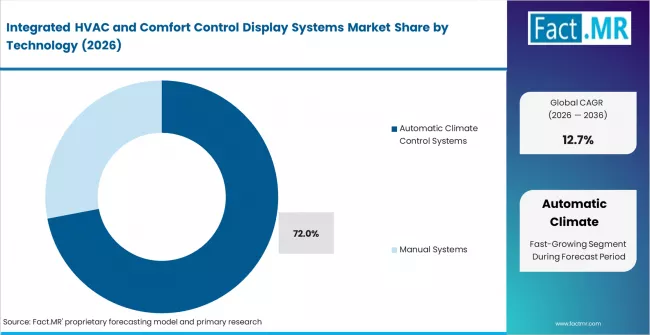
Integrated Hvac And Comfort Control Display Systems Market Analysis By Technology | Source: Fact.MR
Based on FACT.MR, automatic climate control holds 72% share in 2026. It dominates due to sensor-based automation. It supports air quality, zoning, and predictive comfort. Manual systems remain in lower segments.
- Valeo EV HVAC Investment: Valeo reported over 20% growth in electrified HVAC content in 2024. Heat pumps and automatic systems were key drivers [1].
- Hanon Systems Platform Development: Hanon launched integrated thermal and climate modules in 2025. These combine battery and cabin control for EVs [5].
- Automatic System Fitment Trend: OICA data shows 71% of new vehicles include automatic climate systems in 2024. This increased from 58% in 2022 [6].
Integrated HVAC and Comfort Control Display Systems Market Analysis by Display Integration Type
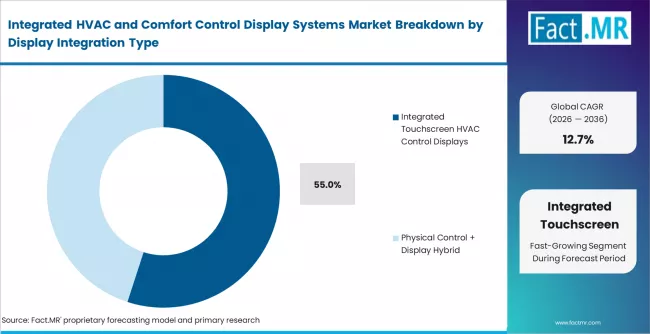
Integrated Hvac And Comfort Control Display Systems Market Analysis By Display Integration Type | Source: Fact.MR
Based on FACT.MR, integrated touchscreen HVAC displays hold 55% share in 2026. OEMs are consolidating controls into central screens. Hybrid systems remain in fleet and near-premium vehicles.
- Continental AG Display Integration: Continental AG showcased integrated HVAC touchscreen platforms at CES 2025. These target 2026–2027 OEM programmes [7].
- Panasonic Automotive HVAC Display: Panasonic Automotive Systems secured a supply deal in 2024 for integrated HVAC displays. It covers ~500,000 units annually from 2026 [8].
- Touchscreen Integration Trend: DSCC data shows touchscreen HVAC systems reached 52% fitment in 2024. This rose from 38% in 2022, driven by cockpit consolidation [9].
Drivers, Restraints, and Opportunities
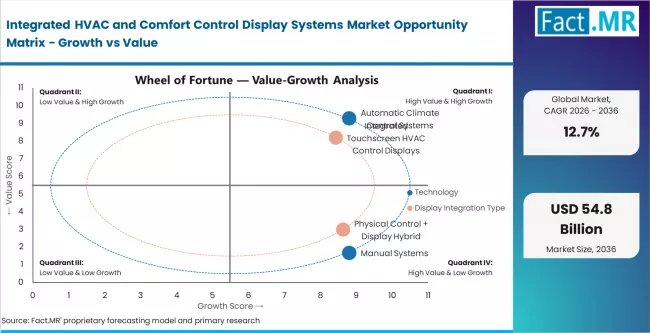
Integrated Hvac And Comfort Control Display Systems Market Opportunity Matrix Growth Vs Value | Source: Fact.MR
FACT.MR analysis indicates that the integrated HVAC and comfort control display systems market is structurally growth-driven. It is undergoing rapid technology transition. Demand is driven by EV thermal management needs. OEMs are integrating HVAC into touchscreen cockpit systems. Consumers expect personalised cabin comfort across segments. Adoption is accelerating from luxury into mainstream vehicles.
Manual climate systems are losing OEM preference. Automatic sensor-based systems are gaining share. Physical panels are being replaced by touchscreen interfaces. Automatic systems command 30–50% higher pricing. This supports strong value growth. Manual systems remain in commercial and entry segments. Suppliers without touchscreen capability risk exclusion from OEM programmes from 2026.
- EU Emission and Thermal Management Regulation: EU CO2 targets are pushing EV thermal efficiency improvements. This is driving heat pump and automatic HVAC adoption. Valeo and Hanon Systems expanded EV HVAC supply in 2024–2025 [2].
- China NEV Smart Cabin Mandate: China’s 2024 MIIT policy promotes smart cabin comfort features. OEMs such as BYD and NIO integrated touchscreen HVAC systems. Denso Corporation and MAHLE GmbH expanded local HVAC partnerships [3].
- India OEM Automatic Climate Standardisation: India’s 2024 PLI extension supports automatic climate control adoption. Tata Motors introduced dual-zone systems in 2025 models. Maruti Suzuki plans wider rollout from 2026. This expands demand in mid-range vehicles [4].
Regional Analysis
The integrated HVAC and comfort control display systems market is assessed across Asia Pacific, North America, Europe, Latin America, and Middle East and Africa, covering major vehicle production and consumption markets with distinct OEM ecosystems, regulatory environments, and cabin comfort feature adoption profiles. The full report provides market attractiveness analysis by region and country.
.webp "Top Country Growth Comparison Integrated Hvac And Comfort Control Display Systems Market Cagr (2026 2036)")
Top Country Growth Comparison Integrated Hvac And Comfort Control Display Systems Market Cagr (2026 2036) | Source: Fact.MR
| Country | CAGR (2026 to 2036) |
|---|---|
| China | 13.0% |
| India | 12.4% |
| United States | 11.3% |
| Germany | 10.8% |
| Japan | 9.6% |
Source: Fact.MR analysis. Updated Apr 29, 2026
Source: Fact.MR (FACT.MR) analysis, based on proprietary forecasting model and primary research
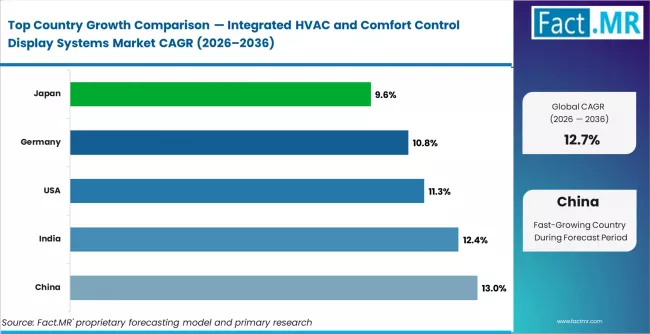
Integrated Hvac And Comfort Control Display Systems Market Cagr Analysis By Country | Source: Fact.MR
Asia Pacific Integrated HVAC and Comfort Control Display Systems Market Analysis
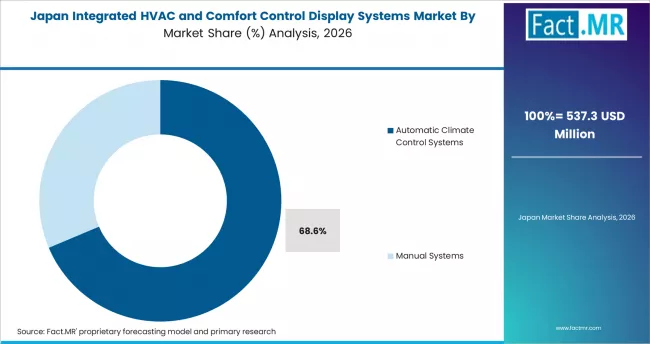
Integrated Hvac And Comfort Control Display Systems Market Japan Market Share Analysis By Technology | Source: Fact.MR
Asia Pacific leads global growth and production for integrated HVAC display systems. China drives scale through NEV policies. India accelerates through localisation and mid-range adoption. Japan contributes through strong OEM-supplier integration. Denso Corporation, Hanon Systems, and Panasonic Automotive anchor regional supply.
- China: Policy momentum is pushing China’s market to 13.0% CAGR through 2036. The 2024 MIIT update positioned smart climate control as a premium NEV feature. BYD deployed touchscreen HVAC systems across Seal and Han EVs. NIO standardised tri-zone climate control in flagship models. Denso Corporation and MAHLE GmbH expanded local integration partnerships, strengthening domestic supply.
- India: Rapid feature adoption is driving India’s 12.4% CAGR through 2036. Mid-range vehicles are increasingly offering automatic climate systems. Tata Motors introduced dual-zone climate control in 2025 refreshes. The 2024 PLI extension supports local manufacturing. Maruti Suzuki is planning touchscreen HVAC rollout from 2026, expanding mass-market penetration.
- Japan: Stability defines Japan’s 9.6% CAGR through 2036. OEMs prioritise seamless system integration over rapid feature rollout. Toyota introduced unified HVAC interfaces through Arene OS in 2024. Denso Corporation is advancing climate sensor and actuator R&D for next-generation EVs. Growth remains steady and specification-driven.
Fact.MR’s analysis of the integrated HVAC and comfort control display systems market in Asia Pacific covers China, India, Japan, South Korea, ASEAN, and Australia and New Zealand. It includes NEV policy impact, OEM fitment trends, and supply chain insights.
Europe Integrated HVAC and Comfort Control Display Systems Market Analysis
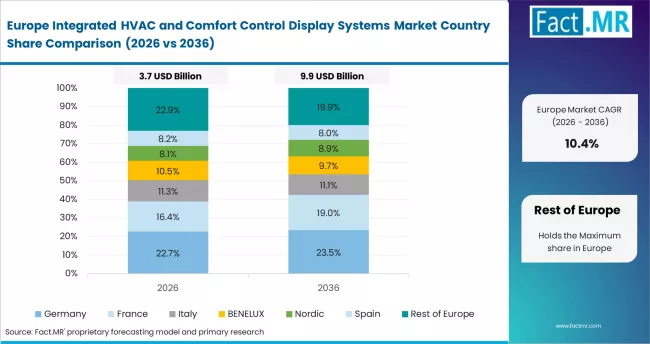
Integrated Hvac And Comfort Control Display Systems Market Europe Country Market Share Analysis, 2026 & 2036 | Source: Fact.MR
Europe serves as a benchmark for premium HVAC integration and EV thermal systems. German OEMs define multi-zone climate and touchscreen standards. Valeo, Continental AG, and MAHLE GmbH shape regional competition. CO2 regulations and EV efficiency targets guide adoption.
- Germany: Premium innovation is driving Germany’s 10.8% CAGR through 2036. BMW introduced multi-zone touchscreen HVAC systems in 2024. Mercedes-Benz expanded integrated cockpit climate displays from 2025. EU CO2 targets are accelerating heat pump and automatic system adoption. Demand is led by luxury and near-premium platforms.
Fact.MR’s analysis of the integrated HVAC and comfort control display systems market in Europe covers Germany, United Kingdom, France, Italy, Spain, Nordic Countries, and BENELUX. It includes regulatory data, OEM trends, and EV thermal demand insights.
North America Integrated HVAC and Comfort Control Display Systems Market Analysis
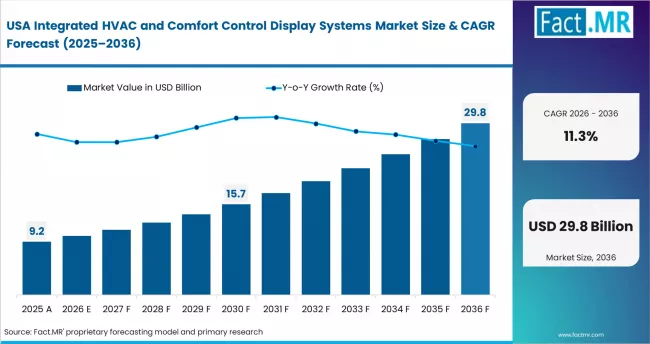
Integrated Hvac And Comfort Control Display Systems Market Country Value Analysis | Source: Fact.MR
North America is driven by connected vehicle ecosystems and EV efficiency standards. Suppliers such as Hanon Systems, Denso Corporation, and Panasonic Automotive Systems support major OEM programmes. Regulations shape procurement strategy.
- United States: Regulatory push is supporting 11.3% CAGR through 2036. EPA updates in 2024 introduced stricter thermal efficiency benchmarks. Ford expanded touchscreen HVAC integration in EV platforms from 2025. General Motors standardised HVAC display systems across Ultium EV models from 2026. Growth is tied to EV adoption and connected cabin demand.
Fact.MR’s analysis of the integrated HVAC and comfort control display systems market in North America covers the United States, Canada, and Mexico. It includes regulatory benchmarks, OEM adoption trends, and HVAC integration forecasts.
Competitive Aligners for Market Players
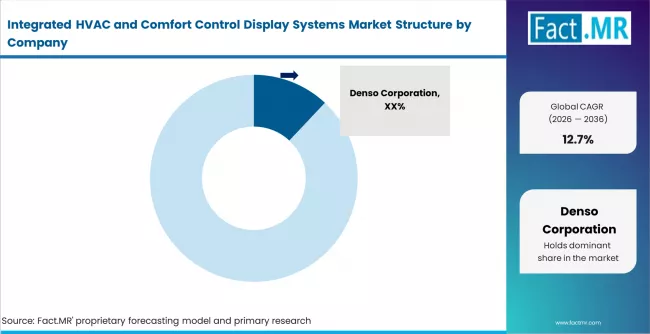
Integrated Hvac And Comfort Control Display Systems Market Analysis By Company | Source: Fact.MR
Competition in the integrated HVAC and comfort control display systems market is no longer just about supplying components. It is increasingly about how well companies can align with OEM expectations around software, integration, and long-term platform support. Players that understand this shift are positioning themselves not just as suppliers, but as strategic partners in cockpit digitalisation. A key aligner is the ability to deliver fully integrated systems. Companies like Denso Corporation and Valeo are combining HVAC hardware with sensors, control software, and touchscreen interfaces. This allows OEMs to reduce complexity and work with fewer vendors. It also strengthens long-term contracts, as switching costs become higher once systems are embedded into vehicle platforms.
Another important factor is software capability. HVAC is becoming a data-driven system, especially in EVs where thermal management directly impacts range. Suppliers that can embed intelligent climate algorithms and predictive control features are gaining an edge. Hanon Systems, for example, is focusing on integrated thermal platforms that link battery cooling with cabin comfort.
Localisation is also shaping competition. In markets like China and India, OEMs prefer suppliers with local manufacturing and engineering support. This is pushing companies to expand regional footprints and build partnerships with domestic OEMs. Flexibility in system design is becoming critical. OEMs want scalable solutions that can work across premium and mid-range vehicles. Suppliers that can offer modular HVAC display systems combining hardware, software, and connectivity are better positioned to win future programmes and maintain relevance as cockpit systems continue to evolve.
Key Players
- Denso Corporation
- Valeo S.A.
- Hanon Systems
- MAHLE GmbH
- Continental AG
- Panasonic Automotive Systems Co., Ltd.
- Robert Bosch GmbH
- Marelli Holdings Co., Ltd.
- Sanden Holdings Corporation
- BorgWarner Inc.
Bibliography
- [1] Valeo. (2024). Annual results communication highlighting over 20% growth in electrified HVAC content driven by heat pump and automatic climate system adoption.
- [2] Valeo and Hanon Systems. (2024–2025). Expansion of EV HVAC and thermal management system supply across European OEM programmes aligned with CO2 efficiency regulations.
- [3] Denso Corporation and MAHLE GmbH. (2024). China NEV smart cabin HVAC integration partnerships supporting touchscreen climate control systems across domestic OEM platforms.
- [4] Tata Motors and Maruti Suzuki. (2024–2025). OEM announcements on automatic climate control standardisation and roadmap expansion across mid-range vehicle platforms.
- [5] Hanon Systems. (2025). Product launch of integrated thermal and climate management modules combining EV battery cooling and cabin comfort systems.
- [6] Organisation Internationale des Constructeurs d'Automobiles (OICA). (2024). Vehicle platform survey data reporting increasing fitment rates of automatic climate control systems globally.
- [7] Continental AG. (2025). Integrated HVAC touchscreen cockpit platform showcased at CES, targeting next-generation OEM programmes.
- [8] Panasonic Automotive Systems. (2024). Supply agreement disclosure for integrated HVAC touchscreen display modules across premium vehicle platforms.
- [9] Display Supply Chain Consultants (DSCC). (2024). Automotive display report showing rising adoption of touchscreen HVAC systems and cockpit consolidation trends.
This Report Addresses
- Strategic insights on HVAC display demand across automatic and manual systems. Covers touchscreen and hybrid integration, along with control panels, sensors, and HVAC hardware across global OEM programmes.
- Market forecast from USD 14.7 billion in 2026 to USD 49.5 billion by 2036, at a CAGR of 12.7%.
- Growth opportunity mapping across China NEV mandates, India climate system standardisation, Germany luxury HVAC integration, and U.S. EV thermal management adoption.
- Segment analysis by technology (automatic, manual), display type (touchscreen, hybrid, physical), and component (control panels, sensors, HVAC hardware).
- Regional outlook covering Asia Pacific NEV-driven growth, North America EPA compliance, and Europe CO2 regulation impact on HVAC systems.
- Competitive analysis of Denso Corporation, Valeo, Hanon Systems, MAHLE GmbH, Continental AG, and Panasonic Automotive Systems. Focus on EV integration, display capability, and OEM programme reach.
- Regulatory analysis covering EU CO2 targets, China NEV policies, U.S. EPA rules, and India PLI incentives.
- Report available in PDF, Excel, and presentation formats. Supported by OEM interviews, Tier-1 data, policy documents, and regulatory filings.
Integrated HVAC and Comfort Control Display Systems Market Definition
The market covers sensor-driven automatic and manual climate control systems integrated with touchscreen and physical display interfaces in vehicle cabins. These systems manage cabin temperature, airflow, humidity, and seat comfort for occupants.
Integrated HVAC and Comfort Control Display Systems Market Inclusions
Covers global and regional forecasts from 2026 to 2036 by technology, display integration type, and component. Includes automatic and manual climate systems. Covers touchscreen HVAC displays, physical-digital hybrid controls, and HVAC hardware across passenger vehicle, luxury vehicle, and commercial vehicle OEM fitment.
Integrated HVAC and Comfort Control Display Systems Market Exclusions
Excludes standalone cabin air purification systems and seat heating modules unless integrated into a centralised HVAC control display interface. Omits industrial vehicle HVAC units and off-highway machinery climate systems. Excludes refrigerant supply and raw HVAC compressor components not assembled into complete OEM-integrated comfort control system modules.
Integrated HVAC and Comfort Control Display Systems Market Research Methodology
- Primary Research
- Interviews with vehicle OEM HVAC engineering leads, Tier-1 climate system suppliers, cabin electronics integrators, and automotive procurement managers across Germany, China, Japan, India, and the United States.
- Desk Research
- Uses OEM annual reports, EU automotive type approval regulation filings, China NEV thermal management policy documents, and company disclosures from Denso Corporation, Valeo, and Hanon Systems from 2024 to 2025.
- Market-Sizing and Forecasting
- Hybrid model using vehicle production volumes by type, HVAC system attach rates by technology and display integration type, average selling prices by component, and OEM platform refresh cycles across all covered geographies.
- Data Validation and Update Cycle
- Validated using OEM sourcing disclosures, Tier-1 earnings communications, and automotive electronics trade data. Cross-checked with HVAC engineering expert interviews. Updated annually.
Segmentation
Scope of Report
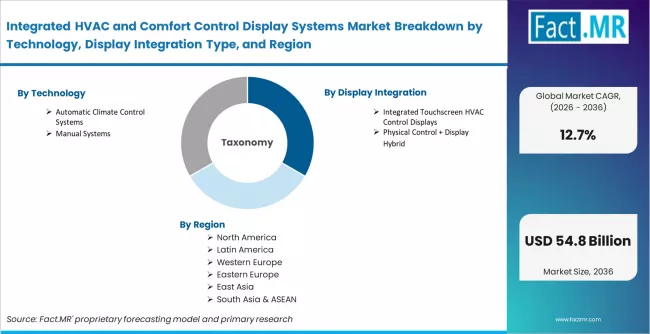
Integrated Hvac And Comfort Control Display Systems Market Breakdown By Technology, Display Integration Type, And Region | Source: Fact.MR
| Attribute | Details |
|---|---|
| Quantitative Units | USD 14.7 billion (2026) to USD 49.5 billion (2036), at a CAGR of 12.7% |
| Market Definition | Automatic and manual vehicle cabin climate control systems with integrated touchscreen, physical-digital hybrid, and fully physical display interfaces, supplied as OEM factory-fit assemblies including control panels, sensors, actuators, and HVAC hardware for passenger, luxury, and commercial vehicle programmes globally. |
| Technology Segmentation | Automatic Climate Control Systems, Manual Systems |
| Display Integration Type Segmentation | Integrated Touchscreen HVAC Control Displays, Physical Control + Display Hybrid, Fully Physical Controls |
| Component Segmentation | Control Panels & Display Interfaces, Sensors & Actuators, HVAC Hardware (Compressors, Evaporators) |
| Application Coverage | OEM factory-fit automatic and manual HVAC display systems, EV thermal management and cabin comfort integration, multi-zone temperature and air quality control, touchscreen climate interface consolidation, and seat-integrated comfort sensing across electric, hybrid, and ICE vehicle platforms globally. |
| Regions Covered | North America, Europe, Asia Pacific, Latin America, Middle East and Africa |
| Countries Covered | USA, Canada, Mexico, Germany, UK, France, Italy, Spain, Nordic, BENELUX, China, Japan, South Korea, India, ASEAN, Australia and New Zealand, Brazil, Argentina, Chile, Saudi Arabia, GCC, Turkey, South Africa, Rest of MEA |
| Key Companies Profiled | Denso Corporation, Valeo S.A., Hanon Systems, MAHLE GmbH, Continental AG, Panasonic Automotive, Robert Bosch GmbH, Marelli Holdings, Sanden Holdings, BorgWarner Inc. |
| Forecast Period | 2026 to 2036 |
| Approach | Hybrid top-down and bottom-up model using vehicle production volumes by type, HVAC system attach rates by technology and display integration type, average selling prices by component, OEM platform refresh cycles, NEV policy mandates, and primary interviews with OEM HVAC engineering leads and Tier-1 climate system suppliers. |
Source: Fact.MR analysis. Updated Apr 29, 2026
Integrated HVAC and Comfort Control Display Systems Market by Segments
-
By Technology:
- Automatic Climate Control Systems
- Manual Systems
-
By Display Integration Type:
- Integrated Touchscreen HVAC Control Displays
- Physical Control + Display Hybrid
- Fully Physical Controls
-
By Component:
- Control Panels & Display Interfaces
- Sensors & Actuators
- HVAC Hardware (Compressors, Evaporators)
-
By Region:
- North America
- United States
- Canada
- Mexico
- Latin America
- Brazil
- Argentina
- Chile
- Rest of Latin America
- Western Europe
- Germany
- United Kingdom
- France
- Italy
- Spain
- Nordic Countries
- BENELUX
- Rest of Western Europe
- Eastern Europe
- Russia
- Poland
- Hungary
- Balkan and Baltic
- Rest of Eastern Europe
- East Asia
- China
- Japan
- South Korea
- South Asia and Pacific
- India
- ASEAN
- Australia and New Zealand
- Rest of South Asia and Pacific
- Middle East and Africa
- Kingdom of Saudi Arabia
- Other GCC Countries
- Turkey
- South Africa
- Rest of Middle East and Africa
- North America
Frequently Asked Questions
How large is the global integrated HVAC and comfort control display systems market in 2025?
What will the market size be in 2026?
What is the projected market size by 2036?
What is the expected CAGR from 2026 to 2036?
Which technology segment is poised to lead the market?
Which display integration type holds the largest share?
Which country shows the fastest growth?
What drives demand for integrated HVAC and comfort control display systems?
What is the key challenge in this market?
Who are the key players in this market?
Who worked on this report


Preview the report firsthand - request a free sample
Free SampleGet the brochure for pricing and purchase details
Download PDF