- Base Value(2025): 4.8 Bn
- Estimated Value(2026): 5.2 Bn
- Forecast Value (2036): 10.8 Bn
- CAGR (2026 - 2036): 7.6%
Sensor-Integrated Side Mirrors Market Forecast and Outlook 2026 to 2036
In 2025, the sensor-integrated side mirrors market was valued at USD 4.8 billion. Based on Fact.MR analysis, demand for sensor-integrated side mirrors is estimated to reach USD 5.2 billion in 2026 and USD 10.8 billion by 2036. Fact.MR projects a CAGR of 7.6% during the forecast period. Market expansion reflects rising electronic content per vehicle and OEM preference for consolidated mirror-sensor modules that simplify integration of ADAS features such as blind-spot detection, camera-based visibility, and driver monitoring support.
Value growth over the decade is driven by increasing penetration beyond luxury vehicles into high-volume mid-range passenger cars, where sensor-integrated mirrors replace conventional assemblies rather than act as optional upgrades. Adoption remains replacement-led in mature markets, while emerging automotive manufacturing hubs account for incremental volume gains.
As Matteo Del Sorbo, President, Mechatronics, Mirrors and Lighting at Magna International, stated, “Our mirror-integrated DMS has proven itself globally, and we’re proud to see it scaling with a leading German OEM. This milestone reflects our commitment to safety innovation and our ability to deliver advanced technologies to customers.” Fact.MR analysis interprets this as confirmation that validated mirror-sensor architectures have moved from pilot programs into repeat OEM sourcing cycles. [1]
China leads country-level growth at 8.1% CAGR due to rapid ADAS standardization in domestic passenger vehicles. India follows at 7.8% as mid-range models adopt blind-spot and camera-integrated mirrors. Mexico records 6.9% tied to export-oriented vehicle assembly, while South Korea posts 6.5% through technology-intensive OEM platforms. Mature markets such as the United States at 4.2%, Germany at 3.8%, and Japan at 3.4% remain driven by premium upgrades and replacement demand rather than first-time adoption.
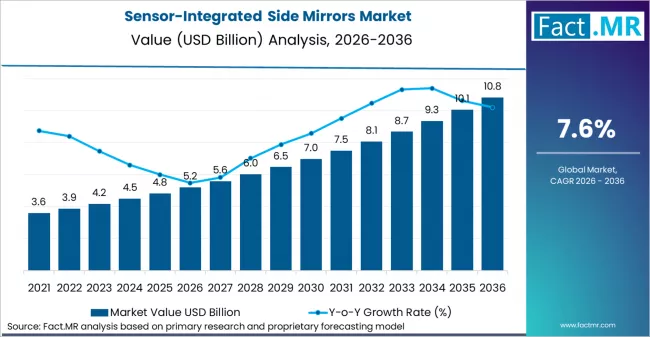
Sensor Integrated Side Mirrors Market Market Value Analysis | Source: Fact.MR
Sensor Integrated Side Mirrors Market Definition
The sensor integrated side mirrors market covers exterior vehicle mirror assemblies that incorporate electronic sensors used for driver assistance and visibility functions. These mirrors combine traditional reflective surfaces with sensors that support features such as blind spot detection, lane change alerts, and camera assisted viewing. Their design and installation are governed by vehicle safety and visibility regulations issued by the US National Highway Traffic Safety Administration and UNECE vehicle construction rules. [2] Sensor integrated side mirrors are supplied mainly for passenger cars and light commercial vehicles.
Sensor Integrated Side Mirrors Market Inclusions
The report covers global and regional market size estimates in volume and value terms with a forecast period from 2026 to 2036. Segmentation includes mirror type with integrated cameras or radar based sensors, application by vehicle category, and end use covering original equipment fitment and replacement demand. The scope also includes regional demand patterns, pricing benchmarks, and international trade flows for automotive exterior visibility components.
Sensor Integrated Side Mirrors Market Exclusions
The scope excludes conventional side mirrors without embedded sensing capability and interior rear view mirrors. Standalone cameras, radar modules, and electronic control units sold separately are not included. Complete door assemblies and wiring harnesses are excluded. Motorsport specific mirror systems, prototype designs without road certification, laboratory testing equipment, and vehicle software services are also outside the scope.
Sensor Integrated Side Mirrors Market Research Methodology
- Primary Research: Primary research involved interviews with mirror system manufacturers, automotive OEM suppliers, sensor integrators, and vehicle safety engineers.
- Desk Research: Desk research used vehicle safety and visibility regulations issued by the US National Highway Traffic Safety Administration and UNECE, vehicle production data from national transport authorities, and company annual reports and technical product disclosures filed with securities regulators.
- Market Sizing and Forecasting: Market sizing applied a hybrid top down and bottom up model using vehicle production volumes, mirror fitment rates by vehicle category, and adoption rates of driver assistance features.
- Data Validation and Update Cycle: Outputs were cross checked against vehicle registration data, regulatory compliance documentation, trade statistics, and OEM supply disclosures, with updates applied when verified public data sources issue revisions.
Segmental Analysis
Sensor-Integrated Side Mirrors Market Analysis by Sensor Content
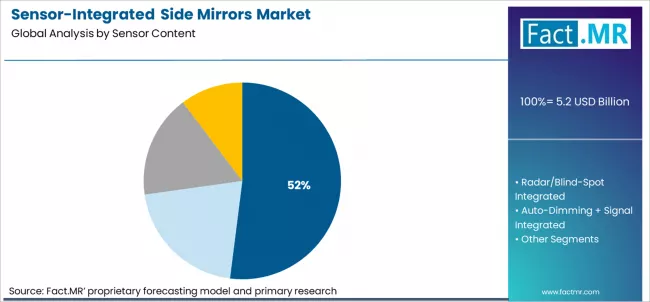
Sensor Integrated Side Mirrors Market Analysis By Sensor Content | Source: Fact.MR
Based on Fact.MR analysis, consumption of camera-integrated side mirrors is estimated to hold 52% share of the global market in 2025. Fact.MR analysts note that camera integration leads because it supports blind-spot monitoring, lane change assistance, and surround-view systems using a single exterior mounting location. As per Fact.MR, this sensor content addresses OEM requirements for clear rearward visibility, compact sensor packaging, and alignment with driver assistance system architectures mandated on new passenger vehicles.
- Safety regulation driver: Rear visibility and indirect vision requirements defined by U.S. vehicle safety regulations support the integration of camera-based monitoring systems in exterior mirrors.
- ADAS integration: Fact.MR analysts reference vehicle platforms where mirror-mounted cameras feed data directly into blind-spot and lane monitoring systems.
- Packaging trend: Camera-based sensor integration reduces the need for separate fender or bumper-mounted sensing units.
Sensor-Integrated Side Mirrors Market Analysis by Mirror Type
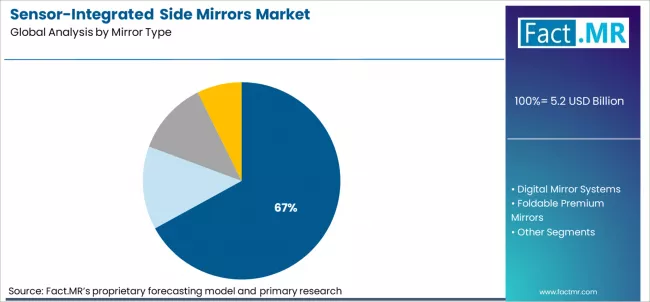
Sensor Integrated Side Mirrors Market Analysis By Mirror Type | Source: Fact.MR
Based on Fact.MR analysis, consumption of conventional mirrors with integrated sensors is estimated to hold 67% share of the global market in 2026. Fact.MR opines that this mirror type leads because it preserves physical reflective surfaces while embedding electronic sensing functions required for safety and driver assistance features. As per Fact.MR, this approach addresses regulatory acceptance, driver familiarity, and cost control compared with fully digital mirror systems.
- Regulatory framework: International vehicle regulations continue to permit physical mirrors as primary rear-view devices while allowing sensor integration for assistance functions.
- Market continuity: Fact.MR analysts note that many regions require physical mirrors, sustaining demand for sensor-integrated conventional designs.
- Cost structure: Conventional mirrors with sensors allow incremental feature addition without full system replacement.
Sensor-Integrated Side Mirrors Market Drivers, Restraints, And Opportunities
Fact.MR analysis indicates that the sensor-integrated side mirrors market exists as a vehicle safety and driver assistance component segment linked to advanced perception systems in light and commercial vehicles. As per Fact.MR assessment, sensor-integrated side mirrors combine conventional mirror assemblies with safety sensors such as blind-spot detection, lane change assist, and camera modules that support vehicle safety requirements outlined in regional regulations such as UNECE Regulation No. 46, which specifies uniform provisions on the installation and field of vision of rear-view mirrors and may include associated equipment that impacts visibility and detection systems. Fact.MR analysts observe that current market size is supported by increased OEM adoption of integrated safety technologies driven by mandated active safety testing protocols and consumer demand for enhanced awareness features.
Fact.MR is of the opinion that the market is undergoing a transition as safety systems evolve toward greater sensor fusion and multifunctional mirror modules. Based on Fact.MR assessment, conventional mirrors without integrated sensing remain prevalent due to cost constraints in entry-level vehicles, but demand for sensor-integrated side mirrors grows in segments where blind-spot monitoring, turn-signal indicators, and camera-assisted views are specified or expected as part of driver assistance packages. These advanced assemblies generally carry higher per-unit pricing because of sensor hardware, wiring harness integration, and vehicle network compatibility, meaning realised value can increase even where overall shipment volume growth is moderate. Fact.MR analysis suggests this combination of evolving safety specifications and premium unit placement shapes near-term market progression.
- Regulated mirror visibility provisions: Fact.MR analysts note that UNECE Regulation No. 46 governs rear-view mirror fields of vision and installation, which indirectly influences design and integration of sensor systems in side mirror assemblies
- Sensor technology convergence: Based on Fact.MR assessment, adoption of integrated sensing modules such as blind-spot detection and camera systems within side mirrors supports advanced driver assistance system (ADAS) functions that extend beyond passive visibility.
- Asia Pacific automotive safety adoption: Fact.MR opines that rising vehicle production and increasing alignment with active safety requirements in China, India, and Southeast Asia support regional demand for sensor-integrated side mirrors in both OEM and aftermarket applications.
Regional Analysis
Based on regional assessment, the sensor integrated side mirrors sector is analyzed across North America, Europe, East Asia, South Asia, and other major automotive manufacturing regions, spanning more than 40 countries. Regional performance varies according to adoption of advanced driver assistance features, regulatory support for camera-based systems, and integration of sensing technologies in exterior vehicle components. The report also presents a comparative market attractiveness evaluation grounded in region-specific demand trends.
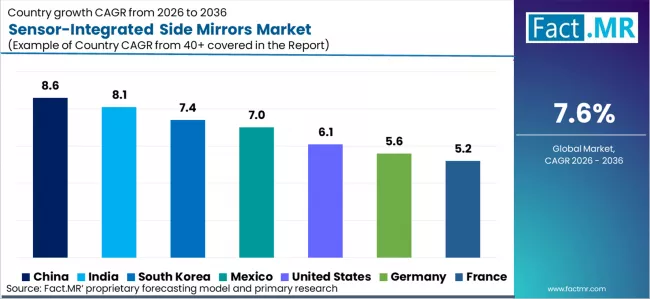
Sensor Integrated Side Mirrors Market Cagr Analysis By Country | Source: Fact.MR
| Country | CAGR |
|---|---|
| China | 8.6% |
| India | 8.1% |
| South Korea | 7.4% |
| Mexico | 7.0% |
| United States | 6.1% |
| Germany | 5.6% |
| France | 5.2% |
| Japan | 4.7% |
Source: Fact.MR analysis. Updated Feb 19, 2026
Source: Fact.MR analysis, based on proprietary forecasting models and primary research.
Asia Pacific Sensor-Integrated Side Mirrors Market Analysis
Asia Pacific operates as a regulation- and production-driven automotive electronics region for sensor-integrated side mirrors, supported by high passenger vehicle output and increasing fitment of ADAS features. Demand is governed by vehicle safety regulations, blind spot detection requirements, and OEM homologation standards. Adoption is enforced through vehicle type approval systems, safety certification regimes, and compliance with national ADAS-related standards across domestic and export-oriented vehicle manufacturing.
- China: Demand for sensor-integrated side mirrors in China is projected to rise at 8.6% CAGR through 2036. Application follows blind spot monitoring and camera-based assistance provisions under GB automotive safety standards revised in 2021 and enforced through national vehicle type approval systems, as per Fact.MR.
- India: Demand for sensor-integrated side mirrors in India is projected to rise at 8.1% CAGR through 2036. Fitment is governed by Automotive Industry Standards aligned with CMVR safety updates issued during 2021 and reinforced through OEM adoption in higher-trim passenger vehicles produced during 2022-2023, according to Fact.MR.
- South Korea: Demand for sensor-integrated side mirrors in South Korea is projected to rise at 7.4% CAGR through 2036. Use follows vehicle safety certification rules enforced under national regulations and reinforced through domestic OEM homologation processes applied during 2021-2022, as per Fact.MR.
Fact.MR’s analysis of the Sensor-Integrated Side Mirrors Market in Asia Pacific consists of country-wise assessment that includes China, India, and South Korea. Readers can find ADAS regulations, homologation frameworks, and production-linked compliance references.
Latin America Sensor-Integrated Side Mirrors Market Analysis
Latin America functions as an OEM- and regulation-aligned automotive components region for sensor-integrated side mirrors. Demand is tied to vehicle assembly activity and increasing adoption of safety assistance features aligned with export market requirements. Adoption is governed by homologation rules, vehicle safety standards, and OEM certification processes applied to vehicles produced for domestic sale and export.
- Mexico: Demand for sensor-integrated side mirrors in Mexico is projected to rise at 7.0% CAGR through 2036. Application follows NOM vehicle safety standards and reinforced through export-oriented OEM production supplying North American markets during 2022-2023, according to Fact.MR.
Fact.MR’s analysis of the Sensor-Integrated Side Mirrors Market in Latin America consists of country-wise assessment that includes Mexico. Readers can find homologation rules, safety standards, and production-based compliance documentation.
North America Sensor-Integrated Side Mirrors Market Analysis
North America operates as a standards-led automotive safety market where sensor-integrated side mirrors are governed by federal safety regulations, ADAS guidelines, and OEM certification requirements. Demand is shaped by compliance with blind spot monitoring standards, vehicle certification processes, and replacement cycles linked to advanced feature adoption.
- United States: Demand for sensor-integrated side mirrors in the United States is projected to rise at 6.1% CAGR through 2036. Application is governed by FMVSS visibility and safety requirements and reinforced through OEM compliance in passenger vehicle production and certification programs applied during 2021-2022, as per Fact.MR.
Fact.MR’s analysis of the Sensor-Integrated Side Mirrors Market in North America consists of country-wise assessment that includes the United States. Readers can find federal safety standards and compliance documentation.
Europe Sensor-Integrated Side Mirrors Market Analysis
Europe functions as a regulation-led automotive electronics market for sensor-integrated side mirrors, with adoption governed by UNECE vehicle safety regulations and EU type approval frameworks. Demand is enforced through conformity assessments, mandatory safety feature integration, and OEM compliance with ADAS-related performance standards across member states.
- Germany: Demand for sensor-integrated side mirrors in Germany is projected to rise at 5.6% CAGR through 2036. Application follows UNECE vehicle safety and visibility regulations and EU type approval rules applied in vehicle manufacturing and certification cycles during 2021-2022, according to Fact.MR.
- France: Demand for sensor-integrated side mirrors in France is projected to rise at 5.2% CAGR through 2036. Use is governed by UNECE regulations and reinforced through OEM adoption in passenger vehicles certified under EU approval systems applied during 2021-2022, as per Fact.MR.
- Japan: Demand for sensor-integrated side mirrors in Japan is projected to rise at 4.7% CAGR through 2036. Fitment is governed by Road Transport Vehicle Act safety provisions and enforced through national vehicle certification systems applied during 2021-2022, according to Fact.MR.
Fact.MR’s analysis of the Sensor-Integrated Side Mirrors Market in Europe consists of country-wise assessment that includes Germany, France, and Japan. Readers can find regulatory frameworks, type approval processes, and component compliance references.
Competitive Landscape of Sensor-Integrated Side Mirrors Market
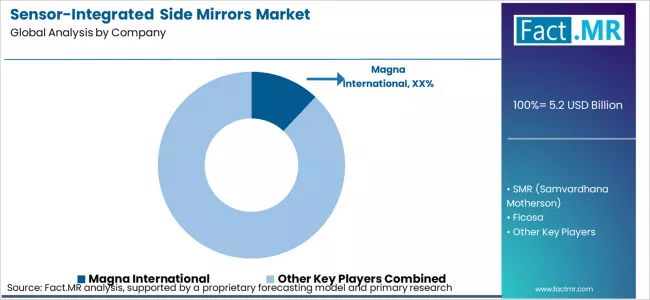
Sensor Integrated Side Mirrors Market Analysis By Company | Source: Fact.MR
As per Fact.MR analysis, the 2026 sensor-integrated side mirrors market is defined by validated sensing performance, system-level integration, and OEM alignment, which determine competitive advantage. Magna International and SMR (Samvardhana Motherson) lead with mirrors that combine camera, radar, and blind-spot detection modules, which improves vehicle safety and enhances adoption across premium and mass-market platforms. Ficosa and Valeo focus on compact, modular designs with validated electronic and optical performance, which reduces integration time and ensures reliability in diverse vehicle architectures. Gentex and Murakami provide high-precision actuation and defrost capabilities, which sustain performance under extreme environmental conditions and enhance durability. Ichikoh and Tokai Rika offer mirrors with tested low-latency sensor communication, which improves responsiveness for ADAS and lane-assist functionalities. Hyundai Mobis and SL Corporation emphasize multi-region compliance and robust manufacturing processes, which ensure consistent quality and supply continuity for OEMs. Across the market, validated sensing accuracy, system-level integration, and manufacturing reliability collectively form enduring competitive moats, reducing dependence on price competition or isolated product features while enabling long-term adoption across global vehicle platforms.
Recent Industry Developments
- Gentex Launches Next-Gen Full Display Mirror (FDM) with "Dynamic View Assist" (January 2026)
- At CES 2026, Gentex Corporation debuted its latest Full Display Mirror featuring "Dynamic View Assist." This system automatically adjusts the digital camera feed based on driving conditions: it expands the field of view at low speeds, tilts downward when in reverse, and widens the side-view perspective to eliminate blind spots during lane changes. [3]
- Magna’s Scalable Mirror-Integrated Driver Monitoring System (October 2025)
- Magna International reached a production milestone in late 2025 with its mirror-integrated Driver Monitoring System (DMS). Unlike bulky dashboard cameras, Magna's sensors are integrated discreetly behind the mirror glass. The system uses infrared sensors to track eye gaze and head position to detect drowsiness or distraction, meeting the strict Euro NCAP safety requirements for 2026. [4]
Key Players in Sensor-Integrated Side Mirrors Market
- Magna International
- SMR (Samvardhana Motherson)
- Ficosa
- Valeo
- Gentex
- Murakami
- Ichikoh
- Tokai Rika
- Hyundai Mobis
- SL Corporation
Bibliography
- [1] Magna International Inc. (2025). Magna ramps up driver and occupant monitoring system deployment in China with Germany-based OEM. Magna International - News & Press Releases.
- [2] U.S. Department of Transportation, National Highway Traffic Safety Administration. (2023). Road safety and vehicle visibility regulations. NHTSA; United Nations Economic Commission for Europe. (2023). Vehicle construction and visibility regulations. UNECE.
- [3] Gentex Corporation. (2026). Gentex highlights new automotive technologies and demonstrates advancements in full display mirrors at CES 2026. Gentex Investor Relations.
- [4] Magna International Inc. (2025). Magna ramps up mirror-integrated driver and occupant monitoring system deployment in China. Magna International - News & Press Releases.
Segmentation
Scope of the Report
| Metric | Value |
|---|---|
| Quantitative Units | USD 5.2 billion (2026) to USD 10.8 billion (2036), CAGR 7.6% |
| Market Definition | The sensor-integrated side mirrors market covers exterior vehicle mirror assemblies that combine reflective surfaces with electronic sensors for driver assistance and visibility functions. These mirrors support blind-spot detection, lane-change alerts, camera-assisted viewing, and ADAS integration. Design and installation are governed by US NHTSA and UNECE vehicle construction rules. Sensor-integrated mirrors are supplied mainly for passenger cars and light commercial vehicles. |
| Sensor Content Segmentation | Camera-Integrated Mirrors, Radar/Blind-Spot Integrated, Auto-Dimming + Signal Integrated, Other |
| Mirror Type Segmentation | Conventional Mirrors with Sensors, Digital Mirror Systems, Foldable Premium Mirrors, Other |
| Vehicle Segment | Mid-Range, Premium/Luxury, Entry-Level, Commercial Vehicles |
| Sales Channel | OEM/Tier 1 Supply, Aftermarket Upgrades, Service Replacement, Other |
| Regions Covered | Asia Pacific, Europe, North America, Latin America, Middle East & Africa |
| Countries Covered | China, India, South Korea, Mexico, United States, Germany, France, Japan |
| Key Companies Profiled | Magna International, SMR (Samvardhana Motherson), Ficosa, Valeo, Gentex, Murakami, Ichikoh, Tokai Rika, Hyundai Mobis, SL Corporation |
| Forecast Period | 2026 to 2036 |
| Approach | Hybrid top-down and bottom-up model using vehicle production data, mirror fitment rates by segment, ADAS adoption trends, and regulatory compliance. Primary research included interviews with mirror manufacturers, OEM suppliers, and sensor integrators; desk research referenced NHTSA, UNECE, and UN Comtrade data. |
Source: Fact.MR analysis. Updated Feb 19, 2026
Sensor-Integrated Side Mirrors Market Analysis by Segments
-
By Sensor Content:
- Camera-Integrated Mirrors
- Radar/Blind-Spot Integrated
- Auto-Dimming + Signal Integrated
- Other
-
By Mirror Type:
- Conventional Mirrors with Sensors
- Digital Mirror Systems
- Foldable Premium Mirrors
- Other
-
By Vehicle Segment:
- Mid-Range
- Premium/Luxury
- Entry-Level
- Commercial Vehicles
-
By Sales Channel:
- OEM/Tier 1 Supply
- Aftermarket Upgrades
- Service Replacement
- Other
-
Region
- Asia Pacific
- India
- China
- Japan
- South Korea
- Indonesia
- Australia & New Zealand
- ASEAN
- Rest of Asia Pacific
- Europe
- Germany
- Italy
- France
- United Kingdom
- Spain
- Benelux
- Nordics
- Central & Eastern Europe
- Rest of Europe
- North America
- United States
- Canada
- Mexico
- Latin America
- Brazil
- Argentina
- Chile
- Rest of Latin America
- Middle East & Africa
- Kingdom of Saudi Arabia
- United Arab Emirates
- South Africa
- Turkey
- Rest of Middle East & Africa
- Asia Pacific
Frequently Asked Questions
How large is the sensor-integrated side mirrors market in 2026?
What will the market size be by 2036?
What CAGR is expected for the market during 2026–2036?
What was the market value in 2025?
What is the primary driver behind market expansion?
Is demand still concentrated in premium vehicles?
Which sensor content segment leads the market?
Why do camera-integrated mirrors dominate sensor content demand?
Which mirror type accounts for the largest share in 2026?
Why do OEMs continue to favor conventional mirrors with sensors over digital mirrors?
Which country leads market growth over the forecast period?
What is the growth outlook for India?
How fast is the market expected to grow in South Korea?
What is Mexico’s projected CAGR and what supports it?
How mature is the market in the United States?
What is the growth outlook for Germany?
How does France compare within Europe?
What is the expected CAGR for Japan?
How does market maturity differ between regions?
What should OEMs and suppliers prioritize to capture long-term value?
Who worked on this report


Preview the report firsthand - request a free sample
Free SampleGet the brochure for pricing and purchase details
Download PDF