- Base Value(2026): 21.0 Bn
- Estimated Value(2026): 21.0 Bn
- Forecast Value (2036): 34.9 Bn
- CAGR (2026 - 2036): 5.2%
IoT-Enabled Equipment Maintenance Solutions Market Forecast and Outlook 2026 to 2036
IoT-enabled equipment maintenance solutions market is projected to grow at a CAGR of 5.2% from 2026 to 2036, expanding from USD 21.04 billion in 2026 to USD 34.93 billion by 2036. Industrial operators shift from reactive maintenance models toward predictive and condition-based strategies. Connected sensors embedded in machinery continuously monitor vibration, temperature, pressure, and acoustic signals to identify early signs of wear or failure. This approach helps prevent costly breakdowns and extends equipment lifespan.
Summary of IoT-Enabled Equipment Maintenance Solutions Market - Key Takeaways
- The market includes condition monitoring, predictive analytics, remote diagnostics, and asset tracking solutions deployed across industrial sectors.
- The defined scope covers revenue generated by solution type, deployment mode, industry vertical, and service model across global markets.
- The IoT-enabled equipment maintenance solutions market is projected to grow at a CAGR of 5.2% from 2026 to 2036, expanding from USD 21.0 billion to USD 34.9 billion based on Fact.MR forecasting.
- Condition monitoring and predictive analytics each lead with 30% share in 2026, supported by manufacturing sector emphasis on unplanned downtime reduction.
- Subscription SaaS models account for 50% of total demand, as operators prefer operational expenditure structures and continuous software updates.
- China records the fastest growth at 6.4% CAGR, supported by Internet Plus roadmap and domestic connected sensor production dominance.
- Competition is led by major players such as IBM Maximo, Siemens, Schneider Electric, Honeywell, PTC, ABB, GE Digital, SAP, Rockwell, and SKF.
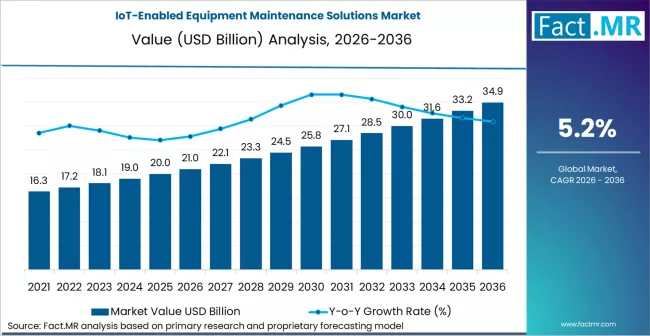
Iot Enabled Equipment Maintenance Solutions Market Market Value Analysis | Source: Fact.MR
Manufacturing plants rely on condition monitoring systems to maintain production line continuity, while power generation facilities use predictive analytics to monitor turbines, generators, and transformers where downtime can result in substantial revenue losses. Oil and gas operators benefit from remote diagnostics that improve visibility across geographically dispersed assets while reducing personnel exposure in hazardous environments.
A major advantage of modern IoT maintenance platforms is the integration of cloud analytics and machine learning. As Jim Heppelmann, CEO of PTC, emphasizes, digital transformation in industry is about reinventing operational models rather than simply deploying new technologies. Platforms such as ThingWorx enable edge-to-cloud architectures where real-time processing occurs locally while enterprise analytics optimize maintenance planning at scale. As organizations prioritize asset reliability, operational efficiency, and data-driven decision-making, demand for advanced IoT-enabled maintenance solutions is expected to remain strong through 2036.
IoT-Enabled Equipment Maintenance Solutions Market
| Metric | Value |
|---|---|
| Estimated Value in (2026) | USD 21.0 billion |
| Forecast Value in (2036) | USD 34.9 billion |
| Forecast CAGR 2026 to 2036 | 5.2% |
Source: Fact.MR analysis. Updated Feb 13, 2026
Category
| Category | Segments |
|---|---|
| Solution Type | Condition Monitoring, Predictive Analytics, Remote Diagnostics, Asset Tracking |
| Deployment Mode | Cloud, Hybrid/Edge, On-Premise |
| Industry Vertical | Manufacturing, Energy/Utilities, Oil & Gas, Transport & Logistics |
| Service Model | Subscription (SaaS), Managed Services, License, Pay-per-Use |
| Region | North America; Europe; Asia Pacific; Latin America; Middle East & Africa |
Source: Fact.MR analysis. Updated Feb 13, 2026
Segmental Analysis
What drives condition monitoring to hold a 30% market share?
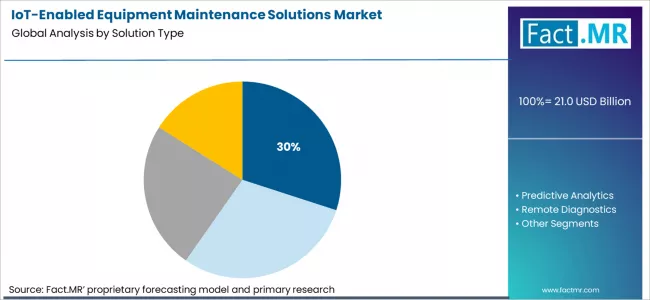
Iot Enabled Equipment Maintenance Solutions Market Analysis By Solution Type | Source: Fact.MR
Condition monitoring leads the market because it focuses on continuous equipment health tracking. Instead of waiting for machines to fail, companies use vibration analysis, thermal imaging, and acoustic monitoring to detect early warning signs. This helps prevent costly breakdowns. These systems measure bearing temperature, motor current, lubrication quality, and other critical indicators. The data replaces manual inspection, which can be inconsistent. Wireless sensors reduce cabling costs and allow flexible installation in existing plants.
Integration with maintenance software automatically generates work orders when thresholds are exceeded. The technology is mature and has a proven return on investment. Many equipment manufacturers now embed sensors directly into machines, enabling lifetime monitoring from the start.
What establishes cloud deployment at 45% market share?
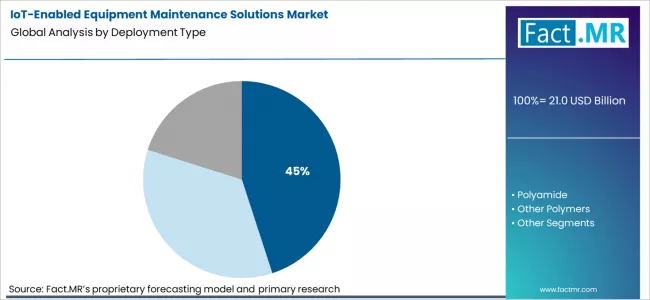
Iot Enabled Equipment Maintenance Solutions Market Analysis By Deployment Type | Source: Fact.MR
Cloud deployment dominates because it removes the need for expensive on-site servers. Companies avoid large upfront capital investments. Software updates and new features are delivered automatically. Cloud platforms are especially attractive for small and mid-sized companies without strong internal IT teams. They also provide centralized visibility across multiple sites worldwide. Elastic computing resources support heavy analytics and machine learning workloads when needed. Cloud providers maintain cybersecurity certifications and compliance standards, reducing customer burden. Mobile access allows technicians to receive alerts and review data from anywhere, supporting distributed workforces.
Drivers
- Drivers: Unplanned downtime costs manufacturers billions of dollars each year. This creates a strong financial case for predictive maintenance. Preventing failures is far cheaper than responding after production stops. Aging industrial infrastructure also increases monitoring needs. Many facilities rely on equipment installed decades ago. Skilled labor shortages in maintenance trades are pushing companies toward automated diagnostics. Energy efficiency goals add further motivation. Monitoring systems identify motors and compressors running inefficiently. Advances in IoT sensors, wireless networks, and analytics platforms have reduced deployment costs.
- Restraints: Legacy equipment without digital interfaces can be expensive to retrofit. For older assets, the cost may outweigh the benefit. Data quality is another challenge. Sensor drift, missing data, and communication failures can reduce reliability. Some maintenance staff may resist adoption due to concerns about job security. Integration across multiple equipment brands and communication protocols is often complex. Proving return on investment can be difficult in early stages. Cybersecurity risks also remain a concern, especially for critical infrastructure.
- Trend 1: Edge computing and distributed intelligence Edge computing processes data locally inside facilities. This reduces latency and cloud costs. It also enables real-time responses where milliseconds matter. For example, initiatives such as Ethernet-APL deployments by Siemens support field-to-cloud integration with local decision-making capabilities. Edge devices can trigger shutdowns or quality control actions without waiting for cloud instructions. Hybrid systems combine edge processing for urgent tasks with cloud analytics for long-term optimization. This approach balances speed, cost, and data sovereignty concerns.
- Trend 2: Artificial intelligence and machine vision integration AI is expanding beyond vibration monitoring. Machine vision systems now inspect product quality and detect equipment anomalies. In Japan, companies such as Makita and Sony have supported smart factory initiatives using AI-based inspection systems. Computer vision identifies oil leaks, discoloration, or cracks that humans may miss. Natural language tools allow technicians to query systems conversationally. Autonomous robots equipped with cameras and sensors perform inspections in hazardous areas. These technologies improve safety, consistency, and decision-making while reducing reliance on scarce skilled labor.
IoT-Enabled Equipment Maintenance Solutions Market
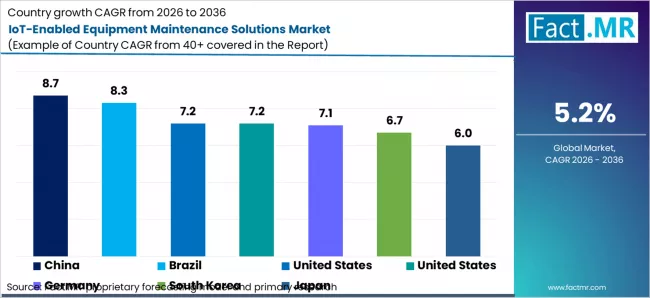
Iot Enabled Equipment Maintenance Solutions Market Cagr Analysis By Country | Source: Fact.MR
| Country | CAGR 2026 to 2036 |
|---|---|
| China | 8.7% |
| Brazil | 8.3% |
| United States | 7.2% |
| United Kingdom | 7.2% |
| Germany | 7.1% |
| South Korea | 6.7% |
| Japan | 6.0% |
Source: Fact.MR analysis. Updated Feb 13, 2026
What explains China’s rapid market acceleration?
China leads growth at 6.4% CAGR, driven by strong state-backed Industrial IoT policies. Initiatives involving China Telecom and Huawei are integrating big data with heavy manufacturing under the Internet Plus strategy. China’s vast manufacturing base across electronics, machinery, and consumer goods creates enormous maintenance optimization demand. Domestic sensor production dominance strengthens supply chain advantages. Smart city expansion and Belt and Road projects also extend IoT-enabled maintenance solutions into infrastructure and international markets.
What factors are shaping expansion in the United States market?
The United States market is growing at a 4.9% CAGR, supported by strong industrial digitalization efforts. The expansion of ThingWorx by PTC in 2026 aligns with CHIPS Act requirements that demand extremely high semiconductor equipment uptime. Edge-to-cloud integration allows sensor data to be processed locally while cloud platforms optimize performance across enterprise networks. The country’s concentration of automotive, aerospace, electronics, and energy industries creates large deployment opportunities. Grid modernization, renewable integration, and shale oil operations increase demand for remote monitoring. Federal infrastructure initiatives further encourage industrial modernization, strengthening the global competitiveness of U.S. technology providers.
What dynamics are influencing the United Kingdom market?
The UK is expanding at 4.9% CAGR as manufacturers pursue productivity improvements following Brexit. Industry 4.0 adoption is seen as essential for competitiveness. Investments in energy transition, rail networks, and infrastructure require predictive asset management. Health and safety regulations mandate monitoring in hazardous industries. A strong domestic software and financial services sector supports enterprise-grade IoT platforms and system integration capabilities.
What is reinforcing Germany’s competitive edge?
Germany is growing at 4.8% CAGR, supported by strong industrial digitalization. Companies such as Siemens and Bosch have expanded Ethernet-APL field-to-cloud capabilities, enabling more autonomous production systems. High energy prices create clear incentives for efficiency optimization. Mittelstand manufacturers are investing carefully in digital upgrades. Automotive electrification and chemical sector monitoring requirements add further demand. Engineering leadership and quality standards allow German firms to command premium positioning globally.
What makes Brazil a high-growth opportunity?
Brazil is expanding at 6.0% CAGR, supported by mining, agriculture, and offshore energy operations. Remote monitoring is essential for geographically dispersed assets. Automotive and machinery manufacturing growth is increasing installed equipment volumes. Deepwater oil production requires advanced diagnostics. Infrastructure development across transport and utilities is boosting asset management needs. As connectivity improves and technology costs decline, adoption is accelerating. Skilled labor shortages in remote regions further strengthen the case for automated monitoring solutions.
What is fueling South Korea’s expansion momentum?
South Korea is growing at 4.4% CAGR, driven by advanced electronics manufacturing and smart factory policies. Companies like Samsung Electronics and LG Chem are integrating AI-driven monitoring into industrial systems. Semiconductor and display manufacturing require extremely high uptime. Shipbuilding and automotive electrification projects add further demand. Government support for digital transformation strengthens domestic platform development.
What is defining Japan’s approach to IoT maintenance?
Japan is progressing at 3.7% CAGR, shaped by demographic pressures and smart factory initiatives. Companies such as Makita and Sony are advancing AI-based machine vision systems under Society 5.0 programs. An aging workforce is accelerating automation of inspections and diagnostics. Japan’s strong robotics and electronics industries support integrated solutions. Energy efficiency priorities and export competitiveness also sustain investment in predictive maintenance technologies.
Competitive Landscape for IoT-Enabled Equipment Maintenance Solutions Market
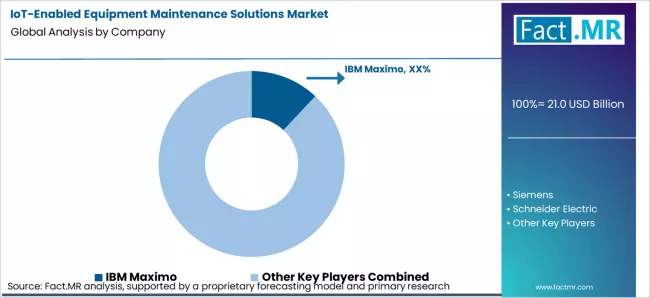
Iot Enabled Equipment Maintenance Solutions Market Analysis By Company | Source: Fact.MR
The IoT-enabled equipment maintenance solutions market brings together enterprise software leaders, industrial automation giants, and niche analytics specialists. Each group approaches the market from a different strength, creating a competitive but complementary ecosystem. IBM, through its Maximo platform, builds on decades of enterprise asset management experience. It combines lifecycle tracking with predictive analytics and AI-driven insights, making it attractive to large industrial operators that manage complex global asset portfolios. Industrial automation leaders such as Siemens and Schneider Electric integrate monitoring capabilities directly into broader automation and control platforms. Their advantage lies in deep operational technology expertise and installed equipment bases.
Companies like Honeywell and GE Digital tailor solutions for process-heavy industries such as refining and power generation, where uptime and safety are critical. PTC differentiates itself through digital twin and augmented reality tools that enhance technician workflows and maintenance visualization.
ABB and Rockwell Automation embed monitoring functions within drives and control systems, while SAP extends ERP systems into maintenance planning and execution. Equipment manufacturers such as SKF integrate intelligence directly into rotating machinery, blending hardware with analytics. Partnerships between software vendors, system integrators, and industrial operators are becoming more common. These collaborations help accelerate deployment through sector-specific templates and proven implementation models, reducing risk and improving time to value.
Recent Development
- In December 2025, industrial IoT firm Treon announced its Treon Flow predictive maintenance platform for material handling. This cloud-native, AI-focused solution is designed to detect equipment faults early, cut maintenance costs, and scale from small pilots to thousands of assets, enabling rapid deployment across enterprise operations.
- In October 2025, Toshiba announced plans to roll out its EtaPRO™ AI-driven equipment monitoring system at 165 thermal power facilities in India. The platform uses IoT sensors and predictive analytics to improve operational efficiency and reliability while enabling early detection of equipment issues.
Key Market Players in IoT-Enabled Equipment Maintenance Solutions Market
- IBM Maximo
- Siemens
- Schneider Electric
- Honeywell
- PTC
- ABB
- GE Digital
- SAP
- Rockwell
- SKF
Bibliography
- ABB Ltd. 2025. Digital condition monitoring and predictive maintenance solutions for industrial automation. Zurich (CH): ABB Ltd.
- IBM Corporation. 2026. IBM Maximo Application Suite: AI-powered asset lifecycle management platform overview. Armonk (NY): IBM Corp.
- International Energy Agency (IEA). 2024. Digitalization and energy efficiency in industry. Paris (FR): IEA.
- PTC Inc. 2026. ThingWorx industrial IoT platform and edge-to-cloud orchestration capabilities. Boston (MA): PTC Inc.
- Rockwell Automation. 2025. Connected enterprise solutions for predictive maintenance and smart manufacturing. Milwaukee (WI): Rockwell Automation Inc.
- SAP SE. 2025. Intelligent asset management and enterprise maintenance planning solutions. Walldorf (DE): SAP SE.
Segmentation
Scope of Report
| Items | Values |
|---|---|
| Quantitative Units (2026) | USD 0.6 Billion |
| Core Material | Carbon/Graphite Core, Stainless Steel Core, Other Conductive Cores |
| Sheath Polymer | Polyester, Polyamide, Other Polymers |
| Application | ESD Garments & Cleanroom Textiles, Industrial/Conveyor & Filtration, Carpets/Upholstery & Others |
| End Market | Electronics & Semiconductor, Pharma & Healthcare, Industrial & Other |
| Regions Covered | North America, Europe, Asia Pacific, Latin America, Middle East & Africa |
| Countries Covered | U.S., Canada, Germany, Italy, UK, France, Japan, China, Brazil, South Korea, Australia, and other countries |
| Key Companies Profiled | Coats Group, Madeira Garnfabrik, Yantai Tayho, Toray Industries, Teijin Frontier, Monofil Technik, FilSpec, Sinterama, Unitika, Huvis |
| Additional Attributes | Dollar revenue in the anti-static carbon core filament yarns market is segmented by core material (carbon/graphite core, stainless steel core, other conductive cores), sheath polymer (polyester, polyamide, other polymers), application (ESD garments & cleanroom textiles, industrial/conveyor & filtration, carpets/upholstery & others), end market (electronics & semiconductor, pharma & healthcare, industrial & other), and region. |
Source: Fact.MR analysis. Updated Feb 13, 2026
Iot-Enabled Equipment Maintenance Solutions Market
-
Solution Type :
- Condition Monitoring
- Predictive Analytics
- Remote Diagnostics
- Asset Tracking
-
Deployment Type :
- Polyester
- Polyamide
- Other Polymers
-
Industrial Vertical :
- Manufacturing
- Energy/Utilities
- Oil & Gas
- Transport & Logistics
-
Service Vertical :
- Subscription (SaaS)
- Managed Services
- License
- Pay-per-Use
-
Region :
- Asia Pacific
- China
- Japan
- South Korea
- Rest of Asia Pacific
- North America
- United States
- Canada
- Mexico
- Europe
- Germany
- France
- UK
- Spain
- Rest of Europe
- Latin America
- Brazil
- Mexico
- Rest of Latin America
- Asia Pacific
Frequently Asked Questions
How big is the iot-enabled equipment maintenance solutions market in 2026?
What will be the size of iot-enabled equipment maintenance solutions market in 2036?
How much will be the iot-enabled equipment maintenance solutions market growth between 2026 and 2036?
What are the key product types in the iot-enabled equipment maintenance solutions market?
Which deployment type segment to contribute significant share in the iot-enabled equipment maintenance solutions market in 2026?
Who worked on this report


Preview the report firsthand - request a free sample
Free SampleGet the brochure for pricing and purchase details
Download PDF