- Base Value(2025): 4 Bn
- Estimated Value(2026): 4.3 Bn
- Forecast Value (2036): 10 Bn
- CAGR (2026 - 2036): 8.7%
Radio Frequency Test Equipment Market Forecast 2026 to 2036
In 2025, the radio frequency test equipment market was valued at USD 4 billion. Based on FMR analysis, demand for radio frequency test equipment is estimated to grow to USD 4.3 billion in 2026 and USD 10 billion by 2036. Fact MR projects a CAGR of 8.7% during the forecast period.
The absolute dollar growth from 2026 to 2036 is USD 5.7 billion. This growth is driven by the increasing demand for high-frequency communication systems, particularly with the rise of 5G technology and the expansion of IoT devices. RF test equipment is essential for ensuring the performance and reliability of wireless communication systems, which are critical for both consumer and industrial applications. However, challenges such as technological complexity, high costs, and the need for continuous innovation could affect growth in certain regions.
As Satish Dhanasekaran, President and Chief Executive Officer of Keysight Technologies, Inc., noted regarding RF and wireless test solutions and innovation, ‘Keysight is committed to developing 5G device test tools that help vendors, test houses, and mobile operators improve test productivity which accelerates 5G commercial roll‑outs.’
China leads with a CAGR of 11.8%, driven by the rapid rollout of 5G networks and the growing demand for RF test solutions in telecommunications. India follows with 10.9%, fueled by increasing investments in telecommunications infrastructure and growing wireless communication needs. Germany grows at 10.1%, benefiting from strong demand in the automotive, industrial, and telecom sectors. Brazil shows growth at 9.2%, supported by investments in communication networks and wireless technologies. The USA grows at 8.3%, reflecting steady demand for RF test equipment in its advanced telecom and technology sectors. The UK grows at 7.4%, driven by the need for high-quality test equipment in both industrial and commercial applications.
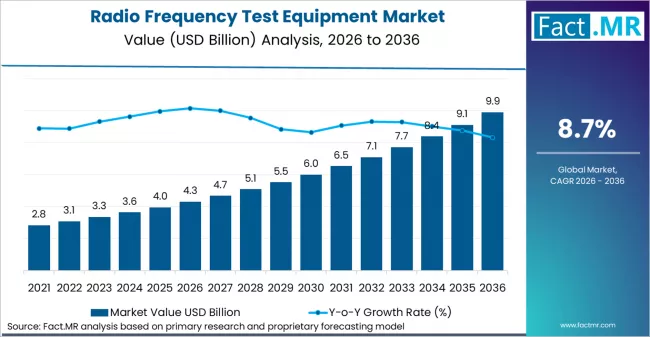
Radio Frequency Test Equipment Market Market Value Analysis | Source: Fact.MR
Radio Frequency Test Equipment Market
| Metric | Value |
|---|---|
| Estimated Value in (2026E) | USD 4.3 billion |
| Forecast Value in (2036F) | USD 10 billion |
| Forecast CAGR (2026 to 2036) | 8.7% |
Source: Fact.MR analysis. Updated Mar 5, 2026
Radio Frequency Test Equipment Market Definition
The Radio Frequency Test Equipment Market involves the production and sale of instruments used to measure, analyse, and validate radio frequency signals, components, and systems in communications, aerospace, defence, and electronics manufacturing.
Market Inclusions
This report covers global and regional market sizes for RF test equipment over a defined forecast period, including equipment types (spectrum analysers, network analysers, signal generators), frequency ranges, application segments (telecom, aerospace, automotive, IoT), and end users (R&D labs, production facilities, service providers).
Market Exclusions
The scope excludes general test and measurement tools not specific to RF signal analysis, software‑only simulation tools without hardware measurement capability, and complete communication systems that include test equipment as part of broader products.
Research Methodology
- Primary Research: Interviews were conducted with test equipment manufacturers, RF engineers, and system integrators.
- Desk Research: Data was sourced from industry reports, standards publications, and trade association statistics.
- Market-Sizing and Forecasting: A hybrid model combining top‑down RF equipment demand forecasts with bottom‑up shipment and revenue data was used.
- Data Validation and Update Cycle: Findings were validated through expert review and aligned with recent production, adoption, and trade figures.
Summary of the Radio Frequency Test Equipment Market
- Market Definition
- The Radio Frequency (RF) Test Equipment Market involves the production and sale of instruments used to measure, analyze, and validate RF signals and systems, essential in industries like telecommunications, aerospace, and electronics manufacturing.
- Demand Drivers
- 5G Technology Growth: The rapid deployment of 5G networks globally increases demand for RF test equipment to ensure high-frequency communication systems perform optimally.
- Expansion of IoT: The growing number of IoT devices and connected systems requires reliable RF testing to guarantee performance and reliability.
- Advancements in Wireless Technologies: The continuous innovation in wireless technologies drives the need for advanced RF testing tools capable of analyzing complex signals and frequencies.
- Key Segments Analyzed
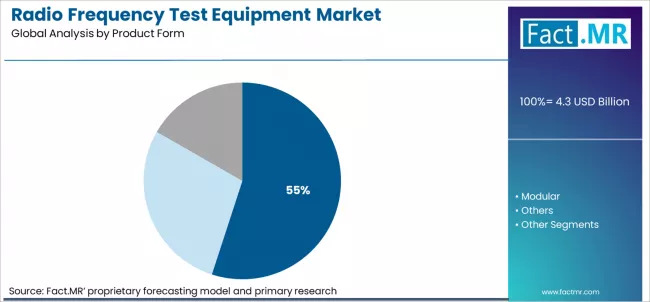
- Product Form: Portable equipment is expected to capture 55% of the market share by 2026 due to its flexibility and use in field and on-site testing.
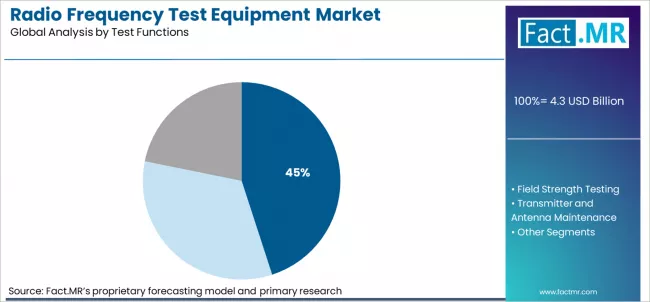
- Test Functions: Radio receiver servicing is projected to hold 45% of the market share by 2026, driven by its critical role in ensuring the performance of communication systems.
- Geography: China leads with a 11.8% CAGR due to its strong telecommunications sector and rapid 5G rollout.
- Analyst Opinion at Fact MR
- Shambhu Nath Jha, Principal Consultant at Fact MR, states, "The increasing rollout of 5G networks and the growth of wireless technologies are key drivers for the expanding RF test equipment market."
- Strategic Implications/Executive Takeaways
- Invest in 5G-Ready Equipment: Companies should prioritize RF test solutions that support 5G networks and high-frequency systems.
- Leverage Mobile and Portable Testing: The growing demand for portable test equipment in field applications presents a valuable market opportunity.
- Expand in Emerging Markets: Regions like China and India present high growth potential due to expanding telecommunications and electronics sectors.
- Methodology
- Primary Research: Interviews with RF engineers, equipment manufacturers, and system integrators.
- Desk Research: Sourcing from industry reports, technical publications, and trade associations.
- Market Sizing & Forecasting: A hybrid model combining top-down forecasts with bottom-up revenue data.
Segmental Analysis
Radio Frequency Test Equipment Market Analysis by Product Form
Radio Frequency Test Equipment Market Analysis By Product Form | Source: Fact.MR
- Market Overview: Portable is expected to capture 55% of the market share by 2026. Portable radio frequency (RF) test equipment is increasingly preferred due to its convenience, flexibility, and ability to perform testing in various environments. This equipment is commonly used in fieldwork, maintenance, and repair services, where portability and ease of use are critical.
- Demand Drivers:
- Convenience and Mobility: Portable RF test equipment allows technicians to perform tests at different locations, including remote or on-site areas, increasing operational flexibility.
- Growing Need for On-the-Go Testing: Industries such as telecommunications, broadcasting, and electronics are driving the demand for portable RF test equipment to perform in-field testing and troubleshooting, where mobility and ease of setup are essential.
- Compact Design with Full Functionality: Portable RF test equipment provides full testing capabilities while maintaining a compact and lightweight design, making it ideal for professionals who require efficient performance without sacrificing portability.
Radio Frequency Test Equipment Market Analysis by Test Functions
Radio Frequency Test Equipment Market Analysis By Test Functions | Source: Fact.MR
- Market Overview: Radio receiver servicing is projected to account for 45% of the market share by 2026. This function is critical for testing and maintaining the performance of radio receivers, which are essential components in communication systems. RF test equipment for radio receiver servicing is used to ensure signal clarity, strength, and overall performance.
- Demand Drivers:
- Increasing Demand for Communication Systems: As wireless communication systems expand globally, the demand for radio receiver testing equipment increases to ensure optimal performance and minimal signal interference.
- Reliability of RF Equipment: Radio receiver servicing is crucial to maintain the integrity of RF communication systems, especially in industries such as telecommunications and broadcasting, where uninterrupted and clear signals are essential.
- Technological Advancements in Communication Systems: As communication systems evolve with higher frequencies and more complex signals, the need for advanced testing equipment for radio receiver servicing continues to rise to meet industry standards and ensure reliable operation.
Radio Frequency Test Equipment Market Drivers, Restraints, and Opportunities
FMR analysts observe that the radio frequency (RF) test equipment market is a growth‑aligned, technology‑anchored segment driven by expanding wireless connectivity across telecom, aerospace, defense, and electronics manufacturing. As wireless standards advanced from 4G to 5G, demand for sophisticated RF test solutions emerged to measure high‑frequency performance and complex modulation schemes. The 2026 valuation reflects this shift, with adoption tied to network build‑outs and device proliferation.
While legacy test tools remain common, advanced RF testers such as vector signal analyzers and high‑frequency network analyzers are gaining share because they support broader frequency ranges and higher accuracy. These solutions are higher priced, contributing to net market value growth, even as volumes grow with the adoption of next‑generation wireless technologies. The market exists because RF performance verification is essential across development, manufacturing, and certification of connected products.
- 5G Connectivity Demand: The growth of 5G networks and high‑speed wireless applications drives demand for RF test equipment capable of validating wideband performance.
- Regulatory & Standards Pressure: Wireless certification and spectrum allocation push adoption of RF test systems that meet accuracy and compliance standards.
- Regional Dynamics: North America and Asia‑Pacific lead RF test equipment adoption due to high wireless infrastructure investment and electronics production.
Regional Analysis
The market analysis covers key global regions, including East Asia, South Asia, Western Europe, North America, and Latin America. It is segmented geographically, with specific market dynamics for each region. The full report provides a detailed market attractiveness analysis.
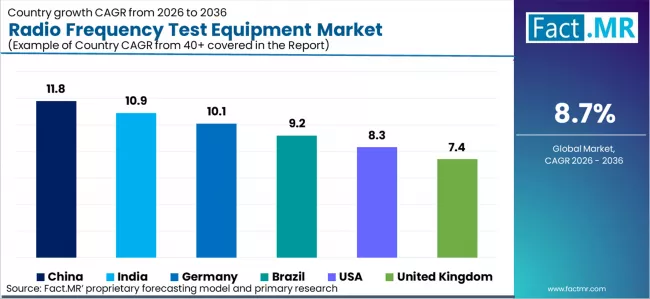
Radio Frequency Test Equipment Market Cagr Analysis By Country | Source: Fact.MR
| Country | CAGR (2026-2036) |
|---|---|
| China | 11.8% |
| India | 10.9% |
| Germany | 10.1% |
| Brazil | 9.2% |
| USA | 8.3% |
| United Kingdom | 7.4% |
Source: Fact.MR analysis. Updated Mar 5, 2026
Source: Fact MR (FMR) analysis, based on proprietary forecasting model and primary research.
East Asia:
In East Asia, China leads the demand for radio frequency test equipment, driven by the growing telecommunications sector, increasing demand for advanced testing technologies in mobile devices, and strong government initiatives supporting 5G infrastructure development.
- China: Demand for radio frequency test equipment in China is projected to rise at 11.8% CAGR through 2036. China’s expanding telecommunications market, rapid deployment of 5G networks, and increased adoption of advanced RF testing technologies continue to drive market growth.
South Asia:
In South Asia, India is a significant market for radio frequency test equipment, supported by rising demand in the telecommunications sector, government investments in 5G infrastructure, and increasing use of RF test equipment in mobile device testing.
- India: Demand for radio frequency test equipment in India is projected to rise at 10.9% CAGR through 2036. India’s growing telecommunications industry, increasing adoption of mobile devices, and government initiatives to expand 5G infrastructure contribute to steady market growth.
Western Europe:
In Western Europe, Germany is a key market for radio frequency test equipment, driven by the country’s strong industrial base, increasing adoption of advanced RF testing technologies, and growing demand for mobile devices and 5G testing solutions.
- Germany: Demand for radio frequency test equipment in Germany is projected to rise at 10.1% CAGR through 2036. Germany’s established manufacturing and telecommunications industries, demand for 5G testing solutions, and growing focus on mobile device testing continue to support market growth.
- United Kingdom: Demand for radio frequency test equipment in the UK is projected to rise at 7.4% CAGR through 2036. The UK’s increasing investments in telecommunications infrastructure, strong mobile device market, and growing demand for 5G testing solutions continue to drive market expansion.
North America:
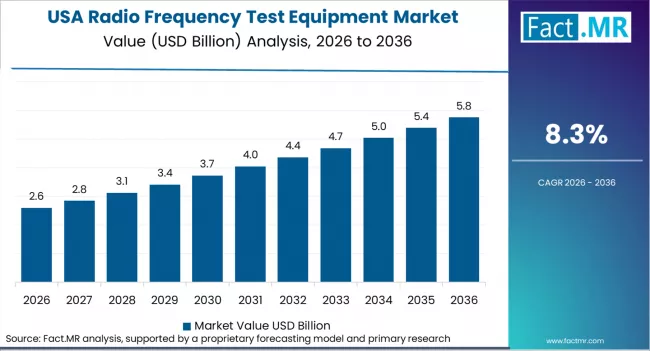
Radio Frequency Test Equipment Market Country Value Analysis | Source: Fact.MR
In North America, the USA remains a significant market for radio frequency test equipment, supported by a strong telecommunications sector, rising demand for mobile devices, and growing investments in 5G technology.
- USA: Demand for radio frequency test equipment in the U.S. is projected to rise at 8.3% CAGR through 2036. The USA’s rapid 5G network deployment, increasing mobile device testing demand, and technological advancements in RF testing solutions continue to drive market growth.
Latin America:
In Latin America, Brazil is the largest market for radio frequency test equipment, driven by growing demand for mobile devices, increased investments in 5G infrastructure, and rising adoption of RF test equipment for telecommunications applications.
- Brazil: Demand for radio frequency test equipment in Brazil is projected to rise at 9.2% CAGR through 2036. Brazil’s expanding telecommunications infrastructure, government initiatives for 5G deployment, and increased demand for RF testing solutions continue to fuel market demand.
Fact MR's analysis of the Radio Frequency Test Equipment Market in East Asia, South Asia, Western Europe, North America, and Latin America consists of country-wise assessments that include China, India, Germany, Brazil, the USA, and the United Kingdom. Readers can find detailed trends, regulatory updates, and company-specific investments shaping the market’s growth in these countries.
What is the Competitive Structure and Buyer Behavior in the Radio Frequency Test Equipment Market?
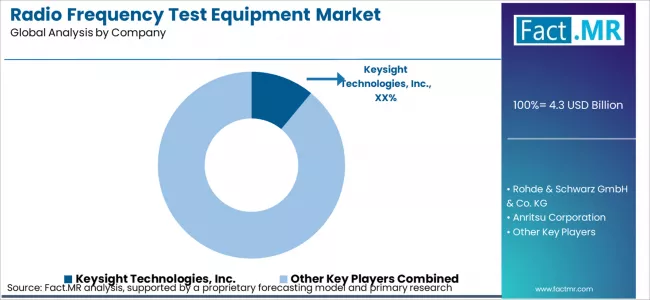
Radio Frequency Test Equipment Market Analysis By Company | Source: Fact.MR
The radio frequency test equipment market is moderately concentrated, with major instrumentation firms such as Keysight Technologies, Inc., Rohde & Schwarz GmbH & Co. KG, Anritsu Corporation, Viavi Solutions Inc., National Instruments Corporation, Yokogawa Electric Corporation, and Teledyne Technologies Incorporated holding a substantial share of global sales while smaller specialized players also compete. The primary competitive variables are measurement accuracy, frequency range coverage, ease of integration with automated test systems, and software ecosystem support, which heavily influence purchasing decisions by engineering and R&D functions. Companies with deep R&D expertise, broad product portfolios, and global sales and service networks have structural advantages, as they can support complex test requirements, provide ongoing calibration and technical support, and respond to evolving wireless standards more effectively. Large OEMs, contract manufacturers, and communications service providers exert significant buyer leverage by qualifying multiple suppliers, leveraging volume purchases, and negotiating long‑term service and pricing agreements, which diminishes the pricing power of individual vendors. To manage supplier dependency, these buyers diversify approved equipment sources and standardize test platform requirements, shifting competition toward performance, interoperability, and support infrastructure rather than price alone.
Recent Industry Developments
- 6G FR3 Readiness: In February 2026, major vendors like Anritsu and Rohde & Schwarz launched hardware options for the FR3 frequency band (7.125 to 24.25 GHz), positioning this "sweet spot" spectrum as the primary focus for early 6G interoperability and carrier aggregation testing.
- AI-Driven Test Automation: Keysight Technologies debuted the Atlas Test Management Center at MWC 2026, a new platform that uses agentic AI to automate device acceptance testing and predict measurement trade-offs, significantly reducing manual configuration time for complex 5G-Advanced and 6G scenarios.
- Digital Twin Network Validation: Rohde & Schwarz integrated the VIAVI™ ray tracing engine into its CMX500 signaling tester in early 2026, allowing engineers to create high-fidelity digital twins of signal propagation to validate 6G receivers in realistic, reproducible virtual environments before physical field testing
Key Players of the Radio Frequency Test Equipment Market
- Keysight Technologies, Inc.
- Rohde & Schwarz GmbH & Co. KG
- Anritsu Corporation
- Viavi Solutions Inc.
- National Instruments Corporation
- Yokogawa Electric Corporation
- Teledyne Technologies Incorporated
Report Scope
| Metric | Value |
|---|---|
| Quantitative Units | USD 4.3 billion (2026) to USD 10 billion (2036), at a CAGR of 8.7% |
| Market Definition | The Radio Frequency Test Equipment Market includes instruments used for testing and measuring radio frequencies across industries like automotive, telecommunications, broadcasting, and research. |
| By Product Type | Network Analyzers, Spectrum Analyzers, Oscilloscopes, Multi Meters, Signal Generators, Others |
| By Test Functions | Radio Receiver Servicing, Field Strength Testing, Transmitter and Antenna Maintenance |
| By Product Form | Portable, Modular, Others |
| By Frequency | Up to 1 GHz, 1 GHz to 6 GHz, More than 6 GHz |
| By End-Use Industry | Automotive, Radio and Television Broadcasting, Telecommunication, Satellite Communications, Industrial, Research |
| Regions Covered | North America, Latin America, Europe, East Asia, South Asia, Oceania, Middle East and Africa |
| Countries Covered | United States, Canada, Mexico, Brazil, Argentina, Germany, France, United Kingdom, Italy, Spain, China, India, Japan, South Korea, Indonesia, Australia, and 40+ countries |
| Key Companies Profiled | Keysight Technologies, Inc., Rohde & Schwarz GmbH & Co. KG, Anritsu Corporation, Viavi Solutions Inc., National Instruments Corporation, Yokogawa Electric Corporation, Teledyne Technologies Incorporated |
| Forecast Period | 2026 to 2036 |
| Approach | Hybrid top-down and bottom-up market modeling validated through primary interviews with manufacturers and supported by trade data benchmarking and market research. |
Source: Fact.MR analysis. Updated Mar 5, 2026
Bibliographies
- Keysight Technologies, Inc. (2023). The role of RF test solutions in advancing 5G networks and wireless device testing.
- Rohde & Schwarz GmbH & Co. KG. (2023). RF testing for high-frequency communication systems: Trends and technologies.
- Anritsu Corporation. (2023). Innovations in RF test equipment for telecommunications and IoT industries.
- Viavi Solutions Inc. (2023). Next-generation RF test equipment: Meeting the demands of 5G and IoT networks.
- Anritsu. (2026). Anritsu launches early support for 6G FR3 frequency band hardware options. Anritsu.
- Keysight Technologies. (2026). Keysight to demonstrate AI-driven wireless innovations and 6G readiness at Mobile World Congress 2026. Keysight Technologies.
- Rohde & Schwarz. (2026). Rohde & Schwarz showcases future 5G, 6G and NTN innovations at MWC Barcelona 2026. Rohde & Schwarz.
This report addresses:
- Market intelligence enabling comprehensive assessment of leading countries and product segments across the Radio Frequency Test Equipment Market globally.
- Market volume (sales units) estimates and 10-year revenue forecasts from 2026 to 2036, validated through manufacturer shipment data, channel partner surveys, and country-level demand modeling.
- Growth opportunity mapping across product types (Network Analyzers, Spectrum Analyzers, Oscilloscopes, Multi Meters, Signal Generators, Others), test functions (Radio Receiver Servicing, Field Strength Testing, Transmitter and Antenna Maintenance), and end-use industries (Automotive, Radio and Television Broadcasting, Telecommunication, Satellite Communications, Industrial, Research).
- Segment and regional revenue forecasts by product type, test functions, end-use industry, and geography across 40+ countries.
- Competition strategy analysis covering dealer network structure, recent developments, product portfolio, USPs, and market share analysis.
- Product and regulatory compliance tracking aligned with telecommunication standards, safety regulations, and electronic testing guidelines.
- Regulatory impact analysis addressing 5G testing standards, spectrum regulations, and compliance requirements across key markets.
- Report delivery in PDF, Excel, PowerPoint, and interactive dashboard formats for executive, procurement, and operational planning use.
Segmentation
Radio Frequency Test Equipment Market Key Segments
-
Product Type :
- Network Analyzers
- Spectrum Analyzers
- Oscilloscopes
- Multi Meters
- Signal Generators
- Others
-
Test Functions :
- Radio Receiver Servicing
- Field Strength Testing
- Transmitter and Antenna Maintenance
-
Product Form :
- Portable
- Modular
- Others
-
Frequency :
- Up to 1 GHz
- 1 GHz to 6 GHz
- More than 6 GHz
-
End-Use Industry :
- Automotive
- Radio and Television Broadcasting
- Telecommunication
- Satellite Communications
- Industrial
- Research
-
Region :
- North America
- USA
- Canada
- Mexico
- Europe
- Germany
- UK
- France
- Italy
- Spain
- Nordic Countries
- BENELUX
- Rest of Europe
- Asia Pacific
- China
- Japan
- South Korea
- India
- Australia
- Rest of Asia Pacific
- Latin America
- Brazil
- Argentina
- Rest of Latin America
- Middle East and Africa
- Kingdom of Saudi Arabia
- United Arab Emirates
- South Africa
- Rest of Middle East and Africa
- Other Regions
- Oceania
- Central Asia
- Other Markets
- North America
Frequently Asked Questions
How large is the demand for Radio Frequency Test Equipment in the global market in 2026?
What will be the market size of Radio Frequency Test Equipment in the global market by 2036?
What is the expected demand growth for Radio Frequency Test Equipment in the global market between 2026 and 2036?
Which product form is expected to dominate the market?
Which region is expected to show the highest growth rate for Radio Frequency Test Equipment?
How significant is the growth outlook for India in this market?
What is the growth outlook for Germany in the Radio Frequency Test Equipment market?
What is the growth forecast for Brazil in the Radio Frequency Test Equipment market?
What is the growth forecast for the United States in the Radio Frequency Test Equipment market?
Which company is identified as a leading player in the Radio Frequency Test Equipment market?
What is Radio Frequency Test Equipment used for?
What does the Radio Frequency Test Equipment market include in this report?
How is the market forecast developed in this report?
What is meant by the Radio Frequency Test Equipment market in this report?
Who worked on this report


Preview the report firsthand - request a free sample
Free SampleGet the brochure for pricing and purchase details
Download PDF