- Estimated Value(2026): 8.0 Bn
- Forecast Value (2036): 14.2 Bn
- CAGR (2026 - 2036): 5.5%
Ischemic Hepatitis Treatment Market Forecast and Outlook 2026 to 2036
In 2025, the ischemic hepatitis treatment market surpassed a valuation of USD 7.5 billion. Based on Fact.MR analysis, demand for ischemic hepatitis treatment is estimated to grow to USD 8.0 billion in 2026 and USD 14.2 billion by 2036. Fact.MR projects a CAGR of 5.5% during the forecast period.
Between 2026 and 2036, the ischemic hepatitis treatment market is expected to create USD 6.2 billion in new revenue, nearly doubling its 2026 value. Growth is steady, driven by rising ICU admissions, ageing populations, cardiovascular disease burden, and higher treatment intensity including acetyl cysteine therapy, antibiotics, and advanced critical care support.
In ischemic (hypoxic) liver injury cases that deteriorate into acute liver failure, clinicians have limited options beyond stabilizing the patient and managing complications-driving interest in bridge-to-recovery solutions that can temporarily support liver function in the acute setting. Reflecting this unmet-need narrative, Michael Curtis, Ph.D. (CEO, eGenesis) said:“We are excited to partner with OrganOx to address a critical unmet need for patients with liver failure. This collaboration is a crucial step in our mission to develop safe and effective human-compatible organs for patients suffering from organ failure.”
Country growth varies by ICU capacity, sepsis burden, and reimbursement strength. China leads at 7.8% CAGR with rapid ICU expansion. India follows at 7.1% supported by national sepsis data and treatment standardization. Germany grows at 6.5% with strong ICU coverage. Brazil records 6.0% from public reimbursement support. The United States posts 5.6%, the United Kingdom 5.3%, and Japan 4.9% reflecting mature healthcare demand.
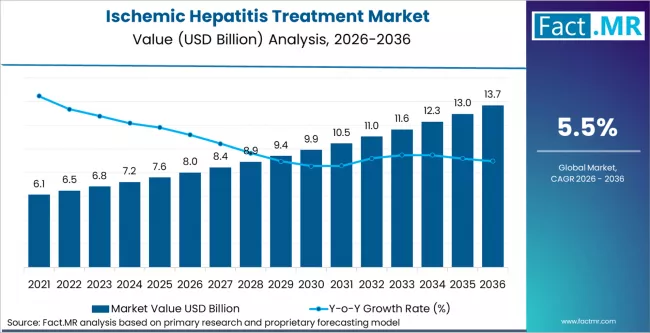
Ischemic Hepatitis Treatment Market Market Value Analysis | Source: Fact.MR
| Metric | Value |
|---|---|
| Estimated Value in 2026 | USD 8.0 billion |
| Forecast Value in 2036 | USD 14.2 billion |
| Forecast CAGR (2026 to 2036) | 5.5% |
Source: Fact.MR analysis. Updated Mar 3, 2026
Market Definition
The ischemic hepatitis treatment market covers drugs and clinical care used to manage acute liver injury caused by systemic hypo perfusion in critically ill patients. The condition follows septic shock, cardiac failure, or severe hypotension with rapid enzyme elevation. Treatments include intravenous N acetyl cysteine, broad spectrum antibiotics, ICU supportive care, perfusion restoration, metabolic monitoring, and liver transplant surgery.
Market Inclusions
The report provides global and regional forecasts from 2026 to 2036 by treatment, application, and distribution channel. It covers acetyl cysteine, antibiotics, supportive care, and transplant services. Applications include infection control, perfusion management, ventilation support, and monitoring. Distribution spans hospital, retail, and online pharmacies. Key countries include China, India, Germany, Brazil, the United States, the United Kingdom, and Japan.
Market Exclusions
Chronic liver diseases and long term cirrhosis therapies are excluded. General vasopressors are excluded unless part of protocol. Extracorporeal liver devices and outpatient hepatology drugs are out of scope.
Research Methodology
- Primary Research: Interviews were conducted with hematologists, intensivists, pharmacists, transplant surgeons, and payers across major regions.
- Desk Research: Sources included peer reviewed journals, WHO 2024 sepsis guidelines, Surviving Sepsis Campaign 2021, ISCCM 2024 statement, ICU expansion plans, and pharmaceutical reports.
- Market Sizing and Forecasting: A hybrid model used ICU bed counts, sepsis incidence, complication rates, drug pricing, transplant reimbursement, and patient volume projections.
- Data Validation and Update Cycle: Findings were cross validated with manufacturer revenues, government procurement data, ICU expansion budgets, and registry studies. Forecasts are reviewed annually for guideline and infrastructure updates.
Summary
- Market Definition
- Ischemic hepatitis treatment includes N acetylcysteine, antibiotics, ICU supportive care, perfusion restoration, and transplant management for hypoperfusion related acute liver injury.
- Demand Drivers
- ICU expansion in China, India, and the Middle East is increasing treated patient volume.
- WHO 2024 sepsis guidelines standardize antibiotic and supportive care procurement globally.
- Clinical evidence supporting acetyl cysteine is expanding formulary adoption.
- Key Segments Analyzed
- By Treatment Type: Acetyl cysteine based therapy holds about 43.0% share in 2026.
- By Application: Infection control accounts for about 38.0% share in 2026.
- By Distribution Channel: Hospital pharmacies dominate due to inpatient ICU use.
- By Region: Asia Pacific hold the largest demand for market.
- Analyst Opinion at FACT.MR
- Shambhu Nath Jha, Principal Consultant at FACT.MR, opines, ‘CXOs reviewing this report will find that the key opportunity lies in formulary positioning of established critical care drugs rather than new molecule development. Intravenous acetyl cysteine and broad spectrum antibiotics are gaining traction within expanding ICU networks across China, India, Brazil, and the Middle East.
- Strategic Implications / Executive Takeaways
- NAC manufacturers should target new ICU networks in Asia and Latin America.
- Hospitals should assess standing NAC infusion protocols in high risk liver patients.
- Transplant centres should strengthen early risk scoring for timely referral.
- Methodology
- Sizing used ICU bed data, sepsis incidence, complication rates, and drug cost benchmarks.
- Segment shares validated through guideline priorities and pharmacy procurement data.
- Country forecasts built from ICU expansion plans, epidemiology trends, reimbursement updates, and guideline adoption timelines.
Segmental Analysis
Ischemic Hepatitis Treatment Market Analysis by Treatment Type
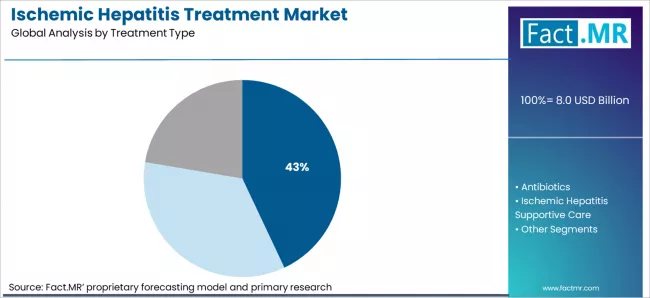
Ischemic Hepatitis Treatment Market Analysis By Treatment Type | Source: Fact.MR
Acetyl cysteine based treatment holds about 43.0% share in 2026 due to RCT evidence showing reduced incidence and mortality. It is low cost, widely available, and used in critical care globally.
- NAC Evidence Scan January 2024: The 2024 Vanderbilt study supported NAC use in non-acetaminophen acute liver failure, influencing formulary expansion. [7]
- Pfizer Acetadote Formulary Positioning: Pfizer supplies intravenous NAC to major hospital networks. Expanded ICU protocols may increase volume uptake. [8]
- A May 2024 review highlighted ILBS RCT evidence supporting NAC in ischemic hepatitis, increasing clinical awareness. [1][2]
Ischemic Hepatitis Treatment Market Analysis by Application
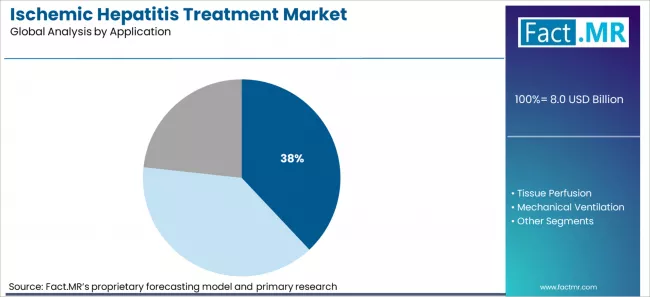
Ischemic Hepatitis Treatment Market Analysis By Application | Source: Fact.MR
Infection control holds about 38.0% share in 2026 as sepsis is the main trigger of ischemic hepatitis. Early antibiotic use is mandatory in septic shock.
- SEPSIS INDIA November 2024: High carbapenem resistance increases demand for expensive last line antibiotics, raising per patient cost. [4]
- WHO January 2024 Guidelines: WHO mandates empiric antimicrobial therapy in sepsis care, expanding formal antibiotic markets in emerging economies. [3]
Drivers, Restraints, and Opportunities
FACT.MR analysts note the market is tied to sepsis, cardiac failure, and respiratory shock rather than new drug innovation. No drug is specifically approved for ischemic hepatitis, so treatment relies on antibiotics, NAC, ventilation, and hemodynamic support.
The market is gradually shifting as evidence supports broader NAC use beyond paracetamol overdose. WHO January 2024 sepsis guidelines and Surviving Sepsis Campaign compliance programmes are standardising antibiotic and supportive care procurement globally. Online pharmacy use for post ICU recovery is also rising.
- WHO January 2024 Sepsis Guidelines Standardising Global Treatment Protocols: WHO published global sepsis guidelines in January 2024, setting standards for early antibiotics, fluid resuscitation, and organ support. This is formalising antibiotic demand across low and middle income countries. [6]
- India SEPSIS INDIA Registry and ISCCM 2024 Position Statement: The SEPSIS INDIA registry reported 36.3% hospital mortality and high carbapenem resistance, increasing antibiotic cost per patient. ISCCM 2024 guidelines are standardising procurement nationwide. [5]
- NAC Evidence Base Expansion Beyond Paracetamol: A January 2024 review from Vanderbilt concluded NAC shows benefit and safety in non-acetaminophen acute liver failure, supporting wider ICU adoption.
Regional Analysis
The ischemic hepatitis treatment market is analysed across North America, Europe, Asia Pacific, Latin America, and Middle East and Africa, spanning over 40+ countries with distinct demand profiles shaped by ICU bed density, sepsis patient burden, healthcare reimbursement depth, and clinical guideline adoption infrastructure. The full report offers market attractiveness analysis by region based on ICU capacity expansion rate, sepsis incidence, pharmaceutical access frameworks, and liver transplant programme development.
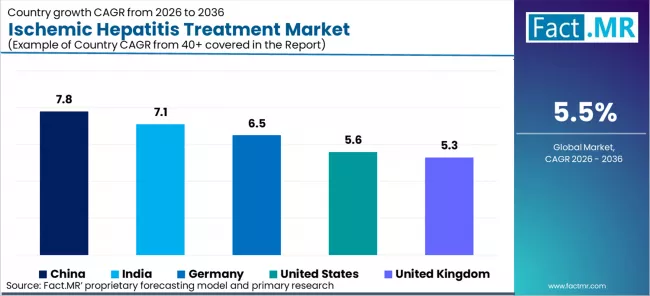
Ischemic Hepatitis Treatment Market Cagr Analysis By Country | Source: Fact.MR
| Country | CAGR (2026-2036) |
|---|---|
| China | 7.8% |
| India | 7.1% |
| Germany | 6.5% |
| United States | 5.6% |
| United Kingdom | 5.3% |
Source: Fact.MR analysis. Updated Mar 3, 2026
Source: Fact.MR (FACT.MR) analysis, based on proprietary forecasting model and primary research
Asia Pacific Ischemic Hepatitis Treatment Market Analysis
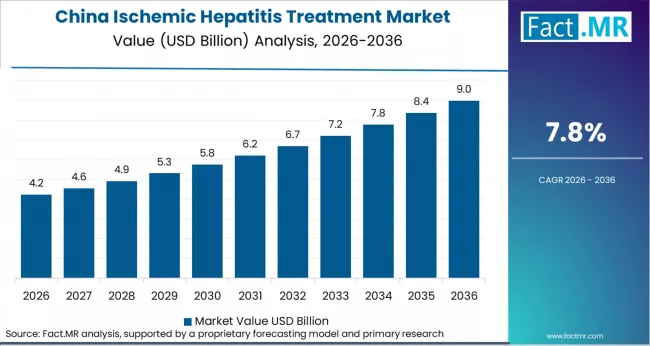
Ischemic Hepatitis Treatment Market Country Value Analysis | Source: Fact.MR
Asia Pacific is the fastest growing region, driven by ICU expansion in China and India and wider adoption of WHO and Surviving Sepsis Campaign protocols. Global and domestic drug makers supply NAC and antibiotics to high volume public hospitals.
- China: China is expected to remain the fastest growing market, with demand rising at 7.8% per year through 2036. ICU hospitals doubled to over 7,000 by 2025 under national health plans. Sepsis protocol compliance and AI risk tools are improving standardized care. National insurance coverage includes NAC and key antibiotics. High cardiovascular ICU admissions sustain patient volume.
- India: India is poised for sustained expansion, recording 7.1% annual growth through 2036. SEPSIS INDIA data highlights high mortality and resistance rates, raising antibiotic demand. ISCCM 2024 guidelines standardize treatment nationwide. ICU beds are expanding rapidly. ILBS trial evidence supports NAC formulary adoption.
FACT.MR covers China, Japan, South Korea, India, ASEAN, Australia and New Zealand, and Rest of Asia Pacific.
Europe Ischemic Hepatitis Treatment Market Analysis
Europe leads in guideline driven care with strong reimbursement systems. Major pharmaceutical suppliers operate within structured ICU formularies.
- Germany: Germany’s ischemic hepatitis treatment market is forecast to expand at an average annual rate of 6.5% through 2036. Germany has Europe’s largest ICU network with broad insurance coverage. DIVI 2024 updates align with WHO and SSC guidance. High cardiovascular ICU admissions support sustained demand.
- United Kingdom: The UK market is expected to advance at a steady 5.3% yearly growth rate through 2036. NICE NG51 mandates early antibiotic bundles across NHS hospitals. NAC protocols are incorporated into acute liver failure pathways. Workforce expansion plans support ICU capacity growth.
FACT.MR covers Germany, France, the United Kingdom, Italy, Spain, the Netherlands, Nordics, and Rest of Europe.
North America Ischemic Hepatitis Treatment Market Analysis
North America is the largest value market with high ICU spending and strong transplant infrastructure.
- United States: Demand is projected to grow at 5.6% CAGR through 2036. Surviving Sepsis Campaign compliance drives antibiotic and NAC procurement. Acetadote holds strong formulary position under major GPO contracts. Over 9,500 liver transplants were performed in 2024, with acute liver failure cases contributing meaningful volume.
FACT.MR covers the United States, Canada, and Mexico including SSC compliance data, transplant volumes, NAC adoption, and hospital procurement dynamics.
Competitive Aligners for Market Players
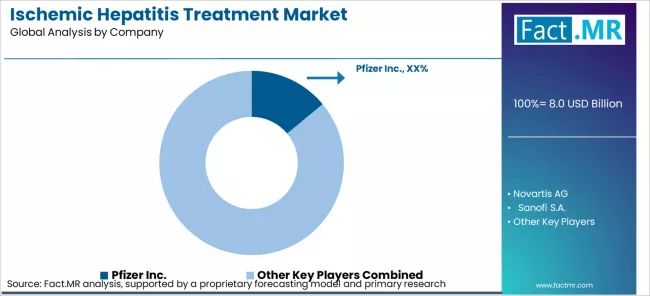
Ischemic Hepatitis Treatment Market Analysis By Company | Source: Fact.MR
The ischemic hepatitis treatment market is moderately concentrated in pharmaceuticals and fragmented in supportive care services. Major companies such as Pfizer, Novartis, Sanofi, GlaxoSmithKline, AstraZeneca, Bristol Myers Squibb, AbbVie, and Merck hold strong positions through broad critical care portfolios and hospital relationships. No company owns a specific ischemic hepatitis indication, as treatment relies on generic NAC, antibiotics, and vasopressors. Competition centres on formulary access, pricing, and supply reliability rather than innovation.
Companies with strong hospital injectable portfolios hold structural advantages. Pfizer’s Acetadote benefits from GPO agreements and established ICU presence. Sanofi and GlaxoSmithKline compete through antibiotic portfolios. AstraZeneca leverages hospital commercial networks in Europe. Generic NAC manufacturers in India and China compete aggressively in public tenders where price drives selection.
Hospital buyers use GPO contracts in the United States, NHS frameworks in the United Kingdom, and public tenders in Asia and Europe to secure pricing and supply stability. Dual supplier approval is common for injectable. In liver transplant segments, purchasing is concentrated in major transplant centres where clinical protocol and reimbursement considerations outweigh price competition.
Key Players
- Pfizer Inc.
- Novartis AG
- Sanofi S.A.
- GlaxoSmithKline plc
- AstraZeneca plc
- Bristol-Myers Squibb Company
- Allergan (AbbVie)
- Merck & Co., Inc.
Bibliography
- [1] Smith, J. E., et al. (2024). Update on ischemic hepatitis. Current Opinion in Gastroenterology, 40(3), 143 to 147. Medical University of South Carolina.
- [2] Maiwall, R., Kumar, A., et al. (2020). Utility of N acetylcysteine in ischemic hepatitis in cirrhotics with acute variceal bleed: A randomized controlled trial. Hepatology International, 14, 577 to 586. Institute of Liver and Biliary Sciences, New Delhi.
- [3] World Health Organization. (2024). Guidelines on the clinical management of sepsis. World Health Organization.
- [4] Dedeepiya, V. D., et al. (2024). A multicentre prospective registry of one thousand sepsis patients admitted in Indian ICUs: The SEPSIS INDIA study. Critical Care.
- [5] Indian Society of Critical Care Medicine. (2024). ISCCM position statement for the management of sepsis in resource limited settings in India. Indian Journal of Critical Care Medicine.
- [6] Society of Critical Care Medicine and European Society of Intensive Care Medicine. (2021). Surviving sepsis campaign: International guidelines for management of sepsis and septic shock 2021. Critical Care Medicine, 49(11).
- [7] Jerome, R. N., et al. (2024). Repurposing N acetylcysteine for management of non-acetaminophen induced acute liver failure: An evidence scan from a global health perspective. Translational Gastroenterology and Hepatology, 9, 2. Vanderbilt University Medical Center.
- [8] Pfizer Inc. (2024). Pfizer 2024 annual report. Pfizer Inc.
This Report Addresses
- Strategic intelligence on NAC formulary expansion beyond paracetamol, WHO January 2024 sepsis guideline impact, SEPSIS INDIA patient data, China ICU expansion, and SSC driven antibiotic procurement in US and Europe.
- Market forecast from USD 8.0 billion in 2026 to USD 14.2 billion by 2036 at 5.5% CAGR, segmented by treatment, application, channel, and region.
- Growth mapping across China ICU scale up, India ISCCM 2024 protocol rollout, Germany DIVI updates, US SSC compliance, and Middle East ICU investment.
- Country CAGR outlook for China 7.8%, India 7.1%, Germany 6.5%, Brazil 6.0%, United States 5.6%, United Kingdom 5.3%, and Japan 4.9% with segment splits.
- Competitive assessment of Pfizer, Novartis, Sanofi, GlaxoSmithKline, AstraZeneca, Bristol Myers Squibb, AbbVie, and Merck across formulary access, GPO depth, and NAC leadership.
- Tracking of WHO 2024 sepsis guidance, NAC evidence updates, SEPSIS INDIA registry, ISCCM statement, Chinese AI sepsis model, and UNOS transplant data.
- Regulatory review covering WHO 2024 guidelines, SSC antimicrobial mandate, NICE NG51, DIVI 2024 updates, China reimbursement changes, and ISCCM standards.
- Delivered in PDF, Excel, PowerPoint, and dashboard formats using verified clinical, regulatory, and pharmaceutical sources.
Segmentation
Scope of Report
| Items | Values |
|---|---|
| Quantitative Units | USD 8.0 billion (2026) to USD 14.2 billion (2036), at a CAGR of 5.5% |
| Market Definition | The ischemic hepatitis treatment market includes drugs, ICU care protocols, and transplant services used to manage acute liver injury from hepatic hypoperfusion. It covers intravenous N acetylcysteine, broad spectrum antibiotics, supportive critical care for perfusion and ventilation, metabolic monitoring, and liver transplant evaluation for severe cases. |
| Treatment Type | Acetylcysteine-Based Ischemic Hepatitis Treatment (43.0%), Antibiotics-Based Ischemic Hepatitis Treatment, Ischemic Hepatitis Supportive Care, Liver Transplant-Based Ischemic Hepatitis Surgery |
| Application | Ischemic Hepatitis Treatment for Infection Control (38.0%), Tissue Perfusion, Mechanical Ventilation, Metabolic Monitoring |
| Distribution Channel | Hospital Pharmacies, Retail Pharmacies, Online Pharmacies |
| Application Coverage | Septic shock related ischemic hepatitis treated with NAC and antibiotics, cardiac failure hypo perfusion managed with ICU support, post cardiac surgery liver injury care, respiratory failure shock liver management, acute liver failure transplant evaluation, vasopressor and fluid resuscitation, mechanical ventilation, and metabolic and lactate monitoring in critical care patients. |
| Regions Covered | Asia Pacific, Europe, North America, Latin America, Middle East and Africa |
| Countries Covered | China, Japan, South Korea, India, Australia and New Zealand, ASEAN, Rest of Asia Pacific, Germany, United Kingdom, France, Italy, Spain, Netherlands, Nordics, Rest of Europe, United States, Canada, Mexico, Brazil, Chile, Colombia, Rest of Latin America, Kingdom of Saudi Arabia, United Arab Emirates, South Africa, Turkey, Rest of Middle East and Africa |
| Key Companies Profiled | Pfizer Inc., Novartis AG, Sanofi S.A., GlaxoSmithKline plc, AstraZeneca plc, Bristol-Myers Squibb Company, Allergan (AbbVie), Merck & Co., Inc. |
| Forecast Period | 2026 to 2036 |
| Approach | A hybrid top down and bottom up model was used. Top down inputs included ICU bed counts, sepsis incidence, complication rates from registries such as SEPSIS INDIA, and average treatment cost per patient. Bottom up inputs covered NAC and antibiotic pricing, transplant reimbursement, ICU drug spending benchmarks, and patient volume projections from sepsis and cardiac failure data. |
Source: Fact.MR analysis. Updated Mar 3, 2026
Ischemic Hepatitis Treatment Market by Segment
-
By Treatment Type
- Acetylcysteine-Based Ischemic Hepatitis Treatment (43.0%)
- Antibiotics-Based Ischemic Hepatitis Treatment
- Ischemic Hepatitis Supportive Care
- Liver Transplant-Based Ischemic Hepatitis Surgery
-
By Application
- Ischemic Hepatitis Treatment for Infection Control (38.0%)
- Ischemic Hepatitis Treatment for Tissue Perfusion
- Ischemic Hepatitis Treatment for Mechanical Ventilation
- Ischemic Hepatitis Treatment for Metabolic Monitoring
-
By Distribution Channel
- Ischemic Hepatitis Treatment Drug Sales Via Hospital Pharmacies
- Ischemic Hepatitis Treatment Drug Sales Via Retail Pharmacies
- Ischemic Hepatitis Treatment Drug Sales Via Online Pharmacies
-
By Region
- North America
- United States
- Canada
- Mexico
- Europe
- Germany
- United Kingdom
- France
- Italy
- Spain
- Netherlands
- Nordics
- Rest of Europe
- Asia Pacific
- China
- Japan
- South Korea
- India
- Australia and New Zealand
- ASEAN
- Rest of Asia Pacific
- Latin America
- Brazil
- Chile
- Colombia
- Rest of Latin America
- Middle East and Africa
- Kingdom of Saudi Arabia
- United Arab Emirates
- South Africa
- Turkey
- Rest of Middle East and Africa
Frequently Asked Questions
How large is the ischemic hepatitis treatment market in 2025?
What will the market size be in 2026?
What is the projected market size by 2036?
What is the expected CAGR from 2026 to 2036?
Which treatment type holds the leading share?
Which application segment commands the largest share?
Which country is projected to grow the fastest?
What is the expected growth rate for India?
What is the forecast CAGR for Germany?
How is the United States expected to grow?
Which distribution channel dominates the market?
What is the main growth driver of the market?
Is there an approved drug specifically for ischemic hepatitis?
What role does liver transplantation play in the market?
Who worked on this report


Preview the report firsthand - request a free sample
Free SampleGet the brochure for pricing and purchase details
Download PDF